L03 - Liquid rocket propulsion
 Call Kai
 Learn
Learn Practice Test
 Spaced Repetition
 Match
Match Flashcards
 Knowt Play
1/75

There's no tags or description
Looks like no tags are added yet.
Name | Mastery | Learn | Test | Matching | Spaced | Call with Kai |
|---|
No analytics yet
Send a link to your students to track their progress
76 Terms
How it works – A liquid rocket engine
Storing fuel and oxidizer separately in tanks
Pumping them into the combustion chamber
Injecting and atomizing them via injectors
Burning them at high pressure
Expanding the hot gases through a nozzle
Generating thrust by momentum conservation
What is the role of propellants before entering the combustion chamber?
Are pressurized and transported
Are conditioned (temperature, phase)
Cool engine components (regenerative cooling)
Are prepared for proper atomization and mixing
Pressure fed engine
advantages and disadvantages
A pressure-fed engine pushes propellants from the tanks into the combustion chamber using high tank pressure, usually generated by a pressurant gas like helium.
✅ Advantages:
Very simple
Very reliable
❌ Disadvantages:
Limited in thrust
Pump fed engine
Turbopumps to raise propellant pressure before injection into the combustion chamber.
The turbine is driven by hot gas from:
Gas generator
Preburner (staged combustion)
Heated fuel (expander cycle)
✅ Advantages:
High chamber pressure
High specific impulse
❌ Disadvantages:
Complex system
Expensive
Pump-fed engines – open vs. closed cycles
Turbine exhaust is fed back into the combustion chamber in closed system. Higher performance, but more complex than open cycle
🔓 Open Cycle (Gas Generator Cycle)
A small portion of propellant burns in a gas generator.
This hot gas drives the turbine.
The turbine exhaust is dumped overboard.
Not all propellant contributes to thrust.
✅ Simpler
❌ Lower efficiency
🔒 Closed Cycle (Staged Combustion / Expander)
Turbine exhaust is fed back into the main combustion chamber.
All propellant contributes to thrust.
Higher efficiency and higher chamber pressure.
✅ Higher performance
❌ More complex and higher system pressure
What is a key benefit of closed cycle systems?
Short: High efficiency.
Long: Since no propellants are wasted, closed cycles achieve higher specific impulse and overall efficiency.
Thrust Generation
explanation within the combustion chamber and nozzle(extension)
In combustion chamber chemical energy to thermal energy, high pressure and high temperature gas is generated. In nozzle thermal energy to kinetic energy. Gas acc. to high exhaust velocity. Momentum change produces thrust
🔥 In the Combustion Chamber:
Chemical energy → thermal energy
High pressure + high temperature gas is generated
This creates stored internal energy
🚀 In the Nozzle:
Thermal energy → kinetic energy
Gas accelerates to high exhaust velocity
Momentum change produces thrust
Where is most of the thermal energy converted to velocity?
Short: In the nozzle.
Long: The nozzle transforms the thermal energy of the high-pressure gas into high-speed flow, producing thrust.
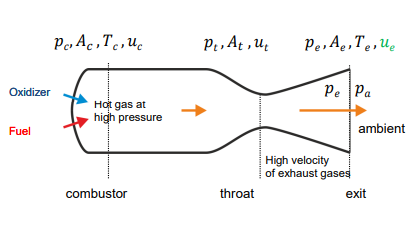
Exhaust Velocity – Energy Conversion
Exhaust velocity ue comes from converting gas thermal/pressure energy (enthalpy) into directed kinetic energy in the nozzle.
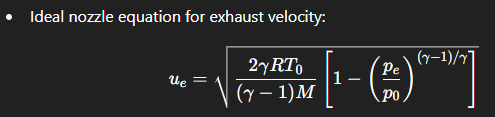
Exhaust Velocity
Hot to maximize ue?
To maximize ue:
Increase total temperature T0
Decrease molar mass M
Increase pressure ratio p0/pe
State Variables in the Nozzle
As gas flows: in nozzle…
As gas flows:
Pressure and temperature and density drop
Mach number increases
Subsonic to supersonic transition occurs at the throat.
Exhaust Velocity – Impact of Mixture Ratio (ROF)
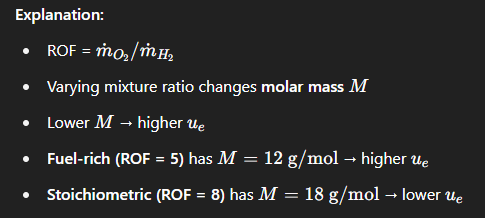
What is ROF (mixture ratio)?
ROF (mixture ratio) is the mass ratio of oxidizer to fuel:
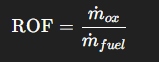
How does ROF affect exhaust velocity?
Short: Lower ROF = higher ue
Long: A fuel-rich mixture results in lower molar mass, which increases exhaust velocity and efficiency.
Which components contribute to total thrust?
1⃣ Momentum thrust Comes from accelerating mass to high exhaust velocity
2⃣ Pressure thrust Comes from pressure difference at nozzle exit
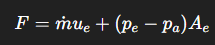
What is the formula for rocket thrust?

What is specific impulse?
It measures engine efficiency: how much thrust you get per unit of propellant mass flow.
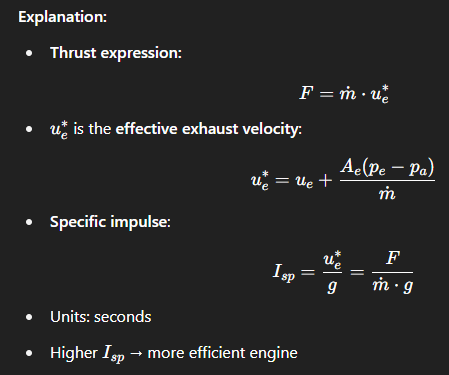
Isp & Mixture Ratio – Fundamentals
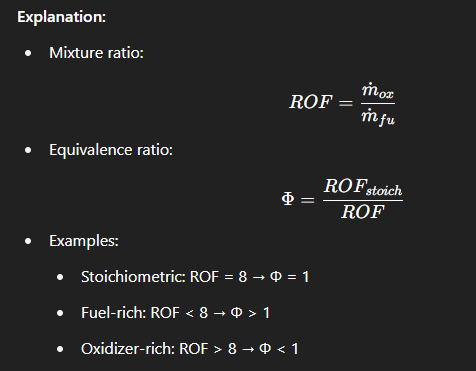
What does Φ > 1 mean?
Short: Fuel-rich
Long: The propellant mix contains more fuel than stoichiometric conditions.
Isp vs ROF – LOX/H₂
Maximum temperature: ROF ≈ 8 (stoichiometric)
But maximum Isp occurs at ROF between 5 and 6
Why?
Because lower molar mass improves exhaust velocity
Even if temp is lower
Why is fuel-rich better for Isp in LOX/H₂?
Short: Lower molar mass
Long: Extra hydrogen lowers the average molecular weight, increasing ue and Isp.
Isp vs ROF – LOX/RP-1
Explanation:
RP-1 (kerosene) has high molar mass (~192 g/mol)
Peak Isp happens below stoichiometric ROF (3.4)
WHY?
Fuel-rich conditions, Because of thermal dissociation of RP-1 at high temperatures,
This lowers the effective temperature
Where does maximum Isp occur for LOX/RP-1?
Long: Fuel-rich conditions (before stoichiometric) yield higher performance due to lower molar mass from dissociation.
Why doesn't Isp peak at stoichiometry in LOX/RP-1?
Short: RP-1 dissociation
Long: Thermal breakdown of RP-1 in fuel-rich mix reduces molar mass and improves exhaust velocity.
Characteristic Velocity in performance characterization
Combustion performance measurement independent of the nozzle.
total chamber pressure
throat area
mass flow rate

What does characteristic velocity c∗ represent?
Short: Combustion performance
Long: It indicates how efficiently chemical energy is converted into chamber pressure and is independent of the nozzle.
c∗ tells you how good your combustion is (thermal energy produced).
What is thrust coefficient cF?
The thrust coefficient CF measures nozzle performance.
It tells us how effectively chamber pressure is converted into thrust.
c∗ makes pressure.
CF makes thrust
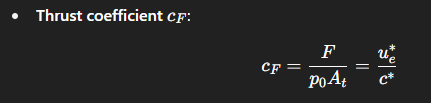
How do we calculate effective exhaust velocity?
Effective velocity is the product of combustion performance and nozzle performance.
ue∗ → overall propulsion performance

Physical Meaning of u*e=c*⋅cF
Interpretation:
This equation separates propulsion performance into:
Combustion performance → c*
Nozzle performance → cF
Allows engine diagnostics:
If ue∗ is low, check if it’s due to poor combustion or nozzle inefficiency.
Short: Engine performance = combustion × nozzle
Advantages of Liquid Propellants
High specific impulse
Higher density than gas
Throttleable (Thrust can be adjusted)
Cooling of structures possible
Reusability
Disadvantages of Liquid Propellants
Complex design
Sloshing inside tanks
Leakage possible, esp. with LH₂
high cost
Propellant Selection Rules
Criterias
Criteria:
Performance: High Isp, stable combustion
Economic: Availability, cost
Handling: Non-toxic, non-corrosive, stable
Ecological: Environmental impact (e.g., H₂ vs. CH₄ vs. RP-1)
Why is CH₄ (methane) considered more ecological than RP-1?
Short: Cleaner combustion
Long: CH₄ burns with fewer soot particles and is easier to handle cryogenically than hydrogen.
What handling factors affect propellant choice?
Short: Toxicity, stability
Long: Ideal propellants are stable, non-corrosive, and easy to store in liquid form.
Monopropellants
Explanation
ignition via ?
self-decomposition, without needing a separate oxidizer.
simpler system
Ignition: thermal or catalytic
What are advantages of monopropellants?
Short: Simple and reliable
Long: Easy fueling, single tank system, suitable for RCS and small satellite thrusters.
Bipropellants – General
Energy release by chemical reaction of two propellants (fuel & oxidizer)
Separate tanks, mixing within the combustion chamber
Name two ignition methods for bipropellant engines.
Short: Electric spark, gas torch
Long: Ignition can be achieved using pyrotechnic charges, spark plugs, or even lasers.
Why are cryogenic propellants challenging to handle? And why they are used?
used for high thrust engines
Gaseous at room temperature → must be stored cold as liquids
Requires:
Insulated tanks
Humidity control
Venting system to manage boil-off
Hypergolic Propellants
Explanation:
Ignite spontaneously when fuel and oxidizer contact.
No ignition system needed.
Used in upper stages and satellites.
⚠ Highly toxic
What defines a hypergolic propellant?
Short: Self-igniting
Long: Hypergolic propellants ignite immediately upon contact without external ignition sources.
What is the main drawback of hypergolic fuels like MMH or NTO?
Short: Toxicity
Long: These substances are highly toxic and require special handling and trained personnel.
Storable Propellants
Explanation:
Can be kept at ambient conditions for long durations
Used for upper stages, military, satellites
Examples:
UDMH, N₂O₄, H₂O₂
What makes a propellant “storable”?
Short: Long-term ambient storage
Long: Storable propellants remain stable over years at room temperature and are ready for immediate use.
Where are storable propellants commonly used?
Short: Upper stages, satellites
Long: Ideal for long-duration missions and spacecraft that need immediate engine restart.
How do monopropellants compare in Isp to bipropellants?
Short: Lower Isp
Long: Monopropellants like hydrazine (~277 s) have lower performance due to lack of combustion with oxidizer.
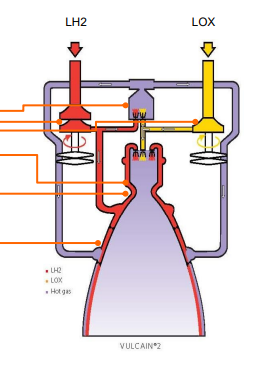
Overview – Vulcain 2 Engine (GG Cycle)
A gas generator (GG) cycle engine includes:
Gas generator: burns small propellant to drive turbine
Turbo pumps: increase pressure
Combustion chamber: main reaction
Nozzle & extension: expands and accelerates gases
Propellant Management involves:
Tanks, feedlines, valves, and sensors
What is the role of the gas generator in GG cycle engines?
Short: Drives turbines
Long: Burns a small amount of propellant to produce hot gas for turbine power.
Tanks used for?
Tanks are used for:
Propellants
Purge/control gases
Pressurization gases
What is a common bulkhead tank?
Short: Shared wall
Long: A tank design where oxidizer and fuel tanks share a single dividing wall to save space and mass.
What are the design criteria for tanks?
Mass, CG, heat transfer
Valves
In staged combustion engines, key valves include:
PBOV, MOV, MFV, HGV
They control the flow of oxidizer, fuel, and hot gas.
Types:
Pyrotechnic, pneumatic, electrical
Turbopump (key components and design dependence)
Used to pressurize propellant using turbine power.
Key components:
Inducer (prevents cavitation)
Impeller (boosts pressure)
Design depends on:
Cycle type, vapor pressure, chamber pressure, throttling
Why are turbopumps essential in liquid engines?
Short: High pressure feed
Long: They increase propellant pressure to ensure stable combustion and high thrust.
Ignition System
Initiates combustion by providing sufficient energy
Energy must evaporate propellants and reach ignition temperature
Injectors
Inject and mix fuel and oxidizer
Influence combustion stability, heat load, and efficiency
What are key roles of injectors?
Short: Mix and stabilize
Long: They determine mixing quality, combustion stability, and wall heat loads.
How do injectors affect combustion efficiency?
Short: Directly
Long: Better mixing from injectors leads to more complete combustion and higher efficiency.
Gas Generator & Preburner
Produces hot gas at lower temp than main chamber
Can be fuel-rich or oxidizer-rich
Far from stoichiometric to limit temperature
What’s the main difference between gas generator and main combustion chamber?
Short: Lower temp
Long: Gas generator operates at a lower temperature to protect turbines.
What’s a challenge of oxidizer-rich combustion?
The hot gas is highly oxidizing and extremely corrosive, especially for turbine materials
Combustion Chamber
Must ensure complete combustion via proper residence time
Optimized for low mass and long life
Costly due to low production numbers
What must the combustion chamber ensure for good combustion?
Short: Sufficient residence time
Long: Enough time for propellants to evaporate, mix, and fully react.
Why is rocket engine production costly?
Short: Low volume
Long: Unlike cars, only a few engines are made per year, increasing per-unit cost.
Nozzle
Converts thermal energy into kinetic energy
Expands hot gases to low pressure
Design goals:
Maximize thrust
Match ambient pressure
Minimum weight & structure size
What is the nozzle’s main function?
Short: Acceleration
Long: It converts hot gas pressure into directed high-velocity exhaust for thrust.
Why must the nozzle be adapted to pressure conditions?
Short: Efficiency
Long: To prevent over- or under-expansion and ensure maximum momentum transfer.
Effect of ROF on exhaust velocity ue
High Tc → high ue
Low M→ high ue
ROF = 4 gives higher ue due to lower molar mass.
ROF = 8 is stoichiometric for H₂/O₂.
Why does ROF = 4 give higher ue for LOX/LH₂?
At ROF = 4, the reaction products are lighter (mostly H₂O and unburned H₂), leading to a lower molar mass and thus a higher exhaust velocity, despite a lower combustion temperature.
Specific Impulse and Propellant Combination
Maximum Isp does not occur at stoichiometric ROF.
LOX/LH₂ has highest maximum Isp (~4500 N·s/kg).
Engine ROF is usually chosen based on system-level optimization (not maximum Isp.
Is engine ROF equal to ROF at max Isp?
No, Because the engine design must also consider tank size, cooling, structural constraints, and density effects. Theoretical IspI_{sp}Isp maximum is not always practical in real systems.
Structural Weight – Space Shuttle
LOX is much denser than LH₂.
Volume of LH₂ needed is much larger despite lower mass.
Tank volume impacts structural design heavily.
Why does LH₂ need a larger tank than LOX?
Although the mass of LH₂ is smaller, its density is about 16 times lower than LOX. Therefore, it needs much more volume for storage, affecting tank design and stage size.
Short: Because LH₂ has much lower density.
Volume-Specific Impulse
Mass-specific Isp peaks at low ROF.
Volume-specific Isp,v peaks at higher ROF due to LOX density.
Optimum design trades off between density and performance.
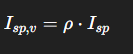
Why is volume-specific impulse important in rocket design?
Volume-specific impulse is important because:
Even if a propellant has high Isp, it may require very large tanks if its density is low.
Volume-specific impulse accounts for both:
Performance (Isp)
Propellant density
Why is the mixture ratio for LOX/H₂ engines typically fuel-rich?
Because hydrogen has very low density, a fuel-rich mixture minimizes the tank volume required for LH₂, making the overall stage lighter and more compact despite not operating at stoichiometric conditions.
To reduce LH₂ tank volume.

