Lecture 8: Animal cognition - comparing models of working memory
 Studied by 0 people
 Call with Kai
 Learn
Learn Practice Test
 Spaced Repetition
 Match
Match Flashcards
 Knowt Play
1/57

There's no tags or description
Looks like no tags are added yet.
Name | Mastery | Learn | Test | Matching | Spaced | Call with Kai |
|---|
No study sessions yet.
58 Terms
cognitive abilities from a comparative perspective
-comparing human and animal abilities gives us a much clearer picture of our own abilities
cognition (range of definitions)
-basis for intelligent behaviour
-overrides reflexive, habitual response in favour of complex, long term goals
-controls sensory, memory and motor systems
-applying top down mental processes
features of cognition
-key structure is prefrontal cortex
-effort and attention required
-core vs higher-order cognitive abilities
core cognitive abilities (executive functions)
-foundational to higher order cognition
working memory → hold and process information simultaneously
inhibitory control → withholding responses
cognitive flexibility
higher order cognitive abilities
object permanence → world exists around us and not just in our perspective
self-recognition → recognise ourselves and our position in the world
mental time travel → going back through our memories
theory of mind → our actions can affect others, understanding other’s perspectives
tool use/casual reasoning
scala naturae (ladder of being)
-hierarchal degree of perfection
-at some point animals stop being simply instinctual and become introspective
-based on how similar we feel things are to us (intelligence-wise)
order of scala naturae
-bottom-up from least intelligent to most intelligent:
fish
amphibians
reptiles
birds
mammals
-humans are at the top → anything observed as being close to us is seen as more intelligent
-evolutionary distant animals perceived as less intelligent
working memory in fish (evidence against scala naturae)
-showed fish stimuli that they had to learn and respond to
-fish demonstrated they had working memory
cognitive flexibility in frogs (evidence against scala naturae)
-frogs demonstrated cognitive flexibility and learned inhibition
-adapted to different situations
-could learn arbitrary rules and respond to them
inhibitory control in lizards (evidence against scala naturae)
-lizards can engage in inhibitory control tasks
-demonstrates to a degree, a lack of instinctual behaviour
limitation of scala naturae
-insight-related cognition might not be specifically human
cortex
-believed to be what differentiates humans from animals
-humans have a laminated cortex
laminated cortex
-6 layers of different types of cells that overlap
-lamination leads to rapid communication and is unique to humans
-defines a new computationally advantageous module
-differentiation of neocortex led to development of cognitive skills
prefrontal cortex (PFC)
-associated with core cognition and executive function
-damage to regions associated with deficits in executive function
-hard to dissociate between executive functions and where they are localised in the brain (use of lesions in patient studies)
size of PFC
-bigger in humans
-the bigger the PFC the more intelligent behaviours we see
-lamination in neocortex of PFC important for human behaviours
birds vs humans (comparative approach)
-birds do not have a neocortex
-have a pallium
-compare birds and humans as want to see if cortex is responsible for behaviour → so compare to animal without cortex
working memory
-representation of items held in consciousness during experiences or after retrieval of memories
-short lasting and associated with active rehearsal or manipulation of information
-key for storage and controlled processes
-key structure is PFC
-have STM and WM
action potentials (mechanism for studying animal cognition)
-electrochemical signal
-brief, stereotypical changes in the membrane potential of a neuron
-due to opening and closing of ion channels
-due to flux of sodium and potassium
-governed by gated ion channels
action potentials in PFC (mechanism for studying animal cognition)
-measure neurons in the PFC or comparative areas
-see whether they’re responding to WM tasks
-measure action potentials in the form of spike trains
measuring action potentials (mechanism for studying animal cognition)
-inserting electrodes into brain during tasks
-measure voltage changes in extracellular space around neurons
-gives indication of many different neurons ‘spiking’
-can visualise these spike trains with dots/dashes
-very precise timing of action potentials → spatial accuracy
Niki - method (neural basis for WM)
-delayed response task for monkeys
-one of two cue lights is illuminated for 1s → left or right
-cue illumination is turned off for 2-3s (delay period)
-monkey has to choose between left and right to identify which light came on
-monkey has to hold onto information during delay period → trained monkeys predicted to perform better on this task
if monkey uses PFC to hold onto information should see activity in PFC
Niki - results (neural basis for WM)
-initial spike at presentation of cue
-sustained spike trains during delay → delay activity
-delay activity → persistent firing rate change → bridges time gap of delay period
-neurons sustaining the memory of which light was active before selection is made
-robust finding → delay activity replicated in many studies
dopamine and classical conditioning
-when animals are conditioned to respond to certain stimulus
-can see observable dopaminergic neurons firing
-when given a reward at start of conditioning → neurons will fire more once they receive reward
-once paired with conditioned stimulus → respond to conditioned stimulus instead of reward
-so respond to anticipation rather than actual reward
neuromodulator (dopamine)
-links to delay activity (WM)
-responds to sensory stimuli which should predict future rewards
criticism of conditioning research
-neuronal activity might not be reflective of WM → may just be the brain’s response to anticipating a reward
-neuronal activity happens because been conditioned to respond in specific environment
not measuring WM (criticism of Niki)
-dopamine cells respond to sensory cues that predict reward
-this signal could be used to tag sensory cues as relevant and facilitate their entrance into WM
-so in the delayed response task:
cue-left and cue-right lead to a response in dopamine neurons
increases dopamine levels in prefrontal cortex
enables persistent delay activity in PFC
monkeys not using WM (criticism of Niki)
-task does not involve any manipulation or interaction with information
-only have to remember which light was on
-so measures STM not WM → passive store of information
delay activity
-activity is delayed
-so when processing information should see delay between stimulus and response
avian brain
-birds do not have cortex
-pallial layer → similar to human subcortical structures like basal ganglia
-primitive structures
-smaller areas considered to be akin to cortex in mammals
analogue
-same or similar function even if the structure is different
avian nomenclature forum
-reconsidered areas to be considered part of pallial area
-this area may support higher order cognition
-this is analogous to human cortex in terms of function → but fundamentally different to architecture of our cortex
pallium
-neuroanatomical term for the grey and white matter covering the cerebrum
nidopallium caudolaterale (NCL)
nidopallium → nested pallium
-nidopallium has many subregions and one of them is the caudolateral part → the NCL
-caudolateral means of the side and tail
investigating NCL (is NCL analogues to PFC?)
-WM task in homing pigeons
-directed forgetting procedure
-single unit recording in NCL during task performance
Rose - overview (is NCL analogues to PFC?)
-trained pigeons on a particular task
-put in front of a screen and presented with a single stimuli they had to learn
-done across two different trial types:
pigeons told to remember
pigeons told to forget
Rose - remember trial (is NCL analogues to PFC?)
-start with inter-trial interval (break)
-presented with a sample (circle stimuli)
-pigeon has to encode specific pattern/array of patterns
-pigeon receives a high note that instructs them to remember the sample information → will later be asked to recall it
-3s delay period
-engage in comparison → presented with an array and must discriminate between two targets and select what most closely matches what they had observed
-if they are correct they receive a reward
Rose - forget trial (is NCL analogues to PFC?)
-start with inter-trial interval (break)
-presented with a sample (circle stimuli)
-pigeon has to encode specific pattern/array of patterns
-pigeon receives a low note that instructs them to forget the sample information → will not be asked to recall it
Rose - results (remember trial)
-increase from sample
-consistent from cue to end of delay
-when provide stimulus see initial spike in neuron activity (encoding stimulus)
-when receive cue telling to remember information see sustained spike trains all the way through to the point that they need to make the choice
-means the pigeon is holding onto the information and maintaining it in the NCL → may be basis of WM in pigeons
Rose - results (forget trial)
-found that when the cue (telling pigeon to forget) is presented, the neural activity returns to baseline
-so the delay activity stops
-shows that when a pigeon is holding onto WM and then is instructed to let that information go, it is no longer being maintained
-NCL is locus of WM behaviour → so pigeons have WM even with completely different brain architecture to human PFC
Rose - abolished delay activity (issues with interpretation)
-abolished delay activity could be linked with reward prediction
-neurons could change firing rate in response to forget, because there is no reward
-difficult to discern between confounds of WM and reward prediction
-neurons could be involved in both
Rose - motor response (issues with interpretation)
-neuron activity could also be due to preparation of motor response
-forget cue requires no motor response
-so there are several possible interpretations
Veit - more advanced measures (follow-on study from Rose)
-used more advanced measures to disentangle WM from motor preparation
-presented with a sample and delay allows us to disentangle WM and motor preparation → every trial the crow has to make a choice, so motor preparation is happening in every trial
therefore the study is only measuring WM
-matching to sample → have to hold onto the information until they have to make a choice
-randomised reward → neutralises the possibility of anticipation of the reward as it is unpredictable
Veit - method (working memory in crows)
-crow in space with a TV screen and electrode in NCL
-presented with ‘go stimulus’ → tells them they are about to engage in a task
-presented with pre-sample black screen
-then presented with a sample and then a delay → after delay have to make a choice about the sample they saw from a selection of options
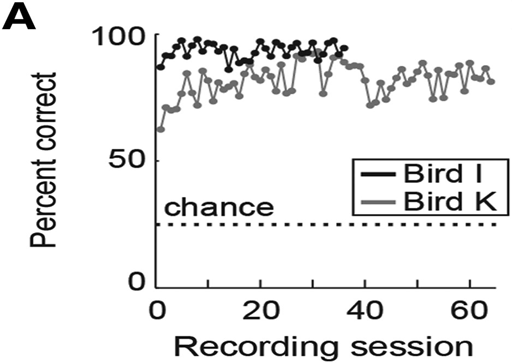
Veit - results (working memory in crows)
-crows perform task at very high level
-good at cognitive tasks → perform close to 100 most of the time
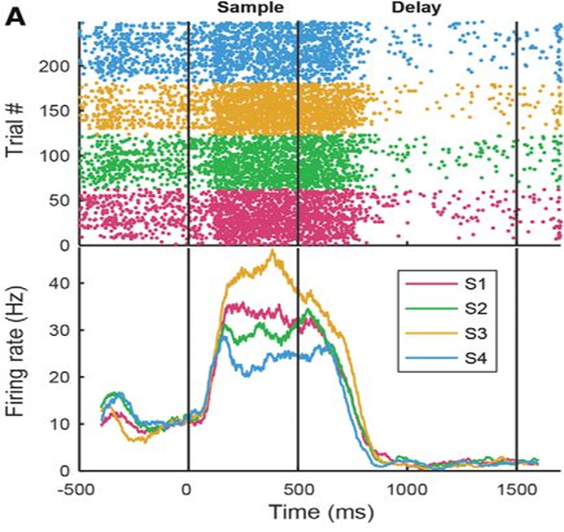
Veit - sample-selective neurons (results)
-delay activity is not in response to the task itself
-crows demonstrate a preference in the firing rate of the neurons
-neurons fire differently in terms of their rates depending on what they are observing
-can see firing rate for each item across 4 trials → can see significant differences in the firing rates in response to what they are observing
-can see that crows hold onto relevant information but also respond differently to different stimuli that is presented to them to accurately complete the task
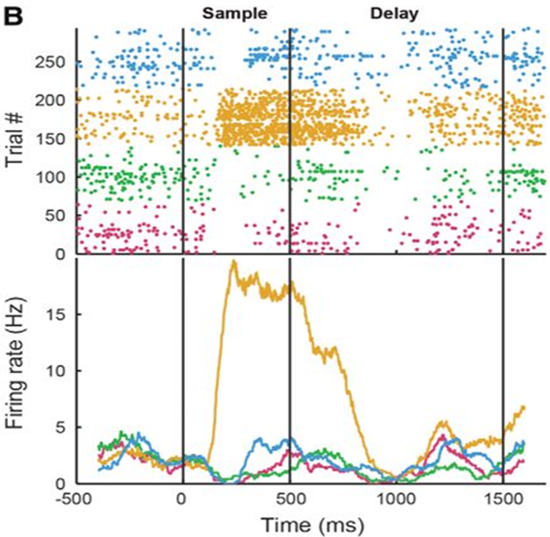
Veit - sample-selective neurons continued (results)
-preferences and differences in firing rate when holding and identifying information compared to during the delay before making their decision
-the activity is not arbitrary → specific to the stimuli the crows are observing
-sample selective neurons demonstrate preference during the delay period
-these differences in firing rate cannot simply be down to them performing the task → because there are significant differences depending on the type of stimuli they’re presented with
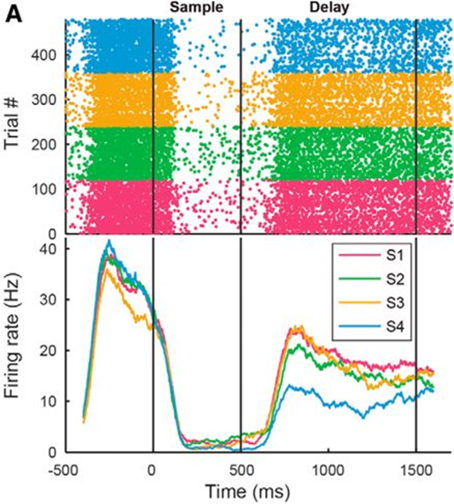
Veit - delay-selective neurons (results)
-the response of the neuron is selective during the delay period
-during the sample period the neuron did not distinguish the stimuli
Veit - population of neurons (results)
-more than half were either sample or delay selective or both
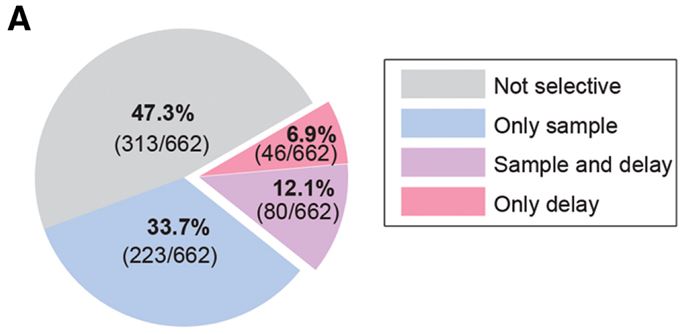
Veit - firing rate (results)
-analysis on relation between neural activity and task performance
-firing rate predicts whether or not they are likely to get the task correct
-in error trials the firing rate of the neurons does not distinguish the different stimuli as well as in correct trials
-true for sample and delay selective neurons
advantages of investigating cognition in animals
-animals studies allow direct recordings of action potentials → single cell recordings
-invasive and not usually possible in humans
-spatial and temporal accuracy can’t get from EEG or fMRI
-provide great insights into the nature of cognition, analogues of cognition in different species
limitations of investigating cognition in animals
-invasive - can be stressful for animals
-animals cannot self-report and have to be trained on tasks that do not reflect typical behaviour
-difficult to design tasks to remove confounds such as reward anticipation, motor preparation, STM or WM
bee brain
-0.5mm3
-only 1,000,000 neurons compared to 16,000,000,000 in humans
-not a simple, hard-wired structure
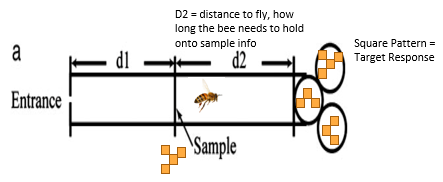
Zhang - delay period (WM in honey bees)
-to create delay period varied the length of the tunnel the bee had to fly through
-the closer the sample is to the entrance, the longer the bee has to fly (delay period) before it can make its choice
-vary the length of the tunnel and where the sample appears, can change how long a bee has to hold off something in memory
Zhang - method (WM in honey bees)
-bee flies through tunnel
-in the tunnel the bee is shown a sample (geometric shape)
-bee has to remember this sample
-where this sample is placed in the tunnel varies (increase/decrease delay period)
-as it progresses through the tunnel the bee has to make a choice between lots of different stimuli at the end of the tunnel (match-to-sample task)
Zhang - results (WM in honey bees)
-high performance levels for short delays (75% correct for 1.24s)
-performance indicates WM of up to 6.5s
Zhang - second method (WM in honey bees)
-added an incorrect pattern framing the other two patterns → so bee has to encode a pattern whilst also ignoring other patterns
-present with sample they have to ignore, then the correct sample and then another sample they have to ignore → correct sample is always shown in the same position, so bees have to learn this and ignore the other stimuli
-called a transfer task
Zhang - second results (WM in honey bees)
-perform pretty well on this task
-only have an issue when shift the pattern → bees don’t know what they are looking for so they fail
-but if it is kept consistent they will start to perform well again
limitations of Zhang (WM in honey bees)
-showed the bees can maintain and withdraw information to get the correct answer
-this is argued to reflective of WM
-however ignoring stimuli may not be manipulating memory → may just be flexibility or another cognitive process
 Note
Note  Flashcards (62)