2. Tectonic Theory
 Call Kai
 Learn
Learn Practice Test
 Spaced Repetition
 Match
Match Flashcards
 Knowt Play
1/15

There's no tags or description
Looks like no tags are added yet.
Name | Mastery | Learn | Test | Matching | Spaced | Call with Kai |
|---|
No analytics yet
Send a link to your students to track their progress
16 Terms
Describe the core of the Earth?
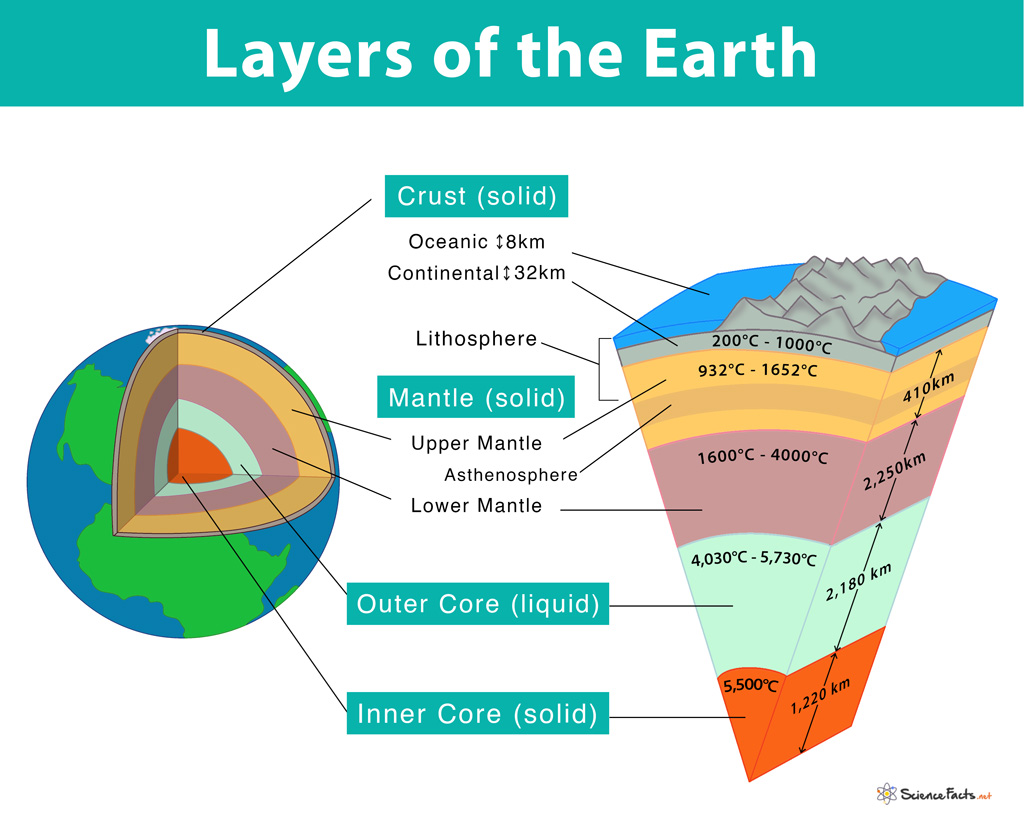
Hottest part of the Earth with temperatures reaching 5000℃
Made up of the inner core (solid due to pressure and made up of iron-nickel alloy) and the outer core (semi-liquid and mainly iron)
Source of heat is the mostly natural radioactive decay of isotopes like uranium and other elements. However, some of the heat energy was primordial (heat left other from the Earth’s formation)
Heat from the core creates convection currents within the mantle which spread through the asthenosphere and may be partly responsible for movement of tectonic plates
What parts of the Earth does the mantle contain compared to the lithosphere?
Mantle - Mesosphere, asthenosphere and upper most solid mantle
Lithosphere - crust and upper-most solid mantle
Describe the composition of the mantle?
Made of molten and semi-molten rocks containing lighter elements like silicon and oxygen. The rocks become denser with depth due to heat and pressure
2900km thick
Describe the asthenosphere?
This is what the plates float on
Under the lithosphere and is semi-molten
Describe the lithosphere?
Crust and rigid/solid upper section of the mantle
Approximately 80-90km thick
Divided into 7 large plates and some smaller plates
Describe the oceanic crust?
6-10km thick
Less than 200million years old
3.0 density (heavier than continental)
Layer of basaltic rock called SIMA (silicon, magnesium, oxygen) but mainly basalt
Describe the continental crust?
30-70km thick
Over 1,500 million years old
2.6 density (lighter than oceanic)
Layer of granite rocks known as SIAL (silicon, aluminium and oxygen) but mainly granite
Explain the overall ideas by Bacon and Wegener?
Bacon noticed in the 17th Century that the continents either side of the Atlantic Ocean fit together well - the bulge of South America fitting into the indent below West Africa
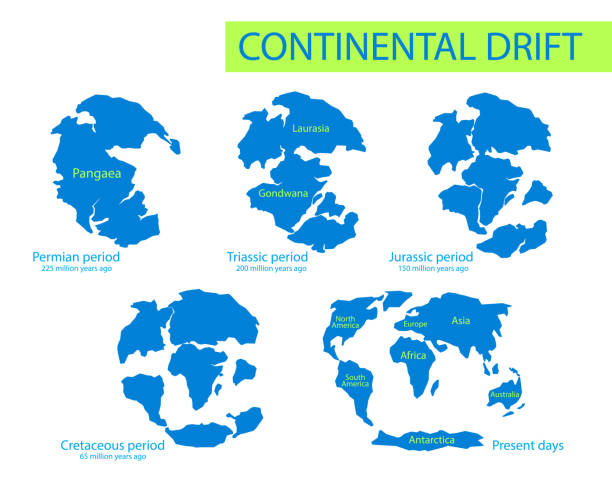
In 1912, Alfred Wegener published the theory that there used to be a single continent 300 million years ago. He called this the super-continent called Pangaea
He said Pangaea later split into 2 more continents called Laurasia and Gondwanaland and today’s continents where formed by these 2 splitting more
This theory is called continental drift
What is geological evidence for the theory of continental drift?
Geological
The bulge of South America fitting into the indent below West Africa
Evidence of late-Carboniferous glaciation deposits (290million yrs ago) found in South America, Antarctica and India which can’t be explained → continents must have been formed together than moved. Also, striations on rocks in Brazil + West Africa supporting this
Rock sequences in Northern Scotland as similar to Eastern Canada indicating they were formed in the same conditions in 1 location
What is biological evidence for the theory of continental drift?
Biological
Fossil remains of the reptile Mesosaurus were found in South America and Southern Africa. It is unlikely the reptile could have developed in both areas or migrated across the Atlantic
Fossil brachiopods found in Indian limestone are comparable with similar ones in Australia
What did Wegener’s theory lack and how did Harry Hess make up for it?
Wegener’s theory didn’t explain how the plates moved but Hess’s theory did through the idea of sea-floor spreading
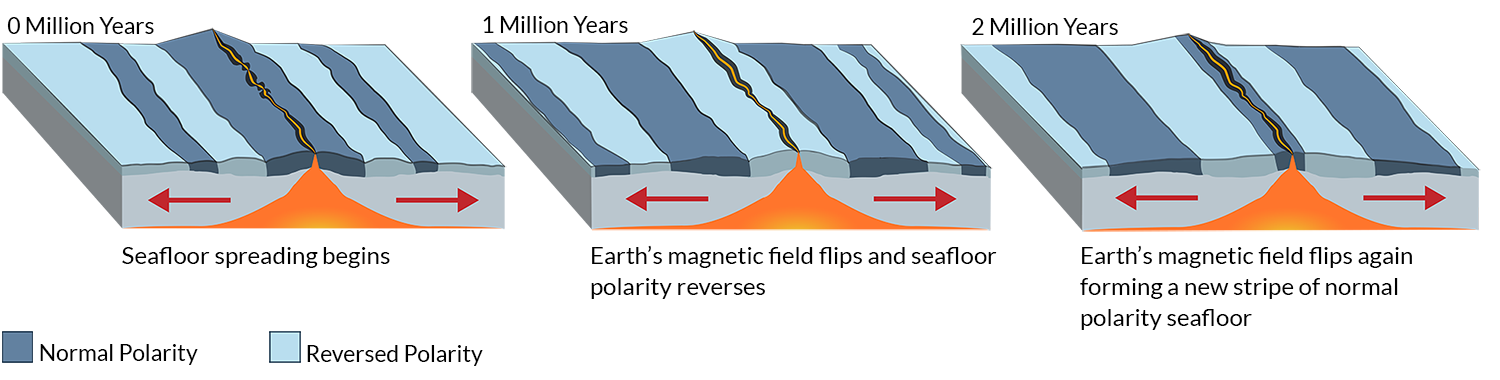
The discovery of the mid-Atlantic Ridge suggested the sea floor was spreading
Evidence for this came from Palaeomagnetism, where symmetrical magnetic stripes were found on either side of mid-ocean ridges aligned with the North and South Poles.
The rocks are formed when iron particles in lava erupt on the ocean floor and align with the Earth’s magnetic field → the rocks then solidify making the rock
The Earth’s polarity reverses every 400,000 years making the striped pattern
These magnetic patterns show that new crust forms at the ridge and moves away over time.
What did sea-floor spreading imply and suggest about oceanic crust?
Suggests the oceanic crust gets older with distance from the mid-oceanic ridge
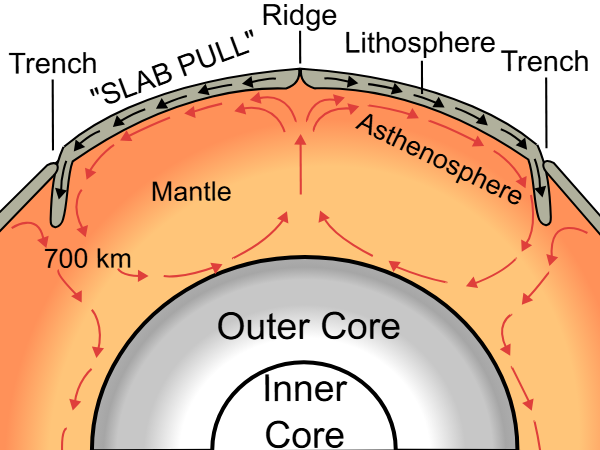
Implies the Earth is getting bigger → evidence of huge oceanic trenches linked to the idea of subduction where the ocean floor was being pulled down by hot spots which generate thermal convectional currents causing magma to rise up and spread before cooling and sinking with the plates floating on top
Name the 7 main tectonic plates?
Pacific Plate, North American Plate, Eurasian Plate, African Plate, Antarctic Plate, Australian Plate, and South American Plate
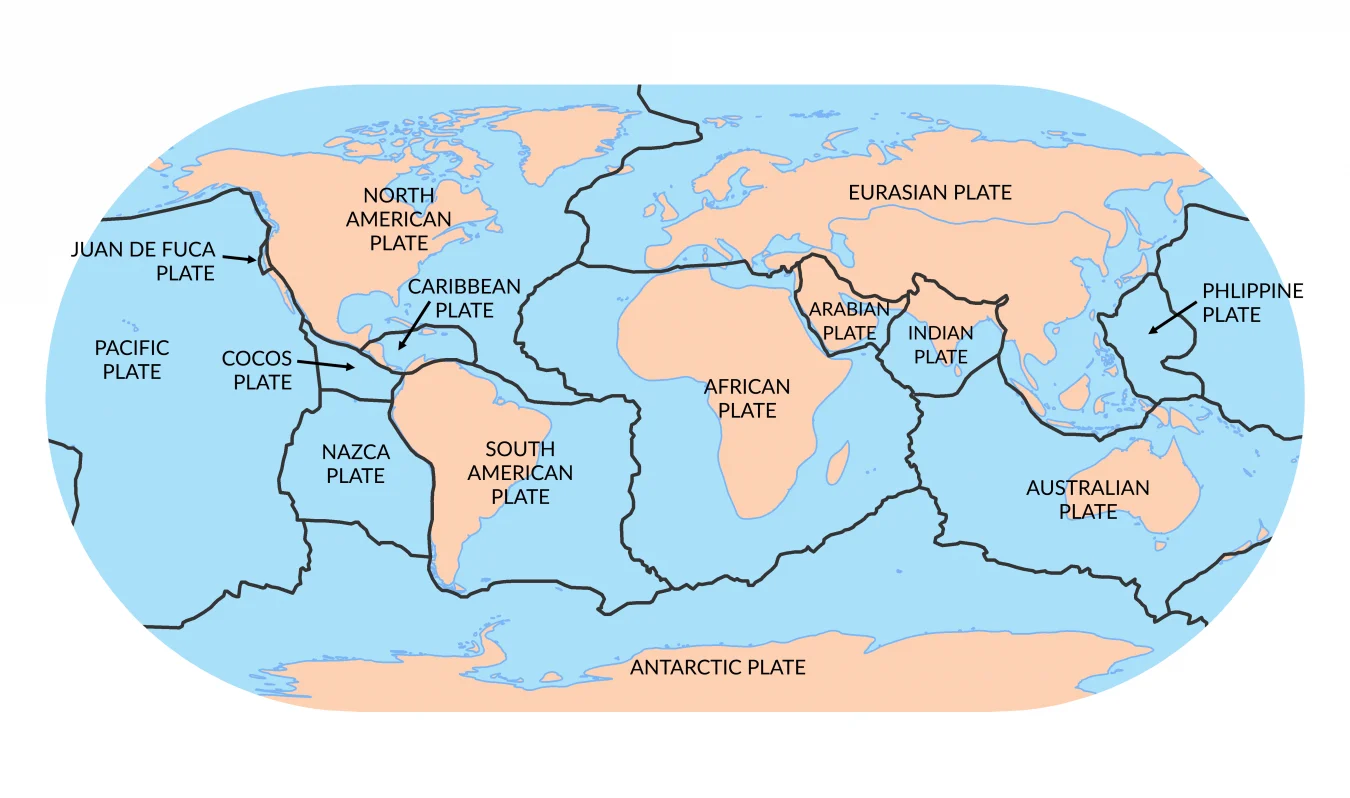
Explain an alternative idea to convection currents making plates move at constructive boundaries?
Ridge push/gravitational sliding
Upwelling of hot material at ocean ridges creates a buoyancy effect making an ocean ridge 2-3km above the ocean floor
Ocean plates experience the force ridge push which acts down the slope of the plate pulling the plates away
The occurrence of shallow earthquakes result from the repeated tearing apart of the newly formed crust. This indicates that there is a frictional resistance to this force
Explain an alternative idea for making plates move at destructive boundaries?
Slab pull
The downward gravity force acting on the oceanic plate as it subducts is as a result of the negative buoyancy of the plate
The pushing of the subducting plate against the overriding plate creates frictional resistance → shallow and deep earthquakes
Evaluate slab pull and ridge push as an explanation for tectonic movements?
Each plate moves at their own rate so forces vary plate to plate → unlikely 1 single agent is solely driving a plate’s movement → must be a combination of forces

