8.3 - Gene pools
 Call Kai
 Learn
Learn Practice Test
 Spaced Repetition
 Match
Match Flashcards
 Knowt Play
1/15

There's no tags or description
Looks like no tags are added yet.
Name | Mastery | Learn | Test | Matching | Spaced | Call with Kai |
|---|
No analytics yet
Send a link to your students to track their progress
16 Terms
What is the definition of a population?
All the organisms of a particular species that live in the same habitat
What are some examples of selection pressures?
Predation
Disease
Competition (e.g. food, habitats, mates, etc)
Environmental conditions (e.g. temperature)
How do selection pressures change allele frequencies within a population?
Organisms with advantageous characteristics are more likely to survive & reproduce to make offspring
Therefore, their favourable alleles get passed on, while unfavourable alleles die out
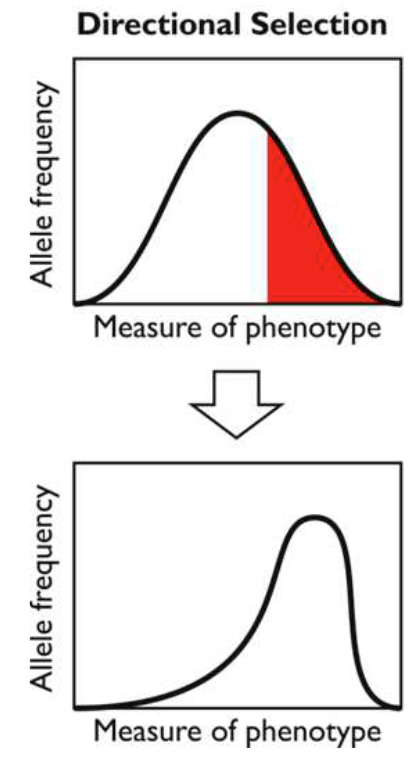
What is directional selection?
Occurs when one extreme phenotype (e.g. tallest) is favoured over the other extreme (e.g. shortest):
this happens when the environment changes in a particular way
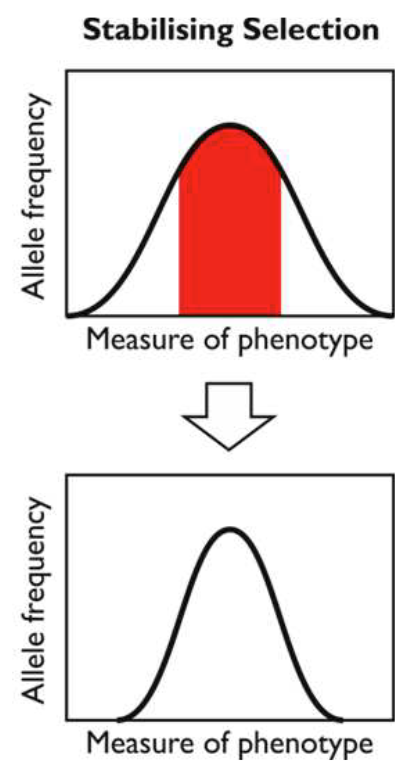
What is stabilising selection?
Occurs when the intermediate phenotype is selected over the extreme phenotypes:
tends to occur when the environment doesn’t change much (e.g. babies of intermediate birth weight are most likely to survive)
Individuals closest to the mean are favoured & any new characteristics are selected against (results in low diversity)
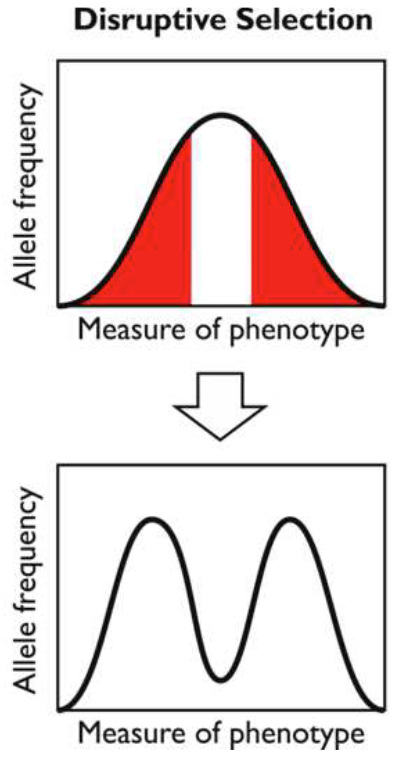
What is disruptive selection?
Occurs when both extremes of phenotype are favoured over the intermediate type:
for example, birds with large & small beaks feed on large & small seeds respectively & both do well, but birds with intermediate beaks have no advantage, & are selected against
over time, the population becomes phenotypically divided & new species may develop
What is the definition of genetic drift?
A change in a population’s allele frequencies that occurs due to chance, rather than selection pressures:
it is caused by ‘sampling error’ during reproduction
What is meant by a population bottleneck?
A catastrophic event (e.g. volcanic eruption, wildfire, flood, etc) dramatically reduces the size of a population
This decreases the variety of alleles in the gene pool & causes large changes in allele frequencies
What is meant by the founder effect?
A small number of individuals become isolated, forming a new population with a limited gene pool - the allele frequencies not reflective of the original population
What is the Hardy-Weinberg principle?
Allows us to estimate the frequency of alleles in a population & if allele frequency is changing over time
What are some assumptions made by the Hardy-Weinberg principle?
No mutations occur to create new alleles
No migration in or out of the population
No selection (so alleles are all equally passed onto the next generation)
Random mating & a large population
Explain the Hardy-Weinberg equation for calculating allele frequency
The frequencies of each allele for a characteristic must add up to 1.0
The equation is therefore: p + q = 1
where p = frequency of the dominant allele (think ‘powerful’)
where q = frequency of the recessive allele (think ‘quiet’)
Explain the Hardy-Weinberg equation for calculating genotype frequency
The frequencies of each genotype for a characteristic must add up to 1.0
The equation is therefore: p2 + 2pq + q2 = 1
where p2 = frequency of homozygous dominant genotype
where 2pq = frequency of heterozygous genotype
where q2 = frequency of homozygous recessive genotype
What is the method to using Hardy-Weinberg calculations?
(all calculations must be carried out using proportions, not percentages)
Examine the question to determine what piece of information you have been given about the population → in most cases, this is the percentage/frequency of the homozygous recessive (q2) or dominant (p2) phenotype
Find out the value of q by taking the square root of q2
Determine p by subtracting q from 1 (p = 1 - q)
Determine p2 by multiplying p by itself
Determine 2pq by multiplying p x q x 2
Check your calculations are correct by adding up the vales for p2 + q2 + 2pq (the sum should equal 1 or 100%)
Answer this Hardy-Weinberg question
In humans, the ability to taste the chemical PTC is inherited as a dominant characteristic. 360 out of 1000 college students could not taste the chemical
Frequency of recessive phenotype (360 out of 1000)
(a) State the frequency of the gene for tasting PTC
(b) Determine the number of heterozygous students in this population
(a) = 64%
(b) = 480
Answer this Hardy-Weinberg question
A type of deformity appears in 4% of a large herd of cattle. Assuming the deformity was caused by a recessive gene
Data: Frequency of recessive genotype (4% deformity)
(a) Calculate the percentage of the herd that are carriers of the gene
(b) Determine the frequency of the dominant gene in this case
(a) = 32%
(b) = 0.8 (8%)