Infratemporal Fossa

0.0(0)
Studied by 0 people
call kaiCall Kai
learnLearn
examPractice Test
spaced repetitionSpaced Repetition
heart puzzleMatch
flashcardsFlashcards
GameKnowt Play
Card Sorting

1/18

encourage image

There's no tags or description

Looks like no tags are added yet.

Last updated 8:45 PM on 3/24/26
Name
Mastery
Learn
Test
Matching
Spaced
Call with Kai

No analytics yet

Send a link to your students to track their progress

19 Terms

1
New cards

What is the infratemporal fossa and what are the borders?

Space medial and inferior to the zygomatic arch.

Borders: Infratemporal surface of maxilla (anterior), styloid process (posterior), lateral pterygoid plate (medial), mandibular ramus (lateral).
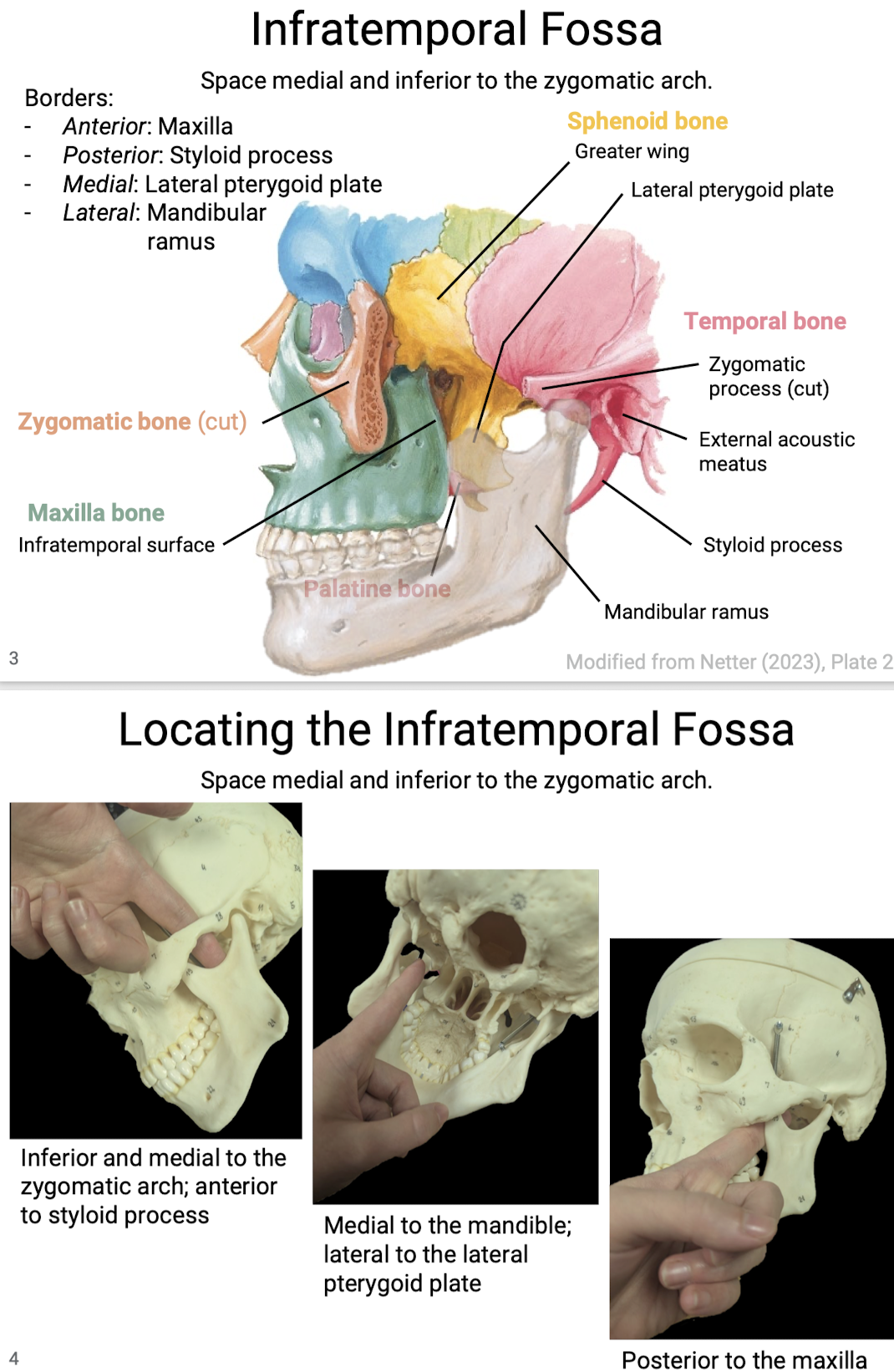
<p>Space medial and inferior to the zygomatic arch.</p><p>Borders: Infratemporal surface of maxilla (anterior), styloid process (posterior), lateral pterygoid plate (medial), mandibular ramus (lateral).</p>
2
New cards

What nerves run through the infratemporal fossa?

Mainly V3, including auriculotemporal n. (which typically splits in half to encircle the middle meningeal artery), inferior alveolar n. (found between the pterygoids with…), lingual n., n. to mylohyoid, and buccal nerve.

Nerves NOT from V3 include the posterior superior alveolar nerve (V2) and chorda tympani n. (VII).
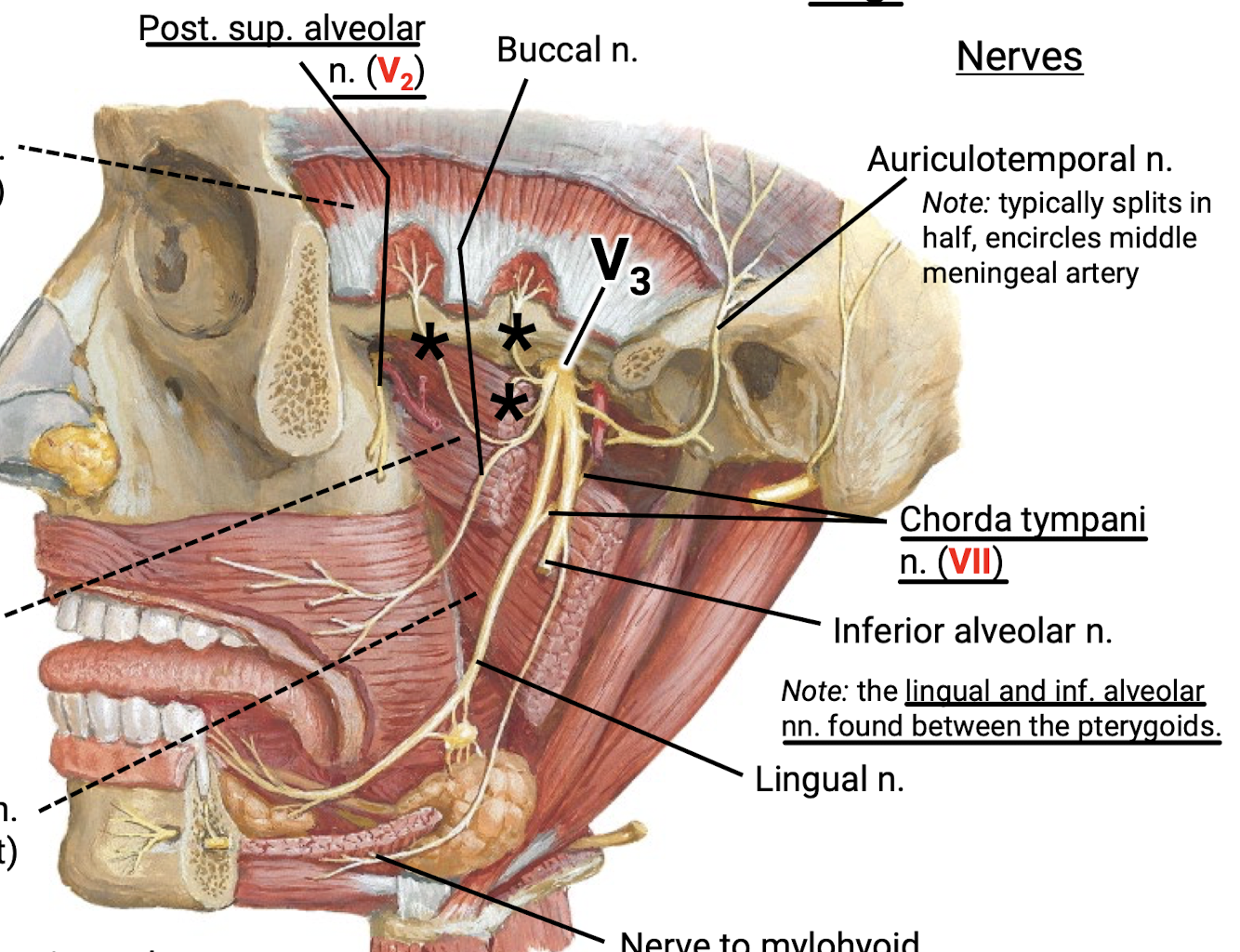
<p>Mainly V3, including auriculotemporal n. (which typically splits in half to encircle the middle meningeal artery), inferior alveolar n. (found between the pterygoids with…), lingual n., n. to mylohyoid, and buccal nerve. </p><p>Nerves NOT from V3 include the posterior superior alveolar nerve (V2) and chorda tympani n. (VII). </p>
3
New cards

What muscles are found in the infratemporal fossa?

Temporalis m., lateral pterygoid m., and medial pterygoid muscle.
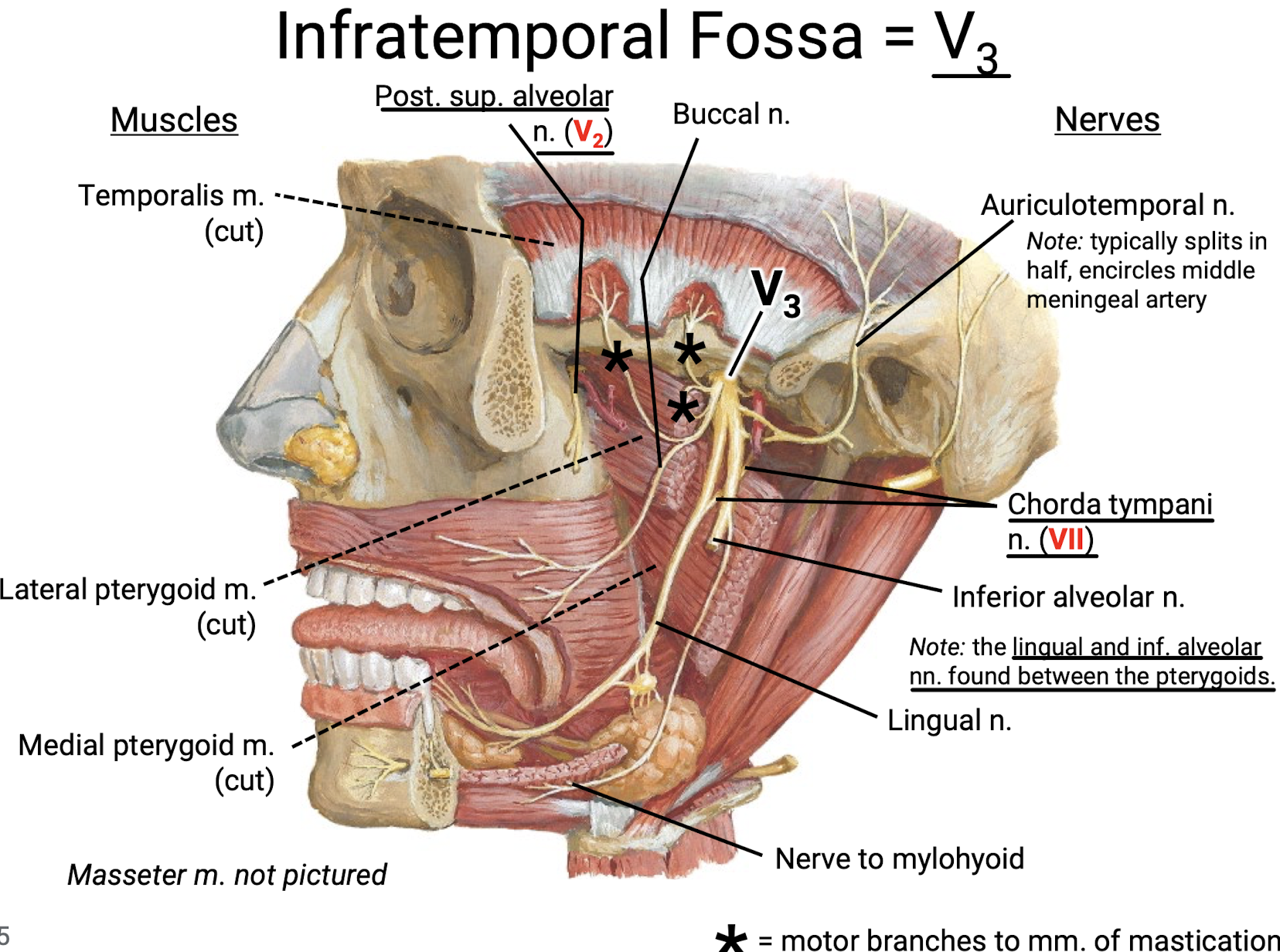
<p>Temporalis m., lateral pterygoid m., and medial pterygoid muscle.</p>
4
New cards

What can be found in the space between the pterygoid muscles? (3)

Hotspot for CN V3 and the maxillary artery. Also sphenomandibular ligament.
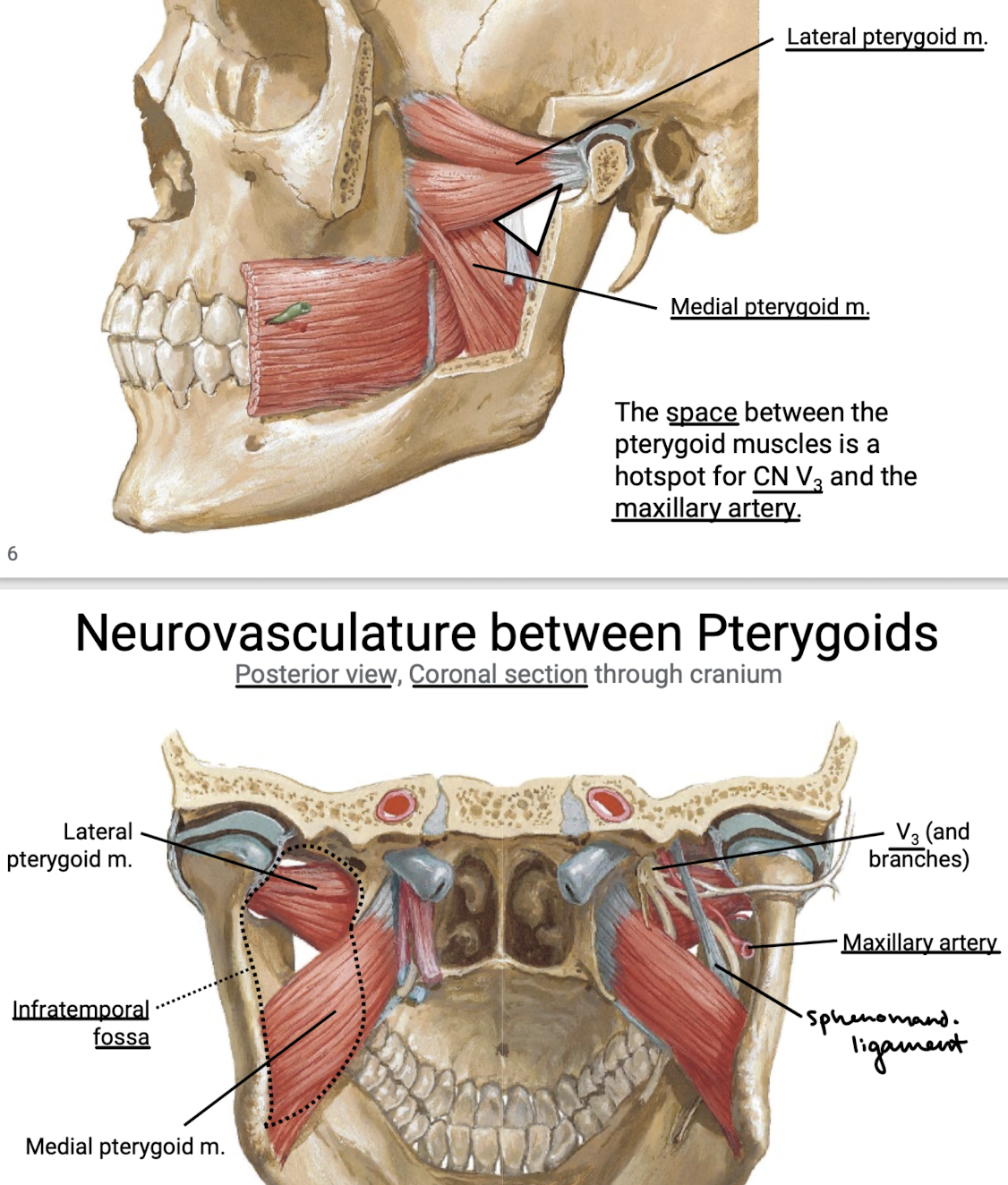
<p>Hotspot for CN V3 and the maxillary artery. Also sphenomandibular ligament.</p>
5
New cards
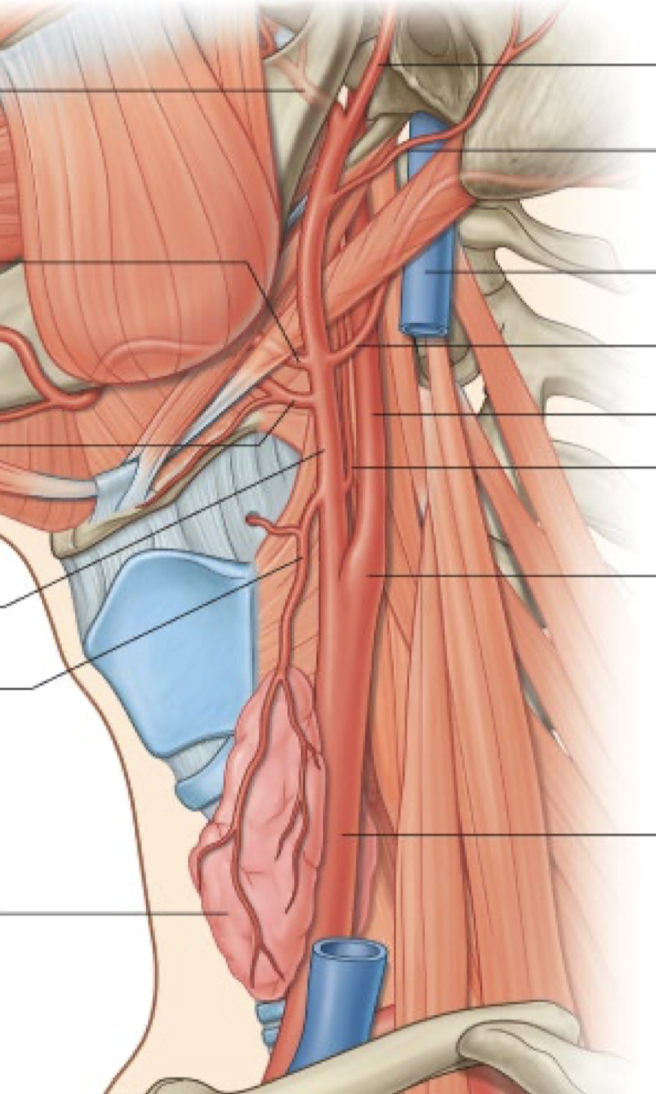
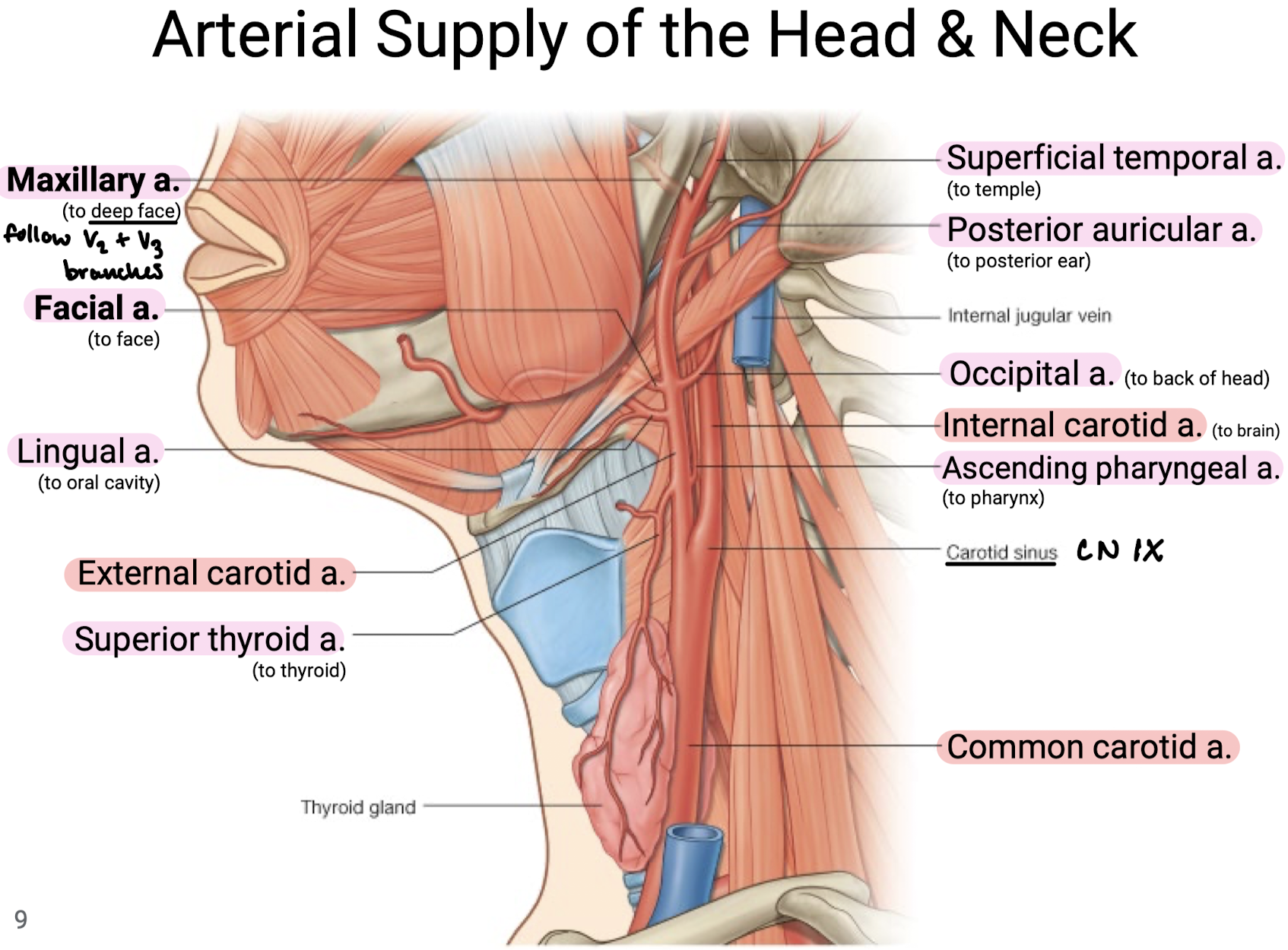
<p>Describe the branches off of the external carotid artery (8) and where they supply.</p>

Describe the branches off of the external carotid artery (8) and where they supply.

  1. Superior thyroid artery (to thyroid)

  2. Ascending pharyngeal artery (to pharynx)

  3. Lingual a. (to oral cavity)

  4. Occipital a. (to back of head)

  5. Facial a. (to face)

  6. Posterior auricular a. (to posterior ear)

  7. Maxillary a. (to deep face)

  8. Superficial temporal a. (to temple)

<ol><li><p>Superior thyroid artery (to thyroid)</p></li><li><p>Ascending pharyngeal artery (to pharynx)</p></li><li><p>Lingual a. (to oral cavity)</p></li><li><p>Occipital a. (to back of head)</p></li><li><p>Facial a. (to face)</p></li><li><p>Posterior auricular a. (to posterior ear)</p></li><li><p>Maxillary a. (to deep face)</p></li><li><p>Superficial temporal a. (to temple)</p></li></ol><p></p>
6
New cards

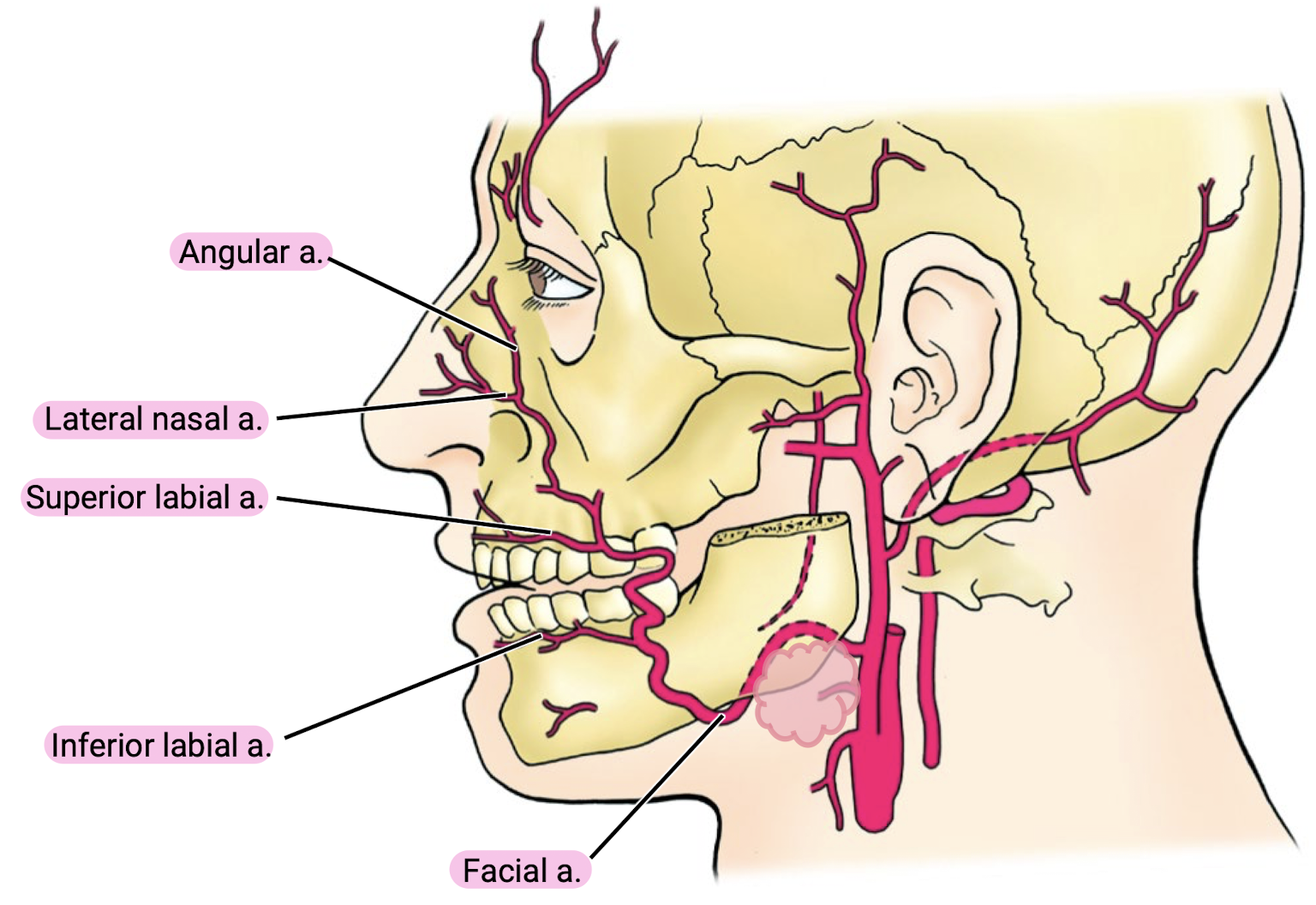
Where does the facial artery branch? Where does it enter the face? Where does it run from there?

The facial artery branches near the angle of the mandible. It briefly runs posterior to the mandibule (and posterior to the submandibular gland in the neck). The facial artery loops around the inferior mandible to enter the face (note: arterial pulse can be taken here!). The facial artery then runs diagonally from the mandible up to the birdge of the nose, giving off several branches along the way.
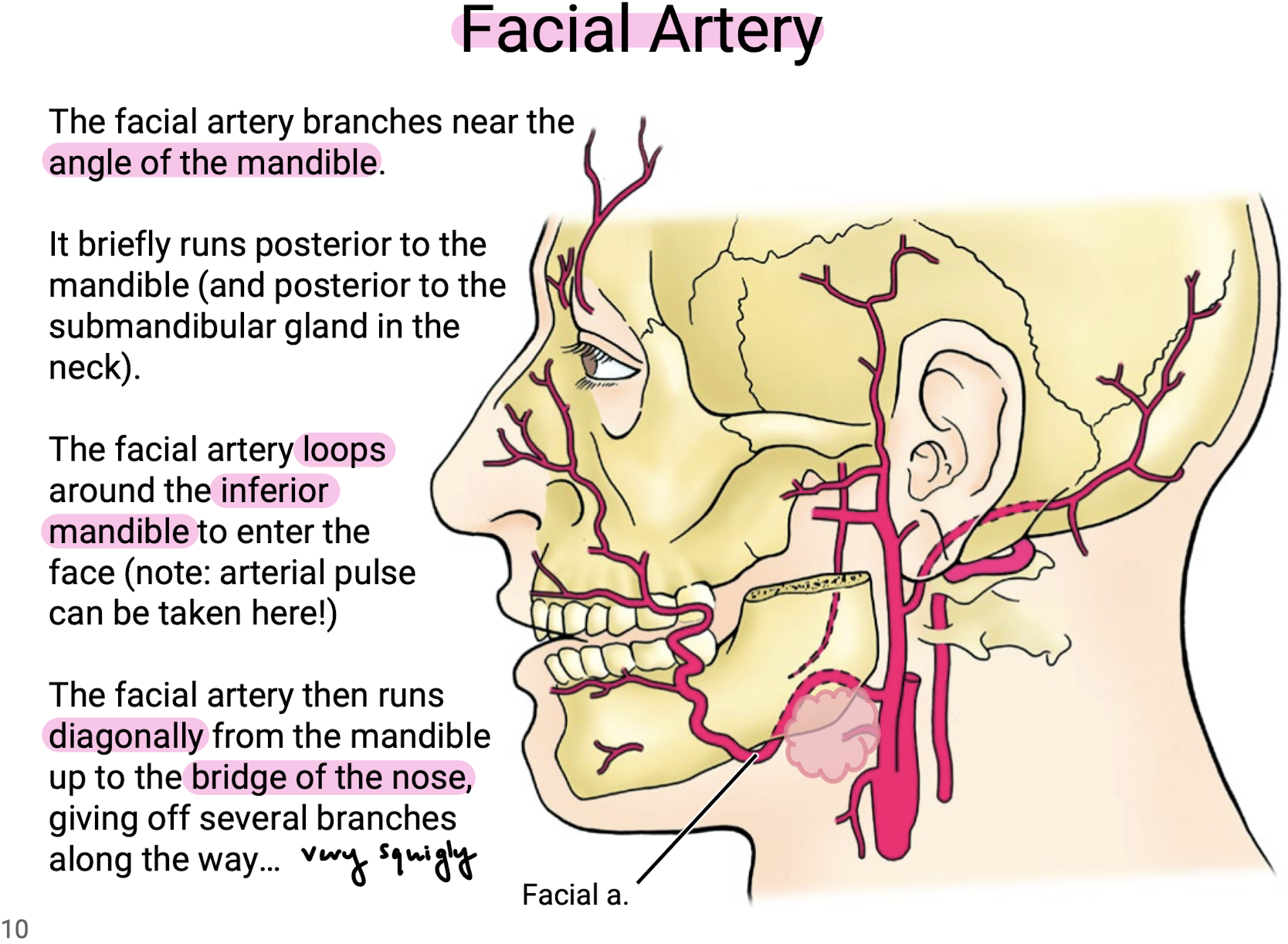
<p>The facial artery branches near the angle of the mandible. It briefly runs posterior to the mandibule (and posterior to the submandibular gland in the neck). The facial artery loops around the inferior mandible to enter the face (note: arterial pulse can be taken here!). The facial artery then runs diagonally from the mandible up to the birdge of the nose, giving off several branches along the way.</p>
7
New cards

What are the branches off of the facial artery?

  1. Inferior labial a.

  2. Superior labial a.

  3. Lateral nasal a.

  4. Angular a.

<ol><li><p>Inferior labial a.</p></li><li><p>Superior labial a.</p></li><li><p>Lateral nasal a.</p></li><li><p>Angular a.</p></li></ol><p></p>
8
New cards

What arterial branches supply the superficial face (from either internal or external carotid)?

Superficial temporal a. and facial a. from external carotid a.

Internal carotid a. branches including supraorbital a. and supratrochlear a. (that run with the nn. of the same name) to supply the forehead area.

NOTE: Many branches of internal carotid a. follow the branches of V1.
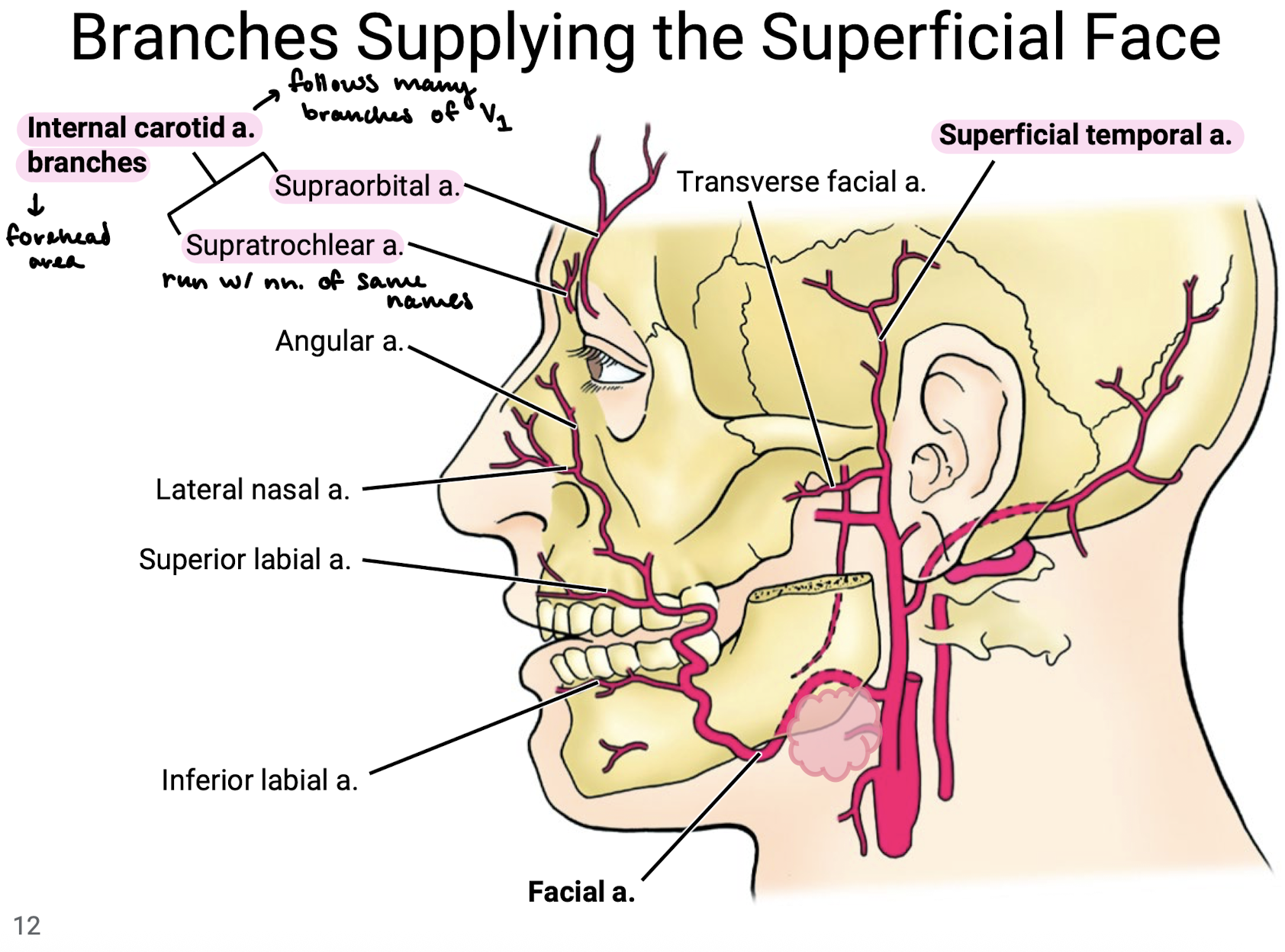
<p>Superficial temporal a. and facial a. from external carotid a.</p><p>Internal carotid a. branches including supraorbital a. and supratrochlear a. (that run with the nn. of the same name) to supply the forehead area.</p><p>NOTE: Many branches of internal carotid a. follow the branches of V1.</p>
9
New cards

What are the different parts to the maxillary artery? Describe the general trends of branches from each part.

3 Parts:

Part 1: Portion BEFORE lateral pterygoid, whose branches run with named V3 branches

Part 2: Portion OVER/UNDER lateral pterygoid, whose branches run with V3 muscular nn. (not named) that go directly to structures (no foramina).

Part 3: Portion AFTER lateral pterygoid, whose branches run with V2 branches.
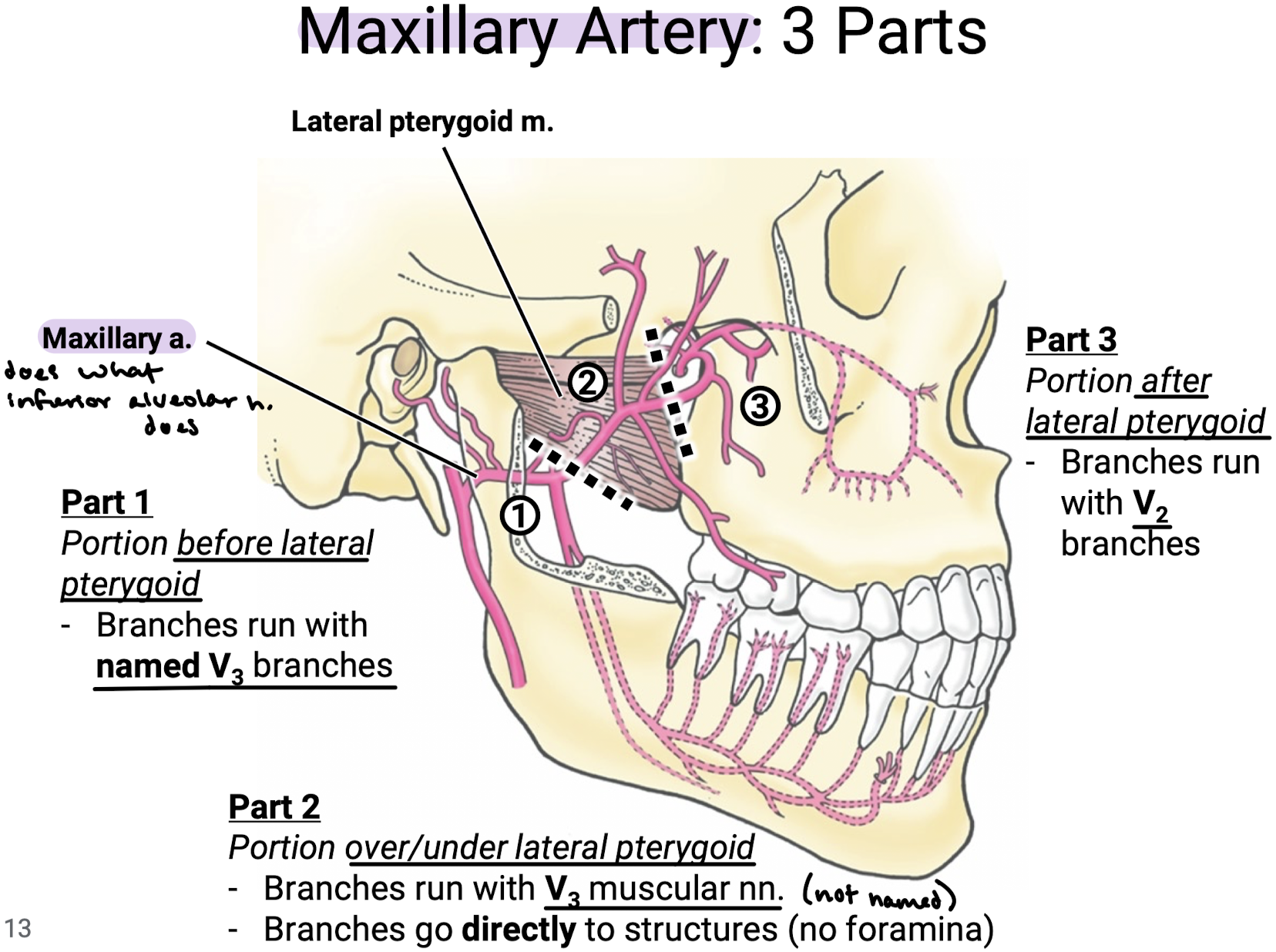
<p>3 Parts:</p><p>Part 1: Portion BEFORE lateral pterygoid, whose branches run with named V3 branches</p><p>Part 2: Portion OVER/UNDER lateral pterygoid, whose branches run with V3 muscular nn. (not named) that go directly to structures (no foramina).</p><p>Part 3: Portion AFTER lateral pterygoid, whose branches run with V2 branches.</p>
10
New cards

What are the four branches off of Part 1 of the maxillary artery? Know what nerve they follow and what area they supply.

  1. Deep auricular a. follows auriculotemporal n. (V3) and supplies the external acoustic meatus.

  2. Anterior tympanic a. follows chorda tympani n. (VII) to supply the tympanic membrane.

  3. Middle meningeal a. enters foramen spinosum to supply the dura mater.

  4. Inferior alveolar a. follows the inferior alveolar n. (V3) into the mandibular foramen to supply the mandibular teeth and chin.
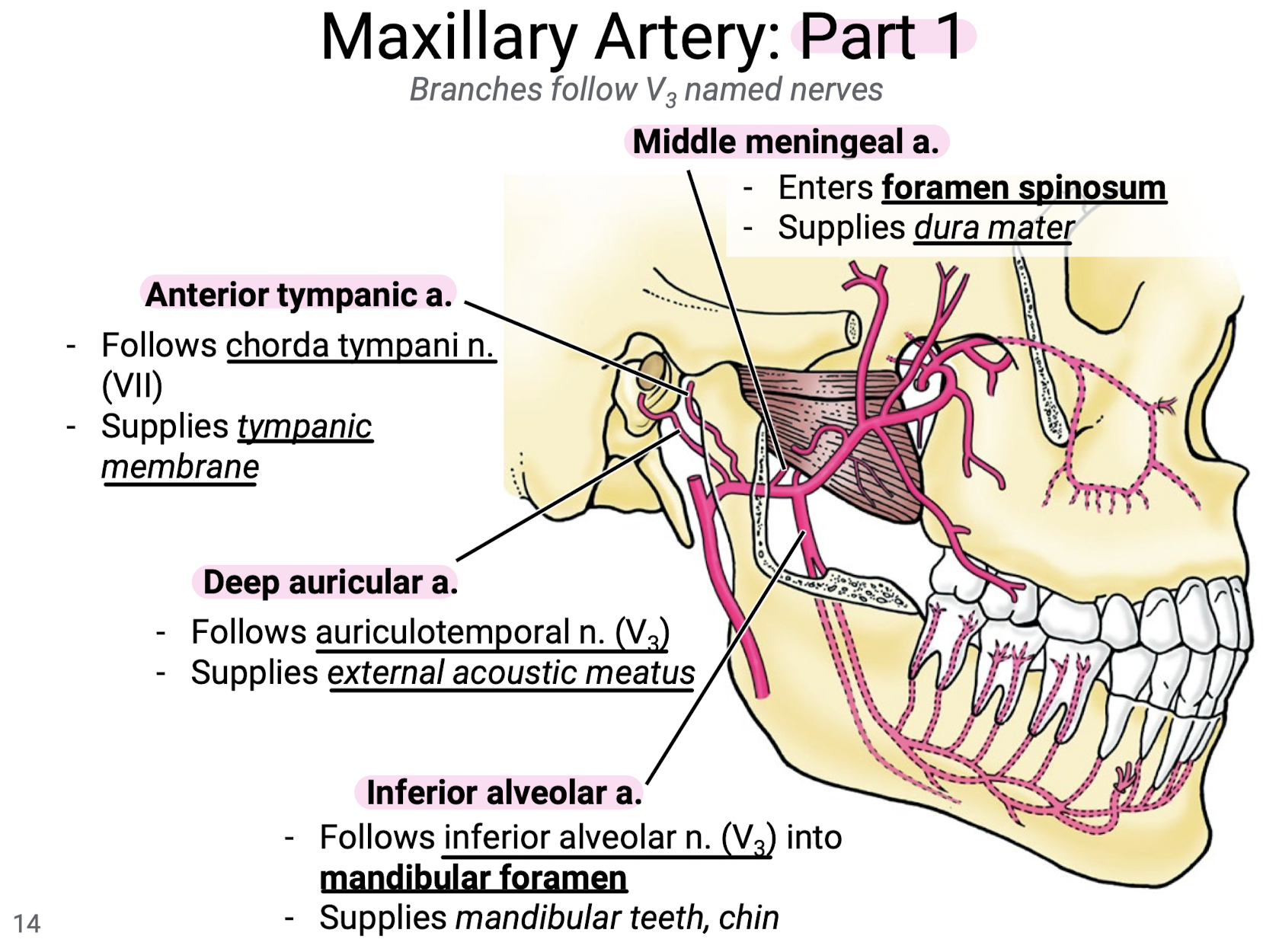
<ol><li><p>Deep auricular a. follows auriculotemporal n. (V3) and supplies the external acoustic meatus.</p></li><li><p>Anterior tympanic a. follows chorda tympani n. (VII) to supply the tympanic membrane.</p></li><li><p>Middle meningeal a. enters foramen spinosum to supply the dura mater.</p></li><li><p>Inferior alveolar a. follows the inferior alveolar n. (V3) into the mandibular foramen to supply the mandibular teeth and chin.</p></li></ol><p></p>
11
New cards

What are the four branches off of Part 2 of the maxillary artery? Know what nerve they follow and what area they supply.

  1. Pterygoid aa. follow nerves to pterygoid mm. (V3) to supply the pterygoid mm.

  2. Masseteric aa. follow the nerves to masseter m. (V3) to supply the masseter m.

  3. Deep temporal aa. follow nerve to temporalis m. (V3) to supply temporalis m.

  4. Buccal aa. follow the buccal n. (V3) to supply buccinator m., but remember the buccal n. of V3 only runs through buccinator and does not supply it.
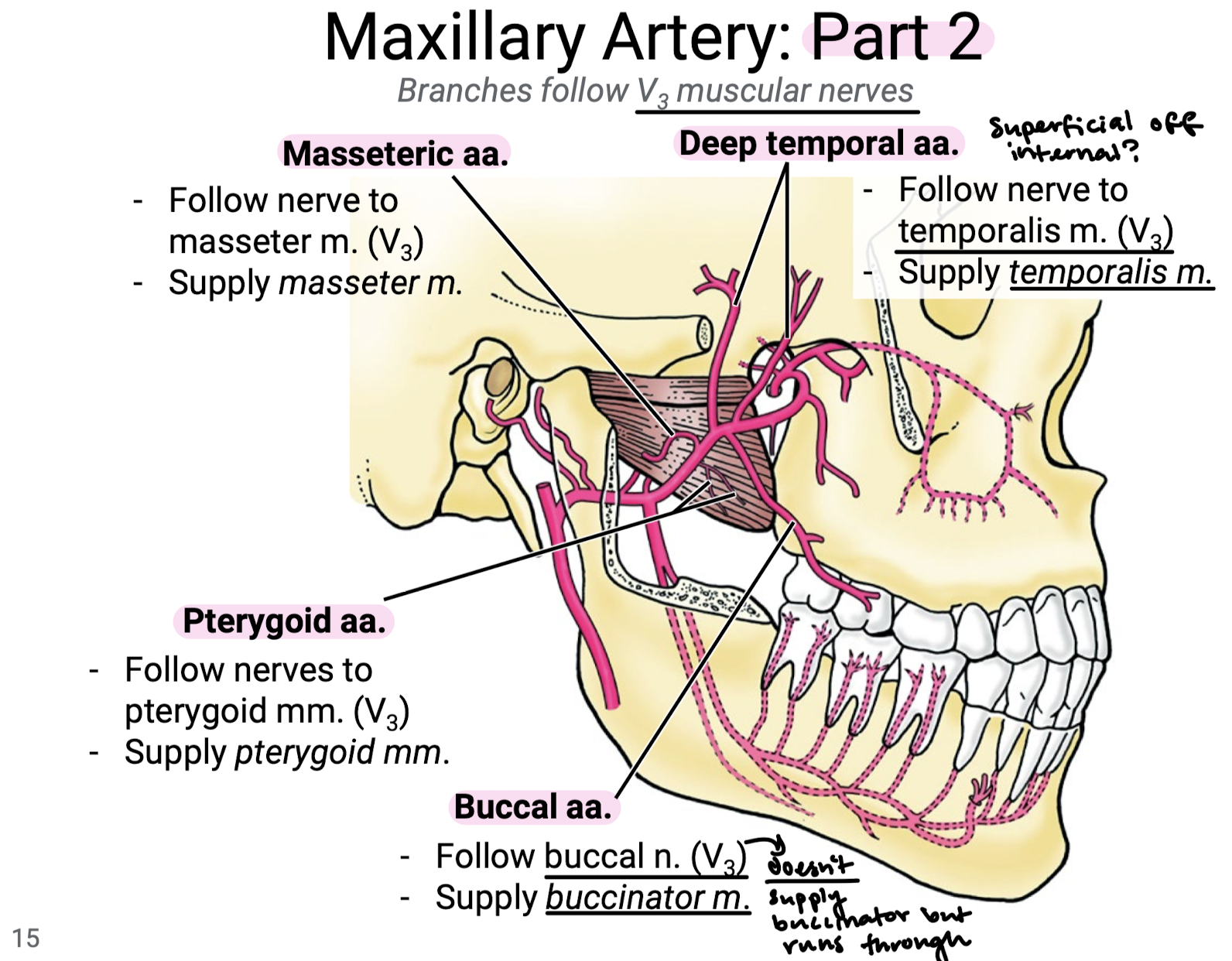
<ol><li><p>Pterygoid aa. follow nerves to pterygoid mm. (V3) to supply the pterygoid mm.</p></li><li><p>Masseteric aa. follow the nerves to masseter m. (V3) to supply the masseter m.</p></li><li><p>Deep temporal aa. follow nerve to temporalis m. (V3) to supply temporalis m. </p></li><li><p>Buccal aa. follow the buccal n. (V3) to supply buccinator m., but remember the buccal n. of V3 only runs through buccinator and does not supply it.</p></li></ol><p></p>
12
New cards

What are the five branches off of Part 3 of the maxillary artery? Know what nerve they follow and what area they supply.

  1. Descending palatine a. follows the greater/lesser palatine nn. (V2) to supply the palate.

  2. Posterior superior alveolar a. follows the post. sup. alveolar n. (V2) to supply the maxillary teeth and maxillary sinus.

  3. Infraorbital a. follows the infraorbital n. (V2) to supply the maxillary teeth and sinus and anterior face.

  4. Artery of pterygoid canal follows the greater petrosal nerve (VII) to supply the pharynx, auditory tube, and middle ear.

  5. Sphenopalatine a. follows the nasopalatine n. (V2), supplying the nasal cavity and anterior palate.
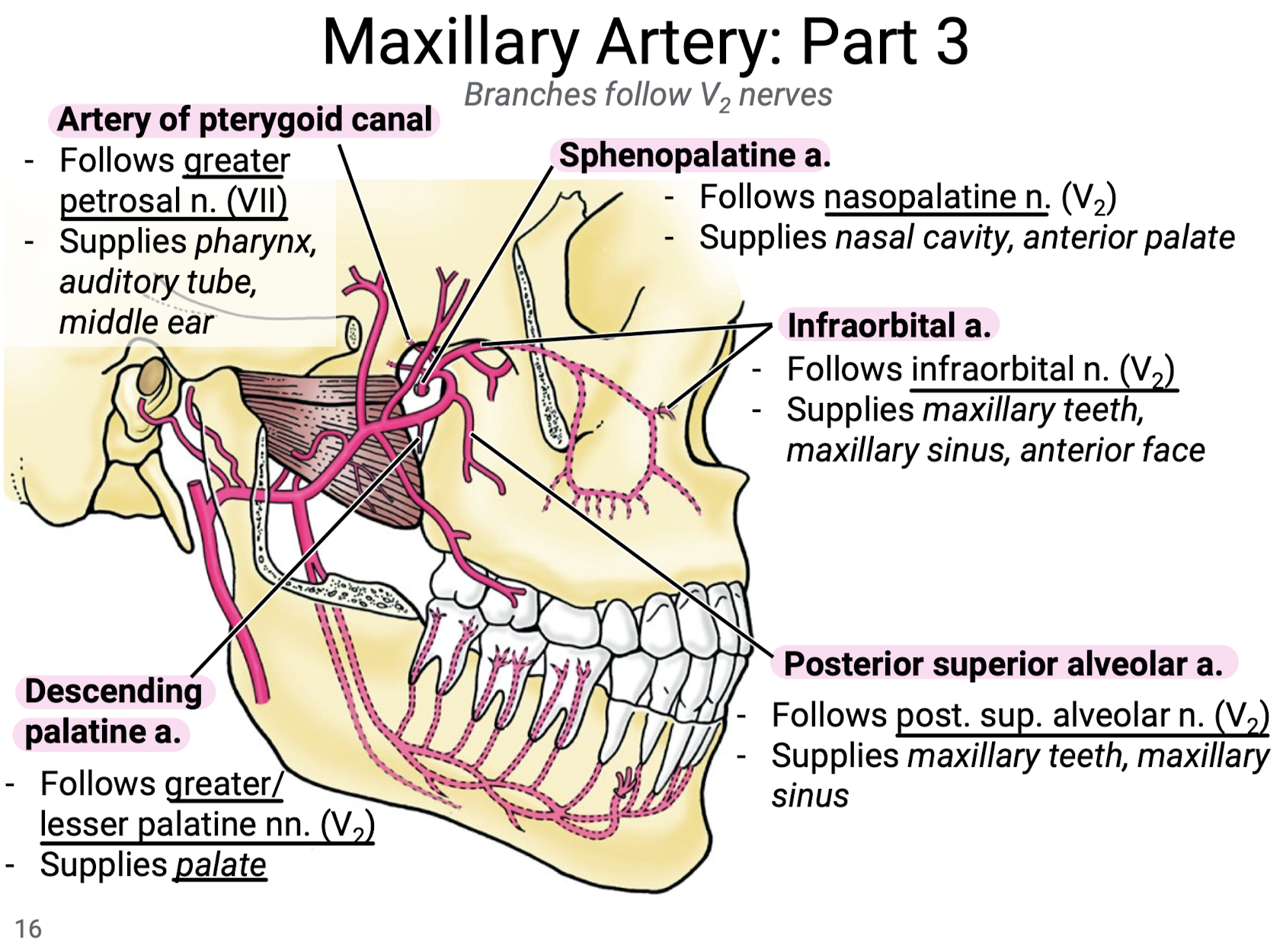
<ol><li><p>Descending palatine a. follows the greater/lesser palatine nn. (V2) to supply the palate.</p></li><li><p>Posterior superior alveolar a. follows the post. sup. alveolar n. (V2) to supply the maxillary teeth and maxillary sinus.</p></li><li><p>Infraorbital a. follows the infraorbital n. (V2) to supply the maxillary teeth and sinus and anterior face.</p></li><li><p>Artery of pterygoid canal follows the greater petrosal nerve (VII) to supply the pharynx, auditory tube, and middle ear.</p></li><li><p>Sphenopalatine a. follows the nasopalatine n. (V2), supplying the nasal cavity and anterior palate.</p></li></ol><p></p>
13
New cards

Which of the maxillary artery branches also supply the superficial face and anastomose with facial artery branches?

Infraorbital a. (part 3) and mental branch (part 1 from inferior alveolar a.).
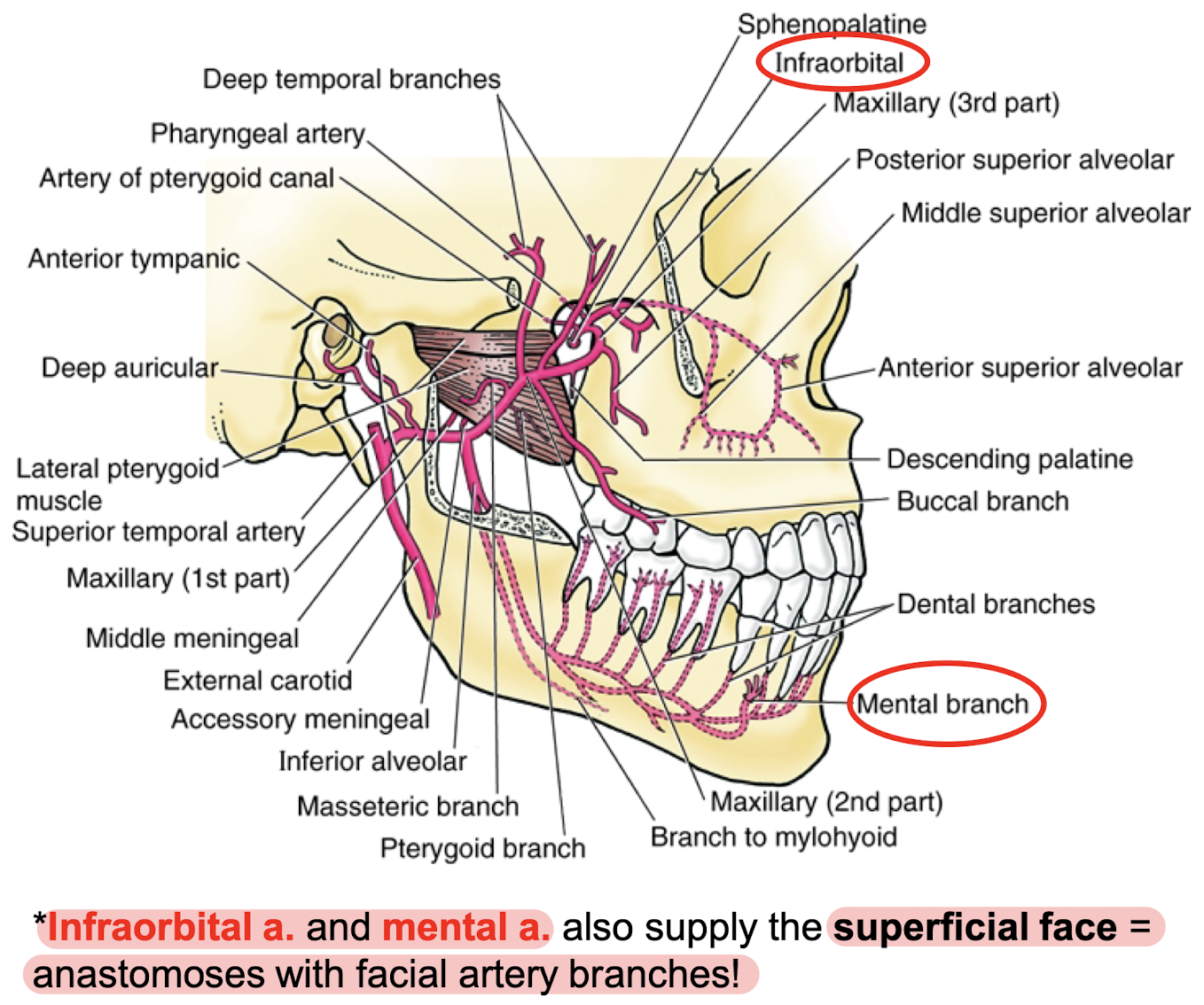
<p>Infraorbital a. (part 3) and mental branch (part 1 from inferior alveolar a.).</p>
14
New cards

What is the main venous return method of the infratemporal fossa? In what four ways do these veins drain?

The pterygoid venous plexus. The plexus and facial veins have multiple draining pathways including:

  • Down to the internal jugular veins

  • Back to the retromandibular veins

  • Up to the ophthalmic veins

  • Up to the cavernous sinus (meningeal blood space)
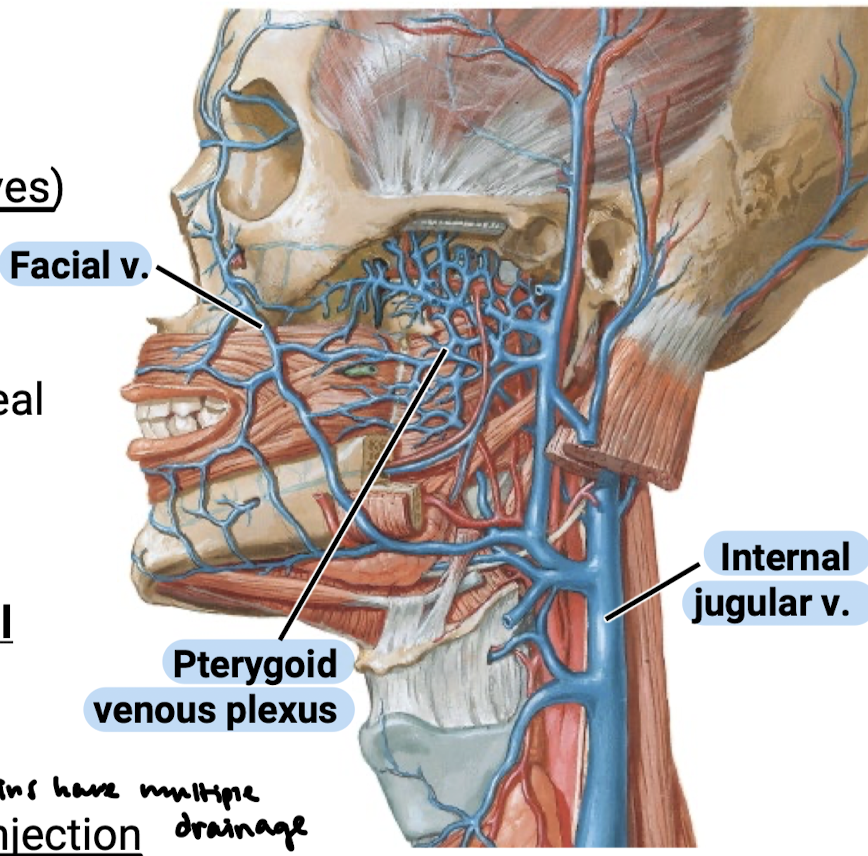
<p>The pterygoid venous plexus. The plexus and facial veins have multiple draining pathways including:</p><ul><li><p>Down to the internal jugular veins</p></li><li><p>Back to the retromandibular veins</p></li><li><p>Up to the ophthalmic veins</p></li><li><p>Up to the cavernous sinus (meningeal blood space)</p></li></ul><p></p>
15
New cards

What is the clinical significance of infratemporal vasculature?

  1. Blood/nutrient supply to the teeth

  2. Spread of infection (especially so because veins have multiple drainage)

  3. Vascular injury during anesthetic injection

  4. Inadvertent intravascular injection of anesthetic
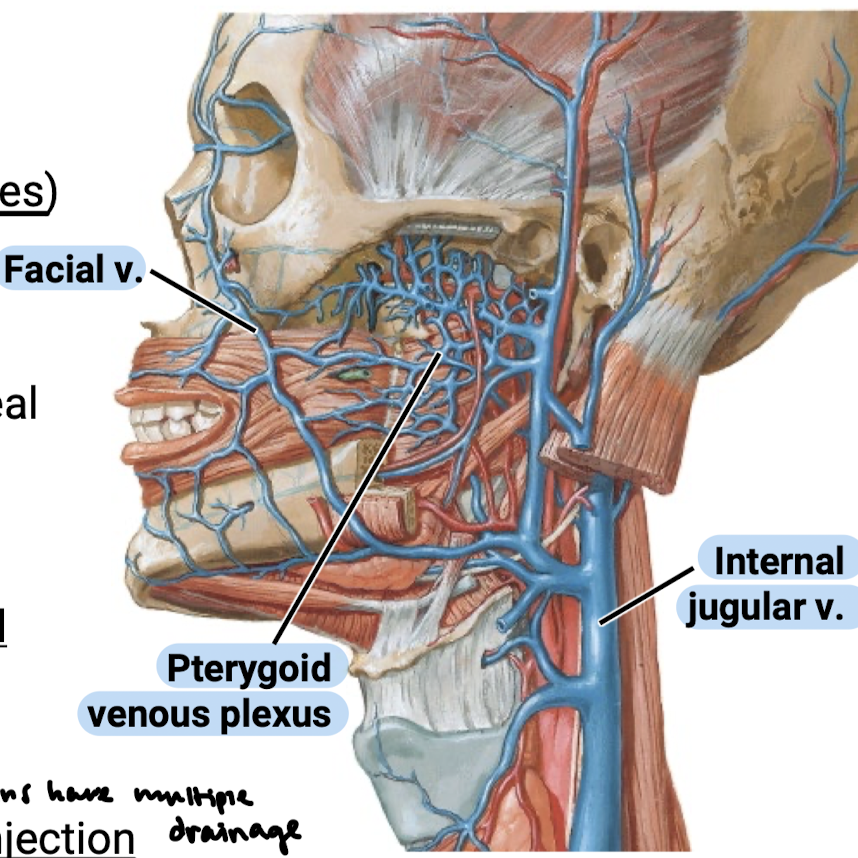
<ol><li><p>Blood/nutrient supply to the teeth</p></li><li><p>Spread of infection (especially so because veins have multiple drainage)</p></li><li><p>Vascular injury during anesthetic injection</p></li><li><p>Inadvertent intravascular injection of anesthetic</p></li></ol><p></p>
16
New cards

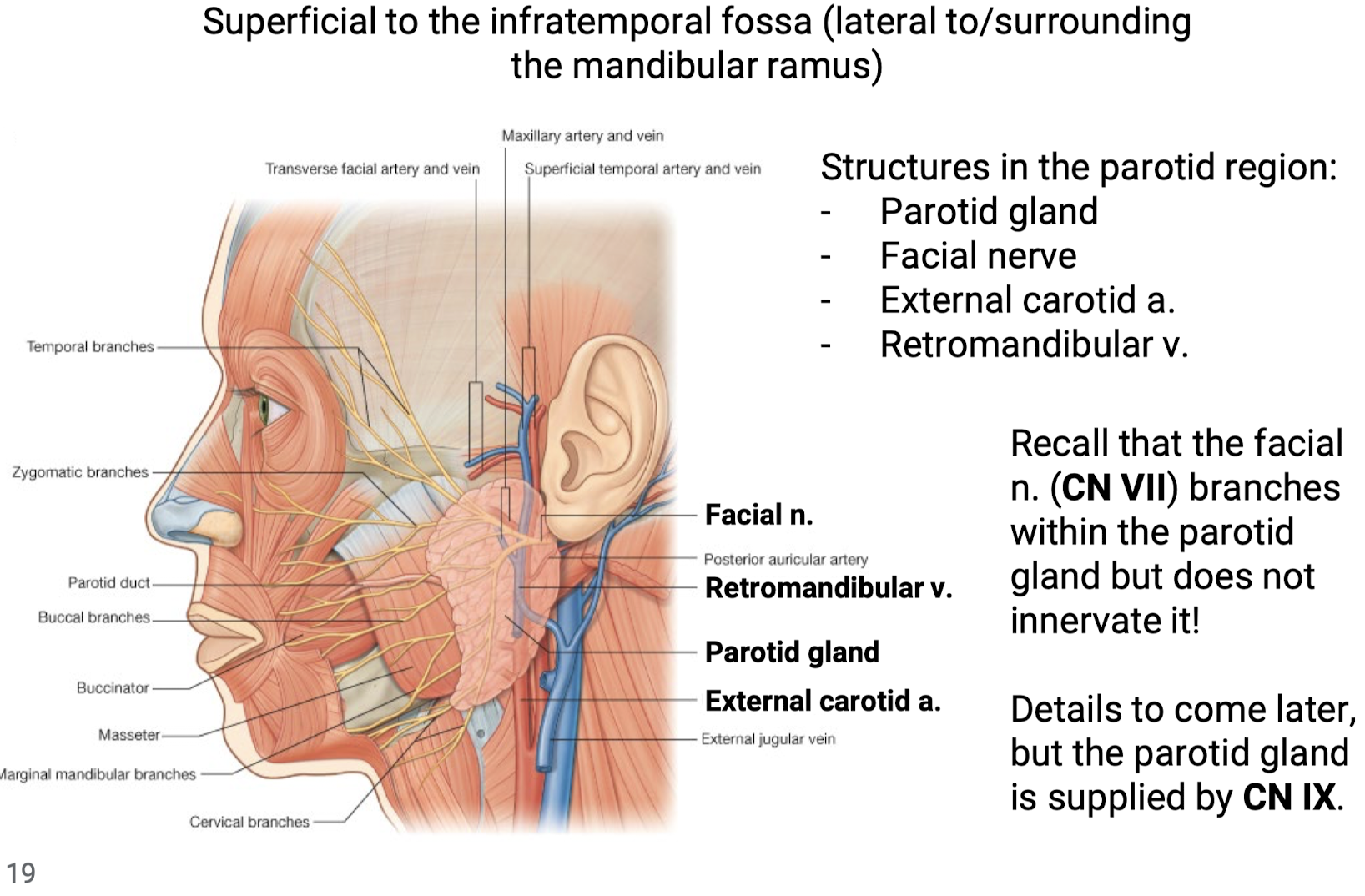
What is the parotid region? What are the structures found in the parotid region?

Superficial to the infratemporal fossa (lateral to/surrounding the mandibular ramus). Structures in the parotid region:

  • Parotid gland

  • Facial nerve (recall that the facial nerve does not innervate the parotid but branches within it)

  • External carotid a.

  • Retromandibular v.

<p>Superficial to the infratemporal fossa (lateral to/surrounding the mandibular ramus). Structures in the parotid region:</p><ul><li><p>Parotid gland</p></li><li><p>Facial nerve (recall that the facial nerve does not innervate the parotid but branches within it)</p></li><li><p>External carotid a.</p></li><li><p>Retromandibular v.</p></li></ul><p></p>
17
New cards

What are the primary secretions of the parotid gland? Explain the parasympathetics of the partoid gland.

Serous secretions. Stimulated by parasympathetics from CN IX (lesser petrosal n.) carrying the preganglionics with CN V3 carrying the postganglionics (auriculotemporal n.).
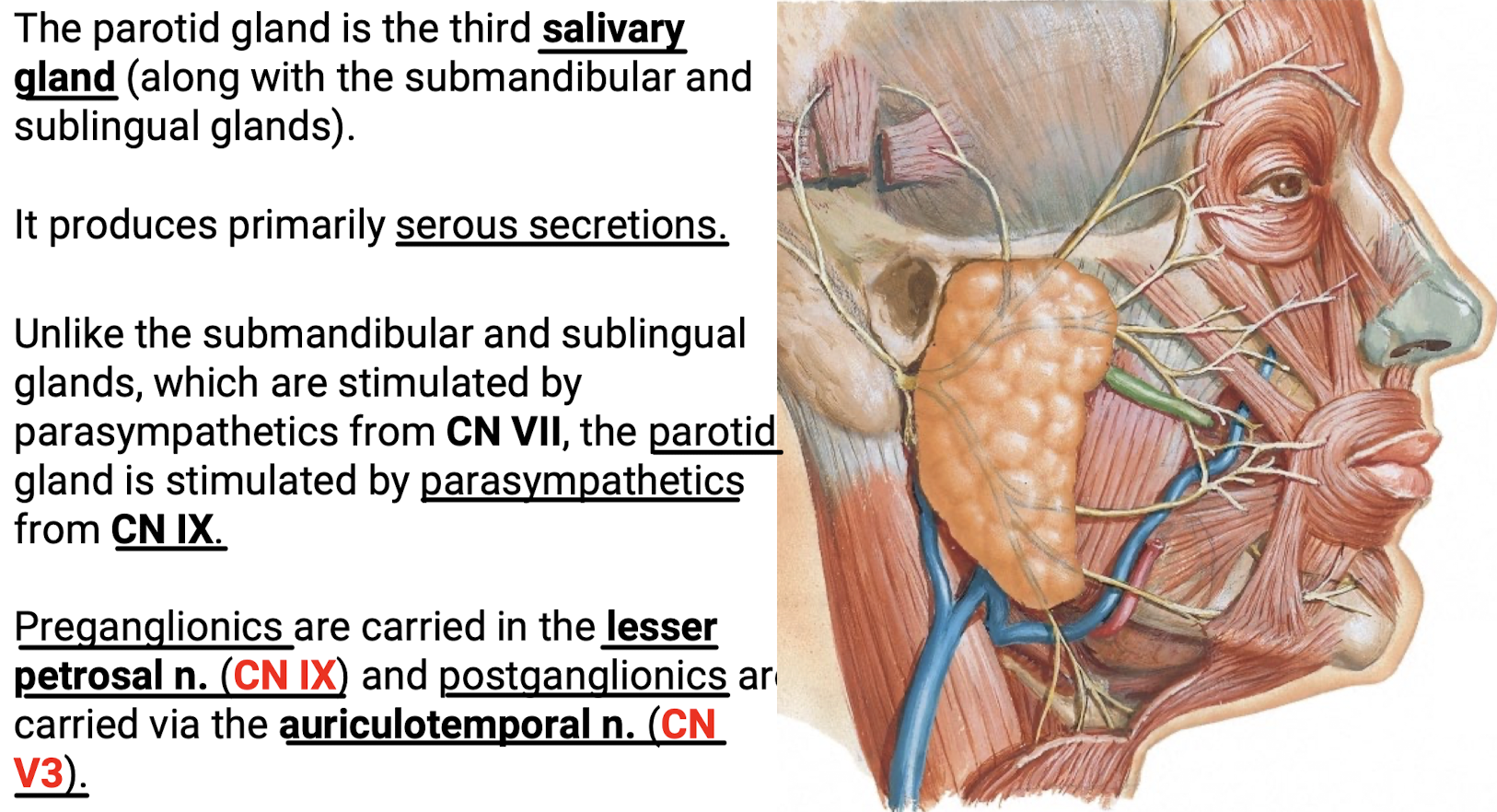
<p>Serous secretions. Stimulated by parasympathetics from CN IX (lesser petrosal n.) carrying the preganglionics with CN V3 carrying the postganglionics (auriculotemporal n.).</p>
18
New cards

Where does the parotid duct travel to enter the oral cavity? Where in the oral cavity does the parotid duct enter? What is the clinical significance?

It passes out of the parotid gland superficial to the masseter muscle. Then it dives down through the fibers of the buccinator muscle to enter the oral cavity. The parotid duct enters the oral cavity adjacent to the 2nd maxillary molar.

Clinical Significance: Poor oral hygiene can lead to infection spread through the duct to the parotid gland (e.g., mumps).
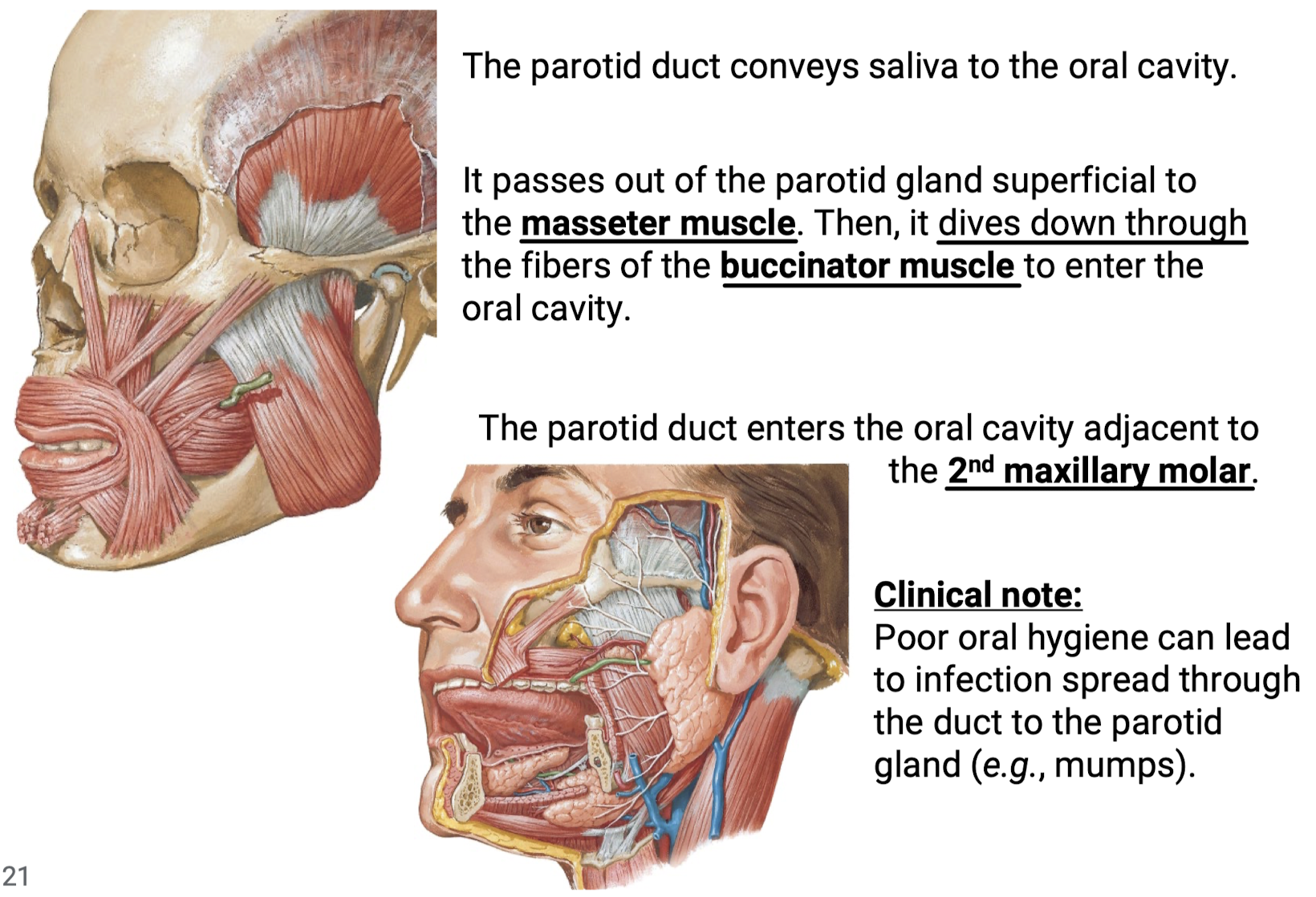
<p>It passes out of the parotid gland superficial to the masseter muscle. Then it dives down through the fibers of the buccinator muscle to enter the oral cavity. The parotid duct enters the oral cavity adjacent to the 2nd maxillary molar.</p><p>Clinical Significance: Poor oral hygiene can lead to infection spread through the duct to the parotid gland (e.g., mumps).</p>
19
New cards

What is important to remember about the parotid region with respect to the infratemporal region?

The parotid gland often wraps around the posterior mandible, meaning small portions of the gland are located in the infratemporal fossa. This has important implications when considering anesthetic injection because accidental injection of the parotid would lead to facial n. paralysis and no salivation from parotid.
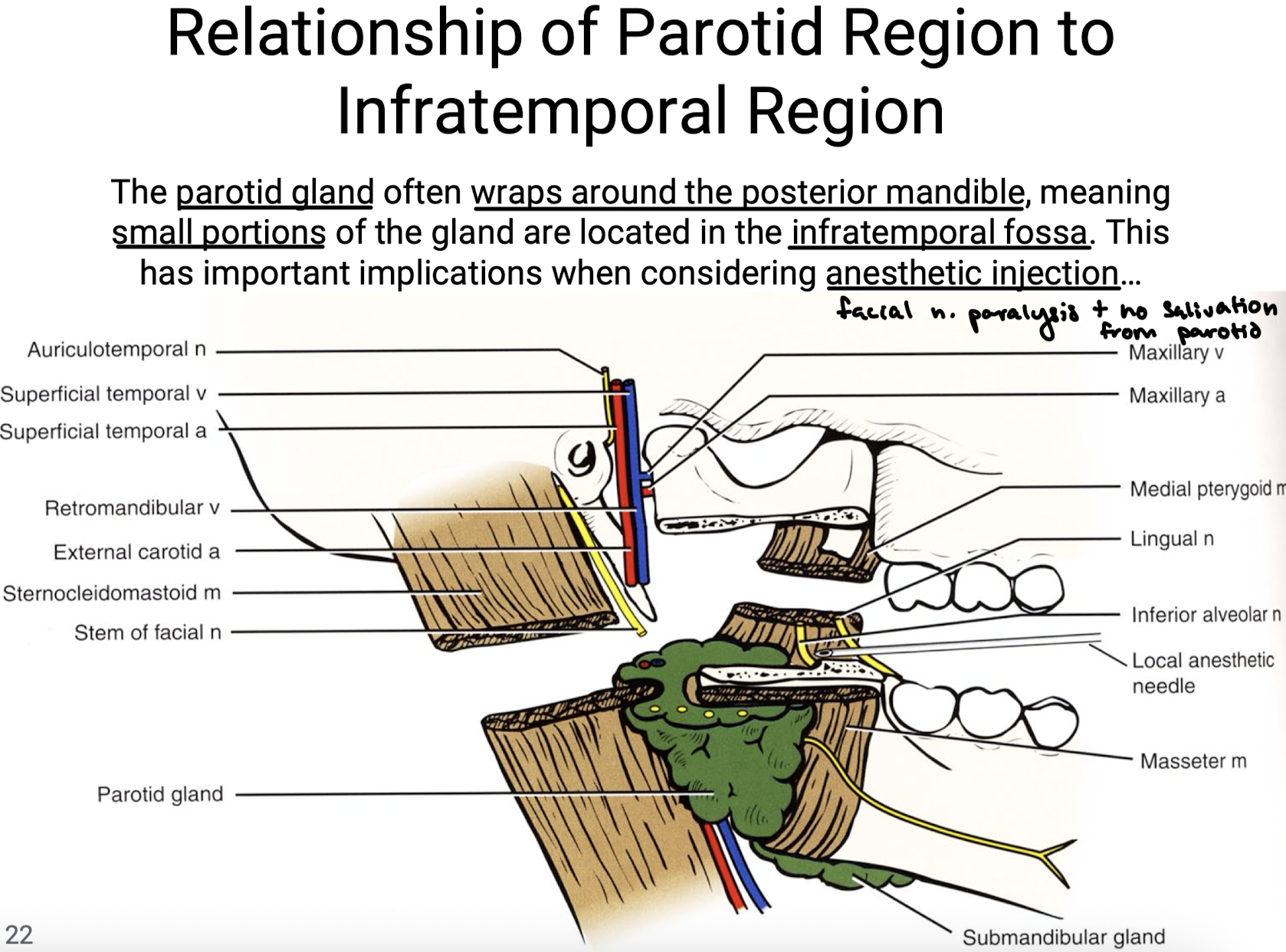
<p>The parotid gland often wraps around the posterior mandible, meaning small portions of the gland are located in the infratemporal fossa. This has important implications when considering anesthetic injection because accidental injection of the parotid would lead to facial n. paralysis and no salivation from parotid.</p>

Explore top notes

note
greece
Updated 1039d ago
0.0(0)
note
MAGMA SERIES
Updated 430d ago
0.0(0)
note
The congregations in Latin
Updated 1011d ago
0.0(0)
note
2.4: ions and ionic compounds
Updated 1257d ago
0.0(0)
note
CGO casus 6
Updated 428d ago
0.0(0)
note
greece
Updated 1039d ago
0.0(0)
note
MAGMA SERIES
Updated 430d ago
0.0(0)
note
The congregations in Latin
Updated 1011d ago
0.0(0)
note
2.4: ions and ionic compounds
Updated 1257d ago
0.0(0)
note
CGO casus 6
Updated 428d ago
0.0(0)

Explore top flashcards

flashcards
McWilliams ACT Vocabulary 1-50
50
Updated 1211d ago
0.0(0)
flashcards
Chapter 8 - Comp Gov.
21
Updated 862d ago
0.0(0)
flashcards
Honors Chemistry elements
57
Updated 197d ago
0.0(0)
flashcards
13 Colonies Test Prep 2025
41
Updated 99d ago
0.0(0)
flashcards
AP Chemistry Unit 2 Review
37
Updated 386d ago
0.0(0)
flashcards
MSKLEC_ TMJ
98
Updated 520d ago
0.0(0)
flashcards
McWilliams ACT Vocabulary 1-50
50
Updated 1211d ago
0.0(0)
flashcards
Chapter 8 - Comp Gov.
21
Updated 862d ago
0.0(0)
flashcards
Honors Chemistry elements
57
Updated 197d ago
0.0(0)
flashcards
13 Colonies Test Prep 2025
41
Updated 99d ago
0.0(0)
flashcards
AP Chemistry Unit 2 Review
37
Updated 386d ago
0.0(0)
flashcards
MSKLEC_ TMJ
98
Updated 520d ago
0.0(0)