511 Midterm 5.2 - Small Intestine->Anus + Accessory Organs
 Studied by 0 people
 Call Kai
 Learn
Learn Practice Test
 Spaced Repetition
 Match
Match Flashcards
 Knowt Play
1/24

There's no tags or description
Looks like no tags are added yet.
Name | Mastery | Learn | Test | Matching | Spaced | Call with Kai |
|---|
No analytics yet
Send a link to your students to track their progress
25 Terms
What are the 3 portions of the Small Intestine
Duodenum
Jejunum
Ilium
What 2 muscle movements does the small intestine utilize?
(Large intestine has an extra 2, what are they?)
Peristalsis —> propels chyme forward
Segmentation —> mix/slosh chyme like a gogurt tube
(Anti-peristalsis (reverse direction) and Mass Movement)
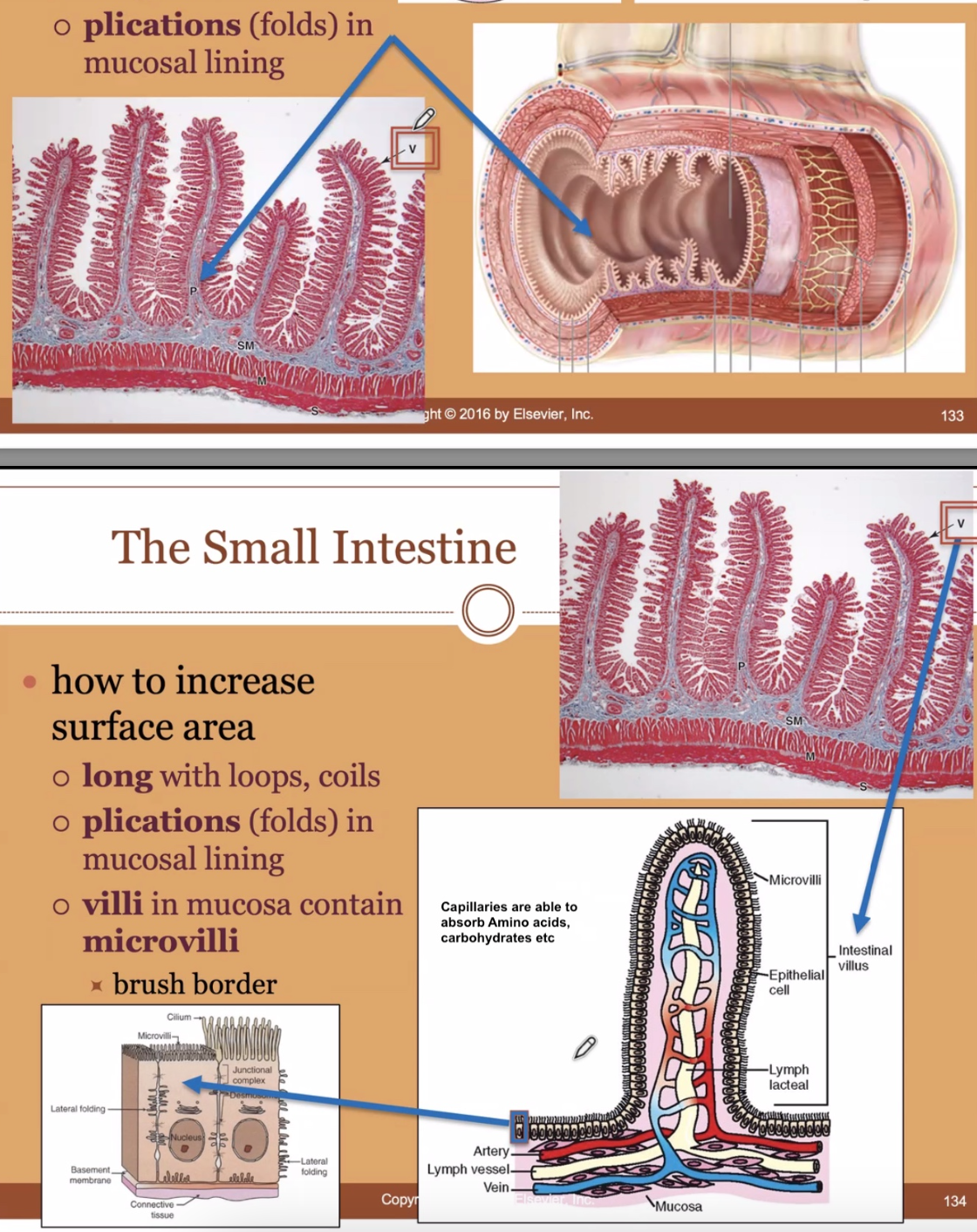
List the 4 ways in which the small intestin increases its surface area
Length - so long it has to loop/coil to fit in abdomen
Plications = folds/ridges in the mucosal lining (wall)
Villi = fingerling projections on the plications; contain microvilli
Microvilli = cells with their own fingerlike projections on the => Brush Border ; Simple columnar ET
What are the 4 portions of the Large Intestine
Cecum
Colon
Rectum
Anus
What are the functions of the Large Intestine? (2)
Absorption of water and ions
Completion of carbohydrate/protein microbial digestion and absorption
Note: this is where horses do all of their fermenting
How does the Cecum vary for:
Carnivores/non-herbivores
Ruminants
Horses/rabbits (non-ruminant/simple stomach herbivores)
Carnivores/non-herbivores —> inconspicuous, small, dead-end
Ruminants —> Large blind tube; still not the star of the show
Horses/rabbits —> HUGE ; Star of their show
Contains the microorganism for hind-gut fermenters
Not as efficient a system as ruminants b/c fermentation occurring after small intestine absorption
T/F - Colon is typically the largest portion of large intestine
True - For non-ruminant herbivores!
What is the function of the Rectum?
Storage of fecal matter
Stretch recepters indicate when full
What is the function of the Anus
Exit route for fecal matter
Controlled by 2 sphincters; inner = involuntary, outer = voluntary
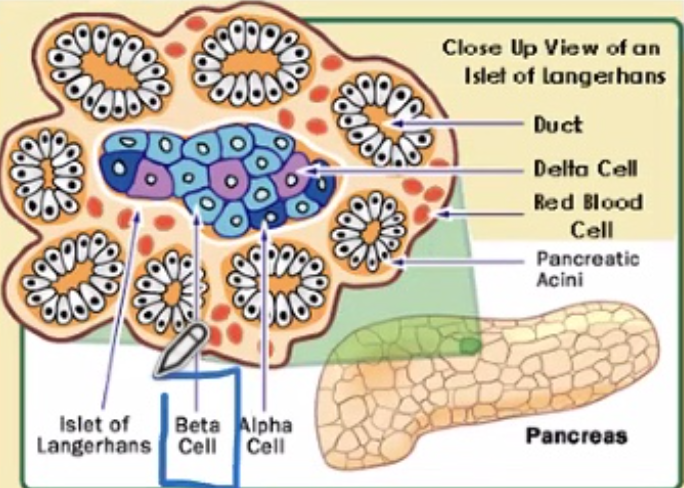
What are the 2 zones of the Pancreas?
Endocrine zone = Islets —> hormone production
Exocrine zone - Anici —> digestive enzyme production
Describe how the Islet zone of the Pancreas works
Each Islet contains serveral different cell types that each produce a different hormone
Ex: Beta cells produce Insulin; Alpha cells produce Glucagon
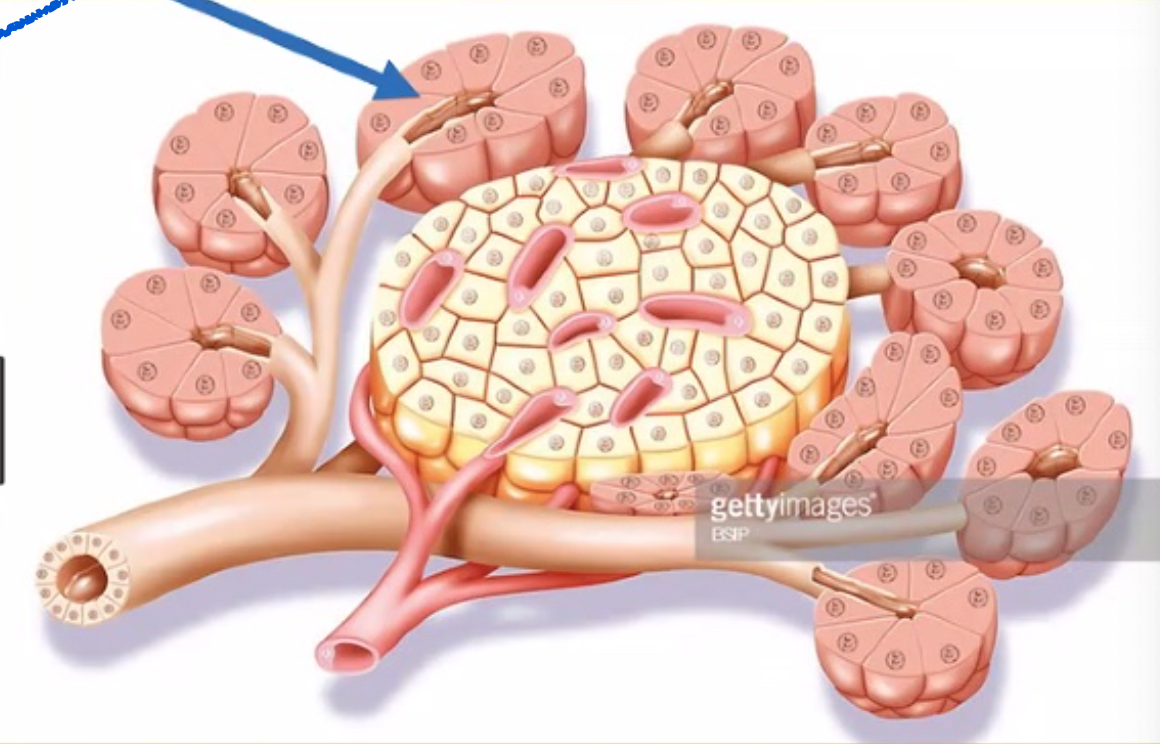
Describe how the Anici zone of the Pancreas works
Anici = outer bundles of cells
Exocrine produ
cts drain through ducts —> Pancreatic duct —> Duodenum
Secretion = Bicarbonate + Dig Proenzymes
The Liver has many functions, what does it contribute to the digestive system?
Processes blood leaving the GI tract —> prevents any toxic substances from entereing general circulation
Describe the physiology and anatomy of the Liver
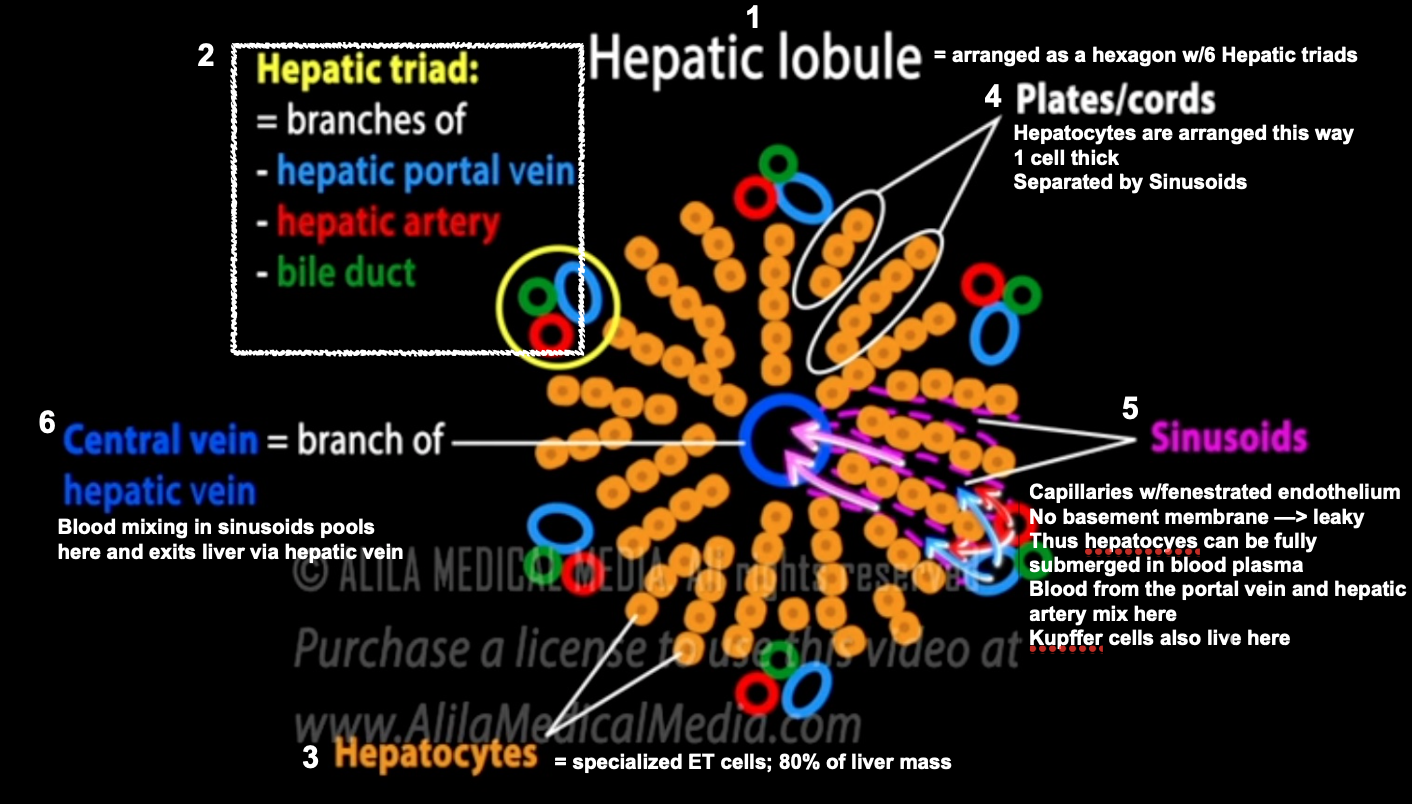
Hepatic Lobule
Portal Triad (list the 3)
Hepatocytes
Sinusoids
Kupffer cells
Hepatic Vein
Liver = colection of Hepatic lobules —> hexagonal crosssection
Each of the 6 points houses a Hepatic Triad = branch of Hepatic Portal Vein + Hepatic Artery + Bile Duct
Bulk of lobule mass = Hepatocytes (specialized ET)
Hepatocytes arrange into plates/cords 1 cell thick, separated by Sinusoids
Sinusoids = Capillaries w/fenestrated endothelium + No basement membrane —> leaky
Blood from the portal vein and hepatic artery mix here —> hepatocytes can be fully submerged in blood plasma
Kupffer cells also live here (immune defense)
Blood mixing in sinusoids pool here and ultimately exits via Hepatic Vein —> back to heart
How does bile flow differently than blood through the liver
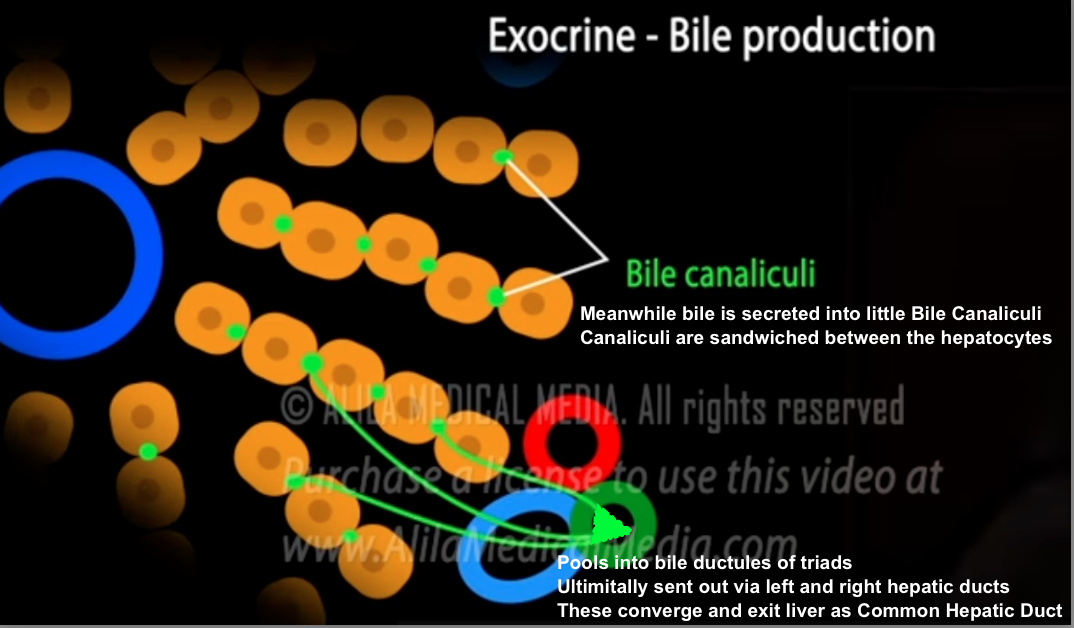
As blood is being secreted into the sinusoids, toxins/bile is being secreted into tiny Bile Canaliculi sandwiched between the hepatocytes
Contents drain opposite direction of blood, back towards Triad
Ultimately sent out via left and right hepatic ducts
These converge and exit liver as Common Hepatic Duct —> Gallbladder
Describe how the Liver has 2 Blood Supplies
Hepatic Artery = normal input from heart; oxygenated blood
Hepatic Portal Vein = extra input form GI tract; un-oxygenated blood
What is the function of the Gallbladder?
Concentrate and store Bile until its needed
CHEMICAL DIGESTION - STOMACH
In the mucosa of the Stomach tract, there are gastric pits filled with glandular cells.
In general, what types of products do these cells make?
Mucos —> protection
Acid —> optimize environment for stomach enzymes
Enzymes —> digestion
Hormones —> control center
Now list, more specifically, the 4 main cells involved and what they produce
Parietal Cells —> HCl
Chief Cells —> Pepsinogen —> Pepsin when activated by HCl
G Cells —> Gastrin —> further stimulates parietal cells —> more HCl
ECL cells —> Histamine —> w/Gastrin —> further stimulates parietal cells
What 3 substances stimulate Parietal Cells? to produce?
Acetylcholine (ACh)
Gastrin
Histamine
—> HCl
Which of those three substances also Activates Chief Cells?
Ach
What goes on during the Cephalic Phase of Digestive Secretion?
Triggered by anticipation of a meal; learned response
Nervous system releases ACh
Ach —> stimulation of Parietal + Chief + G cells —> HCl + Pepsinogen/pepsin + gastrin
Gastrin —> further stimulates parietal cells —> even more HCl
(Acidic enough environment eventually inhibits G cells)
hat goes on during the Gastric Phase of Digestive Secretion?
Begins when foot actually hits stomach
Stretching —> stimulation of Glandular Cells
Peptides —> stimulation of G cells
Together —> inc HCl production (pH can get as low as 2.0)
CHEMICAL DIGESTION - SMALL INTESTINE
Chyme enters duodenum —> secretion of Cholecystokinin (CCK) + Secretin
CCK
Inhibits gastric emptying (gives intestine a sec to work on whats already there)
Stimulates pancreatic (bicarb/enzymes) and bile secretions
Stimulates secretion of Enteropeptidase which activates the pancreatic enzymes
Secretin
Inhibition of HCl production in stomach
Stimulation of bicarb secretions from liver and pancreas
Want to neutralize acid environment for pancreatic enzymes
Pancreatic Enzymes are all secreted in their inactive form
What chemical activates them?
What are the active forms of:
Trypsinogen
Chymotrypsinogen
Procarboxypeptidase
CCK —> Enteropeptidase secretion —> Activation of enzymes
Trypsinogen —> Trypsin
Chymotrypsinogen —> Chymotrypsin
Procarboxypeptidase —> Carboxypeptidase
 Note
Note  Flashcards (20)