Speech Perception, Phonemes, and Sentence Parsing: Key Concepts in Linguistics
 Call Kai
 Learn
Learn Practice Test
 Spaced Repetition
 Match
Match Flashcards
 Knowt Play
1/62

There's no tags or description
Looks like no tags are added yet.
Name | Mastery | Learn | Test | Matching | Spaced | Call with Kai |
|---|
No analytics yet
Send a link to your students to track their progress
63 Terms
What is a phoneme?
The smallest unit of sound in a language that can change meaning.
The words “bat” and “pat” differ because of this
/b/ vs. /p/
What does language comprehension require?
The ability to interpret speech sounds (phonemes) and map them onto meaning.
What is the main problem in speech perception?
Speech sounds (phonemes) do not have stable acoustic forms.
What is perceptual invariance?
The ability to perceive phonemes as the same despite significant acoustic variation.
Example:
The /t/ sound in “top,” “stop,” and “water” sounds different in each word, but we still perceive all of them as the same /t/ phoneme.
What are three primary sources of acoustic variation in speech?
Different speakers (gender, dialect)
Same speaker over time (mood, emphasis)
Surrounding phonemes
How does the surrounding phoneme context (phoneme variation) affect pronunciation?
Nearby sounds influence each other (coarticulation), causing the same phoneme to be pronounced differently.
Example:
/t/ in “top” , “stop” , “water,” and “button” sounds different but is the same phoneme.
What does it mean that phonemes are a “flexible range of acoustics”?
A phoneme is not one exact sound but a range of similar sounds.
What is categorical perception?
When our brain makes us hear speech sounds as distinct categories rather than gradual changes.
Example:
We hear a sound as either /b/ or /p/, not something in between because they are in different categories.
In the model of comprehension, what happens when multiple phonemes are activated?
Everything on the same level competes for activation.
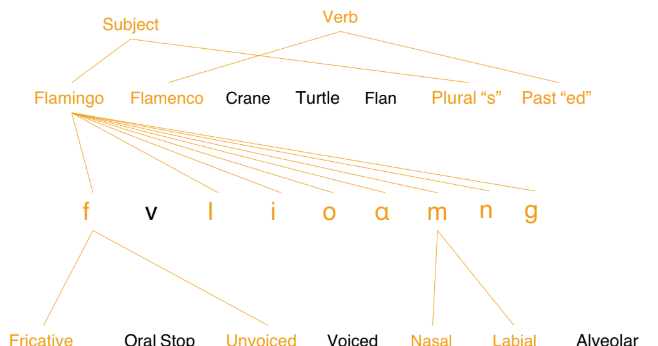
What is the relationship between features, phonemes, and words in comprehension?
Multiple possible words are activated and compete with each other; the brain selects the most likely word based on context and reduces the others.
Example:
When you hear “cap,” the sounds can briefly activate similar words like “cat” or “cab,” but context helps you settle on the correct word, “cap.”
What happens during phoneme processing?
Features activate phonemes
Phonemes activate features
Everything at the same level competes
What is phonological inhibition?
Difficulty recognizing a word when a similar-sounding word was heard before.
Example:
When hearing “cap,” words like “cat” and “cab” are activated but compete and get inhibited so the correct word is selected.
What is semantic priming?
Faster recognition of a word when preceded by a related word.
Example:
After hearing “doctor,” you recognize “nurse” more quickly.
Why is semantic priming considered faciliatory?
It makes the recognition of a word faster and easier because activation spreads to related concepts in the mental lexicon. *it helps with comprehension*
How is vocabulary organized in the brain?
By meaning (semantic networks).
What is spreading activation?
Activation spreads from one word to related words in a network.
What is activation threshold?
The level of activation needed for a word to be recognized.
What happens to activation over distance in a network?
It decays (weakens).
What makes a word harder to comprehend?
Similar-sounding previous words
Competing phonemes/words
What makes a word easier to comprehend?
Semantic context (related words)
Less competition
What is the primary purpose of eyetracking in linguistic experiments?
To track eye movements as a proxy for cognitive activation; where the eye focuses indicates which words are being accessed.
Yee and Sedivy (2006)
What did the Yee and Sedivy (2006) study demonstrate regarding semantic activation?
It showed that hearing a target word leads to the partial activation of semantically related words.
Eye-tracking with pictures.
Example: Hearing “lock” partially activates “key.” (people would look ay a key when hearing lock)
In the context of comprehension, what does 'competition' refer to?
The process where similar stimuli (phonemes or words) compete for selection during the recognition process.
Categorical Perception (competition w/ phonemes)
Phonological Inhibition (competition w/ words)
What are the steps of semantic priming?
A prime word is heard (e.g., “doctor”)
Related concepts are activated (e.g., “nurse”)
The related word is recognized faster due to this activation
How does mood or emphasis affect speech acoustics?
They cause the same speaker to pronounce the same phonemes differently at different times.
True or False: Phonemes have stable acoustic forms.
False; they represent a flexible range of acoustics.
What is the difference between phonological inhibition and semantic priming?
Phonological inhibition hinders comprehension due to sound similarity, while semantic priming facilitates it due to meaning association.
What does the 'Initial Contact' stage of comprehending phonemes involve?
The activation of sound features based on incoming auditory stimuli.
How do dialects and gender influence speech perception?
They contribute to acoustic variation, requiring the listener to normalize these differences to identify the same phoneme.
What is the result of 'competition' in the word recognition model?
Only one word or phoneme is eventually selected, while the others are suppressed.
In the Yee and Sedivy (2006) study, what did the 'control' condition represent?
A baseline to compare eye movements toward semantically unrelated words versus related ones.
What does an eyetracking experiment measure in language comprehension?
Eye movements, which indicate the level of activation of specific words or concepts.
What are the three levels of comprehension required to understand a sentence?
Phonemes, words, and sentences.
Why do phonemes present an ambiguity problem in speech perception?
They lack stable acoustic forms due to variations in speakers, context, and mood.
How does categorical perception help resolve acoustic ambiguity?
Even if a sound is ambiguous, your brain decides “it’s /b/ or /p/,” which makes it easier to understand speech.
In the model of phoneme comprehension, what happens when sound features are activated?
Features activate phonemes, and everything on the same level competes for selection.
What is sentence parsing?
the process of figuring out the grammatical/ syntactic structure of a sentence to understand its meaning.
What is the primary challenge in sentence parsing?
Resolving ambiguous relationships between words in a sentence (multiple possible meanings).
What is lexical access?
The process by which activated phonemes lead to the retrieval of words from the mental lexicon.
What are the two main models of sentence parsing?
Constraint-Based Model
Garden Path Model
What is the Constraint-Based Model?
Generates multiple possible structures
Uses context and likelihood to choose the best one
What is the core assumption (Constraints) of the Constraint-Based Model of parsing?
We use context and multiple constraints (like frequency and meaning) to evaluate all possible syntactic structures simultaneously.
What type of processing does the Constraint-Based Model use?
Top-down processing.
What is the Garden Path Model?
Builds one simple structure first
Revises it later if it turns out to be wrong
What is the core assumption of the Garden Path Model of parsing?
We initially generate only the simplest syntactic structure and reanalyze it only if it fails to fit the context.
What are 'Garden Path' sentences?
Sentences that are locally ambiguous, leading the reader toward an initial incorrect interpretation.
Example of a garden path sentence?
“The horse raced past the barn fell.”
How do researchers use slowdowns in reading to test parsing models?
Slowdowns indicate processing difficulty or errors, helping to determine if a reader is reanalyzing a structure.
What did Ferreira & Clifton (1986) find?
People experience slowdowns even when sentences are implausible, supporting Garden Path processing.
Eye-tracking while reading
What did Trueswell & Tanenhaus (1994) find?
Context can prevent garden path errors, supporting the Constraint-Based Model.
Eye-tracking while reading.
What is a semantic substitution error in speech production?
Replacing an intended word with a semantically (meaning) related one (e.g., 'cow' instead of 'horse').
Example: Saying “I drank some juice” instead of “I drank some water.”
What is a phonological substitution error in speech production?
Replacing an intended word with one that sounds similar (e.g., 'hoard' instead of 'horse').
What do substitution errors reveal about vocabulary organization?
Vocabulary is organized by both meaning and sound.
What are the four steps in the production model?
Decide the message
Access words
Build sentence frame
Insert words
At what stage of production do semantic and phonological substitutions occur?
During the word access stage.
Why do we not make errors with grammar words in speech production?
Grammar words are part of the sentence frame, which is generated separately from lexical word access.
grammar structure is usually preserved.
What constraint must be met when substituting a word in a sentence frame?
The substituted word must preserve the original syntactic category.
How do linguists test models of the mind?
By making hypotheses, creating models, and testing if those models predict observed behaviors and errors.
In other words:
Experimental results
Patterns of errors
What is the role of 'Top-Down Processing' in the Constraint-Based Model?
It favors the syntactic structure most likely to be correct based on context and prior knowledge.
What is 'Reanalysis' in the context of the Garden Path Model?
The process of fixing a syntactic structure when the initial, simplest interpretation is incorrect.
What is the primary difference between the Constraint-Based and Garden Path models?
Constraint-Based models evaluate all structures simultaneously, while Garden Path models evaluate one structure at a time.
How does the activation threshold affect semantic priming?
Activation spreads between associated words and decays over distance/time.
What does the 'Initial Contact' phase represent in phoneme comprehension?
The moment sound features are activated, which then trigger phoneme competition.

