ALL ECONOMICS
 Call Kai
 Learn
Learn Practice Test
 Spaced Repetition
 Match
Match Flashcards
 Knowt Play
1/531

There's no tags or description
Looks like no tags are added yet.
Name | Mastery | Learn | Test | Matching | Spaced | Call with Kai |
|---|
No analytics yet
Send a link to your students to track their progress
532 Terms
What is the Gini coefficient formula?
The area of A above the curve divided by A add B the area below the curve
What is wealth?
The stock of a person’s assets
What is income inequality?
Where the best paid workers recieve higher wages than the rest of the workforce
What is allocative efficency?
Where MC equals AR
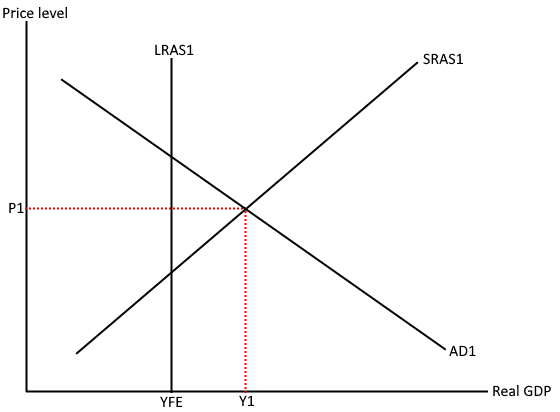
What is a positive output gap and what are the two ways it is shown?
When actual GDP exceeds potential GDP, causing high inflationary pressure and occurs as in the short run workers can do overtime.
Shown by image attached and during a trade cycle when actual growth exceeds trend growth
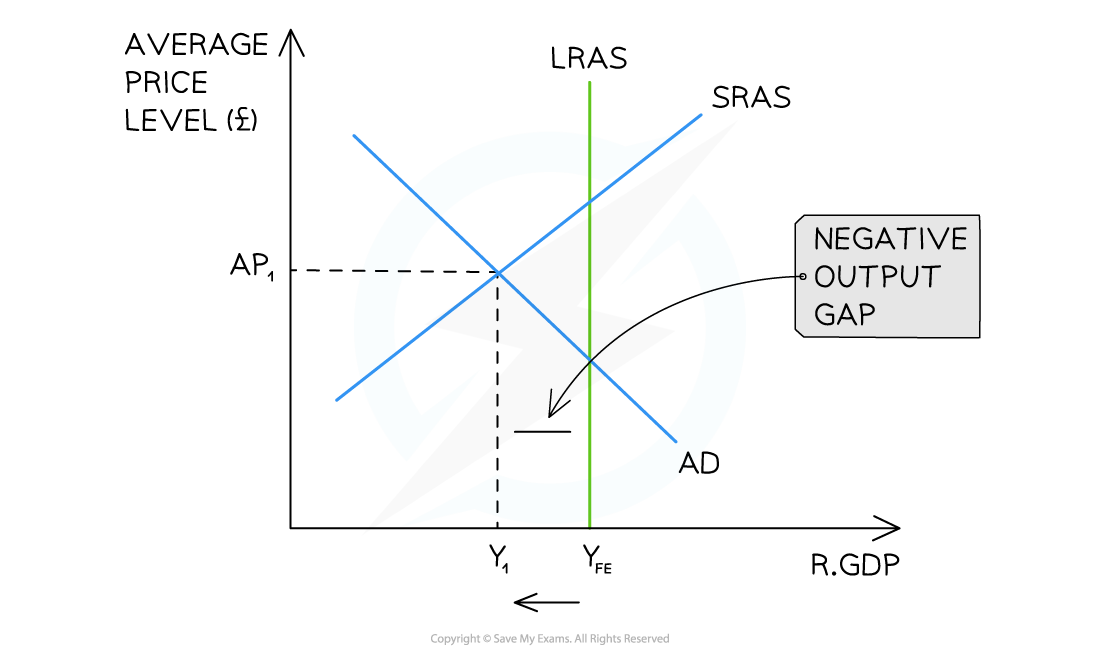
Define a negative output gap and what are the two ways it is shown?
When actual GDP is less than potential GDP, this indicates a recessionary gap with high unemployment and low inflation due to resources being underutilised as the economy operates at spare capacity.
Also shown when actual growth is below trend growth on a trade cycle diagram.
What are information gaps?
A cause of government failure
Where the government lacks the necessary information needed to intervene most efficiently in a market such as not knowing the exact size of a carbon tax to implement.
What do XED scores tell you?
Positive XED shows that the goods are substitutes
Zero XED means the goods are unrelated
Negative XED shows that the goods are complementary
How to draw third party price discrimination?
Three cost and revenues diagram
One horizontal MC curve across all three diagrams and no AC curve.
Then draw on AR and MR with inelastic demand for this market and draw another AR and MR with price elastic demand for this market and show the separate supernormal profits for both
After this draw a costs and revenue diagram for the overall market with balanced price elasticity of demand and show how supernormal profit is higher for the combined elastic and inelastic market than just the overall market
This is because producer surplus is higher and more consumer surplus is exploited
Define the balance of payments?
A framework that records all the transactions and payments between one country and the rest of the world
What is the equation of the multiplier ratio?
1 divided by 1-MPC and 1 divided by MPW
This is because 1-MPC equals the MPW
What is the equation for the marginal propensity to withdraw?
MPT+MPS+MPI
Taxes, Savings and Imports
What are the reasons for consumers making irrational decisions?
Weakness at computation (Consumers struggle to deal with probabilities and offers such as what actually most benefits them)
Habitual behaviour (where consumers continually do something as they are in the habit of doing it)
Herd behaviour (consumers make decisions in alignment with the vast majority of others)
How do you calculate the HDI from the three factors it uses?
Cube root education index times health index times living standards index
The three indices are between 0 and 1
How do you calculate the real exchange rate?
Nominal Exchange Rate times the Domestic Price level divided by the Foreign Price Level
What is sales maximisation on a costs and revenue diagram?
Where AC=AR
How to draw price discrimination?
MR is constant and a horizontal line across all three diagrams
One elastic market
One inelastic market
One overall market with kinked demand curve
What is the acronym showing how TEASS is determined?
Time/ How long does it take to produce as when demand increases there could be a time lag in the production of a good and in the long run its elastic
State of the economy/ In a recession PES is more elastic and in a boom PES is more inelastic. This is because factories can more easily increase production during a recession at lower costs and easier to access labour if unemployment is higher.
Availability of Factors/ How easy is it to find the factors to produce a good? If they are more readily available like plastic supply will be more elastic but not rare raw materials.
Spare Capacity/ Do firms have spare resources? As if firms have more spare capacity they can more easily expand and increase production.
Stockpiles and Perishability/ Is it perishable? If firms can stockpile a good then they can quickly sell stockpiled goods when demand increases
How do you implement chains of reasoning in questions and how would you do this for the impact of earthquakes from fracking for example?
Minor earthquakes from fracking will lead to disturbances for local people in their sleep and could cause minor property damage for example
This will cause people to leave the area over time and could lead to people not buying these houses due to concerns over fracking
Thus the profit for local firms will decrease and there will be less demand for the goods produced by these firms and their profits could fall
This means they may go bankrupt and unemployment could rise in the local area leading to more poverty
This would lead to a significant negative consequences and may require government intervention
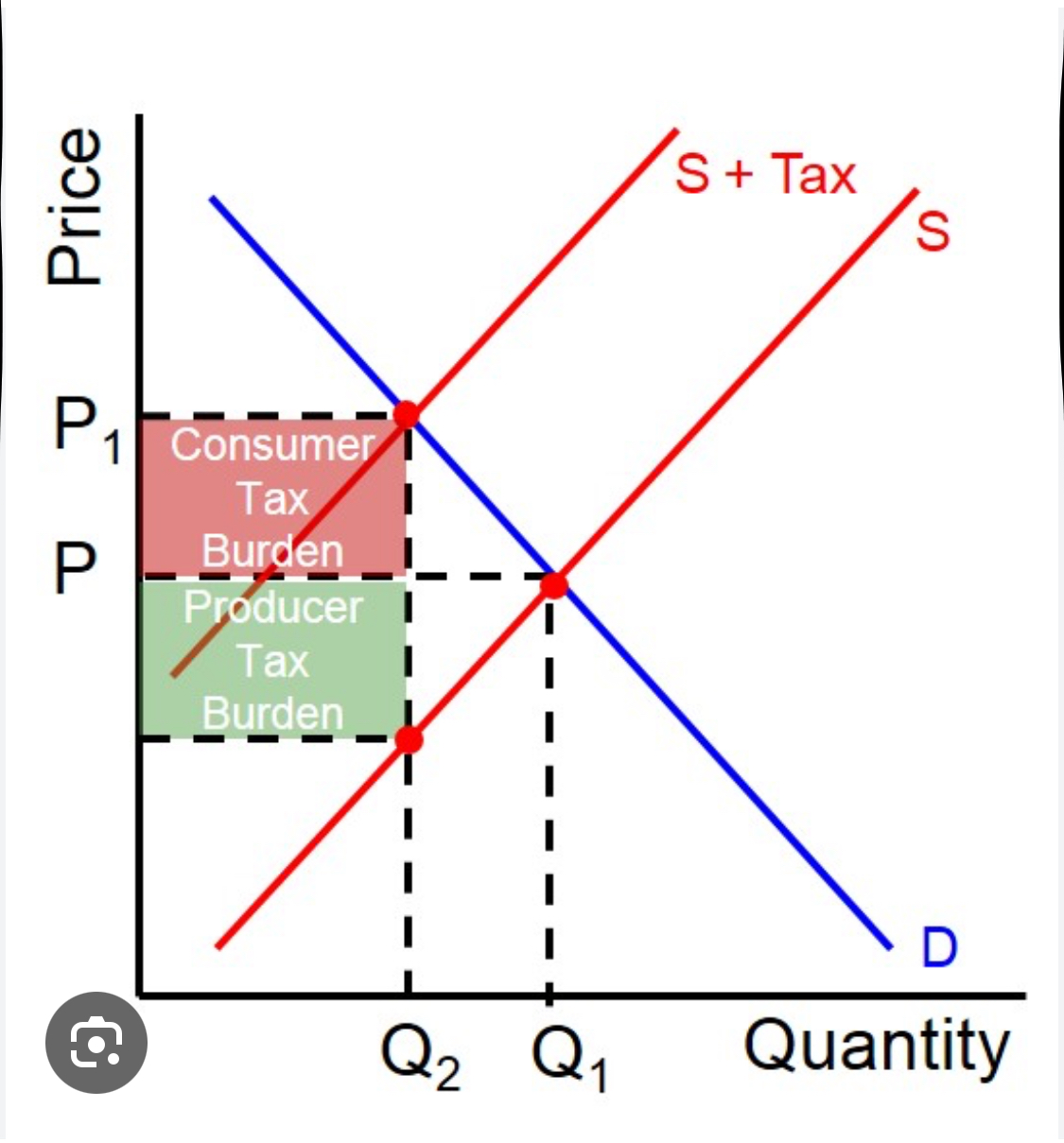
How do you show the incidence of tax on a diagram and how do you identify who is impacted by tax and removal of tax?
This diagram shows the impact and how you find the equilibrium without tax go across to the price axis and anything above this is the producer burden and anything below this is the consumer burden
Define irrational behaviour?
Where consumers act in any way thay does not maximise their own utility and leads to a lower utility for them such as staying with an energy provider which charges then higher prices due to habitual behaviour
What are the steps for the labour force survey to measure the unemployment rate vs the claimant count?
The claimant count is the number of people claiming job seekers allowance as a percentage of the population
The International Labour Force Survey 80,000 households across the United Kingdom which starts with a face to face interview then a series of interviews every quarter where they ask whether anyone in the household has been out of work for 4 weeks and is ready to start work in the next 2 weeks. Using this data they estimate the number and percentage of people unemployed across the whole of the UK.
Define unemployment?
When someone is ready to work and actively seeking employment, but they are not actively employed
How can interventionist supply side policy hinder aggregate demand?
In order to fund large projects like HS2 governments must borrow from the financial sector with around 50 billion borrowed
Thus the demand for borrowed money is higher so banks can choose to charge a higher interest rate to ration what they have available
Thus the cost of investing through borrowing for firms has increased so investment may decrease leading to aggregate demand being hindered
What is an output gap and what is positive/negative?
An output gap is the difference between actual level of output and the maximum potential level of output
A negative output gap is where the actual level of output is less than the maximum potential level of output
A positive output gap is where the actual level of output is more than the maximum potential level of output caused by workers working overtime
What happened to the fiscal deficit in 2009 in the US and why?
It increased
Tax revenue fell as firms made less profit
Also the Obama American Recovery and Reinvestment act increased public expenditure by $787 billion
What is the significance of the US national debt and evaluate?
Taxes may have to rise or public expenditure may have to fall
May have a negative impact on FDI
Also increased risk of financial crowding out as borrowing increases.
However tax cuts for example can generate economic growth which may move the US back to a fiscal surplus
Crowding out is unlikely as the cost of government borrowing is near 0 due to the level of extremely low perceived risk
Laffer curve where tax cuts may increase tax revenue so the negative impacts of having to raise tax could be less significant than expected
What are the impacts of tax cuts on inequality, points for and evaluations against?
Points/ Depends on what tax brackets see cuts and the extent of the cuts seen
A progressive tax system will still work to reduce inequality
The laffer curve shows a reduction in tax rates could increase tax revenue for spending on welfare programmes for example
Jobs can be created as firms profits rise
Evaluations/ Corporation tax cuts cause incomes for shareholders who tend to be well off to rise significantly
Jobs creation is often limited
Depends on how long the tax rates last
Depends on what type of inequality such as wealth or income or race.
What are two points around how tax cuts will increase international competitiveness and two evaluations?
One point for is that lower corporation tax will increase firms profits so they will have more to invest which will shift LRAS outwards and improve the human capital and their machinery. This means that productivity will increase and costs will fall so international competitiveness will be higher.
One evaluation to this however is that many other factors also influence the rate which firms invest at such as the cost of borrowing, the availability of credit and level of regulation
Another point is that cutting income tax rates may incentivise work and increase the labour supply, which would lead to lower wage rates decreasing firms costs and boosting international price competitiveness
One evaluation to this however is that minimum wages can prevent this. Also other countries like Ireland have lower corporation tax rates so the size at which investment increases could be lower.
Pros and Cons of a National Maximum Wage
Pros are the government can reduce spending on workers such as how Mark Carney was paid £800,000 a year as the governor for the Bank of England in the past and he could be paid less. Thus more government tax revenue can be spent on reducing poverty for example which will decrease inequality.
It also reduces the cost of workers for firms so AC and MC will decrease which will make firms more profitable also as wage costs are lower for high income individuals it will reduce wage inflation and real incomes of lower paid workers will be higher
Also caps like Jeremy Corbyns idea of CEOs earning twenty times more than their lowest paid workers does incentives firm to pay workers more and reduce inequality
However the cons are it leads to excess demand of labour as firms want to demand the labour of the high income individuals who are now less willing to offer it which will decrease tax revenue especially when the top 1% of earners pay 26% of total tax which can be spent on reducing inequality
Also it may lead to a flight of high income individuals to other countries which will also take businesses with them and relocate causing unemployment in the country to rise and tax revenue to further decrease. Also it causes high income individuals to be encouraged to evade tax such as being paid through non work perks and bonuses
Furthermore it can cause firms to have to hire less productive workers as the most productive and highly skilled ones leave which will reduce efficiency for firms and could offset any decrease in costs and lead to lower profits.
Go to points and evaluations for substitutes
Points/ Talk about how they have a negative XED and how they both perform similar functions or are used to satisfy similar needs so when the price of one of the goods decreases the quantity demanded of the other also decreases.
Evaluation/ Talk about the strength of substitutes and how they may be weak substitutes with XED closer to 0. This is because like natural gas and oil they do similar things yet for example the use of oil in cars cannot be easily substituted
Basic economic problem
Finite resources, infinite wants and needs.
Opportunity cost
The value of the next best alternative foregone.
Production possibility frontier
The maximum potential output of an economy, given that all factors of production are fully utilized.
Free market economy
Resource allocation determined by supply and demand with minimal government intervention.
Command economy
The government makes all decisions about resource allocation.
Demand
The quantity of a good or service consumers are willing and able to buy at any given price.
Supply
The quantity of a good or service that producers are willing and able to sell at any given price.
Price elasticity of demand (PED)
The responsiveness of quantity demanded to a change in price.
Price elasticity of supply (PES)
The responsiveness of quantity supplied to a change in price.
Cross-price elasticity of demand
The responsiveness of the quantity demanded of one good to changes in the price of another.
Income elasticity of demand
The responsiveness of quantity demanded to a change in income.
Indirect tax
A tax on spending that increases the costs of production.
Subsidy
A government grant to firms that reduces costs and encourages production.
Information gap
A market failure where consumers or producers lack sufficient information to make rational decisions.
Public good
A good that is non-excludable and non-rivalrous.
External cost
A negative impact on third parties ignored by the price mechanism.
External benefit
A positive impact on third parties ignored by the price mechanism.
Market failure
When the price mechanism fails to allocate resources efficiently, leading to a net welfare loss.
Consumer surplus
The difference between what consumers are willing to pay and what they actually pay.
Producer surplus
The difference between the price producers are willing to accept and the price they actually receive.
Minimum price
A price floor set by the government, above equilibrium, to prevent prices from falling too low.
Maximum price
A price ceiling set by the government, below equilibrium, to prevent prices from rising too high.
Regulation
Government rules and laws that control market activities to correct market failure.
Provision of information
Government intervention to provide consumers with accurate data to help them make informed choices.
Government intervention
Actions by the government to correct market failures.
short-run economic growth
An increase in real GDP of an economy.
long-run economic growth
An increase in the productive capacity of an economy.
unemployment
The number of people who are willing and able to work, actively seeking work, but do not have a job.
cyclical unemployment
Unemployment caused by a lack of aggregate demand in the economy, often during a recession.
structural unemployment
Unemployment due to a mismatch between workers' skills and available jobs, often caused by technological change.
frictional unemployment
Short-term unemployment when workers are between jobs or entering the workforce.
real GDP
The total value of all goods and services produced in a country over a given period, adjusted for inflation.
trade deficit
When the value of imports exceeds the value of exports on the current account of the balance of payments.
budget deficit
When government spending exceeds tax revenue in a given time period.
national debt
The total accumulated borrowing of a government over time.
fiscal policy
The use of government spending, taxation, and borrowing to influence aggregate demand.
monetary policy
The use of interest rates, the money supply, and quantitative easing by the central bank to influence aggregate demand.
supply-side policy
Policies aimed at increasing the productive capacity of the economy by improving the quantity and quality of factors of production.
aggregate demand
The total demand for goods and services in an economy at a given price level in a given period.
aggregate supply
The total output of goods and services that producers in an economy are willing and able to supply at a given price level.
inflation
The sustained increase in the general price level and fall in purchasing power of money.
demand-pull inflation
Inflation caused by rising aggregate demand in the economy.
cost-push inflation
Inflation caused by rising costs of production.
recession
A fall in real GDP for two consecutive quarters.
purchasing power parity
The rate at which one country's currency must be converted into that of another country to buy the same amount of goods and services in each country.
marginal propensity to consume
The proportion of additional income that consumers spend on domestically produced goods and services.
current account
A section of the balance of payments that records trade in goods and services, income, and transfers.
multiplier effect
The process where an initial increase in spending leads to a larger overall increase in national income.
What is an output gap?
The difference between Real GDP and potential Real GDP
What is net transfers?
Net transfers are the sum of payments made and received with no good or service in exchange.
What is disinflation?
Disinflation is when the rate of inflation is increasing at a decreasing rate
What is potential growth?
The potential growth of the economy is defined as an increase in the productive potential of the economy.
What is the European Union?
A customs union including 27 countries.
What is the European Single Market?
A common market that includes 31 countries
What is the Eurozone?
A monetary union that includes 20 countries.
What is an example of a free market area?
The USMCA (United States-Mexico-Canada Agreement)
What is a monetary union?
Where all members remove trade barriers between themselves, have a common external tariff on non-member countries, allow the free movement of factors of production and share a common currency.
What is a customs union?
Where all member countries remove trade barriers between themselves and agree upon common external tariffs on non-member countries.
What is a common market?
Where countries agree to remove trade barriers between themselves, agree upon common external tariffs on non members and allow the free movement of factors of production.
What is a free trade area?
Where countries agree to remove tariffs between themselves and have differing tariffs on non-members of their own choice.
What are expenditure switiching policies?
Policies that aim to switich consumer demand from imports to domestic goods such as the use of lowering interest rates to depreciate the currency and improving the current account.
What are expenditure reducing polcies?
Where income tax is increased to reduce people’s disposable income and overall expenditure. Meaning they will import less and import expendtiure will go down which will improve the current account.

