Mitochondrial DNA
 Call Kai
 Learn
Learn Practice Test
 Spaced Repetition
 Match
Match Flashcards
 Knowt Play
1/11

There's no tags or description
Looks like no tags are added yet.
Name | Mastery | Learn | Test | Matching | Spaced | Call with Kai |
|---|
No analytics yet
Send a link to your students to track their progress
12 Terms
Mitochondria
-eukaryotic organelle that synthesis chemical energy via aerobic repiration (op% of cell’s ATP)
Double Membrane
Composed of outer membrane and a highly folded inner membrane (cristae)
Mitochondrial Matrix
The central fluid-filled space containing enzymes, ribosomes, and their own mitochondrial DNA (mtDNA)
Dynamics
Mitochondria are very dynamic, constantly changing shape, dividing, and fusing together
-depends on demand of the cell
Mitochondria energy production
-Tricarboxylic Acid cycle (TCA), Krebs cycle
-makes ATP
-Electron transport chain: key to energy generation, O2 is required
Mitochondrial ROS/Apoptosis
-is the main source of reactive oxygen species
-Mitochondria can initiate cell death
Mitochondrial DNA (mtDNA)
-mtDNA contains 16569 bp
-Encodes 37 genes:
13 gene coded for proteins all to ETC
2 genes for rRNA
22 genes for transfer RNA (tRNA)
-Transcription in controlled by nDNA
mtDNA promoter area
-Mitochondrial has only one promoter area, the D-loop
-nucleus encoded proteins control mtDNA transcription and replication
-Mitochondrial transcription factor A (TFAM) and DNA polymerase gamma (POLG) control transcription and replication
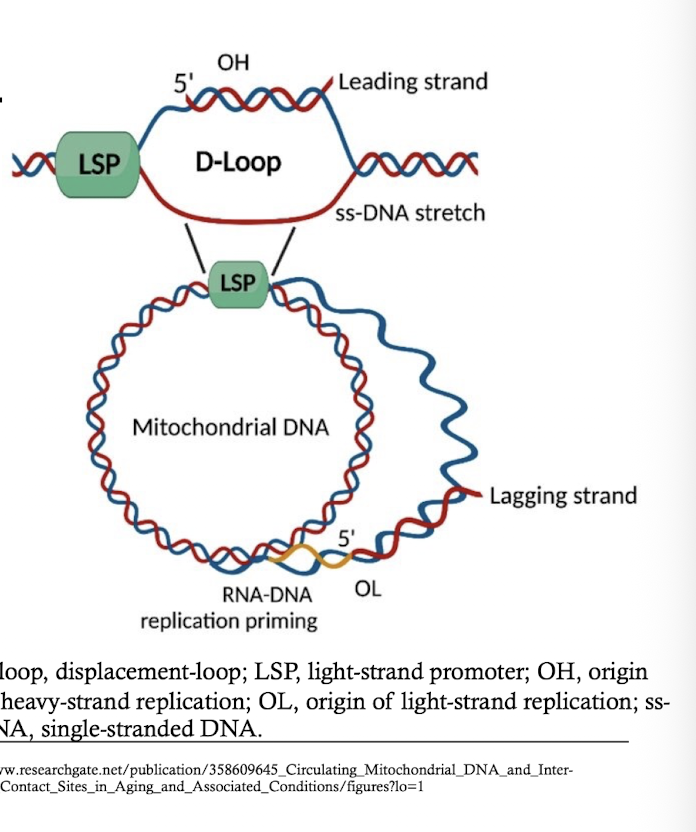
mtDNA replication/transcription
-For mtDNA stop codons are AGA, AAG
-UGA codes for tryptophan
-Initiation codon for AUA
-mtDNA transcripts all genes each time
Mitochondrial DNA inherited
-Nuclear DNA is inherited from all ancestors
-Mitochondrial DNA i inherited from a single lineage
Mitochondria DNA repais
-mtDNA: relying on nuclear-encoded enzymes to repair damage
-Base excision repair (BER): the primary pathway for oxidative lesions
-8-oxoguanine DNA glycosylase-1 (OGG1): removes 7,8-dihydro-8-oxoguanine (8-oxoG), a common oxidative DNA lesion caused by high ROS in mitochondria
-Single strand break repair (SSBR) mismatch repair (MMR)
mtDNA damage
mtDNA is more prone to damage than nuclear DNA (nDNA) primarily due to:
-its close proximity to reactive oxygen species (ROS) produced during oxidative phophorylation
-lack of protective histones
-limited repair mechanisms compared to nDNA
-any problem in chaperon protein or repair mechanism will affect mitochondrial DNA

