M6 Poole- Prokaryotic genomes and cell division
 Studied by 0 people
 Call with Kai
 Learn
Learn Practice Test
 Spaced Repetition
 Match
Match Flashcards
 Knowt Play
1/6

There's no tags or description
Looks like no tags are added yet.
Name | Mastery | Learn | Test | Matching | Spaced | Call with Kai |
|---|
No study sessions yet.
7 Terms
what are bacteriocins?
bacteriocins are antibiotics that bacteria can produce to kill closely related bacteria (other strains of the same organisms but not the same strain) to compete to pass of genes
these are normally contained in plasmids, which can be transferred horizontally
what are incompatibility groups?
two different plasmids in an incompatibility group will use the same replication mechanism
this makes them incompatible because they ‘mess up’ each other’s replication
only one of these can exist at once in a cell
how is the bacterial cell cycle initiated and prevented from initiating?
DnaA protein binds to oriC (the origin of the chromosome) using ATP, initiating bidirectional replication of the chromosome from the origin by recruiting other proteins
it is only able to do this when the chromosome is fully methylated (on both strands)
when the cycle of replication is unfinished, only the parental strand will be methylated, while the new daughter strand will be unmethylated
the SeqA protein binds to this hemimethylated DNA, preventing DnaA binding
this means that DNA replication is only initiated when the previous replication cycle is complete
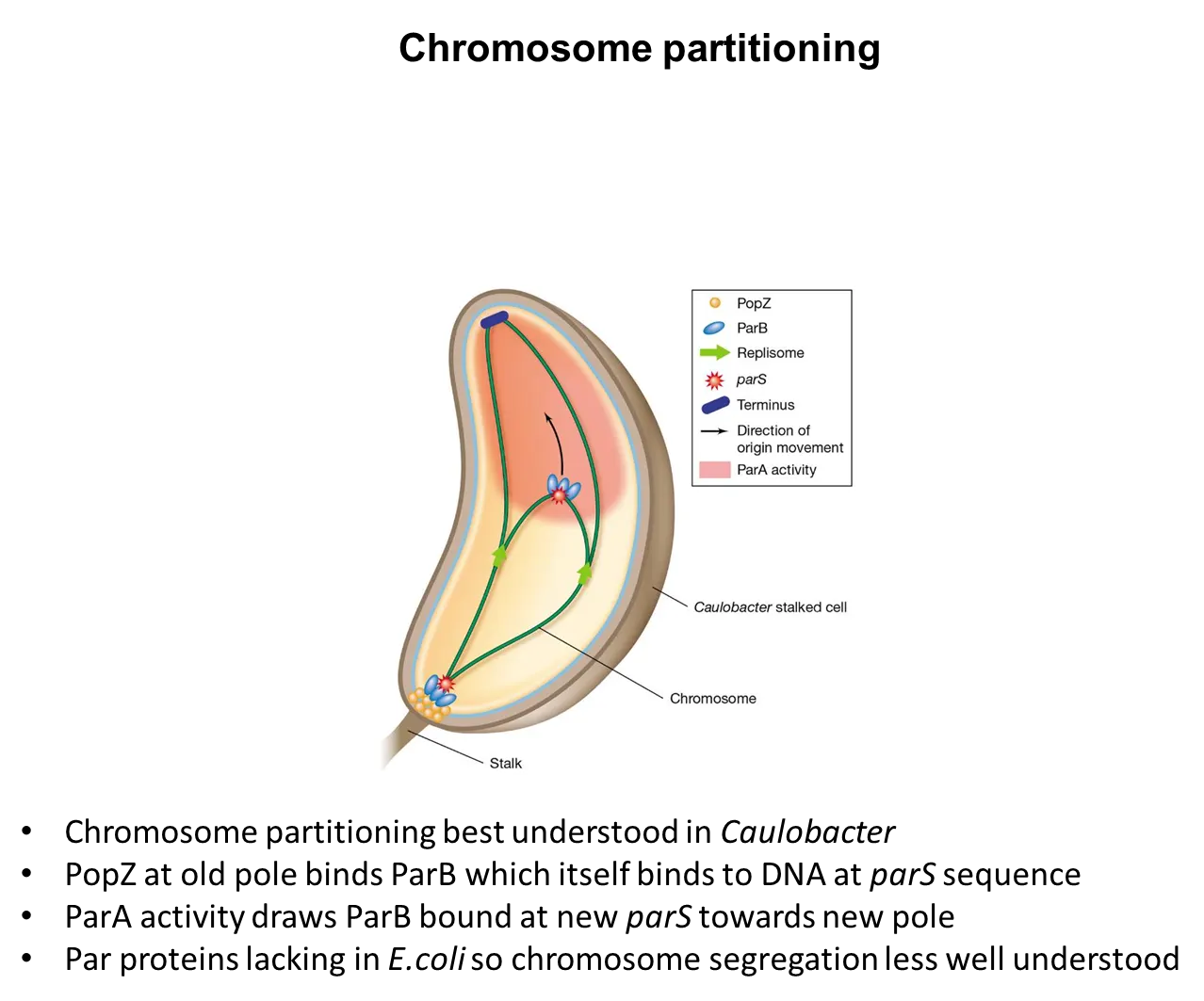
how are bacterial chromosomes partitioned without having spindle fibres?
the PopZ protein found at one pole binds to the ParB protein, which binds to the chromosome at its parS sequence
ParA protein activity at the opposite pole draws the ParB towards the new pole
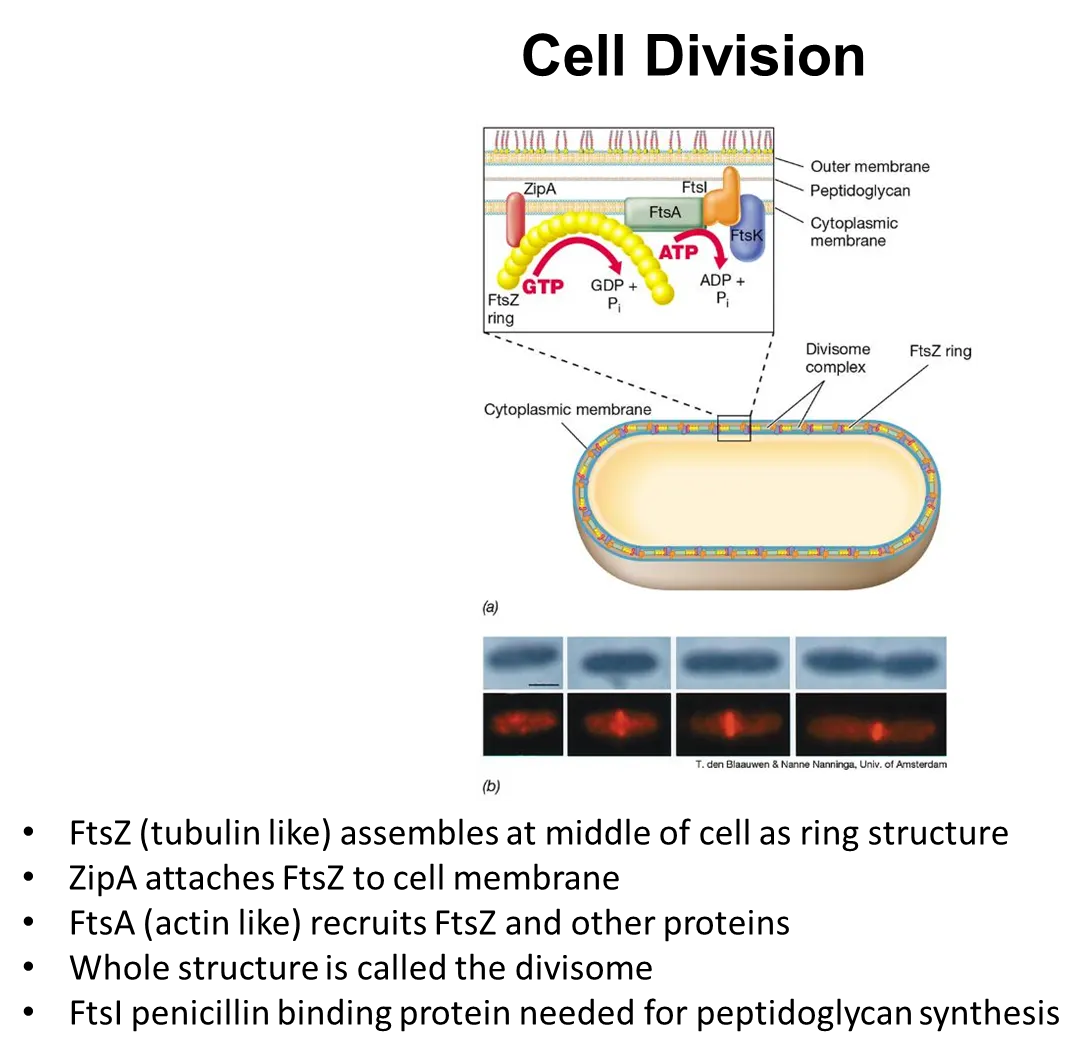
how do bacterial cells contract to divide?
the contractile FtsZ protein (analagous to tubulin) assembles to form a ring in the middle of the cell
the ZipA protein attaches this ring to the membrane
the FtsA protein (analogous to actin) recruits FtsZ and other proteins into a structure called the divisome
the ring gets pulled together to contract the cell
this divisome includes FtsI penicillin-binding protein, a transpeptidase, which catalyses the reaction that cross-links peptidoglycan when forming the septum
meanwhile (in most rod-shaped bacteria), the MreB protein forms in bands around the cell wall, which directs peptidoglycan synthesis, allowing the cell length to increase
how do bacteria find the middle of the cell to divide?
the MinCD protein oscillates from one pole to the other in a spiral
the MinE protein is found near the centre and disperses MinCD towards either pole (so that it has a lower conc in the middle)
MinCD prevents FtsZ polymerisation (the protein that forms a contractile ring in the middle of the cell) when it is in high concentrations, so FtsZ can only work in the middle of the cell

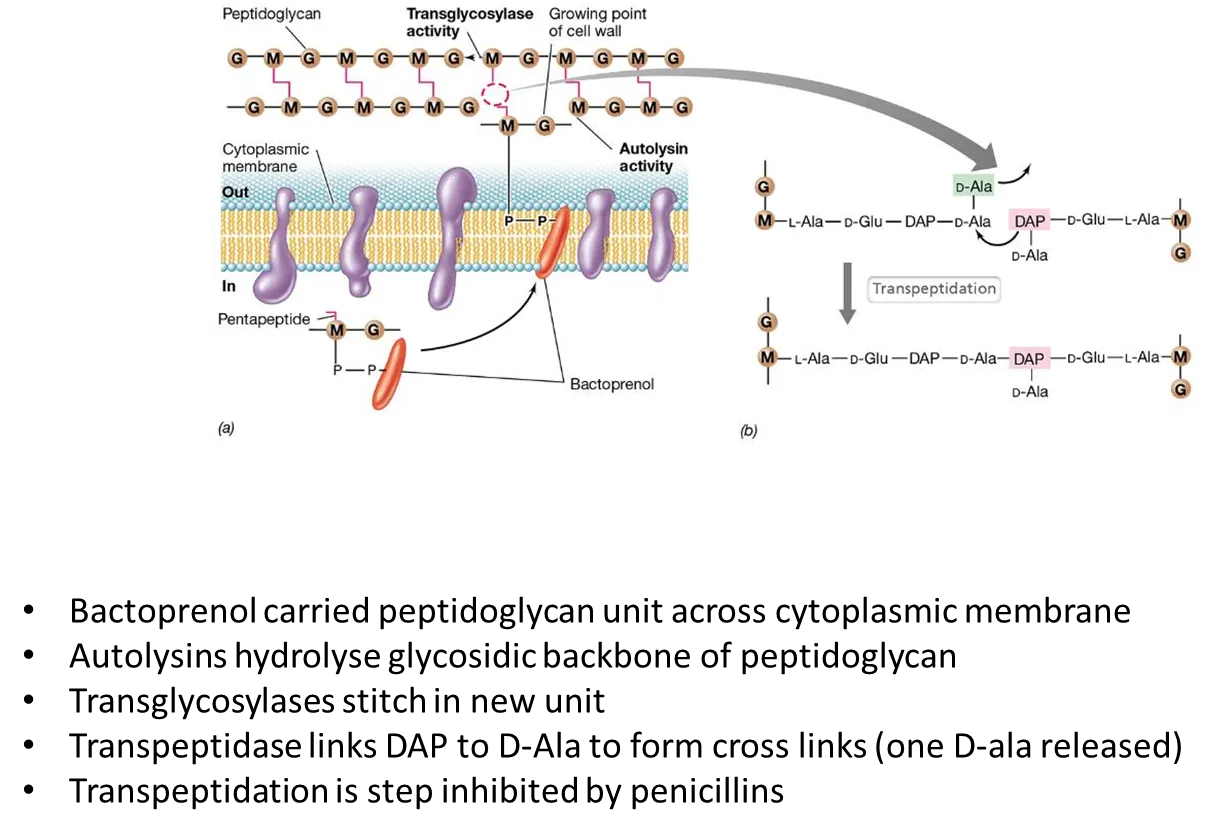
how are peptidoglycan cell walls synthesised?
the NAG-NAM pentapeptide (peptidoglycan precursor) is attached to a large non-polar carrier molecule called bactoprenol that allows it to be flipped across the cell membrane, since it is too polar to cross by itself
autolysins hydrolyse the glycosidic backbone in the existing peptidoglycan
transglycosylases connect the new unit using beta-1,4 glycosidic bonds, and transpeptidases form cross-links to connect the strands (this is the step inhibited by penicillin)
 Note
Note  Flashcards (124)