How Markets Work
 Call Kai
 Learn
Learn Practice Test
 Spaced Repetition
 Match
Match Flashcards
 Knowt Play
1/53

Earn XP
Description and Tags
T1 CC2 (keywords)
Name | Mastery | Learn | Test | Matching | Spaced | Call with Kai |
|---|
No analytics yet
Send a link to your students to track their progress
54 Terms
Demand
The quantity of a good or service that consumers are willing and able to buy at a given price. To be ‘effective’ demand consumers must have the ability to buy (i.e. have sufficient money).
Equilibrium price
The price at which a good/service is being offered for sale is being bought so the market is said to be clear.
Excess demand
Where there is unfulfilled demand at the market price – demand is greater than supply
Excess supply
Where there are unsold goods/services at the market price – supply is greater than demand
Price mechanism
The mechanism through which price is determined in a free market system. The forces of demand and supply are needed to reach equilibrium.
Law of demand
As price decreases demand will increase and vice versa
Extension of demand
A movement down the demand curve due to a fall in price
Contraction of demand
A movement up the demand curve due to an increase in price
Substitutes
Goods that can be used in place of other goods
Complements
Goods that are usually bought together e.g. X-Box and X-Box games
Shift of the demand curve
Where the whole demand curve shifts left or right due to a factor other than a change in price
Derived demand
Where demand for one good is derived from the demand for another e.g. the increase in demand for taxi rides will cause an increase in demand for taxi drivers
Supply
The amount that suppliers are willing and able to sell at any given market price
Supply curve
A line showing the quantity that suppliers are willing to sell at a given price
Total revenue
Price x Quantity. How much suppliers get for selling their goods/services
Production costs
The firm’s costs involved in producing goods/services such as raw materials, wages and rent
Profit
Revenue - Costs
Loss
Where costs are higher than revenue
Extension of supply
When there is a movement up the supply curve caused by an increase in price
Contraction of supply
When there is a movement down the supply curve caused by a fall in price
Shifts of the supply curve
Where the whole curve shifts due to a change in variable other than price e.g. season or fashion
Joint supply
When two goods are produced together from the same origin / raw material e.g. beef and leather
Composite demand (competitive supply)
Where there are multiple uses for a single product e.g. apples can be used for juice or pies
The invisible hand
Term used by economic thinker Adam Smith to describe the way in which resources are allocated in a market economy to the advantage of everyone – free market forces of demand and supply.
Consumer surplus
The difference between what a customer is willing to pay and what they actually pay
Producer surplus
The difference between what a producer is willing to sell their goods/services for and what they actually sell for
Price elasticity of demand (PED)
The responsiveness of demand to a change in price

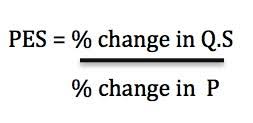
Price elasticity of supply (PES)
The responsiveness of supply to a change in market price
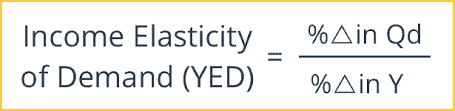
Income elasticity of demand (YED)
The responsiveness of demand to a change in disposable income
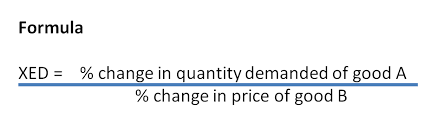
Cross price elasticity of demand (XED)
The responsiveness of demand for one good to a change in the price of another
Elastic
Where one variable is sensitive to changes in another 1 to infinity
Inelastic
Where one variable is insensitive to changes in another 0 to 1
Unitary Elastic
Where one variable changes in the same proportion given changes in another =1
Perfectly Elastic
Demand or supply is infinite at a given price/income = ∞
Perfectly Inelastic
Demand or supply is fixed regardless of the price/income = 0
Short Run
At least one factor of production is fixed
Long Run
All factors of production are variable
Normal Goods
Demand rises when income rises and vice versa, Positive YED
Necessities
Demand changes by a smaller proportion to a change in income, Positive YED < 1
Luxury Goods
Demand changes by a larger proportion to a change in income, Positive YED > 1
Inferior Goods
Demand falls when income rises and vice versa, Negative YED
Income Effect
Change in quantity demanded of a good or service resulting from a change in consumer’s real purchasing power due to a price change.
Substitution Effect
Change in quantity demanded of a good or service as a consumer switches to or from cheaper alternatives when its relative price changes.
Diminishing Marginal Utility
Principle that as a consumer increases consumption of a good or service, the marginal utility (satisfaction) gained from each additional unit decreases.
Conditions of demand/supply
Factors that cause the supply/demand curve to shift
Real income
Income relative to rates of inflation
Disposable income
Income after taxes have been paid and benefits received
Discretionary income
Disposable income less bills
Joint demand
Occurs when two or more goods or services are consumed together. A fall in the price of one good (printers) leads to an increase in the demand for another (ink cartridges.)
Indirect tax
Taxes on expenditure that are collected by a firm and paid directly to the government on behalf of the consumer, i.e. VAT and excise duty.
Subsidy
A government grant given to firms, designed to lower production costs and encourage supply.
Elasticity
The sensitivity/responsiveness of demand or supply to changes in another variable.
Coefficient
A numerical measure used to express degree of responsiveness of one variable to a change in another.
Business cycle
Periodic but irregular fluctuations in levels of economic activity over time, measured by changes in real GDP.

