Management: Exam One
 Studied by 2 people
 Call Kai
 Learn
Learn Practice Test
 Spaced Repetition
 Match
Match Flashcards
 Knowt Play
1/148

There's no tags or description
Looks like no tags are added yet.
Name | Mastery | Learn | Test | Matching | Spaced |
|---|
No study sessions yet.
149 Terms
Scarcity
Implies that we can't do everything that we want.
How does economics relate to "scarcity"?
Studies human behavior in how we make choices for things that we chose to spend our limited resources to produce or obtain.
Markets
Any structure that allows buyers and sellers to exchange any type of goods, services and information.
Supply
The amount of a good that is available.
Demand
The amount of a good that is desired.
Macroeconomics
"Macro" addresses the behavior of the market for more than one good.
example - looking at more than one specific good (i.e. generic 'atorvastatin' by Greenstone AND Lipitor)
Microeconomics
"Micro" addresses the behavior of the market for a single specific good
example - just one product (i.e. generic 'atorvastatin' by Greenstone)
Market Failure
Markets function efficiently ONLY with open access to information and no barriers to entry.
Oligopolies
A market structure in which a few firms dominate.
Monopolies
A market structure where a single seller controls the entire market.
Information Asymmetry
Information selectively hidden.
Barriers to Entry
Legal or "other" means to limit competitors (i.e. patent)
Externalities
Costs that are a consequence of production or use of a good, but are not included in market price
examples - pollution, deforestation, costs to treat advanced state medication conditions in the ED
Public Goods
Markets may undersupply goods that are socially desirable for all or most members of society
examples - roads, U.S. Army, health care services)
What does the "balance sheet" tell you?
High level overview of the financial health of the organization.
What three components make up a "balance sheet"?
1. assets
2. liabilities
3. owners equity
What does the "income statement" tell you?
Can determine if the company is profitable ("Is the business making money?").
What two components make up an "income statement"?
1. sales/revenue (usually "net")
2. costs/expenses
What does the "statement of owners equity" tell you?
Quick look at how much has been "kept" for the organization and how much is shared w/ owners.
What two components make up an "statement of owners equity"?
Profit and transactions AND what's left over ("owner's stake")
What does the "statement of cash flow" tell you?
Used to track flow of cash
separated by general activities like operations, investments, and financing
Time Value of Money
The value of money changes over time!
What concept does "inflation" and "investment" display?
Time Value of Money
Inflation
Money can be worth less overtime due to inflation
$1 item at 2% inflation in 10 years will cost $1.22
Investment
Money can be worth more overtime due to investment
If you invest $1 at 1% interest, in 10 years, you will have $1.10
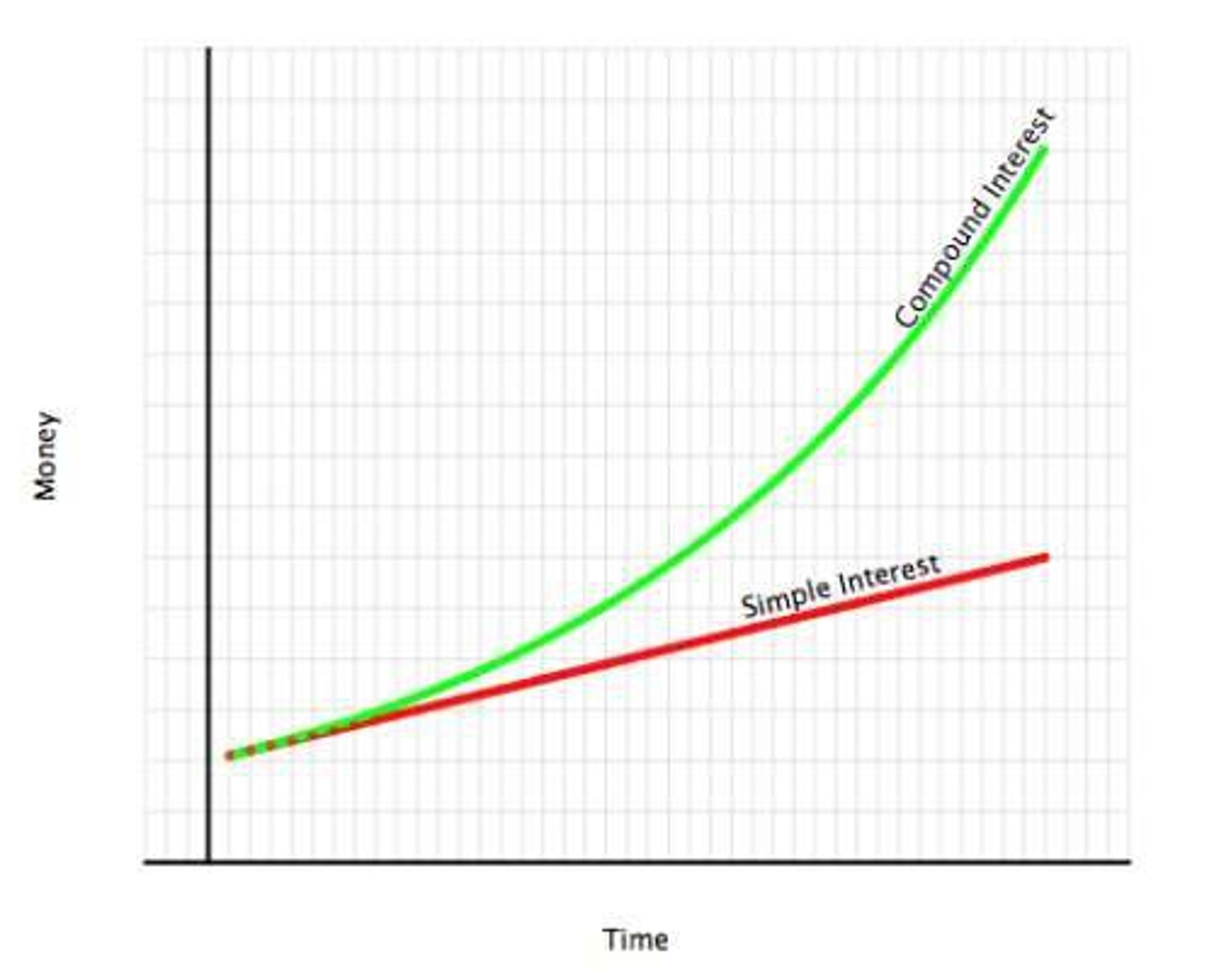
Simple interest
Does NOT take into account earned interest. Only based on original principal (starting amount).
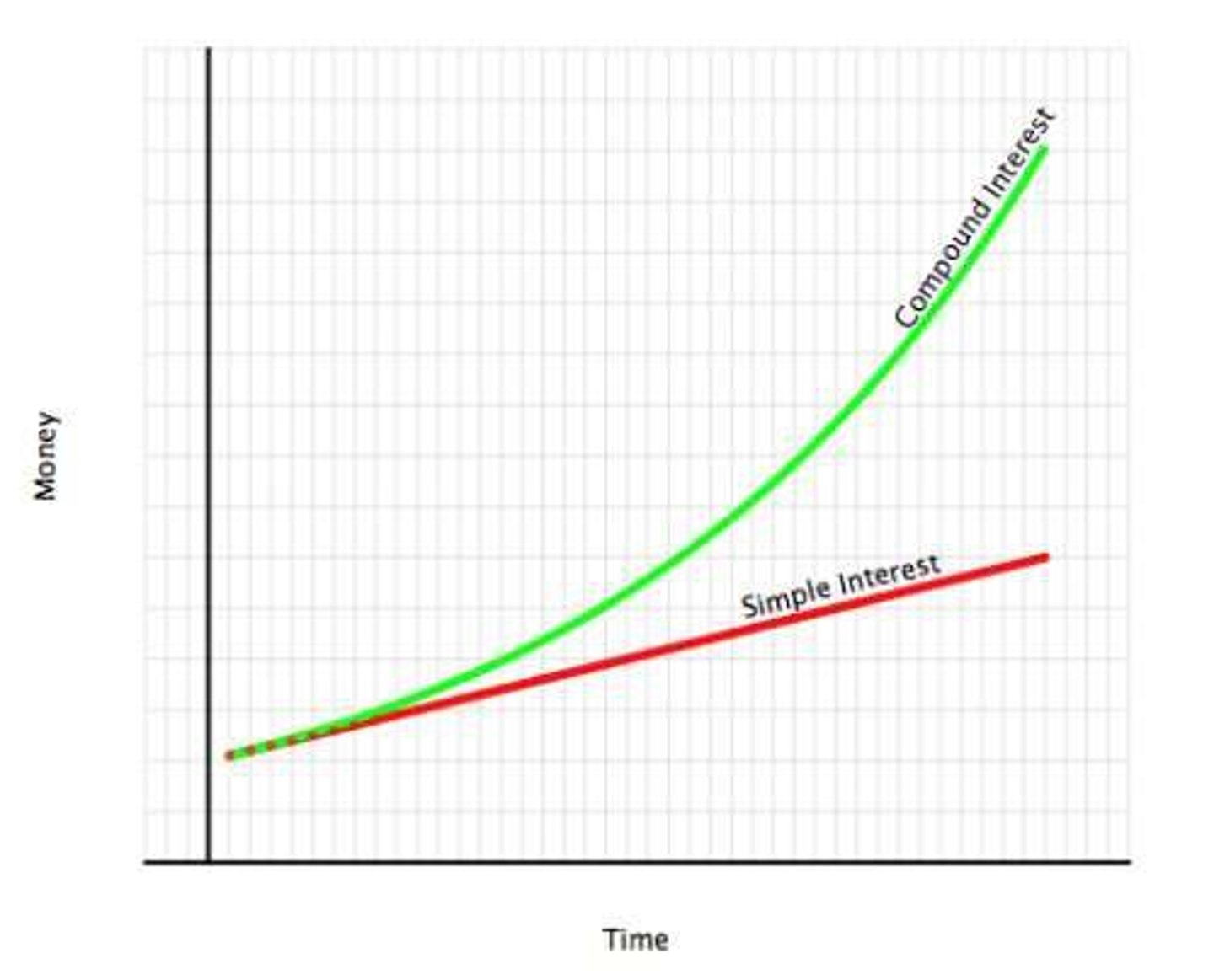
Compound interest
Does take into account earned interest. Includes (1) original principal + (2) any previously earned interest.
Risk
Level of risk is reflected in 'interest rate'
↑ risk = ↑ interest rate
Expenditures
Investments over time
example -
costs of running a pharmacy like paying for a pharmacist's salary
Net present value
Determine present value of each year of stream (includes time AND discount rate)
Vertical analysis
Compared to others in the market
Horizontal analysis
Observes same company/market but over time
Liquidity
Ability to meet short term cash requirements
Solvency
Ability to meet long term debt requirements and long term operations
Profitability
Ability to generate profits from investments in organization
Current Ratio
Current Assets / Current Liabilities
Indication: Ability to pay short term debt
Acid Test
(Cash + Accounts Receivable + Short Term Investments) / Current Liabilities
Indication: ability to pay short term debt without a "fire sale"
Debt Ratio
Total Debt / Total Assets
Indication: long-term liquidity
Debt-Equity Ratio
Total Liabilities / Total Owner Equity
Indication: owners reliance on credit
Interest Coverage Ratio
Pre-tax, pre-interest income/ Interest expense
Indication: ability to pay interest on debt
Net Income Ratio
Net Income / Net Sales
Indication: profitability of sale activities
Return on Assets (ROA)
Net Income / Average Total Assets
Indication: profitability of all assets
Return on Equity (ROE)
Net Income / Average Owner Equity
Indication: profitability of investments
Earnings per Share
Net Income / Shares Outstanding
Indication: amount of profit earned for each share of stock
P-E Ratio
Market Price of Stock / Earnings per Share
Indication: amount investors will pay for $1 of earnings
Dividends per Share
Dividends / Shares Outstanding
Indication: cash amount company pays out to shareholders per share
Dividend Yield
Dividend / Stock Price
Indication: return on investment from dividends (relative to stock)
Scientific Management
Focus on efficiency and productivity
Find the 'best way' to do a task
Bureaucratic and Administrative Management
Focus on structure and organization
Rules, hierarchy, and clear roles
Human Relations Movement
Focus on motivation and relationships
People matter (motivation isn't just money)
Systems Theory
Focus on holistic, interconnected view of business
Organization is a system w/ feedback loops
7 Essential Management Competencies
1. organizational knowledge
2. human resource management
3. communication
4. organizing meetings
5. planning for crises
6. time management
7. "managing up"
Organizational knowledge
Knowledge of organizational context and environment
Human resource management
Motivate and engage employees
Planning for crises
Anticipate what can go wrong and devise strategies to deal with such occurrences
Third Party Payments
Major third-party payers for retail pharmacies include private and public payers
Private: PBMs (CVS Caremark), health insurance companies
Public: Medicare, Medicaid
How do retail pharmacies get paid?
prescription payments (product cost + dispensing fee)
paid by PBMs, Medicare Part D, cash payments
How do LTC facilities get paid?
Medications reimbursement (similar to retail pharmacy)
paid by PBMs and Medicare Part D
How do hospitals get paid?
1. Diagnosis-related group (DRG)
2. Part of hospital stay reimbursement
3. Outpatient/infusion medications
paid by private insurance, Medicare, Medicaid
Wholesale Acquisition Cost (WAC)
The price paid by a retailer or pharmacy to purchase a drug from a wholesaler.
Average Manufacturers' Price (AMP)
The average price paid to manufacturers by wholesalers for drugs distributed to retail pharmacies.
Average Wholesale Price (AWP)
A benchmark used to determine the price of drugs, often considered to be higher than actual market prices.
Actual Acquisition Cost (AAC)
The actual cost that a pharmacy pays for a drug, including discounts and rebates.
Estimated Acquisition Cost (EAC)
An estimate of the price a pharmacy pays for a drug, used for reimbursement calculations.
Maximum Allowable Cost (MAC)
The maximum price that a payer will reimburse for a specific drug.
Retail Pharmacy Reimbursement
The payment made to pharmacies for dispensing medications to patients.
Medicare
A federal health insurance program for individuals aged 65 and older.
Medicare Part A
hospital (inpatient) insurance
Medicare Part B
medical (outpatient) insurance
Medicare Part C
managed care health plans offered to medicare beneficiaries under the medicare advantage program
Medicare Part D
prescription drugs
Medicaid
A state and federal program providing health coverage for low-income individuals.
How do third party payers work to control medication costs for their beneficiaries?
1. Patient cost sharing
2. Generic substitution
3. Quantity limits
4. Mail order
5. Step therapy
6. Prior authorizations
Medication Therapy Management (MTM)
Services designed to optimize therapeutic outcomes for patients through improved medication use.
What are some of the issues related to reimbursement?
1. Inadequate dispensing fees
2. Growth of required mail order pharmacies
3. Issues w/ PBM transparency
4. Diagnosis-related group reimbursement
Diagnosis-related group (DRG) reimbursement
A payment system where hospitals are reimbursed a fixed amount based on the patient's diagnosis.
note: can cause reimbursement issues because pharmacy might not get reimbursed for the total amount of medications because the amount is fixed
Direct and indirect reimbursement fees (DIR Fees)
Fees charged to pharmacies that can reduce the amount they are reimbursed for medications.
Rebates
Payments made to pharmacy benefit managers (PBMs) to incentivize the use of specific medications.
What is the largest investment for most businesses?
inventory (usually at least ~75%)
Cost of goods sold (COGS)
The total cost of purchasing the goods that were sold during a specific period.
What are some important factors when purchasing inventory for a business?
- Products
- Quantity
- Time
- Price
- Vendor
Cash discount
Reduction in price for prompt payment
Product bundling
Reduction in price of one item gained by simultaneously purchasing another product (often related)
Minimum purchasing
Reduction in price of a featured generic or brand medication along w/ a minimum generic order (required to buy a minimum amount!)
What are some factors related to vendor selection?
- Delivery schedule
- Frequency of out-of-stock situations
- Breadth of merchandise lines and assortments
- Assistance with product placement and floor layout
- Available technology and other services
- Returned goods policies
- Financing and credit terms and options
- Purchasing Decisions
Visual Inventory Control Method
Uses physical cues and real-time visual data for stock management
Periodic Inventory Control Method
Involves physical inventory counts at set intervals
Perpetual Inventory Control Method
Provides continuous, real-time tracking of inventory levels through digital systems
Inventory Turnover Rate (ITOR)
Measures how many times a company sells and replaces its inventory over a specific period
Ideally, a turnover rate will be relatively high (~12-15)
What does a high ITOR indicate?
- ↓ investment in inventory (frees cash for other services/activities)
- ↑ return on inventory investment
- Possible out-of-stock situations (if ITOR is too high)
What are three examples of "out of stock" costs?
1. Cost to obtain quickly
2. Loss of 'business' (if the pt moves to another pharmacy)
3. Loss of patient (if there was a critical medication not available)
What are four available technologies to assist with inventory management?
- Barcoding
- Point of sale scanners
- Radio frequency identification (RFID)
- Inventory management software
Declarations page
States the limits for each coverage under the policy.
Aggregate limit
Max insurance will pay regardless of the number of total claims in a policy period.
Per occurrence limit
Max insurance will pay for claims stemming from a single event.
Common policy conditions
Provisions for interrupting the policy.
Property coverages
Covers buildings and personal property.
Commercial liability coverages
Includes bodily injury, covered contract, personal and advertising injury, and product liability.
Medical payments coverage
Provides money for first aid and medical care to individuals injured on business property.
Fire coverage
Pays for damages to buildings rented or loaned due to fire or explosion.
 Note
Note  Flashcards (124)