DEV2011 - W3: Fertilisation to gastrulation

0.0(0)
Studied by 0 people
call kaiCall Kai
learnLearn
examPractice Test
spaced repetitionSpaced Repetition
heart puzzleMatch
flashcardsFlashcards
GameKnowt Play
Card Sorting

1/4

encourage image

There's no tags or description

Looks like no tags are added yet.

Last updated 12:41 PM on 3/19/26
Name
Mastery
Learn
Test
Matching
Spaced
Call with Kai

No analytics yet

Send a link to your students to track their progress

5 Terms

1
New cards

When do sperm gain full motility?

Sperm don’t gain full motility until they reach the uterus.

Enzyme secreted by uterine wall:

  • generate influx of Ca2+ → increase sperm motility (make sperm hyperactive)

  • alters plasma membrane of sperm head for binding to egg

2
New cards

What is the acrosome?

Explain the acrosome reaction.

  • Acrosome derived from Golgi

  • contains digestive enzymes (including hyaluronidase and acrosin)

    • These enzymes are needed to break through the layer of cumulus cells that surround the egg


Acrosome reaction:

  • sperm binds to zona pellucida (at surface of egg)

  • acrosome content released to help sperm head break through zona pellucida

  • plasma membrane of sperm and egg are fused - allowing sperm nucleus and centriole to enter egg. Sperm mitochondria in most cases cannot enter (mitochondria is maternally derived)
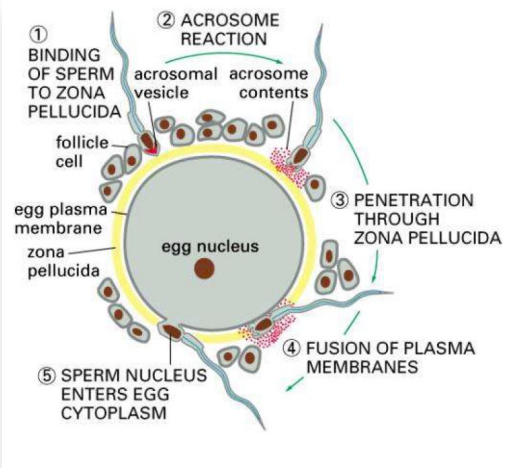
<ul><li><p>Acrosome derived from Golgi</p></li><li><p>contains digestive enzymes (including hyaluronidase and acrosin)</p><ul><li><p>These enzymes are needed to break through the layer of cumulus cells that surround the egg</p></li></ul></li></ul><div data-type="horizontalRule"><hr></div><p><strong>Acrosome reaction:</strong></p><ul><li><p>sperm binds to zona pellucida (at surface of egg)</p></li><li><p>acrosome content released to help sperm head break through zona pellucida </p></li><li><p>plasma membrane of sperm and egg are fused - allowing sperm nucleus and centriole to enter egg. Sperm mitochondria in most cases cannot enter (mitochondria is maternally derived)</p></li></ul><p></p>
3
New cards

What is the polyspermy block?

Fast block and slow block

Fast block

  • egg membrane undergoes rapid depolarisation (sodium influx) to stop any more sperm from binding to the egg

Slow block

  • occurs after fast block

  • release of calcium into egg → stimulates cortical granule response (slow block)

  • cortical granules (just under the surface of the egg) fuse, and release their contents into the space between the cell membrane and the vitelline envelope (zona pellucida)

  • results in hardening of the vitelline envelope (egg surface) and permanently blocks further sperm from binding
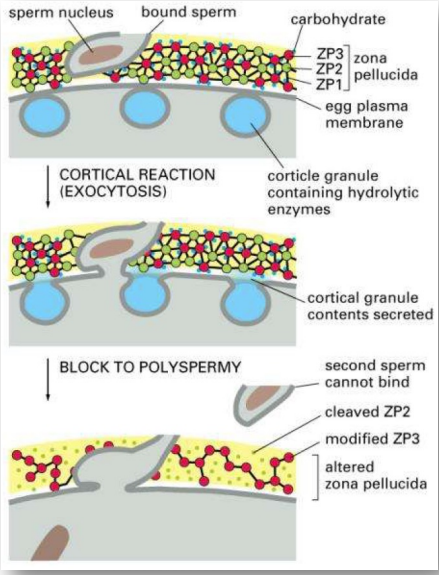
<p><strong>Fast block</strong></p><ul><li><p>egg membrane undergoes rapid depolarisation (sodium influx) to stop any more sperm from binding to the egg</p></li></ul><p></p><p><strong>Slow block</strong></p><ul><li><p>occurs after fast block</p></li><li><p>release of calcium into egg → stimulates cortical granule response (slow block) </p></li><li><p>cortical granules (just under the surface of the egg) fuse, and release their contents into the space between the cell membrane and the vitelline envelope (zona pellucida)</p></li><li><p>results in hardening of the vitelline envelope (egg surface) and permanently blocks further sperm from binding</p></li></ul><p></p>
4
New cards

Pre-implantation development: What is unification and cleavage?

Unification

  • pronuclei unify right after fertilisation

(Sperm’s centriole duplicates and forms critically important first mitotic spindle - allowing chromosomes to align for cell division)


Cleavage stages:

  • First cleavage produces 2 cells (blastomeres)

    • At this point, the embryo is increasing in size - this means it is increasing in cell number (NOT ACTUAL SIZE!!) because of the hard shell around the egg

  • ~day 5 blastocyst formation (with trophectoderm and forming of inner cell mass)
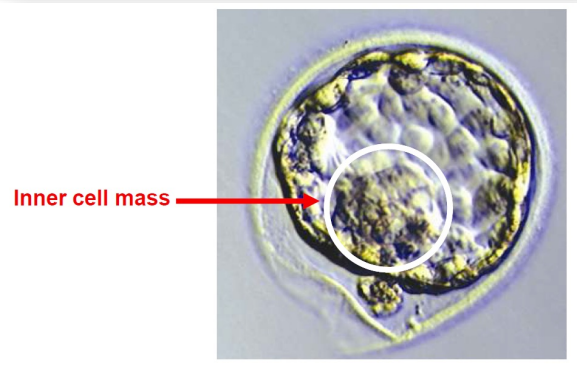
<p><strong><u>Unification</u></strong></p><ul><li><p>pronuclei unify right after fertilisation </p></li></ul><p>(Sperm’s centriole duplicates and forms critically important first mitotic spindle - allowing chromosomes to align for cell division)</p><div data-type="horizontalRule"><hr></div><p><strong><u>Cleavage stages:</u></strong></p><ul><li><p>First cleavage produces 2 cells (blastomeres)</p><ul><li><p>At this point, the embryo is increasing in size - this means it is increasing in cell number (NOT ACTUAL SIZE!!) because of the hard shell around the egg</p></li></ul></li><li><p>~day 5 blastocyst formation (with trophectoderm and forming of inner cell mass)  </p></li></ul><p></p>
5
New cards

When does the egg (oocyte) complete meiosis II (since it stalls at metaphase II)?

Egg completes meiosis 2 as fertilisation occurs - and second polar body is produced (which is important later on)

Explore top flashcards

flashcards
macbeth vocab
25
Updated 487d ago
0.0(0)
flashcards
Road to the Crusades
46
Updated 434d ago
0.0(0)
flashcards
Structure of the Church (ch. 4)
30
Updated 826d ago
0.0(0)
flashcards
Chac Mool Vocab 28-54
27
Updated 872d ago
0.0(0)
flashcards
Lit Words: 2 The Boogaloo
24
Updated 500d ago
0.0(0)
flashcards
Realistic Fiction Quiz #2
23
Updated 910d ago
0.0(0)
flashcards
F451 vocab
29
Updated 336d ago
0.0(0)
flashcards
macbeth vocab
25
Updated 487d ago
0.0(0)
flashcards
Road to the Crusades
46
Updated 434d ago
0.0(0)
flashcards
Structure of the Church (ch. 4)
30
Updated 826d ago
0.0(0)
flashcards
Chac Mool Vocab 28-54
27
Updated 872d ago
0.0(0)
flashcards
Lit Words: 2 The Boogaloo
24
Updated 500d ago
0.0(0)
flashcards
Realistic Fiction Quiz #2
23
Updated 910d ago
0.0(0)
flashcards
F451 vocab
29
Updated 336d ago
0.0(0)



