SLHS 302 Section 1
 Studied by 0 people
 Call Kai
 Learn
Learn Practice Test
 Spaced Repetition
 Match
Match Flashcards
 Knowt Play
1/131

There's no tags or description
Looks like no tags are added yet.
Name | Mastery | Learn | Test | Matching | Spaced | Call with Kai |
|---|
No analytics yet
Send a link to your students to track their progress
132 Terms
why study hearing science?
important for vocal communication, survival, and to understand/treat hearing loss
audibility
detecting sound
intelligibility
understanding sound
hearing loss
affects both audbility and intelligibility
17
percent of American adults that report some degree of hearing loss
signals and systems approach
the ear transforms sound waves into vibrations into neural signals
why we use a signal and systems analysis in speech and hearing?
to understand the physiological systems we are studying and to understand the technological signals and systems that we use in our work to study speech and hearing issues
sound
the vibration of an object that results in the oscillation of a medium through which energy propagates
media
air, water, floor and walls, string
sound source
a disturbance that produces a sound
elastic medium
the medium through which sound travels; any material with mass and elasticity
elasticity
the ability of a mass to return to its natural shape
air
easy to compress so not very elastic
sound pressure wave
how we visualize sound in the physical domain
waveform
how we visualize sound in the time domain
amplitude spectrum
how we visualize sound in the frequency domain
peaks
compressions or high pressure areas
troughs
rarefactions or low pressure areas
sound wave
the visualization of the physical propagation of sound
particle motion
air particles osscilate back and forth around their equilibrium position
sound waves
longitudinal waves
sine wave equation
d(t) = A sin(2πft+θ)
sine wave
indicates change in pressure over time
mechanical
variation in displacement over time
acoustical
variation in air pressure with time
electrical
variation in voltage with time
amplitude
how large is the displacement?
amplitude
how tall it is; related to loudness
instantaneous amplitude
amplitude measured at a given point along a wave
instantaneous amplitude
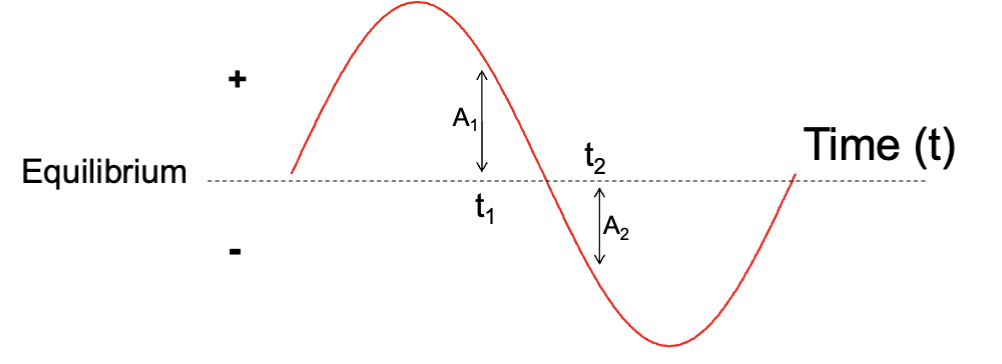
peak amplitude
maximum displacement from equilibrium; related to the size of the vibration
peak amplitude
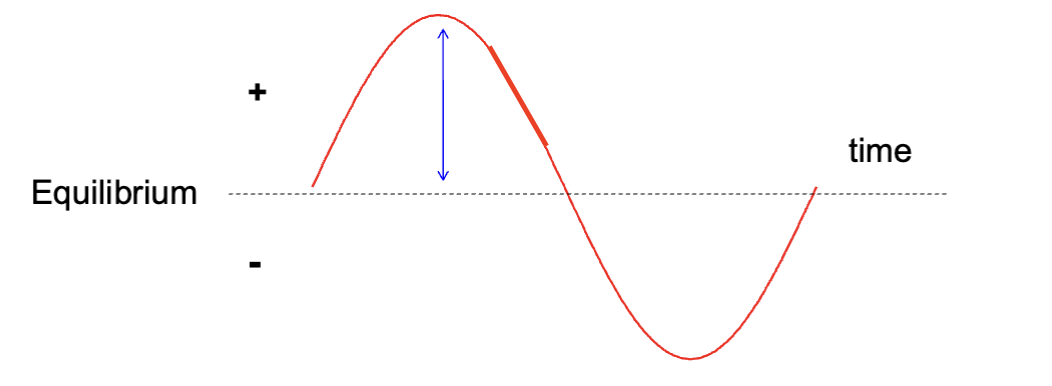
peak-to-peak amplitude
maximum change in displacement
peak-to-peak amplitude
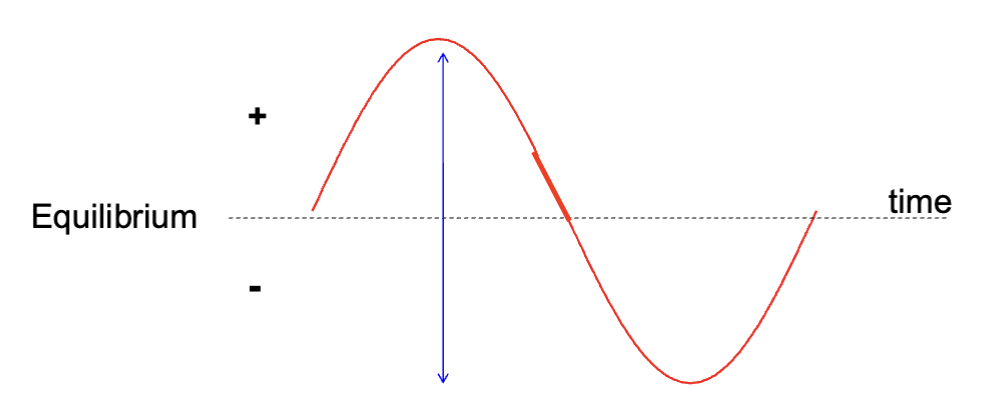
root-mean-squared (RMS) amplitude
a way to quantify the “power” of a signal; helpful representation of amplitude for zero-mean signals
RMS
the square root of the mean (average) of the squared instantaneous amplitudes
frequency
how many times per second does it repeat
frequency
how many squiggles; related to pitch
period
the time taken to complete one cycle
period of a sine wave
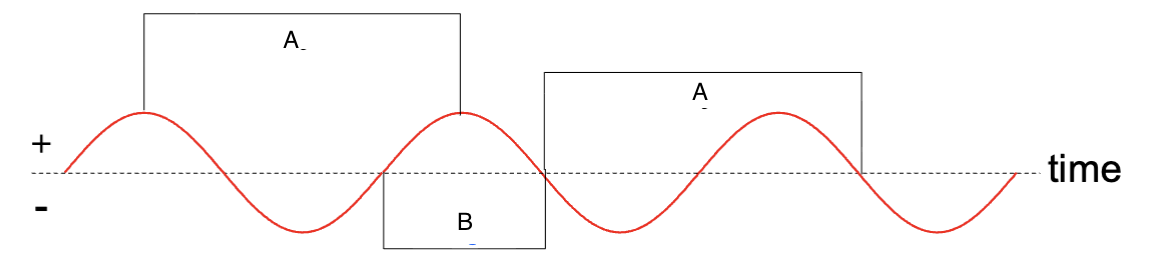
movement from equilibrium to maximum displacement in one direction, back to equilibrium, on to maximum displacement in the opposite direction, and then back to equilibrium
period (sec)

cycle
identifed as extending from any point in a wave to the next identical point in the wave
cycle
A
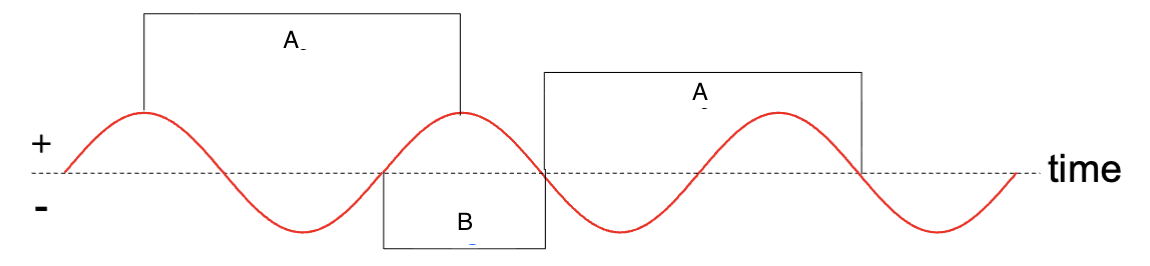
½ cycle
B
frequency
f = 1/T
1 Hz
1 cps
period (T)
T = 1/f
more periods
in a given time as frequency increases
phase
what is the displacement at a given time?
phase
which point along the “squiggle”
phase
differences between the ears are useful for sound localization
phase angle or instantaneous phase
the displacement in degrees at any given instant
phase relationship or difference
lead and lag
inertia (mass)
property that objects in motion tend to stay in motion
elasticity
property of an object, the tendency to return it to its resting state
friction (damping)
will decrease motion over time
amplitude of motion
gradually diminished as energy is lost due to friction
frequency of oscillation
controlled by mass and stiffness; not affected by damping
pressure
a measure of force per unit area
pressure
p = F/area
pressure
reduces if the same force is acting over a larger area
air pressure
a function of the force exerted on a given area by the molecules of air
air pressure increases when
number of molecules increases; volume decreases; density increases
density
amount of mass per unit volume; can change due to number of molecules or the volume
sound wave
alternations of condensation and rarefaction of a medium which propagates through space
wave propagation
a result of the successive oscillations of air molecules
frequency
a function of its sound source and in turn depends on the object’s elasticity and mass; unaffected by the sound transmission medium
wavelength
the amount of distance covered in a single period of a wave
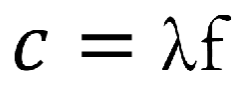
speed of propagation
a function of the medium; measured in meters per second
speed of sound equation
water is more compressible
why water molecules are closer to one another
speed of sound in air
350 m/sec
why does sound move faster in water?
molecules are pushed to one side, encounter other molecules much faster, creating areas of condensation much faster
frequency
determined purely by the sound source
speed
independing of the loudness or frequency of sound
what happens to wavelength when c changes
wavelength becomes longer than in air
sound waves
propogate through a medium in all 3 dimensions
sound intensity
power per area
What happens to intensity as you get farther from a sound source?
the intensity of the sound that will reach your ears gets lower
inverse square law
intensity is inversely related to the square of the distance for spherical waves
inverse square law equation
I = P / (4pir²)
sound pressure
indicates how compressed or rarefied the air particles are
sound pressure
p = F/A
sound intensity
indicates how much sound power is transferred from the sound source to the surrounding area
sound intensity
I = P/A
loudness of sound is related to
its intensity and pressure
pressure
force per unit area
intensity
power per unit area
power
the rate at which energy is transferred by a wave
power
independent of area
sound pressure and intentisty
the amplitude of the sound wave
sound pressure and intensity
depend on the distance from the sound source
sound intensity
proportional to the square of sound pressure
sound intensity
Watts/m²
sound pressure
Newtons/m²
160 dB
instant perforation of eardrum
110 dB
prolonged exposure - hearing loss
0 dB
threshold of hearing
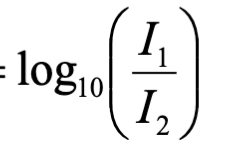
Bel
the logarithm of a ratio of two intensity values
Bel
 Note
Note  Flashcards (117)