Interpersonal Communications: Exam 2
 Call Kai
 Learn
Learn Practice Test
 Spaced Repetition
 Match
Match Flashcards
 Knowt Play
1/36

Earn XP
Description and Tags
Ch. 7, 9, 3, 4
Name | Mastery | Learn | Test | Matching | Spaced | Call with Kai |
|---|
No analytics yet
Send a link to your students to track their progress
37 Terms
The nature of listening: what is listening
define listening-as the active process of making meaning out of another person’s spoken message
important: 1. listening is an active process. you have to make yourself listen to someone. 2. listening isn’t just about hearing, or receiving input, but also about creating meaning from what you hear.
The nature of listening: listening styles
(Textbook) different set of attitudes and beliefs about listening:
Relational style: This style emphasizes concern for other people’s emotions and interests
Task-oriented style: Someone with this style sees listening as part of a transaction. A task-oriented listener likes neat, concise, error-free presentations and gets impatient with disorganized communication
Critical style: This style emphasizes intellectual challenges. Someone with a critical style listens to identify inconsistencies and logical errors while others speak
Analytical style: People with this style withhold judgment while listening and consider all sides of an issue before responding
Regardless of your primary listening style, research demonstrates that we adopt different styles for different situations.
(Lecture) Preferred Listening Styles-How we are listening
People – oriented: emphasizes concern for others
Action – oriented: emphasizes organization, and precision
Content – orientated: emphasizes intellectual challenges
Time – oriented: emphasizes efficiency
The nature of listening: the types of listening
type types of listening (why do we listen)
Informational listening – to learn example: listening to your teacher. most passive type of listening
Critical listening – to evaluate example: googling what car to buy. “Critical” listening doesn’t necessarily mean disapproving of or finding fault with what you’re hearing. Instead, it means analyzing and evaluating the merits of what a speaker is saying. practical/engaging; one of best ways to become a better listener.
Empathetic listening – to provide support example: a friend got kicked out so you listened to them. requires 2 skills: perspective taking (the ability to put yourself in another person’s place and consider a situation from their point of view) and empathic concern ( the ability to identify how someone else is feeling and then experience those feelings yourself). The goal of empathic listening is to understand a situation from the speaker’s perspective and to feel what they are feeling
Appreciative, listening – for enjoyment example: watching a movie
The nature of listening: listening efficiently
Listening with conscious mind and explicit goal of understanding what the speaker is attempting to communicate
The ability to listen effectively is important to our success in a variety of contexts
Listening well doesn’t affect just our relationships; it also has implications for our physical health
Many of us overestimate our listening abilities
The nature of listening: Understand the misconceptions about listening
MYTH: HEARING IS THE SAME AS LISTENING
Hearing is a passive process that occurs when sound waves cause the bones in your inner ear to vibrate and send signals to your brain. listening is an active process of paying attention to a sound, assigning meaning to it, and responding to it. Hearing is a part of that process, but listening requires much more than just perceiving the sounds around you. we sometimes listen without hearing, and our understanding can be impaired as a result.
MYTH: LISTENING IS NATURAL AND EFFORTLESS
listening is a learned skill, not an innate ability like hearing. Learned through mistakes, instruction, education, and training. people vary in their listening abilities
MYTH: ALL LISTENERS HEAR THE SAME MESSAGE
our perceptions of what we see and hear are always limited. Our experiences, our biases, and even our gender and culture all influence how we create meaning from the information we take in.
The ways of listening: the HURIER model of listening
rapid simultaneous process. We don’t necessarily have to enact the stages in order; sometimes listening effectively requires us to go back and forth among them.
hearing: hearing is the physical process of perceiving sound. That is where the listening process begins. we can’t really listen to people unless we can hear them, or at least have access to their words.
understanding:To understand means to comprehend the meanings of the words and phrases you’re hearing.
remembering: remembering, or being able to store something in your memory and retrieve it when needed. can help you to avoid awkward situations. Mnemonic devices are tricks that can improve short- and long-term memory. mnemonic device is the acronym, a word formed from the first letters or parts of a compound term
interpreting:The process of interpreting has two parts. The first part is paying attention to all the speaker’s verbal and nonverbal behaviors so you can assign meaning to what the person has said.The second part of interpreting is signaling your interpretation of the message to the speaker. Signaling not only lets the speaker know you’re following along with what they are saying but also allows you to confirm your interpretations.
evaluating:judging whether the speaker’s statements are accurate and true. also separating factual claims from opinions and trying to determine why the speaker is saying what they’re saying.you’re considering the speaker’s words in the context of other information you have received from that speaker or other sources
responding:responding, or indicating to a speaker that you’re listening. sometimes call that process giving feedback, and we do it both verbally and nonverbally using a variety of strategies
7 types of responses (passive to most active)
Stonewalling: Responding with silence and a lack of facial expression.
Backchanneling: Nodding your head or using facial expressions, vocalizations such as “uh-huh,” and verbal statements such as “I understand” and “That’s very interesting” to let the speaker know you’re paying attention.
Paraphrasing: Restating in your own words what the speaker has said
Empathizing: Conveying to the speaker that you understand and share their feelings on the topic
Supporting: Expressing your agreement with the speaker’s opinion
Analyzing: Providing your own perspective on what the speaker has said,
Advising: Communicating advice to the speaker about what they should think, feel, or do.
Common barriers to effective listening: know the barriers to listening discussed in your book
(book) obstacles to effective listening.
Noise-Anything that distracts you from listening to what you wish to listen to
Pseudolistening-Using feedback behaviors to give the false impression that you are listening
Selective Attention-Listening only to points you want to hear and ignoring all other points
Information Overload-State of being overwhelmed by the huge amount of information you must take in every day
Glazing Over-Daydreaming when you aren’t speaking or listening during a conversation
Rebuttal Tendency-Propensity to argue inwardly with a speaker and to formulate your conclusions and responses prematurely
Closed-Mindedness-Refusal even to listen to ideas or positions with which you disagree
Competitive Interrupting-Interrupting others to gain control of a conversation
Common barriers to effective listening: know the barriers to listening discussed in class
contextual (in our environment):
difficult listening situation ex→ loud heater
distractions ex→ phone
uninteresting topic ex→ boring topic
cognitive (within brain):
information overload (at full capacity can’t take in any more info.) ex→ too much lectures and reading
glazing over
bias and prejudice ex→ hearing a red flag and stop listening to the message
rebuttal tendency (the urge to formulate a comeback or debate a speaker's point while they are still talking)
competitive interrupting ex→ constantly interrupting to get your thoughts in
pseudolistening ex→ look like your listening but you aren’t really
Becoming a better listener: become a better informational listener
Separate what is and isn’t said: beware of the tendency to “hear” words or statements that aren’t actually said. be careful to distinguish between what is actually being said and what you are simply inferring.the most effective way to determine whether you have understood a speaker’s message is to paraphrase it ex→ A common tactic for advertisers is to claim that “nothing is more effective”All they said is that nothing is more effective, which means there may be several other products that are just as effective as theirs.
avoid the conformation bias: The confirmation bias is the tendency to pay attention only to information that supports one’s values and beliefs while discounting or ignoring information that doesn’t
For substance more than for style:the vividness effect refers to the tendency for dramatic, shocking events to distort one’s perceptions of reality being able to look past what is dramatic and vivid to focus on the substance of what you’re hearing. That process begins with being aware of the vividness effect and remembering that vivid experiences can distort your perceptions.
Becoming a better listener: become a better critical listener
be a skeptic:Being a good critical listener starts with being skeptical of what you hear. Despite its reputation, skepticism isn’t about being cynical or finding fault; rather, it’s about evaluating the evidence for a claim. you carefully evaluate them to determine whether they make sense.
Evaluate s speaker’s credibility:Credibility is a measure of how reliable and trustworthy someone is. Several qualities make a speaker more or less credible. One is expertise. It’s easy to confuse having expertise with having experience. Having experience with something may give a person credibility on that topic or area, but it doesn’t necessarily make the individual an expert.Another characteristic that affects a speaker’s credibility is bias. If the speaker has a special interest in making you believe some idea or claim, that fact tends to reduce their credibility
understand probability: Evaluating the merits of a claim means speculating about the likelihood that the claim is true An event or a fact is possible if there’s even the slightest chance, however small, that it might be true. To be probable, a statement has to have greater than a 50 percent chance of being true. A statement is certain only if its likelihood of being true is 100 percent, nothing less.
Becoming a better listener: become a better empathic listener
listen nonjudgmentally: when we listen to learn, and especially when we listen to evaluate, we often make judgments about the information we’re taking in. Good empathic listening, however, is about being open-minded and nonjudgmental. don’t interrupt and don’t offer advice unless asked
Acknowledge feelings: Empathizing involves understanding how someone else is feeling and trying to relate to those feelings. continuer statements, phrases that identify the emotions a person is experiencing and allow them to communicate them further.it is important to avoid terminator statements, phrases that fail to acknowledge a speaker’s emotions and thereby shut down the person’s opportunity to express them.
Communicate support non-verbally: communicate your support nonverbally. When you’re listening rather than speaking, your nonverbal behaviors convey your interest, understanding, and empathy to the speaker.. ex→ eye contact
Why relationships matter: the need to belong theory
That fundamental human inclination to bond with others is the idea behind psychologist Roy Baumeister’s need to belong theory.3 The need to belong theory proposes that each of us is born with a drive to seek, form, maintain, and protect strong relationships. To fulfill that drive, we use interpersonal communication to form social bonds with others at work, at school, in our neighborhoods, in community and religious organizations, on sports teams, in online communities, and in other social contexts.
to satisfy our drive for relationships, we need social bonds that are both interactive and emotionally close.
Why relationships matter: the rewards and costs of relationships
rewards:
emotional-someone to seek comfort, support, or share excitement. Through at least two types of emotional wards: emotional support, and happiness.
Material – money, a friend drives you places, time, any material needs
Health – people can encourage positive behaviors. There are two reasons why relationship may help keep us healthy: the happiness and relaxation a relationship provides us can ward off stress and people look out for our safety/well-being
costs: if you're providing your rewards for someone, then you have a cost
The nature of personal relationships: the levels of relational commitment
Commitment is our desire to stay in a relationship no matter what happens
Our close relationships usually include some level of emotional commitment, a sense of responsibility for each other’s feelings and emotional well-being.
Our close relationships also involve a level of social commitment, which motivates us to spend time together, to compromise, to be generous with praise, and to avoid petty conflict.
some close relationships are bound by legal and financial commitments, which are more formal expressions of people’s obligations to each other. ex→ Parents have a legal responsibility to provide housing, food, clothing, health care, and education for their children who are minors
At an extreme level, commitment can turn into obsession,
The nature of personal relationships: the four common characteristics of personal relationships
committment-was staying no matter what, having desire
Foster interdependence – our personal relationships have varying levels of interdependence, it changes based on if the relationship is growing or dying. Your behavior affects the other person. ex→ as a relationship gets more serious. You have to let them know what you're doing because of interdependence your lives are meshed
Require continuous investment – must put work into the relationship. We want equity match with the other gives you
Spark dialectical tensions – because of independence tensions will arise there will be: autonomy versus connections; openness versus closeness; predictability versus novelty
The nature of personal relationships: examples of dialectical tensions and how we manage them – know this well.
autonomy versus connection:autonomy—the feeling of wanting to be one’s own person—and connection—the desire to be close to others.
openness versus closedness: openness—the desire for disclosure and honesty—and closedness—the desire to keep certain facts, thoughts, or ideas to oneself.
predictability versus novelty: predictability—the desire for consistency and stability—and novelty—the desire for fresh, new experiences.
managing dialectical tensions: only become problematic when they are not managed correctly. their effectiveness depends on the individual’s goals for the relationship and the context in which they are using them.
Denial: This strategy involves responding to only one side of the tension and ignoring the other. ex→ avoiding connection and focusing on autonomy and a toxic relationship
Disorientation: This strategy involves escaping the tension entirely by ending the relationship ex→ just leave
Alternation: Alternation means going back and forth between the two sides of a tension ex→ winter is predictable because of school. Summer has a novelty and you alternate between the two
Segmentation: This strategy involves dealing with one side of a tension in some aspects, or segments, of one’s relationship, and dealing with the other side of the tension using other segments. ex→ open with certain things with your mom, but also segments you would not share
Balance: People who use balance as a strategy try to compromise, or find a middle ground, between the two opposing forces of a tension ex→ giving some context, but not saying everything (openness versus closeness)
Integration: In this strategy, people try to develop behaviors that will satisfy both sides of a tension simultaneously. ex→ both sides are fully satisfied
Recalibration: Adopting this strategy means “reframing” a tension so that the contradiction between opposing needs disappears ex→ being annoyed with a kid being clingy, but recalibrated as he's not gonna wanna do that soon cause he's gonna grow up
Reaffirmation: Finally, reaffirmation means simply embracing dialectical tensions as a normal part of life. ex→ teens wanting independence is a part of life
Forming social bonds: three theories of relational formation-attraction
theory/interpersonal attraction
The process of forming most relationships begins with interpersonal attraction, which is any force that draws people together.
physical attraction, or being drawn to someone because of their looks
social attraction, which means being attracted to someone’s personality
task attraction, or being attracted to someone’s abilities and dependability.
physical social and task attraction are influenced by appearance proximity similarity and complementary
when we find someone to be physically attractive, we are often motivated to get to know that person better.two reasons why we behave that way. One reason is that we value and appreciate physical attractiveness, so we want to be around people we consider attractive and throughout history, humans have sought physically attractive persons as mates.What makes one person more physically attractive than another is a combination of social and genetic characteristics. aspects of physical attractiveness are cross-cultural. (symmetry and proportionality)
proximity, which refers to how closely together people live or work and how often they interact.We’re more likely to form and maintain relationships with people we see often than with people we don’t.
When we meet people with backgrounds, experiences, beliefs, and interests similar to our own, we find them to be comfortable and familiar; sometimes it’s almost as if we already know them. we generally see similarity as an attractive quality in others.34 Why? One reason is that we often find social validation in people who are similar to us. It is also in our genetic interest to do so
we can also be attracted to people who are different from ourselves if we see their differences as complementary—that is, as beneficial to ourselves because they provide a quality we lack The key to attraction based on complementarity is that the people involved have to see their differences as positive.
Forming social bonds: three theories of relational formation- uncertainty reduction theory
uncertainty reduction theory suggests that you will find uncertainty to be unpleasant, so you’ll be motivated to reduce your uncertainty by using communication behaviors to get to know them.As you get to know them better, they will probably disclose more personal information.each new piece of information you gain reduces your uncertainty more.suggests that the less uncertain you are, the more you will like the person.
Forming social bonds: three theories of relational formation-predicted outcome theory
predicted outcome value theory, he suggested that when we first communicate with others, we try to determine whether continued communication with them will be worth our effort. If we like what we learn about someone during our initial conversations, we predict positive outcomes for future communication with that person, meaning we will want to get to know the person better. if we don’t like what we learn about someone during our initial conversations, we predict negative outcomes for future communication, and we won’t be motivated to continue to get to know that person
Forming social bonds: the stages of relationship development – be able to identify and recognize each stage
Initiating – people meet for the first time
Experimenting – communicate to learn more about each other
Intensifying – go from acquaintances to being close friends
Integrating – developing a deep commitment
Bonding – publicly announced their commitment
Understanding the self: self–concept: the characteristics that make up self-concept
Your self-concept, also called your identity, is composed of your stable ideas about who you are. Self-concepts have three fundamental characteristics: They are multifaceted, partly subjective, and enduring but changeable. SMALLER SELVES COME TOGETHER TO MAKE YOUR PERSONALITY
self concepts are multifaceted: names, physical/social categories, skills/interests, evaluations of ourselves
Self-concepts are partly subjective: objective, which means they’re based on fact and not on someone’s opinion Many aspects of our self-concept are subjective rather than objective. “Subjective” means that they’re based on our impressions of ourselves rather than objective facts. Importantly, it’s often difficult for us to judge ourselves accurately or objectively. sometimes our self assessments can be unreason le positive or unreasonably negative
self concepts are enduring, but changeable: several studies have shown that once we develop a self-concept, we tend to seek out others who will confirm it by treating us as we see ourselves When you associate with people who see you as you see yourself, your self-concept is continually reinforced, and it becomes even more resistant to change. Self-concepts do change, however, in response to developmental changes and significant life events.
Understanding the self: self–concept: the Johari Window,
multifaceted: Johari window, a visual representation of the self as composed of four parts.1 According to the model, the open area consists of characteristics that are known both to the self and to others. That probably includes your name, gender, hobbies, and academic major, and other aspects of your self-concept that you are aware of and freely share with others. In contrast, the hidden area consists of characteristics that you know about yourself but choose not to reveal to others, such as emotional insecurities or past traumas that you elect to keep hidden. blind area is people’s self-concept of which they may be unaware. Finally, the unknown area comprises aspects of your self-concept that are not known either to you or to others
These four parts of the Johari window—open, hidden, blind, and unknown—are not necessarily of equal importance for each individual
Your own open, hidden, and blind areas of the Johari window are relevant to your image, including the image you portray in social media
Understanding the self: self–concept: how self-concepts develop
personality/biology-An important part of your self-concept is your personality, the pattern of distinctive ways you tend to think and act across most situations. personality trait, a characteristic that describes you in most circumstances. Personality determines how this smaller solve stuff, determining interest and etc. Biology determines genetics.
culture and gender roles-The way we see ourselves is also strongly affected by the culture in which we grow up and the gender roles we enact. Recall that gender roles are socially constructed ideas about how women and men should think and behave. They affect/influence who become
reflected appraisal-positive or negative messages help us form a mental picture of what others think of us. In turn, that mental picture often affects the image we form of ourselves. The process whereby our self-concept is influenced by how we think other people see us is called reflected appraisal.looking-glass self” to explain how reflected appraisal works. In his model, each of us imagines how we appear to others; people’s judgements affect how we see ourselves.
social comparison-social comparison, or observation of how we compare with others.The people we use to evaluate our characteristics are called reference groups.
personality and biology, culture and gender roles, reflected appraisal, and social comparison—can significantly affect self-concept. Importantly, none of those factors operates on self-concept by itself. Rather, all come into play in shaping self-identity.
Understanding the self: self–concept: how we manage our self-concept
self monitoring-an individual’s awareness of how they look and sound and of how that person’s behavior is affecting others.people on the high end of the self-monitoring scale pay attention to how others are reacting to them, and they have the ability to adjust their communication as needed. Conversely, people on the low end express whatever they are thinking or feeling without paying attention to the impression they’re creating.
self fulfilling prophecy- a situation in which a prediction causes people to act and communicate in ways that make that prediction come true
Valuing the self: self esteem: key concepts related to self-esteem
about your self-esteem, your subjective evaluation of your value and worth as a person.
interpersonal needs theory-self-esteem interacts with three important interpersonal needs to affect our communication with others: the need for control(motivation to maintain some degree of influence in our relationships), the need for inclusion(our need to belong, to be included in the activities of others, and to have positive human contact), and the need for affection (need to have people in our lives who love and appreciate us and who communicate their affection to us. We also need to give love and intimacy to others.)
Presenting the self: image management: key concepts related to image management
When you consider how you want others to perceive you, you’re considering the kind of image you want to project; managing your image is a collaborative, multidimensional, and complex process.
image management-the way you act reflects a specific image you wish to project, and you adjust your behavior accordingly. Image management is collaborative; We manage multiple identities; Image management is complex.
face management-face: describes our desired public image. Facework: describes the behaviors we use to project that image to others. Fellowship Face-Our need to have others like and accept us. Autonomy Face-Our need not to be imposed upon by others. Competence Face-Our need to be respected for our intelligence and abilities.
Face-threatening-often lead people to behave in ways that help restore their face; defense mechanism.
Communicating the self: self-disclosure: what self-disclosure is
Self-disclosure is the act of intentionally giving others information about ourselves that we believe to be true but that we think they don’t already have. IT HAS TO BE INTENTIONAL, TRUE, OUR INFORMATION TO GIVE, AND THINK THEY DON’T ALREADY KNOW IT.
Communicating the self: self-disclosure: the principles of
self-disclosure
intentional and truthful- you must deliberately share information about ourselves and believe that it is true
varies in depth and breadth- Breadth- describes the range of topics you discuss, which varies by person. Open to talking about a lot of different topics about yourself. Depth- measures how personal or intimate your disclosures are. How deep you go into the topics also varies by the person we are interacting with and how close we are.
varies among relationship-Not every relationship is characterized by the same breadth and depth of self-disclosure.
is a gradual process- Closeness develops over time as two people get to know each other and reveal more and more information about themselves.
Online self disclosure follows a different path-Research shows that the lack of face-to-face interaction in computer-mediated contexts encourages self-disclosure, so that people are often more disclosive at the start of an online relationship than in a face-to-face one. hyperpersonal-contains more private information than people would typically share face-to-face.
usually reciprocal- when someone gives you some type of gift or resource, you are expected to return the favor (the norm of reciprocity). the norm of reciprocity usually extends to self-disclosure; that is, when we disclose things to other people, we typically expect them to disclose things to us in return.
can serve many purposes-One purpose is simply to share the information. Another might be to signal to your roommates that you could use their support or that you might be late with your share of the rent that month. Your disclosure might also remind your roommates that you trust them, and this act of trust may strengthen your friendships with them. Not appropriate in every case
influenced by culture and gender roles-Self-disclosure is affected by norms for gender and culture/cultural norms.
Communicating the self: self-disclosure: The social penetration theory, paying special attention to the class lecture on this theory and its stages
Social penetration theory helps explain differences of breadth and death and self disclosure and personal relationships. It uses the analogy of the onion. We get to know each other through two processes: Breadth and depth of disclosure. As you get to know someone you peel back the layers of the onion the closer to the core the more personal the information gets we increased breadth and depth of disclosure.
stages-
Orientation stage – minimal breadth, no depth. Communication becomes acquainted by exchanging intimate information about themselves. Interaction adheres to social norms.
Exploratory effective stage – low depth increase in breadth. Communication begins to reveal more about themselves, but deeply personal information is withheld.
Effective stage – increased breadth, introduced depth. Give a little information to see how they respond. Communications began to disclose personal information and private matters.
Stable stage – reach highest levels of breath and depth. Disclosure is open and comfortable. Communicator share relationship in which disclosure is open and comfortable. They can predict how the other person will react to certain types of information.
Deep penetration – occurs when one or both communicators perceived that the cost of self disclosure outweigh its benefit benefits. Communication withdrawals from self disclosure decrease in breadth and depth.
The process of perception: Understand the process of interpersonal perception
Perception is the process of making meaning from the things we experience in our environment, and when we apply this process to people and relationships, we engage in interpersonal perception
3 stages-
selection process- Rather than paying attention to all the stimuli in your environment, you engage in selection, the process in which your mind and body help you choose certain stimuli to attend to. Not necessarily a conscious process. What makes us choose to select:
Unusual or unexpected: violates social norms
Repeated: if frequent, you'll notice it more ex→ a fire alarm beeping
Intensity: if it's a high intensity ex→ loud, pungent smell, colorful
Organization – helps you make sense of the information by revealing how it is similar and different from other things you know about. How can information for groups together in meaningful ways based on what you already know? For perceptual schema to help classify this information:
Physical construct – emphasize peoples appearance. Objective (height) and subbjective assessment (physical attractiveness).
Role construct – emphasizes peoples, social (father) or professional (teacher) positions
Interaction construct – emphasizes people's behavior
Psychological construct-emphasizes people thoughts/feelings
Interpretation – when you sign meaning to figure out what it means to you. Three things that influence interpretation:
Past experiences- → what is the person usually like?
knowledge- of the person
closeness- of the relationship
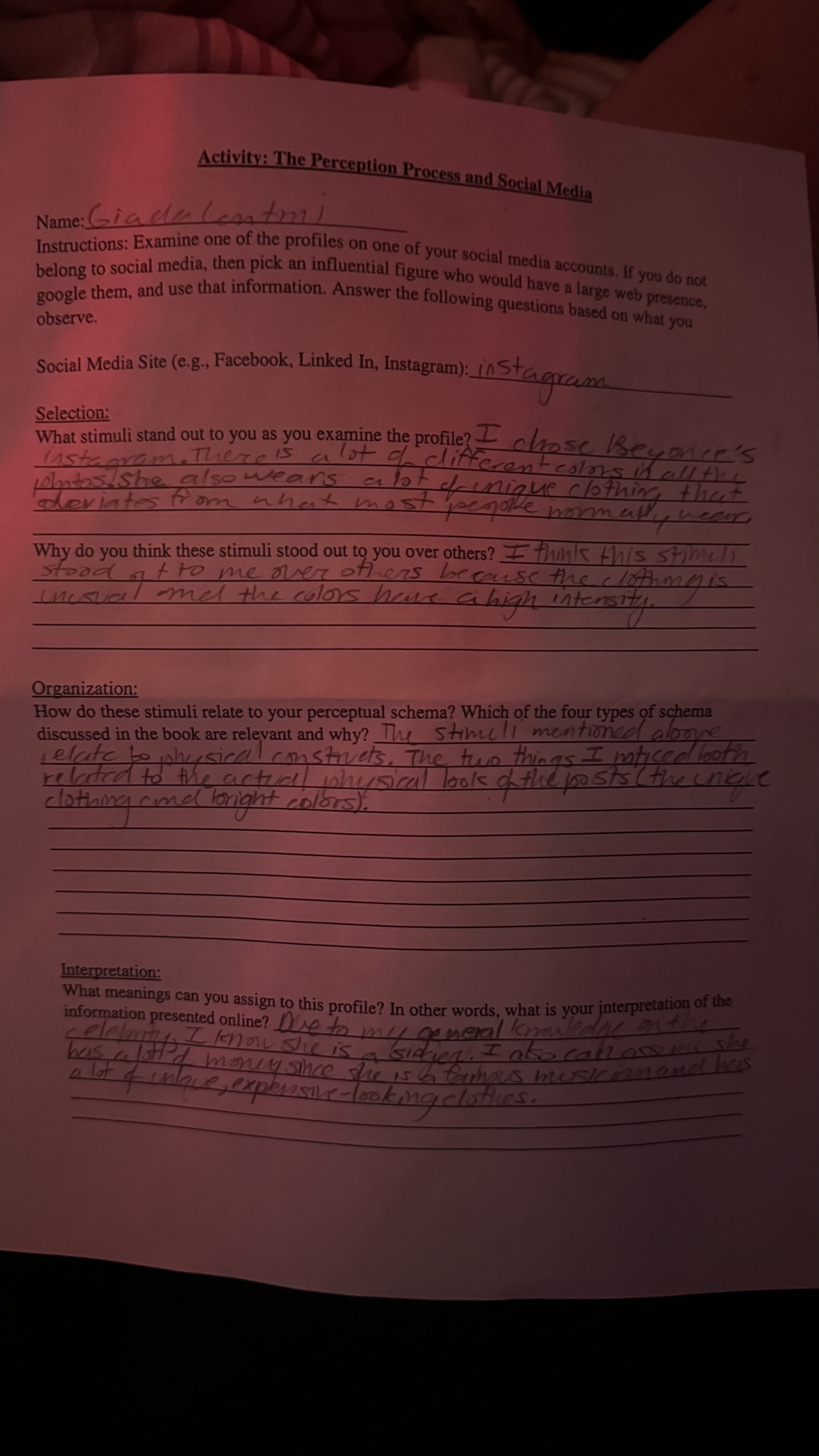
The process of perception: your activity, the perception process and social media, and your notes from the discussion of this activity.
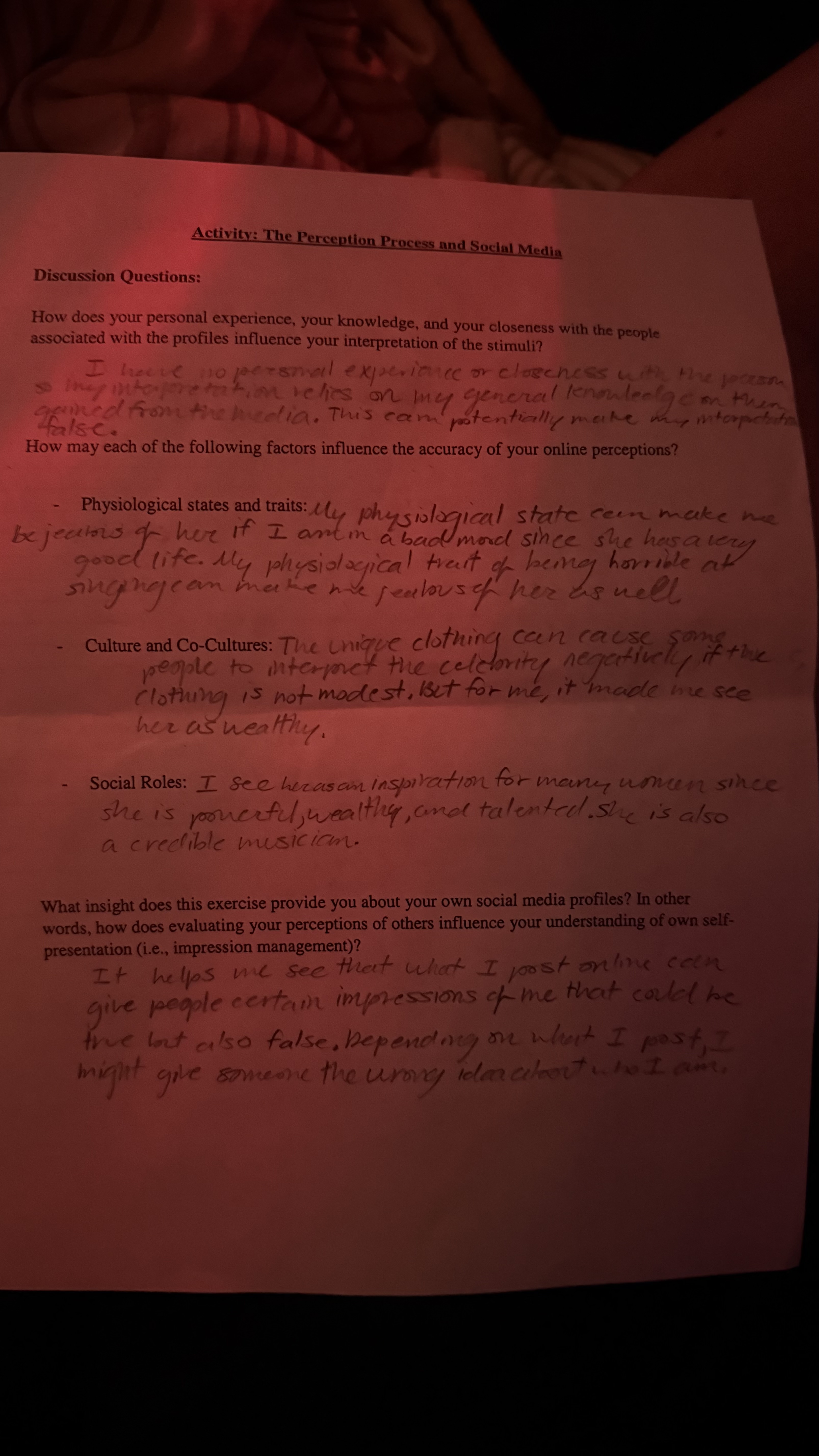
The process of perception:Understand the influences on perceptual accuracy
Physiological states and traits- Physiology is the study of the mechanical and biochemical ways in which our bodies work. Physiological states are conditions that are temporary. We enter and leave various physiological states, meaning that their influence comes and goes over time. Physiological traits are conditions that affect us on an ongoing basis. Compared with states, which are continually changing, traits are more enduring
Cultures and co cultures- Cultural values and norms have many different effects on the way we communicate interpersonally. Affects our behavior, culture influences our perceptions and interpretations of other people’s behaviors. Co-cultural differences can also influence perceptions.
Social roles- A social role is a set of behaviors that are expected of someone in a particular social situation. Each of us plays several social roles, and those roles can also influence the accuracy of our perceptions
Fundamental forces in interpersonal perception: key concepts in this section.
stereotypes- which are generalizations about a group or category of people that can have powerful influences on how we perceive those people.
the primacy effect- first impressions are critical because they set the tone for all future interactions. First impressions are most important
recency effect- which says that the most recent impression we have of someone is more powerful than our earlier impressions. Most recent impression is most important.
both appear to be more important than any impressions that we form in between
perceptual set- predisposition to perceive only what we want or expect to perceive
egocentric- lack the ability to take another person’s perspective.
positivity bias- pay the most attention to positive information
negativity bias- tendency to weigh negative information more heavily than positive
Explaining what we perceive: Understand the three factors important to explaining behavior through attributions
attribution is simply an explanation, the answer to a why question
Locus-where the cause of a behavior is located, whether within ourselves or outside ourselves.
internal- caused within ourselves
external- caused outside ourselves
Stability- stable cause is one that is permanent, semipermanent, or at least not easily changed. unstable causes occur only from time to time in unpredictable places with unpredictable effects. ex→ why are you late? stable- professor always holds class over time. unstable- there was traffic
controlability- how controllable they are. The behavior under the person's control
All three related to each other, combination of them helps to determine attributions
Explaining what we perceive: Review the common attribution errors
Self-Serving Bias- We attribute our successes to internal causes and our failures to external causes.
Fundamental Attribution Error- We attribute other people’s behaviors to internal causes more often than to external causes.
Overattribution- We focus on one characteristic of a person and attribute a wide variety of behaviors to that characteristic. ex→ stereotypes/clichés “blondes are dumb”
Improving your perceptual abilities: the processes for being mindful of your perceptions
know yourself- ask yourself how perceptions are influenced by your personal attributes. (gender, cultural values, expectations, physiological states and traits, experiences)
focus on other people’s characteristics: the influence of gender and culture- Being mindful of our perceptions also means acknowledging how they are influenced by characteristics of the people we’re perceiving. when we observe interactions between people from other cultures, we are more likely to misinterpret their behaviors
consider the context: the context itself limited the information that you could select for attention. An important part of being mindful of your perceptions, therefore, is to ask whether there are pieces of information to which you didn’t have access.
Improving your perceptual abilities: checking your perceptions
Separate interpretations from facts-describing what you actually saw or heard is not the same thing as interpreting it. If we are to check the accuracy of our perceptions, we must start by separating what we heard or saw from the interpretation we assigned it.
Generate alternative perceptions- A better approach is to look for alternative ways of perceiving the situation, even if they contradict your initial perception.The practice of generating alternative perceptions is important for two reasons. First, it requires you to look at information about the situation that doesn’t match your original perception. Second, generating alternative perceptions encourages you to ask yourself what information you don’t have that might be relevant
Engage in perception checking behaviors- Perception checking is the process of testing your perceptions for accuracy. You can engage in either direct or indirect means of perception checking. Direct perception checking involves simply asking other people if your perception of a situation is accurate:
Acknowledging the behavior you witnessed.
Interpreting that behavior.
Asking whether your interpretation was correct.
Direct perception checking will be the most useful, therefore, when you approach people who are willing either to confirm your perceptions or to correct them. indirect perception checking involves listening and observing in order to seek additional information about the situation. you might observe her facial expressions, listen to how she talks to others, and watch her body language. It is best to use direct and indirect perception checking because neither is completely fool proof.
Revise your perceptions when necessary-Good communicators use what they learn from perception checking to modify their perceptions of a situation. you’ll realize that they were not accurate, for any of the reasons we’ve considered:
They were limited by characteristics of yourself, of the people involved, or of the situation
you were confusing facts and interpretations
you didn’t consider any alternative perceptions.

