Algae and Non Vascular plants
 Studied by 0 people
 Call Kai
 Learn
Learn Practice Test
 Spaced Repetition
 Match
Match Flashcards
 Knowt Play
1/27

There's no tags or description
Looks like no tags are added yet.
Name | Mastery | Learn | Test | Matching | Spaced | Call with Kai |
|---|
No analytics yet
Send a link to your students to track their progress
28 Terms
Algae
Photosynthetic eukaryotic organisms
Polyphyletic
Chrysophyta
(golden brown algae and related colorless forms)
chlorophyll a and c, fucoxanthin
Stramenopile (SAR)
Phaeophyta
(brown algae)
chlorophyll a and c, fucoxanthin
Stramenopile (SAR)
Xanthophyta
(yellow- green algae)
Related to brown algae
chlorophyll a, c1 and c2, β-carotene, xanthophylls
Stramenopile (SAR)
Rhodophyta
(red algae)
chlorophyll a, α- and β- carotene, lutein, zeaxanthin, phycobilin
Archeaplastida
Chlorophyta
(green algae)
chlorophylls a and b, carotene, xanthophyll
Archeaplastida
producer
bioindicator for environmental changes
Food Source
Algae’s ecological significance
xylem and phloem
stomata
internal air spaces
three things non-vascular plants do not have
poikilohydric
Non-vascular plants are unable to control the rate of water loss from their tissues and are said to be ___________
lacks a vascular system
simpler tissues that are used for internal transport of water
structures that looks like leaves but are not true leaves
Non-vasular plants characteristics (3)
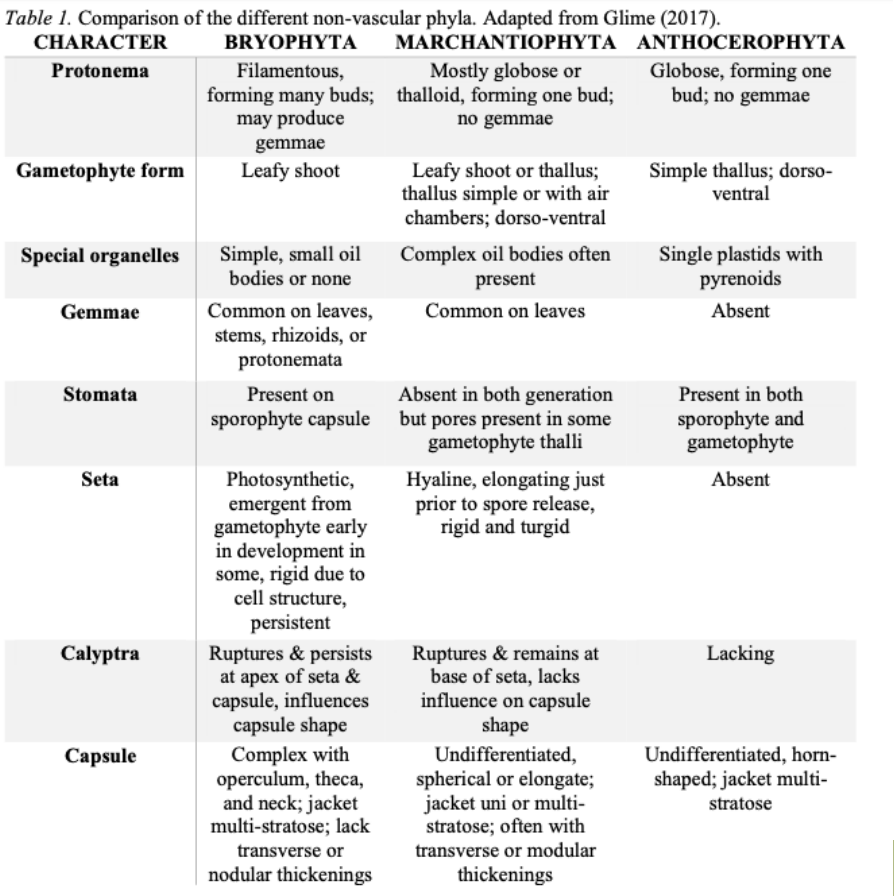
Bryophytes
represented today by three phyla of small herbaceous (nonwoody) plants
Gametophytes
larger and longer-living than sporophytes
Sporophytes
typically present only part of the time
liverworts
mosses
hornworts
Three phyla of non-vascular plants
Mosses
range in height from less than 1 mm - 60 cm (most are <15 cm)
The blades of their “leaves” are usually only one cell thick
The familiar carpet of moss you observe consists mainly of gametophytes.
Moss sporophytes are typically elongated and visible to the naked eye, with heights ranging up to about 20 cm.
Though green and photosynthetic when young, they turn tan or brownish red when ready to release spores.
capsule
seta
In mosses, it comprises the sporophyte (a sturdy plant that takes months to grow)
tan or brownish red
In mosses, when they are ready to release spores, what color will the mosses turn into
Liverworts
• Old name: Marchantiophyta
• Some have liver-shaped gametophytes
• Two types: thalloid and leafy
Thalloids – have flattened gametophyte
Leafy - gametophytes have many leaflike appendages
Thalloids
Leafy
Two types of Liverworts
Hornworts
• long, tapered shape of the sporophyte. A typical sporophyte can grow to about 5 cm high.
• Its sporophyte lacks a seta and consists only of a sporangium.
• The sporangium releases mature spores by splitting open, starting at the tip of the horn.
• The gametophytes grow mostly horizontally and often have multiple sporophytes attached.
• Frequently among the first species to colonize open areas with moist soils; a symbiotic relationship with nitrogen-fixing cyanobacteria contributes to their ability to do this
symbiotic relationship with nitrogen-fixing cyanobacteria
Hornworts can colonize areas with moist soils; what is the reason?
seta
hornwort sporophyte lacks a _____ and consists only of a sporangium.
horizontally
The gametophytes of hornworts grow mostly _______ and often have multiple sporophytes attached.
remember
ecological importance of mosses
• initiating soil formation on barren terrain
• prevent soil erosion ; maintaining soil moisture
• recycling nutrients; help retain nitrogen in the soil
• Formation of Peat (fuel source)
Peat is a brown or dark color substance formed by the gradual compression and carbonization of the partially decomposed pieces of dead vegetative matter in the bogs
• Packing Material
Dried mosses and Bryophytes have great ability to hold water. Due to this ability the Bryophytes are used as packing material for shipment of cut flowers, vegetables, perishable fruits, bulbs, tubers etc.
• Medicines
antibacterial, antifungal, cytotoxic, antitumor and insecticidal
Sphagnum
an important global reservoir of organic carbon
Overharvesting of it and/or a drop in water level in peatlands could release stored CO2 to the atmosphere
Low temperature, pH, and oxygen levels of peatlands inhibits decay of moss and other organisms
Peat
brown or dark color substance formed by the gradual compression and carbonization of the partially decomposed pieces of dead vegetative matter in the bogs
Dried Mosses and Bryophytes
________and ______ have great ability to hold water. Due to this ability, they are used as packing material for shipment of cut flowers, vegetables, perishable fruits, bulbs, tubers
 Note
Note  Flashcards (24)