Lecture 1: Intro to Physiology/Background Terms
0.0(0)
 Studied by 1 person
 Call Kai
 Learn
Learn Practice Test
 Spaced Repetition
 Match
Match Flashcards
 Knowt Play
Card Sorting
1/99

Last updated 12:27 AM on 1/9/23
Name | Mastery | Learn | Test | Matching | Spaced | Call with Kai |
|---|
No analytics yet
Send a link to your students to track their progress
100 Terms
1
New cards
What is physiology?
The study of interactions between molecules, cells, tissues, organs, and organ systems to understand the structure and function of an organism and its interaction with the environment
2
New cards
At what levels can physiology be studied?
cell + molecular physiology → systems physiology → organismal physiology → ecological physiology
3
New cards
Comparative physiology
studies and explores the diversity of functional characteristics of various kinds of organisms
4
New cards
Integrative physiology
investigates the broader aspects of physiology that involve the integration of mechanisms and regulatory functions at all biological levels
5
New cards
Structure vs. function (with examples)
* Differences between related animals living in different extreme environments (ex: arctic vs. temperate forest vs. desert foxes)
* Similarities between unrelated animals living in the same environment (ex: we see this primarily with color)
* Common solutions to physiological problems in unrelated organisms (ex: breathing and gas exchange)
* Causes of pathological conditions
* Pathophysiological conditions + disease states can provide insight to physiological regulatory mechanisms (ex: Goiter)
* Similarities between unrelated animals living in the same environment (ex: we see this primarily with color)
* Common solutions to physiological problems in unrelated organisms (ex: breathing and gas exchange)
* Causes of pathological conditions
* Pathophysiological conditions + disease states can provide insight to physiological regulatory mechanisms (ex: Goiter)
6
New cards
Goiter
thyroid hyperplasia that can be prevented by the use of idolized salt
7
New cards
Physiological regulation
a. Conformers vs. Regulators
b. Homeostasis
c. Positive vs. Negative Feedback
b. Homeostasis
c. Positive vs. Negative Feedback
8
New cards
Conformers (+ ex)
Allow internal conditions to change when subjected to variation in external conditions
\
(ex: temperature regulation in fish, amphibians, reptiles, most insects)
\
(ex: temperature regulation in fish, amphibians, reptiles, most insects)
9
New cards
Regulators (+ ex)
Maintain relatively constant internal conditions regardless of external conditions (ex: temperature regulation in birds and mammals)
10
New cards
Can an animal be a conformer for one physiological condition and a regulator for another? What is an example of this?
Yes; fish are conformers for body temperature but are regulators for salt balance in body fluids
11
New cards
Homeostasis
The process of maintaining a stable internal environment in the face of changing external conditions
12
New cards
_______ about a variable is used to control processes in cells, tissues, and organs that influence the internal level of the variable
Sensory information
13
New cards
What is the generalized feedback control system cycle
Disturbance → Sensory → Reponse
14
New cards
Negative feedback loop
* The sampling of a controlled variable with immediate corrective action
* Common in physiological systems because they maintain homeostasis
* Common in physiological systems because they maintain homeostasis
15
New cards
Negative feedback loop cycle
Disturbance → Sensor → Correction
16
New cards
The set point
The desired point of homeostasis
17
New cards
Negative feedback loops will always do what to the set point?
Bring the system back to the set point
18
New cards
Negative feedback loop examples
* BP
* Hormone levels
* Salt concentrations
* Hormone levels
* Salt concentrations
19
New cards
Positive feedback loop
the sampling of a controlled variable leading to the amplification of the disturbance
20
New cards
Positive feedback loop cycle
Disturbance → Sensor → Amplification
21
New cards
What do positive feedback loops do to the set point?
They lead the system away from the set point
22
New cards
Are positive feedback loops stable or unstable?
Highly unstable; due to this, they are rarely encountered in healthy states
23
New cards
Positive feedback loop examples
* Birth of a baby
* Milk production
* Milk production
24
New cards
Adaptation
* A trait that arose via an evolutionary process such as natural selection and improves an animal’s fitness (survival and reproductivity success)
* As a result of adaptation, the physiology of an animal is usually very well suited to its environment
* Gradual changes over many generations
* Hereditary
* Not reversible
* As a result of adaptation, the physiology of an animal is usually very well suited to its environment
* Gradual changes over many generations
* Hereditary
* Not reversible
25
New cards
What makes acclimatization and acclimation different from adaptation?
* They are adjustments of physiological processes in response to environmental change
* They are changes that occur during an animal’s lifetime and are usually reversible
* Result from chronic exposure to a new environment
* They are changes that occur during an animal’s lifetime and are usually reversible
* Result from chronic exposure to a new environment
26
New cards
Acclimatization
Refers to changes in a natural environment
27
New cards
Acclimation
Changes are induced experimentally in the lab, not in a natural environment
28
New cards
Polarity
degree to which positive and negative charges are separated at different ends of the molecule
29
New cards
Is water polar?
Yes, because it forms H bonds
30
New cards
\-philic
To have an affinity for
31
New cards
\-phobic
To have an aversion to
32
New cards
Amphipathic
Contains both hydrophobic and hydrophilic components
33
New cards
Hydrophobic
Doesn’t mix with water
34
New cards
Hydrophilic
Mixes with or dissolves in water
35
New cards
Lipophobic
Having no affinity for fats or organic solvents
36
New cards
Lipophilic
Tending to combine with or dissolve in lipids or fats
37
New cards
Acid
Any molecule that can donate a proton (H+) // ex: hydrochloric acid, HCl
38
New cards
Base
Any molecule that can accept a proton (H+) // ex: ammonia, NH3
39
New cards
pH scale
a measure of acidity ranging from 0-14 (0=extremely acid, 7=neutral, 14=extremely basic)
pH = -log10\[H+\]
pH = -log10\[H+\]
40
New cards
Do cells and tissues have wide or narrow pH tolerances/ranges?
narrow
41
New cards
How is this narrow pH range achieved?
Buffers! The body generates bicarbonate ions (HCO3-) to bind to the protons generated during metabolism
\
HCO3- + H+ → H2CO3
\
HCO3- + H+ → H2CO3
42
New cards
Carbohydrates
molecules consisting of C, H, O containing many alcohol ground (-OH)
43
New cards
Monosaccharides (+ ex)
Small carbohydrates, often in a ring structure (ex: glucose)
44
New cards
Disaccharides (+ ex)
Two monosaccharides attached by a covalent bond (ex: lactose)
45
New cards
Polysaccharides (+ ex)
* aka complex carbohydrates
* Long polymers of monosaccharides
* Can function in energy storage (e.g. starch + glycogen) or can be structural (e.g. cellulose + chitin)
* Hydrophilic due to polar -OH groups
* Long polymers of monosaccharides
* Can function in energy storage (e.g. starch + glycogen) or can be structural (e.g. cellulose + chitin)
* Hydrophilic due to polar -OH groups
46
New cards
Proteins
* Molecules consisting of linear chains of amino acids
* Can be structural (i.e. muscle) or can be enzymes
* Can be structural (i.e. muscle) or can be enzymes
47
New cards
Amino acids
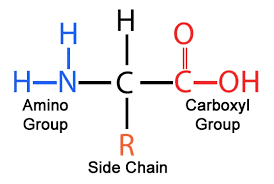
* Have both an amino group (-NH2) and a carboxylic acid group (-COOH)
* The side chain varies depending on the specific amino acid (side chains can be hydrophilic or hydrophobic)
* The side chain varies depending on the specific amino acid (side chains can be hydrophilic or hydrophobic)
48
New cards
Draw an amino acid chain
49
New cards
Peptides
Small chains of amino acids joined by peptide bonds
50
New cards
Enzymes
Molecules that catalyze or increase the rate of chemical reactions (i.e. Carbonic Anhydrase)
51
New cards
Protein structure
Primary structure, secondary structure, tertiary structure, quaternary structure
52
New cards
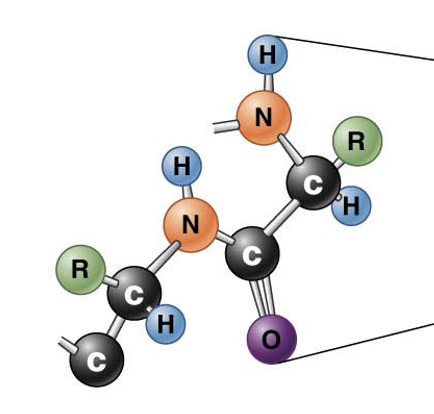
Protein primary structure
Amino acid sequence
53
New cards
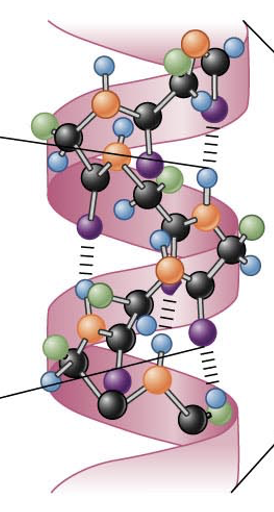
Protein secondary structure
Highly regular sub-structures (i.e. alpha helix, beta sheets)
54
New cards
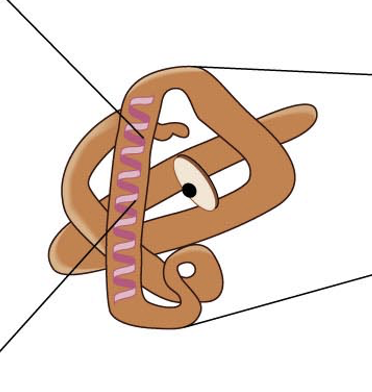
Protein tertiary structure
3D structure of single protein molecule
55
New cards
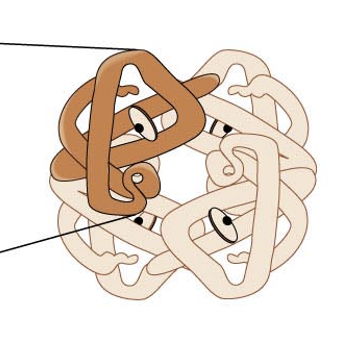
Protein quaternary structure
3D structure of multi-subunit protein (i.e. hemoglobin)
56
New cards
Are proteins hydrophilic or hydrophobic? Why?
* Hydrophilic due to their 3D structure
* Hydrophobic amino acids contained on the inside; hydrophilic amino acids found on the exterior – this allows for interaction with water
* Hydrophobic amino acids contained on the inside; hydrophilic amino acids found on the exterior – this allows for interaction with water
57
New cards
Lipids (+ ex)
Hydrophobic molecules containing mostly C and H atoms (ex: fats, phospholipids, and steroids)
58
New cards
Fatty acids
* Hydrocarbon chains with a carboxylic acid group (-COOH) at one end.
* Saturated = no double bonds between Cs
* Unsaturated = at least one double bond
* Saturated = no double bonds between Cs
* Unsaturated = at least one double bond
59
New cards
Triglyceride
* A glycerol molecule bonded to three fatty acid chains.
* Functions in energy storage
* Functions in energy storage
60
New cards
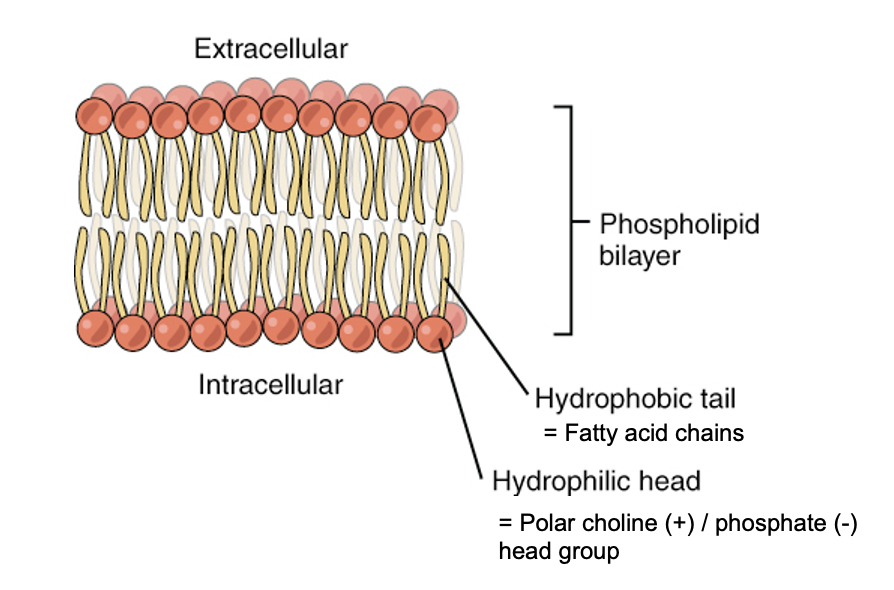
Phospholipids
* Lipids containing a polar head with phosphate group (hydrophilic) and fatty acids (hydrophobic) à amphipathic
* Important structural molecules in cell membranes
* Important structural molecules in cell membranes
61
New cards
Steroids
Lipid molecules composed of four hydrocarbon rings (ex: Cholesterol, many hormones like estrogen and testosterone)
62
New cards
Energy transfer in cells
Some chemical reactions occur spontaneously and release energy (**exergonic**) whereas others require energy to proceed (**endergonic**)
63
New cards
Exergonic
Release energy/occur spontaneously
64
New cards
Endergonic
Require energy to proceed
65
New cards
ATP
Adenosine triphosphate; most common molecule used for energy transfer in cells
66
New cards
Metabolism
* All the reactions that occur in living organisms to maintain life
* Involves reactions that harvest energy from food and use energy for life processes
* Involves reactions that harvest energy from food and use energy for life processes
67
New cards
What are cell (plasma) membranes composed of?
A phospholipid bilayer
68
New cards
Draw the phospholipid bilayer and explain
69
New cards
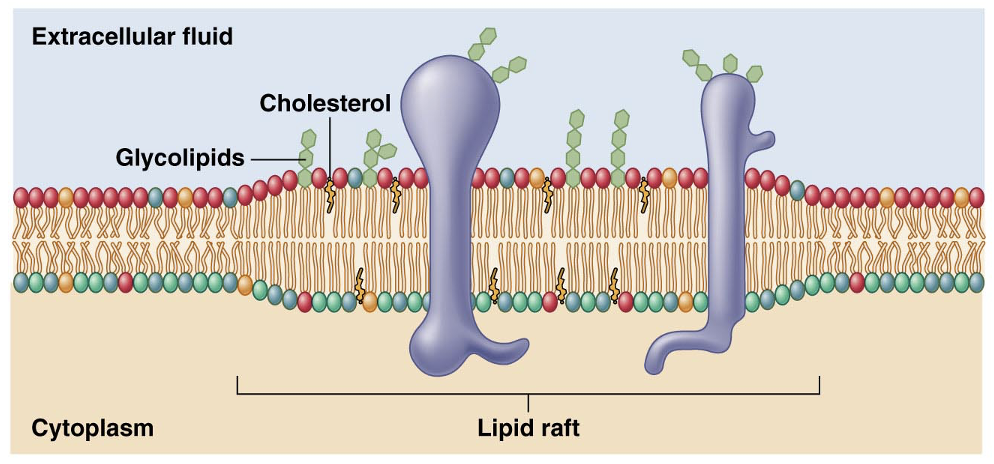
Cholesterol
Reduces membrane permeability by strengthening interactions between polar head groups
70
New cards
How does temperature influence fluidity in how it pertains to cholesterol?
Higher temps → decrease fluidity
Lower temps → increase fluidity
Lower temps → increase fluidity
71
New cards
Lipid rafts
membrane microdomains containing elevated levels of cholesterol and phospholipids with saturated fatty acid chains. These play an important role in membrane protein localization.
72
New cards
Membrane function
* Selective permeability
* Ion gradients across lipid bilayers (ex: there is a large, around 20,000 fold, calcium gradient across the cell membrane)
* Ion gradients across lipid bilayers (ex: there is a large, around 20,000 fold, calcium gradient across the cell membrane)
73
New cards
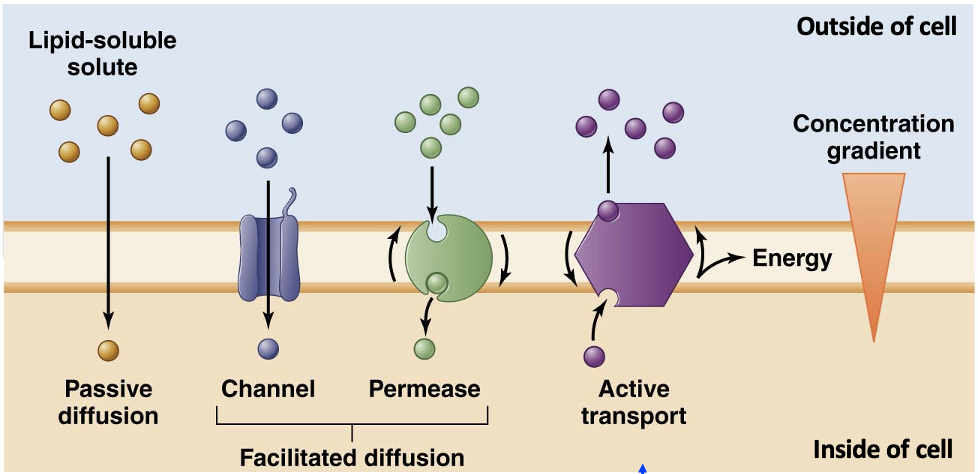
Types of transport mechanisms across the membrane
1. Passive diffusion
2. Facilitated diffusion (either channel or permease)
3. Active transport
4. Concentration gradient
74
New cards
Which types of transport do not require energy?
Passive diffusion and facilitated diffusion
75
New cards
Which types of transport require energy?
Active transport
76
New cards
What are the two types of active transport?
Primary active transport and secondary active transport
77
New cards
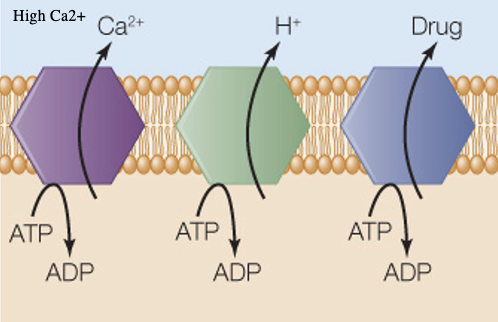
Primary active transport
Uses energy stored in ATP to move molecule/ion against concentration gradient
78
New cards
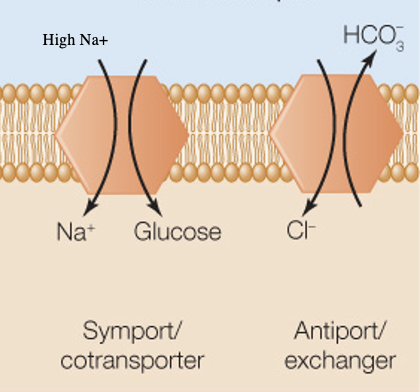
Secondary active transport
Uses energy associated with gradient of one molecule/ion to move another molecule/ion against its concentration gradient
79
New cards
Example of primary active transport
Na+K+ATPase
* Pumps 3 Na+ out of the cell for every 2 K+ it pumps into the cell. This requires energy provided by the hydrolysis of ATP.
* This contributes to several electrochemical gradients
* \[Na+\] greater outside than inside the cell
* \[K+\] greater inside than outside the cell
* Inside of cell is negatively charged relative to outside
* Pumps 3 Na+ out of the cell for every 2 K+ it pumps into the cell. This requires energy provided by the hydrolysis of ATP.
* This contributes to several electrochemical gradients
* \[Na+\] greater outside than inside the cell
* \[K+\] greater inside than outside the cell
* Inside of cell is negatively charged relative to outside
80
New cards
Example of secondary active transport
The Glucose-Na+ cotransporter
* Na+ concentration high outside cell, glucose concentration high inside cell
* Movement of glucose into cells against its concentration gradient using the energy supplied by the concentration gradient of Na+
* Na+ concentration high outside cell, glucose concentration high inside cell
* Movement of glucose into cells against its concentration gradient using the energy supplied by the concentration gradient of Na+
81
New cards
G-protein-coupled receptors (GPCRs) (+ ex)
* Signal across the membrane
* Located in the cytoplasm
* Ex: some hormone receptors (e.g. adrenalin) and some neurotransmitter receptors
* Located in the cytoplasm
* Ex: some hormone receptors (e.g. adrenalin) and some neurotransmitter receptors
82
New cards
How do GPCRs work
1. Ligand binds to a G-protein-coupled receptor, causing a conformational change
2. The activated receptor signals to an associated G protein, causing the alpa subunit to release GDP and bind GTP
3. The activated alpha or beta gamma subunits move through the membrane and interacts with an amplifier enzyme
4. The activated amplifier enzyme converts and inactive second messenger to its active form
5. The activated second messenger activates or inhibits cellular pathways
83
New cards
Mitochondria
* Produce ATP through aerobic processes
* Powerhouse of the cell
* Powerhouse of the cell
84
New cards
Nucleus
Contains DNA, the genetic material that encodes proteins
85
New cards
Endoplasmic reticulum (two types)
Smooth endoplasmic reticulum
* does not bind ribosomes
* site of Ca2+ storage
\
Rough endoplasmic reticulum
* has ribosomes bound to outer surface (“rough”)
* Involved in packaging proteins fro secretion
* does not bind ribosomes
* site of Ca2+ storage
\
Rough endoplasmic reticulum
* has ribosomes bound to outer surface (“rough”)
* Involved in packaging proteins fro secretion
86
New cards
Golgi apparatus
Aka Golgi complex or Golgi network
Involved in protein processing and modification
Involved in protein processing and modification
87
New cards
Endosomes
* transport
* contain proteins, etc. from outside of the cell via endocytosis (pinocytosis or phagocytosis) or from inside the cell (ER or Golgi)
* Recycle proteins or deliver them to the lysosome for protein breakdown
* contain proteins, etc. from outside of the cell via endocytosis (pinocytosis or phagocytosis) or from inside the cell (ER or Golgi)
* Recycle proteins or deliver them to the lysosome for protein breakdown
88
New cards
Lysosomes
* breakdown
* have acidic interior
* break down proteins and other molecules
* have acidic interior
* break down proteins and other molecules
89
New cards
Cytoskeleton
* Made up of microtubules, microfilaments, and intermediate filaments
* Determine the cell shape and intracellular transport of molecules
* Determine the cell shape and intracellular transport of molecules
90
New cards
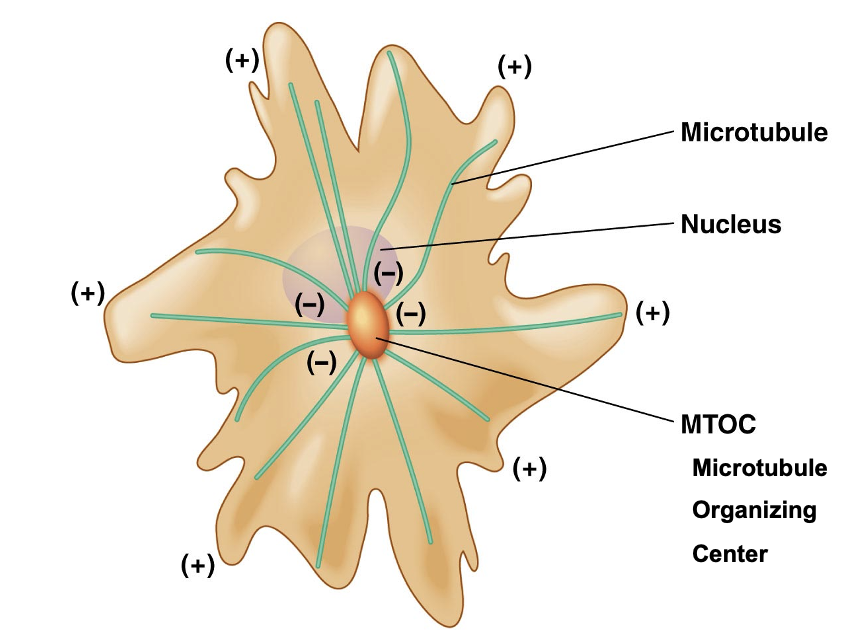
MTOC
Microtubule Organizing Center
91
New cards
Microtubule Organization
92
New cards
Cell cargo transport in microtubules
Kinesin and Dynein
93
New cards
Kinesin
Motor protein that transports its cargo vesicles along microtubules in a “plus-end” direction
94
New cards
Dynein
Motor protein that transports it cargo vesicles along microtubules in a “minus-end” direction
95
New cards
What is found in the space between cells
* The extracellular matrix (ECM), which is a network of extracellular molecules secreted by cells
* It contains collagen, fibronectin, and integrin
* It contains collagen, fibronectin, and integrin
96
New cards
Collagen
Protein that forms fibers and sheets for structural support
97
New cards
Fibronectin
Glycoprotein that can bind to integrin and fibers in the ECM, contributing to cell adhesion
98
New cards
Integrin
Membrane receptors for ECM proteins, help attach cells to their external environment
99
New cards
Plasma membrane
Also called the cell membrane, it’s the membrane found in all cells that separates the interior of the cell from the outside environment
100
New cards
Ribosomes
Involved in making proteins
 Note
Note  Flashcards (117)