Pollution, Environmental, Degradation & Disease
 Studied by 0 people
 Call Kai
 Learn
Learn Practice Test
 Spaced Repetition
 Match
Match Flashcards
 Knowt Play
1/27

There's no tags or description
Looks like no tags are added yet.
Name | Mastery | Learn | Test | Matching | Spaced | Call with Kai |
|---|
No analytics yet
Send a link to your students to track their progress
28 Terms
Pollution & environmental degradation
Even if habitats are structurally intact, individuals, populations, species, communities & ecosystems can be profoundly damaged
Pollution and evntal degradation - obvious causes
keeping too many cattle in a grassland community gradually damages it, often eliminating native spp. and favoring invasive spp.
Pollution and evntal degradation - causes not obvious
fishing trawlers drag ~15 million km2 of ocean floor annually, destroying delicate creatures (e.g., anemones, sponges), reducing spp. diversity & biomass and altering community structure
Pollution
Subtle form of environmental degradation caused by:
pesticides, herbicides, sewerage, fertilizers from agriculture, industrial chemicals & wastes, emissions from factories & automobiles, & sediment deposits from erosion
Pesticide pollution
▪History: first brought to our attention in Rachel Carsen’s influential book: Silent Spring
▪She described biomagnification, whereby pesticides such as DDT become concentrated as they ascend the food web
▪For example, pesticides are added to crops to kill insects or added to water bodies to kill mosquitos
Pesticide pollution DDT
Animals, especially top predators such as eagles and hawks, were declining due to biomagnification after WWII, because they were eating animals exposed to DDT (dichlorodiphenyltrichloroethane)
For example, during 1970-2000 there were no bald eagles nesting in Louisiana; now they are common in many areas
Peregrine Falcons - DDT
Once common
1940s: DDT introduced to control mosquitos
DDT>DDE = interferes w/calcium production
Eggshells too thin, mothers crushed their own eggs
Severe declines in PFs, bald eagles, brown pelicans & others
1970s: DDT banned
1999: PF de-listed as an Endangered Species
water pollution
Destroys food sources, contaminates drinking water with chemicals
Severely damages aquatic ecosystems
Pesticides, herbicides, petroleum products, heavy metals (e.g., mercury, lead, zinc), detergents, toxic chemicals (PCB’s) and industrial wastes directly kill aquatic organisms, including fish, invertebrates, amphibians and marine mammals
River, lakes and oceans are used as open sewers for industrial waste & residential sewerage
More people = more water pollution
Diffuses over a wider area than terrestrial pollution
Biomagnification is also a problem in aquatic systems
Plants & animals are often adapted to filter large volumes of water in order to obtain essential minerals…
…but when the water is polluted they end up concentrating toxins (e.g., mercury) which can bioaccumulate in fish and effect the nervous systems of animals high in the food chain that eat fish (e.g., humans, marine mammals, eagles)
Water pollution - too much of essential minerals
Even essential minerals that are normally beneficial become harmful pollutants at high concentrations
For example, releases of human sewerage, agricultural fertilizers, detergents and industrial wastes add harmful levels of N & P in aquatic systems (eutrophication)
Algal blooms from the above outcompete other planktonic species & detrimentally shade bottom-dwelling plant species
As the algae die and sink they cause booms in bacteria and fungi & absorb oxygen. Without oxygen, animal life perishes (e.g., visible as fishkills)
Water pollution - red tides
Red tides are algal blooms involving dinoflagellates
Can cause massive fish kills
air pollution
Historically, people assumed that the atmosphere was so vast that the materials released would become widely dispersed with minimal effects
Today we know that air pollution has damaged whole ecosystems and creates problems for humans as well
Acid Rain
Produced when smelting operations and coal- and oil-fired power plants release huge quantities of nitrogen oxides & sulfur oxides in the atmosphere
Those chemicals combine with moisture in the air to produce nitric & sulfuric acids
These acids are incorporated into weather systems and dramatically lower the pH of rainwater (pH<5)
Adverse impacts on forests, freshwaters, soils. Leads to the death and weakening of trees & other plants, insects & other animals over wide areas
Acid rain effects
Increased acidity (pH< 5) of freshwater systems causes invertebrates, fish and amphibians to perish, or causes them to fail to breed (e.g., eggs and tadpoles of frogs)
Increased acidity also inhibits the process of decomposition, lowering the rate of mineral recycling & ecosystem productivity
Many ponds & lakes in industrial countries have lost portions of their animal communities due to acid rain; many are in near-pristine areas hundreds of miles from sources of pollution
Acid rain – regulations lead to a solution!
1970s: public awareness of acid rain began
1980s: dismissed by President Reagan, until he visited Canadian border: damaged forests due to drifting pollution from he U.S. Midwest
1990s: report: 2% of New England lakes too acidic for trout; 6% for minnows
1990s: series of amendments to the Clean Air Act to control emission of SO2 and NO2
Called for 50-70% reductions in emissions over time
By 2000s: SO2 emission reductions were ahead of their 2010 target
ozone
an upper atmosphere gas that is “earth’s sunscreen,” protecting organisms from dangerous wavelengths of (solar) UV radiation
Automobiles, power plants & industrial activities release hydrocarbons as waste products; in the past CFCs (chlorofluorocarbons) and halons were used extensively in refrigeration, aerosol spray cans and as propellants (e.g., fire extinguishers)
In the presence of sunlight, these chemicals react with the atmosphere to reduce ozone
Negative effects of ozone depletion
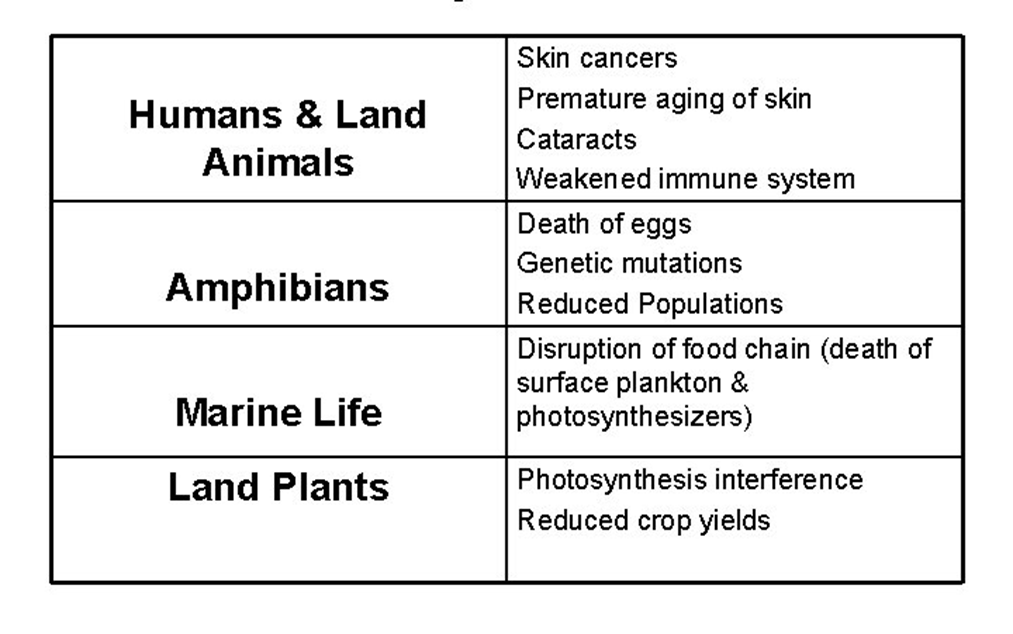
Too much ozone?
Although ozone high in the atmosphere is important for protection from UV radiation, too much ozone at ground level damages plants (including agriculture) and animals
Toxic metals
Lead gasoline, coal burned for heat and power, mining and smelting operations, and other industrial activities release large quantities of lead, zinc & mercury which are poisonous to plants & animals
Lead poisoning cases are down in recent decades in many countries due to the ban on leaded gasoline and lead-based paints
lead levels over time
unleaded gas introduced in 1970s; leaded gas banned by 1996
lead-based paints were banned in 1978; paint on/in houses built before then likely contain lead
EPA - its creation
In 1970, following a number of environmental problems/disasters, President Richard Nixon created the Environmental Protection Agency (EPA)
The problems included deteriorating city air, human debris in natural areas & contaminated urban water supplies
The EPA was tasked with improving water treatment facilities, setting air quality standards, a cleanup of facilities that fouled air & water, legislation to end dumping of wastes into the Great Lakes, taxing lead additives to gasoline & strategies for prevention and cleanup of oil spills
Superfund
By the 1970s thousands of contaminated sites existed nationally due to hazardous waste being dumped, left out in the open, or otherwise improperly managed
These sites include manufacturing facilities, processing plants, landfills and mining sites
In 1980 the EPA set up Superfund, which allowed them to clean-up the nation’s worst hazardous waste sites & respond to locally and nationally significant environmental emergencies
EPA - recent times
The previous Trump administration dismissed or re-assigned many EPA scientists and replaced them with lobbyists
Regulations on industry were rolled back
The Biden administration has dismissed many of those lobbyists in an attempt to restore the science that informs regulations
The new Trump administration is beginning to deregulate industry including safety measures designed to prevent human fatalities and injuries
Those genuinely interested in environment are concerned that without a science-informed EPA we will repeat the mistakes of the past with regards to polluting the environment
Pollutants do not observe political boundaries!
Many countries have tightened regulations (e.g., the banning of leaded gasoline lead-based paints in the U.S.)
However, pollutants can often cross borders, in both water and air, causing major issues for neighboring countries with different regulations
Therefore, international agreements are important for the health of humans and ecosystems
Disease
Disease can be a major threat to biodiversity
Often grouped with invasive species effects; sometimes in its own category
Responsible for 31 extinctions and countless extirpations & population declines
May increase due to not only habitat loss but also environmental degradation
Chytrid fungus and amphibians
Frogs with the invasive chytrid fungus develops chytridiomycosis which often kills them
Degrades the keratin layer in the skin of frogs & mouthparts of tadpoles
Interferes with breathing and nervous system function
9 spp. have gone extinct, 500 have exhibited declines, others mildly or not affected
White-nosed Syndrome & Bats
White-nosed syndrome is an invasive disease caused by a cold-loving fungus
Grows on the skin and disturbs bats during hibernation, causing dehydration, starvation and death
First found in New York in 2006; has spread to 35 states
Has caused >90% declines in 3 species of bats: northern long-eared bat, little brown bat, tricolored bat
Avian influenza (Bird flu) & birds
Occur naturally among >100 wild aquatic birds worldwide
Ducks, geese, swans, gulls, terns, shorebirds, etc
Spread through saliva, nasal secretions, feces & surfaces
Can kill wild birds but some individuals & species become reservoirs
Pentastomes & reptiles
Parasitic crustaceans that live in the lungs of snakes & other reptiles
Eggs pass through the digestive tract of the definitive host (e.g., snake)
Coprophagous insects ingest the eggs (e.g., roaches)
Insectivores (e.g., lizards, frogs) become the intermediate host when they eat the insects and are infected by larvae
Definitive host is infected when consuming the intermediate host
 Note
Note  Flashcards (40)