Physics - Oscillations
 Call Kai
 Learn
Learn Practice Test
 Spaced Repetition
 Match
Match Flashcards
 Knowt Play
1/17

There's no tags or description
Looks like no tags are added yet.
Name | Mastery | Learn | Test | Matching | Spaced | Call with Kai |
|---|
No analytics yet
Send a link to your students to track their progress
18 Terms
![<p><span><span>Use faradays law and energy conservation to explain why the amplitude of the oscillation of the magnet reduces after time 6 seconds. [3] (light damping graph)</span></span></p>](https://assets.knowt.com/user-attachments/859a2ecb-6a12-4d8b-b813-fad95e291586.png)
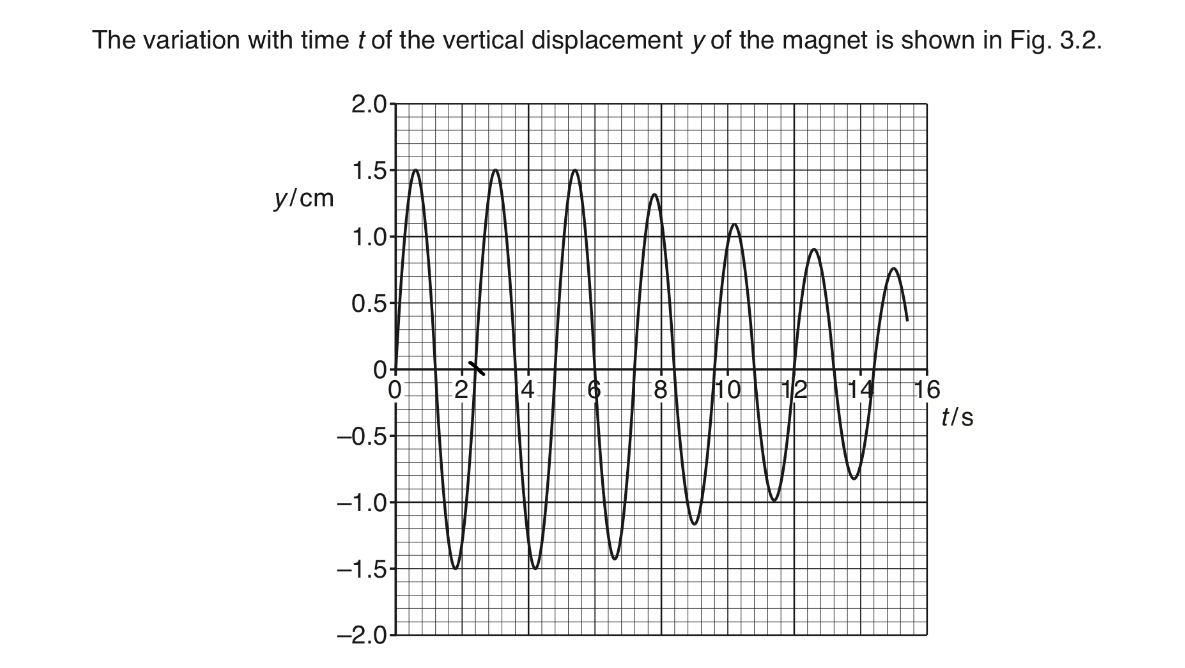
Use faradays law and energy conservation to explain why the amplitude of the oscillation of the magnet reduces after time 6 seconds. [3] (light damping graph)
as coil cuts the magnetic flux, an EMF is induced which gives a rise to current
The current passes to the resistor which causes heating
The energy lost through heating causes amplitude to decrease.
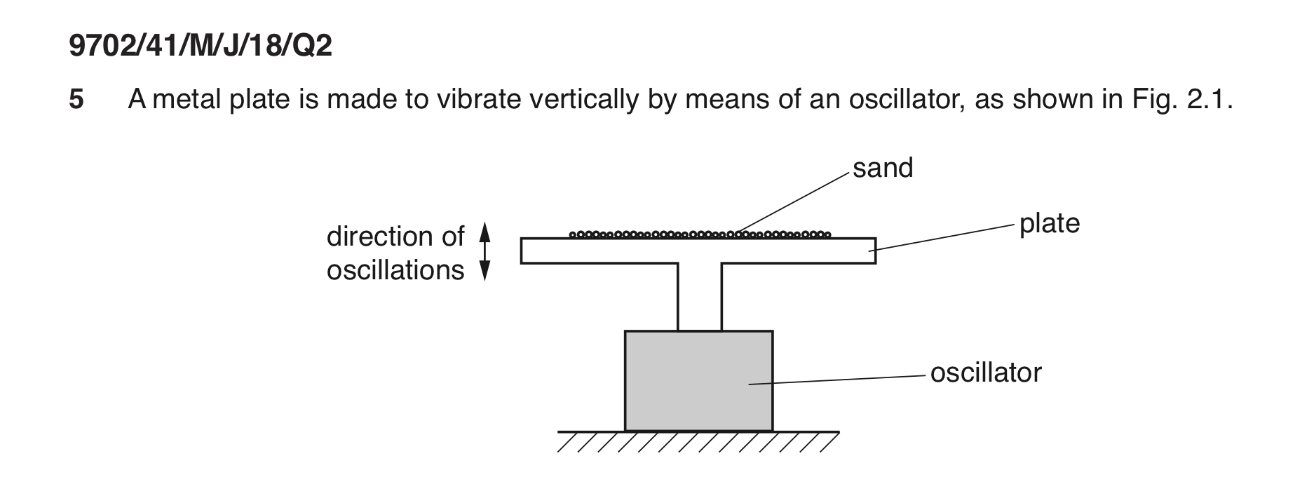
The amplitude of the oscillation of the plate is gradually increased beyond 8 mm the frequency is constant at one amplitude the sand is sent to loose contact with the plate for the plate when the sand first lose his contact with the plate state the position of the plate.
Above equilibrium position are at highest position.
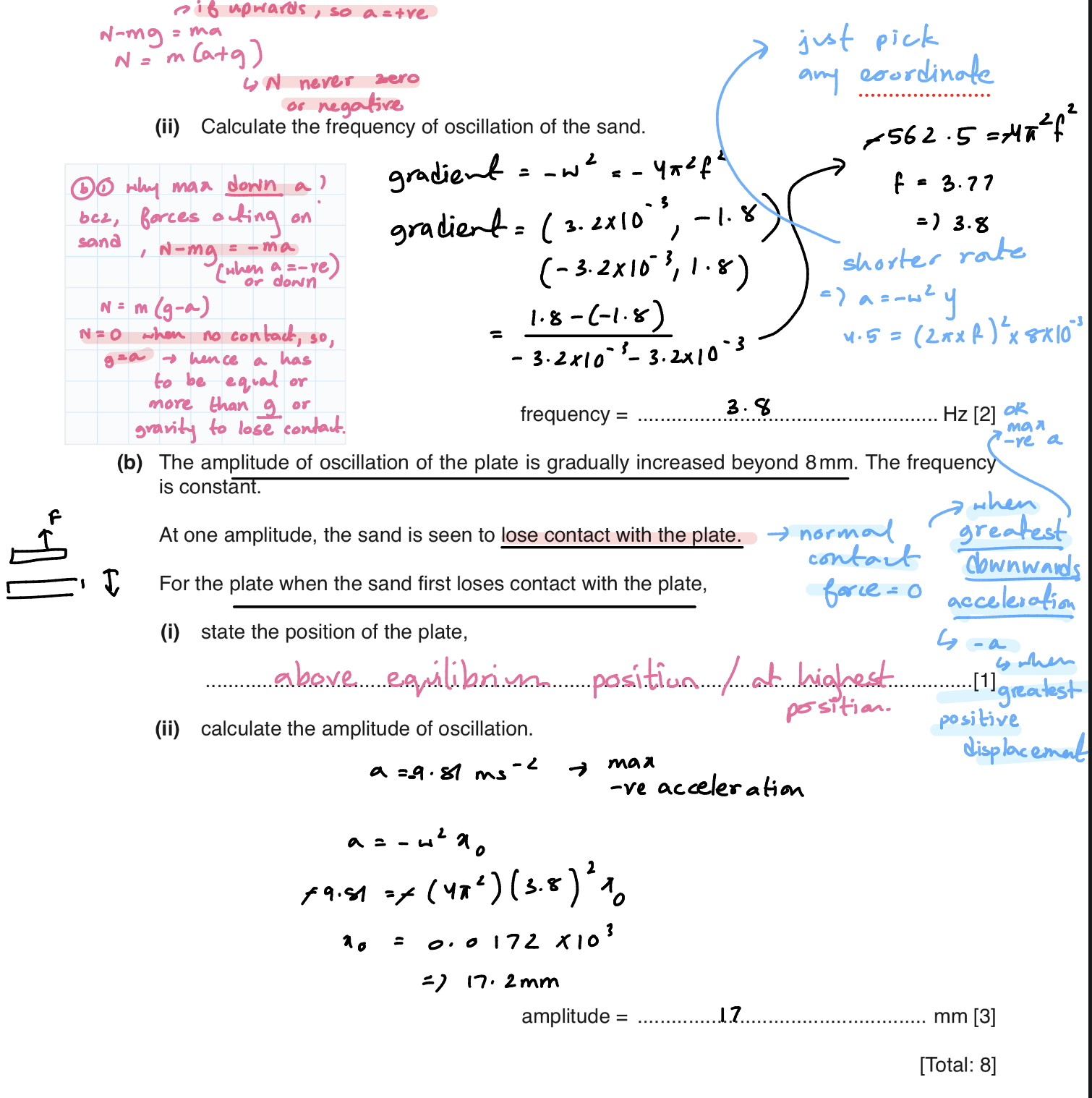
State two conditions necessary for a mass to be undergoing simple harmonic motion
Acceleration proportional to displacement
Displacement and acceleration and opposite or acceleration directed towards a fixed point (the point being equilibrium position)
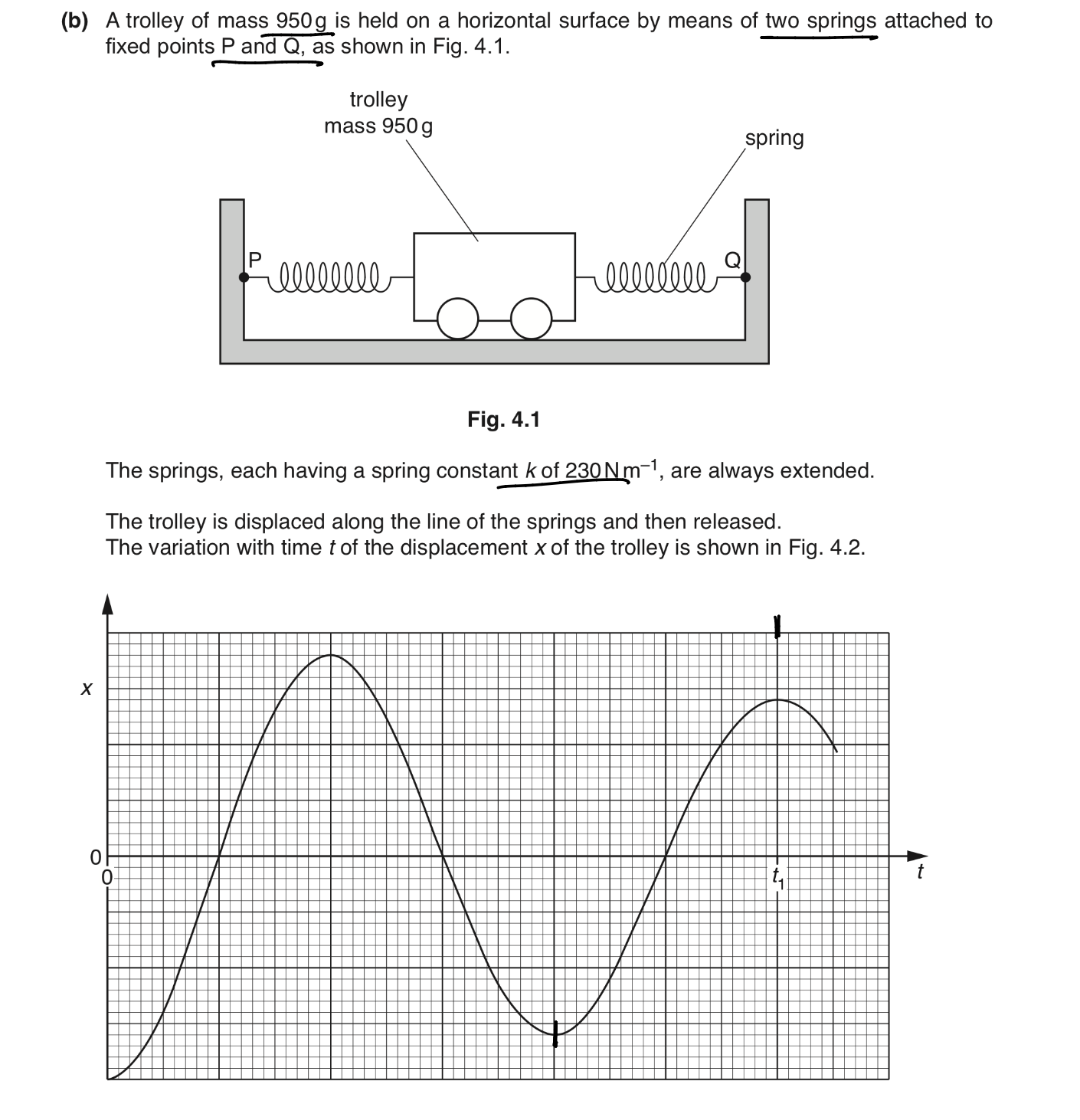
State and explain whether the oscillations of the trolley are heavily damped, critically damped or lightly damped.
Suggest the cause of damping
Lightly damped as amplitude gradually decreasing OR oscillations continue so light damping
Energy is lost (as heat) due to friction between wheels and surface OR air resistance on trolley.
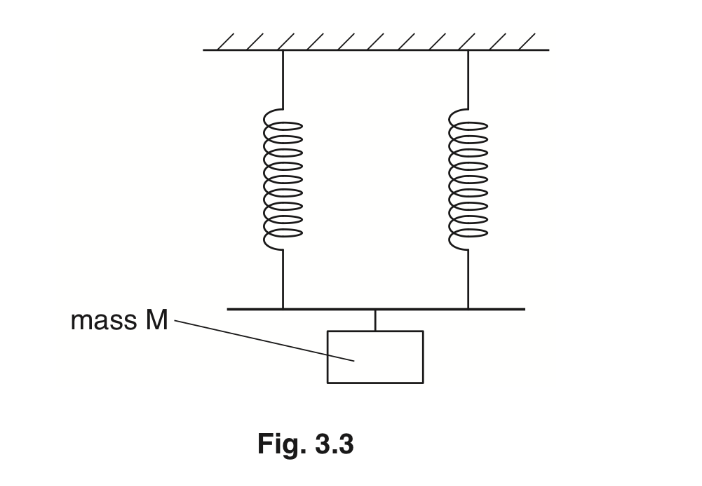
![<p>The mass M is now suspended from two springs each identical to the figure and 3.1 as shown in figure 3.3.</p><p>Suggest and explain the change if any in the period of oscillation of the mass, a numerical answer is not required. [2]</p>](https://assets.knowt.com/user-attachments/8e530b90-04b0-4ebb-acad-0e2d8ecdb2b8.png)
The mass M is now suspended from two springs each identical to the figure and 3.1 as shown in figure 3.3.
Suggest and explain the change if any in the period of oscillation of the mass, a numerical answer is not required. [2]
period decreases
As (any point among these)
Greater spring constant or stiffness
Restoring force is greater (for any given extension)
Acceleration is greater (for any given extension)
Greater energy or maximum speed (for a given amplitude)
(As concept: when springs in parallel, k+k=2k, so larger spring constant, hence double stiffness hence half extend , (when in series, (1/k + 1/k )^-1=0.5 K less stiff so double extend).
F=kx, where F restoring force
ma = kx
mw²x = kx
mw² = k
k/m= 4\pi ² / T²
K inversely proportional to time period, so increasing spring, spring constant decreases period.
Relationship between amplitude and energy.
Total energy= 1/2mw²A²
So energy directly proportional to amplitude²
![<p>The oscillator is switched on. The frequency of oscillation of the oscillator is varied, keeping its amplitude constant.</p><p>At any given frequency, the amplitude of oscillation of trolley is constant. </p><p>Explain how this indicates that there resistive forces opposing the motion of the trolley. [2]</p>](https://assets.knowt.com/user-attachments/2d3c47a2-c7b2-40c7-a99f-fa26910ae3f0.png)
The oscillator is switched on. The frequency of oscillation of the oscillator is varied, keeping its amplitude constant.
At any given frequency, the amplitude of oscillation of trolley is constant.
Explain how this indicates that there resistive forces opposing the motion of the trolley. [2]
oscillator supplies, energy continuously
Without loss of energy, the amplitude would continuously increase.
(Remember if amplitude² directly proportional to Energy)
REMEMBER Energy is not only dependent on amplitude. If energy of oscillation is constant, it does not mean amplitude also has to be constant.
Energy = 1/2mw²A²
Amplitude can be changing and the mass or the angular frequency also can change to keep the energy constant.
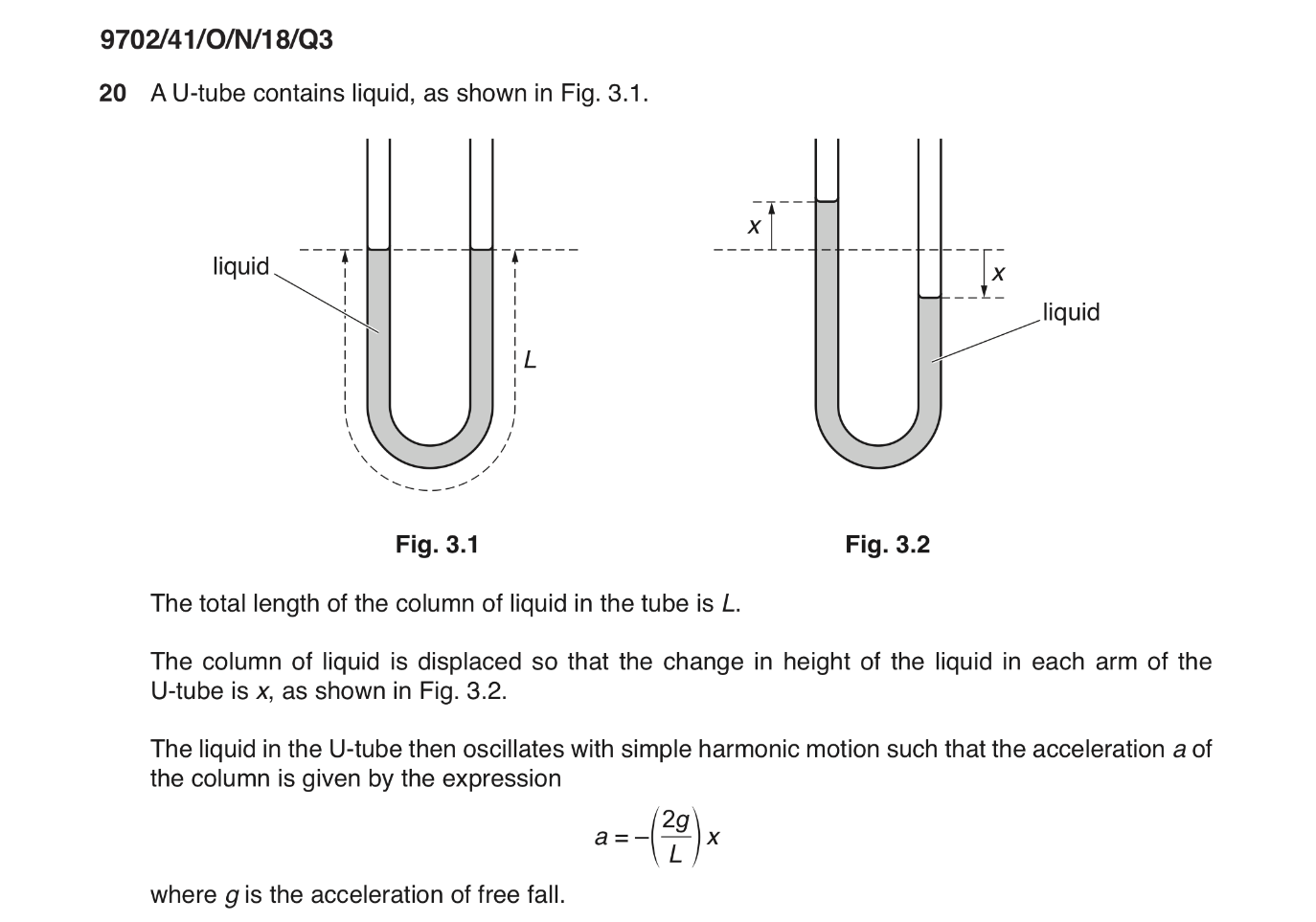
The acceleration a of a oscillating object is related to the displacement x by the expression
a = -(g/L)x
Where g is the acceleration of freefall.
Explain how the expression shows that the object is undergoing simple harmonic motion. [3]
acceleration is an opposite direction to displacement shown minus sign
g/L is a constant
Showing that acceleration is directly proportional to displacement x.
![<p>Show that the liquid column under goes s.h.m [2]</p>](https://assets.knowt.com/user-attachments/c03aa571-b8a6-40d1-9931-ea2e1ec67243.png)
Show that the liquid column under goes s.h.m [2]
a = -kx where k is a constant
g and L are constants
So this shows a proportional to -x
Hence, s.h.m
State what is meant by displacement of the mass on the spring [1]
Distance from a (reference) point from a given direction
Describe without calculation the interchange between the potential and the kinetic energy of the oscillation in shm. [3]
Sum of potential energy and kinetic energy remains constant
When with maximum displacement from equilibrium potential energy energy, maximum kinetic energy is zero
When at zero displacement from equilibrium kinetic energy is max and potential energy is 0.
State, by reference to simple harmonic motion, what is meant by angular frequency. [1]
The relation to the period by 2\pi / T and the frequency by 2\pi f.
![<p>Show that the load is undergoing simple harmonic motion. [3]</p>](https://assets.knowt.com/user-attachments/d63382cd-5328-440f-a8fc-314b94f640d9.png)
Show that the load is undergoing simple harmonic motion. [3]
displacement from equilibrium (2.0 cm) is proportional to the acceleration if load is in s.h.m
Straight line shows that acceleration is directly proportional to displacement
Negative gradient shows that acceleration and displacement in opposite directions
State one cause of the damping
Any of these causes
friction between the liquid and the walls of tube
Viscosity of liquid
Friction within the liquid
Viscous Drag
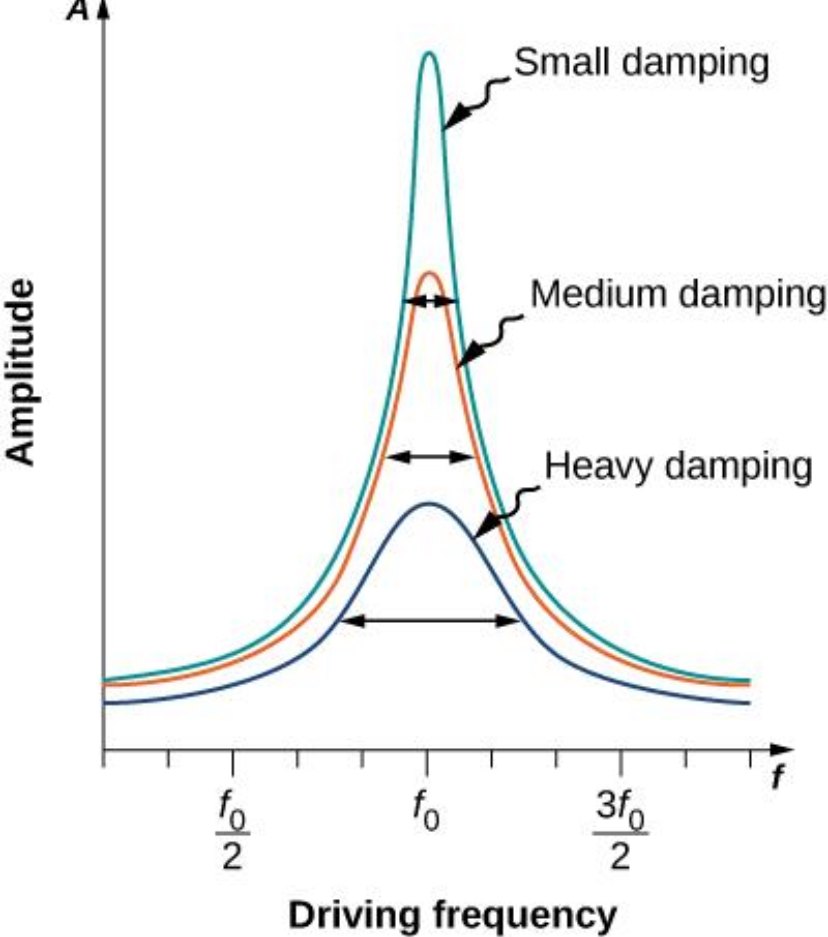
The effects of damping on Resonance
As the degree of damping increases
The height of peak decreases (the height of the resonance peak decreases as damping increases because energy is dissipated more rapidly(Energy is constantly being lost (as heat, etc.), so not all the input energy can be stored in the system, reducing the maximum amplitude)
The peak moves slightly to the left (Some of the driving energy is “wasted” overcoming resistive forces The system can’t respond as effectively at higher frequencies So the maximum amplitude now occurs at a slightly lower frequency)
The peaks become less sharp (“Sharpness” means:
How quickly amplitude drops as you move away from resonance
With low damping:
Only frequencies very close to f_0 can build large amplitude
So you get a sharp, narrow peak
With high damping:
Oscillations die out quickly
Energy doesn’t build up much at any frequency
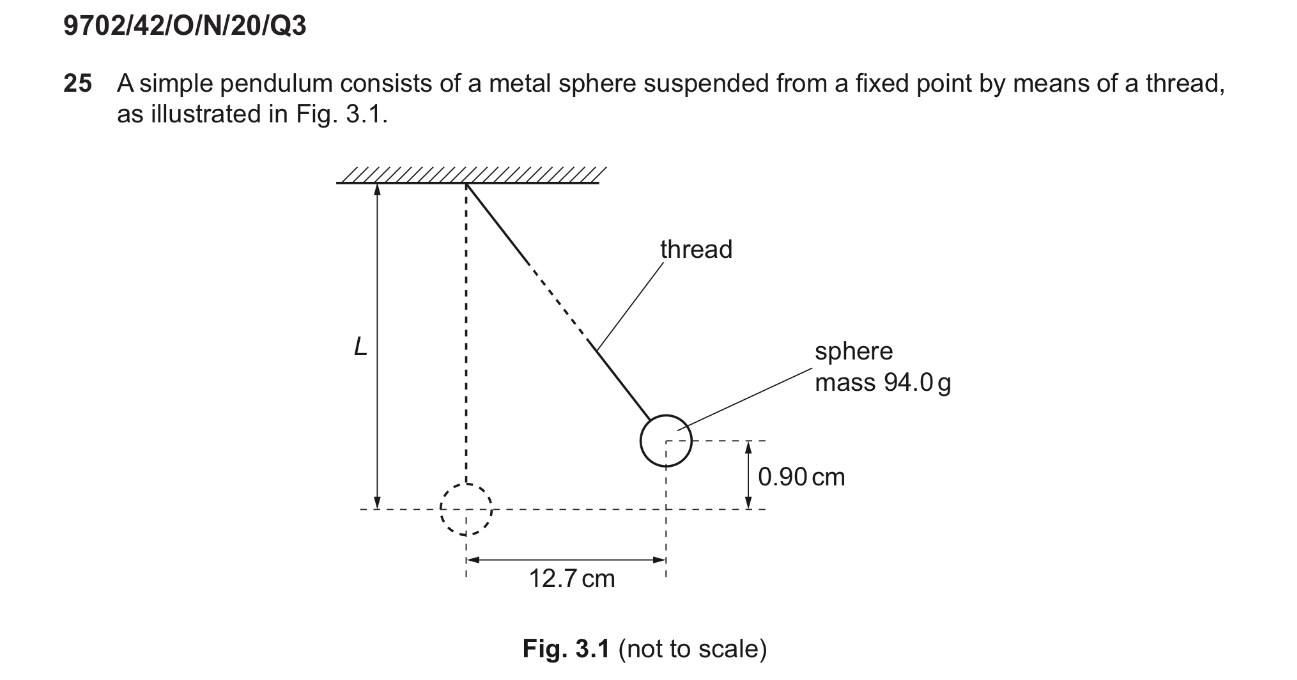
When calculating the total energy using maximum kinetic energy (instead of mgh)
Always use the horizontal distance
E total= 1/2mw²A² (where A is max horizontal distance from equilibrium)

