psyc 211 - neurotransmitters
 Call Kai
 Learn
Learn Practice Test
 Spaced Repetition
 Match
Match Flashcards
 Knowt Play
1/27

There's no tags or description
Looks like no tags are added yet.
Name | Mastery | Learn | Test | Matching | Spaced | Call with Kai | Chat |
|---|
No analytics yet
Send a link to your students to track their progress
28 Terms
On which cellular processes do g proteins affect
Opening ion channels
Changing gene expression
Secretion of substances
Cell growth
Cell division
Cell death
Anything the cell wants
What does “ -tropic” mean
It means “turn toward”
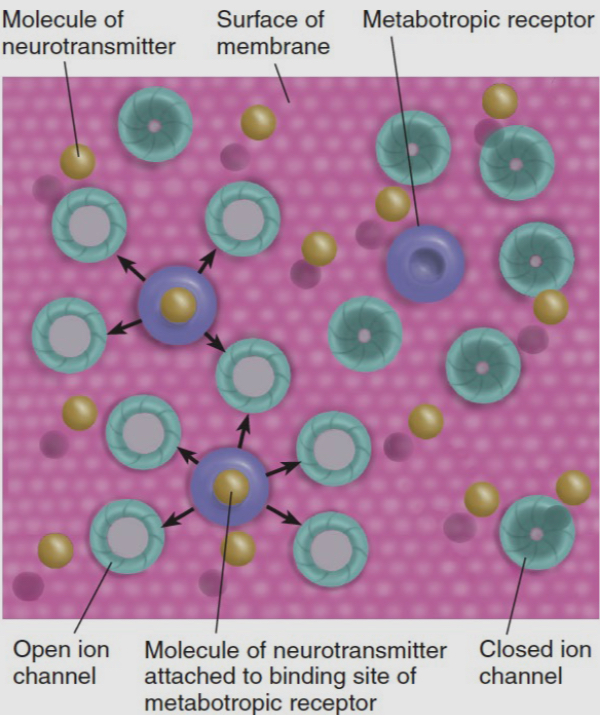
ionotropic receptors turn toward ions to mediate their effects
Metabotropic receptors turn towards metabolism to meditate their effects
How do metabotropic receptors mediate their effects
Metabotropic receptors trigger intracellular signaling cascades that catalyze chemical reactions
Most metabotropic receptors mediate their effects by activating G proteins
What are g proteins
G protein symbolizes that these proteins use GTP instead of ATP for energy needed to catalyze a reaction
They are molecular switches. When bound to GTP (ON) they catalyze reactions. This state can last between 10 seconds and minutes. This state is temporary because G proteins have a natural tendency to convert GTP to GDP causing them to be inactivated
In the OFF stage, they will stand next to a metabotropic receptor and wait for it to become activated. When this happens, the g proteins can let go of its GDP molecule and bind to a new GTP molecule causing it to become ON again
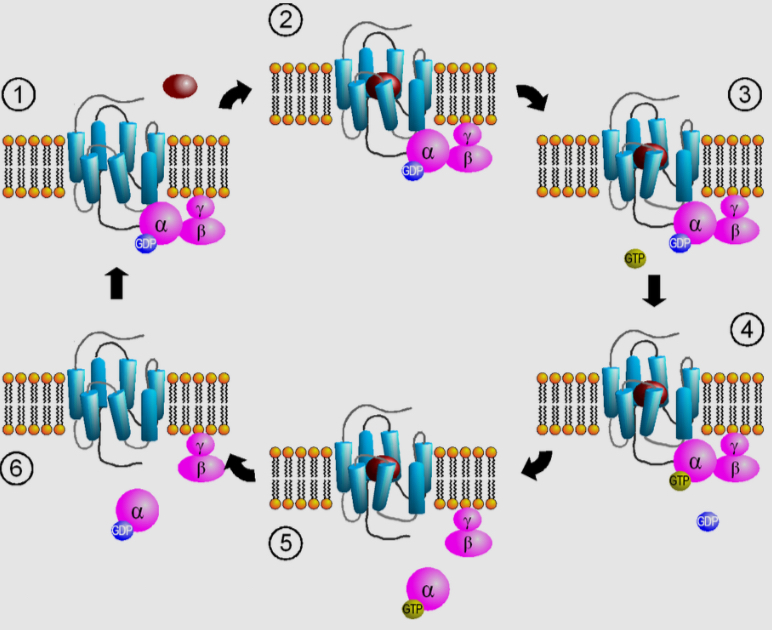
What are the steps of the activation cycle of G proteins
1) the cycle starts when a ligand finds a metabotropic receptor
2) the ligand binds to a metabotropic receptor
3) this induces a conformational change that helps the G protein let go of GDP
4) it then binds to a GTP molecle
5) the G proteins diffuse away to trigger chemical reactions
6) thing protein will convert GTP to GDP
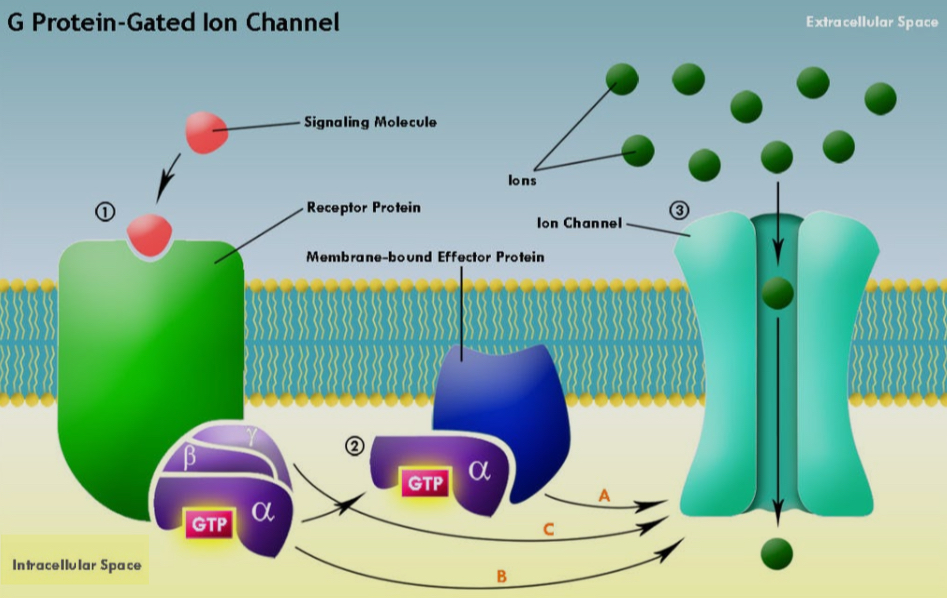
how do you open G protein-gated ion channels
1) a signaling molecule has to activate a metabotropic receptor
2) this allows a G protein to become activated
3) the activated G protein can bind (directly or indirectly)to a g-protein ion channel
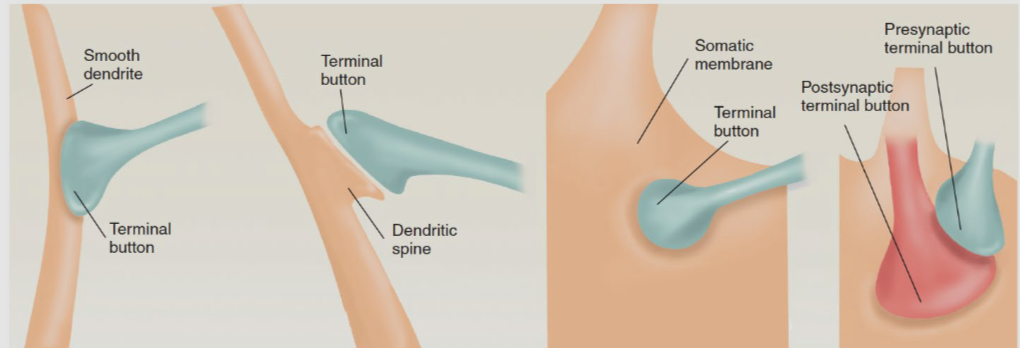
How are synapses formed?
they can form between an axon terminal and:
A smooth dentrire
A dentritic spine
A soma
Another axon terminal
these locations are well-positioned to generate an action potential
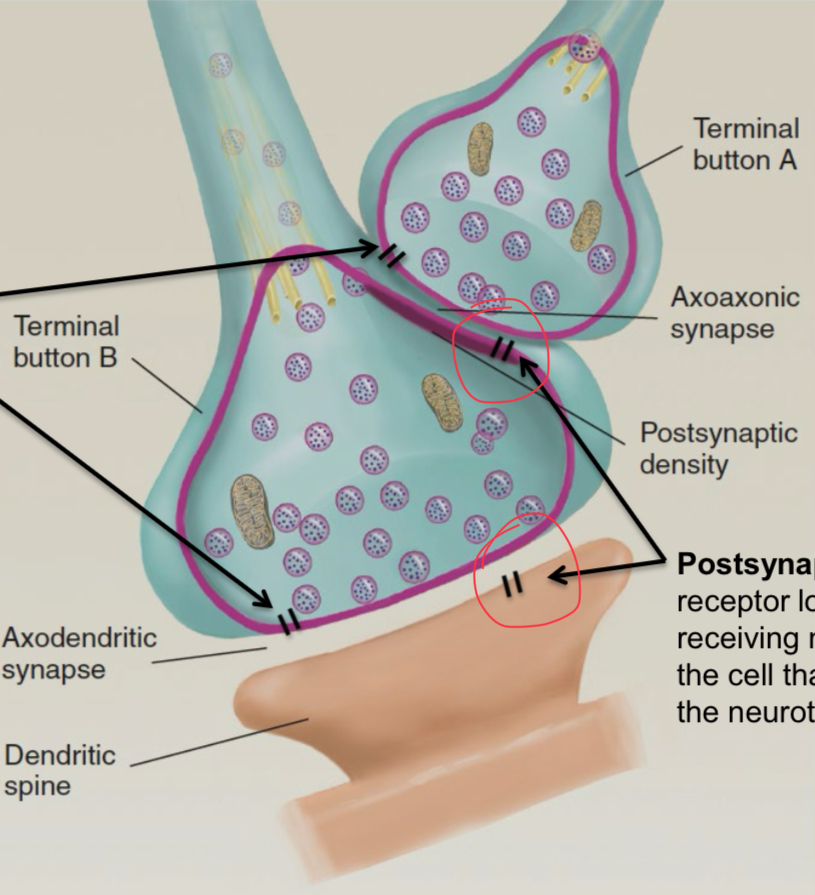
What is an axoaxonic synapse
it is a synapse that regulates the amount of neurotransmitter that a second neuron (red) will release when it has an action potential
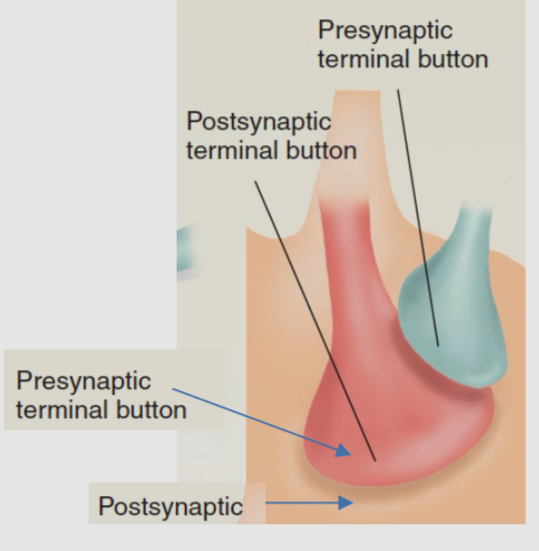
What is presynaptic inhibition
axoaxonic synapses can hyperpolarize the axon terminal of the downstream neuron (in red) so its voltage-gated calcium channels will not up as much as they normally do when there is an action potential (in the red cell)
The net effect is to reduce neurotransmitter release from the reed cell when it has an action potential
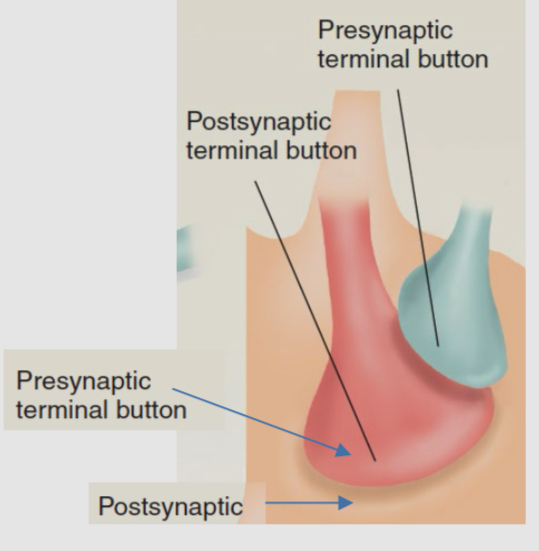
What is presynaptic facilitation
axoaxonic synapses can depolarize the axon terminal of the downstream neuron (in red) so that its voltage-gated calcium channels are more likely to open when an action potential arrives.
The net effect is to increase neurotransmitter release from the red cell when it has an action potential
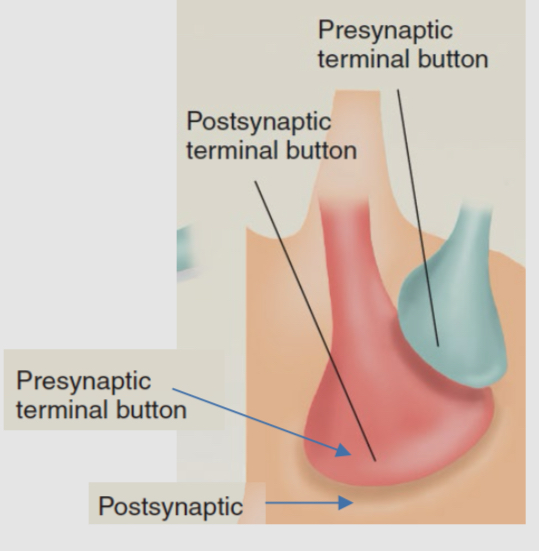
What is an auto receptor
it is a receptor located on the presynaptic membrane that makes the cell sensitive to its own neurotransmitter release
Ex: neurons that release serotonin have serotonin autoreceptors on their own axon terminals
Autoreceptors are always metabotropic and inhibitory
Axon terminal inhibition is devient by autoreceptors and inhibitory axoaxonic synapses
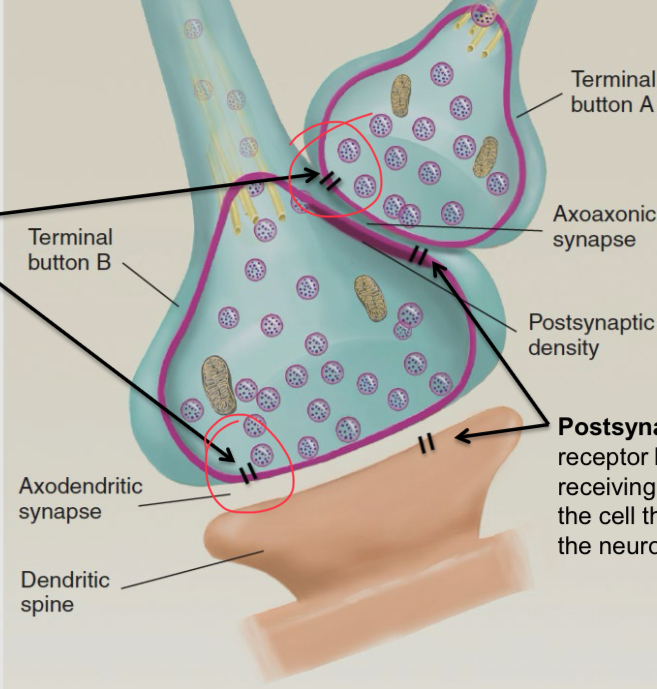
What is a postsynaptic receptor
it is receptor located in the receiving neuron (not on the cell that is releasing the neurotransmitter)
What are the two types of neurotransmitters
an ion channel (ionotropic): excitatory ones mediate fast membrane depolarization via Na+ influx (EPSP), inhibitory ones mediate fast membrane hyper polarization via Cl- influx (IPSP)
not an ion channel (metabotropic): excitatory ones mediate gradual membrane depolarization (slow EPSP), inhibitory ones mediate gradual membrane hyper polarization (slow IPSP), modulatory ones can do anything
How are signaling molecules named
they are named based on what they release and do
Signaling molecules released in the brain to regulate neural activity → neurotransmitters
Signaling molecules released into the blood → hormones
Ex: when dopamine is released into the brain, it is a neurotransmitter, but when it is released into the blood, it is a hormone
-
What are the different categories of neurotransmitters
classical, conventional neurotransmitters (glutamate, GABA, domapine, serotonin)
Neuropeptides (over 70 types)
Lipid based neurotransmitters (primarily the endocannabinoids)
Gasotransmitters (primarily nitric oxide)
What is the function of Glutamate (classical neurotransmitter)
it is the main excitatory neurotransmitter
Lets Na+ in, causing membrane depolarization
Drugs that activate these receptors can cause seizures and excitoxicity (cell death)
Drugs that block these receptors slow you down
What is the function of GABA (classical neurotransmitter)
it is the main inhibitory neurotransmitter
Let Cl- in, causing membrane hyperpolarization
Drugs that block they receptors can cause seizures
Drugs that activate these receptors slow you down
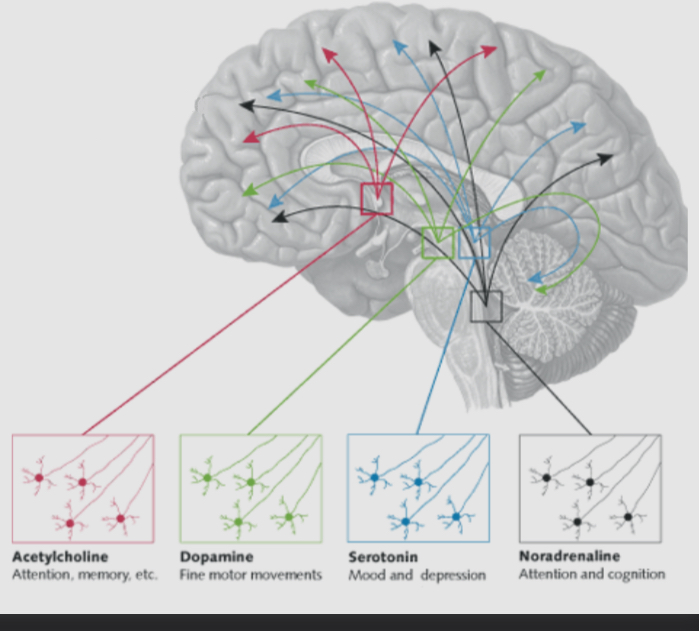
What are the 4 main neuromodulators
acetylcholine
Dopamine
Serotonin
Norepinephrine
Why are the classical neurotransmitters called this way
they tend to have a modulatory influence on downstream cells
Most of their receptors are metabotropic
The information they convey is broadcasted over a large area
They can diffuse short distances outside of the synapse and influence the activity of neighboring neurons
What is a conventional neurotransmitter
they are modified amino acids (small molecules) (glutamate, GABA, dopamine)
They are synthesized locally in axon terminals
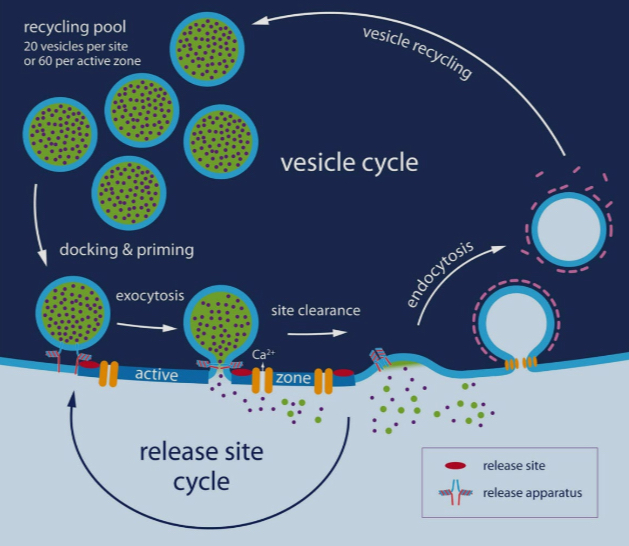
Packaged in small synaptic vesicles that dock close to the site of Ca2+ entry in the axon terminal
Recaptured and reused (via Reuptake proteins)
Rarely leave the synapse
Have both ionotropic and metabotropic receptors (except dopamine and norepinephrine)
What are neuropeptides
they have a small chain of amino acids (10-30)
Synthesized in the cell body transported down the axon and released just once
Packaged in large dense core vesicles that dock a way back from the site of Ca2z+ entry into the axon terminal
Not recycled
May diffused long distances and exert action at a distance
Only have metabotropic receptors
What are liquid-based signaling molecules
they are fat soluble molecules, they are the main players in the endocannabinoids
Synthesized and released on demand
Are not packaged in vesicles (they can pass through cell membranes if not attached to something)
Signal backwards (they are released from postsynaptic membrane and the receptors are on axon terminals)
They are a source of presynaptic inhibition
Only have metabotropic receptors
How are neurotransmitters classified
The following questions are asked:
what type of molecule is it? (Amino acids, peptide)
How and where is it made (made by enzymes in the axon terminal ?)
How does it get released? (Packaged into vesicles)
What kind of receptors can it bind to? (Ionotropic or metabotropic)
How does it get cleared away after it releases (constrained by the synapse or can diffused freely)
What are the classic targets for drugs and toxins
the enzymes that synthesize neurotransmitters
The vesicular transporters that package neurotransmitters into vesicles
The vesicle release machinery that regulates neurotransmitter release
The reuptake transporters that clear neurotransmitter out of the synapse
The receptors that are acvitvated by neurotransmitters
Where are classical neurotransmitter made
they are made in the axon terminals
The raw materials and necessary enzymes are in axon terminals
Once a neurotransmitter is made, it gets packaged into a synaptic vesicles by a vesicular transporter
What are monoanimes
they are serotonin, dopamine, norepinephrine
They have similar three dimensional structures
How are the monoamines distinct from each other?
they’re are released from different neurons
they have their own receptors
In axon terminals, there is only one protein that can package monoamines into vesicles: the vesicular monoamine transporter
Drugs that affect one type of monoamine receptor often affect another type of monoamine receptor, but there are distinct reuptake transporters for each of the monoamines
What are dirty druges
They are drugs that can affect multiple types of receptors