6. Carbon Cycle: Stores, transfers and local and global cycle
 Call Kai
 Learn
Learn Practice Test
 Spaced Repetition
 Match
Match Flashcards
 Knowt Play
1/17

There's no tags or description
Looks like no tags are added yet.
Name | Mastery | Learn | Test | Matching | Spaced | Call with Kai |
|---|
No analytics yet
Send a link to your students to track their progress
18 Terms
What is the difference between a carbon sink and source?
Carbon sinks absorb more carbon than they release whereas sources do the opposite.
What are the 5 stages of the slow carbon cycle?
CO2 absorption from the atmosphere into the hydrosphere in the oceans. Naturally acidic rainfall dissolves surface rocks and transfers soluble bicarbonate compounds via rivers to the sea
Marine plants (phytoplankton) absorb CO2 and marine creatures take in carbon to construct shells. Shell remains fall to the sea bed when they die
Carbon rich accumulations of deposits may be converted to carbon rich rocks eg: limestone by compression and heat
The sedimentary rock may eventually become a collision margin as they move in the direction their plate moves so they could become a mountain range and be once again exposed to weathering and erosion and return to the sea as eroded carbonate rocks
Or if at a subduction zone the carbon rich rocks may be ejected from volcanic eruptions in the form of gaseous compounds into the atmosphere
Give an example of carbon in the lithosphere? GLOBAL
Can be organic (litter/organic matter/humic substances in soils/peat) or inorganic (fossil fuels eg: coal, oil)
99.9% of carbon can be found in sedimentary rocks eg: limestone. Millions of gigatonnes
This is the largest store of carbon and is formed over millions of years so is a long term store of carbon.
0.004% of carbon is stored in fossil fuels eg: coal and oil
SLOW cycle
Give examples of carbon in the hydrosphere? GLOBAL
CO2 can be dissolved in rivers, lakes and oceans via diffusion. 38,000 Gt
Oceans are the second largest store of carbon on Earth containing 0.04% of carbon on Earth
This is in the form dissolved inorganic carbon
Since the industrial revolution oceans now absorb more carbon from the air due to more emissions
When organisms die their shells etc sink to deep water forming layers of sedimentary rock over tome
SLOW cycle
Give an example of carbon in the biosphere? GLOBAL
Carbon is stored in the tissues of living organisms and is transferred into the soil when they die and decay as plant/animal litter
Humus
Peat - the accumulation of partically decayed vegetation/organic matter which is unique to peatlands and forms in wetland conditions. The water saturation there creates anaerobic conditons slowing the rate of decomposition
Rainforests eg: Brazil are the main locations for the carbon to be stored giving tropical rainforests a positive NPP all year round whereas deciduous forests have a negative NPP in winter.
Vulnerable to climate change and results in carbon storage in forests declining
Fast cycling store
Give examples of carbon in the atmosphere? GLOBAL
0.001% of the Earth’s atmosphere contains carbon in the form CO2 and methane (CH4)
Human activity caused C02 levels to increase by 40% since the industrial revolution
Carbon may return to the atmosphere through tectonic forces such as volcanic eruptions where subducted sedimentary rocks from oceans may return CO2 into the atmosphere
Fast cycle
Give examples of carbon in the cryosphere? GLOBAL
Less than 0.01% of carbon is in the cryosphere
Most of the carbon is in the soil areas of the permafrost where decomposed plants and animals froze into the ground
If permafrost melted a powerful positive feedback loop accelerates global warming beyond human-caused emissions.
What is the difference between slow and fast cycles of carbon?
Fast carbon cycles are between the land and the atmosphere and only take a matter of days
Slow carbon cycles are between surface bedrock and the atmospheric or ocean stores
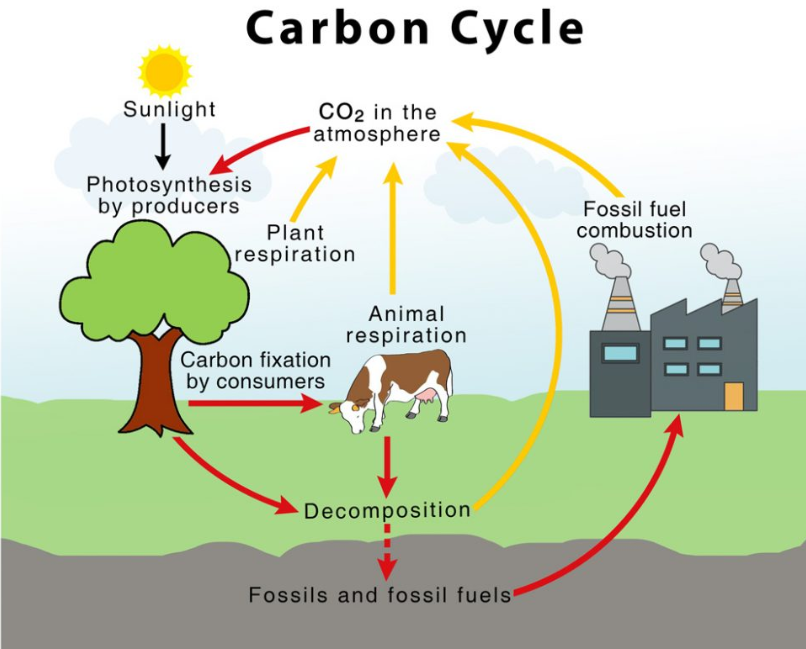
Explain how photosynthesis is a carbon flux in the fast carbon cycle?
Photosynthesis is where organisms convert: Carbon Dioxide +Water → Oxygen and Glucose using light energy
The plants are sequestering carbon and acting as a carbon sink
This is part of the fast carbon cycle as it takes min/hr/day
Explain how respiration is a carbon flux in the fast carbon cycle?
Occurs when plants and animals convert: Oxygen + Glucose → Carbon Dioxide + Water
This happens because at night photosynthesis stops due to no light
Despite this releasing carbon, plants are a net carbon sink as they absorb more CO2 than they emit
Explain combustion as a transfer in the fast carbon cycle?
When fossil fuels or organic matter is burnt in the presence of oxygen they emit the CO2 into the atmosphere which was previously locked inside them. Eg: wildfires. If other elements are present they may combine with oxygen to form nitrogen oxides
Biomass combustion burns living and dead vegetation. Trees die after severe fires but this may allow new tree growth to begin causing no net carbon change
Old growth northern latitude forests may be considered a carbon sink because older trees have absorbed a lot of carbon and their heavy canopy blocks sunlight from reaching the floor slowing decomposition of forest litter
Explain decomposition as a transfer in the fast carbon cycle?
When living organisms die and are broken down by decomposers (bacteria) which respire so C02 is returned to the atmosphere
Some organic matter may be returned to the soil where it’s stored adding carbon matter to the soil
This allows plants to grow as a plant can’t make its DNA molecules without a supply of chemicals in the soil eg: phosphorus
Explain diffusion as a transfer in the ocean carbon cycle?
Oceans absorb CO2 from the atmosphere increasing their acidity through gas exchange. Colder waters absorb more carbon
This causes coral bleaching so many of the world’s coral reefs are under threat
Vertical deep mixing may occur where warm water is carried to the cold polar regions from the tropics where it is cooled and sinks to the ocean bed. When the cold water returns to the surface it warms up again losing CO2 to the atmosphere - this is a carbon pump
Carbon can also be exchanged from the ocean to atmosphere as the carbon-rich water from deep in the oceans may rise releasing CO2
Explain weathering and erosion as a transfer in the ocean carbon cycle?
Acid rain transfers carbon into the oceans. This can be natural or anthropogenic releasing sulphur dioxide
Carbonation weathering can cause CO2 to mix with rainwater creating carbonic acid which erodes rocks such as limestone and the water cycle can transport them to help build the shells of marine creatures
Explain sequestration as a slow carbon cycle transfer? (natural)
Where carbon from the atmosphere is transferred into sedimentary rocks or fossil fuels
This happens through burial and compaction when dead animal and plant material is compacted capturing the carbon → creating limestone
What are the pros of CCS (Carbon capture and storage) as a human carbon sequestration?
Can be fitted to existing power stations
Captures 90% of carbon produced
There’s a demand for CO2 from big TNC’s such as Coca-Cola so transport systems via pipeline already exist
What are the cons of CCS (Carbon capture and storage) as a human carbon sequestration?
High cost
Increased energy demand for power stations
May not fit in power stations
Leakage risk which will damage ecosystems
Uncertain in long-term liability - who will be responsible for leaks, will carbon stay down there for centuries
Some say money should be spent on renewable energy instead
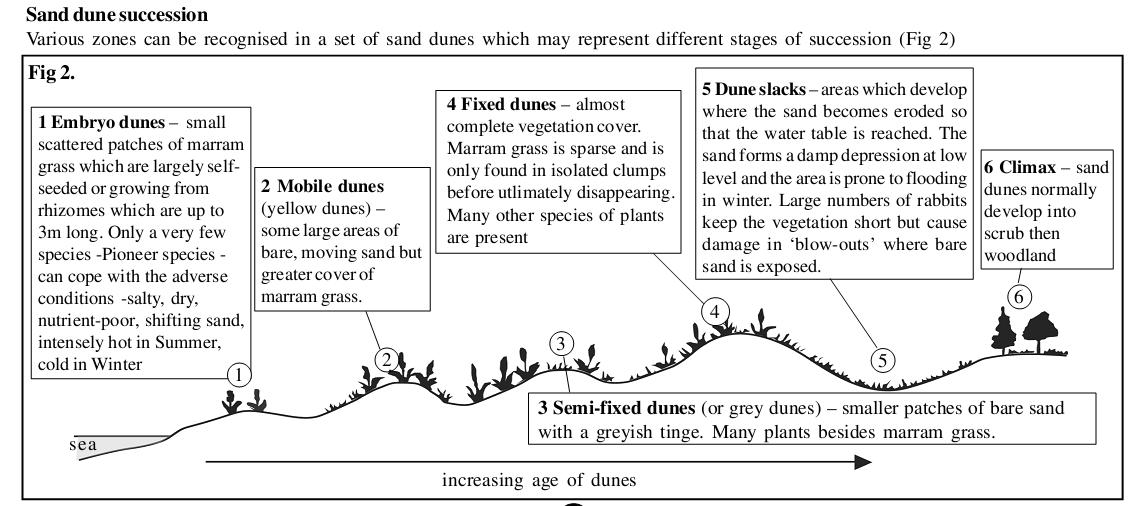
Explain the vegetation succession (psammosere) as the carbon cycle at a local scale?
This is the climatic climax where there is a vegetation succession.
In the UK this would be woodland whereas in Brazil it may be a rainforest.
Here the ecosystem is fully developed and stable so an environmental equilibrium is achieved and will not change dramatically as the equilibrium will counteract the change
Eg: psammoseres are a succession of sand dunes leading to a woodland
Carbon is in soil humus and there is the highest primary productivity of carbon at the woodland as the plants compete for light and get taller.
picture shows psammosere environment