LEC 5.1: Nursing Process | Overview of the Nursing Process
 Call Kai
 Learn
Learn Practice Test
 Spaced Repetition
 Match
Match Flashcards
 Knowt Play
1/25

There's no tags or description
Looks like no tags are added yet.
Name | Mastery | Learn | Test | Matching | Spaced | Call with Kai |
|---|
No analytics yet
Send a link to your students to track their progress
26 Terms
Nursing Process
Systematic, rational method of planning and providing individualized nursing care
“Fundamental blueprint” for how to care for patients
Lydia Hall (1955)
From who and what year did the term “Nursing Process” originate?
Johnson, Orlando, Weidenbach
Who were the first to refer to the “Nursing Process” as a series of phases describing the practice of nursing?
American Nurses Association (ANA) Standards of Nursing Practice (1973)
What were the “Nursing Process” phases included into, thus legitimizing them? What year did this occur?
Individual
Family
Community
Group
What are the clients of the Nursing Practice?
Group of women with breast cancer who underwent mastectomy
Example of a group (a type of client of the Nursing Practice)
To identify client’s health status and actual or potential health care problems or needs
To establish plans to meet the identified needs
To deliver specific nursing interventions to meet those needs
What are the 3 Purposes of the Nursing Process?
ADPOIE:
Assessment
Diagnosis
Planning
Outcomes Identification
Implementation
Evaluation
What are the Phases of the Nursing Process according to the American Nurses Association (ANA)?
ADPIE:
Assessment
Diagnosing
Planning
Implementation
Evaluation
What are the Phases of the Nursing Process according to the National Licensure Examination for Registered Nurses (NCLEX)?
Cyclic & Dynamic
Client-Centeredness
Focus on Problem-Solving & Decision-Making
Interpersonal & Collaborative Style
Universal Applicability
Use of Critical Thinking & Clinical Reasoning
6 Characteristics of the Nursing Process
Cyclic & Dynamic
One of the characteristics of the Nursing Process
Each phase provides input into next phase
For example, ADPIE has a systematic order from assessment in which we observe unusual or significant findings of the client proceeding to diagnosing → planning → implementing → evaluating.
Client-Centeredness
One of the characteristics of the Nursing Process
Plan of care is according to the client’s problem rather than the nursing goal
Focus on Problem-Solving & Decision-Making
One of the characteristics of the Nursing Process
Involves:
Problem-Solving, a mental activity in which a problem is identified that represents an unsteady state and requires the nurse to obtain info that clarifies the nature of the problem and suggest possible solutions
Decision-Making, in which nurses creatively determine when and how to use data to make decisions and direct towards client’s responses, rather than on physiological systems and disease process
Problem-Solving
A mental activity in which a problem is identified that represents an unsteady state
Requires the nurse to obtain info that clarifies the nature of the problem and suggest possible solutions
Decision-Making
Nurses creatively determine when and how to use data to make decisions
Directed towards client’s responses, rather than on physiological systems and disease process
False (The Nursing Process is directed towards the client’s responses, rather than physiological systems and the disease process.)
True or False: The Nursing Process is directed towards physiological systems and the disease process, rather than the client’s responses.
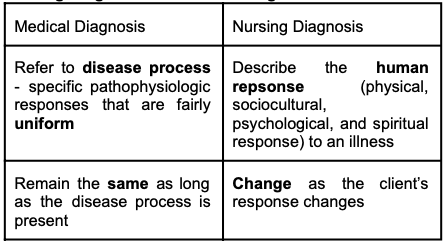
Medical Diagnosis
Refer to disease process, specific pathophysiologic responses that are fairly uniform
Remain the same as long as the disease process in present
Nursing Diagnosis
Describe the human response (physical, sociocultural, psychological, and spiritual response to an illness)
Change as the client’s response changes
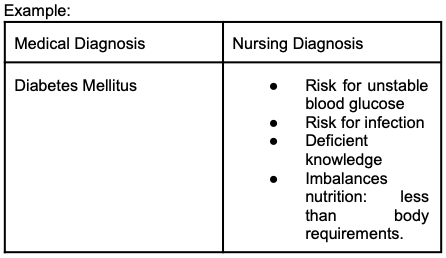
Diabetes Mellitus
Example of a Medical Diagnosis
Risk for unstable blood glucose
Risk for infection
Deficient knowledge
Imbalanced nutrition: less than body requirements
Example of a Nursing Diagnosis
Interpersonal & Collaborative Style
One of the characteristics of the Nursing Process
Communicate directly to clients
Collaborate with other members of the health care team
Universal Applicability
One of the characteristics of the Nursing Process
Used as a framework for nursing care in all types of health care settings
Use of Critical Thinking & Clinical Reasoning
One of the characteristics of the Nursing Process
Involves:
Critical Thinking: process of intentional higher level thinking to define a client’s problem, examining the evidence-based practice in caring for the client, and make choices in the delivery of care
Clinical Reasoning: cognitive process that uses thinking strategies to gather and analyze client information, evaluate the relevance of the information and decide on possible nursing actions to improve the client’s psychological and psychosocial outcomes AND requires the integration of critical thinking in the identification of the most appropriate interventions that will improve the client’s condition
Critical Thinking
Process of intentional higher level thinking to…
define a client’s problem,
examining the evidence-based practice in caring for the client, and
make choices in the delivery of care
Clinical Reasoning
Cognitive process that uses thinking strategies to…
gather and analyze client information,
evaluate the relevance of the information and
decide on possible nursing actions to improve the client’s psychological and psychosocial outcomes
Clinical Reasoning
Requires the integration of critical thinking in the identification of the most appropriate interventions that will improve the client’s condition

