AQA Psychology - Memory
 Call Kai
 Learn
Learn Practice Test
 Spaced Repetition
 Match
Match Flashcards
 Knowt Play
1/124

There's no tags or description
Looks like no tags are added yet.
Name | Mastery | Learn | Test | Matching | Spaced | Call with Kai |
|---|
No analytics yet
Send a link to your students to track their progress
125 Terms
Coding
The format in which information is stored. (How)
Who Did Research On Coding?
Baddely
Process of Baddely's Experiment on coding
Group 1 - Accoustically similar
Group 2 - Acoustically disimilar
Group 3 - Semantically similar
Group 4 - Semantically disimilar
They were given a list of original words in wrong order. Had to recall in correct order. (LTM 20 Min Interval)
Result of Baddley's Experiment For coding STM
Confusion between acoustically similar words
Result of Baddley's Experiment for coding in LTM
Confusion between semantially similar words
Conclusions for Baddley's Experiment on coding
STM - Acoustic confusion, coded acoustically
LTM - Semantic confusion, coded semantically
Positive Evaluation for Baddley's Experiment on coding
identified 2 memory stores. development of MSM
Negative Evaluation of Baddley's Experiment on coding
Artificial Stimuli - Cautious about generalising
Lacks EV
Small difference in recall between semantic lists = semantic coding is STM.
What is Capacity?
Amount of information that can be held.
Research for Capacity
Jacobs and Miller
Method for Jacob's Study on capacity
Aim - See how much info STM can hold at one time
Developed a technique - Digit Span
Research gave a certain number of digits then the PP recalled in correct order. If recalled correctly, amount of digits increased. Determines individuals digit span.
Results of Jacob's Study on capacity
7.3 letters
9.3 words
Positive Evaluation(s) of Jacob's Study on capacity
REPLICATED. supported by other studies.
Negative Evaluation(s) of Jacob's Study on capacity
Conducted a long time ago - Lacked adequate control
Lacks EV - Lacks Mundane realism
May not have controlled for confounding variables - reduces validity
What Did Miller's Study Discover?
Instead as keeping the information as individuals, the unit of informaiton can be increased by chunking.
What is Miller's Magic Number?
7 +/- 2 (5-9 chunks)
Evaluation Points For Miller's Study
Lacks EV
Miller may have overestimated STM capacity
Cowan reviwed the research and found it was only 4 chunks.
Evaluation of Capacity
Other factors at play - Age and practice effects
Nowadays limitations of STM seen as due to processing limitations associated with STM
What is Duration?
Length of time information can be held
Who Conducted STM Duration Research?
Peterson and Peterson
Method for Peterson and Peterson's Study on duration
Each student was given a nonsense triagrams (3 consenants), as well as a 3 digit number. The student had to count backwards from this number (prevents mental rehearsal) told to stop counting at different intervals.
Results for Peterson and Peterson's Study on duration
Amount recalled correctly:
3 seconds - 90%
18 seconds - 3%
(Significant difference between them)
Conclusion for Peterson and Peterson's Study on duration
STM has a very short duration unless it is rehearsed, I.e. Mental Rehearsal.
Positive Evaluation of Peterson and Peterson's Study on duration
Operationalised - Replicable
Controlled for confounding variables (counting backwards)
People do try and remember phone numbers - relevance
Negative Evaluation of Peterson and Peterson's Study on duration
Artificial situation - Lacks EV
Methodology flawed - Different triagrams used in each trial (interference)
Memory trace disappears if not rehearsed - Alternate explanation = information is displaced.
Evaluation of Duration in STM
Brief duration is due to displacement as it has limited capacity.
Little way in research considering the duration in other forms of stimuli I.e Visual Images.
Who Did a Study on Long Term Duration?
Bahrick et al.
Method of Bahrick's Study
400 American PPs aged 17-74 Y/O.
Recall was tested:
Photo Recognition - School year book pictures
Free Recall - Names of people graduating in their class.
Results of Bahrick's Study
FREE RECALL- 15, 60%. 48, 30%. recognition- 15- 90%. 15, 70%
Conclusions from Bahrick's Study
LTM can last a very long time, potentially a lifetime.
Positive Evaluation(s) of Bahrick's Study
High EV - Real life memories
Negative Evaluation(s) of Bahrick's Study
Confounding Variables are not controlled for - People could have looked at the year book. (rehearsal)
Evaluations of Duration of LTM
LTM may be seen as lost but actually is just a problem with memory access
Type of testing technique used may affect findings
Who Devised the Multi-Store Model?
Atkinson and Shiffrin
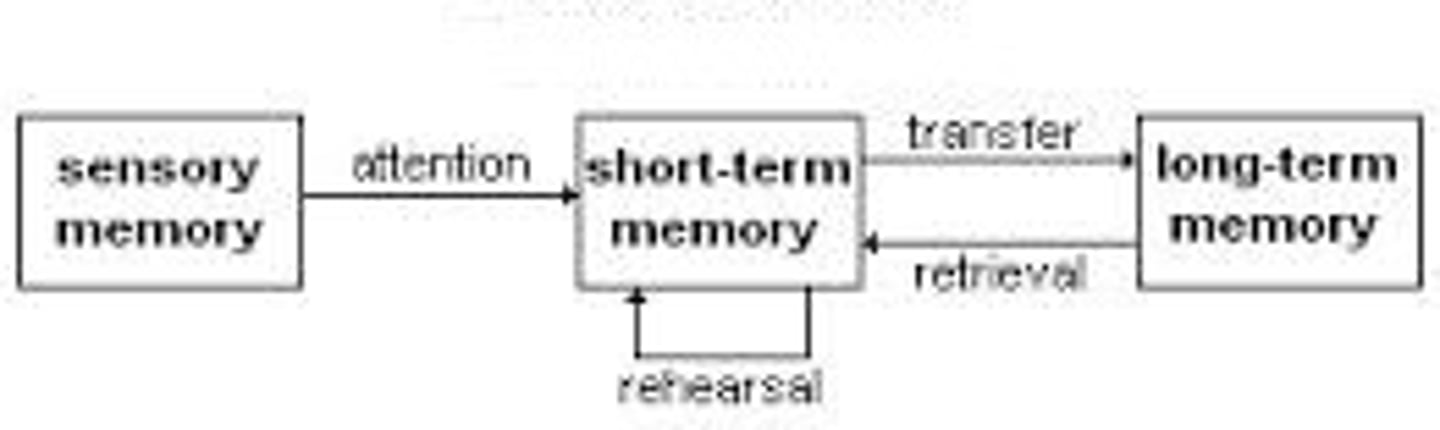
What is the Multi-Store Model?
An explanation of how the memory works in terms of 3 stores:
Sensory Register
STM
LTM
Through flowing Storage systems
Describe the structure of the Multi-Store Model
What is the Sensory Register?
A short duration store that holds information we have gained through the 5 senses.
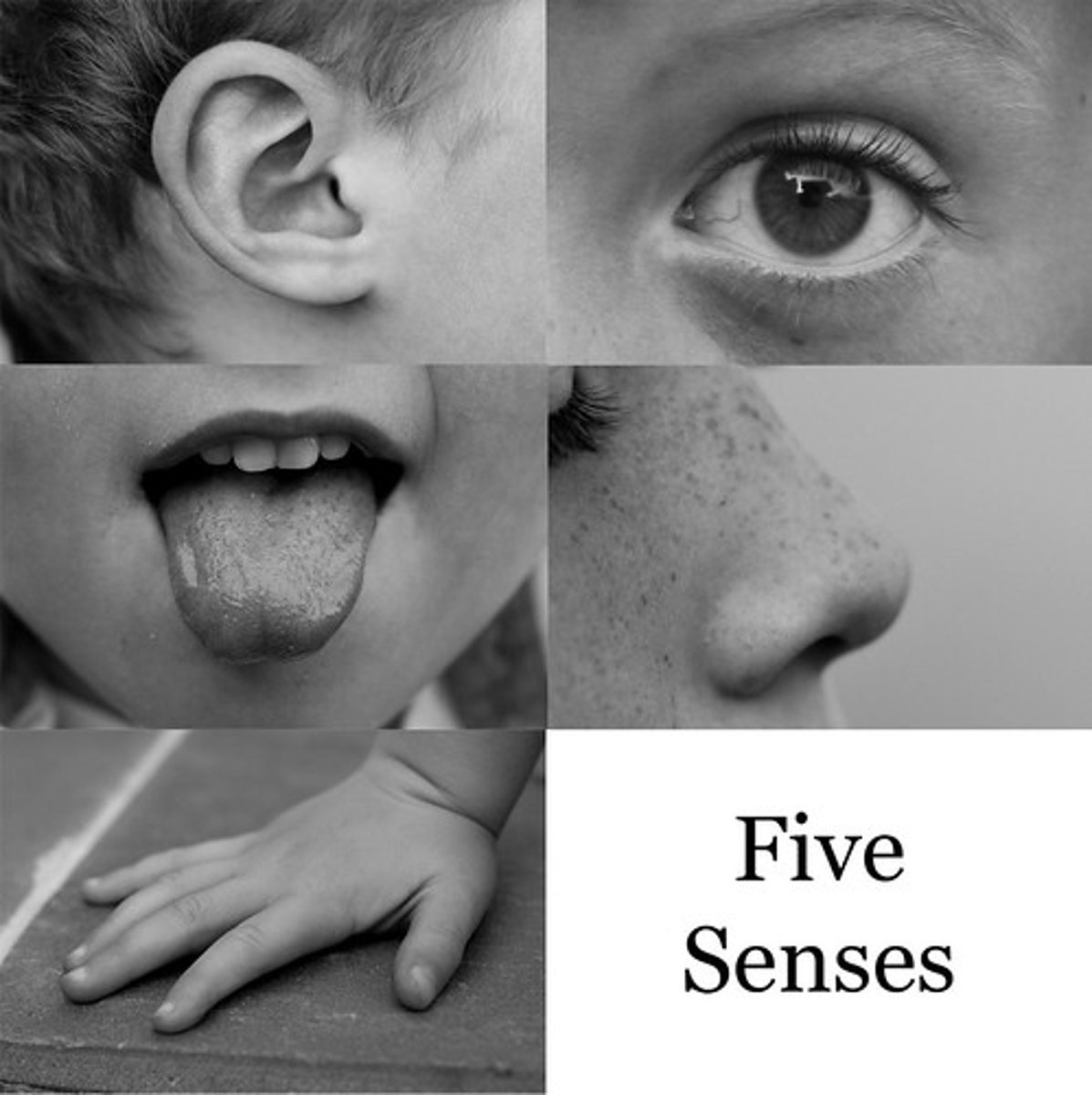
How is the Sensory Register Mainly Coded?
Via all 5 senses.
Mainly iconic (visual) and echoic (acoustic)
What is the Duration of the Sensory Register?
Very Brief
What is the Capacity of the Sensory Register
Very High
Describe Sperling's Research into the Sensory Register's Capacity
Flashed a 3x4 grid of letters for 1/20th of a second. A different tone indicated for each row.
Recall was high.
Capacity for SR is very large.
How is STM Coded?
Mainly Acoustic
Capacity of STM?
7 +/- 2 (5-9)
Duration of STM?
Max 30 seconds
How is the LTM Coded
Mainly Semantically
Capacity of LTM?
Huge
Duration of LTM
Very long time - Lifetime?
Was Case Study Supports the MSM?
Case of HM:
Man underwent surgery, his hippocampus was removed. When his memory was assessed, he thought it was 4 years ago. LTM was damaged but STM performed well. (Indicates sepperate stores)
Positive Evaluation(s) of MSM
First cognitive explanation - went on to progress and gave a greater understanding.
Considerable evidence - shows they're different.
Supported by amnesia cases.
Negative Evaluation(s) of MSM
More than one type of STM - KF couldn't recall digits when read aloud but could when read to himself.
Most studies don't represent real life situations
More than one type of LTM
Focuses of structure not processes.
Who Devised the Working Memory Model?
Baddley and Hitch
What is the Working Memory Model?
An explanation of STM as an active store that holds several different types of info in different sub-units
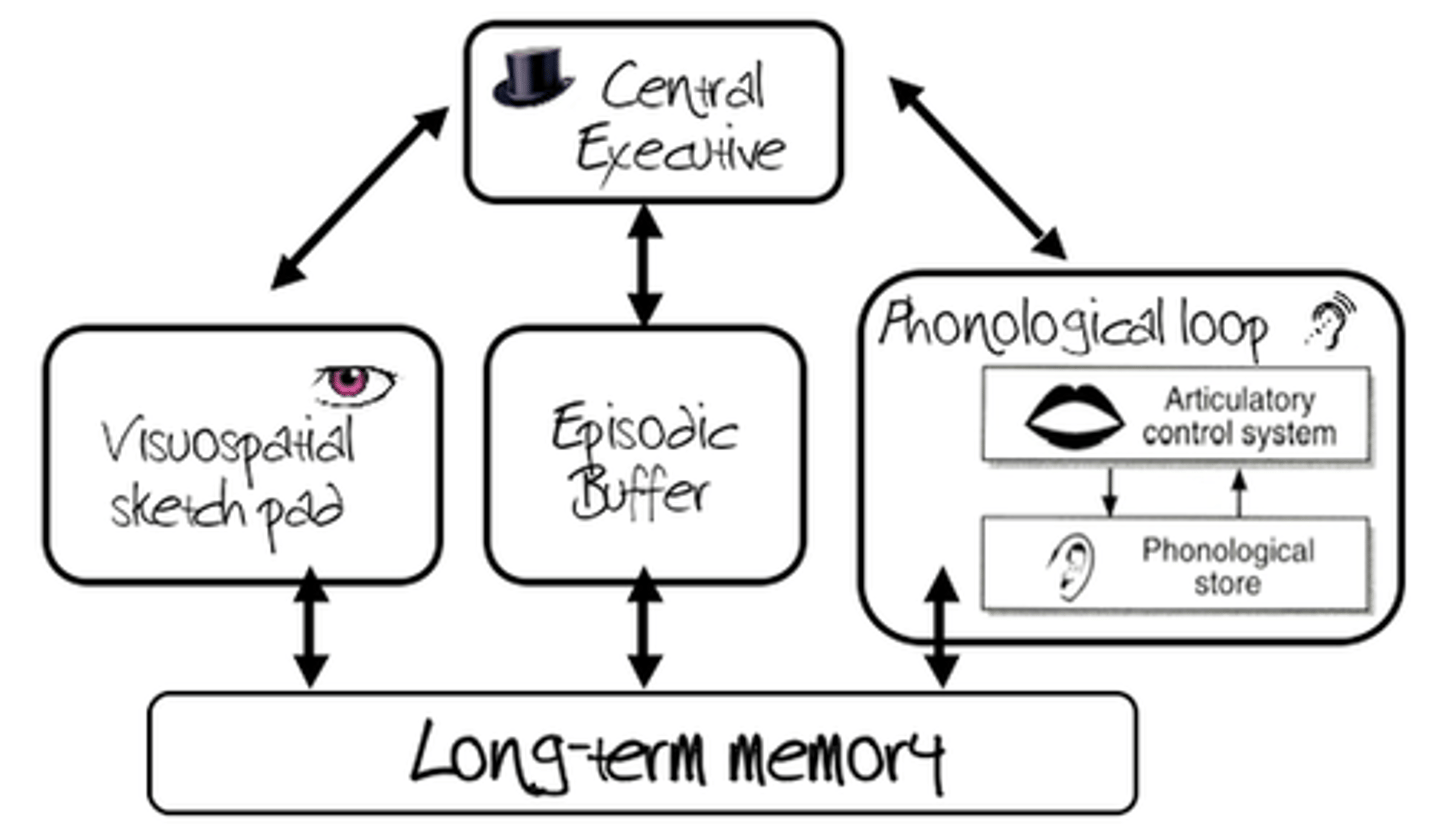
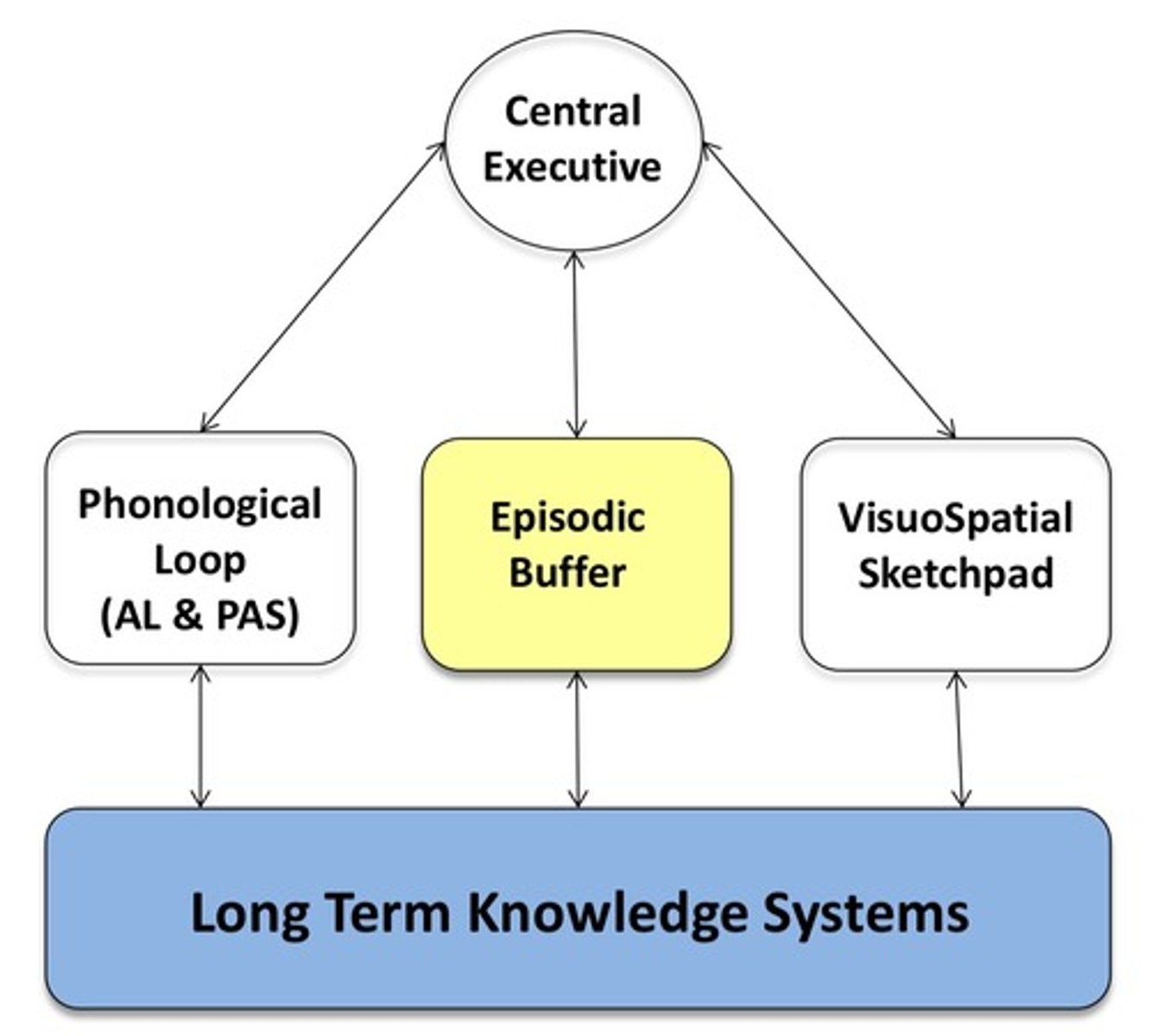
Structure of Working Memory Model
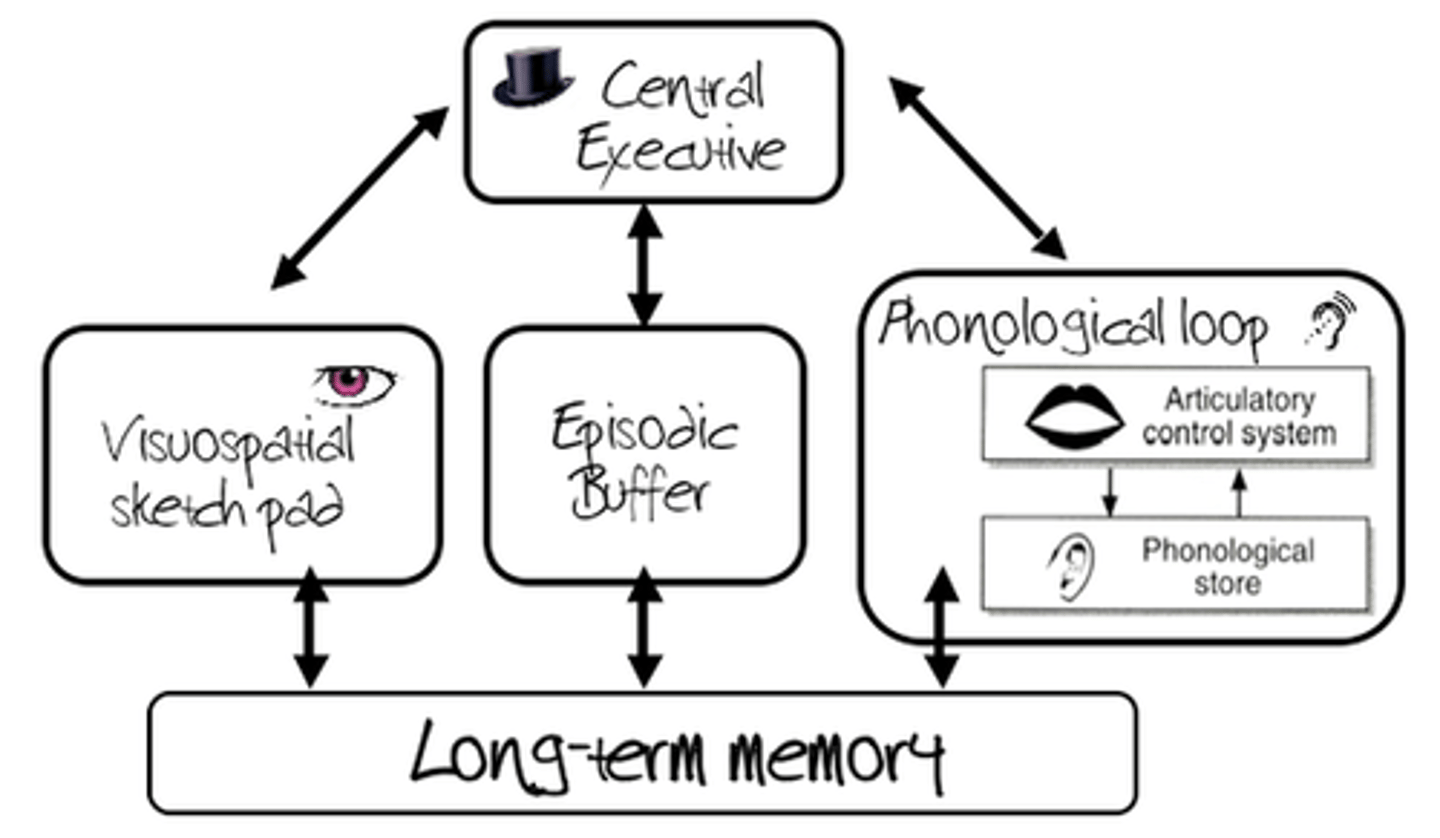
What is the Central Executive?
Attentional process that monitors incoming data. Allocates data to certain slave systems. Has limited processing capacity.
Evaluation of CE
Little is known about it - Most important but least understood (Baddley)
Better understood as attention rather than a memory store.
What is the Phonological Loop?
Deals w/ auditory info, both written and spoken. Preserves the order info arrives. 2 Parts:
Phonological Store
Articulatory Process
What is the Phonological Store? (Primary Acoustic Store)
Stores words heard.
What is the Articulatory Process?
Allows for maintainence rehearsal/sub-vocal repetition.
Capacity of this is about 2 seconds.
Linked to speech production.

Evaluation(s) of Phonological Loop
Baddley demonstrated that people find it more difficult to remember a list of long words than short words. Only 2 seconds in store. So can't repeat if being vocal - Two stores in it.
PET scan shows different activities when doing verbal tasks.
What is the Visuo-Spatial Sketchpad?
Stores visual or spatial information. Helps navigate around & interact with their environment. Through mental pictures.
Two Parts:
Visual Cache
Inner Scribe

What is the Visual Cache?
Stores Visual Data - Form and Colour.

What is the inner scribe?
Information about the Physical Relationship between items. Arrangment of objects in visual field.
Evaluation of Visuo-Spatial Sketchpad
Dual task Performance- supports the existance of the VSS. -->
The pp had diffculty doing two visual tasks other than visual and verbal- different slave systems.
PET scans show them as seperate stores.
What is the Episodic Buffer?
Added by Baddely later on (2000)
A temporary store- intergrating information from other sub systems rather than seperate strands
It's a bridge between working memory and LTM.
Who Looked at different sections of LTM?
Tulving-
He realised thsat the Multi-Store LTM was too simplistic
What did Tulving Propose about LTM?
Made of 3 Parts:
-Episodic Memory
-Semantic Memory
-Procedural Memory
What is Episodic Memory?
A LTM store for Personal Events
They're 'time stamped' (Dates)
The memory of a single episode which includes several elements.i.e places and people
Concious recall
What is Semantic memory?
Contains our knowledge of the world, includes facts and our knowledge of what words and concepts mean.
Concious Recall
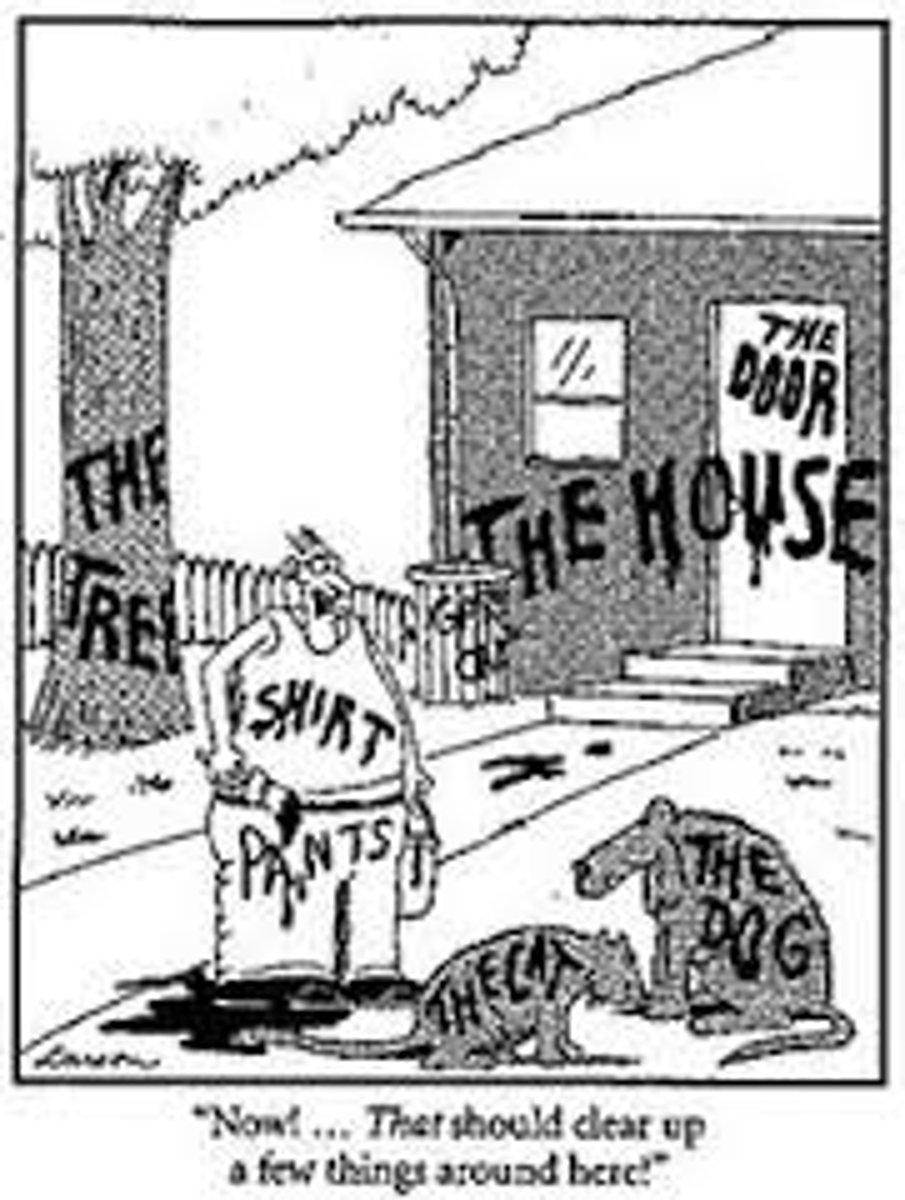
What is Procedural Memory?
Stores our knowledge of how to do things. Includes memories of learned skills.
Unconcious Recall

Which case study shows that LTM has different stores?
Clive Wearing- The episodic part of his brains were impaired due to his amnesia. They had trouble recalling thier past.
His Semantic and procedural memory were unaffected.
Wearing knew hoe read music sing and play the piano.
Supports Tulving Theory.
Postive Evaluation Points for LTM?
Case Studies support the idea of different stores
Brain scan studies provide evidence that there are 3 different stores
Benefits real-life applications
Negative Evaluation Points for LTM?
Problems with clinical evidence- case studies ( lacks control of all variables)
Could be two instead of three- actually seperated as declarative and non-declarative (Cohen and Squire)
What are the two explanations for forgetting?
Interfernece Theory
Retreival Faliure Theory

What is Interferene Theory?
Forgetting in LTM is because you can't get access to information.
As the info is stored at different times so makes it harder to locate
(one memory blocks another)
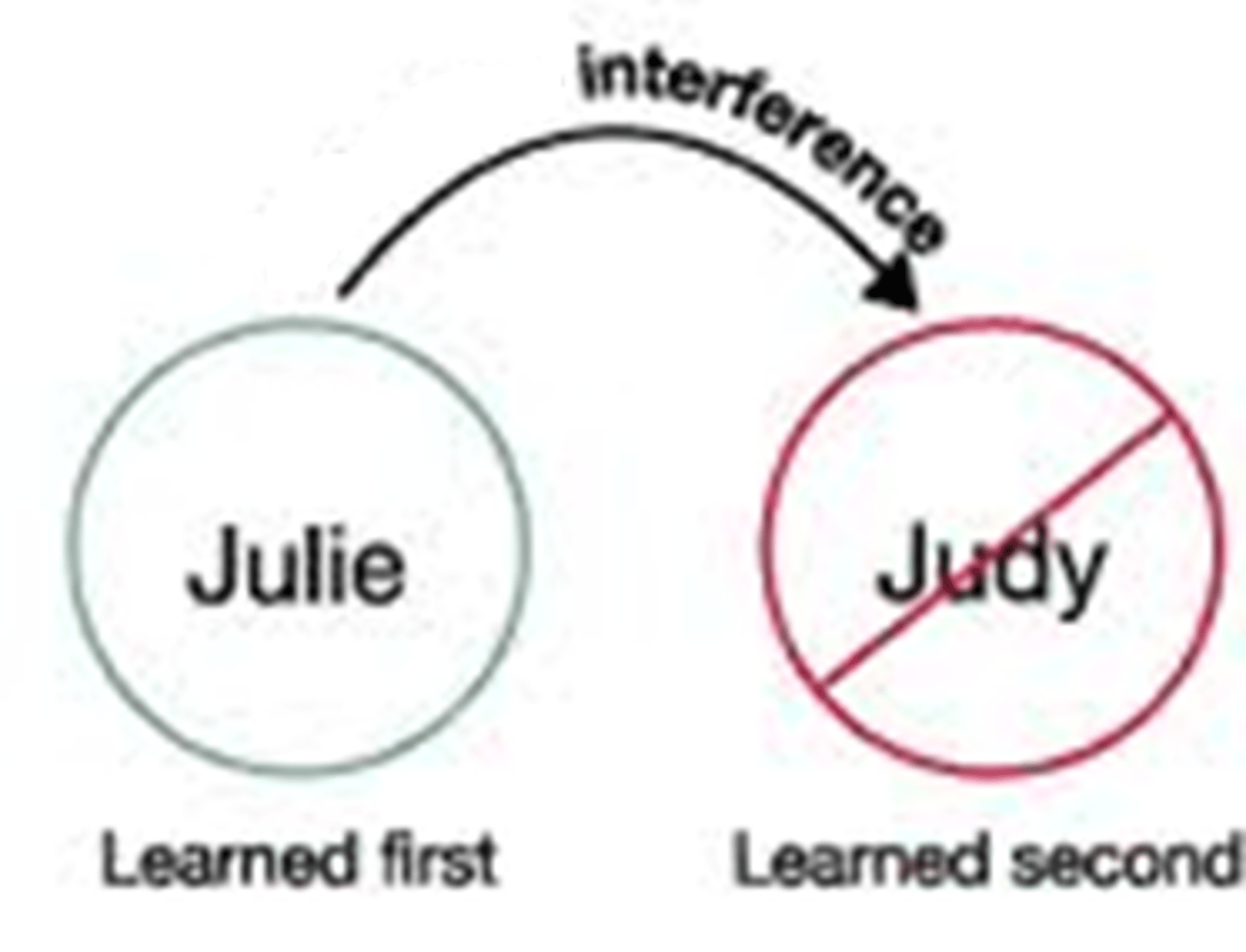
What is Proactive Interference?
Older Memories interferes with the new
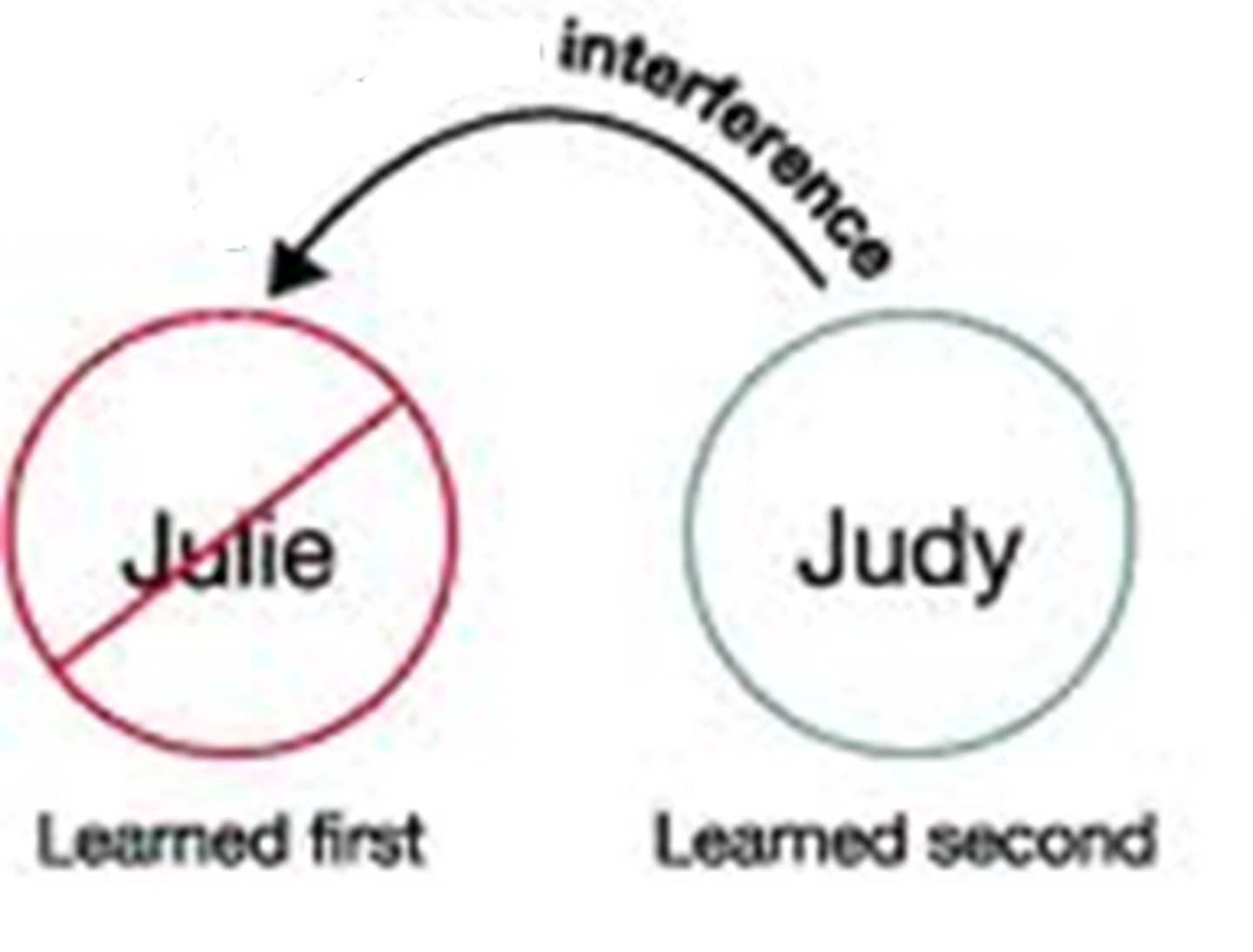
What is Retroactice Interference?
New Memories interferes with the old
When is Interference worse?
When the memories or learning is similar
What was Schmidt et al's Study?
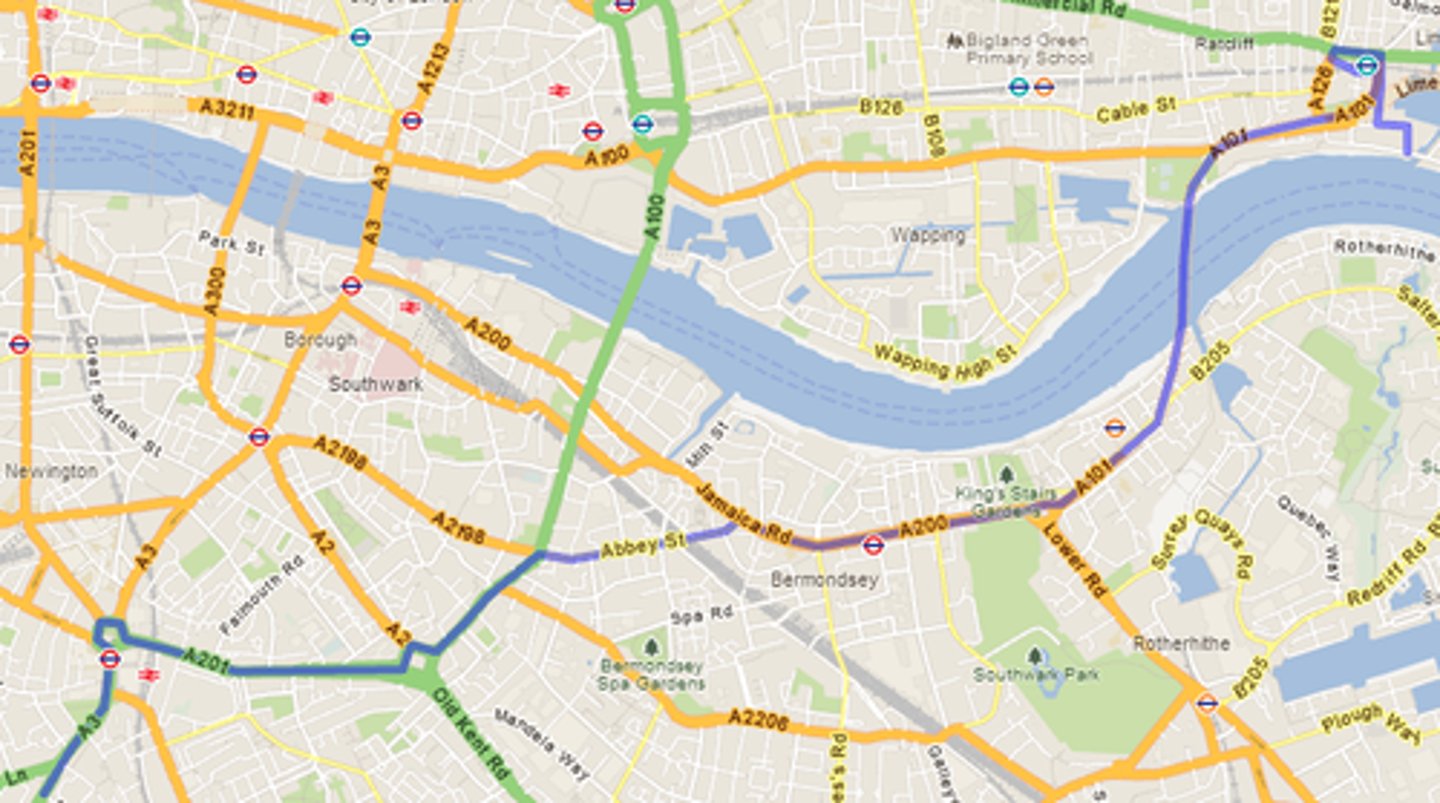
Real-life study of childhood street names- PPs were given a map with the street names replaced by numbers.
Asked to remember as many as possible.
(Other relevant info was collected by questionnaire) - how man times they moved
Positive association between number of times moved and number of street names forgotten.
What was the conclusions of Schmidt's Study?
Learning new patterns of street names when moving makes recalling older patterns more difficult.
Retroactive interference effects recall in real-life situations
What was the Evaluation of this Study?
Extraneous Variables - confounded results
Methodolgy used shows that its possible to research RI in real-life situations.
What was Baddeley and Hitch's Study?
Asked Rugby Players to try and remember the names of the teams they had played so far in that season week by week
What did Baddeley and Hitch's results?
Very clearly showed that accurate recall didn't depend on how long ago the match took place. Numbers of games they had played in the meantime.
A player's recall of a team from three weeks ago was better if they had played no matches since then.
Positive Evaluation Points of Interference Theory?
Evidence from lab studies consistently demonstrates interference
Real-life studies supports it
The effects of interference may be overcome using cues
Negative Evaluation Points of Interference Theory?
Only really explains forgetting when two sets of info are similar.
Most are lab experiemnts- lacks EV
Don't clearly identify the cognitive processes
What is Retreival Theory? (Cue-dependent Forgetting)
When you don't have the necessary cues to access memory. (Cue-dependent forgetting)

What two types of forgetting are in Cue-dependent forgetting?
Context-dependent Faliure
State-dependent Faliure
What is Context-dependent forgetting?
Where recall occurs in an external setting or code?

What was the divers study to explain context-dependent faliure? (Godden and Baddeley)
This study looked at how external cues present at the time of encoding affected memory recall.
Divers learnt a list of words either underwater or on land- thren asked to recall the words either on land or water.
Four groups-
Land- Land
Land- Water
Water- Land
Water- Water
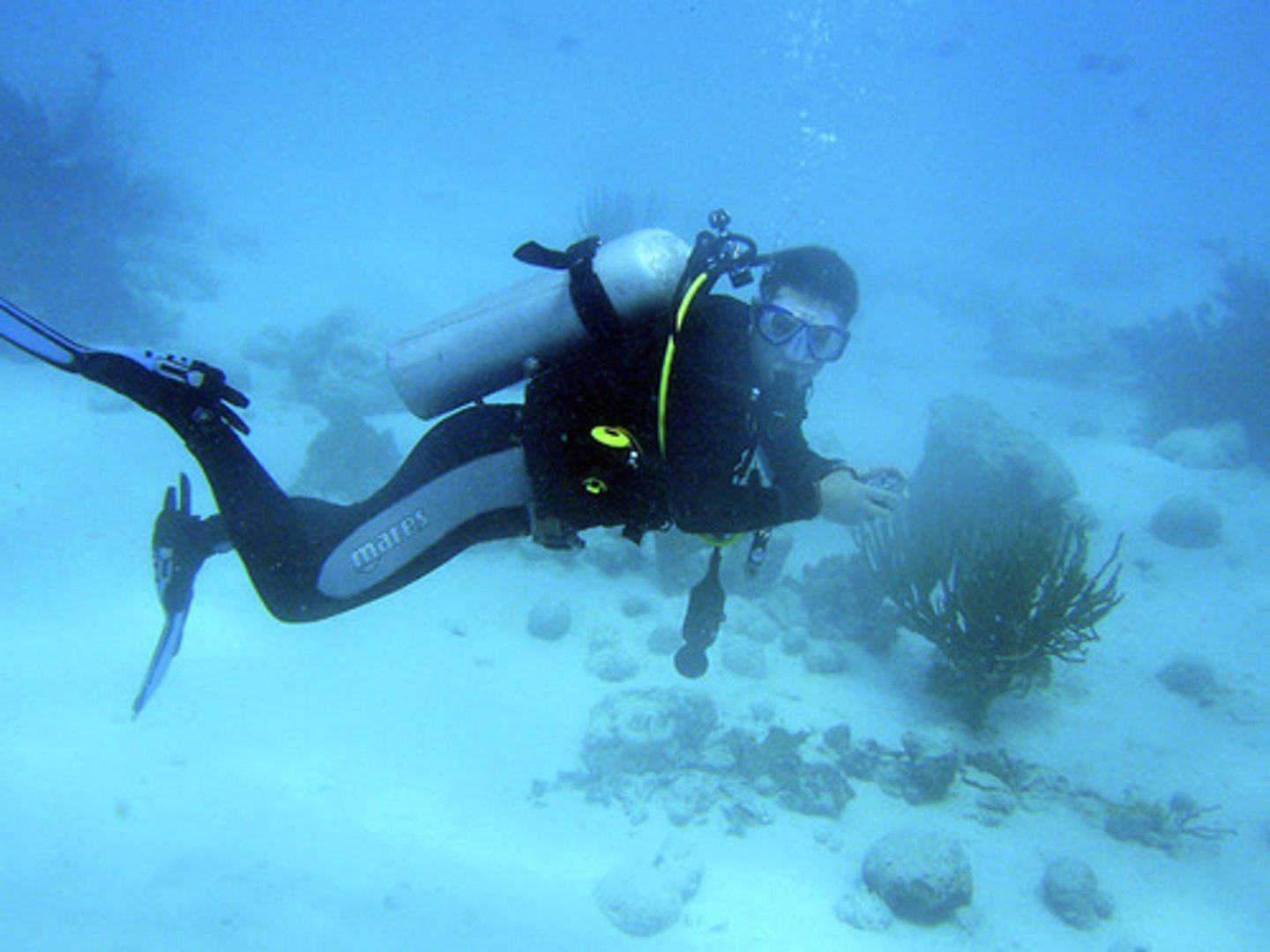
What was the findings for the divers study? (Godden and Baddeley)
Recall 40% lower in non-matching conditions
External cues are available at learning were different from recall there was a lack of cues.
What is State-dependent faliure?
Where recall occurs in different internal setting to coding.

What was the study looking at SDF? (Overton)
Got PPs to learn material when either drunk or sober.
Found that PPs recall was worse when they were different internal state than at coding.
Supports explanation
Positive Evaluation Points for Retrieval Faliure? (CDF)
Loads of research supporting the theory- Goddan and Baddeley.
Has good real- life applications
Negative Evaluation Points for Retrieval Faliure? (CDF)
Baddeley argues that context effects aren't as strong in real life
Most are laboratory based- lacks EV
What is the Encoding Specifity Principle (ESP)?
Tulving reviewed research into retrieval faliure and concluded that cues can help us recall information if the cue was present at encoded and at retrieval.
The closer the retrieval cue is to the original cue, the better the cue works.
It can't be teseted fully.
What is Eyewitness testimony?
The ability of people to remember the details of events like accidents/crimes.
What can affect Eyewitness Testimony?
Leading questions
Post-event Discussion
Anxiety
What are leading Questions?
A question which because of the way it has been phrased suggests a certain answer.
What was the procedure for Loftus and Palmer's Study?
They arranged for 45 American pps to watch film clips of car accidents and then gave them questions about the accidents.
Critical Question - 'About how fast were the cars going when they hit each other?'
Each of 5 groups were given different verbs in the critical question.
Hit, Contacted, Bumped, Collided, Smashed
What were the findings for the Loftus and Palmer Study?
Smashed produced the highest estimate (40.5 mph) and contacted was the lowest (31.8 mph).
What are the Positive Evaluation Points for Loftus and Palmer?
Replicable- Standardised Procedure
High Controls

