W1 - Westgard Rules and Levey-Jennings Chart
 Studied by 7 people
 Call with Kai
 Learn
Learn Practice Test
 Spaced Repetition
 Match
Match Flashcards
 Knowt Play
1/49

There's no tags or description
Looks like no tags are added yet.
Name | Mastery | Learn | Test | Matching | Spaced | Call with Kai |
|---|
No study sessions yet.
50 Terms
What is Westgard Rules?
A set of quality control rules that is used to determine when quality control results are acceptable
What is the purpose of the Levey Jennings Chart?
A visual representation of QC results over time
What is the X axis in a levey jenning chart?
Each sucessive run of QC
What is the % of 1SD?
68.2%
What is the % of 2SD?
95.5%
What is the Y axis in the Levey-Jennings Chart?
The results that is usually centered around the mean with major gridlines drawn at 1,2 and 3 SD
What is the symbol for Control Rules?
AL
What does the “A” represent in the Control rule?
The statistic or represent the number of control measurements
What does the “L” represent in the Control rule?
The control limits
What is 12s
A control measurement that exceeds the limit of the mean plus or minus 2 standard deviation
What is Random Error?
The unpredictable, uncontrollable variation in measurement of observation due to change factors
What is Systematic Error?
A consistent, directional error in measurement or data collection that makes results skewed away from the true value
Is 12S a random error or systematic error?
Random error
Is 22S random error or systematic error?
Systematic error
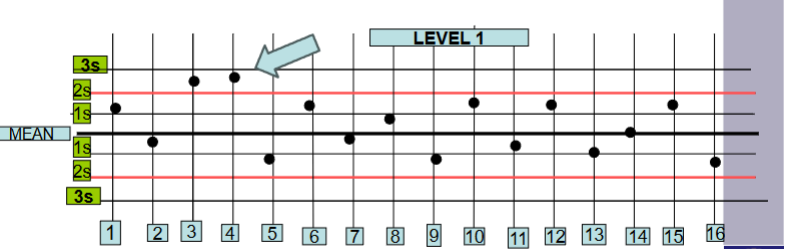
What is the nomenclature for this chart?
22s
Why do you need 2 or more 3 level of QC?
Cause you need to make sure the analyzer is covering the whole range of the analyte that its testing
Ex) Glucose range 50-300; Level one goes from 50-200 and Level two goes 150-300 ect
When would you use R4s?
When you have 2 levels of QC and the run on the SAME day are both above 2SD
Is R4s considered a random error or systematic error
Random error within the same run
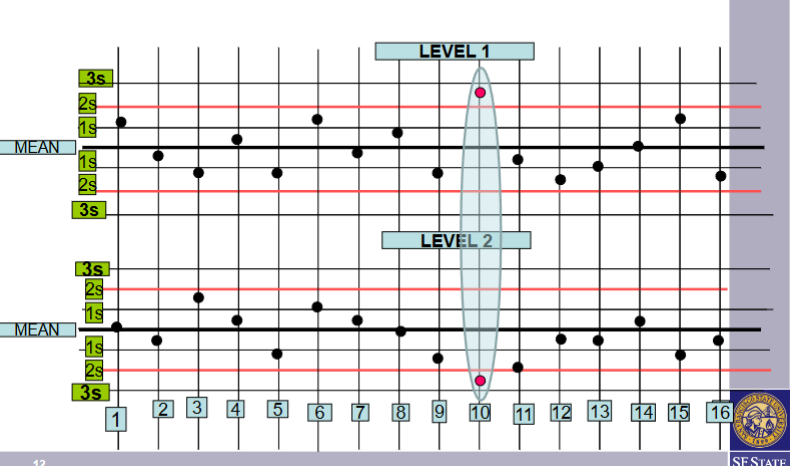
What is the nomenclature for this graph?
R4s
Would you reject or accept 41s?
Reject
Is 41s a random error or systematic error?
Systematic error
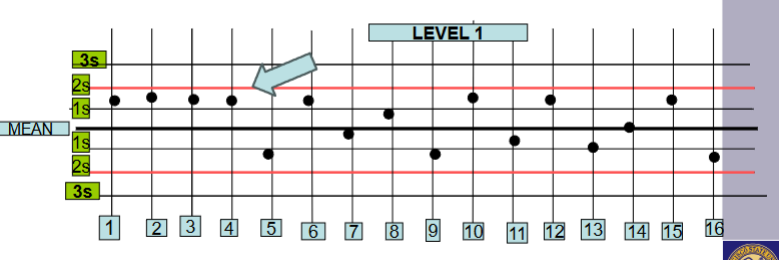
What is the nomenclature for this chart? Would you accept or reject the QC?
41s; Reject
What is 10x? Is it a random error or systematic error?
When 10 consecutive control measurements are one 1 side of the mean; Systematic error
Is a Shift a random error or a systematic error?
Systematic error
Is a Trend considered a random error or systematic error?
Systematic error
Is an Increased Imprecision a random or systematic error?
Random Error
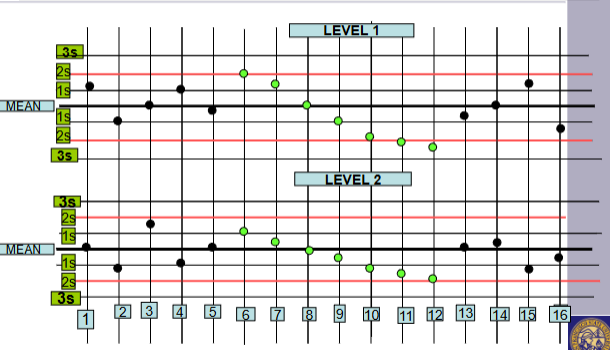
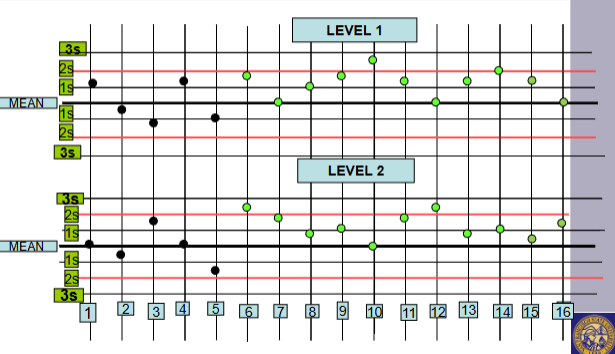
What kind of error is this? Is it random or systematic?
Trend; Systematic
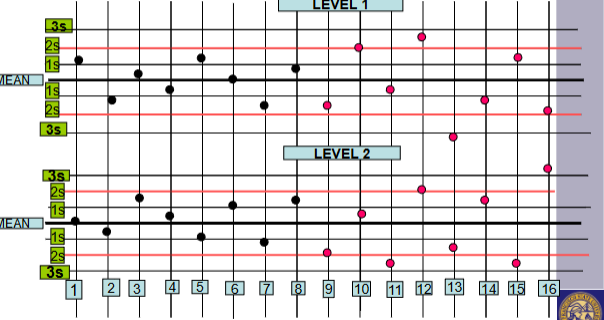
What kind of error is this? Is it random or systematic?
Shift; Systematic
What kind of error is this? Is it random or systematic error?
Random Error
What are the 3 habit you should remember when checking QC?
1) Open Date
2) Expiration Date
3) Initial of who opened it
What are some causes of systematic error?
Electronic drift
New lot# of reagent
Wrong/deteriorating reagent
Out of reagent
Pipette volume change
Blanking Error
Incorrect calibration
Incorrect timing of reaction
Interference
What are some causes of Random Error?
Instrument instability
Erratic volume change of sample of reagent
Temperature change
Erratic electrical current fluctuation
What are some artifactual error that can appear SE?
QC range set improperly
Control is either
1) Incorrectly reconstituted
2) Both are deteriorating
What are some artifactual error that can appear RE?
QC Range set improperly
One control is either
1) Reconstituted incorrectly
2) is deteriorating due to time, temp or contamination
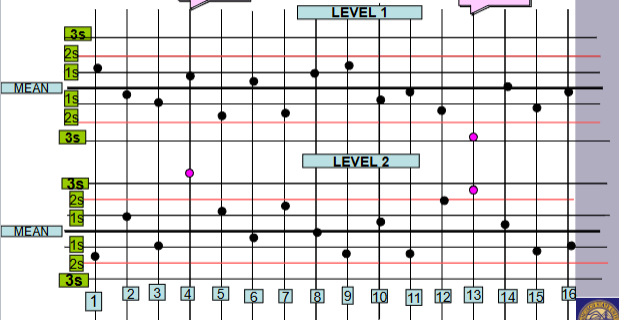
What type of error is happening on day 13? is it a random or systematic error
R4s; Random error
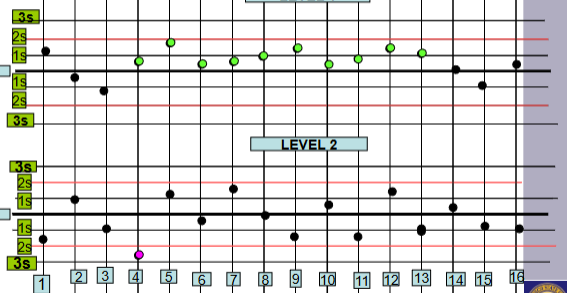
What kind of error is happening here? Which Level and what type of error?
Shift on Level 1; Systematic Error
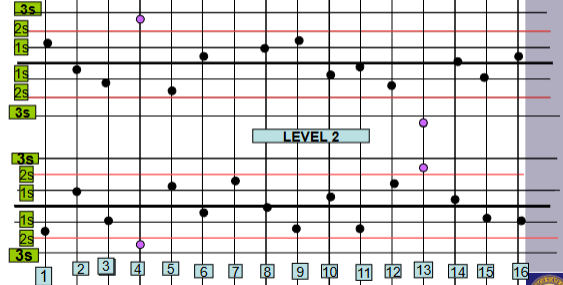
What are the 2 nomenclature for day 13? Is it a random or systematic error?
13s or R4s; Random error
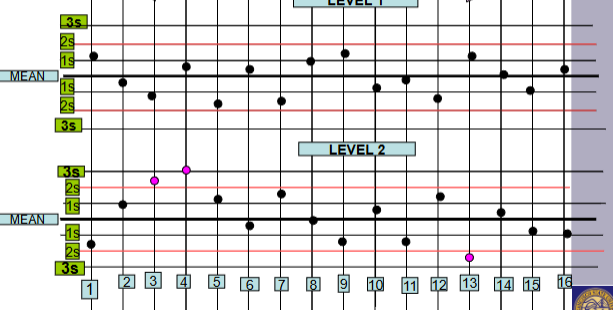
What is the nomenclature for this error? Is it a random or systematic error?
12s and 22s; systematic error
What is a false reject?
When the QC system shows a flag but no significant change is present
What is a false accept?
When a significant change is present but the QC system fails to flag it

What is the accuracy and precision of this target?
High accuracy; High precision

What is the accuracy and precision of this target?
High accuracy; Low precision

What is the accuracy and precision of this target?
Low accuracy; high precision
WHat is Trend
Gradual changes that occur such as a lamp deteriorating
What is shift
A major change in analyzer part of different reagent log number change, often suddenly and drastically
 Note
Note  Flashcards (100)