Multistore model
 Call Kai
 Learn
Learn Practice Test
 Spaced Repetition
 Match
Match Flashcards
 Knowt Play
1/27

There's no tags or description
Looks like no tags are added yet.
Name | Mastery | Learn | Test | Matching | Spaced | Call with Kai |
|---|
No analytics yet
Send a link to your students to track their progress
28 Terms
What is the Multi-Store Model of Memory?
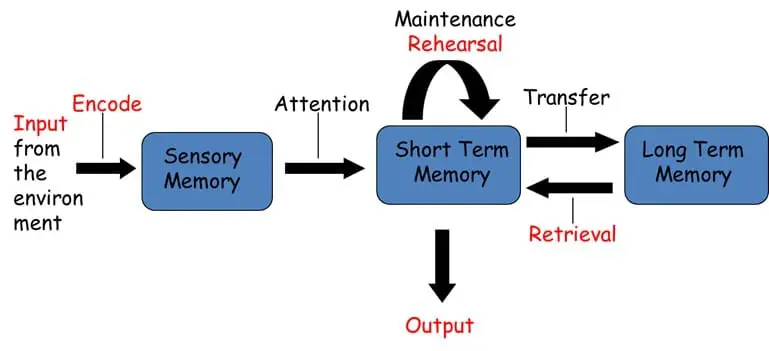
The Multi-Store Model of Memory was devised by Atkinson and Shiffrin (1968). It explains how information is transmitted from the environment through different memory stores and how it is processed at each stage.
What are the three stores in the Multi-Store Model?
Sensory Register, Short-Term Memory (STM), and Long-Term Memory (LTM).
multi-store model diagram
What are the key features of memory stores?
Coding (format of information), Capacity (amount of information), Duration (how long information lasts), and Function (role of the store).
What is the sensory register?
The sensory register is the first store that receives environmental stimuli from the senses (eyes, ears, touch, taste, smell).
How is information coded in the sensory register?
Coding is modality specific – information is stored in the same form it is received (e.g., visual, auditory).
What are the different stores in the sensory register?
Iconic (visual), Echoic (sound), Olfactory (smell), Haptic (touch), Gustatory (taste).
What is the capacity and duration of the sensory register?
Capacity is unlimited, but duration is very short (around 250 milliseconds).
What determines whether information moves from the sensory register?
Only information we pay attention to moves to STM; most is lost.
What did Sperling (1960) find about sensory memory?
Participants briefly saw a grid of letters and could recall specific rows when prompted, suggesting the sensory register has a large capacity.
What is the duration of STM?
About 18–30 seconds without rehearsal.
How is STM coded?
Acoustically (sound-based), due to internal rehearsal.
What is the capacity of STM?
Limited capacity of around 7±2 items (Jacobs, 1887).
What is rehearsal in STM?
Repetition of information to keep it in STM and transfer it to LTM.
What are the two types of rehearsal?
Maintenance rehearsal (repeating to keep information in STM) and elaborative rehearsal (adding meaning to transfer to LTM).
What is chunking?
Grouping items together so they are treated as one unit, increasing STM capacity.
What did Baddeley (1966) find about STM coding?
Immediate recall was worst for acoustically similar words, suggesting STM is coded acoustically.
What did Jacobs (1887) find about STM capacity?
Capacity was around 7 items for letters and 9 for numbers, showing STM is limited.
What did Peterson and Peterson (1959) find about STM duration?
After 18 seconds, recall dropped below 10%, showing STM duration is very short without rehearsal.
What is the capacity of LTM?
Unlimited capacity.
What is the duration of LTM?
Potentially lifelong (unlimited duration).
How is LTM coded?
Semantically (based on meaning).
What is retrieval?
The process of bringing information from LTM back into STM for use.
What happens to information in LTM?
It may be lost (inaccessible) but can sometimes be retrieved later.
What did Wagnaar (1986) find about LTM capacity?
He recorded 2400 events over 6 years and showed high recall, suggesting LTM capacity is very large.
What did Bahrick (1975) find about LTM duration?
Participants showed 90% recall after 15 years and 80% after 48 years, suggesting LTM duration is very long.
How does information flow through the MSM?
Sensory Register → Attention → STM → Rehearsal → LTM → Retrieval → STM
What controls movement between stores?
Attention (SR → STM) and Rehearsal (STM → LTM).

