2.1 Intro to Hearing Aids
 Call Kai
 Learn
Learn Practice Test
 Spaced Repetition
 Match
Match Flashcards
 Knowt Play
1/115

There's no tags or description
Looks like no tags are added yet.
Name | Mastery | Learn | Test | Matching | Spaced | Call with Kai |
|---|
No analytics yet
Send a link to your students to track their progress
116 Terms
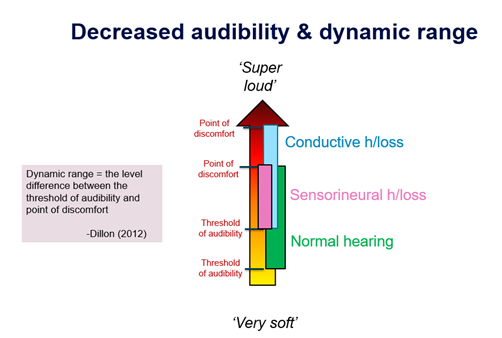
what is the dynamic range?
the difference between the threshold of audibility (where something is just audible) and the point of discomfort (when sound becomes too loud).
how do hearing aids help fit a person’s dynamic range?
amplification of those sounds
how much is the dynamic range shifted by in people with CHL and SNHL?
shifted by the extent of the ABG
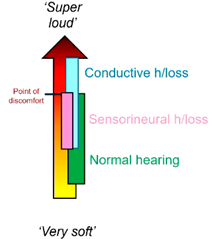
what is the dynamic range of people with CHL?
no longer can hear soft sounds.
point of discomfort is higher than normal.
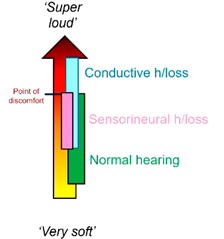
what is the dynamic range of people with SNHL?
dynamic range is a lot smaller.
they cannot hear sounds which are soft and have same point of discomfort as someone with normal hearing.
what is decreased in patients who need hearing aids?
audibility and dynamic range
what is the most recommended intervention for mild hearing loss?
hearing aids are helpful but not necessary.
what is the most recommended intervention for moderate hearing loss?
hearing aids are necessary
what is the most recommended intervention for severe hearing loss?
hearing aids necessary and cochlear implants considered
what is the most recommended intervention for profound hearing loss?
hearing aid possible and cochlear implant recommended.
what is the appropriate intervention and rehabilitation dependent on hearing loss?
degree and type of hearing loss and communication needs of specific patient
what sounds are amplified?
Between 200-8000/10000Hz (most important for speech perception).
Sounds at different frequencies amplified by different amounts.
why are hearing aids beneficial?
reintroduce sound to improve audibility.
Improves speech clarity and communication.
Which helps foster relationships and connection with one’s environment.
Better physical and mental wellbeing which improve quality of life.
what are the 5 parts inside a hearing aid?
microphone, analogue to digital converter (ADC), digital signal processor (DSP), digital to analogue converter (DAC) and receiver (loudspeaker)
what is the function of a microphone?
Picks up the acoustic signal (sound) and changes it to an electrical signal
what is the function of an Analogue to digital converter (ADC)?
Converts electrical signal to a binary code (digitised signal) which a computer can interpret
what is the function of a Digital signal processor (DSP)?
A digital circuit that decides where amplification is applied depending on hearing loss and filters sound
what is the function of a Digital to analogue converter (DAC)?
Converts digital signal back into an electrical signal
what is the function of a receiver?
- Changes amplified electrical signal back to acoustic signal (sound pressure waves), channels down ear canal helping someone to hear
- Location can differ depending on hearing aid style
batteries for hearing aids can either be:
rechargeable or disposable
what are the two types of hearing aid styles?
Custom/in the ear hearing aids
behind-the-ear hearing aids
What are the in-the-ear options?
custom made hearing aids.
non custom options.
what are custom made hearing aid options?
ITE, ITC, CIC and IIC
what are non custom options?
lyric and instant fit
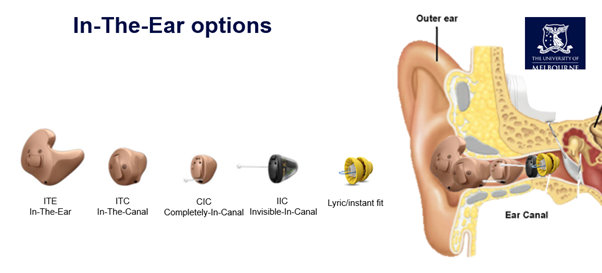
rank all hearing aid options from largest to smallest?
ITE, ITC, CIC, IIC, lyric and instant fit.
also going deeper from left to right.
parts of custom hearing aids
microphone.
battery door.
volume control.
removal pin.
vent.
wax filter/sound output.
receiver or loudspeaker.
what is one of the reasons why vents are used for hearing aids?
allows ear to become aerated (prevent moisture from building up which can lead to bacterial growth).
what is the faceplate of hearing aid?
sits on the outside and contains microphone, battery door, volume control rotator and vent
what is a lyric?
hearing aid sitting close to the eardrum.
Extended wear device that stays in the ear 24/7 until the battery dies.
Is disposable.
what is a lyric made out of?
Soft, porous foam seals contour to ear canal.
who is not suitable for lyric fitting?
those with middle ear pathologies e.g. perforation, exostoses.
potential challenges of wearing lyrics
can cause discomfort.
quite expensive (pay subscription service every year).
what does lyric make use of?
natural resonance of ear.
which hearing aid can be most easily inserted and removed?
CIC, ITC and ITE
what hearing aid have easily manipulated controls?
ITC and ITE since they are larger devices.
what hearing aid is insensitive to wind noise?
lyric, instant fit, IIC and CIC
how does wind cause noise in hearing aids?
- Caused by turbulence going through microphone ports
- Deeper fitting hearing aids less prone and fewer microphones
what hearing aids have better directionality?
those with multiple microphones.
ITE and some ITCs.
what hearing aid has the least occlusion?
Lyric and IICs good.
Sit deeper and so less of an issue.
what hearing aids are phone friendly?
Good options include Lyric, instant fit, IIC and CIC.
what hearing aids can be fitted on the same day?
instant fit and lyric. so not custom options.
what options can you have with Behind the Ear or BTE?
BTE with a thick tube (standard) and attached to an earmould.
Or a slim tube attached to a dome.
Or a slim tube is attached to an earmould.
what options can you have with Receiver in the Ear or RIC?
can have either domes or moulds. no differentiation of tube thickness.
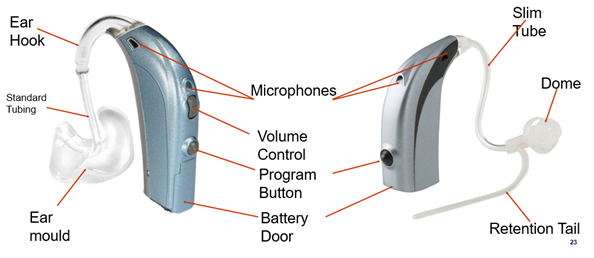
name the parts of BTE hearing aids.
have either an earhook attached to standard tubing and earmould.
or slim tube to dome or earmould.
also have microphones at the front and rear, volume control (Switch), program button and battery door.
domes sometimes have a retention tail to securely anchor speaker in the canal and prevent it from slipping out during daily movement.
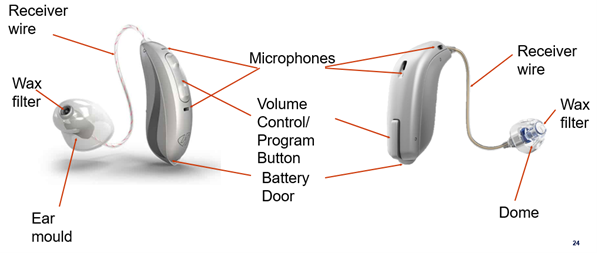
name the parts of RIC.
you’ve got a wire connected to an earmould or dome.
the earmould or dome should have a wax filter in it.
the rest are the same as BTE.
what are some key differences between BTE and RIC?
Receiver inside the body of the aid for BTE.
Versus outside the body of the aid for RIC.
receiver is coupled to the BTE by a removable wire (no tubing).
receiver is attached either to a dome or custom tip.
interchangeable receiver powers e.g. standard, medium or high power versus fixed power for BTE.
downsides of using a receiver outside for RIC
have to repair BTE if receiver breaks.
what is the effect of having a receiver outside the aid for RIC?
The body of hearing aid can be much smaller, more versatile.
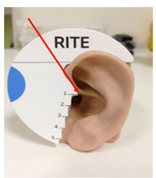
how to select correct slim tube or receiver length (which are stock size)?
Place manufacturer gauge on client’s ear.
Look at the number on the gauge (manufacturer gauge) coinciding with the top of the ear canal.
e.g. 1 for this client.
retention tail is optional.
what are the 3 types of domes?
open domes, closed domes, and power domes.
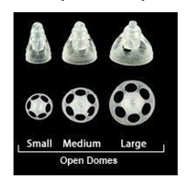
structure of open domes:
Have holes in the flange to keep ear canals as open as possible to allow for aeration
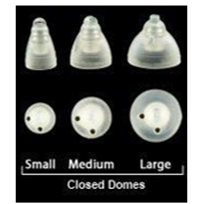
structure of closed domes:
Have no holes in the flange to keep sound in
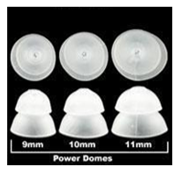
structure of power domes:
Provides a tight seal to prevent sound leakage.
so domes can differ in:
size (small to large) and type.
all of which are stock size.
downsides of domes
cannot choose vent size
BTE dome options for what degrees of hearing loss?
Open dome for mild to moderate (0-20).
Occluded dome for moderate (20-40).
Custom earmould for severe to profound (40-100).
Ear canal should be occluded to prevent sound leakage (for severe hearing loss).
Open or unoccluded for mild hearing loss.
what is more easily inserted BTE vs RIC?
BTE with earmould because largest of devices less fiddly compared to RIC which is smaller.
what has easier controls BTE or RIC?
Large BTE or RIC.
what is insensitive to wind BTE or RIC?
None (CIC/IIC better as protect actual ear).
what has better directionality BTE or RIC?
All BTE and RIC options (all have 2 microphones).
which has better phone usage BTE or RIC?
All RICs and BTEs will have Bluetooth connectivity.
Microphones behind ears and receivers have to be held higher.
which is better for same day fit BTE or RIC?
RICs with domes and BTEs with slim tubes and domes (but not for earmoulds since they have to be made).
what is better for cosmetic preference BTE or RIC?
RIC is smaller and better than BTE cosmetically.
how does program change work for hearing aids?
Hearing aids can be set with more than 1 program which is accessible either via the program button or via the hearing aid app on the client’s phone
what is a hearing loop?
coil of wire that is activated (getting only the signal being broadcasted into the hearing aid)
how can hearing aids directly connect to other sound sources?
via hearing loops or mobile phones.
requires separate programs for this when client wants to activate it.
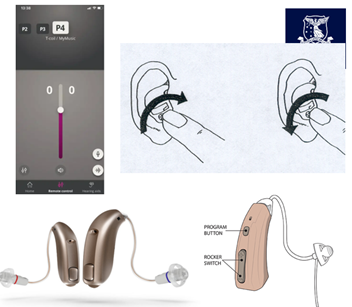
how is volume controlled in hearing aids?
different for different manufacturer.
Continuous rotary wheel.
Push button rocker switch (up or down).
Single push button.
Or accessible via the clients’ hearing aid app on a phone.
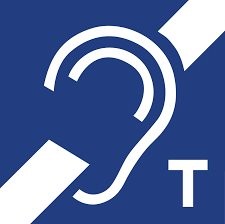
what is a sign for a venue that can use telecoils?
telecoil symbol
what is the fitting range of a hearing aid or HA dependent on?
size, brand and receiver of HA
weaker receivers are typically what size:
smaller than larger ones which are stronger.
fitting range how is it helpful clinically and relate it to hearing loss or HL?
Look at the fitting range of the receiver within manufacturer software.
See where the client hearing loss falls in that range.
And then pick what receiver to choose.
If fitting range fits the hearing loss range then choose that one if not choose next most powerful receiver.
how to turn on a battery operated hearing aid?
Peel off sticker on battery.
Wait about 30s to activate battery.
Open battery door and insert it.
Then close the battery door.
how to turn on a rechargeable operated hearing aid?
push down the button (green flashing indicates it is on).
Push down the button again (red flashing indicates it is off).
or remove it from charging station (should automatically turn on and be green).
visibility of hearing aids dictate
their strength in amplifying sound.
As visibility decreases it is typically not as powerful than something that is more visible.
e.g. lyrics less powerful than say CIC.
what are real ear measures?
A thin probe microphone is placed in the ear canal.
We played a controlled speech like signal to the hearing aids (through a loudspeaker).
The sound level is measured close to the eardrum.
The measured output of the hearing aid is compared to calculated prescription targets.
If poor match then adjust the hearing aid to better match.
why do we do REMs?
Ensures:
- Hearing aid is matching a prescription
- Doing what it’s supposed to be doing for your client i.e. making sounds audible according to their hearing loss
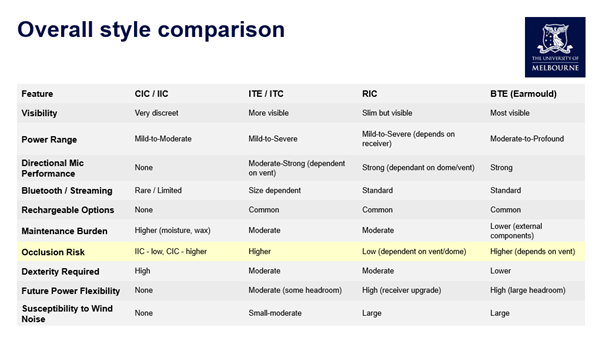
what is the visibility of CIC/IIC?
very discreet.
what is the power range of CIC/IIC?
mild to moderate
what is the directional mic performance of CIC/IIC?
none
bluetooth streaming of CIC/IIC?
rare or limited
rechargeable options of CIC/IIC?
none
maintenance burden of CIC/IIC?
higher (moisture and wax prone)
occlusion risk of CIC/IIC?
IIC- low, CIC- higher
Invisible-in-the-Canal (IIC) models because CIC devices sit shallower in the ear canal, resting in the cartilaginous portion rather than deep into the bony part (which is more rigid and does not vibrate easily). This shallower placement traps more bone-conducted sound, causing the wearer's own voice to sound boomy or hollow, whereas IIC devices are placed deeper, significantly reducing or eliminating this effect.
dexterity required CIC/IIC?
high
future power flexibility for CIC/IIC?
none
susceptibility to wind turbulence or noise CIC/IIC?
none
visibility of ITE/ITC?
more visible
power range of ITE/ITC?
mild to severe
directional mic performance of ITE/ITC?
moderate to strong dependent on vent size
bluetooth or streaming options for ITE/ITC?
size dependent
rechargeable options for ITE/ITC?
Common
maintenance burden of ITE/ITC?
moderate
occlusion risk of ITE/ITC?
higher
dexterity required for ITE/ITC?
moderate
future power flexibility for ITE/ITC?
moderate (some headroom)
susceptibility to wind noise for ITE/ITC?
small to moderate.
visibility of RIC?
slim but visible
power range of RIC?
mild to severe depending on receiver
directional mic performance of RIC?
strong dependent on dome and vent
bluetooth or streaming for RIC?
standard
Explore top notes

