Exam 2 (slides)
0.0(0)
 Studied by 2 people
 Call Kai
 Learn
Learn Practice Test
 Spaced Repetition
 Match
Match Flashcards
 Knowt Play
Card Sorting
1/136

Earn XP
Description and Tags
Last updated 5:34 AM on 5/8/23
Name | Mastery | Learn | Test | Matching | Spaced | Call with Kai |
|---|
No analytics yet
Send a link to your students to track their progress
137 Terms
1
New cards
Trait theory
“great person”
based on assumption that certain traits distinguish leaders from non-leaders
based on assumption that certain traits distinguish leaders from non-leaders
2
New cards
behavior theory
stresses what leaders do
leader behavior description questionnaire
leader behavior description questionnaire
3
New cards
Fielder’s contingency model
an approach to the study of leadership that takes into account characteristics of both the leader and the situation- right person at the right time
4
New cards
task oriented
works with loose, unfavorable or ridged, favorable situations
5
New cards
relationship oriented
work in the middle
6
New cards
path goal theory
proposes that effective leaders motivate subordinates to achieve goals by making rewards available, keeping the path to goal achievement free of obstacles, and being mindful of subordinates’ levels of personal satisfaction
7
New cards
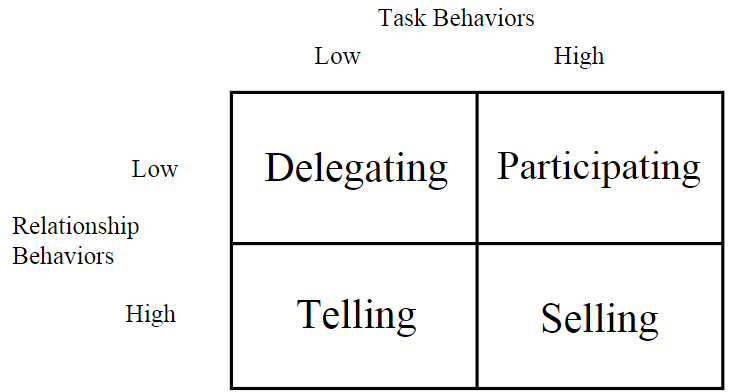
life cycle theory
focuses on the “maturity” of followers. changes in the maturity of followers prompt changes in the leader’s task behavior and relationship behavior
8
New cards
dispositional approach
3 major assumptions
3 major assumptions
* if persons are truly disposed to act or respond in particular ways, then personality should be fairly stable across time
* dispositions have consistency and generality within a person
* individual differences arise from differences in the strength, amount and number of dispositions a person has
* dispositions have consistency and generality within a person
* individual differences arise from differences in the strength, amount and number of dispositions a person has
9
New cards
individual psychology
allport
10
New cards
trait
“a generalized and focalized neuropsychic system (peculiar to the individual) with the capacity to render many stimuli functionally equivalent and to initiate and guide consistent (equivalent) forms of adaptive and expressive behaviors”
11
New cards
types of traits
* cardinal
* central
* secondary
* central
* secondary
12
New cards
cardinal
characteristics that are pervasive and dominant in a person’s life
(master motives that underlie most behaviors)
(master motives that underlie most behaviors)
13
New cards
central
control less of behavior but are still important (commonly the ones people use to describe themselves)
14
New cards
secondary
preferences (easily overridden)
15
New cards
common traits
categories for classifying many people (like a type)
16
New cards
personal dispositions
unique characteristics of people (how does this person differ from most other persons?)
17
New cards
Cattell- Expectations
defined personality based on what we can expect the person to do
R=f(S,P)
response of a person is a function of the situation confronted and the individual’s personality
R=f(S,P)
response of a person is a function of the situation confronted and the individual’s personality
18
New cards
roles in groups
* task roles
* socioemotional roles
few people can fulfill both types of roles although leaders can and often do
* socioemotional roles
few people can fulfill both types of roles although leaders can and often do
19
New cards
task roles
focus on the work to be done in the group
20
New cards
socioemotional roles
focus on the quality of relationships among group members
21
New cards
group cohesion
The factors that most saliently distinguish a group from a random gathering of individuals is the degree of attraction, commitment, and involvement of the individual members related to the collective totality.
22
New cards
3 characteristics of cohesion
1. attraction
2. commitment
3. involvement
23
New cards
models of cohesion in sport
pendular model
linear model
life cycle model
linear model
life cycle model
24
New cards
pendular model
the idea that forces swing team members back and forth between cohesion and disunity
(initial tryouts, assignment of roles, competition for play time, competition time)
(initial tryouts, assignment of roles, competition for play time, competition time)
25
New cards
linear model
the idea that cohesion progresses in a predictable way through a series of stages:
forming, storming, norming, and performing
forming, storming, norming, and performing
26
New cards
life cycle model
the idea that the life cycle of a group is similar to the human life cycle
27
New cards
factors affecting team cohesion
* group size
* the task
* team tenure
* satisfaction
* the task
* team tenure
* satisfaction
28
New cards
group size
the larger the group, the more challenges to cohesion and more likely that sub-groups will form
29
New cards
ringelman effect
avg. effort decreases with an increase in group size
30
New cards
social loafing
decrease in individual effort due to presence of coworkers
31
New cards
social loafing
decrease in individual effort due to presence of coworkers
32
New cards
social striving
increase effort in groups when task relevance, intergroup competitiveness, and personal involvement
33
New cards
the task
how much cooperation is required
34
New cards
satisfaction
success leads to satisfaction and cohesion
35
New cards
task role: initiator-contributor
function: offers ideas, new approaches
36
New cards
task role: opinion seeker
Function: ask for attitudes, values
37
New cards
task role: information giver
Function: provides date for group
38
New cards
task role: orienter
Function: keeps group focused
39
New cards
task role: energizer
function: stimulates group
40
New cards
task role: recorder
function: maintains records
41
New cards
task role: critic
function: appraises quality
42
New cards
socioemotional role: encourager
function: rewards with praise
43
New cards
socioemotional role: harmonizer
function: mediates conflicts
44
New cards
socioemotional role: compromiser
function: shifts position to keep peace
45
New cards
socioemotional role: gatekeeper
function: ensures equal participation
46
New cards
socioemotional role: standard setter
function: for assessing quality
47
New cards
socioemotional role: observer
function: points out positives and negatives
48
New cards
socioemotional role: follower
accepts others ideas
49
New cards
Stage of group development: orientation
major process: task exploration
50
New cards
Stage of group development: conflict
major process: resistance, disagreement
51
New cards
Stage of group development: organization
major process: growth of cohesiveness and unity
52
New cards
Stage of group development: performance
major process: goal achievement, focus on task
53
New cards
Stage of group development: dissolution
major process: completion of tasks, reduction of dependence
54
New cards
Order of group development
1. orientation= forming
2. conflict= storming
3. organization= norming
4. performance= performing
5. dissolution= adjourning
55
New cards
personality (definition)
The underlying, relatively stable psychological structure and processes that organize human experience and shape a person’s activities and reactions to the environment
56
New cards
psychological core
a person’s basic personality, composed of core traits, stable and \n unchanging over time, by which we know ourselves and known others
57
New cards
peripheral states
aspects of a person’s basic personality that are constantly in flux
58
New cards
six basic categories of personality theories:
1. Freud’s psychoanalytic
2. Horney’s sociocultural
3. Trait theories
4. humanistic theories
5. behavioral and social learning views
6. neurobiological
59
New cards
Freud’s psychoanalytic theory
* All facets of human personality arise from a basic conflict between our pleasure-seeking urges & the social restraints against them
* Energy that motivates our behavior comes from our aggressive and sexual urges
* Energy that motivates our behavior comes from our aggressive and sexual urges
60
New cards
personality structure involves 3 components: (Freud)
Id, Ego, Superego
61
New cards
Id (Freud)
* our biological urges (the only aspect of personality we are born with)
* operates according to the “pleasure principle”
* no ability to delay gratification
* operates according to the “pleasure principle”
* no ability to delay gratification
62
New cards
Ego (Freud)
* develops through contact with reality to help Id satisfy its urges safely
* does not “pass judgment” on what Id wants
* will help Id get what it wants but will work within the reality that there are safe and unsafe ways to get what we want
* operates according to the “reality principle”
* is not “moral”
* does not “pass judgment” on what Id wants
* will help Id get what it wants but will work within the reality that there are safe and unsafe ways to get what we want
* operates according to the “reality principle”
* is not “moral”
63
New cards
superego (Freud)
* operates accoring to the “morality principle”
* learned by how we are raised
* attempts to get Id and Ego to “do the right thing”
* “A rule is a rule” (makes it irrational)
* learned by how we are raised
* attempts to get Id and Ego to “do the right thing”
* “A rule is a rule” (makes it irrational)
64
New cards
Horney’s sociocultural view
* felt that social forces were important contributors to personality development
* felt the need for security was the primary influence in personality development
* felt the need for security was the primary influence in personality development
65
New cards
Horney’s approach
* poor childhood relationships may lead to “basic anxiety”
* neurotic trends
* moving toward, away from, and against people
* idealized image
* neurotic pride
* neurotic trends
* moving toward, away from, and against people
* idealized image
* neurotic pride
66
New cards
5 major features of personality:
1. emotional stability (calm vs anxious)
2. extroversion (outgoing vs withdrawn)
3. openness (flexible vs rigid)
4. agreeableness (helpful vs difficult)
5. conscientiousness (careful vs careless)
67
New cards
central feature of personality is one’s
self-concept
68
New cards
our behaviors are driven by our quest for
self-actualization
69
New cards
actual self (Rogers)
who we currently believe ourselves to be
70
New cards
ideal self (Rogers)
who we would most like to be
71
New cards
Ought self (Rogers)
who others tells us we “should” be
72
New cards
reciprocal determinism
behavior, internal personal factors (traits etc.), and environmental influences all operate to influence each other and determine our personality
73
New cards
control
humans are motivated to feel they are in control of the world moving around them
74
New cards
self-efficacy
“I am an entity capable of actions and those actions have predictable consequences”
75
New cards
learned helplessness
“the world happens to me:
76
New cards
What is personality assessment?
process in which a psychologist uses systematic procedures to gather and organize information about a person to aid in understanding, prediction, or the making of decisions about the person (often for treatment)
77
New cards
Sunberg’s 5 stages of personality assessment
1. establishing the reason for the assessment
2. selecting the assessment techniques
3. gathering the information
4. organizing and interpreting the information
5. communicating conclusions and making decisions
78
New cards
reliability
means that a tests’ results must be repeatable
79
New cards
validity
the degree to which a test measures what it is designed to measure
80
New cards
content validity
* do the items on the test sample the behaviors of interest?
* do scores indicate likely behavior?
* foes the score indicate what someone is likely to do or NOT do?
* do scores indicate likely behavior?
* foes the score indicate what someone is likely to do or NOT do?
81
New cards
criterion-related validity
test shows the capacity to make predictions about a person’s behavior by demonstrating a statistical relationship with scores on a second test (concurrent vs. predictive)
82
New cards
construct validity
occurs when support for a hypothesis based on theory is demonstrated (convergent vs. divergent)
83
New cards
Projective technique
Rorschach inkblot
thematic apperception tests
(highly subjective and low in reliability)
thematic apperception tests
(highly subjective and low in reliability)
84
New cards
prejudice
unjustifiable negative attitude toward a group and its members
85
New cards
stereotype
generalization about a group of people that distinguishes them from others
86
New cards
discrimination
any behavior directed against persons because of their identification with a particular group
87
New cards
genetic or other biological influences (superiority of African American athletes)
proposed differences between black and white athletes:
longer legs/arms
less body fat
more muscles
culture vs genetics/bio
longer legs/arms
less body fat
more muscles
culture vs genetics/bio
88
New cards
social/cultural influences (AA)
black superiority in some sports appears to be best explained in terms of social influences
* examples: sport opportunity structure/stacking
* examples: sport opportunity structure/stacking
89
New cards
sport opportunity structure
a form of discrimination whereby minorities are denied access to the opportunities for success in athletics (or, perhaps, certain athletics)
90
New cards
stacking
peripheral positioning of minority players in sports such as football or baseball
91
New cards
implications of stacking
* coaches select athletes for some positions and discourage them from aspiring to others
* leads to few AA athletes being groomed for leadership positions
* belief that sport is the ticket to success for the black person in America (even though only 2,500 athletes per year are employed)
* leads to few AA athletes being groomed for leadership positions
* belief that sport is the ticket to success for the black person in America (even though only 2,500 athletes per year are employed)
92
New cards
psychological explanation (AA)
college football coaches have been found to stereotype black athletes as: possessing physical speed and quickness and achievement motivation
and white athletes as more reliable, more mentally facile, superior thinking ability
and white athletes as more reliable, more mentally facile, superior thinking ability
93
New cards
psychological explanation
Lynch, Sjomeling, and Darley- 1999
Lynch, Sjomeling, and Darley- 1999
* Were able to demonstrate that black subjects performed significantly worse on a “golf task” when the task was presented as diagnostic of sports intelligence than when it was presented as diagnostic of natural athletic ability.
* The opposite occurred with white subjects.
* Performance expectations influenced by racial \n stereotypes.
* The opposite occurred with white subjects.
* Performance expectations influenced by racial \n stereotypes.
94
New cards
Who participates in high-risk sports?
State-trait anxiety
State-trait anxiety
high-risk sports exhibit less trait anxiety
95
New cards
Who participates in high-risk sports?
Locus of control
Locus of control
internal vs external
96
New cards
Who participates in high-risk sports?
Sensation seeking
Sensation seeking
thrill and adventure seeking
experience seeking- nonconforming lifestyle
disinhibition- traditional sensation-seeking
boredom susceptibility
experience seeking- nonconforming lifestyle
disinhibition- traditional sensation-seeking
boredom susceptibility
97
New cards
Sensation seeking
* Drive reduction theories
* tension is unpleasant and we are motivated to reduce it
* optimal stimulation
* humans have an optimal tension level (differs from person to person
* increase arousal
* tension is unpleasant and we are motivated to reduce it
* optimal stimulation
* humans have an optimal tension level (differs from person to person
* increase arousal
98
New cards
Who participates in high-risk sports?
Birth order
Birth order
* first-borns are consistently underrepresented in high-risk sports
* third-borns are significantly overrepresented in high-risk sports
* third-borns are significantly overrepresented in high-risk sports
99
New cards
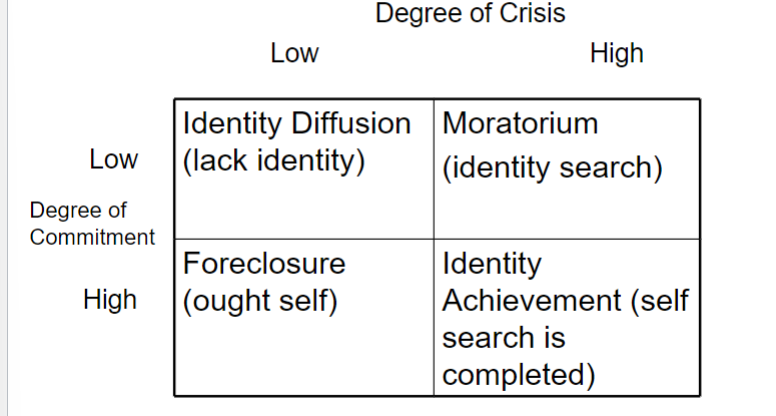
two characteristics to identity
* crisis= has the individual actively explored the “who am I?” question
* commitment= has the individual accepted an identity
* commitment= has the individual accepted an identity
100
New cards
How does the NCAA define “impaired student athletes?
those who are confined to a wheelchair, those who are deaf, blind, or missing a limb; those who have only one of a set of organs; or those \n who may have behavioral, emotional, and psychological disorders that substantially limit a major life activity
 Note
Note  Flashcards (84)