Comparative Advantage and Gains from Trade
 Call Kai
 Learn
Learn Practice Test
 Spaced Repetition
 Match
Match Flashcards
 Knowt Play
1/34

There's no tags or description
Looks like no tags are added yet.
Name | Mastery | Learn | Test | Matching | Spaced | Call with Kai |
|---|
No analytics yet
Send a link to your students to track their progress
35 Terms
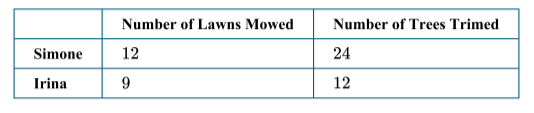
The table below shows the landscaping productivity of Simone and Irina during an eight hour workday with the same amount of resources. Simone can mow twelve lawns or trim twenty-four trees in eight hours. Irina can mow nine lawns or trim twelve trees in eight hours.
(D) Simone has an absolute advantage in trimming trees and mowing lawns.

The table shows that Home Nation can produce five autos or one hundred computers using all its available resources in a year. Foreign Nation can produce five autos or fifty computers using all its available resources in a year. Based on the information provided above, which of the following must be true?
(A) Home Nation has an absolute advantage in the production of computers.
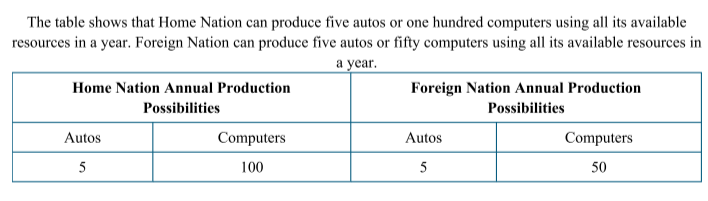
Based on the information provided above, which of the following are mutually beneficial terms of trade at which both Home and Foreign Nation will be willing to specialize and exchange?
(C) 1 auto for 17 computers
Michael and Martha run a mechanic shop. In one hour Michael can perform eight oil changes or change ten tires. In one hour Martha can perform seven oil changes or change fourteen tires. Michael and Martha have the same amount of resources. Given this information which of the following is true?
(E) Michael has an absolute and a comparative advantage in changing oil.
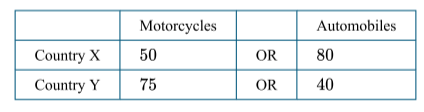
The table above shows the quantity of motorcycles and automobiles produced by two countries that use the same amount of resources. Which of the following is true?
(E) Country Y has an absolute and comparative advantage in the production of motorcycles.
Suppose countries Alphania and Betania produce electronics and apparel using identical resources. Which of the following is true if Alphania exports electronics to and imports apparel from Betania within a free-trade system ?
(B)
Betania has a comparative advantage in producing apparel, and Alphania has a comparative advantage in producing electronics.
As nations specialize in production and trade in international markets, they can expect which of the following
domestic improvements?
I. Allocation of domestic resources
II. Standard of living
III. Self-sufficiency
(D) I and II only
Assume that Country A exports one bushel of wheat in exchange for 2.5 bushels of corn from Country B. If the terms of trade are beneficial to both countries, which of the following must be true?
(B) The cost of producing a bushel of wheat in Country A is less than 2.5 bushels of corn.
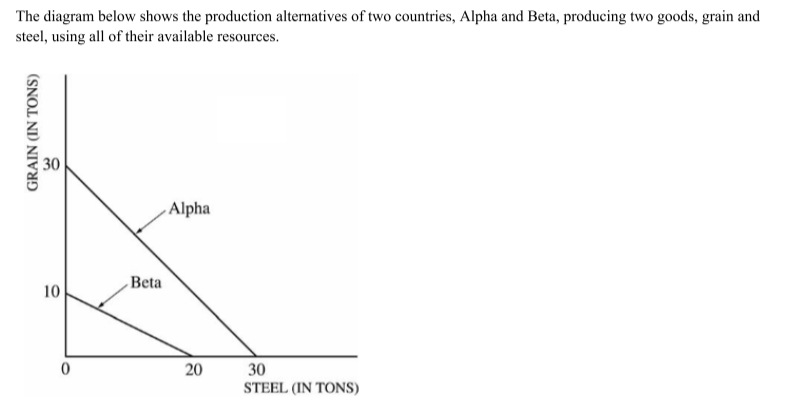
At what real exchange ratio, also referred to as the terms of trade, between grain (G) and steel (S) would both Alpha and Beta find it mutually advantageous to specialize and trade?
(B) 1G = 1.5S
The theory of comparative advantage implies that Alpha would find it advantageous to
(A) export grain and import steel
If two nations specialize according to their individual comparative advantages and engage in trade, then which of the following must be true?
(C) Both nations can consume beyond their individual production possibilities.
Suppose two countries are each capable of individually producing two given commodities. Instead, each specializes by producing the commodity for which it has a comparative advantage and then trades with the other country. Which of the following is most likely to result?
(D) Both countries will become better off.
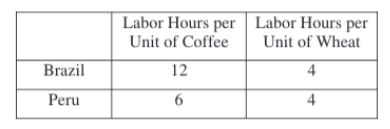
Brazil and Peru produce both coffee and wheat using labor as the only input. The table below shows the labor hours required to produce a unit of coffee and a unit of wheat in each country. Based on the information in the table above, which of the following is true?
(D) Peru has a comparative advantage in producing coffee.
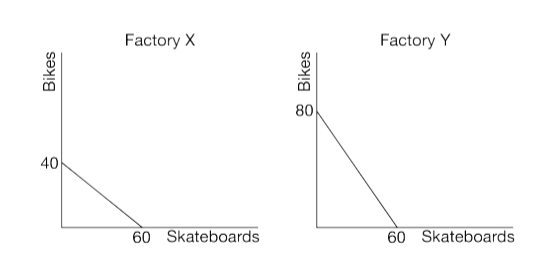
If Factory X uses the same amount of resources to produce skateboards and bikes as Factory Y uses, which of the following is true?
(C) Factory X has a comparative advantage in producing skateboards.
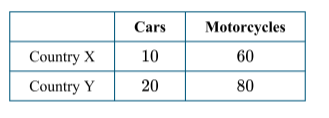
The table shows the maximum quantity of cars or motorcycles that can be produced by two countries, X and Y, using equal amounts of resources.Based on the data in the table, which of the following is true?
(B) Country Y has a comparative advantage in producing cars.
Based on the data in the table, which of the following will happen if Country X and Country Y agree to specialize and trade based on their comparative advantage?
B) Country X will export motorcycles, and both countries will gain from trade if car is exchanged for motorcycles.
Country A can produce either 2 tons of cocoa or 4 cars with 10 units of labor. Country B can produce either 5 tons of cocoa or 25 cars with 10 units of labor. Based on this information, which of the following is true?
B) Country A has a comparative advantage in the production of cocoa, while Country B has a comparative advantage in the production of cars.
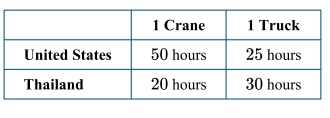
The table provided shows the time required to produce one crane or one truck in the United States and Thailand. The United States and Thailand have the same amount of resources. Which of the following can be accurately concluded from the data?
B) Thailand has a comparative advantage in producing cranes, and the United States has a comparative advantage in producing trucks.
Comparative advantage implies that
(D) two countries should benefit from trade unless both have equal opportunity costs in every good
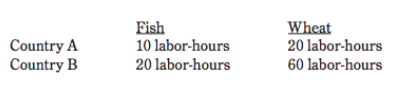
The data above indicates labor-hours needed to produce a single unit of each of two commodities in each of two countries. If labor is the only factor used to produce the commodities, which of the following statements must be correct?
I. Country A has an absolute advantage in the production of both commodities, but a comparative advantage in the production of wheat.
II. Country B has an absolute advantage in the production of both commodities, but a comparative advantage in the production of fish.
III. Mutually advantageous trade can occur between the two countries when 2.5 units of fish are exchanged for 1 unit of wheat.
(D) I and III only
If two nations specialize according to the law of comparative advantage and then trade with each other, which of the following would be true?
(D) Each nation would increase its consumption possibilities.
If France has a comparative advantage in the production of grapes, and Italy has an absolute advantage in the production of olives, which of the following statements must be true?
(D) France has a lower opportunity cost in producing grapes than Italy does.
Which of the following would be most likely to occur if the United States placed high tariffs on imported goods?
(D) The United States economy would become less efficient.

The table below indicates the number of labor hours required in Countries X and Y to produce one unit of food or one unit of clothing. Given this information, which of the following statements is correct?
C) X has a comparative advantage in food production, whereas Y has a comparative advantage in clothing production.
The main benefit of free trade between two countries is that
(D) each country can consume beyond its constraints of resources and productivity
Mary Jane is a lawyer who can earn $150 per hour in her law practice. She is also an excellent carpenter who can build cabinets three times as fast as the best carpenter, whose hourly wage is $20 per hour. Which of the following is a correct economic statement?
A) Mary Jane has a comparative advantage in law so she should specialize in law and hire a carpenter to make her cabinets.
Nations A and B produce only chairs and bicycles. If each laborer in Nation A can produce twice as many chairs as each laborer in Nation B, then which of the following is necessarily true?
(C) Nation A has an absolute advantage in chairs.
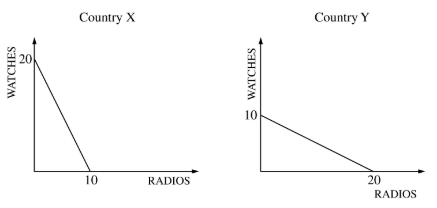
Using equal amounts of labor hours, Country X and Country Y can each produce the number of watches and radios shown in the production possibilities curves above. Based on the information, which of the following is true?
(C) Countries X and Y can engage in a mutually advantageous trade by exchanging 1 watch for 1 radio.
Sam and Bill run a leaf raking and lawn mowing business. In one day, Sam can rake 3 lawns or mow 5 lawns whereas Bill can rake 2 lawns or mow 6 lawns. Which of the following correctly describes Sam’s and Bill’s absolute and comparative advantages?
(D) Bill has a comparative advantage in mowing and an absolute advantage in mowing.
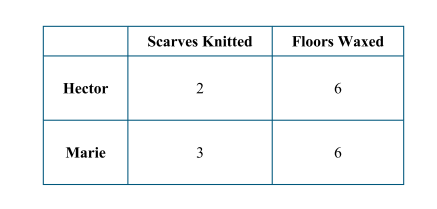
The table shows the number of scarves that can be knitted or floors that can be waxed by Hector and Marie in a 6-hour work period with equivalent resources. Which of the following is true based on the available data?
(B) Hector gives up 3 waxed floors for every scarf that he knits.
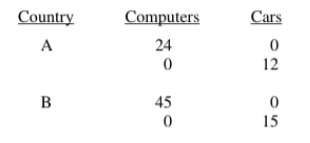
The table below shows the production alternatives of Country A and Country B for producing computers and cars with equal amounts of resources that are fully and efficiently employed.Which of the following is true according to the data in the table?
(B) Country B has an absolute and comparative advantage in the production of computers.
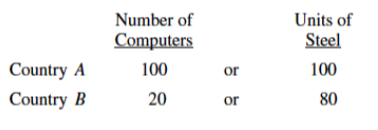
The table above indicates the production alternatives of two countries, A and B, which produce computers and steel using equal amounts of resources. If both countries always produce at full employment, which of the following statements must be correct?
B) Mutually advantageous trade can occur between the two countries when 2 units of steel from Country B are exchanged for 1 computer from Country A.
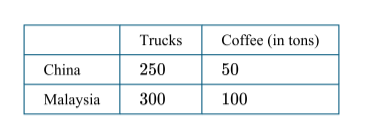
The table above shows the maximum amount of trucks or coffee that China and Malaysia can produce using the same amount of resources. Based on the data provided, which of the following terms of trade are mutually beneficial for the two countries?
(B) 1 ton of coffee for 4 trucks
Wally can make 40 units of good X or 30 units of good Y in a day, and Sam can make 20 units of good X or 10 units of good Y in a day. Assuming constant trade-offs between good X and good Y, which of the following is true?
(A) Sam has a comparative advantage in making good X.
Which of the following best explains why many United States economists support free international trade?
(D) The long-run gains to consumers and some producers exceed the losses to other producers.
Explore top notes

