Lecture 22
 Call Kai
 Learn
Learn Practice Test
 Spaced Repetition
 Match
Match Flashcards
 Knowt Play
1/60

Earn XP
Description and Tags
asdasdffasdasdfasdf
Name | Mastery | Learn | Test | Matching | Spaced | Call with Kai | Chat |
|---|
No analytics yet
Send a link to your students to track their progress
61 Terms
Which Immunoglobulin (Ig) type is described:
Monomer
Primary response
produced by plasma cells
2nd Ig produced
Memory cell or secondary response
1st Ig produced
Most prevalent in tissue fluid and blood
Functions: neutralizes toxins, opsonizes, fixes complement
Crosses placenta
IgG
Which Ig type is produced by plasma cells during Primary response and by memory B cells during Secondary (anamnestic) response?
IgG
What are the functions of the IgG?
neutralizes toxins, opsonizes, fixes complement
[True or False]
IgG cannot cross the placenta.
False
Which Immunoglobulin (Ig) type is described:
Dimer
held together by a J chain
Mucous membranes & serious secretions
Salivary glands, intestine, nasal membrane, breast, lung, genitourinary tract
Local immunity to enteric, respiratory, and genitourinary pathogens
Protection for newborns
Monomer
small amounts circulate in the blood
IgA
What is the term for the dimers of IgA?
Secretory IgA
Which Immunoglobulin (Ig) type is described:
five monomers = pentamer
10 binding sites
Held together by a J chain
Primary response
Associated with complement fixation
Circulates in the blood
IgM
How many binding sites does the pentamer IgM have?
10
Which immunoglobulin is the 1st Ig synthesized during Primary Response and is a receptor for antigens on B cells?
IgM
Which Immunoglobulin (Ig) type is described:
monomer
small amounts in the serum
receptor for antigens on B cells
helps trigger B-cell activation
IgD
Which Immunoglobulin (Ig) type is described:
uncommon blood component
for allergies and parasite infections
Function: release chemical mediators that aid inflammation
Fc portion binds to mast cells and basophils
IgE
Problems such as anaphalaxis, asthma, and other allergic reactions stem from having high amounts of which Ig?
IgE
[Fill in the Blanks]
A complementary fit between an antibody and antigen involves (BLANK) bonds and (BLANK) attractions.
hydrogen, electrostatic
What are the 4 primary functions/mechanisms of Antibodies?
Opsonization, Agglutination, Complement Fixation, Neutralization
Which antibody function/mechanism involves tagging to encourage the uptake of the microbe by phagocytes?
Opsonization
Which antibody function/mechanism involves clumping?
the capacity for antibodies to aggregate, or [redacted], antigens is the consequence of their cross-linking cells or particles into large clumps.
rendering microbes immobile and enhances their phagocytosis.
Agglutination
Which antibody function/mechanism involves tagging bacterial cells so complement proteins start to work?
the interaction of an antibody with [redacted) can result in the specific rupturing of cells and some viruses
Complement Fixation
Which antibody function/mechanism involves binding to prevent things from working?
antibodies fill the surface receptors on a virus or the active site on a microbial enzyme to prevent it from attaching normally?
Neutralization
Which type of cell actually secretes antibodies?
T cell
Plasma cell
Macrophage
Monocytes
2
The cross linkage of antigens by antibodies is known as
Agglutination
Opsonization
Neutralization
Cross-reaction
Complement fixation
1
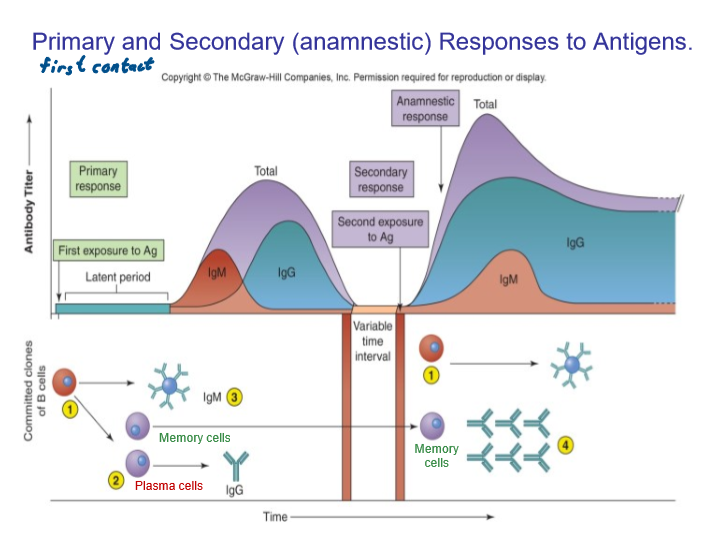
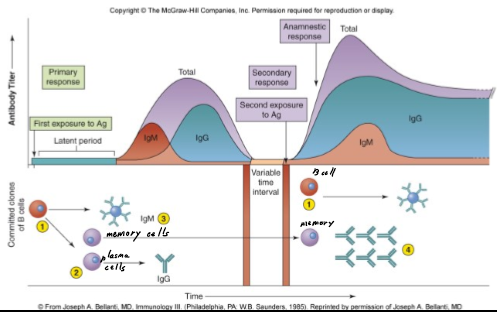
Be able to explain what happens in this chart regarding IgM and IgG.
Primary Response
During first exposure of a new Ag, B cells create IgM, Plasma cells, and Memory cells.
The plasma cells created help create IgG for the first response.
Secondary Response
The memory cells create a much greater and more effective response to the Ag for the next exposure while B cells also create IgM.
Greater response/defense against Ag for the next exposure due to memory cells making IgG
[True or False]
T cell activation is activated after B cell activation.
False
What type of immunity is T cell activation which is a direct involvement of the T cell?
Cell-mediated immunity
T cell activation interact directly with antigen to stimulate T cells, B cells, and phagocytes to produce what?
cytokines
What type of T cell is described:
various types
Role in regulating immune reactions to antigens
Activate B cells, other T cells, and macrophages
Most prevalent in blood and lymphoid organs (~65%)
T Helper (TH) Cells
[Fill in the Blanks]
T Helper cells role in regulating immune reactions to antigens
Directly through (BLANK) contact
Indirectly through (BLANK) release
interferon gamma
interleukins
receptor, cytokine
What type of T cell is described:
Within the TH class
CD4 marker and co-receptor
Encourage immune activity
Control inflammatory process
Prevent autoimmunity
Make sure immune response does not target normal biota
T Regulatory (TR) cells
What type of T cell is described:
Have capacity to kill certain target cells
Produce [redacted] proteins
Perforins
Granzymes
Bind and lyse cells (apoptosis)
Destroy
Virally infected cells, bacteria carrying cells, cancer cells, foreign cells (animal/human)
responsible for graft rejection
Cytotoxic T (TC) cells
What is the term for the cytotoxic protein produce by TC cells that punch holes in the membrane?
Perforins
What is the term for the cytotoxic protein produce by TC cells that degrade proteins?
Granzymes
What type of T cell is described:
Have T cell receptors but respond more like nonspecific system
Act quickly
Produce memory cells
Bridge 2nd and 3rd lines of defense
Gamma-Delta T cells
What type of T cell is described:
related to Tc
Lack specificity for antigens
attack virus infected cells and cancer cells
Not really part of cell-mediated immunity
Natural Killer (NK) & Natural Killer T Cells (NKT)
What general type of acquired immunity involves the following:
antigen activates B and T cells
In normal immunocompetent individuals
Traits
Memory cells
Several days to develop
Long-term protection
Natural or artificial
Active
What general type of acquired immunity involves the following:
receive antibodies from another individual or animal
Traits
no memory cells
no antibody production
immediate
short term protection
Natural or artificial
Passive
What general type of acquired immunity involves the following:
immunity produced by normal biological experiences, no medical intervention
Natural
[Choose]
Natural Immunity
Natural (active/passive)
eg. infection
Natural (active/passive)
eg. mother to child
active, passive
What general type of acquired immunity involves the following:
immune protection through medical procedures or intervention
Artificial
[Choose]
Artificial Immunity
Artificial (active/passive)
eg. immunotherapy
Artificial (active/passive)
eg. vaccination
passive, active
[Fill in the Blanks/Choose]
Ideal Vaccines
(High/Low) adverse or toxic effect on host
Protect against (BLANK) wild forms of pathogen
Stimulate (BLANK) cell responses
Long-term, lasting effect - produce (BLANK) cells
(High/Low) # doses/boosters
Economical
low, natural, B and T, memory, low
What type of vaccine is described:
killed cell or inactivated viruses
live, attenuated cells or viruses
unrelated viruses
Whole Cell/Virus Vaccines
What type of vaccine is described:
surface antigenic molecules
genetically engineered DNA or mRNA vaccines
surface antigen conjugated with proteins
Antigenic Components Vaccines
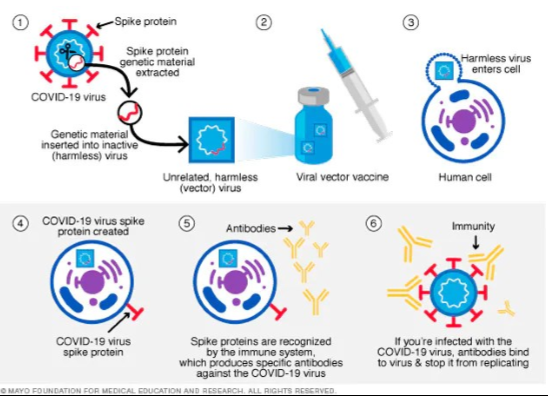
What type of vaccine is shown?
use of a harmless virus
memory & specificity
ex: Johnson & Johnson, AstraZeneca for COVID19
Viral Vector Vaccines
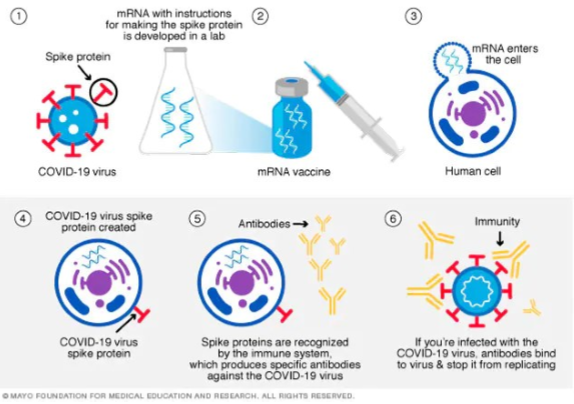
What type of vaccine is shown?
memory & specificity
ex: Pfizer-BioNTech, Moderna for COVID19
mRNA Vaccines
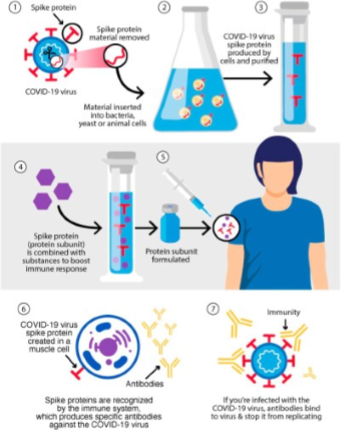
What type of vaccine is shown:
Subunit - S protein
memory & specificity
ex: Novavax for COVID19
Protein Subunit Vaccines
Benefits of vaccinations include long-lasting immunity and this term which explains the indirect protection of nonimmune or those unable to be vaccinated and prevents epidemics.
Herd Immunity
aight
Short answer or essay question: describe the primary and secondary response of antibody production, including cells.
aight
What is the function of IgG molecules
Major Ig of primary response to Ag
Major Ig of secondary response to Ag
Fixes complement
involved in allergic reaction
1 and 2 are both functions
2 and 3 are both functions
6
Which of these Ig molecules functions in allergic reactions?
IgA
IgD
IgE
IgG
IgM
3
Widespread immunity that protects the population from the spread of a disease is called:
Epidemic prophylaxis
Cross-reactivity
Herd Immunity
Seropositiviy
3
Short Answer Essay part 1:
A. Describe the structure of immunoglobulins
B. What are the functions of the Fab and Fc regions
A. Light short chain and long chain, Fc and Fab sites
B. Fc attaches Ig molecule to a B cell, Fab attaches Ig molecule to the antigens
ok
Short Answer Essay part 2:
C. Describe two ways antibodies function in immunity
D. Where do antigens bind to antibodies
ok
What are the 3 main categories of microbial methods used to identify an infectious agent?
Phenotypic, Genotypic, Immunological (Methods)
What are typical samples collected from the body? (at last 2?)
Saliva, Sputum, Blood, Urine, Fecal, Skin, Cutaneous membrane
What process has 2 categories and is used to isolate and identify a specimen?
Analysis Scheme
[Fill in the Blanks]
Analysis Scheme Categories
(BLANK): presumptive data » genus
(BLANK): specific » species
preliminary, confirmatory
Which phenotypic method is described:
examine appearance or behavior
determine cell shape
determine cell wall property
gram positive
gram negative
mycolic acid on cell surface (acid fast)
Other stain or [redacted] methods
Microscopic
Which phenotypic method is described:
enable growth of specific microbe
specialized media
selective media
differential media
biochemical media
enable pure culture isolation
take 18-24 hrs for results
Cultivation
[Choose]
Phenotypic: Cultivation
Specialized media
(high/low) # in specimen
Selective media
(high/low) # in specimen; urine, feces
low, high
Which phenotypic method is described:
indirect method of identification
identify enzyme and product
ideal for bacterial identification
Haploid
Express genes related to nutrient used
not many microscopic features
Biochemical
[True or False]
The following are all common biochemical tests for identifying a microbe phenotypically.
Carbohydrate fermentation
Hydrolysis of gelatin, starch, urea
Catalase
Oxidase
Coagulase
True
What type of test uses multiple biochemical tests that each yield a code for ID and is an API system (23-50 tests)?
Rapid Tests