Special Research Designs I-II
 Studied by 0 people
 Call Kai
 Learn
Learn Practice Test
 Spaced Repetition
 Match
Match Flashcards
 Knowt Play
1/30

There's no tags or description
Looks like no tags are added yet.
Name | Mastery | Learn | Test | Matching | Spaced |
|---|
No study sessions yet.
31 Terms
What makes a study quasi-experimental?
No random assignment
Uses pre-existing or self-selected groups
IV is “manipulated,” but researchers cannot fully control who enters each level
Has many but not all elements of a true experiment
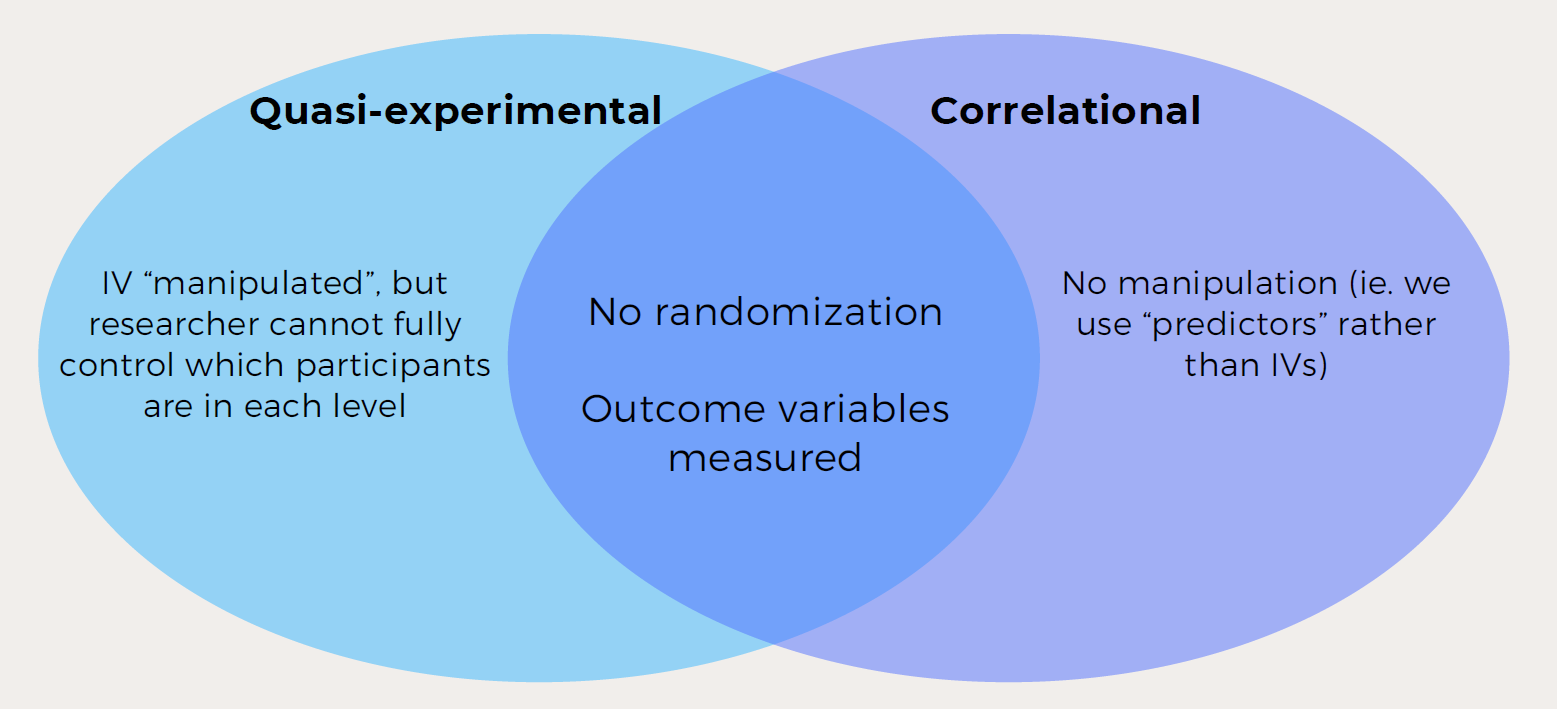
How do quasi-experiments differ from correlational designs?
Both:
No random assignment
Only measure outcome variables
Quasi:
Researcher attempts to manipulate an IV (but lacks full control)
Correlational:
No manipulation at all; uses predictors, not IVs
Why might a true experiment not be possible?
Ethical issues (e.g., illness, drug use)
Impossible/unrealistic to manipulate (e.g., age, sex, genetics)
What is the structure of a one-group post-test only design?
Treatment → Post-test only (no baseline)

What are limitations of one-group post-test only design (e.g., VapeAway study)?
No baseline/pre-test → cannot see change
No control group → cannot attribute effect to treatment
Cannot rule out alternative explanations (history, maturation)
Cannot claim causation

What is the one-group pre-test/post-test design?
Pre-test → Treatment → Post-test

What are the limitations of one-group pre-test/post-test design?
Still no control/placebo group
Threats to internal validity (history, testing effects)
Cannot ensure the treatment caused the change

What is a non-equivalent group post-test only design?
Two groups formed based on existing differences (self-selection, natural groups)
Both measured only at post-test
Between-groups quasi-experimental design
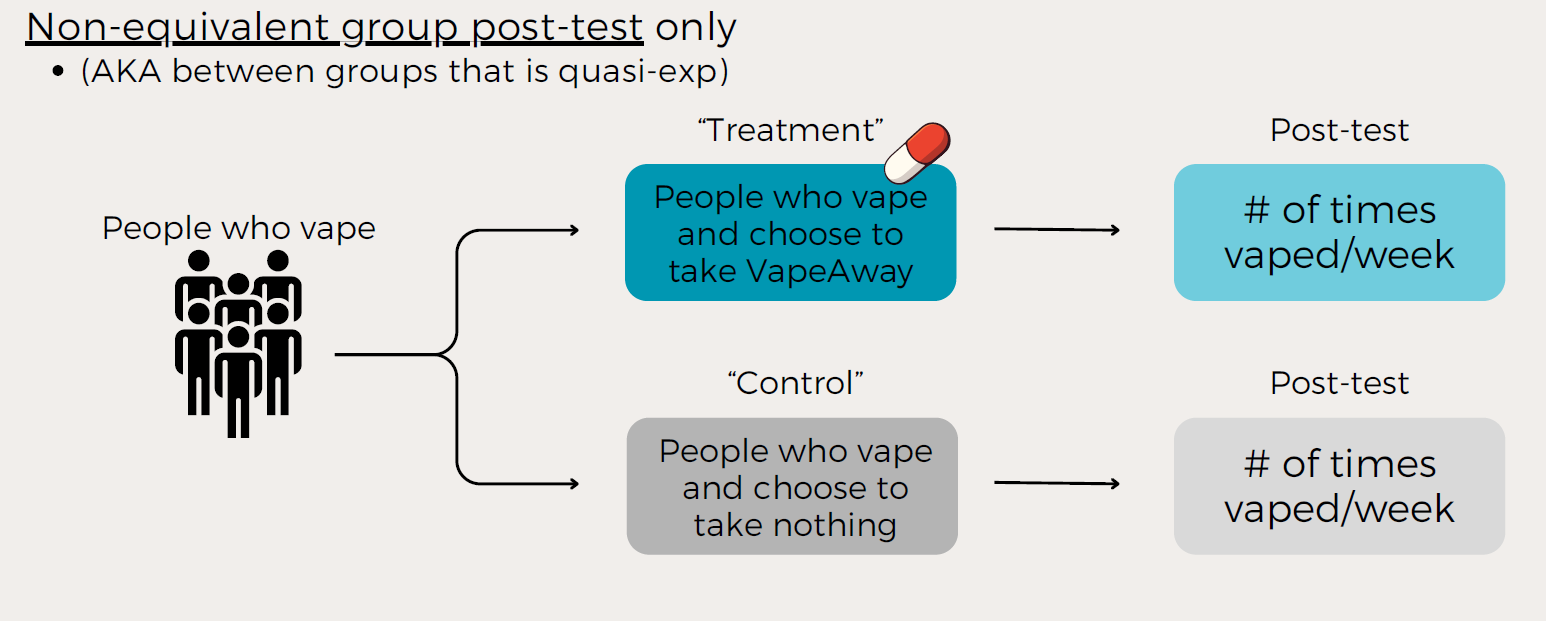
What are the key limitations of non-equivalent group post-test only design?
No random assignment → selection bias
Cannot claim causality
No baseline (cannot measure change)
Alternative explanations uncontrolled (motivation, time, difficulty to quit, etc.)
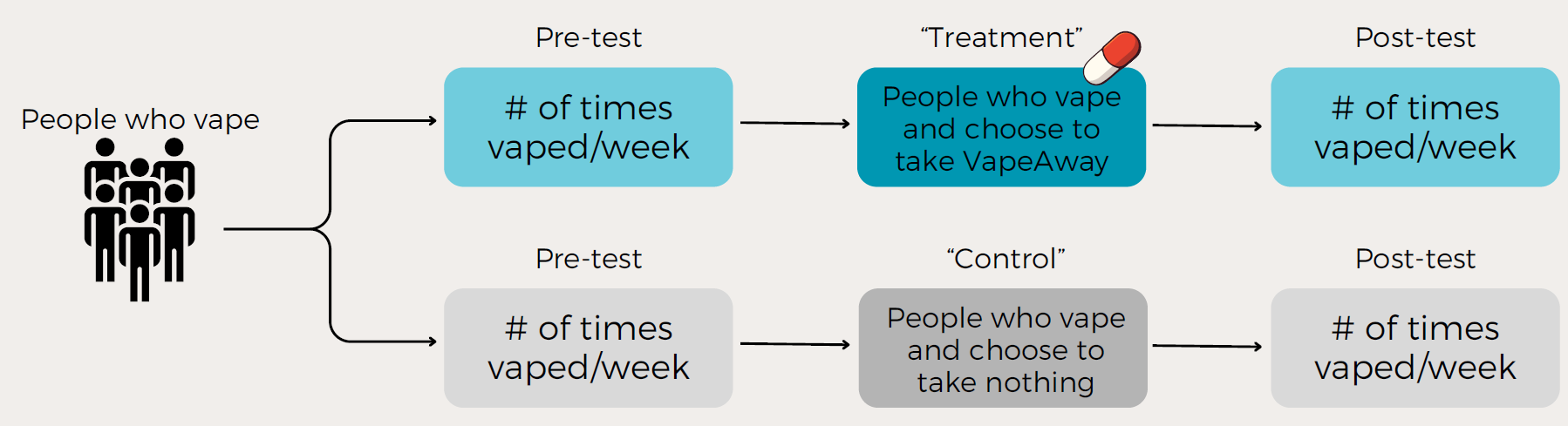
What is a non-equivalent group pre-test/post-test design?
Both groups: Pre-test → Post-test
Still no random assignment (thus selection bias remains)

What are the main limitations of non-equivalent group pre-test/post-test design?
Improved design (has a baseline), but…
Still lacks random assignment → cannot fully claim causation
Internal validity remains threatened
Can you use t-tests and ANOVA with quasi-experiments?
Yes, same statistical techniques can be used —
BUT interpretations must reflect the study design and lack of full control.
What are the three requirements for causality?
Covariation of cause and effect
Temporal precedence (cause before effect)
Eliminate alternative explanations
Hypothesis: Having multiple concussions impacts cognitive functioning.
Recruit 50 American Football players who’ve been diagnosed with a concussion
Measure their cognitive function using Raven’s Matrices
Results - accuracy on Raven’s Matrices = 20%
Conclusion: Concussions lead to impaired cognitive functioning
Why does the football concussion study fail?
No covariation (no comparison group)
No temporal precedence (only one time point)
Cannot rule out alternative causes
Overall: extremely weak design for causal inference
What is an interrupted time series (ITS) design?
Multiple pre-tests and post-tests around a “natural manipulation”
Looks for a shift in trend after the intervention event (e.g., EBT introduction)
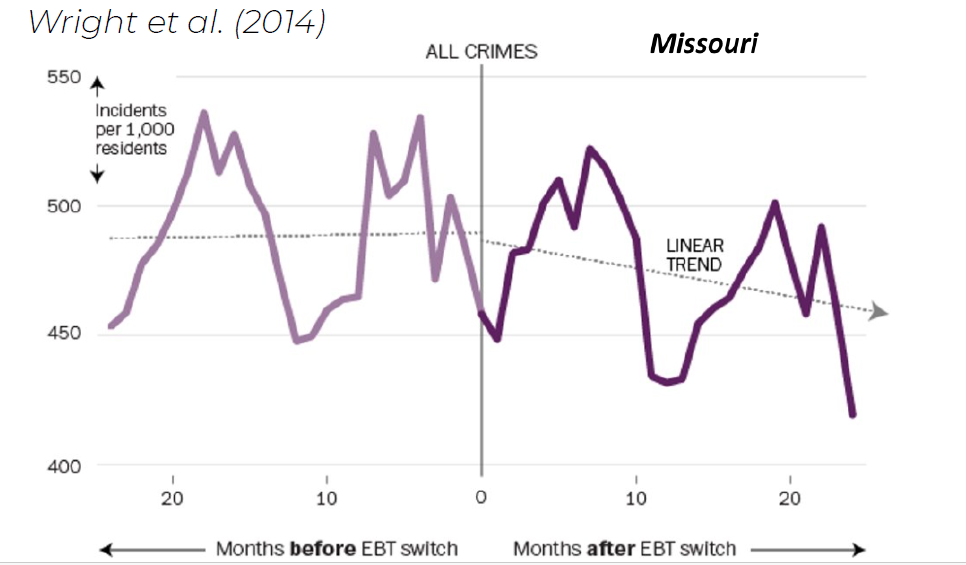
Strengths of ITS (interrupted time series)?
Stronger internal validity than single pre-post
Can detect trends over time
Good for natural interventions
Limitations of ITS (interrupted time series)?
Potential confounds (e.g., crime decreasing linearly anyway)
History effects at the same time as the intervention
What is a control series design?
ITS (interrupted time series) with a non-equivalent control group also tracked over time
Compares treatment trend vs. control trend
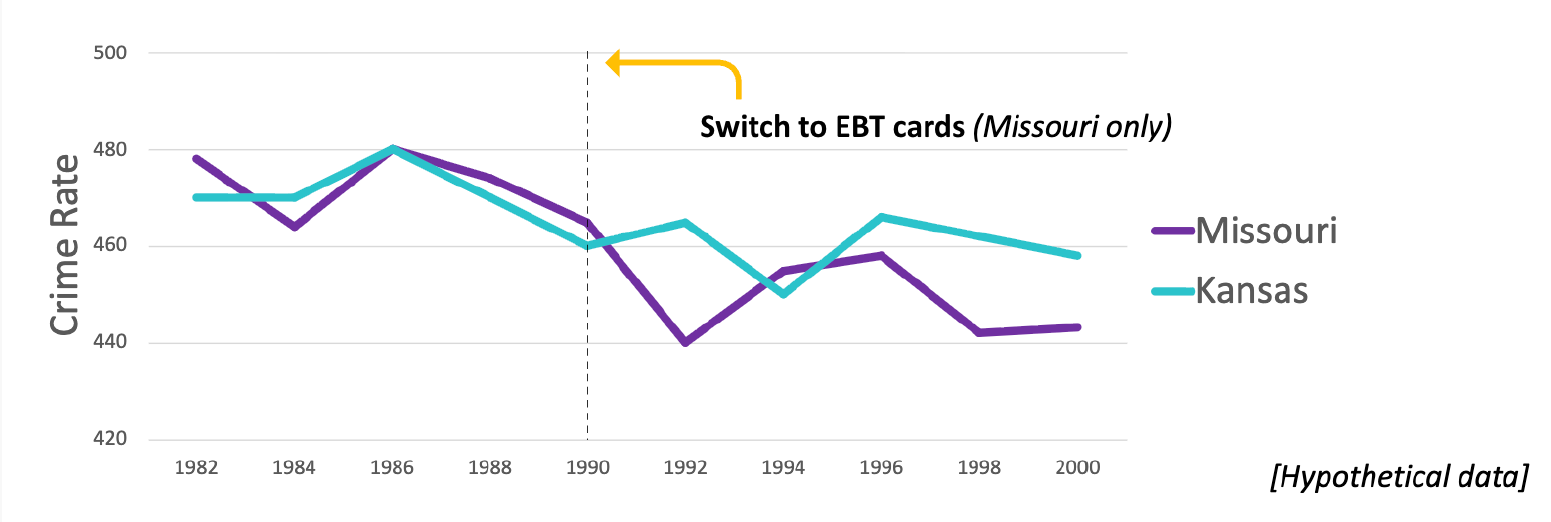
How do you interpret results if both groups follow the same trend?
Suggests the intervention likely did not have a significant effect
Trend may be driven by broader societal changes, not the treatment
Why are developmental studies quasi-experiments?
Because age cannot be randomly assigned → no manipulation and no randomization.
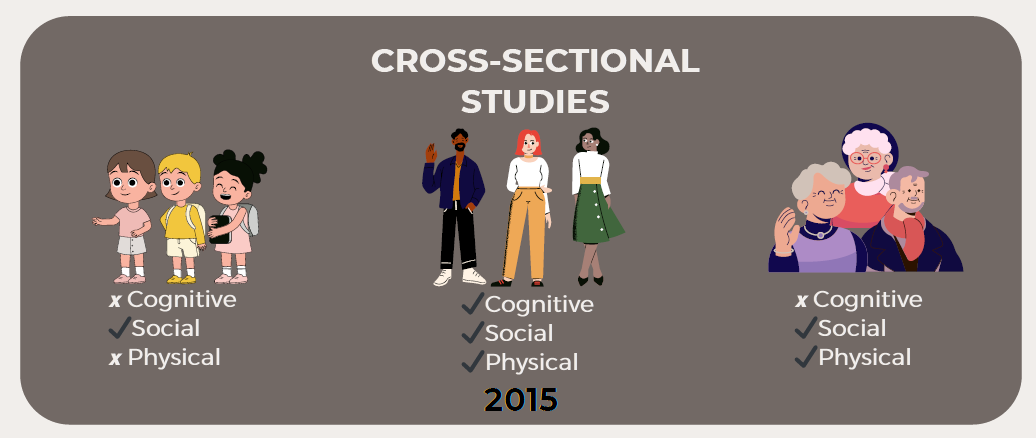
What is a cross-sectional design?
Different age groups measured at one time
Useful for observing group differences and cohort effects
Fast and cheaper
Limitations: cohort effects, cannot show individual change over time
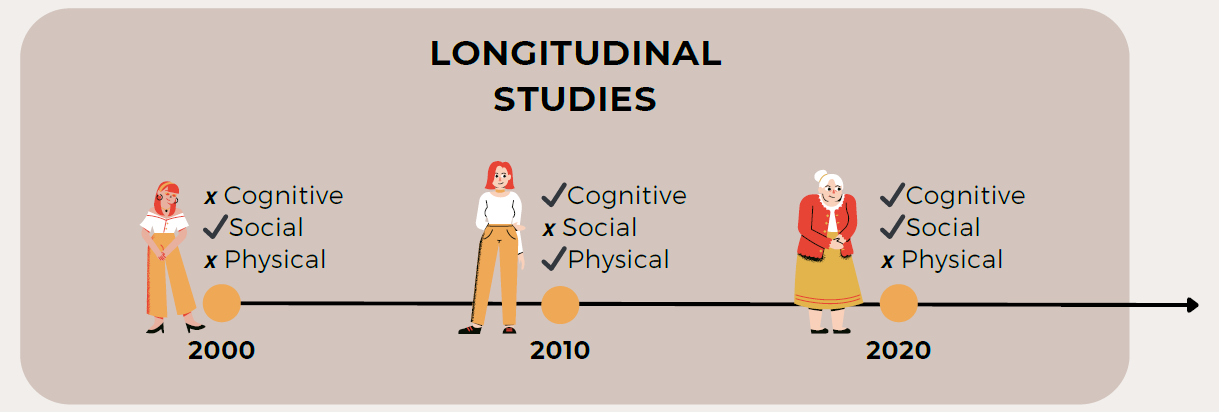
What is a longitudinal design?
Same individuals followed over time
Higher internal validity
Can track individual developmental trajectories
Limitations: time-consuming, expensive, attrition, history effects
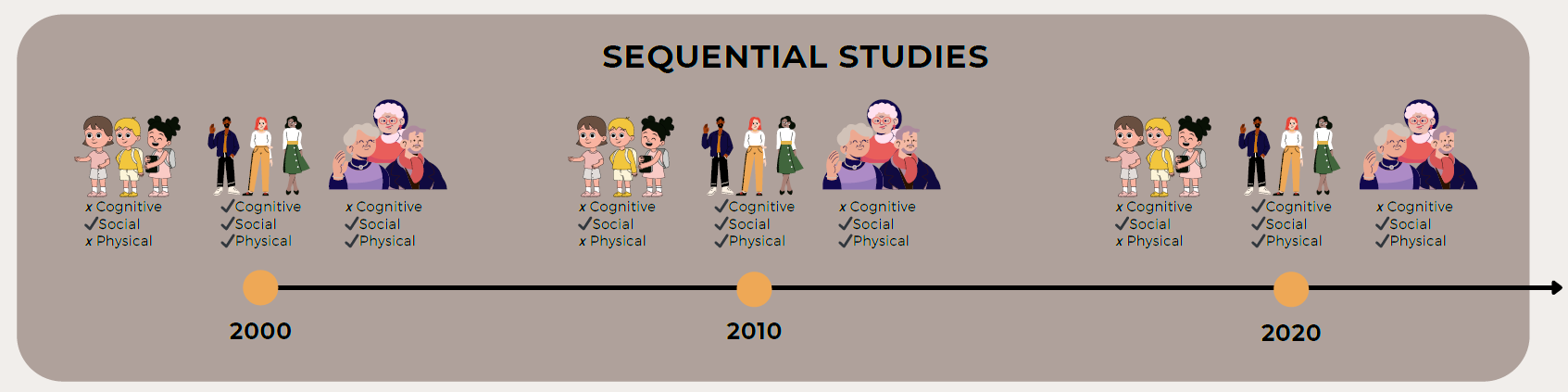
What are sequential designs?
Combines cross-sectional + longitudinal
Multiple cohorts followed over time
Best for separating age, cohort, and time-of-measurement effects
Limitations: very resource-intensive, attrition, tech/time changes
What is p-hacking?
Using unethical researcher practices to artificially obtain statistically significant results.
Examples of p-hacking?
Collecting extra data until significant
Dropping outliers to support your hypothesis
Using several measures but reporting only the significant one
Reporting exploratory significant interactions as if predicted
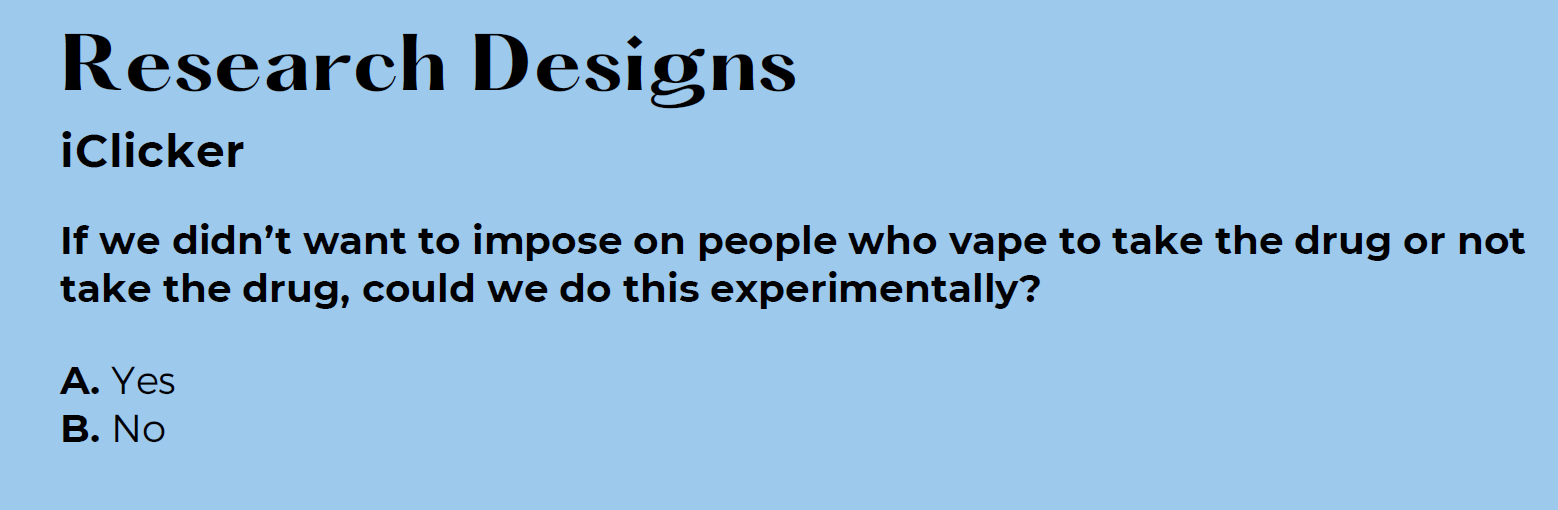
b) is correct
We cannot ethically manipulate who vapes and not by random assignment
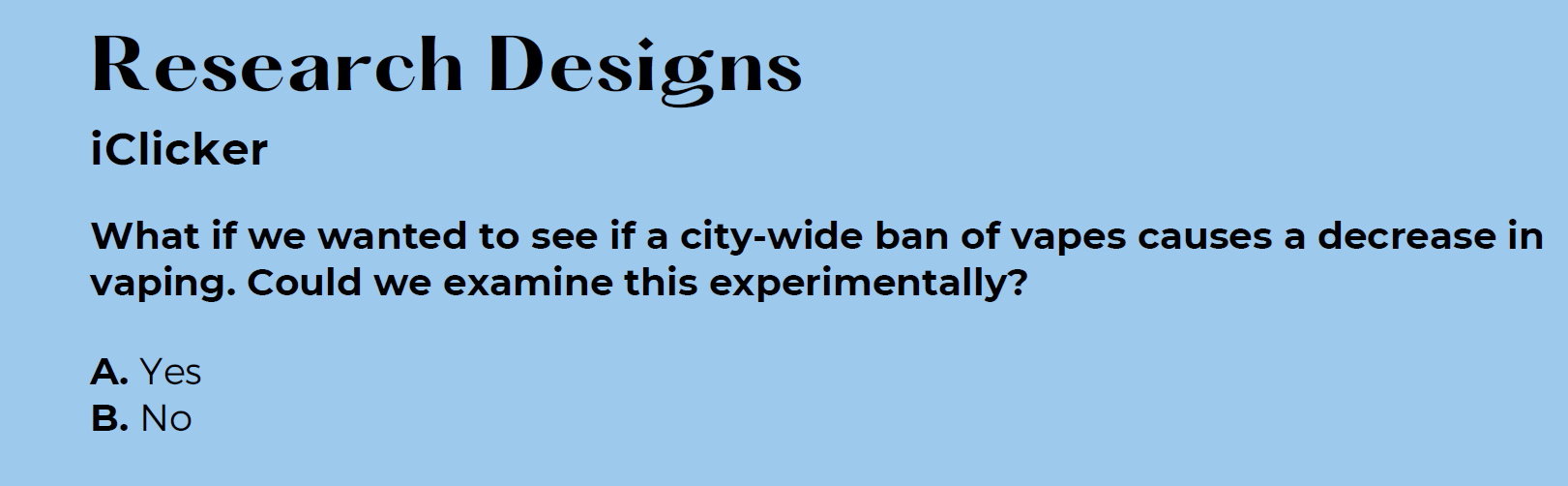
b) is correct
Not ethical
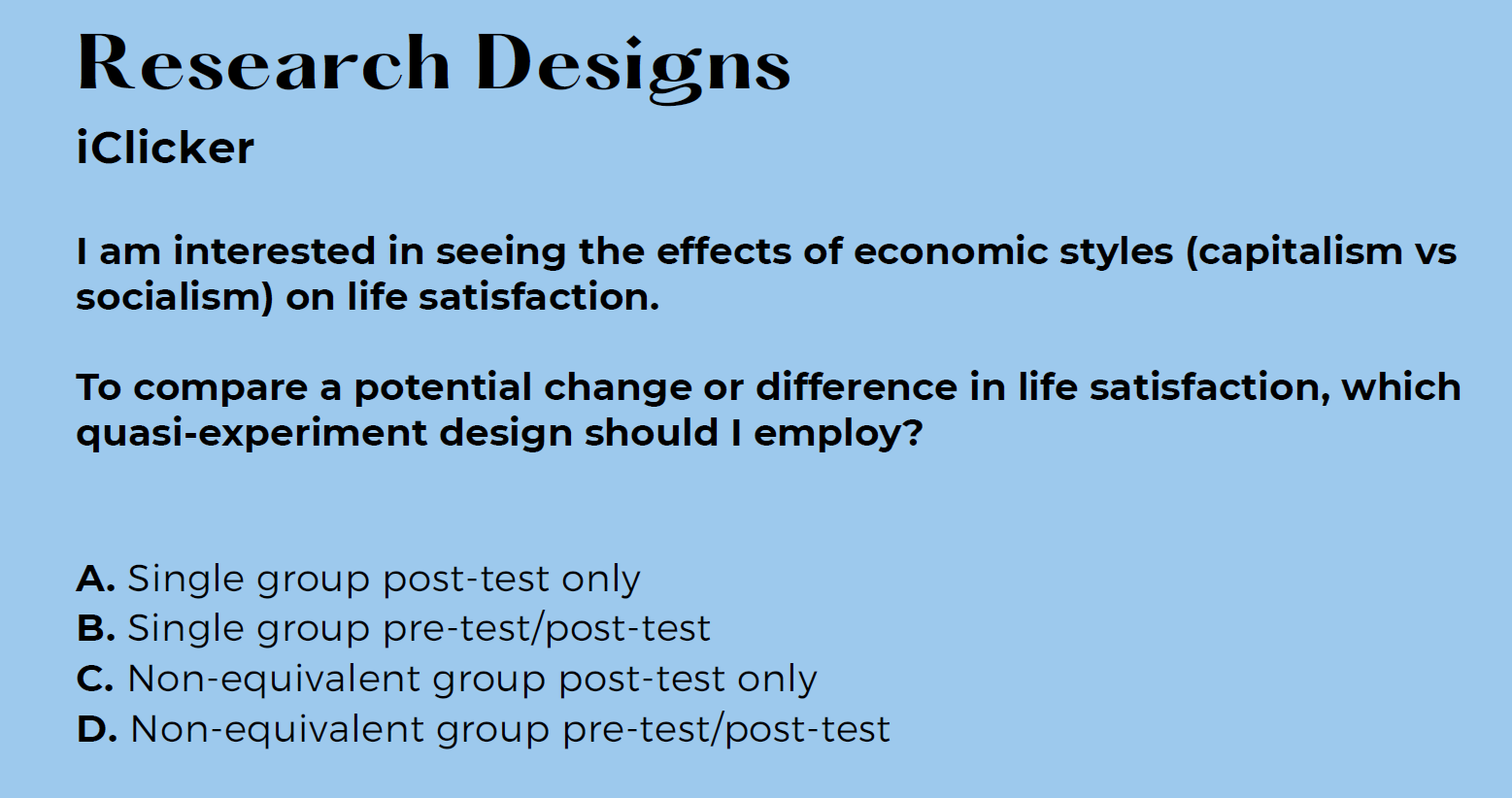
We need to make assumptions → e.g., pre-test data can be found in past records; we can take pre-existing data (key strength of quasi-experimental design)
We can just collect and compare → nothing needs to be manipulated
d) is correct
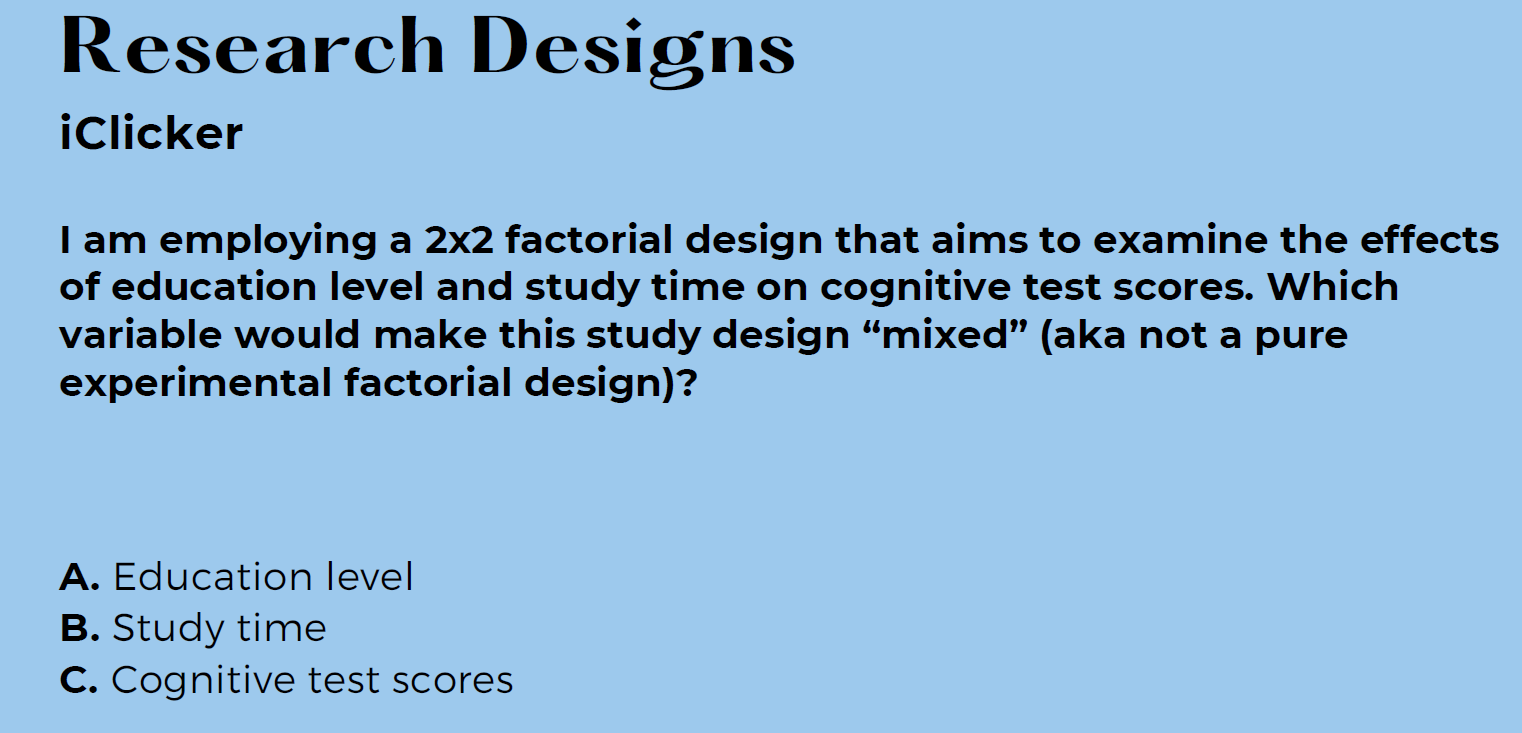
Educational level → person variables are not easily manipulated
a) is correct

To control for football players, they can be compared with normal people with concussion
a) is correct
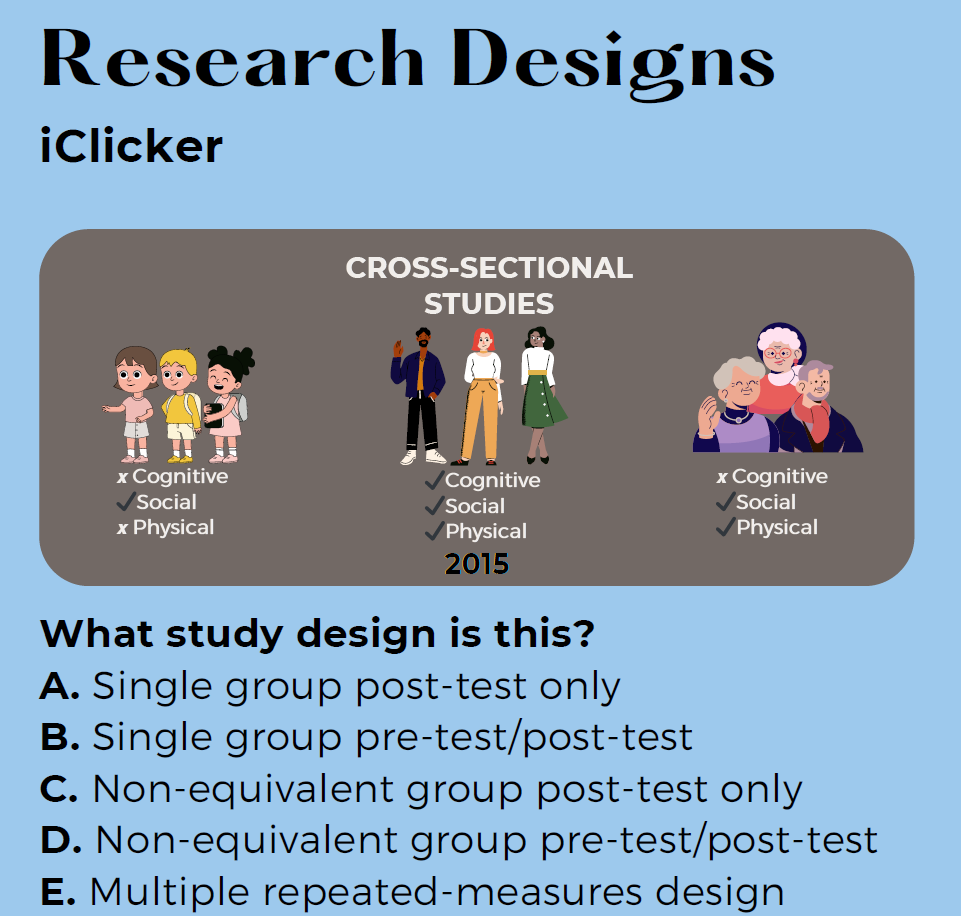
c) is correct
 Note
Note  Flashcards (92)