micro ch. 14 pearson
 Call Kai
 Learn
Learn Practice Test
 Spaced Repetition
 Match
Match Flashcards
 Knowt Play
1/31

There's no tags or description
Looks like no tags are added yet.
Name | Mastery | Learn | Test | Matching | Spaced | Call with Kai |
|---|
No analytics yet
Send a link to your students to track their progress
32 Terms
the situation
During a six-month period, 239 cases of pneumonia occurred in a town of 300 people. A clinical case was defined as fever ≥ 39°C lasting >2 days with three or more symptoms (i.e., chills, sweats, severe headache, cough, aching muscles/joints, fatigue, or feeling ill). A laboratory-confirmed case was defined as a positive result for antibodies against Coxiella burnetii. Before the outbreak, 2000 sheep were kept northwest of the town. Of the 20 sheep tested from the flock, 15 were positive for C. burnetii antibodies. Wind blew from the northwest, and rainfall was 0.5 cm compared with 7 to 10 cm during each of the previous three years.
The etiologic agent of the disease in the situation is
pneumonia.
wind.
Coxiella burnetii.
soil.
sheep.
Coxiella burnetii
Transient microbiota differ from normal microbiota in that transient microbiota
are present for a relatively short time.
are always acquired by direct contact.
are found in a certain location on the host.
never cause disease.
cause diseases.
are present for a relatively short time.
The frequent use of antibacterial agents might remove normal microbiota which can cause ________.
fewer diseases
body odor
increased susceptibility to disease
normal microbiota returning immediately
no bacterial growth because washing removes their food source
increased susceptibility to disease
Which of the following is NOT an example of microbial antagonism?
bacteriocin production
acid production by bacteria
bacteria causing disease
bacteria producing vitamin K
bacteria occupying host receptors
bacteria causing disease
Which of the following is an example of the symbiotic relationship known as mutualism?
Corynebacterium on the surface of the eye
E. coli within the large intestine
A tapeworm in the gastrointestinal tract of a human
Saprophytic Mycobacterium of the ear
E. coli within the large intestine
The significance of Robert Koch's postulates is that:
Diseases can be transmitted from one animal to another.
Specific microorganisms cause specific disease.
Microorganisms can be cultured.
Microorganisms are the result of disease.
Microorganisms are present in a diseased animal.
Specific microorganisms cause specific disease.
Koch observed Bacillus anthracis in the blood of cattle. What is the condition specifically called when bacteria are present in the blood?
Systemic infection
Focal infection
Local infection
Bacteremia
Bacteremia
Koch's postulates established criteria for proving that a specific organism causes a specific disease. Which of the following is NOT one of the criteria given by Koch's postulates?
The same pathogen must be present in every case of the disease.
The pathogen isolated from a pure culture must cause the disease in a healthy lab animal.
The pathogen must be isolated from inoculated animals and must be different from the original organism.
The pathogen must be isolated from the diseased host and grown in pure culture.
The pathogen must be isolated from inoculated animals and must be different from the original organism.
Which of the following definitions is INCORRECT?
sporadic: a disease that affects a population occasionally
pandemic: a disease that affects a large number of people in the world in a short time
incidence: number of new cases of a disease
endemic: a disease that is constantly present in a population
epidemic: a disease that is constantly present across the world
epidemic: a disease that is constantly present across the world
The rise in herd immunity amongst a population can result from ________.
improved handwashing
increased use of antibiotics
antibiotic-resistant microorganisms
vaccinations
None of the answers is correct
vaccinations
Which of the following is NOT a communicable disease?
malaria
AIDS
tuberculosis
tetanus
typhoid fever
tetanus
Which of the following definitions is INCORRECT?
secondary infection: a long-lasting illness
acute: a short-lasting primary infection
inapparent: infection characteristic of a carrier state
chronic: a disease that develops slowly and lasts for months
primary infection: an initial illness
secondary infection: a long-lasting illness
Symptoms differ from signs of disease in that symptoms ________.
are changes felt by the patient
are changes observed by the physician
are specific for a particular disease
always occur as part of a syndrome
are changes felt by the patient
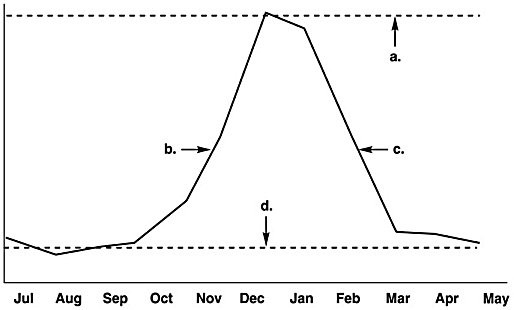
the figure shows the incidence of influenza during a typical year in the northern hemisphere. Which letter on the graph indicates the endemic level?
a
b
c
d
D
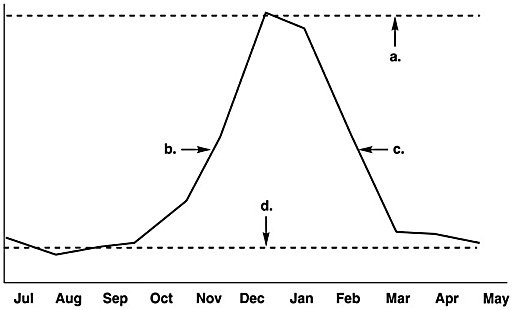
In the figure, which letter on the graph indicates the epidemic level?
a
b
c
d
A
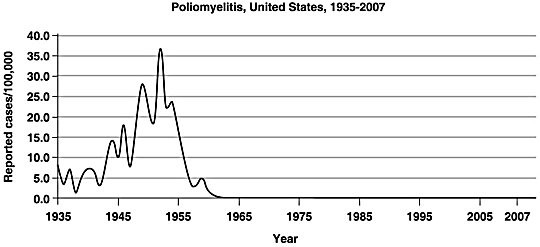
The graph in the figure shows the incidence of polio in the United States. The period between 1945 and 1955 indicates a(n)
endemic level.
sporadic infection.
pandemic.
epidemic level.
communicable disease.
epidemic level
Which of the following is classified as a latent disease?
Tuberculosis
Infectious mononucleosis
Shingles
Influenza
Shingles
Malaria is an infectious disease caused by infection with a protozoan. In certain tropical regions, malaria is constantly present. We would say that malaria is a(n) __________ disease in these regions.
epidemic
pandemic
endemic
sporadic
endemic
In which of the following diseases can gender be considered a viable predisposing factor?
tetanus
pneumonia
salmonellosis
anthrax
urinary tract infections
urinary tract infections
Which of the following statements about the development of infectious diseases is correct?
During the incubation period, the infected individual exhibits obvious signs of sickness.
The prodromal period is characterized by very severe symptoms.
The period of convalescence is the time during which the person regains health and fully recovers (back to the pre-disease state).
The period of decline is the time when the infected individual's health rapidly deteriorates.
The period of convalescence is the time during which the person regains health and fully recovers (back to the pre-disease state).
Which of the following diseases is not transmitted by droplets?
Diphtheria
Tuberculosis
Measles
Botulism
Common cold
Botulism
Biological transmission differs from mechanical transmission in that biological transmission
works only with noncommunicable diseases.
involves reproduction of a pathogen in an arthropod vector prior to transmission.
requires direct contact.
occurs when a pathogen is carried on the feet of an insect.
involves fomites.
Involves reproduction of a pathogen in an arthropod vector prior to transmission.
Which of the following is a fomite?
water
droplets from a sneeze
insects
pus
a hypodermic needle
a hypodermic needle
Which of the following statements about biological transmission is FALSE?
The pathogen may enter the host in the vector's feces.
The pathogen may require the vector as a host.
Houseflies are an important vector.
The pathogen reproduces in the vector.
The pathogen may be injected by the bite of the vector.
Houseflies are an important vector.
Which of the following pairs is mismatched?
salmonellosis – vehicle transmission
syphilis – direct contact
influenza – droplet infection
malaria – foodborne transmission
malaria – foodborne transmission
A common cold transmitted by a facial tissue is an example of ________.
fomite
droplet transmission
vector
vehicle transmission
direct contact
fomite
Reservoirs of infections are always inanimate objects.
True
False
false
A healthcare-associated infection (traditionally known as a nosocomial infection) is:
Always present but is inapparent at the time of hospitalization.
Only a result of surgery.
Always caused by pathogenic bacteria.
Always caused by medical personnel.
Acquired during hospitalization.
Acquired during hospitalization.
Which of the following statements about healthcare-associated infections is FALSE?
They may be caused by normal microbiota.
The patient was infected before hospitalization.
They may be caused by drug-resistant bacteria.
They may be caused by opportunists.
They occur in compromised patients.
The patient was infected before hospitalization.
Pseudomonas bacteria colonized the bile duct of a patient following his liver transplant surgery. This is an example of a
nosocomial infection.
communicable disease.
sporadic disease.
latent infection.
None of the answers is correct.
nosocomial infection.
As a health care worker, you are keenly aware of how important it is to avoid harming patients. You worry about inadvertently transmitting an infectious disease to an already-compromised individual. According to the CDC, what is the most important thing you can do to avoid this?
Wear shoe covers
Shave my head
Wash my hands before and after interacting with any patient
Wear a lab coat
Wash my hands before and after interacting with any patient
The science that deals with when diseases occur and how they are transmitted is called
ecology.
epidemiology.
communicable disease.
morbidity and mortality.
public health.
epidemiology.
Explore top notes

