Effect Size
 Studied by 0 people
 Call with Kai
 Learn
Learn Practice Test
 Spaced Repetition
 Match
Match Flashcards
 Knowt Play
1/14

There's no tags or description
Looks like no tags are added yet.
Name | Mastery | Learn | Test | Matching | Spaced | Call with Kai |
|---|
No study sessions yet.
15 Terms
What does measuring the effect size allow us to do?
To not only to identify significance by also the level/size of the effect observed
What is the simplest effect size measure?
There are a variety of effect size measures, the simplest is the mean. However, mean differences are “scale dependent” and do not take account of variation in distribution shapes
What do you need when measuring difference or effect size?
A measure than can have a consistent scale (eg. standard deviation units)
What is the importance of reporting effect size estimates?
Effect size reflect the magnitude of effects obtained in experiments (ie evaluating the magnitude of a difference)
Applying a test of significance only and stating the p-value may only provide information about the presence or absence of a difference
Effect size estimates allow the results from different sources and authors to be properly compared. The p-value alone, which depends on the sample size, does not permit such comparisons
Effect size estimates can be used to calculate the power of a statistical test (power statistics), which in turn allows the researcher to determine the sample size needed for the study
Effect sizes estimates obtained in pilot studies where the sample size is often small may be an indicator of future expectations of research results
How many varieties of effect sizes are there?
>70
How are effect sizes used in everyday?
They are expressed in terms of some quantifiable change (eg. Change in percentage, change in odds, change in temperature)
What are scientists more often interested in?
Making comparisons or in measuring relationships
What are the two “families of effects”?
d and r
What is the d family?
Assesses the differences between groups. Groups can be compared on dichotomous or continuous variables. Where we compare groups on dichotomous variables (eg. Treated versus untreated), comparisons may be based on the probabilities of group members being classified into one of the two categories
What is the r family?
Measures the strength of a relationship/association. The effect sizes covers various measures of association involving two (or more) variables. Many of these measures are variations on the correlation coefficient
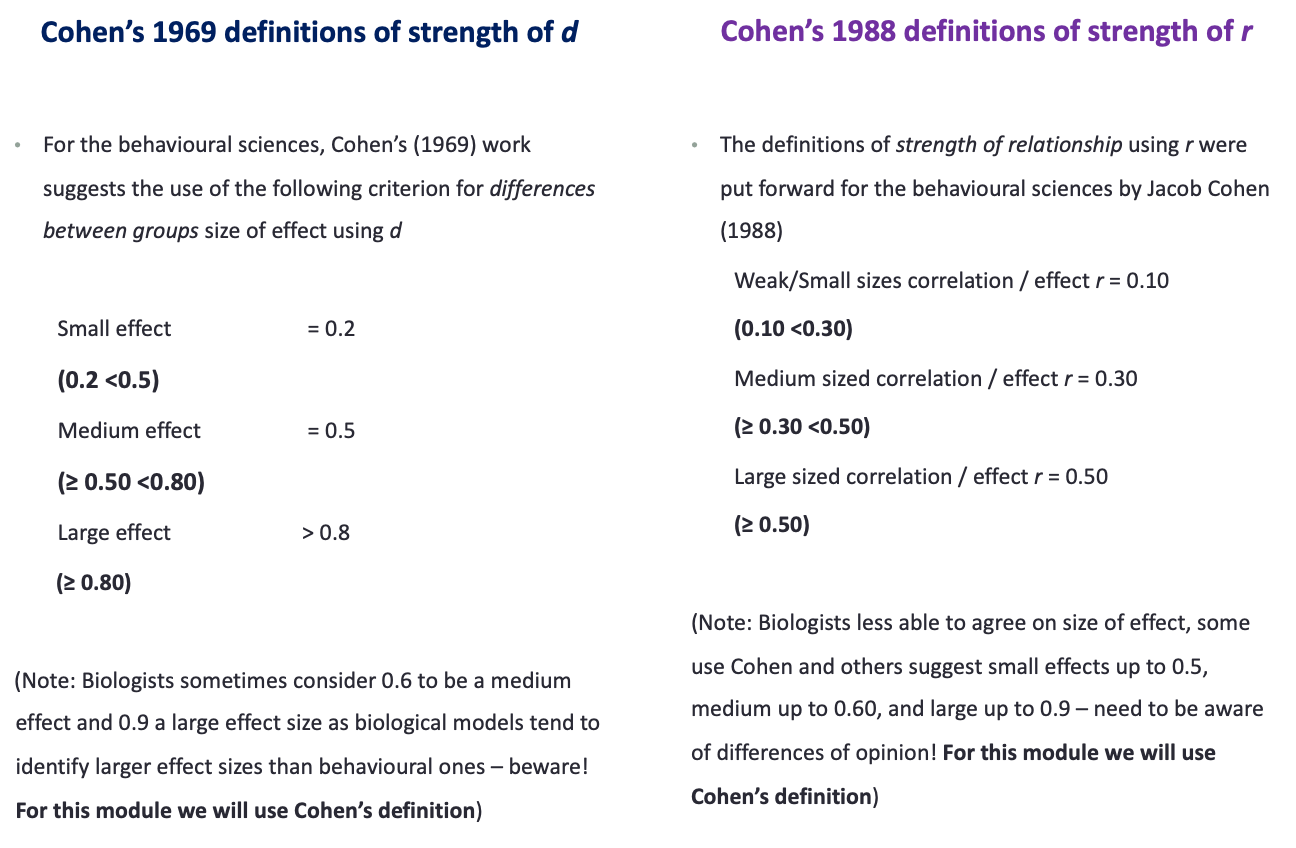
What are Cohen’s 1969 definitions of strenght of d and r?
How do you calculate parametric effect size for independent samples t-test using d statistic?

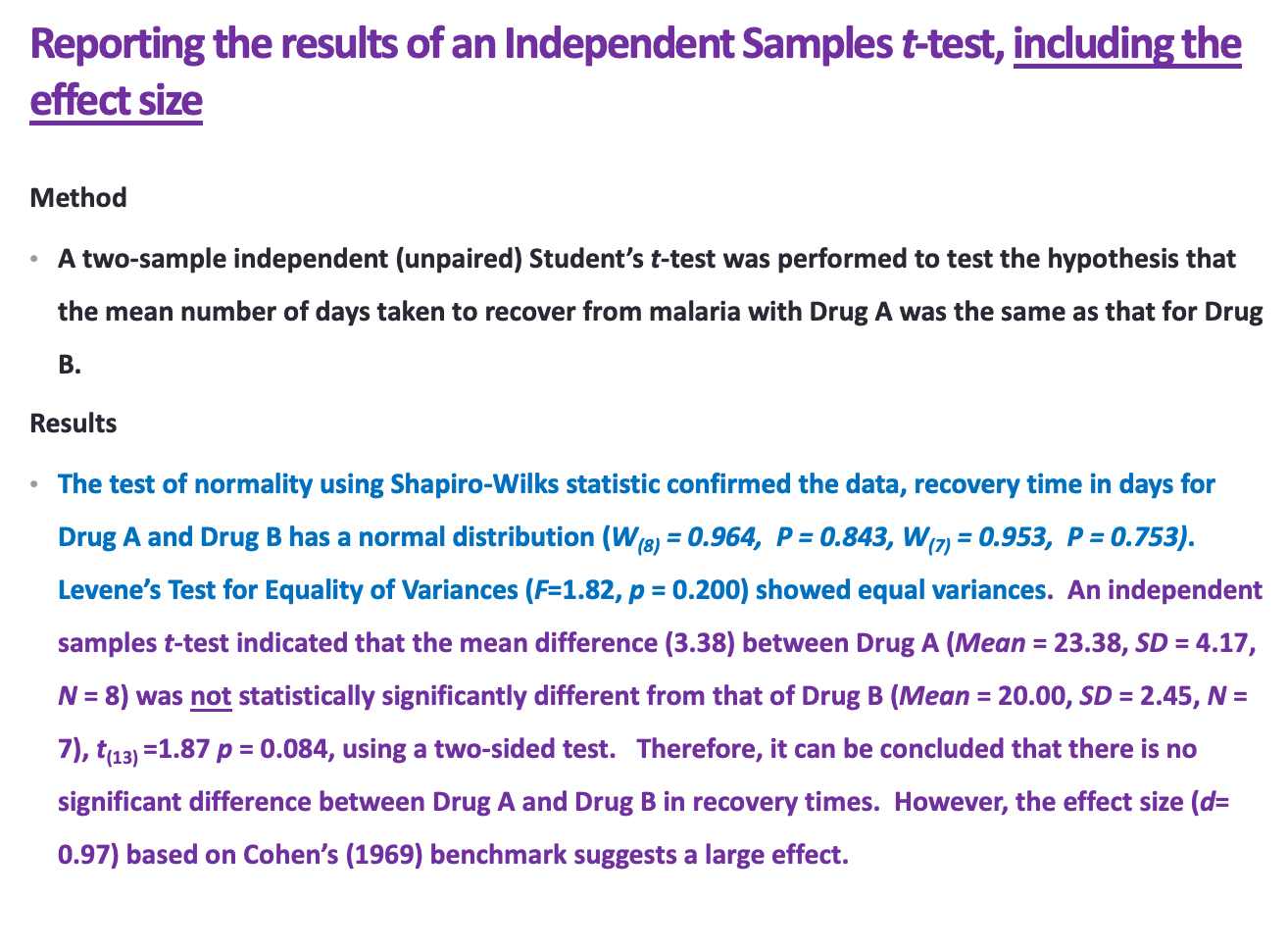
How do you report the results of an independent samples t-test including the effect size?
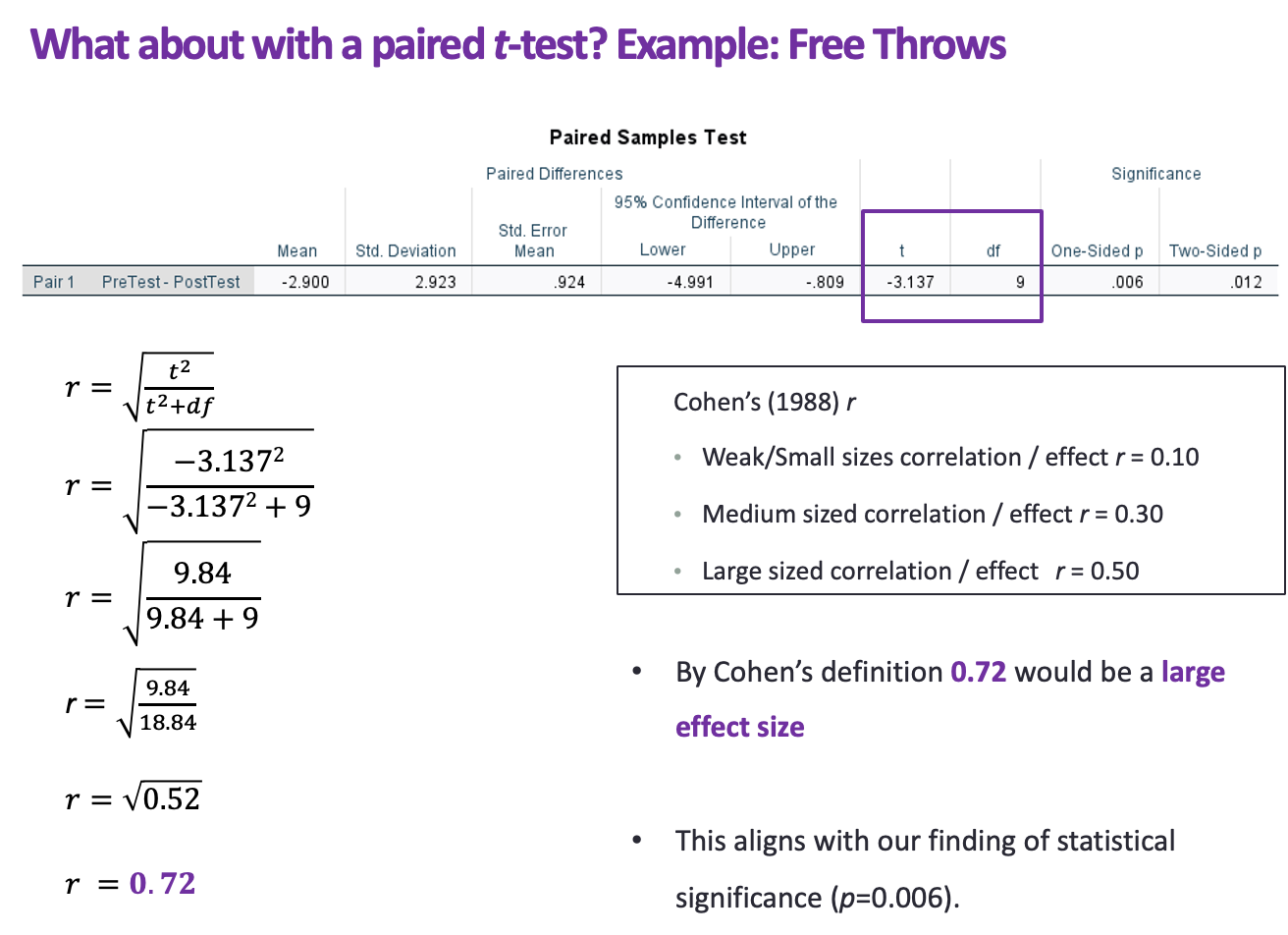
How do you calculate effect size for a paired t-test?
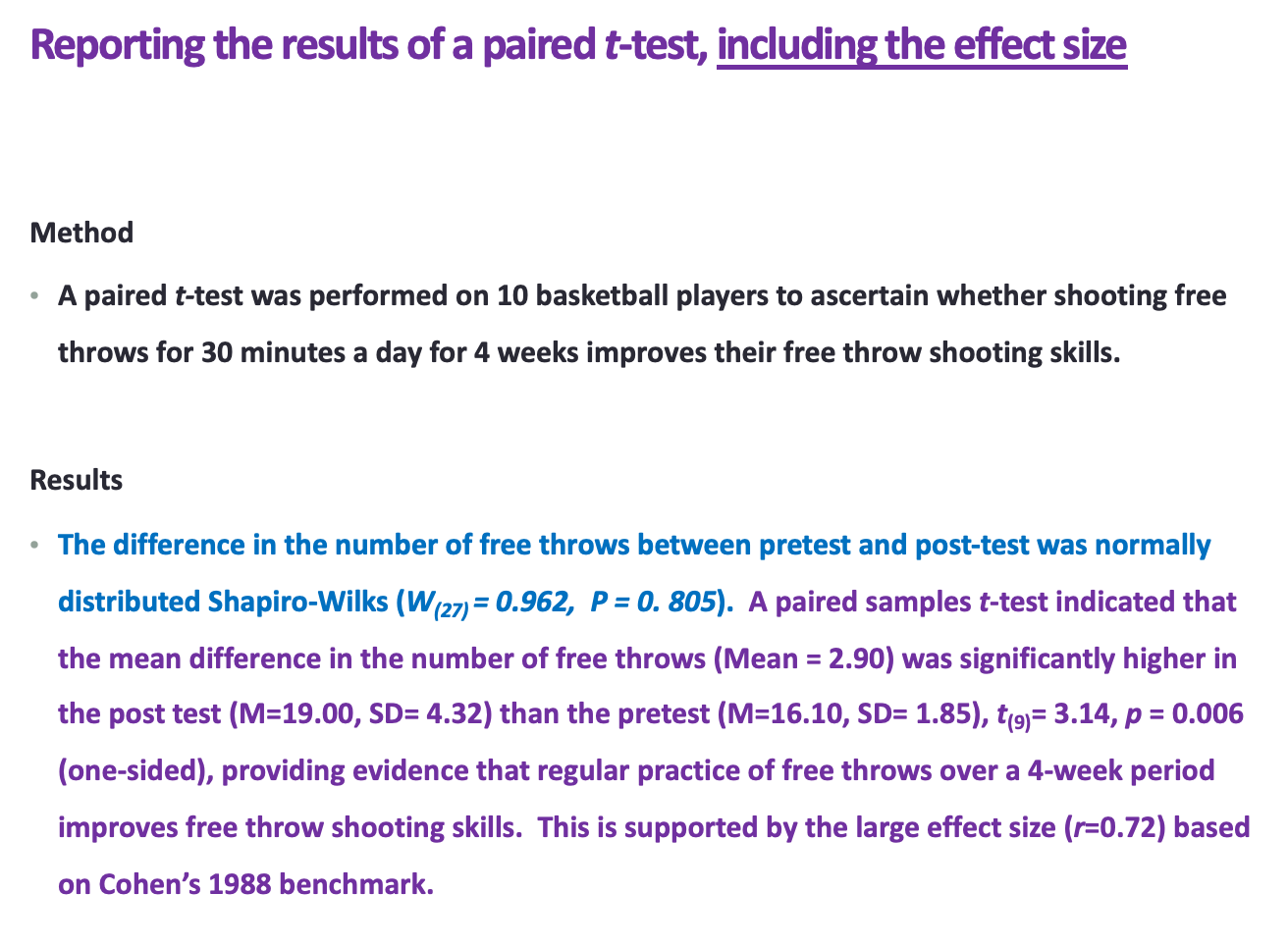
How do you report the results of a paired t-test including the effect size?
 Note
Note  Flashcards (22)