Week 4 Stationary/Standing Waves
 Studied by 0 people
 Call Kai
 Learn
Learn Practice Test
 Spaced Repetition
 Match
Match Flashcards
 Knowt Play
1/16

There's no tags or description
Looks like no tags are added yet.
Name | Mastery | Learn | Test | Matching | Spaced | Call with Kai |
|---|
No analytics yet
Send a link to your students to track their progress
17 Terms
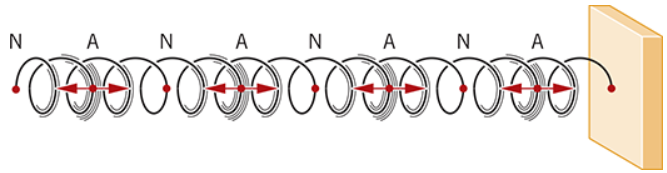
stationary/standing wave
wave patterns formed by the interference of two waves with the same frequency and amplitude traveling in opposite directions, storing energy without transfering it; has nodes and antinodes
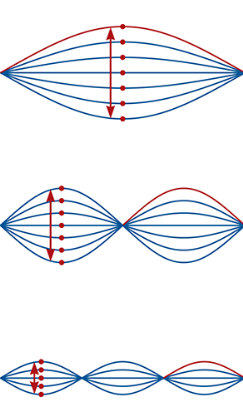
antinode
maximum vibration of the stationary wave
node
zeero vibration of the stationary wave
harmonic wave
sin wave with frequency = integer x frequency of the original (fundamental) wave; harmonic number corresponds to the # of loops in the standng wave pattern
fundamental frequency
lowest frequency in the series, aka first harmonic
overtone
any resonant frequency above the fundamental frequency (ex. second harmonic is called first overtone)
first overtone is also
second harmonic
equation to find the fundamental frequency of standing wave
f1 = v/wavelength = 1/2L x v = 1/2L x sqrt(T/linear density)
where v = speed, L = length of string, and T = tension force
equation to find wavelength of nth harmonic on a string
wavelengthn = 2L/n
equation to find frequency of nth harmonic on a string
fn = v/wavelength = n x v/2L = n/2L x sqrt(T/linear density) = n x f1(fundamental frequency)
equation to find harmonic frequency for stationary wave on string
harmonic frequency = # of ½ wavelenths x fundamental frequency
resonance
phenomenon where an ocillating system (ex. sound wave) absorbs max energy and vibrates with significantly larger amplitude because the frequency of a periodically applied force is equal or close to the medium’s natural frequency
natural frequency
any frequency an object vibrates when disturbed (determinedby its mass and stiffness), fundamental frequency is the lowest of the natural frequencies
comparing standing and progressive wave’s frequency, amplitude, and phase difference
frequency: stationary wave all particles except at the nodes are at the same frequency - progressive wave all particles vibrates at the same frequency
amplitude: stationary wave amplitude varies from 0 @ nodes & max @ antinodes - progressive waves amplitude is the same for all particles
phase difference b/w 2 particles: stationary waves equal to mπ where m = # b/w 2 particles - progressive waves equal to 2πd/wavelength wehre d=distance apart
principle of linear superposition
when two or more waves are present simultaneously at the same place, the resultant disturbance is the sume of the disturbances from the individual waves. can be applied to all types of waves
condensation in waves
also means compression in longitudinal waves
closed pipes and waves
pipes with one side closed and one side open must have node at closed end and an antinode at the open end
 Note
Note  Flashcards (44)