Disorders of the Hair and Nails - Clin Med
 Call Kai
 Learn
Learn Practice Test
 Spaced Repetition
 Match
Match Flashcards
 Knowt Play
1/39

There's no tags or description
Looks like no tags are added yet.
Name | Mastery | Learn | Test | Matching | Spaced | Call with Kai |
|---|
No analytics yet
Send a link to your students to track their progress
40 Terms
What does this refer to
Partial or complete absence of hair from areas of the body where it normally grows; baldness
Rapid onset and in a sharply defined area
Condition attacks but does not destroy hair follicles
Common classifications
Androgenetic alopecia (male)
Androgenetic alopecia (female)
Alopecia areata
Alopecia
What does this refer to
Larger than vellus hair follicles
Extend into the subcutaneous fat
(Usually) at least 0.06mm in diameter
At birth
Scalp
Eyebrows
Eyelashes
Terminal Hair type (Alopecia)
What does this refer to
Lowest portions extend only into the reticular dermis
Short, fine
(Usually) < 0.03mm in diameter
Location
Remaining hair-bearing areas
During puberty
Stimulated to become terminal hairs in the genital area & axilla
Vellus Hair Types (Alopecia)
What does this refer to
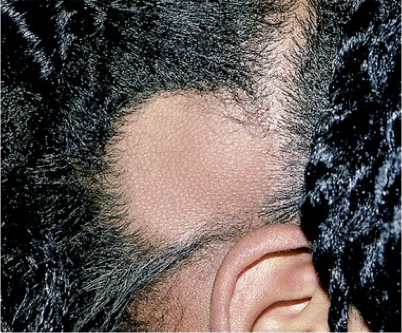
Common form of non-scarring alopecia
Autoimmune disorder
Usually occurs in patches
May also progress to loss of all scalp or body hair
May also occur at the occiput scalp margin (ophiasis)
Alopecia areata
What does this refer to
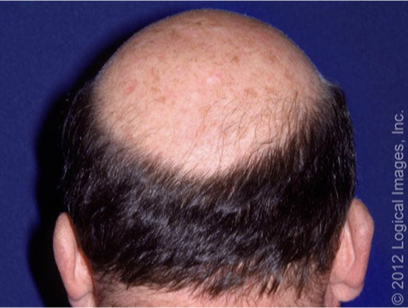
Male pattern hair loss
Slow progressive loss of hair in a characteristic distribution
Androgenetic alopecia in men
What does this refer to
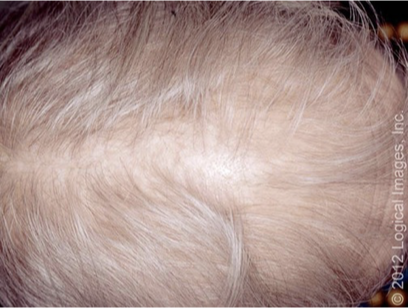
Hair loss most frequently presents as hair thinning
Frontal and crown areas of the scalp
Relative sparing of the occipital scalp
Female pattern hair loss
What does this refer to
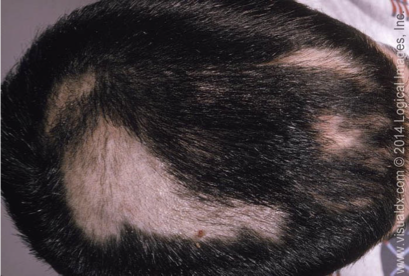
Disorder in which individuals repeatedly pluck hairs from the scalp or other hair-bearing areas
Psychiatric disorder included in the DSM
Areas of alopecia may have irregular, bizarre shapes
Trichotillomania
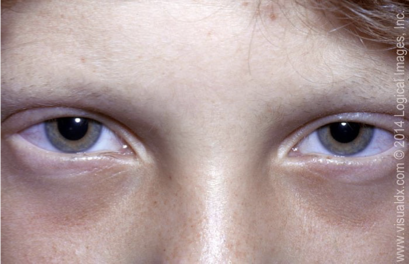
What does this refer to
Common disorder
MC in those under 30yo
Includes children and teenagers
Early onset (5-10yo) is most severe
MC AA or Hispanics, especially in women
Epidemiology of Alopecia Areata
What does this refer to
Autoimmune
Genetic
Etiology Alopecia Areata
What does this refer to
May have burning or tingling in the area
Hair loss is rapid
Clinical history Alopecia Areata
What does this refer to
Round or oval patches of baldness
Healthy looking skin where hair loss occurred
Co-occurring symptoms of fingernails or toenails
Softer or brittle nails
Dents or ridges across the nail
Nails that feel rough or "sandpaper-like"
Red coloration of the nail bed
Physical exam Alopecia Areata
What does this refer to
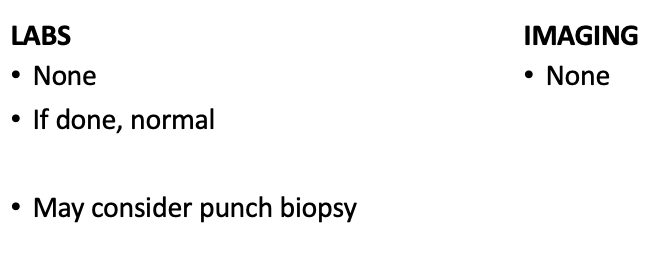
Workup Alopecia Areata
What does this refer to
Minoxidil (Rogaine or Theroxidil) foam or solution
Applied to affected areas
Does not stop disease
Considered safe tx and is good choice for children
Topical contact sensitizers
Designed to produce a contact dermatitis
Clinical intervention Alopecia Areata
What does this refer to
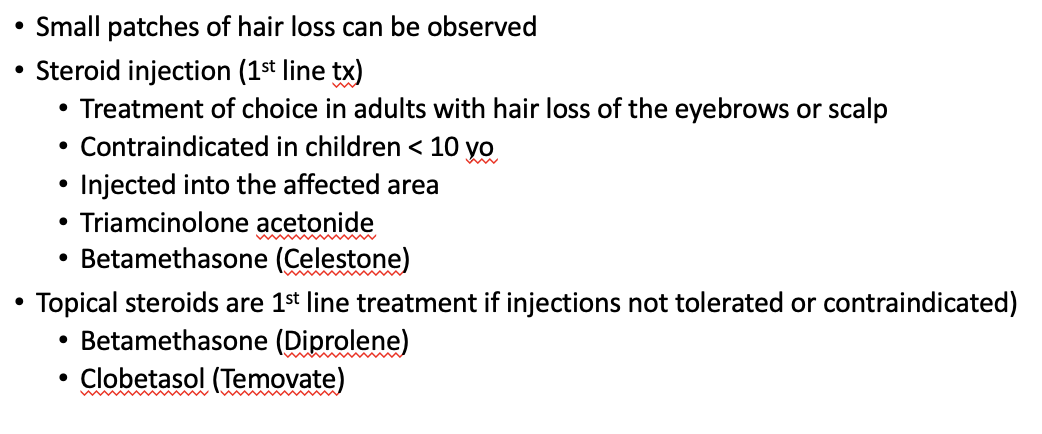
JAK inhibitors (currently in clinical trials) blunt inflammation by blocking the signaling pathways during the immune response
Tofacitinib
Ruxolitinib
Baricitinib
Clinical management Alopecia Areata
What does this refer to
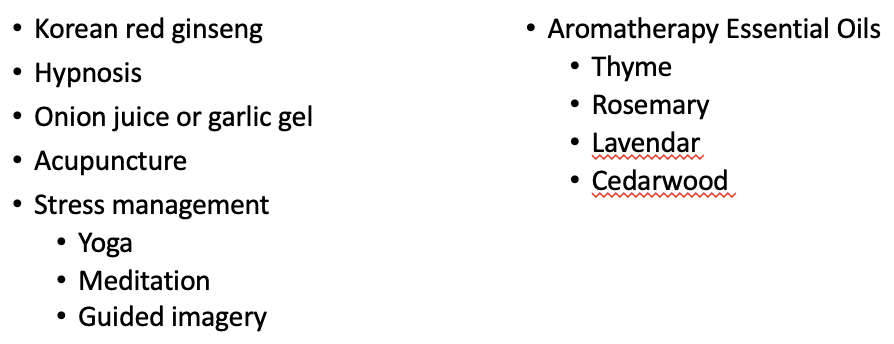
Complementary & alternative medicine (CAM) Alopecia Areata
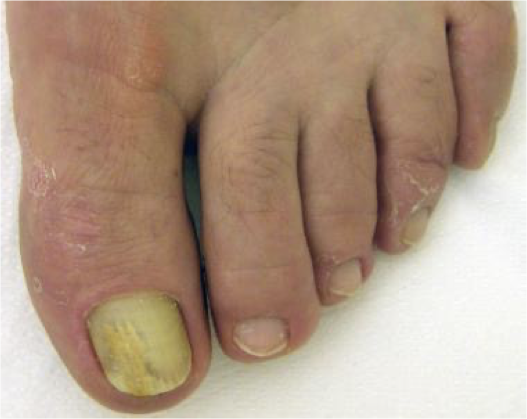
What does this refer to
Fungal infection of the toenails or fingernails
May involve any component of the nail unit
Matrix, bed, or plate
Onychomycosis
What does this refer to
Equally affects all races
M > F
MC in adults
MC affects the great toe
Epidemiology Onychomycosis
What does this refer to
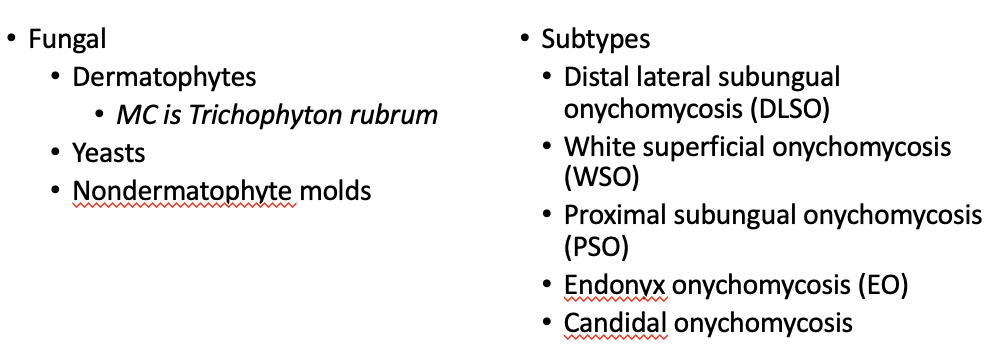
Etiology Onychomycosis
What does this refer to
Complains of nail appearance
Disease progression = symptoms
Interfering with standing, walking and exercising
Further progression
Paresthesia
Pain and discomfort
Loss of dexterity
Clinical history Onychomycosis
What does this refer to
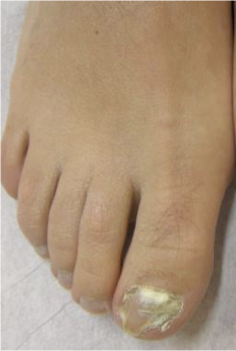
Distal lateral subungual onychomycosis
Subungual hyperkeratosis and onycholysis
Yellow-white in color
Yellow streaks and/or yellow onycholytic (nail detachment) areas in the central portion of the nail plate
Physical exam Onychomycosis
What does this refer to
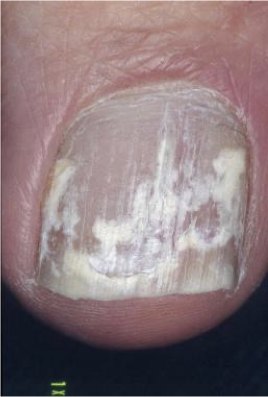
Endonyx onychomycosis
Milky white discoloration of the nail plate (small, white, speckled)
No subungual hyperkeratosis or onycholysis is present
Physical exam Onychomycosis
What does this refer to
Proximal subungual onychomycosis
Leukonychia in the proximal nail plate that moves distally with nail growth
Leukonychia caused by molds
Marked periungal inflammation
Physical exam Onychomycosis
What does this refer to
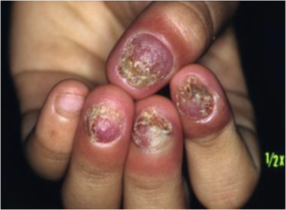
Total dystrophic onychomycosis
Thickened
Opaque
Yellow-brown
Periungal inflammation
Multiple digits involved
Bulbous or drumstick appearance
Image shows Candida onychomycosis associated with Chronic mucocutaneous candidiasis
Physical exam Onychomycosis
What does this refer to
Workup Onychomycosis
What does this refer to
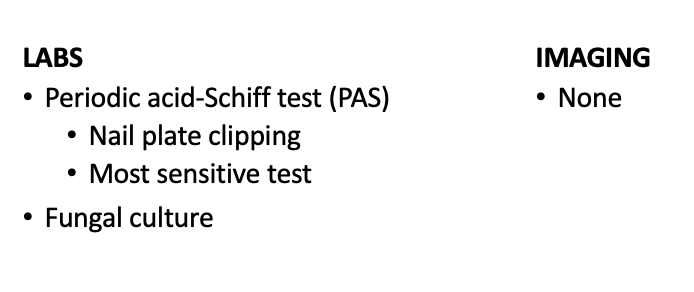
History and physical exam
KOH or PAS + culture
Diagnosis Onychomycosis
What does this refer to
Appropriate footwear
High exposure areas include communal bathing facilities and health clubs
Clinical intervention Onychomycosis
What does this refer to
Fungal infection should be confirmed by culture + rapid test (KOH or PAS)
Can initiate tx before cultures result if KOH or PAS is positive
Systemic antifungals
Terbinafine (Lamisil) (1st line for dermatophytes)
Itraconazole (dermatophytes and candida)
Topical antifungals
Efinaconazole (Jublia)
Tavaborole (Kerydin)
Clinical management Onychomycosis
What does this refer to
Tea tree oil (topical)
Vitamin E (topical)
Oil of bitter orange (topical)
Complementary & alternative medicine (CAM) Onychomycosis
What does this refer to
Residual nail changes
Onychomycosis with mold etiology usually not responsive to systemic therapies
Recurrence is common
Fungal infections of fingernails have more favorable prognosis than toenail infections
Prognosis Onychomycosis
What does this refer to
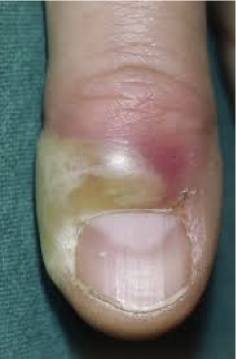
Inflammation/infection involving the lateral and proximal fingernail folds (the cuticle)
Paronychia
What does this refer to
Fingernails MC than toenails
MC hand infection in the US
F > M
Appearance of the hand (or foot) often greater issue than severity of infection
Occurrence of cracks, fissures or trauma allows organisms to enter moist nail crevice
Epidemiology Paronychia
What does this refer to
Overzealous manicuring, including acrylic nails and glue
Nail biting
Thumbsucking
Diabetes mellitus
Frequently immersing hands in water
Bacterial and fungal etiology MC
What do you think the most common bacterial pathogen is
Etiology/risk factors Paronychia
What does this refer to
Initial presentation may be simple, uncomplicated cellulitis (< 24hrs)
Characterized by the onset of pain and erythema of the posterior or lateral nail folds
Subsequent development of a superficial abscess
Fluctuant paronychia usually bacterial infection
Clinical history & presentation Paronychia
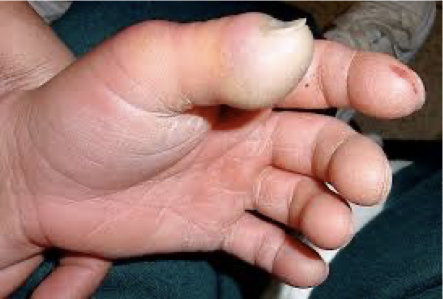
What does this refer to
Throbbing pain in pulp of the finger
Fingertip swelling and redness
Pain and swelling progressive
Tense fingertip pulp
Delay in treatment (ORTHO CONSULT)
Can extend toward phalanx (deep)
More extensive infection may result in necrosis or involve the palmar tissue/fascia
Felon finger (A CAN’T MISS DIAGNOSIS)
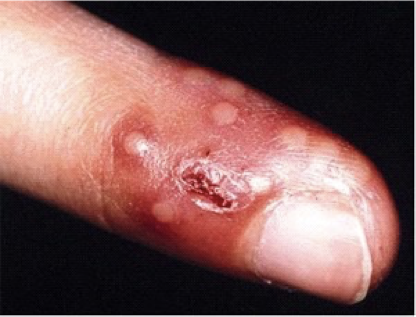
What does this refer to
Viral infection of the pulp of the fingertip
Often confused with bacterial paronychia
Characterized by
MC terminal phalanx
Clear vesicles grouped on erythematous bases
May be on more than 1 finger
Herpetic whitlow not a paronychia
What does this refer to
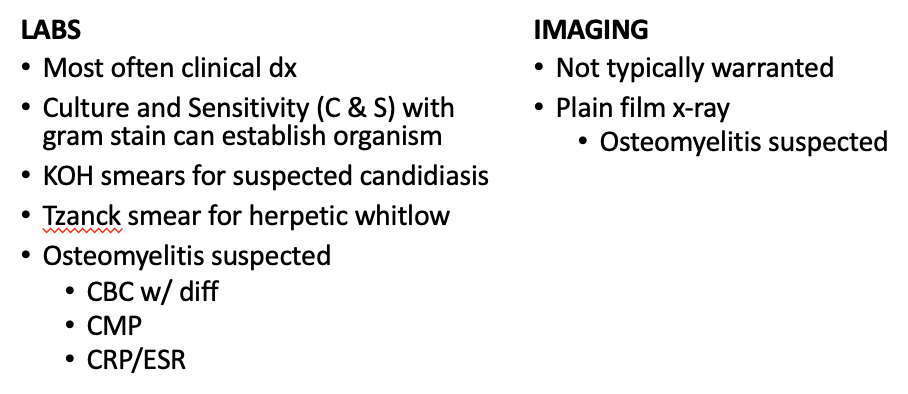
Workup Paronychia
What does this refer to
Good hand hygiene
No nail biting
Manicures with caution
Warm soaks, compresses 3-4x daily
Clinical intervention Paronychia
What does this refer to
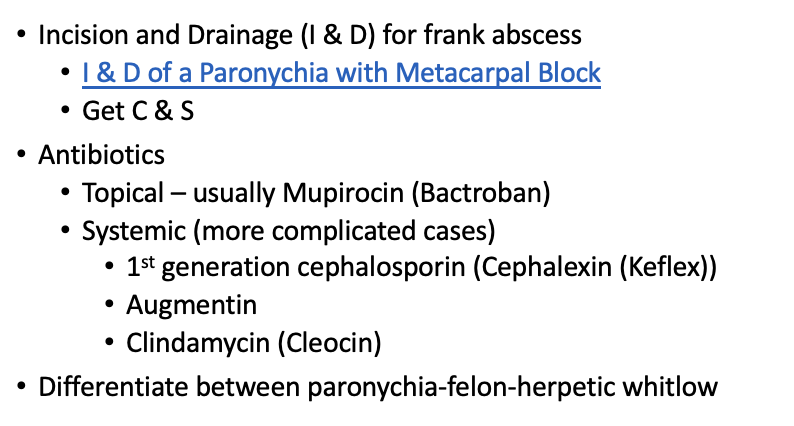
Clinical management Paronychia
What does this refer to
Warm water soaks
Apple cider vinegar soaks
Topical Tea tree oil
Limit acidic foods/beverages
Baking soda and water paste (topical)
Complementary & alternative medicine (CAM) Paronychia
What does this refer to
Good with prompt treatment
Untreated or delay in treatment
May lead to septic tenosynovitis, osteomyelitis or by spreading to the pulp space of the finger
May result in loss of nail
Secondary nail changes (ridging, thickening and discoloration)
Prognosis Paronychia

