Lecture 6 - Long Term Memory: In Practice
 Call Kai
 Learn
Learn Practice Test
 Spaced Repetition
 Match
Match Flashcards
 Knowt Play
1/51

There's no tags or description
Looks like no tags are added yet.
Name | Mastery | Learn | Test | Matching | Spaced | Call with Kai |
|---|
No analytics yet
Send a link to your students to track their progress
52 Terms
Define autobiographical memory.
Memory about ourselves that consists of episodic and semantic memories.
*essentially, any memory that is about yourself
In terms of autobiographical memory, what are researchers most concerned about?
Researchers are concerned with the quality (ie. accuracy) of people’s auto-biographical memories.
Why are autobiographical memories difficult to study?
Because it is hard to verify.
How do we overcome the difficulties when studying autobiographical memories?
measure a person’s memory for public events
confirm the person’s memory with their family members
use diary studies
What are the limitations of using family members to confirm the person’s memories?
Families oftentimes re-tell the same stories over and over again. Therefore, the family’s memory could be equally distorted.
What are the limitations when using diary entries to verify the person’s memory?
Usually people will not write something down in their diary unless it is worth mentioning (ie. unless it’s unique or important). Therefore, it is not really considered to be normal memories and people are more likely to remember it more easily.
Moreover, writing what happened at the end of the day is a type of elaborate rehearsal, which can enhance the person’s memory of the events.
Other than diary entries what else is used to verify people’s memories?
Text messages throughout the day
People now receive text messages throughout the day asking them what they are doing at the moment. This helps with getting mundane things noted down, but does not help with elaborative rehearsal as they are still writing things
Record the person’s say
this is technically the most effective as it notes down everything and does not require elaborative rehearsal, though most people do not want their days fully recorded for privacy and ethical reasons
Define infantile amnesia.
This is the idea that adults cannot recall memories before the age of 2.
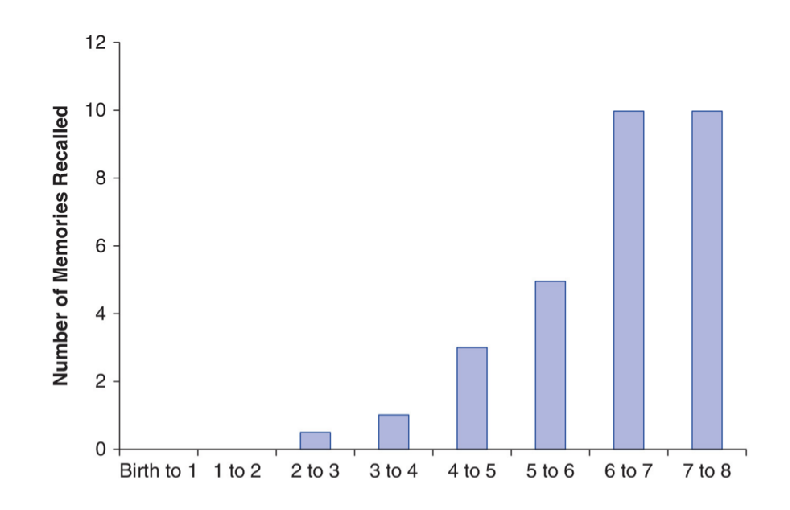
From what age are our earliest memories from?
Age of 4 onwards is when we start to develop true memories.
*though 2-4 we do have memories but they are very disjointed fragments (so not true episodic memories)
If we only have memories from when we are 4 ish years old, how come some people claim to have memories from before then?
This is likely due to them remembering someone telling them that the event happened, rather than them actually remembering the event happening.
Explain the first argument on why infantile amnesia occurs.
The way infants encode memories are different to how adults encode memories. This is because before we became verbal our brains encoded memories in some way. However, once we become verbal, our brains, by default, coded things into a verbal code.
Hence, making us no longer able to access memories coded beforehand.
What is another argument for why infantile amnesia occurs?
The memory traces that are formed before the age of 2 are replaced as we lose synapses, as the pre-frontal cortex develops and as hippocampal neurons regenerate. Therefore, getting rid of those memory traces.
What is the reminiscence bump?
The idea that when we look back on our past experiences, the time period that we remember the best is from our late teens to early adulthood.
*improved memory from late teens to early adulthood
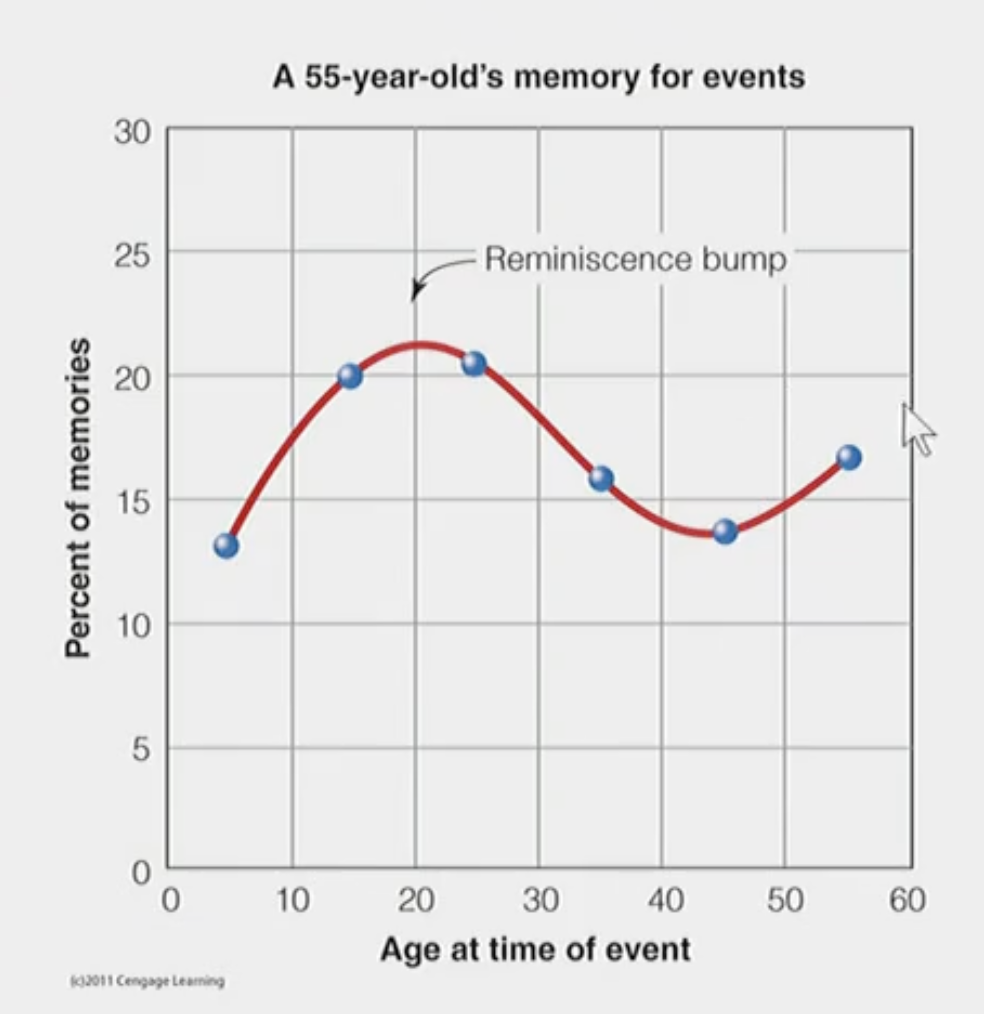
Who does the reminiscence bump apply to?
Middle aged to older adults (55+).
Why is the reminiscence bump usually tested in 55+ year olds?
Because if you test a group younger than that, of course they will remember things better that just happened to them. Hence, that time difference is necessary in order to see how people’s memories of that period of time is affected.
What other effect is seen when testing for a reminiscence bump?
Long-term recency effect (the slight upward increase at the end of the graph).
This is because there is improved memory for events that just happened—you will see that for whatever age group you test.
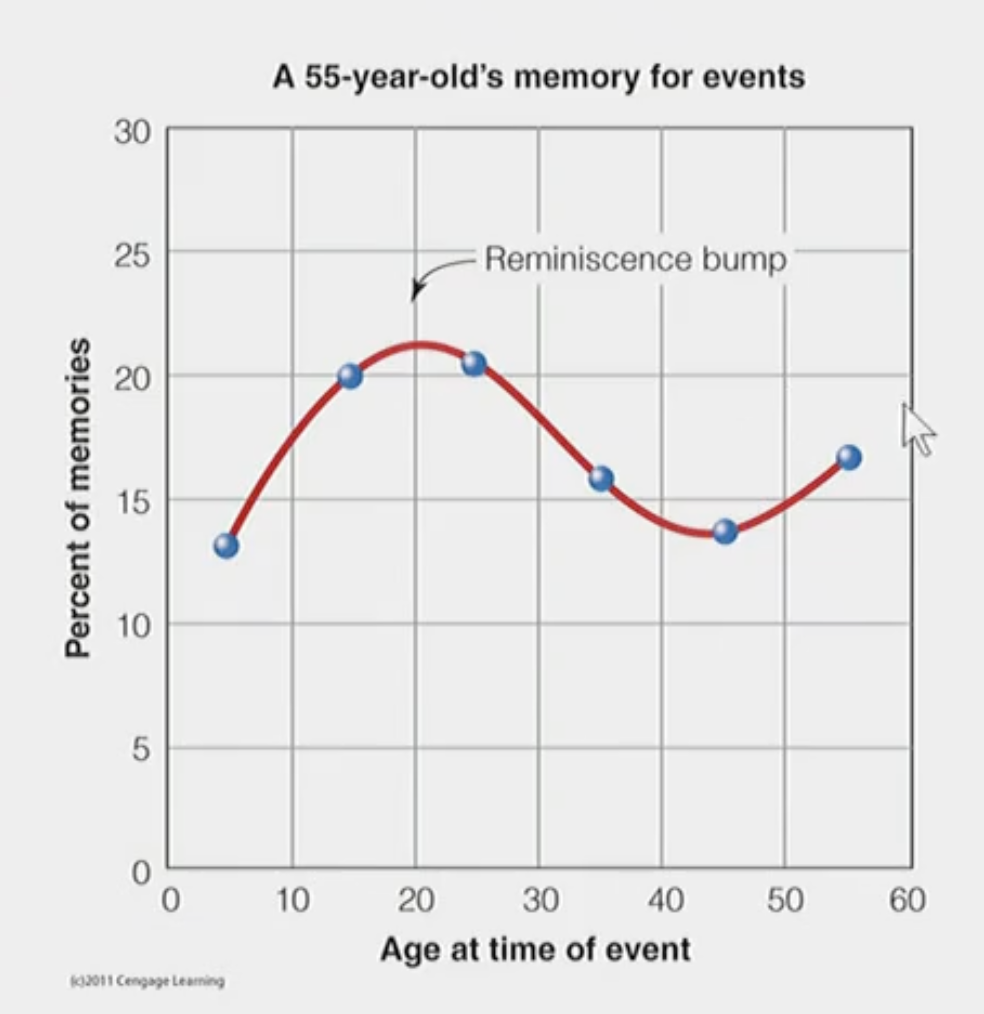
Are memories in the reminiscence bump usually positive or negative?
It usually contains positive memories—hence, the name reminiscence bump.
Are episodic or semantic memories usually found in the reminiscence bump?
Both!
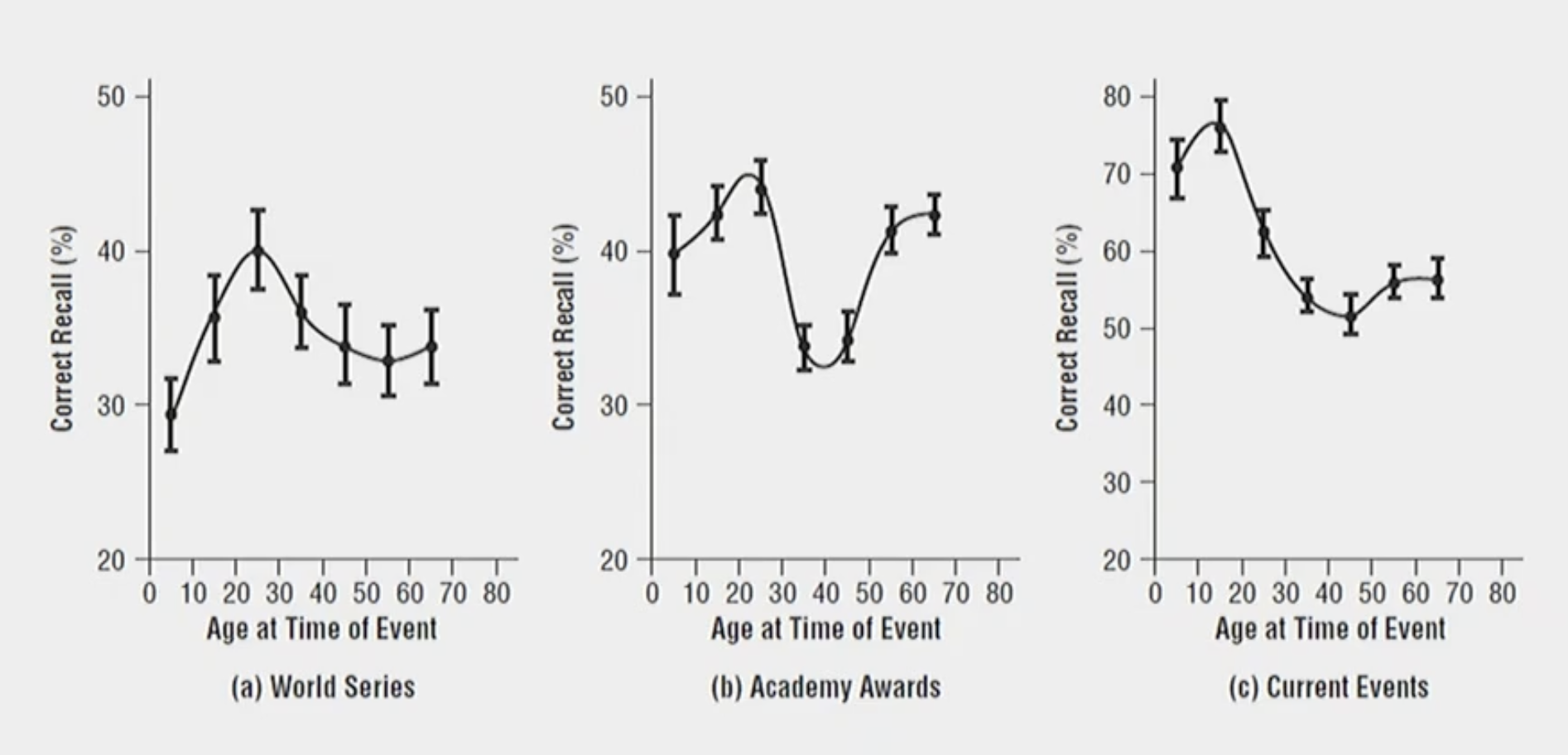
Explain some studies where the reminiscence bump occured?
In the image you will see:
People remembered who won the world series around their 20s better than any other age
People remembered who won the academy awards around their 20s better than any other age
People remembered current events better when they were in their 20s compared to when they were any other age
Why do we see this reminiscence bump? What are the 2 leading theories?
Cognitive Hypothesis
Cultural Life Script Hypothesis
Explain the Cognitive Hypothesis and how it explains for the occurrence of the reminiscence bump.
The cognitive hypothesis explains that nothing very special is happening to cause the reminiscence bump in our 20s, it is just that the things that happen in our 20s are usually distinctive and we elaborate on those memories (which are things that always help us remember stuff—that’s not a new idea) which enhances our memories of it.
For example, the things that occur in our 20s are usually firsts and so are distinct and important to us. Due to this, we tend to elaborate on them, which helps us remember.
However, after our 20s, we tend to form a routine and we don’t have as many firsts, so what happens is not as distinct anymore.
Though, the things that we elaborate on are still things from our 20s—which only further enhances our memories.
What is some evidence to support the Cognitive Hypothesis’ explanation of the reminiscence bump?
If you look at the reminiscence bump of people who immigrated to a new country in their 30s or 40s, their reminiscence bump shifts in time to when they moved to a new country and decided to start a new life.
This supports the Cognitive Hypothesis as it explains that nothing particularly special is occurring, it is just the speciality of the event that makes the memory distinct and makes us elaborate on it—therefore, enhancing our memory for that time period.
Hence, nothing special is specifically happening at that age, it is just that is usually when important stuff happens.
Explain the Cultural Life Script Hypothesis and how it explains for the occurrence of the reminiscence bump.
This is the idea that we remember things well during our 20s because of our expectations of what will happen during that timeframe that has been set by our culture. Hence, it is not the actual experiences, but the expectation of those experiences.
For example, a lot of cultures think that a lot of things will happen when people are in the late teens/early 20s. Hence, this expectation of important things happening during that specific time frame makes us elaborate a lot on the events that occurred during that time—regardless of whether you engaged in those activities.
Therefore, enhancing our memories of things that happened during that time period.
What is some evidence to support the Cultural Life Script Hypothesis’ explanation of the reminiscence bump?
In study they got participants to watch a movie about someone’s life from childhood to old age. Then they are asked to write about the fictional characters from the movie.
The participants remembered most things from the characters’ late adolescence and early 20s because they were expecting things to happen to the characters within that time period.
Hence, supporting this Cultural Script Hypothesis rather than the cognitive hypothesis as the things that stood out to them was within that period of time, even though they did not personally experience the event (which contradicts the cognitive hypothesis since they were not experiencing a personal first but that time period still stood out to them).
Must we reconsolidate memories when we try and retrieve them? What are the implications of this?
Yes, when we are trying to retrieve our memories, we must reconsolidate our memories.
This means that our memories are fragile and malleable.
What do we use to help build our memories?
We use schemas and scripts.
Define schema.
Our knowledge structure about something.
*it is all the knowledge that we know about that topic to help us understand that situation or event
How do schema’s help us build our memories?
Since it is all the information we know about a topic, we use that information from our past experiences to understand our current experiences. Moreover, we use it as a way to organise all the information we know about a topic, which can guide our retrieval by showing us where to ‘find’ the information in our head.
They can also act as heuristics (mental shortcut) that tells us what is likely to occur.
Define script.
A schema for an event (ie. going to class schema—what is the series of events that usually happen—guides our behaviour).
Who was Bartlett?
He was the first person to investigate the idea of schema’s and scripts in memory research.
What type of memory was Bartlett interested in?
He was interested in everyday memory as during his time, researchers actively tried to remove meaning from memories (ie. how do we remember random strings of letters?).
What technique did Bartlett create?
Bartlett created the repeated reproduction technique.
Explain Bartlett’s Repeated Reproduction Technique.
Participants are shown a real world ish type of stimulus, something they have never encountered before, but is similar to what they have seen.
After a delay, they are asked to reproduce the stimulus from memory. This process is repeated multiple times (but they are not re-shown the stimulus, they are only shown the stimulus once in the experiment and are not shown the image they previously drew).

What did Bartlett conclude from multiple experiments he conducted using the Repeated Reproduction Technique?
Bartlett found that detail was lost the more people reproduced the stimulus from memory and that after a certain point, the content of the reproduction changed entirely.
Therefore, Bartlett noticed that as detail was lost, participants tried to fill in the blanks of their memory with what they knew (aka. they used their schematic information to make some guesses on what the thing was because they couldn’t remember).
For example, when people were first shown a line drawing on an owl like figure, it later became a blob and then a detailed drawing of a cat. Hence, when participants saw that what they were drawing was somewhat of a blob in the middle stages, they began to think of schemas that would match their drawings and it eventually morphed into their schematic knowledge of a cat—creating a brand new item.
Therefore, demonstrating the reconstructive nature of our memories and the importance of our schemas to help reconsolidate our memories.
Explain Deese-Roediger-McDermott (DRM) Procedure.
In this procedure participants are read lists of semantically related items and then asked to complete a recognition task. Some of the items on the recognition task are critical lures.
ie. participants are read a bunch of medical terms and when doing a recognition task, many will falsely believe that they heard the word doctor, even though it was never presented—it was just semantically related to the words in the list.
Define critical lures.
Words that are semantically related to the items presented, but were not actually presented.
What is the most common explanation for why false memory occurs as a result of the DRM procedure?
Activation monitoring theory.
Explain the activation monitoring theory.
This is the idea that when we are encoding the semantically related items, we are activating a schema from memory. Then, during the recognition task, we commit a source monitoring error: a specific type of false memory, where the content of the memory is correct, but we misremember where the information came from.
Therefore, in the DRM procedure, we are correctly remembering the content of the schema. However, we are falsely remembering that it came from the list.
For example, our medical schema is active, making us think of the word doctor. However, doctor is only active in our minds because we thought of it ourselves, not because we were presented that. Hence, when doing the recognition task we falsely think that the word doctor was there—it was there, but it was from the association you made, not from the actual list—that’s why it’s a source monitoring error.
Define source monitoring error.
A specific type of false memory, where the content of the memory is correct, but we misremember where the information came from.
Explain the misleading information effect.
The idea that when people are told misleading information after an event has occurred, people tend to recall the information that they were told, rather than the actual event.
Explain the first experiment that studied the misinformation paradigm.
Elizabeth Loftus (1978)
Encoding Phase
In the first phase, participants watched a video where there was a red car who stopped at a corner and then turns the corner and goes off-screen. The participants do not see a car accident occur because the car goes off screen, but they hear it.
Misinformation Phase
In the second phase, some participants were given misleading information about the video they just watched.
Half of the participants were asked if another car passed the red car when it was stopped at the stop sign (that was exactly what participants saw in the video—not misleading info)
the other half of participants were asked if another car passed the red car when it was stopped at the yield sign (there was no yield sign—misleading info)
Recognition Phase
In the third phase, participants were asked to recognise which image they saw from the video (red car with stop or yield sign—image that matched what happened vs. matched the misleading information, respectively).
if participants were not given misleading information, 75% recognised the correct image
if the participants were given misleading information, only 41% recognised the correct image
What did Loftus’ Misinformation paradigm indicate about the misinformation effect?
The experiment highlighted the misinformation effect as participants remembered what they were told because they incorporated that information in their memories, rather than the actual event that occurred.
What is another experiment that highlights the fragility of our memories? Explain the experiment and its results.
In another experiment, participants were asked to judge the speed of the car. What was different between the participants was the connotation of the word used to describe the information:
How fast were the cars going when they hit each other?
How fast were they going when they smashed each other?
When participants were asked about the cars smashing, they judged the driving speeds of the cars as faster than the cars asked about them hitting. Moreover, participants who heard the word smash were more likely to report seeing broken glass on the scene, even though there was no broken glass.
Therefore, illustrating information being presented after the fact altering our memory and our schemas. When you hear cars smashing, you access your schematic knowledge and think of something much more severe (likely with broken glass—making people report that).
Can we have false memories about ourselves?
Yes.
Explain a study about implanting memories (shopping mall study).
Shopping Mall Study by Loftus and Pickrell’s (1995)
Loftus recruited participants and their family members. She got the participants’ families to send her 3 childhood stories about the participant, and then she mixed it with a false story that they were lost in a mall (none of the participants were lost in a mall when they were kids).
She mailed participants a booklet with the 3 true stories, and the 1 false story. Then, she asked them to write about what they remembered from the events, if they did not remember anything, they were told the leave it blank.
Participants mailed it back and she got the participants to do the two more times (once at home, and another in her lab).
Afterwards, participants were told that one of the stories did not happen. Then, participants had to identify which one was the false event.
25% of participants picked the wrong event (so 25% of participants believed that they had been lost in a mall as a child and they picked something that really happened as the false event—indicating the researchers successfully implanted memory)
Explain another study about implanting memories (Hot Air Balloon). What are the implications?
Hot Air Balloon by Wade et al (2002)
Instead of stories like Loftus, they photoshopped childhood pictures of the participants into hot air balloons (none of the participants had been on hot air balloons). The procedure was the same as Loftus.
50% of participants falsely remembered that they had been on a hot air balloon
some participants even elaborated on the event (even though it was completely false)
This study highlights how easy it can be to form false memories.
What are the problems with eye-witness testimonies?
Problems are linked to attention and memory
Misinformation Effect
Source Monitoring Errors
Confirmation Bias and Confidence
Explain how attention and memory affect eye-witness testimonies.
If we pay attention to something, we are more likely to remember it later. Hence, we are most likely to attend the parts that are dangerous if we are in a threatening situation. Due to this, we will probably remember the weapon quite well and nothing else from the scene because we were so focused on the weapon.
Therefore, this can skew our eye-witness testimonies.
Explain how misleading information effect affects eye-witness testimonies.
If witnesses are being interviewed and the investigators are not careful, this can easily lead to a misinformation effect.
ie. you witnessed a robbery and the investigator asks you, “how bushy was their mustache?” You did not remember them having a mustache but you will begin to think that they did afterwards.
Explain how source monitoring errors affect eye-witness testimonies.
If you witness a crime, you may remember many people being there and falsely think that a by-stander was the perpetrator. Yes they were there, but the source is wrong—they were also a bystander.
Explain how confirmation bias and confidence affect eye-witness testimonies.
If witnesses are given feedback on their responses, any type of positive feedback makes them more much confident in their responses. The problem with that is that juries believe confidence—though confidence is not a reflection of accuracy.
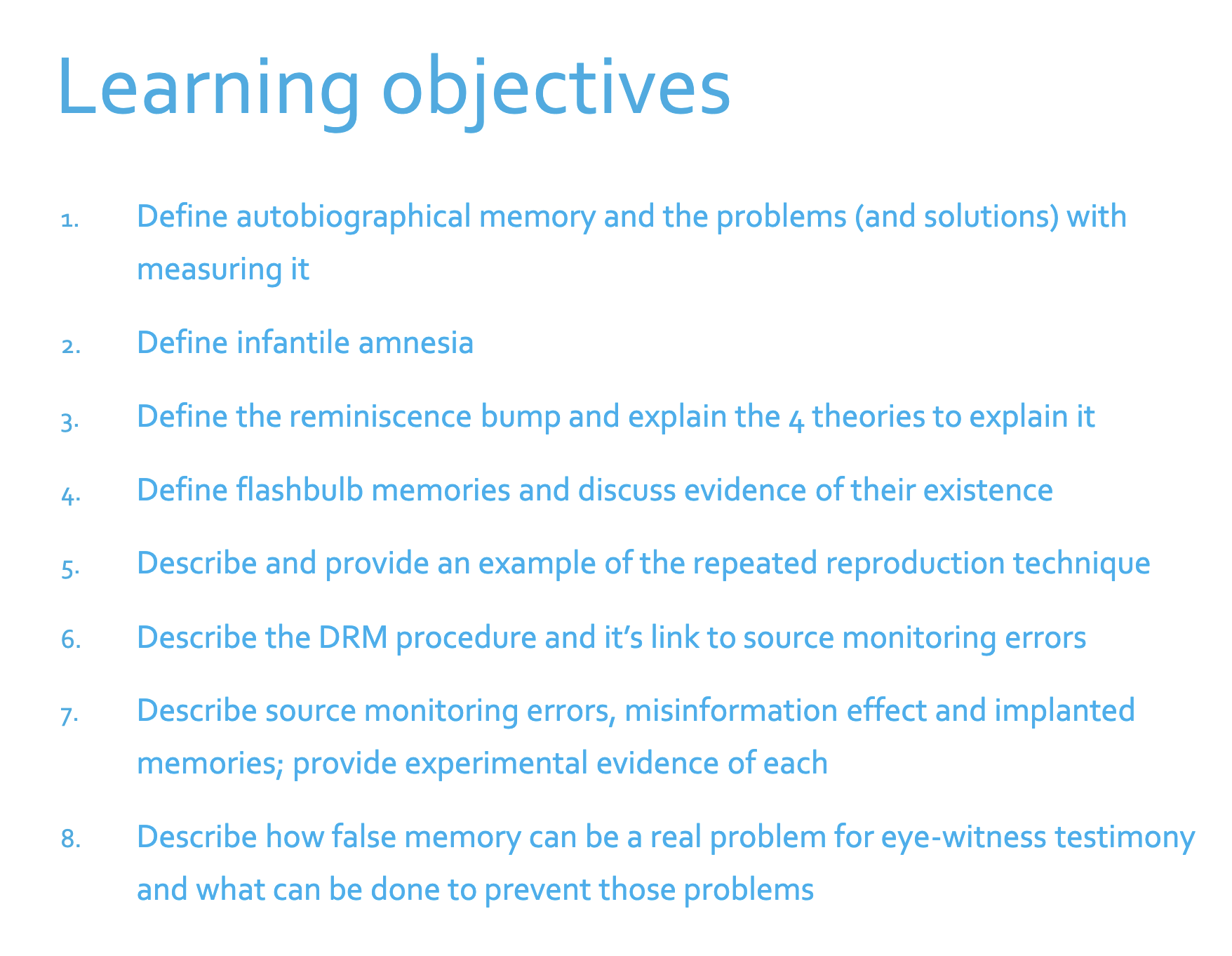
Do you know all the learning objectives?

