Cell and Molecular Biology Chapters 9 and 10: Glycolysis, Fermentation, and Aerobic Respiration
 Call Kai
 Learn
Learn Practice Test
 Spaced Repetition
 Match
Match Flashcards
 Knowt Play
1/99

There's no tags or description
Looks like no tags are added yet.
Name | Mastery | Learn | Test | Matching | Spaced | Call with Kai |
|---|
No analytics yet
Send a link to your students to track their progress
100 Terms
What is a phototroph
This is an organism that obtains energy form light for cellular processes and the synthesis of the compounds that they need to live
What is a chemotroph?
The need to obtain energy from small organic building blocks of outside sources (consumed).
What does anabolic mean
Building up
What does catabolic
Breaking down
What is the cells metabolism
All of the anabolic and catabolic processes used in the metabolic pathways
What is the primary energy currency model of the cells
ATP
What are some energy molecules other than ATP
GTP, Acetyl CoA, and Creatine Phosphate
What is a molecule that stores electrons that can be used to reduce
NADH
What is the chemotropic energy metabolism
This is the process that catabolizes nutrients to release energy
What does the chemotropic energy metabolism involve
It involves the series of enzyme driven reactions
What are the types of molecules received from the input sources
It uses fats, proteins, and carbohydrates.
What are the five basic steps to aerobic cellular respiration of glucose
Glycolysis
Pyruvate Oxidation
TCA Cycle
Electron Transjport
ATP synthesis
What part of aerobic cellular respiration is cytosolic
Glycolysis
Where do the rest of the steps occur
The mitochondria
How many steps are in glycolysis
10
What is each step of glycolysis catalyzed by
Each step is catalyzed by a specific enzyme.
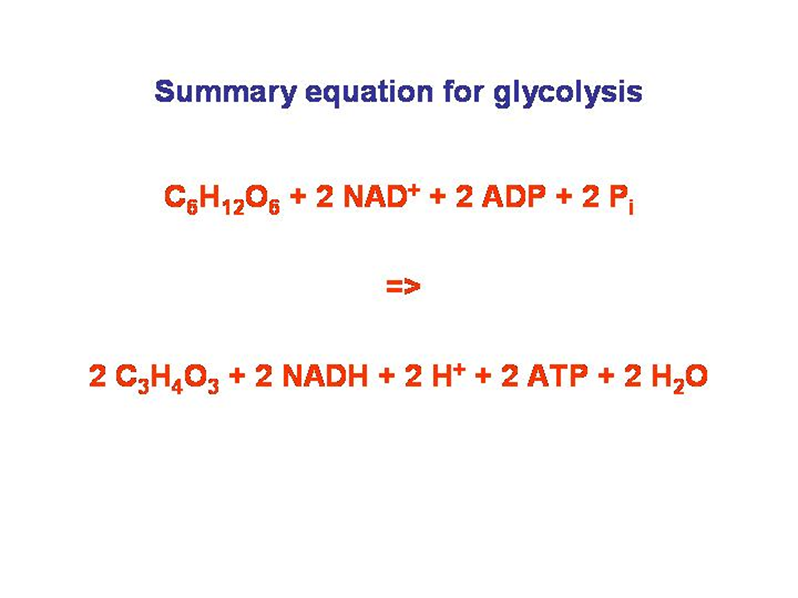
Summarize Glycolysis
What does the fate of pyruvate depend upon?
It depends on whether O2 is available or not.
What happens to pyrubate if oxygen is not available?
Pyruvate is reduced.
What does the reduction of pyruvate of mammals result in?
It results in lactate
What is the product of reduced lactate in other organisms
Other organisms produce alcohol.
What is the fate of pyruvate if oxygen is available?
If it is available, it enters the tricarboxylic acid cycle to be completely oxidized which releases a lot more ATP.
What is the main source of energy used by animal cells
Glucose!
What is the level of glucose that is maintained in the blood by hormone systems
80-100mg/100mL
Where does the body have reserves of glucose? What is it called?
It is in the muscles and liver as glycogen.
What sugars do we take in as a part of our diet?
Monosaccharides like galactose, fructose, as well as three and five carbon sugars.
Where can sugars also be found?
They can be liberated from polysaccharides that have α bonds and not β bonds.
What is the main reason that gluconeogenesis cannot simply reverse all of glycolysis.
This is because some glycolysis reactions are irreversible and myst be bypassed with different enzymes.
Which of the glycolysis steps are irreversible
Gly-1 and Gly-3
Why can Gly1 not be reversed?
It is an irreversible ATP driven step. What
What is is the enzyme that bypasses the GLy1 step during the gluconeogenesis
Glucose-6-phosphatase
What is the reaction that the glycose-6-phosphatase catalyzes
It removes a phosphate from glucose-6-phosphate to form glucose
What happens in Gly-3 during glycolysis?
Fructose-6-phosphate is phosphorylated to fructose-1,6-bisphosphate.
Why can the Gly-3 reaction not simply run backward during gluconeogenesis?
Because it is also an irreversible, ATP-driven reaction.
What enzyme bypasses the Gly-3 step during gluconeogenesis?
Fructose-1,6-bisphosphatase.
What reaction does fructose-1,6-bisphosphatase catalyze?
It removes a phosphate from fructose-1,6-bisphosphate to form fructose-6-phosphate.
Why does the slide say these bypass reactions cannot be coupled to ATP synthesis?
Because the phosphate is released directly as inorganic phosphate instead of being used to make ATP.
What does it mean that the reactions are “uncoupled”?
It means phosphate removal happens separately and is not linked to ATP production.
How is the phosphate removed in these gluconeogenesis bypass steps?
By hydrolysis using water.
What is released when the phosphate group is removed during these steps?
Inorganic phosphate (Pi).
Does gluconeogenesis when it has to reverse the irreversible glycolysis steps?
NO! ATP IS NOT MADE!
What is the purpose of the bypass reactions in gluconeogenesis
This is to get aroudn the irreversible glycolysis steps so that glucose can be synthesized.
Why is gluconeogenesis not able to convert pyruvate directly back to PEP?
This is because glycolysis from PEP to pyruvate is irreversable.
What is the intermediate between pyruvate and PEP in gluconeogenesis?
Oxaloacteate
What is the molecule that is required to convert the pyruvate to oxaloacetate?
ATP
What is the cofactor that is used by pyruvate carboxylaase
Biotin
What molecule is required to convert oxaloacetate to PEP
GTP
What happens to the CO2 in the bypass pathway
The CO2 is added to the pyruvate to form the oxaloacetate and then removed when it is converted to the PEP.
For gluconeogenesis, how much ATP is used to make 1 glucose
It uses 6 ATP
How much ATP does glycolysis generate per glucose
2 ATPT
If gluconeogenesis is used, what is the Net ATP gained
(-2 ATP)
What is a method that the body uses to avoid the waste of resources?
The body takes advantage of a separation of the reaction sites
What is an example of separation of the reaction sites
The Cori Cycle
Where does most gluconeogenesis take place?
This takes place in the liver where the glycolysis rates do not need to be high.
What is the biological reason that the liver would perform gluconeogenesis.
The liver has glucose-6-phosphatase, which converts glucose-6-phosphate into free glucose that can leave the cell. The tissues like the brain and red blood cells depend on glucose for energy, so if there are no nutrients, the G6P can catalyze conversion of gluconeogenesis causing you to stay alive. Yay for not dying!
What is the primary regulator of glycolysis and gluconeogenesis?
F-2,6-BP
What does the F-2,6-BP do?
It stimulates the Gly 3 step, inhibiting the corresponding step in glucose synthesis.
What does F-2,6-BP respond to
It responds tohormones via the cAMP messenger
To extract the remaining energy out of pyruvate, what cycle, involving citric acid as a key component, occurs?
It is the citric acid Cycle
When and who was the citric acid cycle first elucidated?
1930s by Hans Krebs
What are some of the names for the TCA cycle
Citric Acid Cycle, Krebs Cycle, or Tricarboxylic acid cycle.
Where is pyruvate moved to begin TCA
It is moved into the mitochondrial matrix
What is the pyruvate that is moved to the mitochondreial matrix converted to?
Acetyl CoA, CO2, and NADH
Where does the enzyme conserve the energy?
It conserves it in a thioester bond
Is this conversion endergonic or exergonic
It is exergonic with it being -7.5Kcal/mole
How many times does TCA cycle run?
2 times
What are all of the Carbon-Oxygen bonds released as
They are released as CO2. W
What are all of the hydrogen electrons used for?
They are channeled into reducing the electron carriers.
Similarly to gluconeogenesis, is the TCA cycle regulated?
Yes!
How does fatty acid catabolism proceed
It happens through β-oxidation
How many carbons are liberated through the oxidation of the 2nd Carbon
2 Carbon units are liberated
What do the liberated units of carbon produce
Acetyl CoA
What happens to the acetyl CoA that is produced via fatty acid catabolism
It goes through TCA to be oxidized
If there is a 16 carbon fatty acid that is broken down, how many acetyl-CoA molecules are produced
8
What process releases amino acids
Proteolysis of proteins
What are the amino acids received by proteolysis used for
To be converted to TCA intermediates for breakdown
What is the first step of proteolysis?
Deamination
What happens to amino acids after deamination?
Some enter the citric acid cycle directly while others require more paths to make TCA intermediates.
What is deamination
This is the removal of an amino group from an amino acid
Why is it necessary that the amino acids are deaminated
This is crucial because TCA uses Carbon not nitrogen
Are the reactions to convert amino acids to TCA molecules reversible?
YES!
if the reactions to convert the amino acids to the TCA cycle is reversible, what does this mean
It means that the TCA cycle can be used to make aino acids.
What are the ATP/Glucose after glycolysis? After TCA? lWhat is the energy payoff?
2 ATP. After TCA, 4 ATP. The energy payoff is in the 10 NADH and the 2 FADH2.
What does the electron transport chain do
It removes the electrons from the carriers
It passes the electrons to reduce O2 ,releasing energy as a part of the process
How are the electrons removed from the high energy electron carriers
They are transported out with H+ acorss the inner mitochondrial membrane stored as a proton gradient.
Where can the electron transport chain do with electron carriers?
It can put them in order based on reduction potential
In the mitochondrial membrane, what are most carriers a part of?
They are a part of large protein complexes
Does this increase or decrease the efficinecy of the transfer of electrons?
This increases electron transfer efficiency
What is the process that transfers the electrons through the chain?
This is a spontaneous exergonic process
What is the enrgy that pumps the protons out of the matrix and into the cristae?
It is the E- energy
What is the characteristic number of H+ ions for every 2 electrons that are transported
Complex I is four H+, Complex III is four H+, and Complex IV is 2 H. This means that there is a total of 10 H+ pumped out. The Q cycle can add more under certain conditions
What is the complex responsible for synthesizing ATP
FoF1
How does f0f1 synthesize the ATP
It uses the movement of the H+ into the mitochondrial matrix from the cristae>
What is the process in the mitochondria that uses the electron transport chain and a proton gradient to drive ATP synthesis via ATP synthase called?
Oxidative phosphorylation
What is the F0F1 complex made of
Protein subunits that all have different functions
What are the subunits designed to do
They are designed to create a molecular motor that rotates as H+ is transferred.
What is the process of energy conversion
Chemical to electron to chemiosmotic to mechanical energy to chemical energy.
Is the Max value of ATP synthesis achieved?
No!
How much ATP per NADH? FADH2?
2.5 and 1.5
So, summarize the reaction
1 Sugar, and 6 O2 yields 6 H2O and 6 CO2.
Additionally, there is 4 ATP from the reaction, 25 ATP from the 10 NADH, and 3 ATP from the FADH2.

