Old Testament - Midterm Exam
 Studied by 2 people
 Call with Kai
 Learn
Learn Practice Test
 Spaced Repetition
 Match
Match Flashcards
 Knowt Play
1/59

There's no tags or description
Looks like no tags are added yet.
Name | Mastery | Learn | Test | Matching | Spaced | Call with Kai |
|---|
No study sessions yet.
60 Terms
Central Highlands
Place where most of Israel's cities were settled
Good defensively
House of the Father/Clan/Tribe
Order of society from small to large
Deuteronomic Theology
Centralization of worship and "the place the Lord will choose as a dwelling for His Name"
Election and Loyalty
Principle: God's choice and expectations of covenantal fidelity
location and focus Holiness Code
Location: Found in Leviticus 17-26
Focus: Instructions for the people of Israel
Patriarchal Society
Male-dominated social structure with the father as the household head
Casuistic Law
Conditional laws (if/then statements), e.g., goring ox law
Importance of Shechem
Significance: First place where God appeared to Abram
Canon Endings (Jewish vs Christian)
Jewish Canon: Chronicles - expectation to rebuild the temple
Christian Canon: Malachi - waiting for someone to come
Location of Daniel in Canon (Jewish vs Christian)
Jewish Canon: Writings
Christian Canon: Prophets
Peace Offering
Widest latitude of species and sex of animal for sacrifice-could be shared
Purification Offering
Also called sin offering
A means to enable someone with major ritual impurity back into a state of ritual purity
Retribution Principle
Found in: Deuteronomy
Concept: Covenant blessings and curses
Define the Covenant and its types
Definition: An oath-bound relationship with expectations
2 Types: Treaty-parity or suzerain-vassal
Royal Land Grant
Land given unconditionally by a king
Purpose of Kosher Laws
To maintain Israelite holiness and separation from neighboring nations and groups (Hittites, Philistines, etc.)
meaning and scope of the Torah
Meaning: Law, instruction, teaching
Scope: First five books of the Bible
Sign of the Covenant (Abrahamic)
Circumcision (Genesis 17)
Last 3 Books Brought into Canon that are up to debate
Song of Songs (Song of Solomon), Esther, Ecclesiastes
Interpretive Pluralism
Diversity of Christian interpretations of the Bible
Languages of the OT
Hebrew and Aramaic (Hebrew dominant)
Hittite Treaty
Six-part pattern similar to suzerain-vassal treaties
Importance of Merneptah Stele
First mention of Israel as a people group outside the Bible
Shephelah
Breadbasket of Israel
Region between the Philistine Plain and Central Highlands
Means shoulders
Shema
Deut 6:4-9; Shema means listen or hear in Hebrew
An ancient Jewish prayer with a focus on teaching children
Also, commands to fix as emblem on forehead and write them on the doorpost
Contribution of Julius Wellhausen
Associated with the Documentary Hypothesis (JEDP)
Role of Judah and Ephraim in Joseph Story
Key figures rising to power
importance of Ketef Hinnom
Earliest biblical textual language ever found
Dates to the 600's BC
Relates to Numbers 6 (the Lord bless you and keep you)
Source Analysis
The quest to find the (hypothetical) sources behind the text before it was edited together
Scholars who work on the Documentary Hypothesis practice this approach
Apodictic Law
Type of law code, using absolutes, showing no grey area
ex. 10 commandments
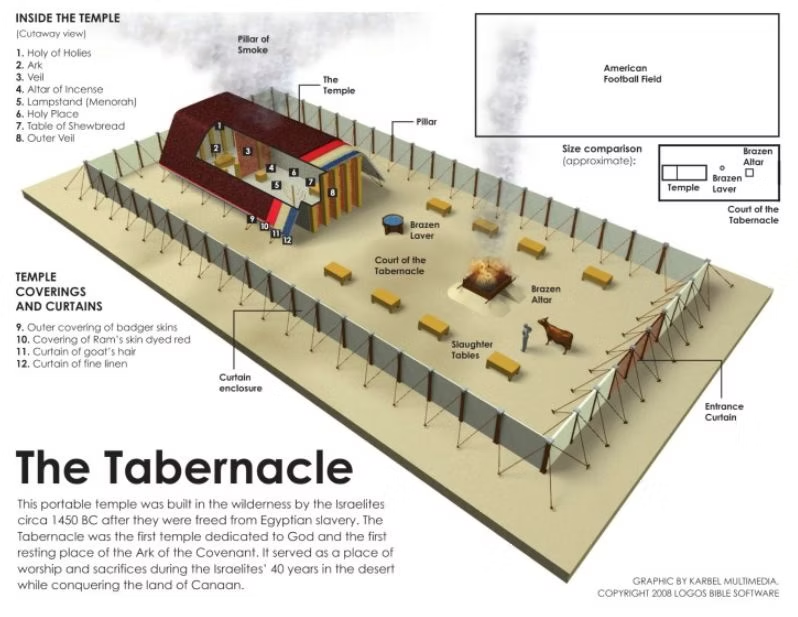
Tabernacle and Zones of Holiness
Zone 1-Holy of Holies-restricted to High Priest, one day a year
Zone 2-Holy Place-the long room inside the tabernacle where priests would go daily
Zone 3-Courtyard-place for ritually pure Israelites and priests
Zone 4-Camp-place for Israelites to live, either ritually pure or minor ritually impure
Zone 5-Ouside the camp-place for major ritual impurity, so it would not spread to
others
Redaction Analysis
Focus on how texts are brought/edited together
Exodus 4:23-27 as an example → who did God try to kill?
debate of the Neo-Assyrian Treaty
Scholars debate whether Deuteronomy more formally resembles a Hittite treaty or a Neo-Assyrian treaty
civilizations of Map of Ancient Near East: where did they live?
Egypt in Egypt; Hittites in Anatolia; Assyrians and Babylonians in Mesopotamia; Canaanites in Canaan (where Israel is now)
Northern Kingdom Kings
Key figures were Jeroboam, Omri, and Ahab
Biblicism
Forcing the Bible to address every life situation
revelation of the Name of God (YHWH)
"I AM who I AM" (burning bush)
purpose of Yom Kippur
Cleanse the space and the people so God would continue to dwell with his people
Exod 19/3 things Israel is to be: (roles) (3 of them)
My treasured possession
A Kingdom of priests
A holy nation
Early and late dates of the Exodus
Early date=1400's, built on the chronology of 1 Kings 6:1
Late date=1200's, based on archaeology which does not find occupation of biblical sites of several locations in the 1400's
Theme of book of Leviticus
Holiness
Sin and connection of the golden calf
Sin: Idolatry
Connection: Jeroboam in 1 Kings 12 and Exodus 32
God's character, in being gracious to Israel
gracious
compassionate
slow to anger
abounding in love
Burnt Offering
The most holy offering, fully devoted to God, done daily-nothing could be eaten
Grain Offering
Would accompany the burnt offering
Only could be eaten by the priests
what is the blessing in the Pentateuch connected to?
Tied to land
Two Great Sins of Israel examples
Golden calf and scouts' faithlessness
Pentateuch
five books/scrolls
Abrahamic Covenant Promises
Land, descendants, blessing
Meaning/Translation of Deuteronomy
"second law"
Documentary Hypothesis (JEDP)
J=Yahwist (preference for the name of YHWH)
E=Elohim (preference of the name of God)
D=Deuteronomy (just the book of Deuteronomy)
P=Priestly (focus on priestly concerns especially Leviticus, but also found as an editor of the entire Pentateuch, in this theory)
Division/Structure of Genesis
Chapters 1-11 (Primeval History); 12-50 (Patriarchs)
Six Parts of Ancient Near Eastern Covenant
preamble
historical prologue
stipulations
deposition
witnesses
curses/blessings
10 Commandments in Exodus vs. Deuteronomy
Sabbath:
Remember (Exodus); Observe (Deuteronomy)
The command is strengthened in Deuteronomy
Also the reason/motive for why we should Sabbath
Exodus=creation
Deuteronomy=because we were slaves in Egypt
Book of the Covenant/Covenant code
Location: Exodus 21-23.
Description: Earliest collection of covenantal laws.
Causitic- "if x..., then y..."
Date and connection of Josianic Reform
Date: 623 BC
Connection: Language aligns with Deuteronomy
Consequence of Moses Striking the Rock
Exclusion from the Promised Land
Similarities: Enuma Elish and Genesis 1-3 (themes)
Primeval waters before formal creation
Splitting the waters
Creation of Heavenly lights to determine the calendar
Man as the climax of creation
Treaty structure of Deuteronomy
Modeled after ancient treaties
Interpretations of "Us" in Genesis 1
Declarative statement-let us go do it!
Trinity-Christian reading, built on progressive revelation
Divine Council-likely how ancient Israel understood the us
 Note
Note  Flashcards (20)