Nerv Sys Cell Communication
 Call Kai
 Learn
Learn Practice Test
 Spaced Repetition
 Match
Match Flashcards
 Knowt Play
1/37

There's no tags or description
Looks like no tags are added yet.
Name | Mastery | Learn | Test | Matching | Spaced | Call with Kai |
|---|
No analytics yet
Send a link to your students to track their progress
38 Terms
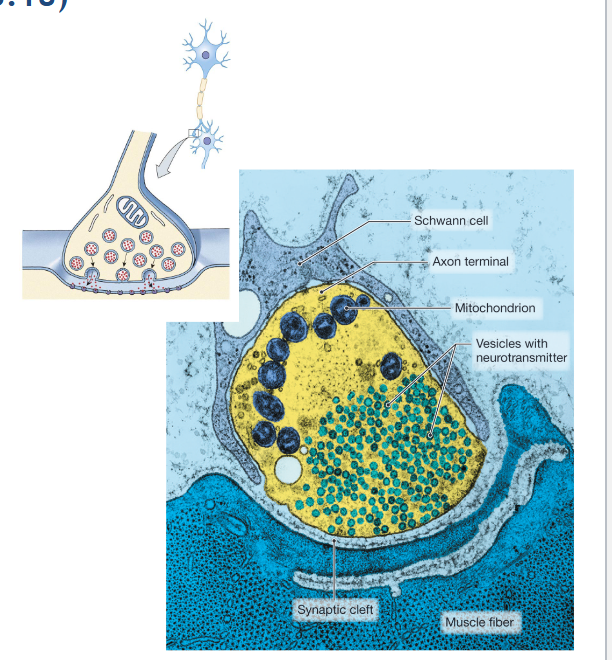
Chemical synapses
are the bridge between two neurons
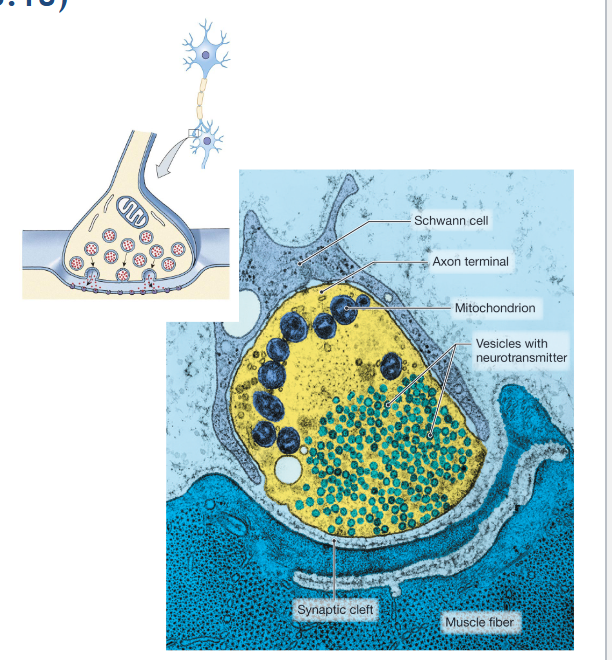
Pre-synaptic cell
action potential arrives at axon terminal
Voltage-gated Ca2+ channels open
Ca2+ influx triggers exocytosis of Neurocrine signal molecules
→ neurotransmitters, neuromodulators, neurohormones
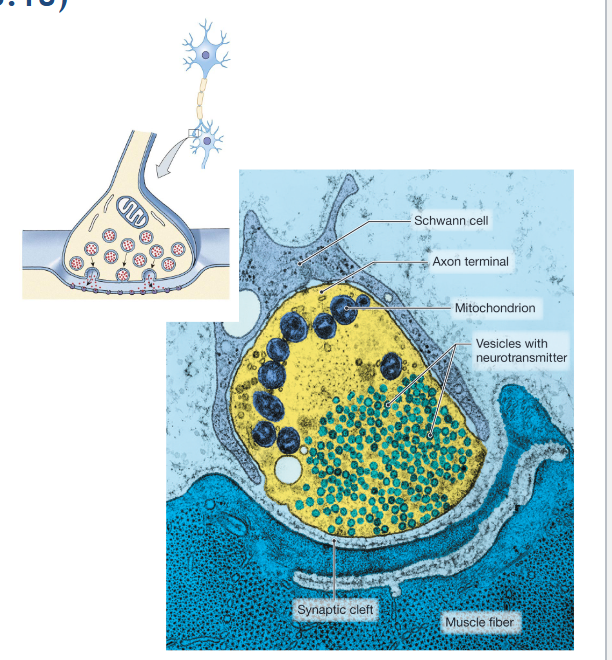
Post-synaptic
Is the target cell (another neuron [dendrites], muscle fiber, etc)
Must have receptors for the Neurocrine secreted onto it
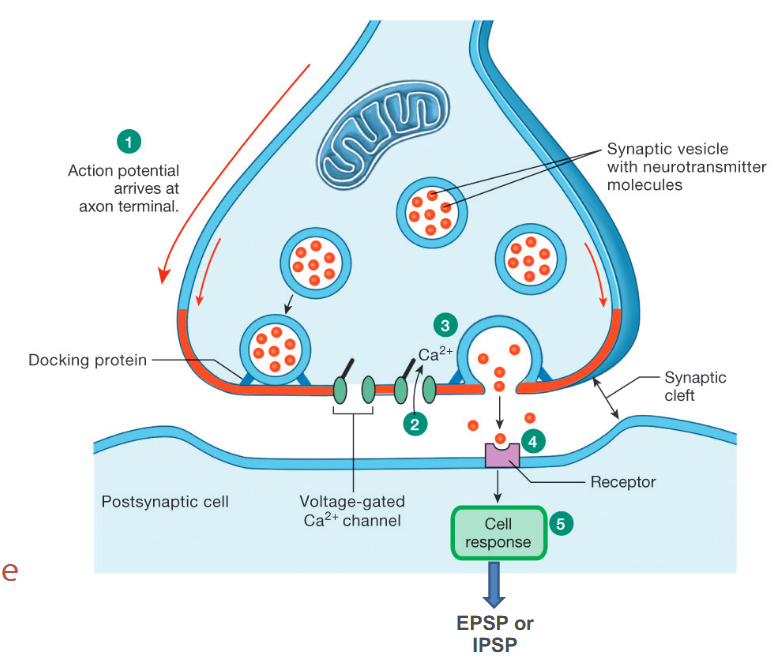
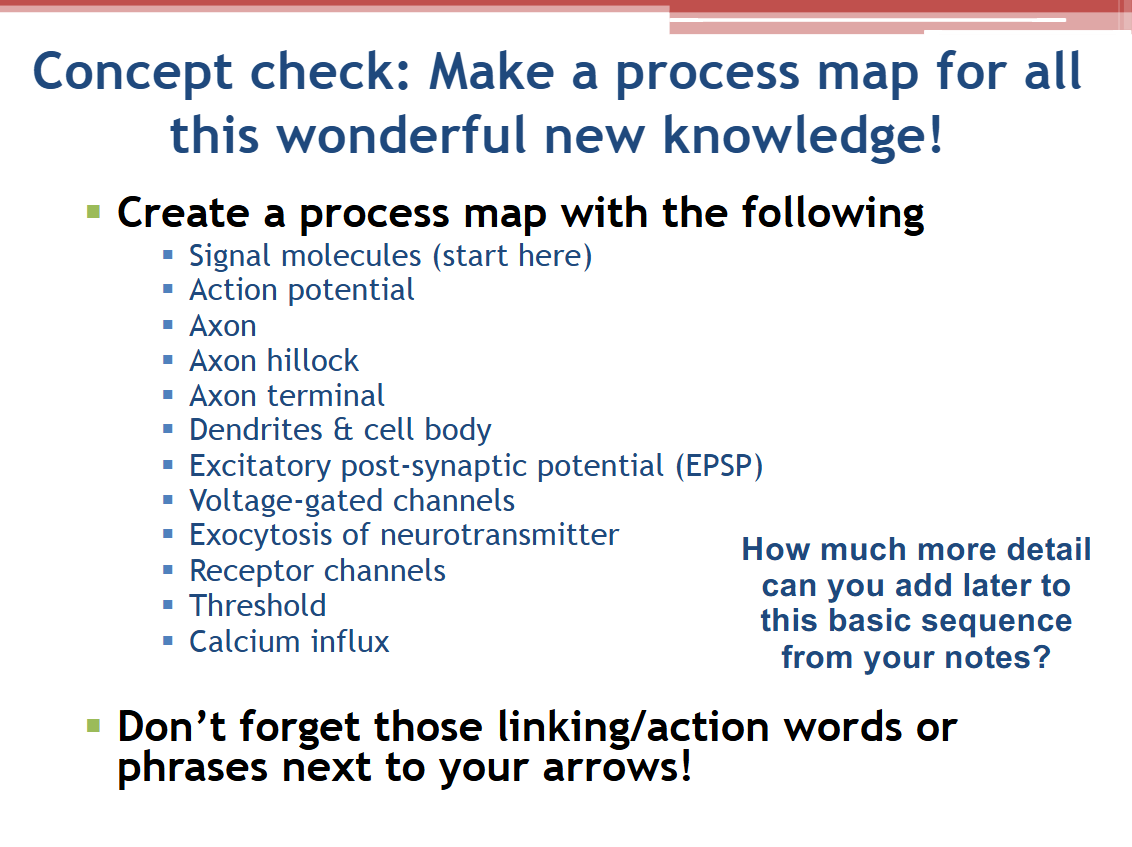
How synaptic transmission occurs
When the action potential reaches axon terminal…
Voltage gated channels of Ca++ open → Ca++ influxes → cues exocytosis of neurotransmitter → neurotransmitter crosses synapse → neurotransmitter interacts with a receptor (could be an enzyme, g-protein coupled receptor, etc) → leading to a cell response (EPSP or IPSP)
Post synaptic cell response
Neuron’s goal is to communicate w/ a target cell by sending a Neurocrine signal
The goal was to get that targe cell to change function or perform work
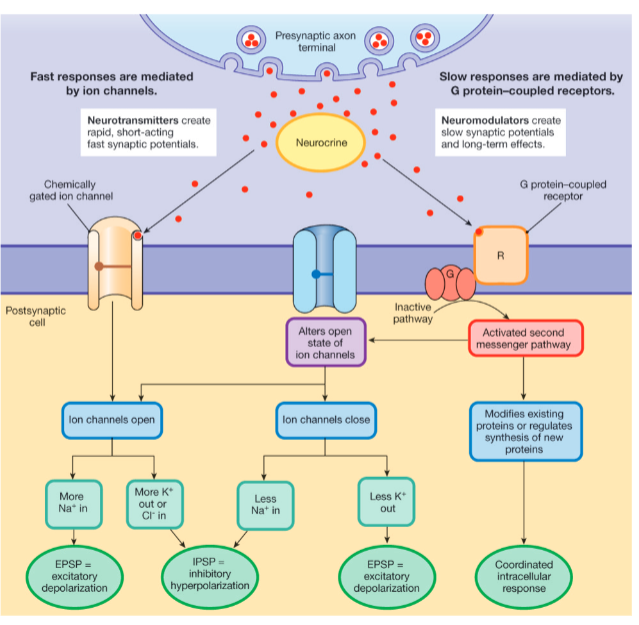
So, what happens when the signal molecule reaches an adjacent neuron or muscle cell?
that
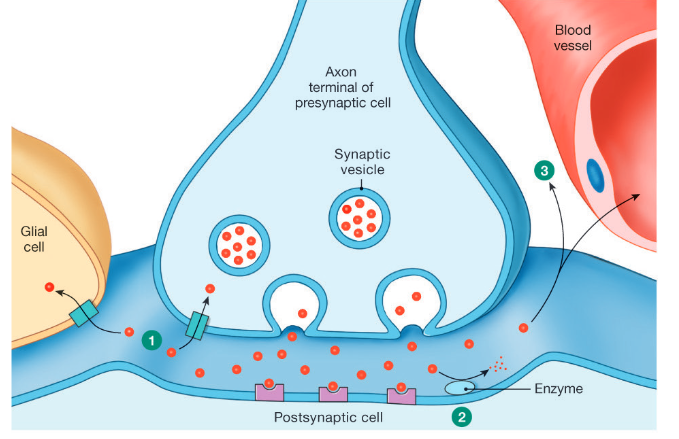
Termination of Neurocrine action
Various mechanisms!
Re-uptake by pre-synaptic cell or removal by glial cells
Inactivating enzyme
Diffusion away from site
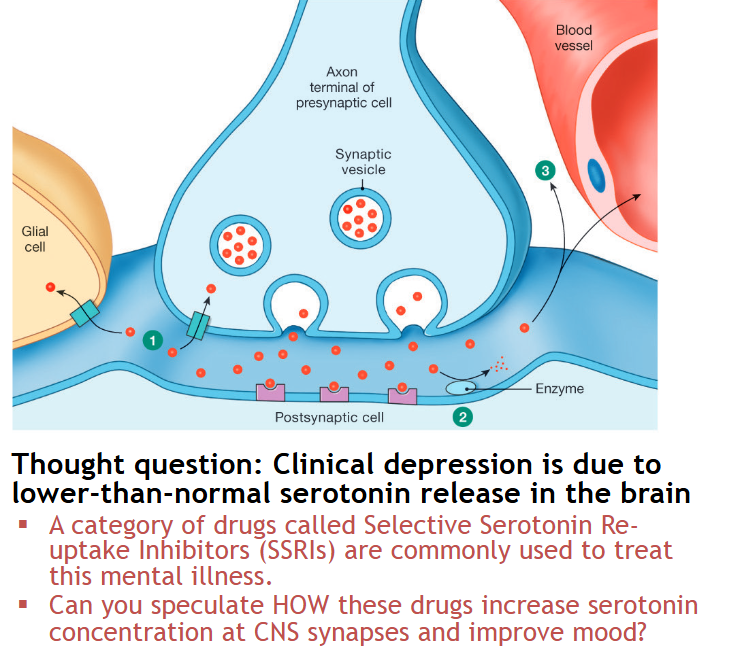
Selective Serotonin Reuptake Inhibitors (SSRIs) increase serotonin concentration at CNS synapses by blocking the serotonin transporter (SERT) protein, which inhibits the reuptake (recycling) of serotonin from the synaptic cleft back into the presynaptic neuron. This blockage causes increased serotonin availability in the synaptic cleft, strengthening neurotransmission and alleviating depressive symptoms
7 classes of Neurocrines that differ by chemical structure and function
Remember that each Neurocrine can have multiple receptors!
Acetylcholine
Monoamines
Amino acids
Purines
Gases
Peptides
Lipids
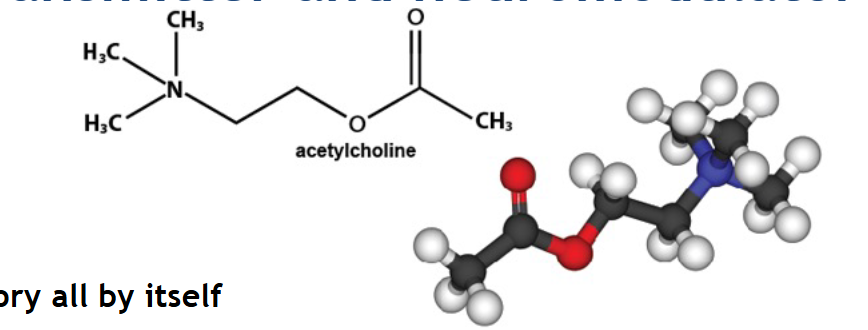
Acetylcholine (ACh) acts as both a neurotransmitter and neuromodulator
In a category all by itself
An important neurotransmitter and neuromodulator in the CNS
ALWAYS an excitatory neurotransmitter for skeletal muscles at the neuromuscular junction
Used by parasympathetic branch of ANS to control body organs
→ that influence can be excitatory or inhibitory depending on the receptor ACh binds to
Formed from acetyl CoA and choline
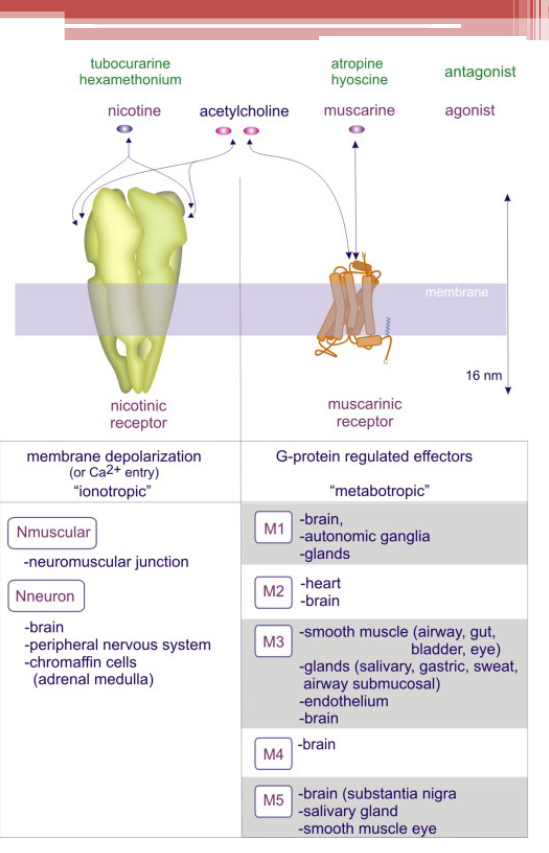
Cholinergic receptors
Remember that the specific receptor type ultimately determines the action of the target cell (depolarize and activate or hyperpolarize and inactivate)
There are 2 categories of cholinergic receptors
Their natural neurotransmitter is acetylcholine
→ Nicotinic receptors
→ Muscarinic receptors
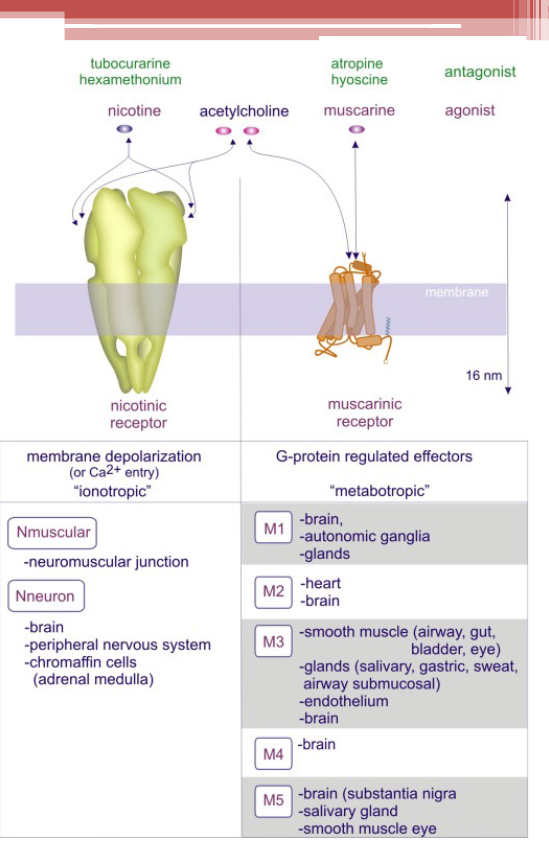
Nicotinic receptors
are located on skeletal muscle and in PNS and CNS
Two subtypes: Nm and Nn
→ nicotinic N sub M and nicotinic N sub n
both are chemically gated receptor channels
→ allow influx of Na+ and efflux of K+ (monovalent cation channels)
→ also referred to as “ionotropic” channels
Always excitatory because more Na+ influxes than K+ effluxes
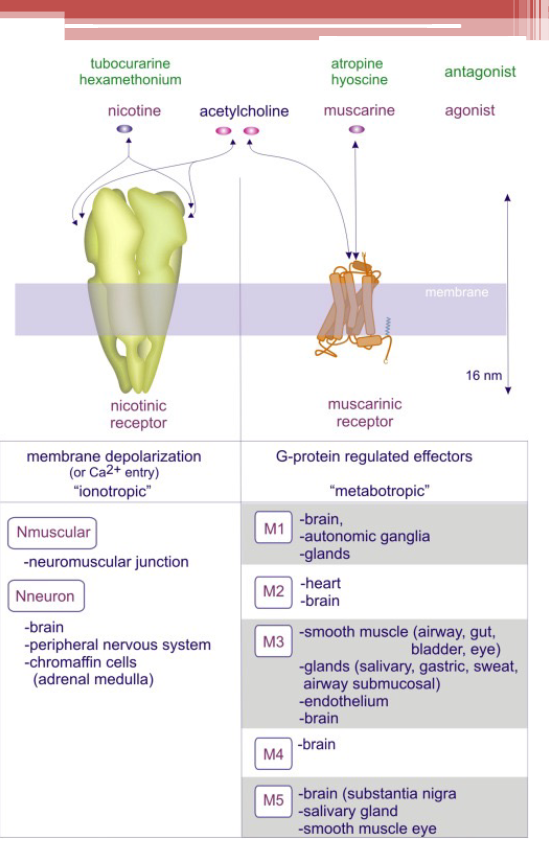
Muscarinic receptors
are located throughout the CNS and PNS
Five subtypes: M1, M2, M3, M4, M5
They are G-protein coupled receptors
Also referred to as “metabotropic” receptors
They can be excitatory or inhibitory depending on the intracellular cascade
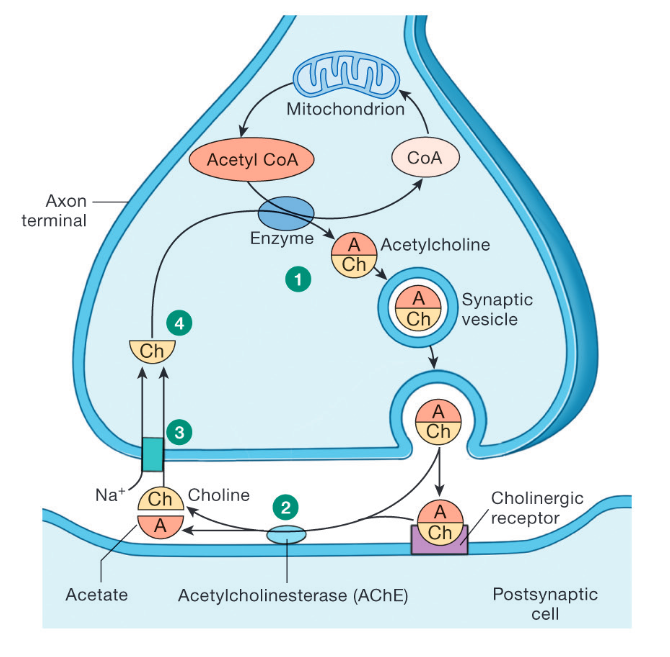
The “lifecycle” of acetylcholine
Note how ACh is synthesized
→ The enzyme that synthesizes ACh at step 1 is called choline acetyltransferase
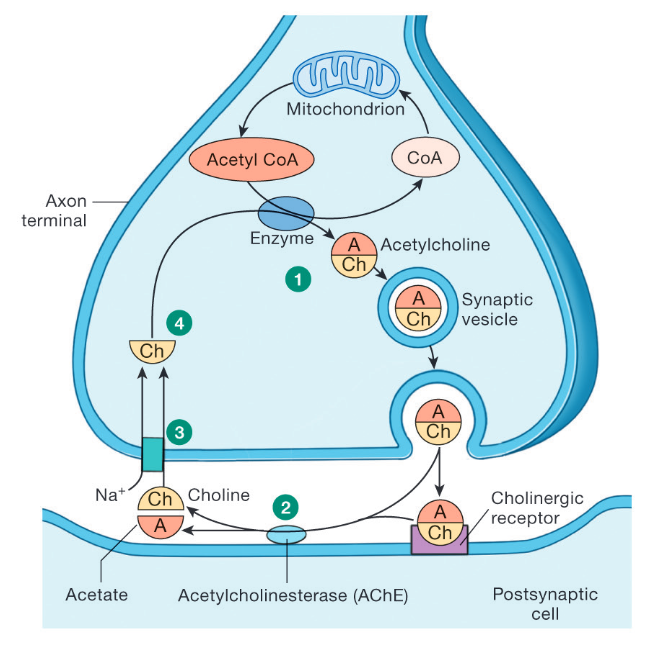
There are two types of receptors for ACh
Nicotinic - a monovalent cation channel
Muscarinic - A GPCR
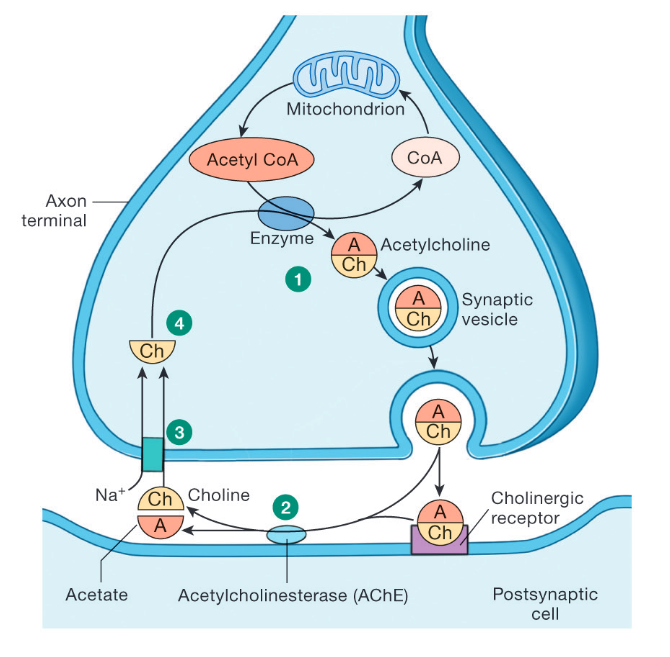
Note its inactivating enzyme in the synaptic cleft
acetylcholinesterase (AChE)
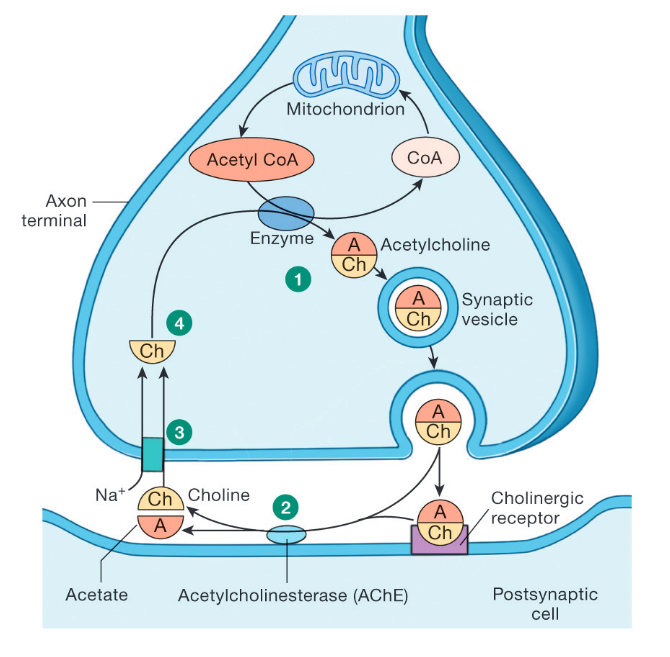
Note re-cycling of choline
symport!
Secondary active transport
Na+ going down concentration gradient, and Choline going against concentration gradient
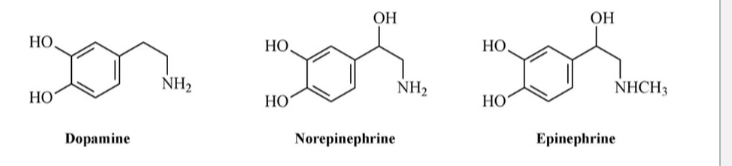
Monoamine neurotransmitters, neuromodulators, and neurohormones
this category is called “amines”
These Neurocrines are derived from single amino acids
Catecholamines: derived from the amino acid tyrosine
→ they include…
Epinephrine
Norepinephrine
Dopamine
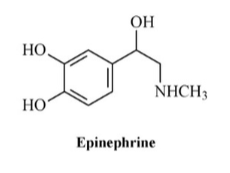
Epinephrine
ALWAYS a neurohormone, which is secreted form modified, adrenergic neurons called chromaffin cells in the adrenal medulla
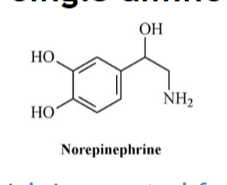
Norepinephrine
a neurotransmitter and neuromodulator secreted by noradrenergic neurons; also acts as a neurohormone when secreted from the adrenal medulla
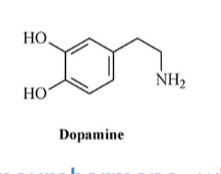
Dopamine
a neurotransmitter and neuromodulator secreted from dopaminergic neurons; also acts as a neurohormone when secreted from the adrenal medulla
Others….
Serotonin and melatonin (the indolamines) are neurotransmitters and neuromodulators made from tryptophan
Histamine is a neurotransmitter and neuromodulator made from histidine
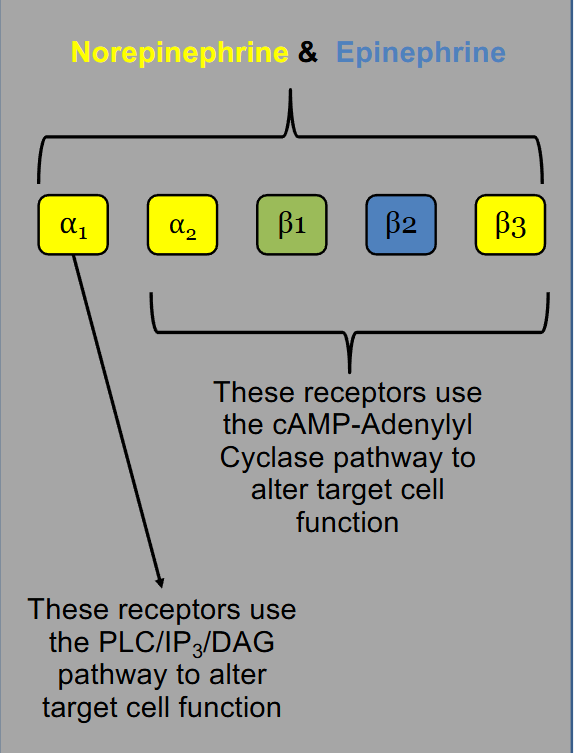
Adrenergic receptors
There are two subcategories of adrenergic receptors
Natural Neurocrines (catecholamines)
Alpha receptors + beta receptors
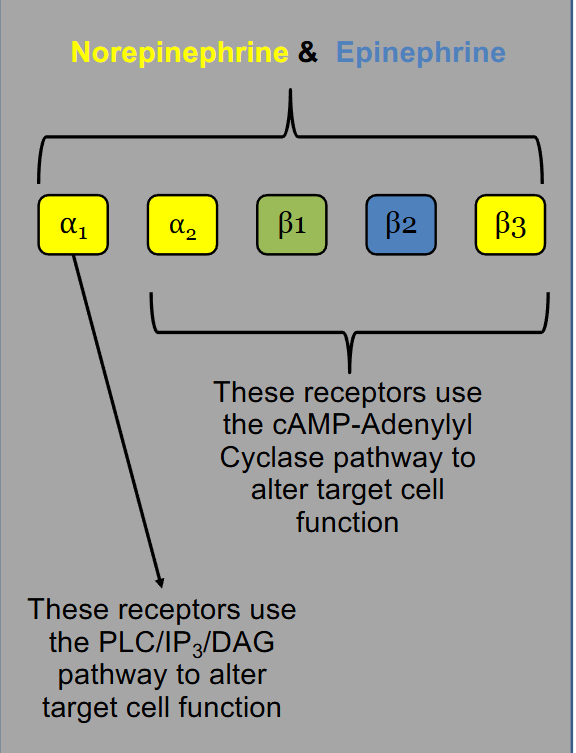
Catecholamines
norepinephrine or epinephrine can bind
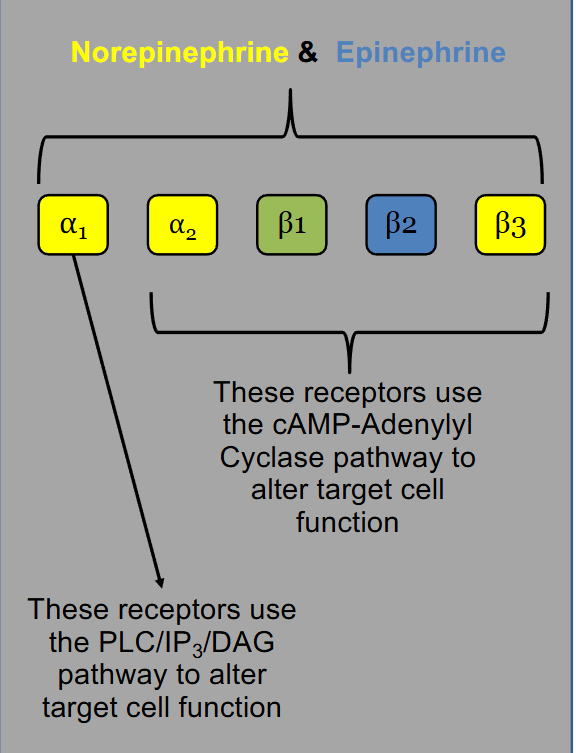
Alpha receptors and beta receptors
Alpha receptors: ⍺1 and ⍺2
Beta receptors: β1, β2, & β3
→ these receptors differ in their affinity for epinephrine and norepinephrine (indicated by the colors in the adjacent diagram)
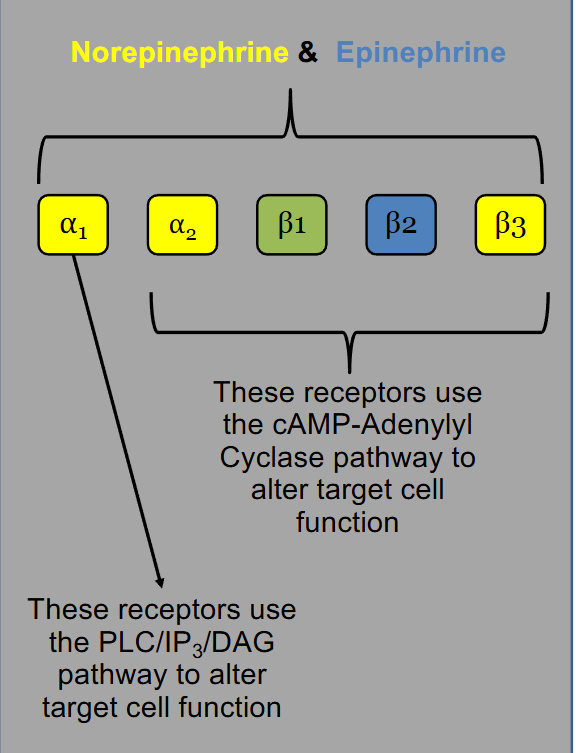
All adrenergic receptors are G-protein coupled receptors, so…
so… they too can be either excitatory or inhibitory depending on the intracellular cascade
Amino Acid neurotransmitters
Rather than being used in protein synthesis, several amino acids are packaged into secretory vesicles within neurons for release as neurotransmitters
Glutamate
Aspartate
Gamma-aminobutyric acid (GABA): Inhibitory
Glycine
Glutamine
Excitatory → Used throughout the CNS
Aspartate
Excitatory → used only in the brain
Gamma-aminobutyric acid (GABA): Inhibitory
Used only in the brain, a derivative of glutamine
-→ released in large amounts whenever u drink alc or do drgz
Glycine
Inhibitory → used only in the spinal cord
May also be excitatory in some cases
Glutamine is particularly important for…
for the strengthening of neural circuits based on how much they are used, so it is critical for learning and memory
Other neurocrines…
Peptide neurocrines
Purine neurocrines
Gas neurocrines
Lipid neurocrines
Peptide neurocrines
Substance P and opioid peptides (ex: endorphins and enkephalins)
→ part of the pain perception and pain suppression pathways in your nervous system
Vasopressin (antidiuretic hormone)
→ part of water balance
Oxytocin
→ involved in childbirth (stimulates uterine contractions) and lactation in females, along with social bonding and secxual attraction in males and females
Purine neurocrines
Adenosine, AMP, and ATP
→ these are all important neurocrines in sleep/wake cycles and attentiveness
→ caffeine blocks adenosine! keeps u awake longer
Gas neurocrines
Nitric Oxide (NO) and Carbon Monoxide (CO)
→ stimulate localized vasodilation, to bring more nutrients to and increase waste pick-up from hard-working neurons
Lipid neurocrines
Some eicosanoids are natural ligands for cannabinoid (CB1) receptors in the brain
This receptor also binds exogenous ligands like ∆9-tetrahydrocannabinoid, which is the main psychoactive ingredient in maryjane

