(BIOL) Exam 3 Review
 Call Kai
 Learn
Learn Practice Test
 Spaced Repetition
 Match
Match Flashcards
 Knowt Play
1/72

There's no tags or description
Looks like no tags are added yet.
Name | Mastery | Learn | Test | Matching | Spaced | Call with Kai |
|---|
No analytics yet
Send a link to your students to track their progress
73 Terms
Which of the following clues would tell you if a cell is prokaryotic or eukaryotic?
whether or not the cell is generally partitioned by internal membranes
Which structure is common to plant and animal cells?
mitochondrion
Which one of the following statements about the endomembrane system is correct?
Proteins that will be secreted from the cell are likely to be found in closed spaces bounded by membranes of the endomembrane system.
*Proteins that will be secreted are always enclosed by some membrane of the endomembrane system until they are secreted
A cell has formed a food vacuole as it ingested a food particle. Which of the following events is associated with the breakdown of that food particle?
digestion of the food particle occurs in a vesicle enclosed by a membrane that separates the digestion from the cytoplasm
*Digestion occurs within a vesicle. If the digestive enzymes were in the cytosol, they might degrade essential components of the cell*
Identify the correct statement about differences between rough and smooth endoplasmic reticulum (ER)
The outer surface of smooth ER lacks ribosomes, whereas the outer surface of rough ER has ribosomes.
Mitochondria are found in __________.
plant and animal cells
Select the correct statement describing cellular structure or function.
Plant and animal cells both carry out cellular respiration, producing ATP.
The cilia and flagella of eukaryotic cells are composed of _____.
microtubules
Choose the best description of the cell cytoskeleton
The cell cytoskeleton is a dynamic network of fibers that can be quickly dismantled and reassembled to change cell shape and the position of cell components.
Which of these cell junctions form a barrier to the passage of materials?
tight junctions
The primary role of _____ is to bind animal cells together.
desmosomes
_____ aid in the coordination of the activities of adjacent animal cells.
Gap (communicating) junctions
Suppose you discover a large protein (19 nm in diameter) that is synthesized in the cytoplasm and is transported into the nucleus as needed by the cell. Which of the following would be large enough to facilitate transporting this protein into the nucleus?
nuclear pore
Membranes facilitate the production of ATP by separating an area with high H+ concentration from an area of low H+ concentration. When exploring this cell in the Interactive Visual Activity, where did you find ATP synthase embedded in a membrane?
mitochondria and chloroplast
Which of the following proteins in a plant cell transports substances or conducts signals across the plasma membrane?
aquaporin, proton pump, and calcium channel
Cell junctions in plant cells are called __________, and communicating junctions in animal cells are called __________
plasmodesmata; gap junctions
The function of the rough endoplasmic reticulum (RER) is __________.
to synthesize proteins that are secreted as glycoproteins
Evidence that supports the prokaryotic origins of mitochondria and chloroplasts are all of the following except __________
that mitochondria and chloroplasts have multiple copies of linear DNA molecules associated with their inner membranes
True or False: There is evidence that the ancestral engulfed prokaryotes had two outer membranes, which became the double membranes of mitochondria and chloroplasts
True - (the prokaryotes eaten did have two outer membranes)
Which statement about the cytoskeleton is true?
Components of the cytoskeleton often mediate the movement of organelles within the cytoplasm.
You would expect a cell with an extensive Golgi apparatus to __________.
secrete a lot of protein
*After leaving the ER, many transport vesicles travel to the Golgi apparatus. We can think of the Golgi as a warehouse for receiving, sorting, shipping, and even some manufacturing. Here, products of the ER, such as proteins, are modified and stored and then sent to other destinations. Not surprisingly, the Golgi apparatus is especially extensive in cells specialized for secretion.
The organelle that is a plant cell’s compartment for the storage of inorganic ions such as potassium and chloride is the __________.
central vacuole
Which of the following groups is primarily involved in synthesizing molecules needed by the cell?
Ribosomes, rough endoplasmic reticulum, and smooth endoplasmic reticulum
A protein that ultimately functions in the plasma membrane of a cell is most likely to have been synthesized __________.
in the rough endoplasmic reticulum
Your intestine is lined with individual cells. No fluids leak between these cells from the gut into your body. Why?
The intestinal cells are bound together by tight junctions.
__________ are membrane-bound metabolic compartments that specialize in the production of hydrogen peroxide (H2O2) and its conversion to water
peroxisomes
Which of the following is false in respect to cells' chromosomes?
Chromosomes are only visible as a cell is about to divide. *they’re visible, you just can’t tell them apart
Cell motility, which includes changes both in cell location and in the movement of cell parts, requires interactions of the cytoskeleton __________.
with motor proteins
The extracellular matrix of the animal cell has all of the following molecular components except __________
a middle lamella
The region of a bacterial cell that contains the genetic material is called the __________.
nuceloid
Cilia and flagella move due to the interaction of the cytoskeleton with which of the following?
motor proteins
Observing a fluorescent micrograph cell with intermediate filaments would help you identify the cell as a __________
human skin cell
Microfilaments function in cell motility including __________.
muscle contraction, amoeboid movement, and cytoplasmic streaming in plants
Basal bodies are most closely associated with which of the following cell components?
Cilia
Animal cells have unique organelles called __________ that are composed of structures called __________.
centrosomes; centrioles
The network of fibers that organizes structures and activities in a cell __________.
the cytoskeleton
The endoplasmic reticulum is part of the endomembrane system, which also includes the __________.
nuclear envelope, the Golgi apparatus, lysosomes, and vesicles
What is the functional connection between the nucleolus, nuclear pores, and the nuclear membrane?
Subunits of ribosomes are assembled in the nucleolus and pass through the nuclear membrane via the nuclear pores.
The walls of plant cells are largely composed of polysaccharides and proteins that are synthesized __________.
in the rough endoplasmic reticulum and in the Golgi apparatus
*Most secretory proteins are glycoproteins, proteins that have carbohydrates covalently bonded to them. The carbohydrates are attached to the proteins in the ER by enzymes built into the ER membrane. Products of the endoplasmic reticulum are usually modified during their transit from the cis region to the trans region of the Golgi apparatus. For example, glycoproteins formed in the ER have their carbohydrates modified, first in the ER itself, then as they pass through the Golgi. The Golgi removes some sugar monomers and substitutes others, producing a large variety of carbohydrates. Membrane phospholipids may also be altered in the Golgi
Which of the following pathways would a protein destined for the interior of the nucleus follow?
The protein is translated on free ribosomes and then passes through the pore complex to enter the nucleus.
*Proteins that function in the nucleus, such as DNA polymerase, are synthesized by free ribosomes in the cytoplasm. The completed proteins then enter the nucleus through nuclear pores
Which of the following proteins are synthesized by bound ribosomes?
insulin, lysosomal enzymes, ER protein
*Most proteins that function in the cytosol (such as actin) or in the nucleus (such as DNA polymerase) are synthesized by free ribosomes. Proteins that function within the endomembrane system (such as lysosomal enzymes) or those that are destined for secretion from the cell (such as insulin) are synthesized by bound ribosomes. As a protein destined for the endomembrane system is being synthesized by a ribosome, the first amino acids in the growing polypeptide chain act as a signal sequence. That signal sequence ensures that the ribosome binds to the outer membrane of the ER and that the protein enters the ER lumen.
Proteins that are secreted from a eukaryotic cell must first travel through the endomembrane system. What is their pathway?
ER —> cis Golgi —> medial Golgi —> trans golgi —> plasma membrane —> extracellular
*As they are being synthesized, secretory proteins enter the lumen of the endoplasmic reticulum. From the ER, vesicles transport these proteins to the Golgi, where they are sequentially modified and concentrated in a cis-to-trans direction. Secretory vesicles bud from the Golgi and move along cytoskeletal filaments to eventually fuse with the plasma membrane, secreting their protein cargo. Each of these transport steps requires specialized proteins to ensure that the cargo is sent to the proper location and is able to fuse with the target membrane.
Motor proteins are responsible for moving vesicles and organelles within the cell. Motor proteins move along protein "tracks." In the example shown in the Visualizing figure, what are those tracks made of?
actin
Which molecules and cellular components pass through the nuclear pore during normal cellular activity?
ribosomal subunits and mRNA
Which of the following statements is true regarding potential energy?
Potential energy is the energy possessed by matter due to its location or structure.
Which of the following best describes the structure of a biological membrane?
two layers of phospholipids, with proteins either crossing the layers or on the surface of the layers
In what way do the membranes of a eukaryotic cell vary?
Certain proteins are unique to each membrane.
The permeability of a biological membrane to a specific polar solute may depend on which of the following?
the types of transport proteins in the membrane
Which of the following statements about the conditions shown in the U-shaped tube are true?
There is less free water in the right arm of the tube than in the left arm of the tube
Water is tightly clustered around the hydrophilic solute molecules on both sides of the membrane
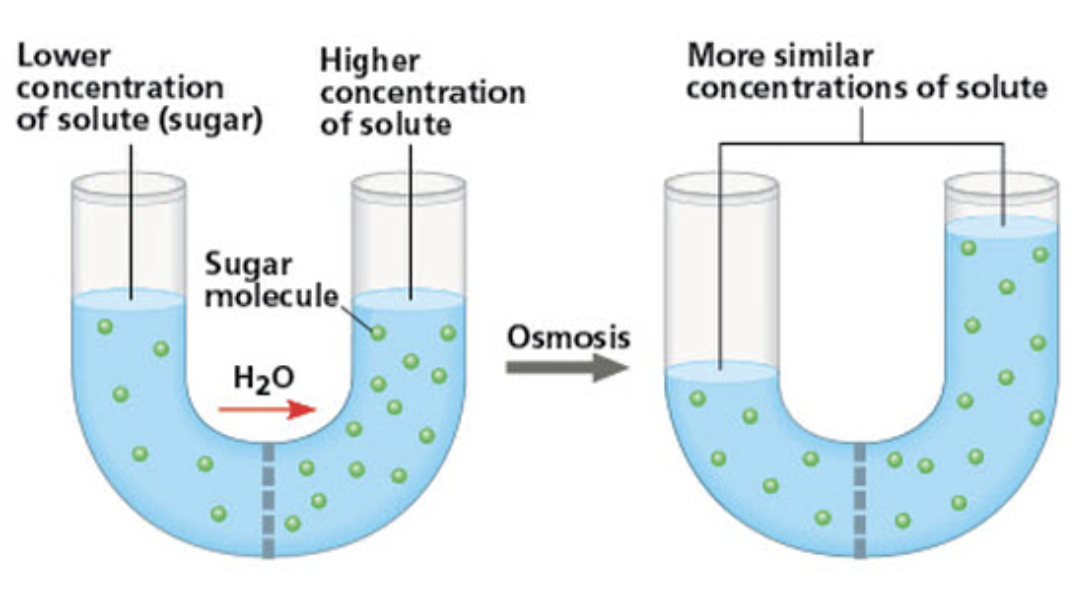
If the pores in the selectively permeable membrane became larger, but still not large enough to let the sugar pass through, what would happen during osmosis in the U-shaped tube compared to what is shown in the figure?
The final water levels would be the same as shown in the figure, but the solutions would reach near equal concentrations faster.
Which of the following statements about osmosis is correct?
The presence of aquaporins (proteins that form water channels in the membrane) speeds up the process of osmosis.
Active and passive transport of solutes across a membrane typically differ in which of the following ways?
Active transport always involves the utilization of cellular energy, whereas passive transport does not require cellular energy.
The movement of glucose into a cell against its concentration gradient is most likely to be accomplished by which of the following?
cotransport of the glucose with a proton or sodium ion that was pumped across the membrane using the energy of ATP hydrolysis
Endocytosis moves materials _____ a cell via _____.
into ... membranous vesicles
You can recognize the process of pinocytosis when _____.
the cell is engulfing extracellular fluid
A white blood cell engulfing a bacterium is an example of _____
phagocytosis
Which of the following statements correctly describes some aspect of exocytosis or endocytosis?
Exocytosis and endocytosis change the surface area of the plasma membrane.
Cells A and B are the same size, shape, and temperature, but cell A is metabolically less active than cell B; cell B is actively converting oxygen to water in cellular respiration. Oxygen will diffuse more rapidly into cell __________ because __________
B; the diffusion gradient in cell B is steeper
How does cholesterol affect membrane fluidity?
At body temperature, it makes the membrane less fluid.
Which of the following is correct regarding integral proteins?
These proteins exhibit both hydrophilic and hydrophobic properties
Which of the following is a correct difference between active transport and facilitated diffusion?
Active transport requires energy from ATP, and facilitated diffusion does not.
Which of the following processes and organelle(s) accounts for the replacement of lipids and proteins lost from the plasma membrane?
Exocytosis and smooth and rough ER
Which of the following structural arrangements of the components in biological membranes facilitates the cell membrane's property of selective permeability?
Proteins embedded in two layers of phospholipids
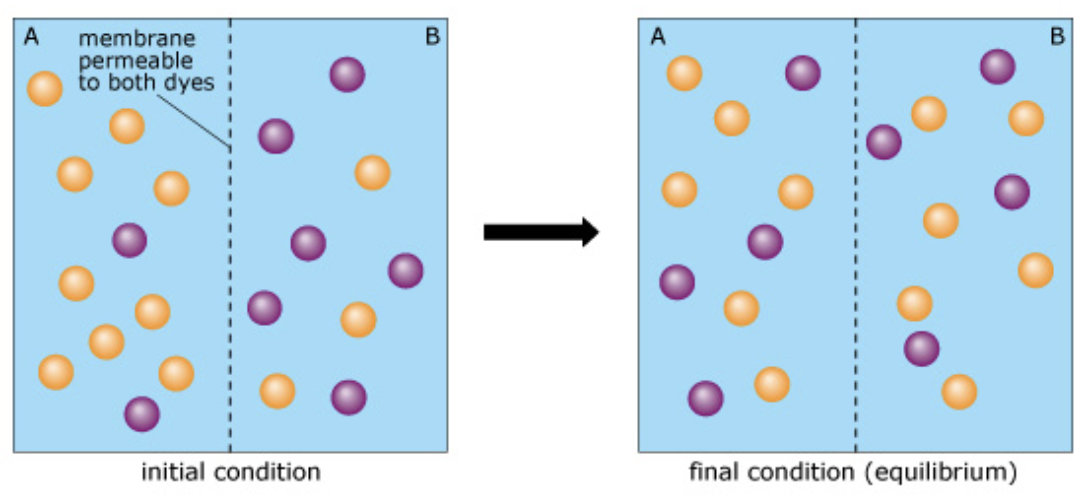
When is this true? Orange dye moves independently of the purple dye
Always
*Each solute moves down its own concentration gradient regardless of other substances present
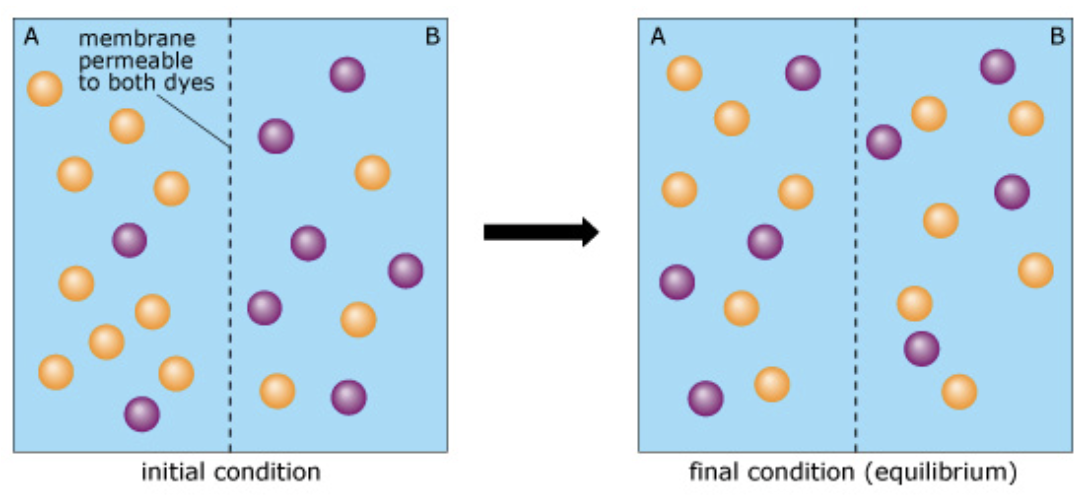
When is this true? Concentration gradients exist that drive the diffusion gradient
Only before equilibrium is reached
*By definition, equilibrium is the point where the concentration is equal on both sides and the gradient no longer exists
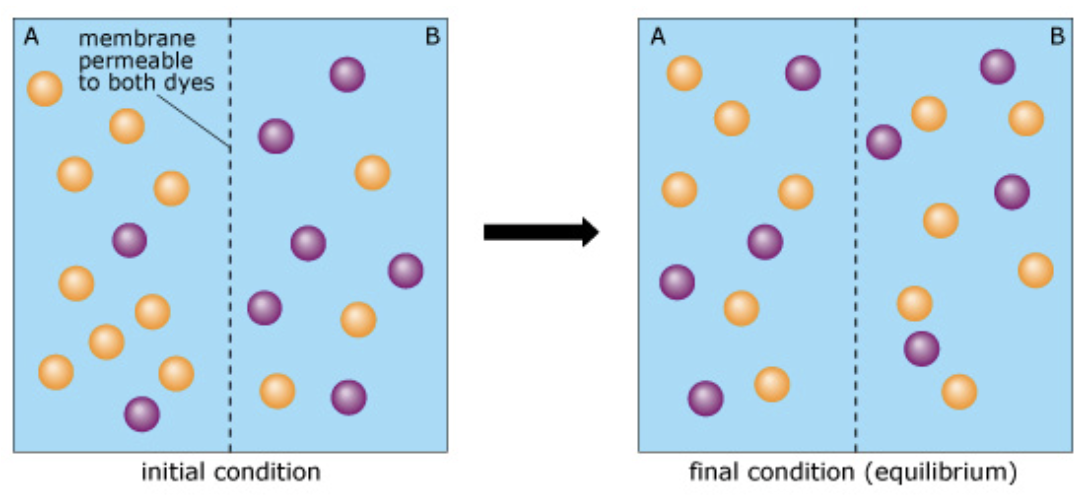
When is this true? There is a net movement of orange dye from side A to side B.
Only before equilibrium is reached
*"Net movement" only happens when there is a gradient. At equilibrium, movement happens equally in both directions, so the net change is zero.
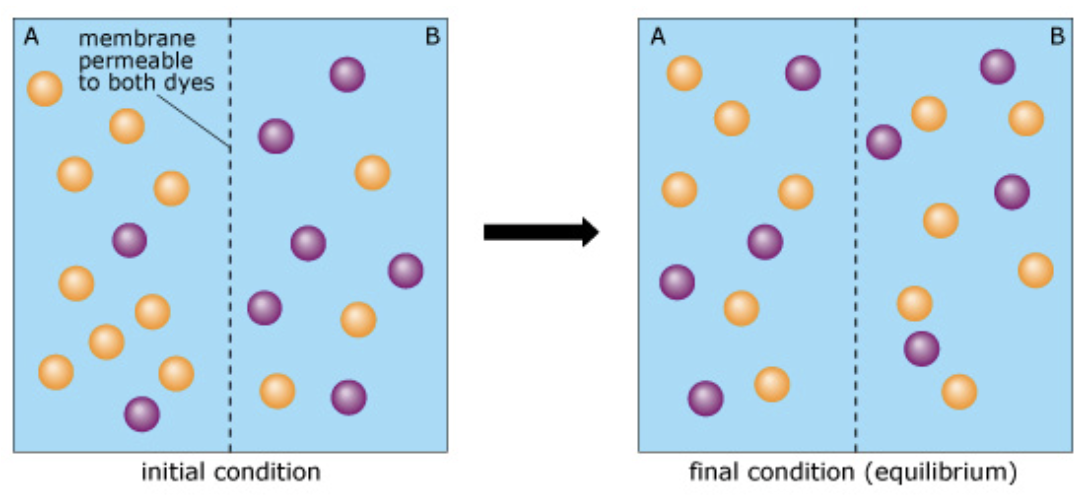
When is this true? Purple dye moves only from side B to side A
Never
*Molecules are in constant, random motion. Even if the net flow is toward side A, individual molecules will still move from A to B
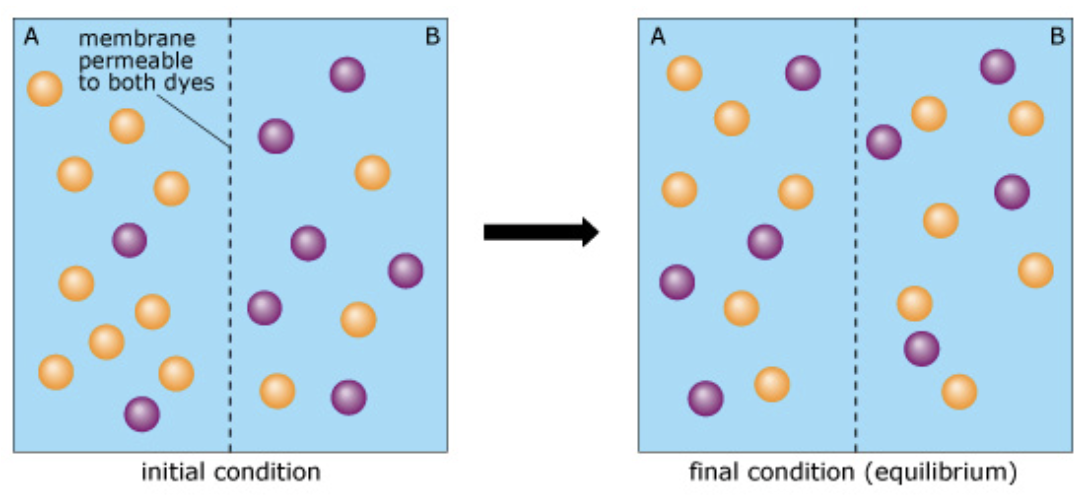
When is this true? There is no net movement of purple dye.
Only at equilibrium
*This is the state of dynamic equilibrium: molecules move back and forth at the same rate, resulting in no overall change in concentration
Which of the following molecules can cross the lipid bilayer of a membrane directly, without a transport protein or other mechanism? Select all that apply
CO2, O2, water, sucrose, ions, proteins, lipids
CO2, O2, water, lipids
*Small nonpolar (hydrophobic) molecules, such as dissolved gases (O2, CO2, N2) and small lipids, can pass directly through the membrane. They do so by interacting directly with the hydrophobic interior of the lipid bilayer. Very small polar molecules such as water and glycerol can pass directly through the membrane, but much more slowly than small nonpolar molecules. The mechanism that permits small polar molecules to cross the hydrophobic interior of the lipid bilayer is not completely understood, but it must involve the molecules squeezing between the hydrophobic tails of the lipids that make up the bilayer.
What is the permeability of polar molecules, small nonpolar molecules, large molecules, ions?
For large polar molecules, it is very limits
Small polar molecules can pass, but very slowly
Small nonpolar molecules can pass through readily because they interact with the hydrophobic interior
Large molecules, like proteins, cannot pass
Ions and charged molecules are impermeable because they are more soluble in water than in the interior of the membrane
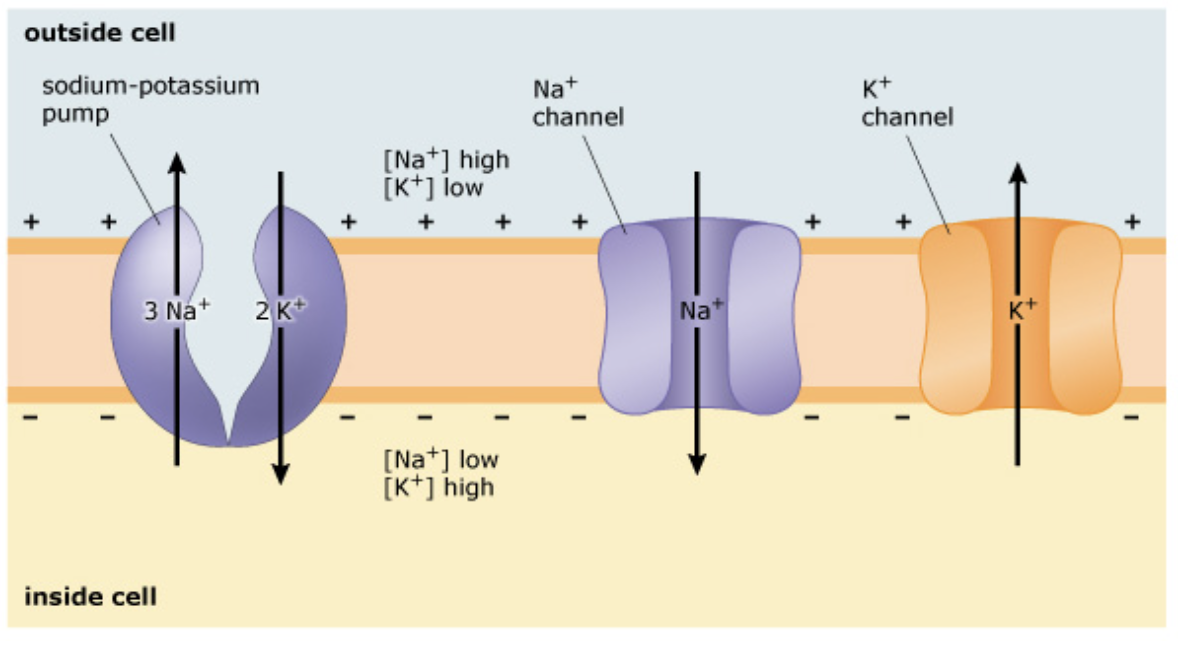
Which of the following statements correctly describe(s) the driving forces for diffusion of Na+ and K+ ions through their respective channels? Select all that apply
The diffusion of Na+ ions into the cell is facilitated by the Na+ concentration gradient across the plasma membrane
The diffusion of Na+ ions into the cell is impeded by the electrical gradient across the plasma membrane
The diffusion of K+ ions out of the cell is impeded by the K+ concentration gradient across the plasma membrane
The diffusion of K+ ions out of the cell is impeded by the electrical gradient across the plasma membrane
The electrochemical gradient is larger for Na+ than for K+.
The diffusion of Na+ ions into the cell is facilitated by the Na+ concentration gradient across the plasma membrane
The diffusion of K+ ions out of the cell is impeded by the K+ concentration gradient across the plasma membrane
The electrochemical gradient is larger for Na+ than for K+.
Which statements about the fluid mosaic structure of a membrane are correct? Select the three correct statements.
The diverse proteins found in and attached to membranes perform many important functions
The kinky tails of some proteins help keep the membrane fluid by preventing the component molecules from packing solidly together.
Membranes include a mosaic, or mix, of carbohydrates embedded in a phospholipid bilayer.
The framework of a membrane is a bilayer of phospholipids with their hydrophilic heads facing the aqueous environment inside and outside of the cell and their hydrophobic tails clustered in the center.
Because membranes are fluid, membrane proteins and phospholipids can drift about in the membrane.
The diverse proteins found in and attached to membranes perform many important functions
The framework of a membrane is a bilayer of phospholipids with their hydrophilic heads facing the aqueous environment inside and outside of the cell and their hydrophobic tails clustered in the center.
Because membranes are fluid, membrane proteins and phospholipids can drift about in the membrane.
Which of the following would be a factor that determines whether the molecule selectively enters the target cells?
the nonpolar, hydrophobic nature of the drug molecule
the phospholipid composition of the target cells' plasma membrane
the concentration of the drug molecule that is transported in the blood
the similarity of the drug molecule to other molecules that are transported into the target cells
The similarity of the drug molecule to other molecules that are transported into the target cells
*If the target cells have transport proteins that specifically bind to certain molecules, they may bind with and transport a drug that is similar in structure.

