Motivation and Emotion unit 2
 Studied by 0 people
 Call with Kai
 Learn
Learn Practice Test
 Spaced Repetition
 Match
Match Flashcards
 Knowt Play
1/33

Earn XP
Description and Tags
main aspects involved in motivation
Name | Mastery | Learn | Test | Matching | Spaced | Call with Kai |
|---|
No study sessions yet.
34 Terms
what did Plato say about motivation? 1 pt
motivation flows from a hierarchally arranged soul containing three aspects:
appetitve aspect- bodily appetites and desires such as hunger and sex
competitive aspect- social standards e.g. feeling honoured or shamed
calculating aspect- reason and choosing
what did Aristotle say about motivation? 1 pt
endoreses plato’s structure but uses other terminology:
nutritive aspect (appetitive)- impulve and irrational
sensitive aspect (competitive)- bodily related and regulates pain and pleasure
rational concept- unique to humans, intellectually related
what did Descartes add to the mind-body dualism? 2 pts
body- a mechanical and motivationally passive agents that responds to the environment through senses, reflexes and physiology
mind- inmaterial and motivationally active agent; a spiritual thinking entitity that possesses a purposive will
what is will? 1 pt
Will = Choosing + Striving + Resistance
was found to be too difficult and mysterious as an explanation for motivation
led to the appearance of the motivational principle-insitinct
what is Darwin’s biological determinism theory? 1 pt
behaviors are primarily shaped by genetics and biology rather then environmental factors
what is the Man-Animal dualism theory? 1 pt
the human-mind and human-body are 2 distinct entities unlike with animals that are viewed as lacking a conscious
Instincts according to Darwin
arise from a physical substance
express themselves through inherited bodily reflexes given the appropriate stimulus
what were the reasons fo the decline of instincts? 3 pts
lists of instincts grew to over 6000
underlying theory was exposed to be circulated; instincts cause behavior but behavior is evidence of instincts
when 2 similar animals are raised with differnt life expereinces instincts do not leas to similar behaviors
characteristics of drive? 5 pts
brought as a replacement for instincts
drive’s source- biological urge/bodily deficit
drive’s impetus- intensity of the bodily deficit grows and provokes discomfort
drive’s object- seeking to reduce anxiety and satisfy the deficit
drive’s aim- if the object satsfies the deficit satisfaction occurs
what is Hull’s drive theory?
states that motication has a purely physiological basis
predicts motivation before it occurs
when responses are followed by a reduction in drive learning occurs and the specifc habit is reinforced
motivation is calculated from 0-1

what is evidence against Hull’s drive theory? 3 pts
some motives arise without biological needs
research acknowledges external motivators of behavior
learning often occurs without an corresponding experience of drive reduction
what are the contemporary theories of motivation?6 pts
humanistic theory- maslow
two factory theory- herzberg
self-efficacy- bandura
goal-setting theory
attribution theory- weiner
expectancy theory- vroom
Humanistic theory, Maslow (1954)
posits a hierarchy of human needs based on deficiency needs and growth needs
each lower need must be met before progressing to the next level
criticisms:
some individuals may strive for self-actualization without satisfying lower needs
no causal relationship between needs and behavior has been established
two-factor theory, Herzbery
proposed that job satisfaction and dissatisfaction arise from 2 different sets of factors rather than from opposite ends of a single continuum:
motivators/intrinsic factors- responsibilities, recognition, growth opportunities, and achievement
hygiene/ extrinsic factors- company policies (salaries, facilities), work conditions (temp, environment), and quality of supervision in relation to others
he found that motivator (intrinsic) factors increased job satisfaction while hygiene (extrinsic) factors cause job dissatisfaction
a lack of job satisfaction =/= job dissatisfaction
criticisms of Herzbergs two factor theory? 3 pts
focuses more on job satisfaction then motivation as their relationship was not analysed and only assumed to be strong
no overall assessment of satisfaction
is salary a motivator factor or hygiene factor
what is self-efficacy according to bandura? 1 pt
belief in one’s capacity to succeed at tasks based on the skills possessed and the circumstances faced
self-efficacy (global) =/= self-esteem/ability (specific)
what is doubt? 1 pt
the opposite of self-efficacy as it undermines our confidence in out ability to cope leading to surprises, setback, and difficulties that result in anxiety, confusion, bodily tension etc
what are the requirements of competent functioning? 2 pts
possessing skills i.e. ability
the capacity to translate skills into effective performance
example: planning something requires creativity
importance of self-efficacy vs self-esteem/ability in determining competent functioning? 1 pt
self-efficacy and ability are equally important in determining competent functioning because performance situations are often stressful, ambiguous, and unpredictable with circumstances continually changing
factors that lead to the development of self-efficacy? 4 pts
enactive mastery- learning from one’s own direct experiences of success/failure; choice approximation vs avoidance
vicarious experiences- forming beliefs about one’s ability by observing others expecially those similar to ourselves e.g. self-modelling; effort and persistence
verbal persuasion- the influence of feedback, encouragement, or discouragement from others; thought/decision making
physiological arousal- interpreting one’s bodily and emotional states as signs of competence of incompetence; emotional reactions e.g. anxiety
NB: self-fullfilling prophecy can also affect the development of self-efficacy
what is self-modelling? 1 pt
a form of vicarious learning where the person learns by observing themselves perform a behavior successfully; you are your own model e.g. through videos of them succeeding at something
what is competence? 1 pt
sheer desire and intrinsic motivation to challenge onesself for the spontaneous satisfaction the activity brings
similar to self-efficacy but are NOT interchangeable
what are the building blocks of self-efficacy? 1 pt
efficacy expectations
what are the building blocks of learned helplessness? 1 pt
expectation outcomes
characteristics of learned helplessness? 5 pts
a person experiencing this perceives factors outside their control as the determinants of outcomes rather than their own behavior
a learned response
aversive effects on our motivation- decreased willingness to try because what’s the point
aversive effects on our learning- interferes with one’s abilities to learn new response-outcome contingencies
aversive effects on our emotions- belief that nothing can be done about one’s situation cause energy-depleting emotions (depression) to appear more than energy-mobilizing ones (fear)
characteristics of goal-setting theory
A. discrepancy can be understood in 2 ways:
reduction of discrepancy- involves the information provided by the environment about the alignment between the current and desired state
creation of discrepancy- based on a straighforward system where the person looks ahead and sets higher goals
B. TOTE model:
Test- compare present state with ideal state
Operate- act on environment to get the ideal state
Test- compare present state with the ideal state
Exit- present state in congruity with ideal state
C. Goal difficulty, energises behavior:
difficult goals stimulate high efforts leading to linear increases in performance
they enhance persistence causing individuals to work longer and improve their performance
contributes to enhanced performance
D. Goal specificity, directs behavior:
increases attention and focus
increases planning and speed of working
increases direction
contributes to enhanced performance
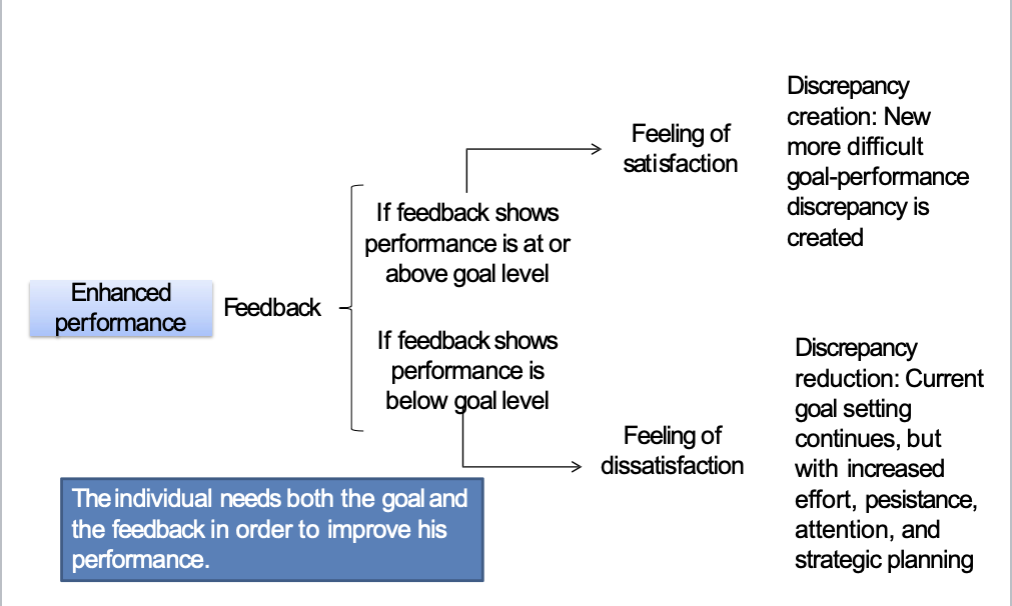
E. Enhanced performance:
if feedback shows performance is at or above goal level → feeling of satisfaction → discrepancy creation
if feedback shows performance is at or below goal level →feeling of dissatisfaction → discrepancy reductionn
when is goal acceptance high? 4 pts
goals are easy to moderately difficult
goals are self-set and not forced on you
goals are assigned by credible people
goals promise forthcoming personal benefits
criticisms of goal setting?
primary purpose is to enhance performance not necessarily motivation
most effective when tasks are uninteresting or straighforward otherwise does not enhance performance
associated with stress, opportunity of failure, and risks surrounding creativity and intrinsic motivation
characteristics of weiner’s attribution theory?
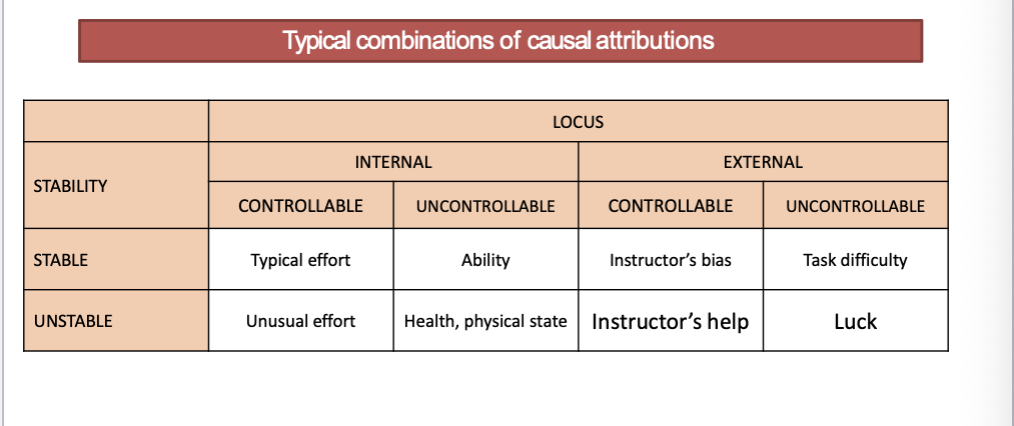
motivation is determines by causal factors
causal factors are determines after the awareness of the results
if the result is positive and expected → trust on the plan and feeling of happiness
if the result is negative and unexpected → feelings of surprise and sadness and need to modify the feeling
explanation are found in 1. locus of control, 2. stability, 3. control
locus of control? 1 pt
originates from the actor, the environment, or other people
stability? 1 pt
reflects whether the causal factor remains stable or changes over time
control? 1 pt
indicates whether the causal factor was under the actor’s control or beyond it
characteristics of the expectancy theory (vroom)?
A. aims to intergrate many elemts of prior theories and combines the perceptual aspects of equity theory with the behavioral components of other theories
B. uses the formula : M = V * I * E where:
M(otivation)- the extent to which a person is motivated by their current experience
V(alence)- perceived strength of the reward or punishment resulting from performance
I(nstrumentality)- the person’s perception that performance will lead to a reward or punishment
E(xpectancy)- person’s belief that effort will result in performance depending on the effort put in
C. Expectancy/effort → Instrumentality/performance → Valence/rewards where:
expectancy effort- person believes that effort will lead to an acceptable perfomance influenced by self-efficacy, goal difficulty, and perceived control
instrumentality performance- belief that a person will receive a reward in their performance meets expectations and decreases when the reward is the same for all levels
valence rewards- the value an individual places on the expected rewards or outcomes and if the reward in not meaningful motivation diminishes
criticisms of vroom’s expectancy theory? 3 pts
focuses on outcomes rather than needs unlike maslow’s hierarchy theory
assumes that behavior results from conscious decisions among alternatives with the primary goal of maximizing pleasure and minimizing pain
a contigency model that recognizes there is no universal method for motivating people and is based on individual factors e.g. personality, skills, knowledge etc
 Note
Note  Flashcards (149)