Cancer Genetics, DNA Repair and Genome Maintenance

0.0(0)
studied byStudied by 0 people
0.0(0)
call with kaiCall with Kai
learnLearn
examPractice Test
spaced repetitionSpaced Repetition
heart puzzleMatch
flashcardsFlashcards
GameKnowt Play
Card Sorting

1/28

encourage image

There's no tags or description

Looks like no tags are added yet.

Last updated 4:57 PM on 12/23/25
Name
Mastery
Learn
Test
Matching
Spaced
Call with Kai

No analytics yet

Send a link to your students to track their progress

29 Terms

1
New cards

DNA damage leads to

mutations

2
New cards

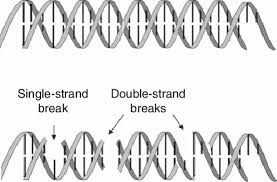
What are the two main types of DNA damage?

  • Single-stranded break (SSB)

  • Double-stranded break (DSB)

<ul><li><p>Single-stranded break (SSB)</p></li><li><p>Double-stranded break (DSB)</p></li></ul><p></p>
3
New cards

Which type of DNA damage can cause chromosome rearrangements?

Double-stranded break

4
New cards

What can unrepaired DNA damage can result in?

  • apoptosis (ageing)

  • senescence (ageing)

  • escape from growth suppression (cancer)

  • unregulated cell division (cancer)

5
New cards

What are the two main sources of DNA damage?

  • exogenous (ionising radiation, UV from sun, chemotherapy, x-rays, viruses)

  • endogenous (errors during DNA replication, ROS, alkylation)
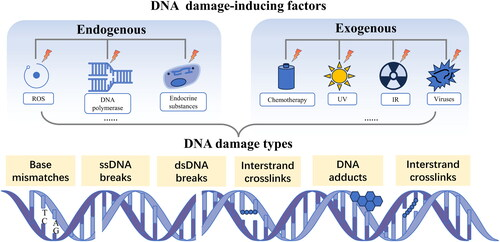
<ul><li><p><mark data-color="green" style="background-color: green; color: inherit;">exogenous </mark>(ionising radiation, UV from sun, chemotherapy, x-rays, viruses)</p></li><li><p><mark data-color="blue" style="background-color: blue; color: inherit;">endogenous </mark>(errors during DNA replication, ROS, alkylation)</p></li></ul><p></p>
6
New cards
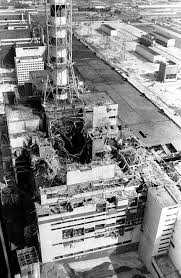
<p>A famous example of exogenous DNA damage caused by release of ionising radiation is the 1986 Chernobyl nuclear disaster. As a result, there was a significant increase in the number of which type of cancer?</p>

A famous example of exogenous DNA damage caused by release of ionising radiation is the 1986 Chernobyl nuclear disaster. As a result, there was a significant increase in the number of which type of cancer?

early childhood thyroid cancer

7
New cards

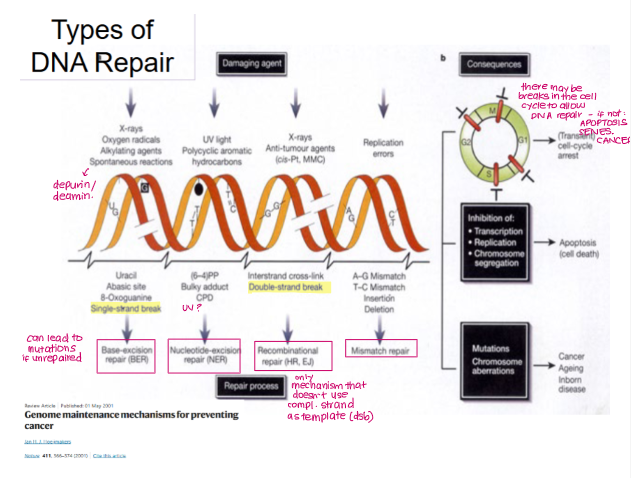
What are the four main types of DNA repair mechanisms?

  1. BER (base-excision repair)

  2. NER (nucleotide-excision repair)

  3. Recombinational repair

  • Homologous repair (HR)

  • Non-homologous end joining (NEJ)

  1. Mismatch repair

<ol><li><p>BER (base-excision repair)</p></li><li><p>NER (nucleotide-excision repair)</p></li><li><p>Recombinational repair</p></li></ol><ul><li><p>Homologous repair (HR)</p></li><li><p>Non-homologous end joining (NEJ)</p></li></ul><p></p><ol start="4"><li><p>Mismatch repair</p></li></ol><p></p>
8
New cards

The choice of repair mechanism depends on?

  • type of lesion

  • stage of cell cycle

<ul><li><p>type of lesion</p></li><li><p>stage of cell cycle</p></li></ul><p></p>
9
New cards

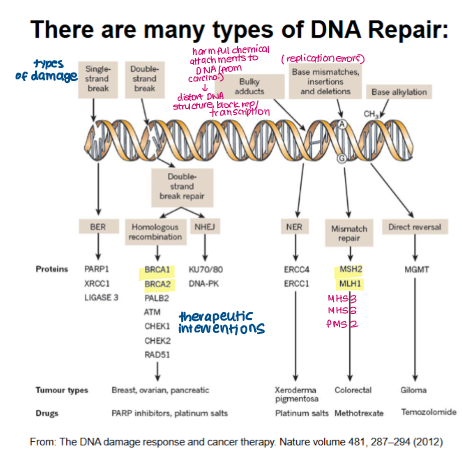
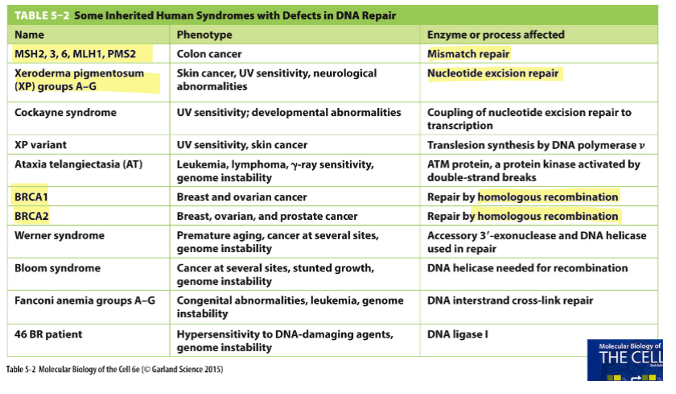
Examples of inherited human syndromes linked to defects in DNA repair

  • MSH2/3/6, MLH1, PMS2 (BER) → colon cancer

  • Xeroderma pigmentosum (NER) → skin cancer

  • BRCA1/2 (HR) → breast/ovarian cancer

<ul><li><p>MSH2/3/6, MLH1, PMS2 (BER) → colon cancer</p></li><li><p>Xeroderma pigmentosum (NER) → skin cancer</p></li><li><p>BRCA1/2 (HR) → breast/ovarian cancer</p></li></ul><p></p>
10
New cards

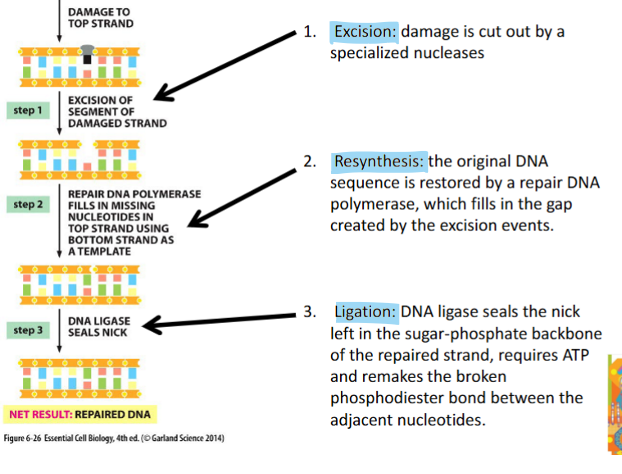
What are the three basic steps involved in DNA repair?

  1. Excision

  2. Resynthesis

  3. Ligation

<ol><li><p>Excision</p></li><li><p>Resynthesis</p></li><li><p>Ligation</p></li></ol><p></p>
11
New cards

Which types of DNA damage are repaired by BER mechanism?

  • ROS

  • Spontaneous depurination and deamination

  • Alkylating agents

  • X-rays

12
New cards

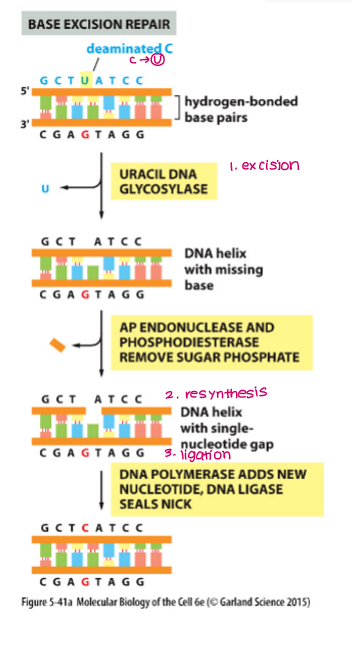
Explain how the BER mechanism repairs DNA damage.

Excision

  • Damaged base removed by DNA glycosylase

  • Strand incision by AP endonuclease

  • Remaining nucleotide excised by dRpase exonuclease

Resynthesis and Ligation

  • DNA polymerase fills in gaps using intact strand as a template

  • DNA ligase seals nicks in strand

<p><strong>Excision</strong></p><ul><li><p>Damaged base removed by <strong>DNA glycosylase</strong></p></li><li><p>Strand incision by <strong>AP endonuclease</strong></p></li><li><p>Remaining nucleotide excised by <strong>dRpase exonuclease</strong></p></li></ul><p></p><p><strong>Resynthesis and Ligation</strong></p><ul><li><p><strong>DNA polymerase</strong> fills in gaps using intact strand as a template</p></li><li><p><strong>DNA ligase </strong>seals nicks in strand</p></li></ul><p></p>
13
New cards

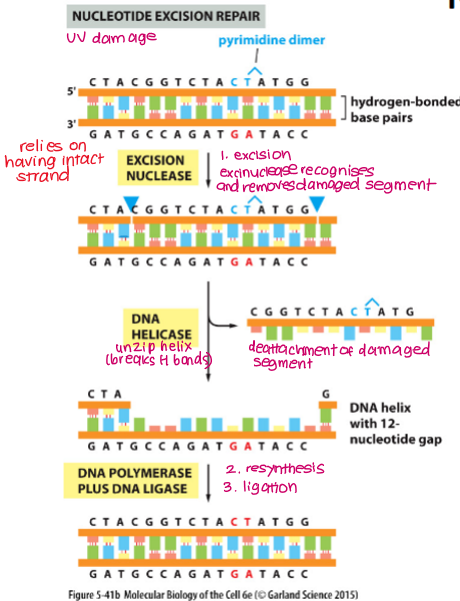
Explain how the NER mechanism repairs DNA damage.

Pyrimidine dimer is removed along with many other adjacent bases

Excision

  • Exonuclease recognises and removes damaged segment

  • DNA helicase unzips helix and removes damaged segment

Resynthesis and Ligation

  • DNA polymerase fills in gaps using intact strand as a template

  • DNA ligase seals nicks in strand

<p>Pyrimidine dimer is removed along with many other adjacent bases</p><p><strong>Excision</strong></p><ul><li><p><strong>Exonuclease </strong>recognises and removes damaged segment</p></li><li><p>DNA helicase unzips helix and removes damaged segment</p></li></ul><p></p><p><strong>Resynthesis and Ligation</strong></p><ul><li><p><strong>DNA polymerase</strong> fills in gaps using intact strand as a template</p></li><li><p><strong>DNA ligase </strong>seals nicks in strand</p></li></ul><p></p>
14
New cards

The NER mechanism is used exclusively to repair DNA damage caused by?

UV

15
New cards

What is a common consequence of NER mutation?

xeroderma pigmentosum
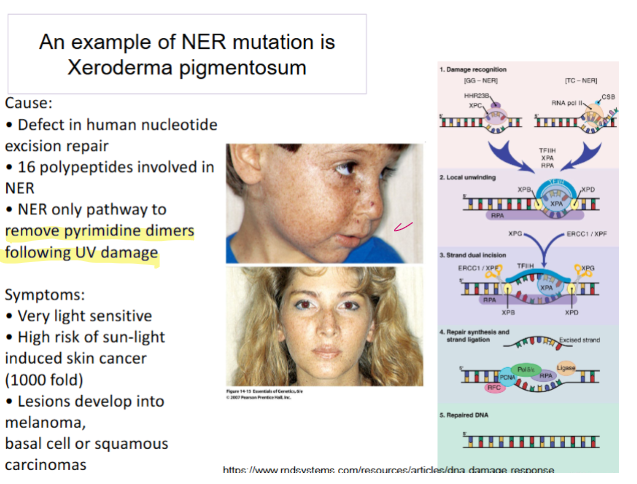
<p>xeroderma pigmentosum</p>
16
New cards

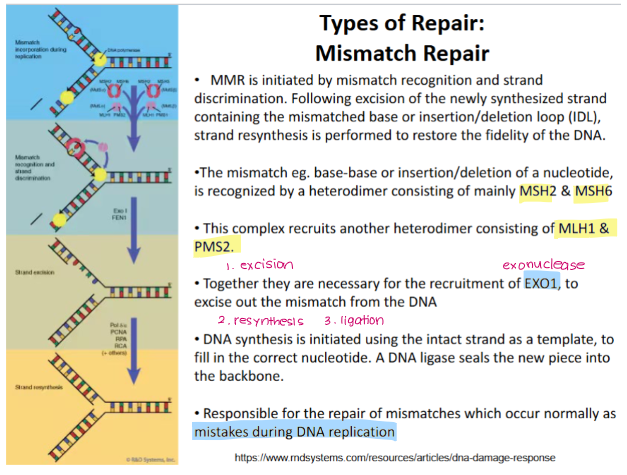
Mismatch repair mechanism repairs which kind of DNA damage?

DNA damage caused by errors in DNA replication (insertion, deletion, mismatched base)
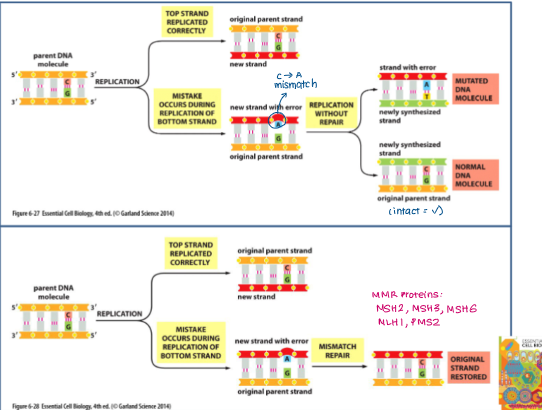
<p>DNA damage caused by <mark data-color="purple" style="background-color: purple; color: inherit;">errors in DNA replication</mark><mark data-color="#ffffff" style="background-color: rgb(255, 255, 255); color: inherit;"> (insertion, deletion, mismatched base)</mark></p>
17
New cards

Name the five mismatch proteins

  • MSH2 and MSH6 (forms dimer)

  • MLH1 and PMS2 (forms dimer)

  • MSH3

18
New cards

Explain how the mismatch repair (MMR) mechanism repairs DNA damage.

Excision

  • Dimer (MSH2 and MSH6) recognises mismatch

  • Complex recruits another dimer (MLH1 and PMS2)

  • Both dimers together recruit EXO1 (exonuclease) which excises the mismatch out from the strand

Resynthesis and Ligation

  • DNA polymerase fills in gaps using intact strand as a template

  • DNA ligase seals nicks in strand

<p><strong>Excision</strong></p><ul><li><p>Dimer (MSH2 and MSH6) recognises mismatch</p></li><li><p>Complex recruits another dimer (MLH1 and PMS2)</p></li><li><p>Both dimers together recruit <strong>EXO1 (exonuclease) </strong>which excises the mismatch out from the strand</p></li></ul><p></p><p><strong>Resynthesis and Ligation</strong></p><ul><li><p><strong>DNA polymerase</strong> fills in gaps using intact strand as a template</p></li><li><p><strong>DNA ligase </strong>seals nicks in strand</p></li></ul><p></p>
19
New cards

What is a common consequence of MMR mutation?

HNPCC (hereditary non-polyposis colon caner)

MMR mutation causes microsatellite instability in coding regions of cancer associated genes
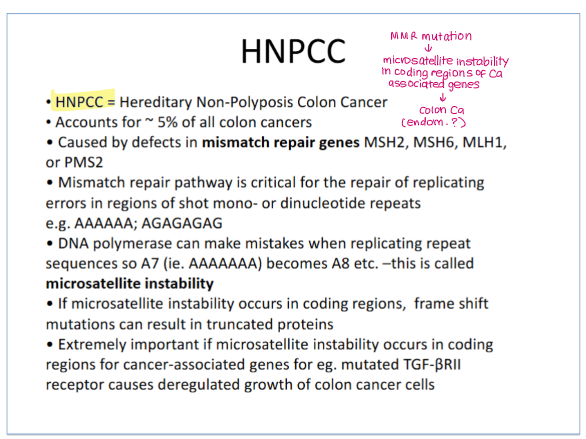
<p><strong>HNPCC </strong>(hereditary non-polyposis colon caner)</p><p>MMR mutation causes microsatellite instability in coding regions of cancer associated genes</p>
20
New cards

Recombination repair mechanism repairs which kind of DNA damage?

Double-stranded breaks (DSB)

Prevent use of complementary strand as a template
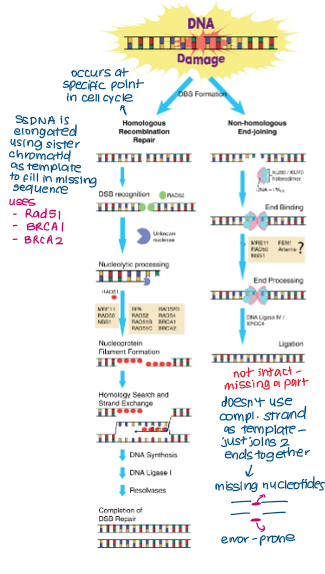
<p>Double-stranded breaks (DSB)</p><p>Prevent use of complementary strand as a template</p>
21
New cards

What are the two types of recombination repair?

  • homologous recombination (HR)- uses sister chromatids as template

  • non-homologous end joining (NHEJ)- no template used, just joins ends together
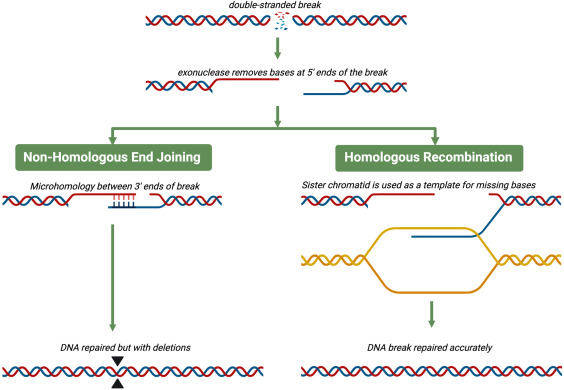
<ul><li><p><mark data-color="purple" style="background-color: purple; color: inherit;">homologous recombination</mark> (HR)- uses sister chromatids as template</p></li><li><p><mark data-color="purple" style="background-color: purple; color: inherit;">non-homologous end joining</mark> (NHEJ)- no template used, just joins ends together</p></li></ul><p></p>
22
New cards

Explain how the homologous recombination (HR) mechanism repairs DNA damage.

  1. Resection: A DSB is processed, creating single-stranded DNA (ssDNA) tails with free 3' ends.

  2. Filament Formation: RAD51 protein loads onto the ssDNA to form a helical filament, with help from BRCA2 and other factors.

  3. Homology Search & Invasion: The RAD51 filament searches for and invades a homologous (identical) intact DNA molecule (sister chromatid or homologous chromosome) to find a template.

  4. DNA Synthesis: The invading 3' end acts as a primer, and DNA polymerase synthesizes new DNA, copying the template sequence to fill the gap.

  5. Resolution: The resulting DNA structures (like Holliday junctions) are resolved by nucleases and ligases, restoring two intact DNA molecules. 

Uses RAD51, BRCA1/BRCA2
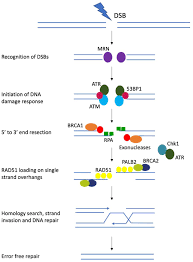
<ol><li><p><span><strong><span>Resection:</span></strong><span> A DSB is processed, creating single-stranded DNA (ssDNA) tails with free 3' ends.</span></span></p></li><li><p><span><strong><span>Filament Formation:</span></strong><span> RAD51 protein loads onto the ssDNA to form a helical filament, with help from BRCA2 and other factors.</span></span></p></li><li><p><span><strong><span>Homology Search &amp; Invasion:</span></strong><span> The RAD51 filament searches for and invades a homologous (identical) intact DNA molecule (sister chromatid or homologous chromosome) to find a template.</span></span></p></li><li><p><span><strong><span>DNA Synthesis:</span></strong><span> The invading 3' end acts as a primer, and DNA polymerase synthesizes new DNA, copying the template sequence to fill the gap.</span></span></p></li><li><p><span><strong><span>Resolution:</span></strong><span> The resulting DNA structures (like Holliday junctions) are resolved by nucleases and ligases, restoring two intact DNA molecules.&nbsp;</span></span></p></li></ol><p></p><p>Uses <mark data-color="red" style="background-color: red; color: inherit;">RAD51, BRCA1/BRCA2</mark></p><p></p>
23
New cards

BRCA1 and BRCA2 mutations account for what percentage of:

a) hereditary breast cancers

b) all breast cancers

c) ovarian cancers

a) 20-25%

b) 5-10%

c) 15%

<p>a) 20-25%</p><p>b) 5-10%</p><p>c) 15%</p>
24
New cards

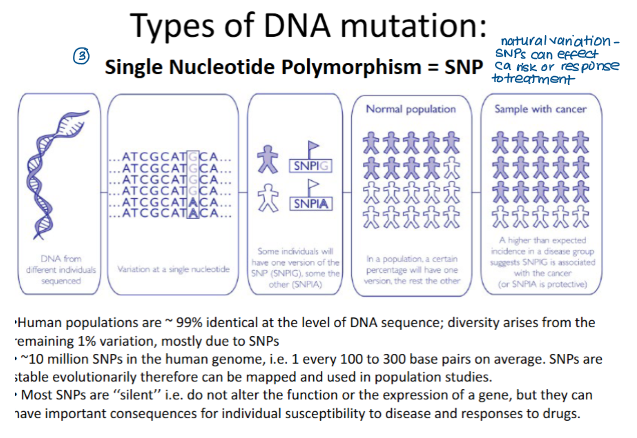
What are the three main categories of DNA mutation.

  1. Base-pair (substitution, insertion, deletion, frameshift)

  2. Chromosomal (translocation, duplication, deletion)

  3. SNPs

<ol><li><p>Base-pair (substitution, insertion, deletion, frameshift)</p></li><li><p>Chromosomal (translocation, duplication, deletion)</p></li><li><p>SNPs</p></li></ol><p></p>
25
New cards

Translocation between chromosome 14 and 11/4 is associated with with type of cancer?

multiple myeloma
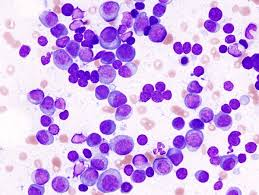
<p>multiple myeloma</p>
26
New cards

Duplication of chromosome 21 (trisomy) is associated with which syndrome and has an increased risk of developing which type of cancer?

Downs syndrome

Increased risk of leukaemia
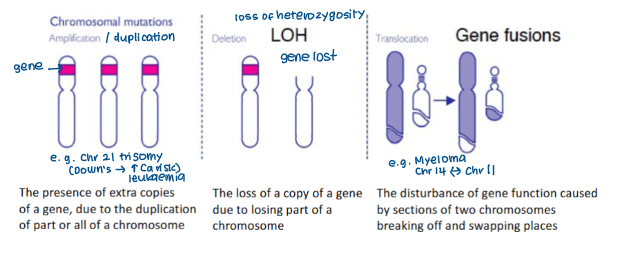
<p>Downs syndrome</p><p>Increased risk of leukaemia</p>
27
New cards

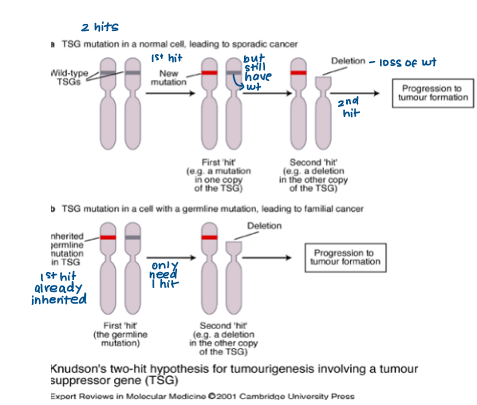
What did Knudson’s two-hot hypothesis of tumorigenesis (1971) suggest?

Inherited retinoblastoma vs sporadic retinoblastoma

  • inherited cases occur earlier

  • inherited cases developed in both eyes

“Two hits” needed- in inherited cases, first hit already present (inherited mutation) so only one more needed (deletion)
<p>Inherited retinoblastoma vs sporadic retinoblastoma</p><ul><li><p>inherited cases <strong>occur earlier</strong> </p></li><li><p>inherited cases developed in <strong>both eyes </strong></p></li></ul><p></p><p>“Two hits” needed- in inherited cases, first hit already present (inherited mutation) so only one more needed (deletion)</p><p></p>
28
New cards

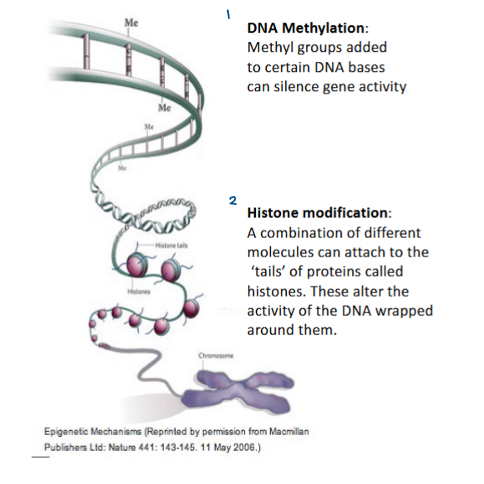
Mutations can also be caused by epigenetic modifications. Give two examples.

  1. DNA methylation

  2. Histone modification

<ol><li><p>DNA methylation</p></li><li><p>Histone modification</p></li></ol><p></p>
29
New cards

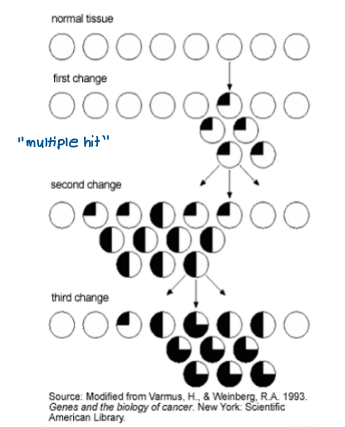
Cancer is a genetic disease resulting from the accumulation of multiple mutational events. What is the relationship between mutation and cancer progression?

Cells with higher DNA mutation rates will tend to progress faster

e.g. BRCA1/2 mutation → develop breast cancer earlier
<p>Cells with higher DNA mutation rates will tend to progress faster </p><p>e.g. BRCA1/2 mutation → develop breast cancer earlier</p>