Quiz Insect Bio 1 Part 1
 Studied by 2 people
 Call Kai
 Learn
Learn Practice Test
 Spaced Repetition
 Match
Match Flashcards
 Knowt Play
1/38

There's no tags or description
Looks like no tags are added yet.
Name | Mastery | Learn | Test | Matching | Spaced | Call with Kai |
|---|
No analytics yet
Send a link to your students to track their progress
39 Terms
Taxonomy
The science of classifying living things
Phylogenetics
The study of evolutionary relationships between species and the history of organisms as they change through time
Monophyletic group
contains a last common ancestor and all of its descendants
Paraphyletic group
contains a last common ancestor but not all of its descendants
Polyphyletic group
is a group of organisms that do not share a recent common ancestor
Taxonomy of insects (give order)
Domain: Eukaryote, Kingdom: Animalia, Phylum: Arthropoda (subphylum: hexapoda), Class: Insecta, Order: theres many
Arthropoda characterisitcs
exoskeleton, segmented body, & jointed appendages
Hexapod characteristics
includes all insects and entognathous hexapods.
They are defined by 3 tagma (head, thorax, abdomen), 3 pairs of thoracic legs
Hexapod anatomy
Head
Thorax
prothorax - 1 pair of legs, 1 pair of wings
metathorax - 1 pair of legs, 1 pair of wings
mesothorax - 1 pair of legs
Abdomen
Class Insecta Characteristics
Defined by external mouthparts
Entognathous hexapods orders:
Protura, collembola, diplura
What is a close relative to insects but not considered insects
Class Entognatha
define Entognathous hexapods name
“sunken mouthparts” “6 legs”
defining feature of entognathous hexapods
All are ametabolous: no metamorphosis
*immature stages look like adults
*evolutionary primitive orders
*Primitively wingless
*Internal mouthparths located inside the head capsule
*lack wax layer in cuticle
*All Entognathous hexapods can be collected using a Berlese funnel
Ametabolous
eggs —> juveniles —> adults
Hemimetabolous
eggs —> nymphs —> adults
Holometabolous
egg —> larvae —> pupae —> adult
define Protura name
“first tail”
Protura common name
coneheads
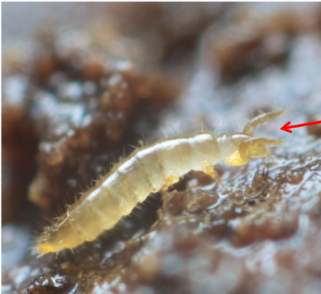
Protura characteristics
no eyes
no antennae
no pigmentation
no wings
no cerci/terminal filament
cone-shaped head
forelegs as antennae
very small - under 2 mm
Where is protura found?
in moist environments like lead litter, soil, & moss
What does protura eat
decaying plants and fungi
How do you curate protura properly?
preserve adults & immatures in 70% ethanol
Collembola name definition
glue peg
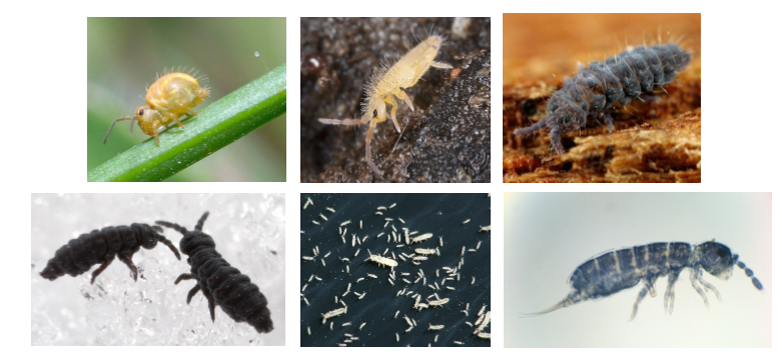
Collembola common name
Spring tails
Collembola characteristics
collophore: peg-like structure on the first abdominal segment that helps with water regulation
many have furcula: a tail-like appendage used for jumping
small eyes or eyeless
smaller than 6mm
Where is collembola found?
moist environments: lead litter, soil, moss
What is collembola eating habits
ominivorous & detrivorous
How do you preserve collembola?
preserve immatures and adults in 70% Ethanol
What shapes can collembola be?
Globular or elongate
Define Diplura name
two tail
Diplura common name
two prolonged bristletails
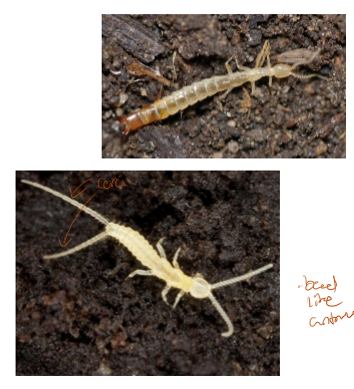
Diplura characterization
well developed cerci (“tails”)
long (bead-like) antennae
no pigmentation
no eyes
What types of cerci does diplura have?
pincer-like
long and filamentous (thread-like)
size of diplura
7-10mm
Where is Diplura found?
in moist environments: leaf litter, soil, moss
Diplura eating habits?
herbivorous or carnivorous, also detritovores
How can diplura be preserved?
preserve immatures and adults in 70% EtOH
Berlese funnels
used to collect arthropods from soil and lead litter samples
1) samples are placed into a large funnel that empties into a collecting pot with ethanol
2) A light source is added to top of the funnel shining onto the samples, the insects don’t like the light/heat, crawl away, and fall into the pot with ethanol
 Note
Note  Flashcards (22)