Section 7 Chapter 18 population and evolution
 Call Kai
 Learn
Learn Practice Test
 Spaced Repetition
 Match
Match Flashcards
 Knowt Play
1/13

There's no tags or description
Looks like no tags are added yet.
Name | Mastery | Learn | Test | Matching | Spaced | Call with Kai |
|---|
No analytics yet
Send a link to your students to track their progress
14 Terms
Define ecosystem carrying capacity:
The maximum population size that can be supported for a particular species.
That are determined by abiotic and biotic factors.
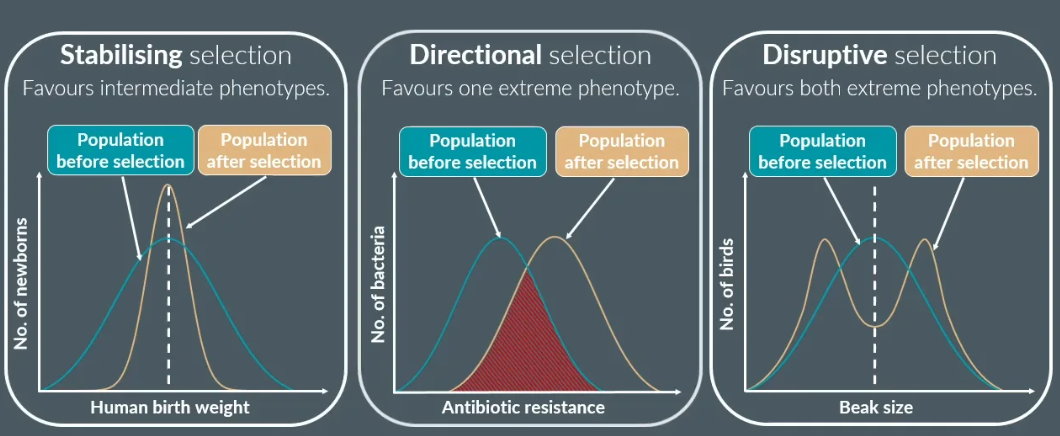
What are the three types of natural selection:
Define Gene pool
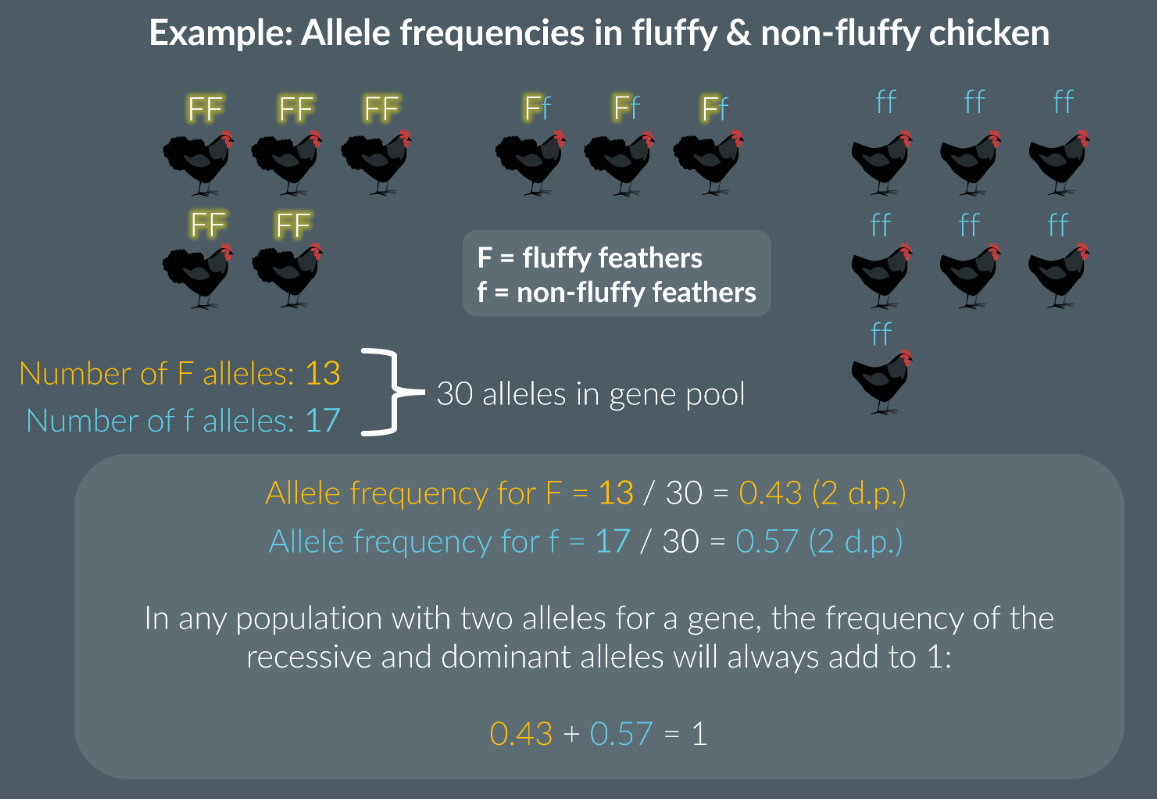
All the alleles in the population
Define allele frequency
Frequency/ probability of an allele appearing in the gene pool
In a population where there is a dominant and recessive allele the proability will always add up to…
Probabilities will add up to 1
We can then calculate the homozygous dominant by p(dominant) x p(dominant)
To calculate the heterozygous recessive p(recessive) x p(recessive)
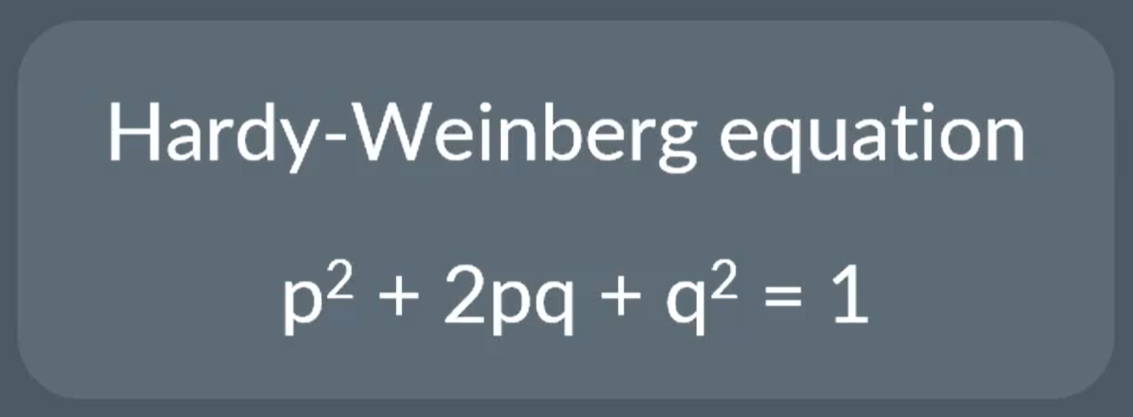
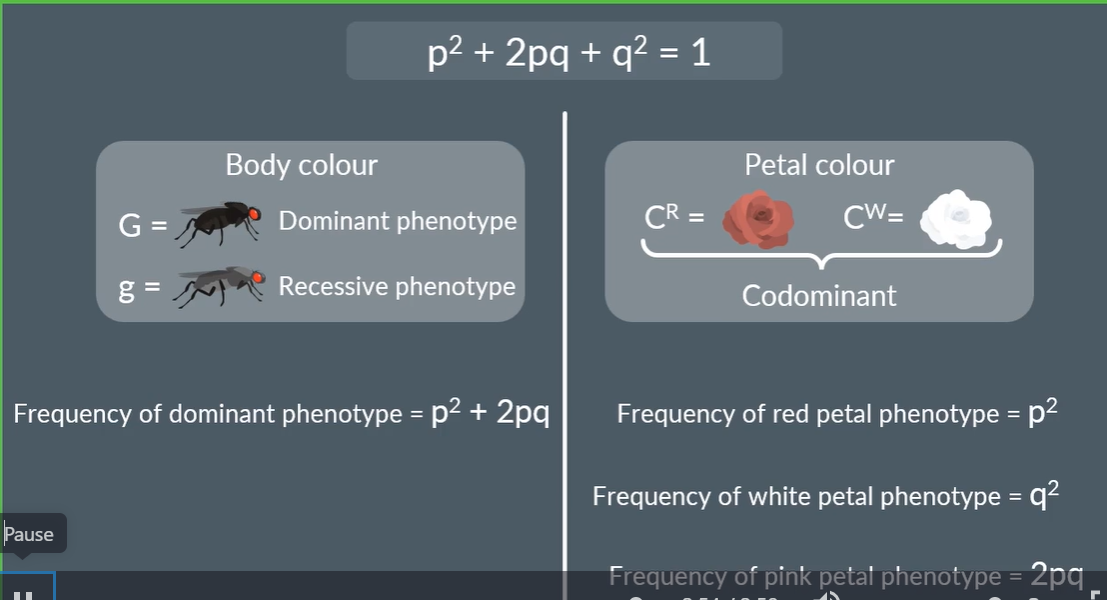
What is the Hardy-Weinberg equation?
The frequency of a heterozygous genotype is given by 2pq
p+q =1
The steps when using the hardy-weinberg equation:
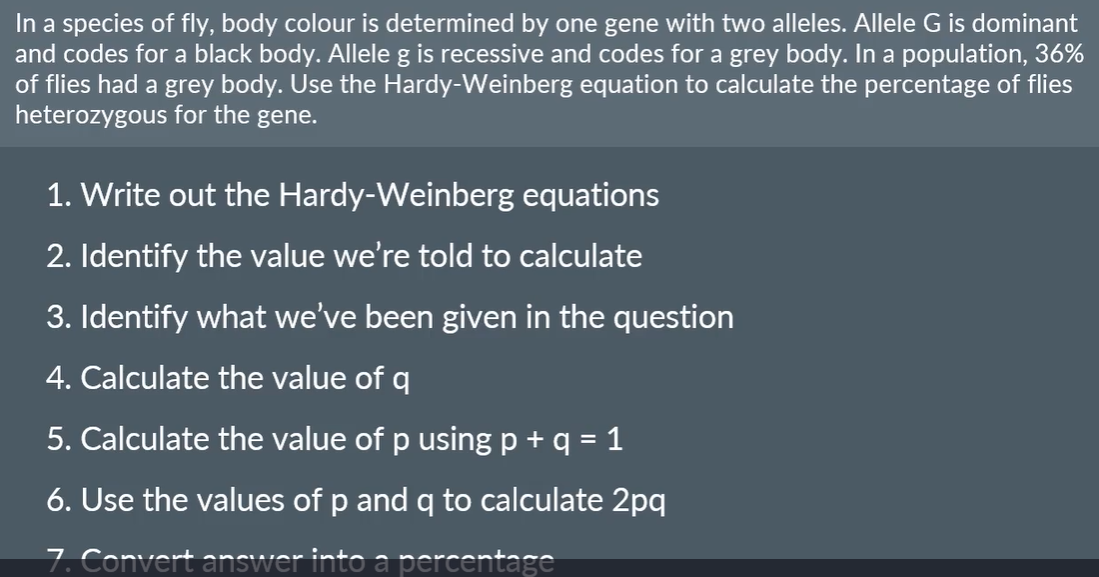
To find the frequency of dominant phenotype and recessive phenotype: careful two scenarios, when there is one recessive one dominant and when they are co-dominant
What condition do we assume from the Hardy-Weinburg principle?
The allele frequencies in a population will remain constant from generation to generation
Their conditions:
no mutation, so no change in the allele
No migration, as leaving will remove the allele and coming will add an allele
Large population, as having a small population more likely for in directional, disruptive or stabilising selection (if small population then the organism can easily be removed from population, which in turn changes the gene pool)
Mating is random, so alleles are equally likely to be passed on
No natural selection, all alleles are eqyally help organism survive and reproduce
Just information on selection:
High reproductive rate has occured in organism, in order to survive as a species of high death rate (from predetors, extreme weather, natural disasters and disease).
However, with increased individuals in a population, there is increased intraspecific competition.
Key phrase: Increased frequency of an allele
Define speciation:
The evolution of new species from existing ones. And species having the same genes, but different combination of alleles
Define adaptive radiation:
When there is a rapid burst of speciation that causes different changes to the allele frequencies.
What is Allopatric speciation:
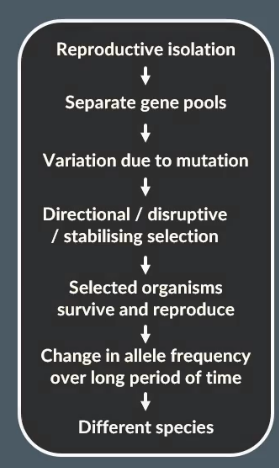
Form a speciation that occurs when population becomes geographically separated, preventing from interbreeding, and the geographical differences in each environment causes genetic variation
THE PICTURE IS THE KEY SIX MARK ANS
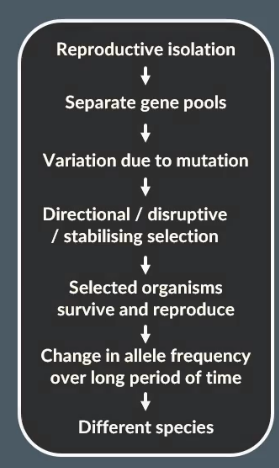
Sympatric specication:
Variation occurs through variation in fertillisation or courtship behaviour, where the two new populations are located in the same habitat
This natural selection occurs in the same habitat (no geographical isolation)
Random mutation causes different behaviours (such as different flowering times)
This causes a reproductive isolation
Where different advantageous alleles are passed on
Causes a disruptive selection
This eventually causes both of these species not to interbreed