BIOC 4331 Lecture 27

0.0(0)
Studied by 0 people
call kaiCall Kai
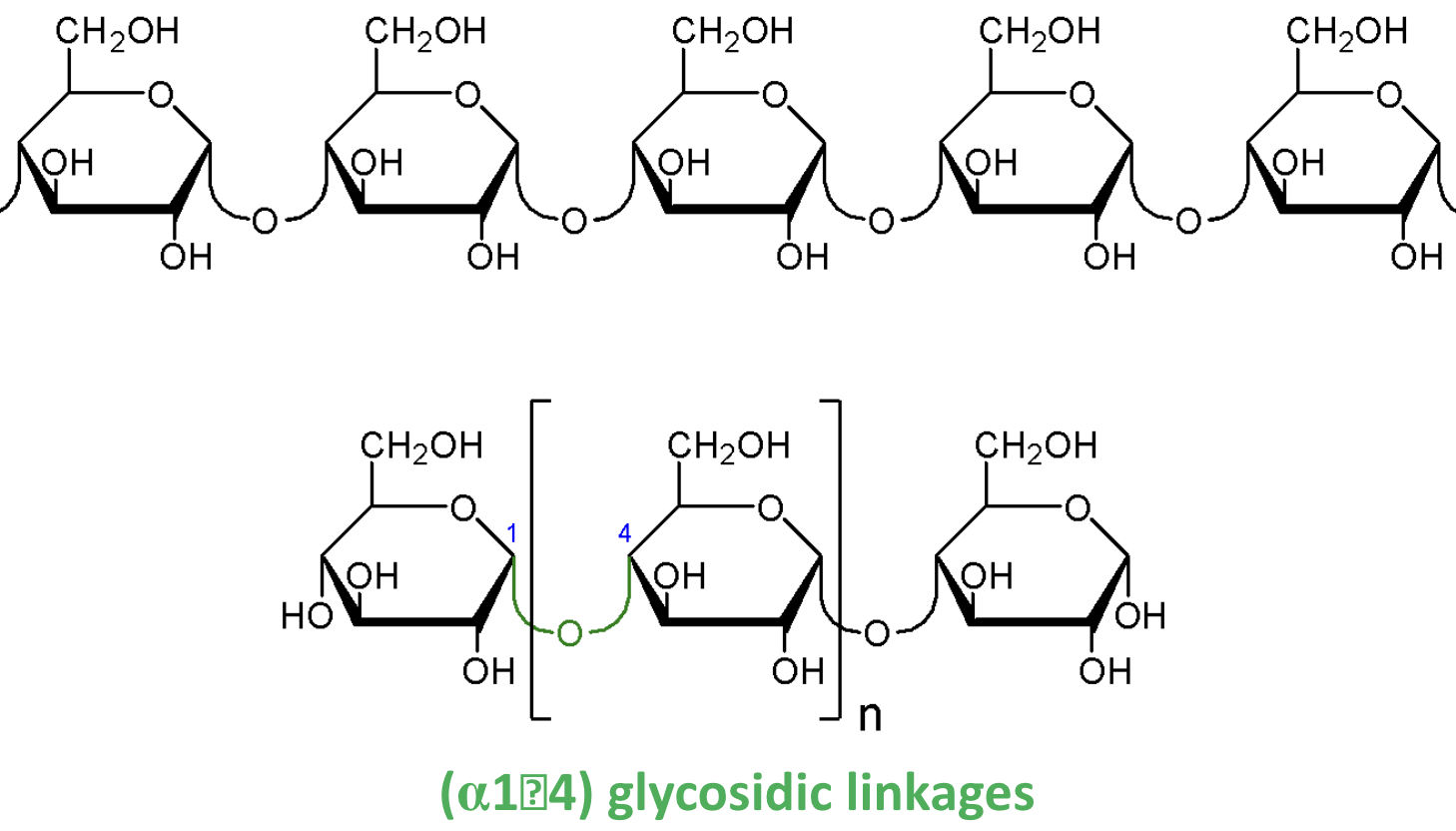
learnLearn
examPractice Test
spaced repetitionSpaced Repetition
heart puzzleMatch
flashcardsFlashcards
GameKnowt Play
Card Sorting

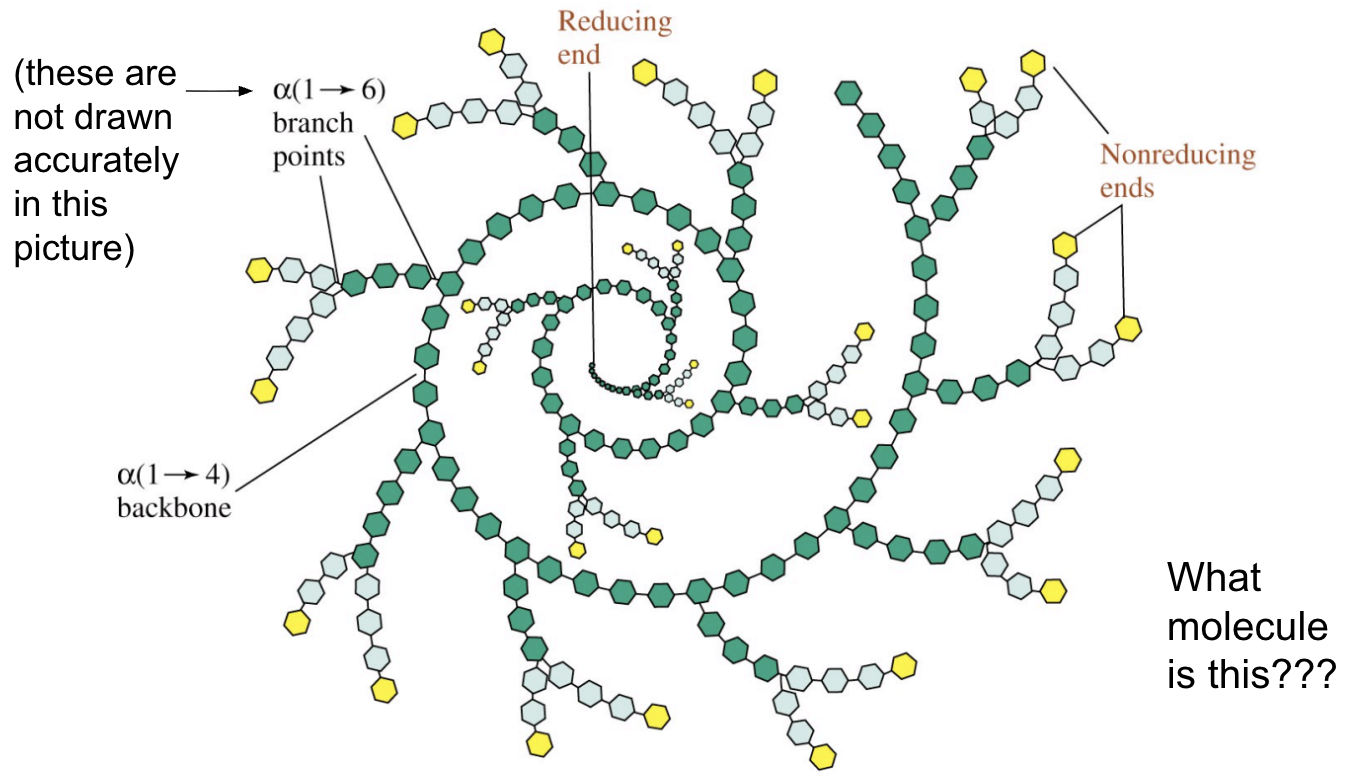
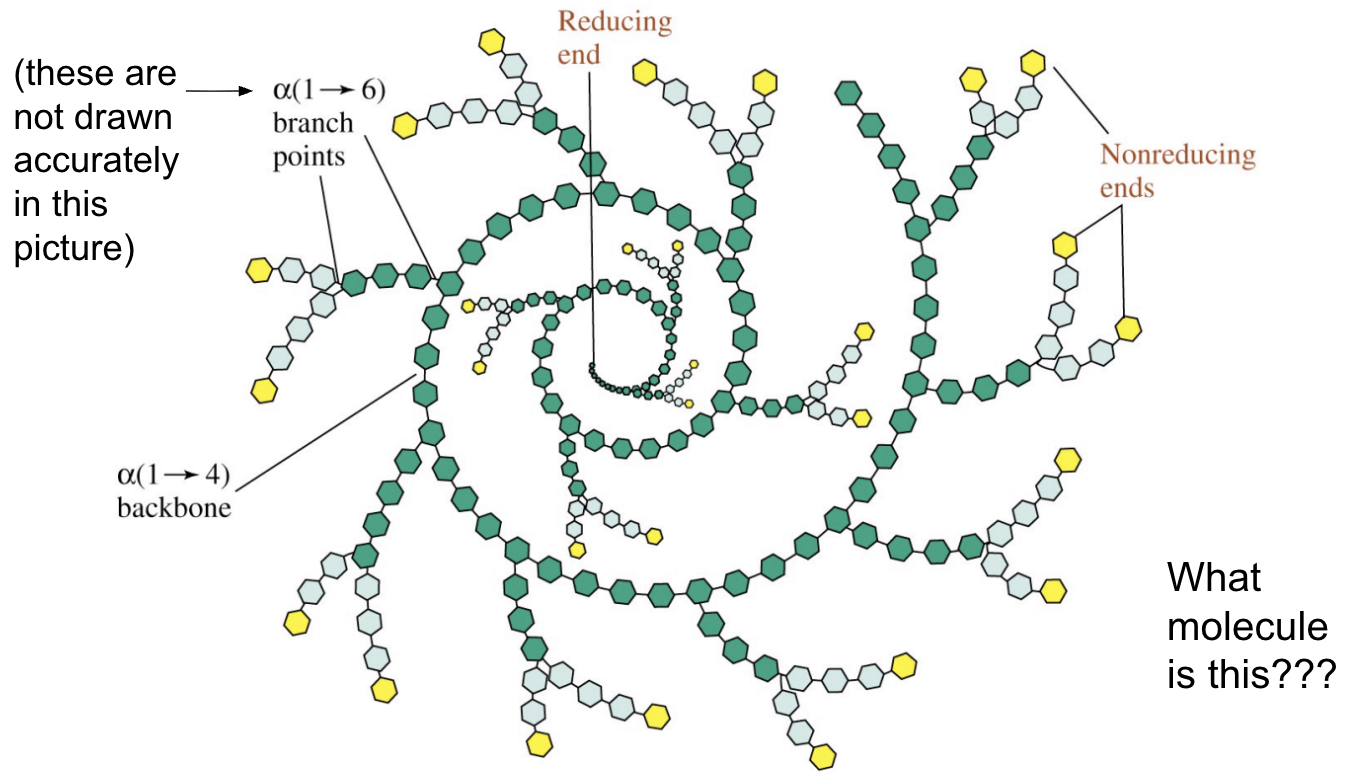
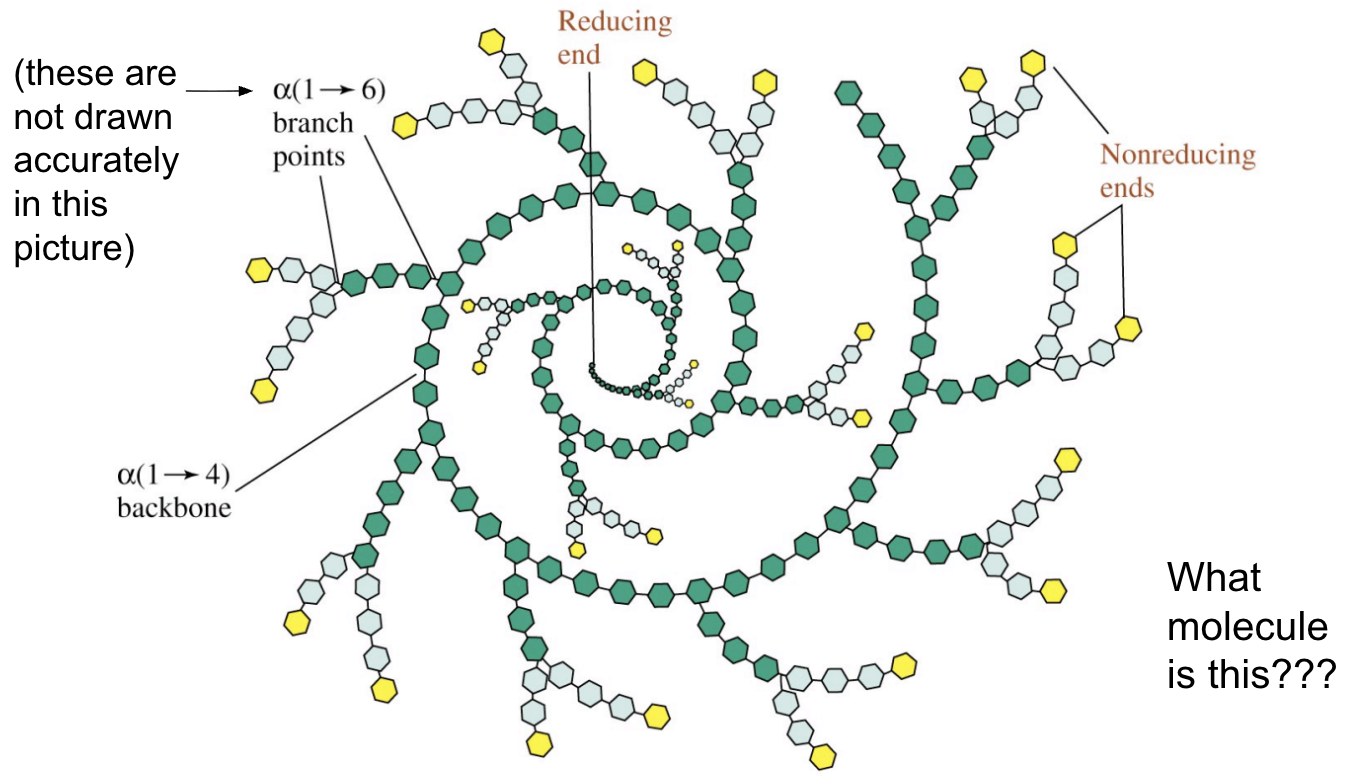
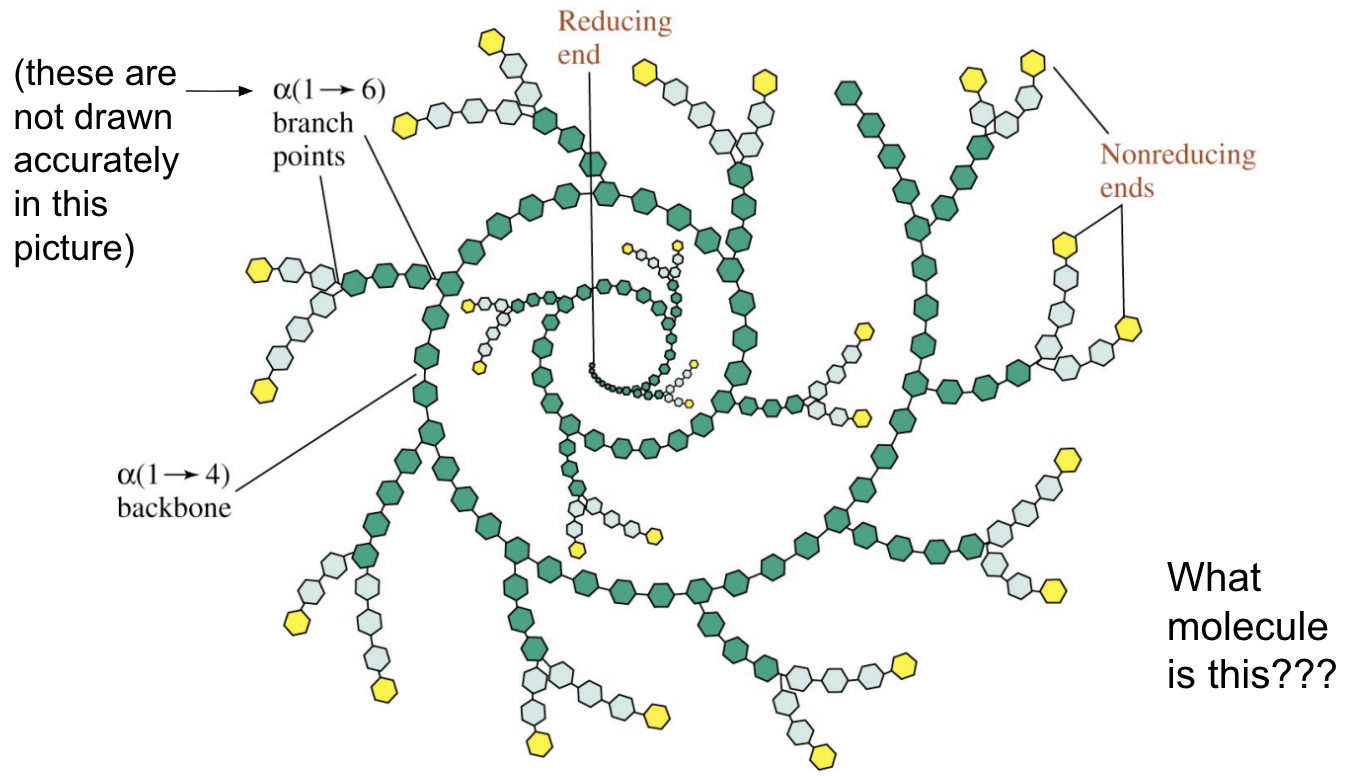
1/68

encourage image

There's no tags or description

Looks like no tags are added yet.

Last updated 4:32 PM on 4/6/26
Name
Mastery
Learn
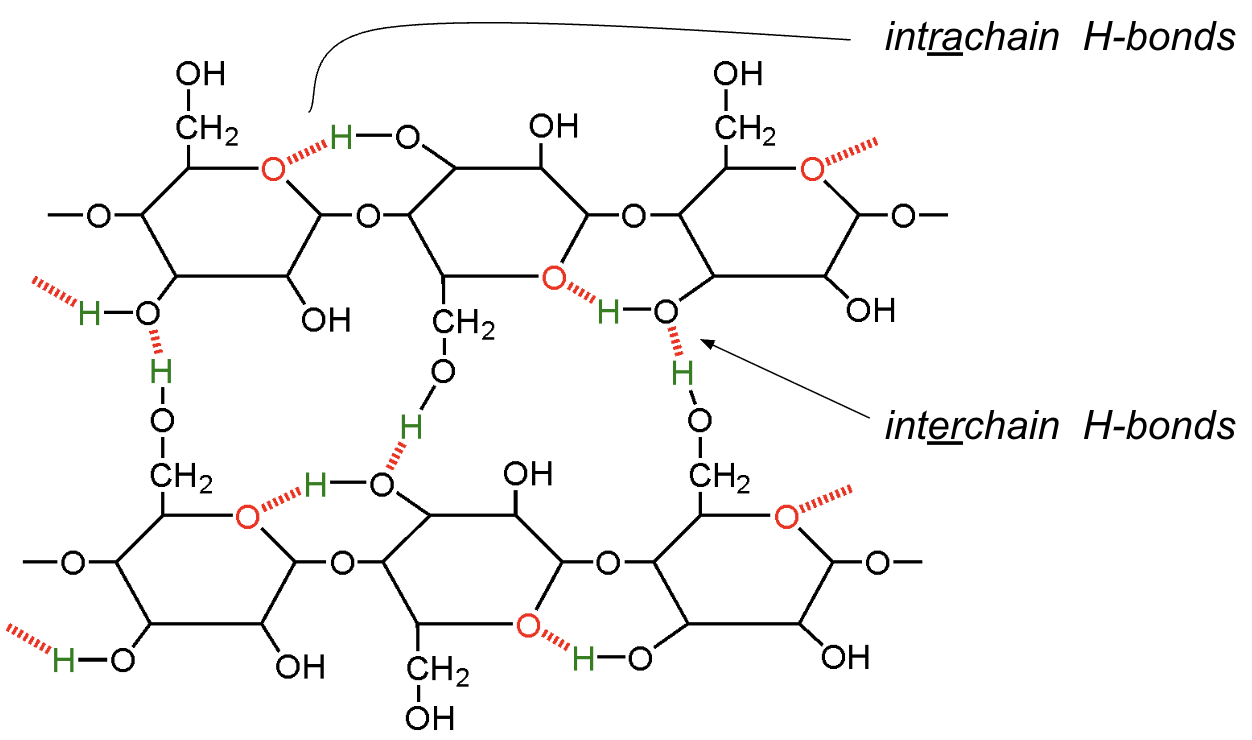
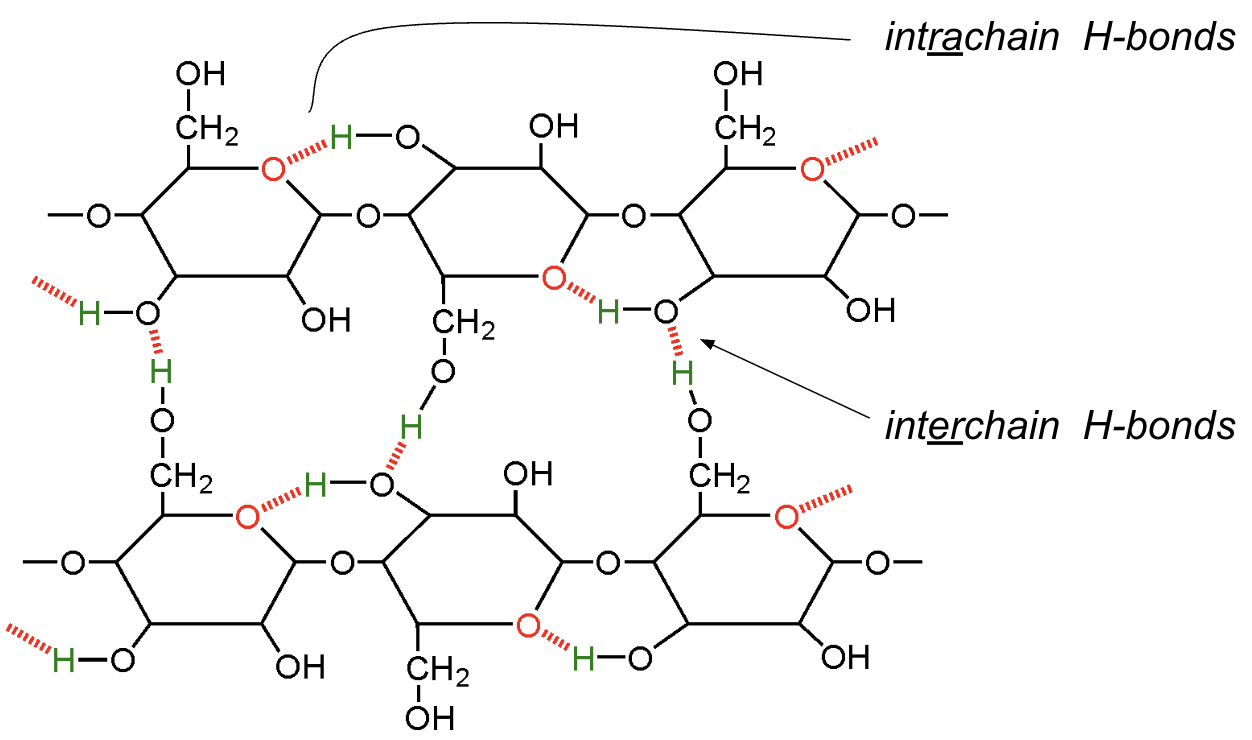
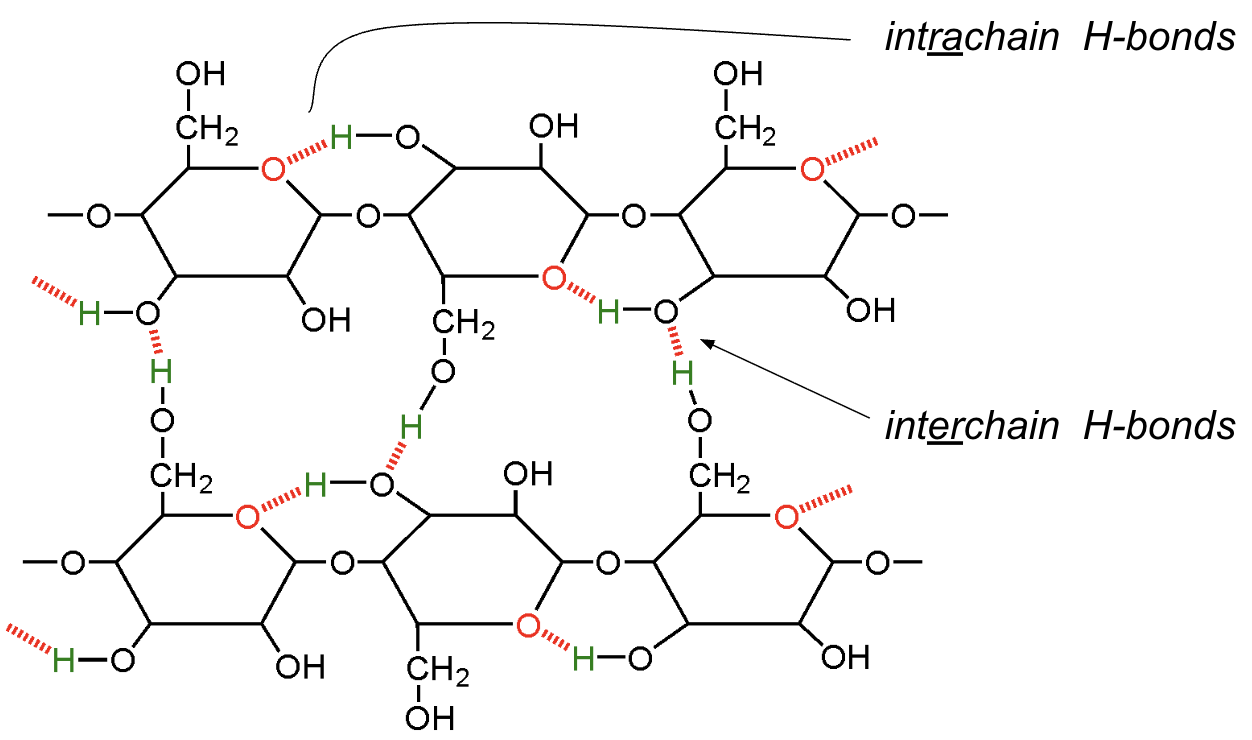
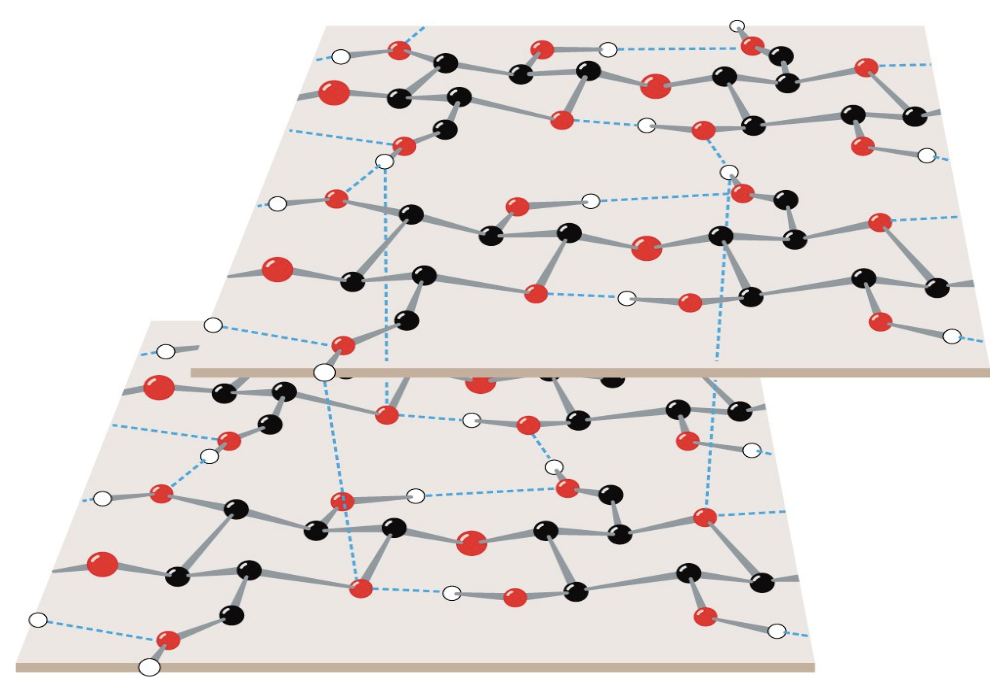
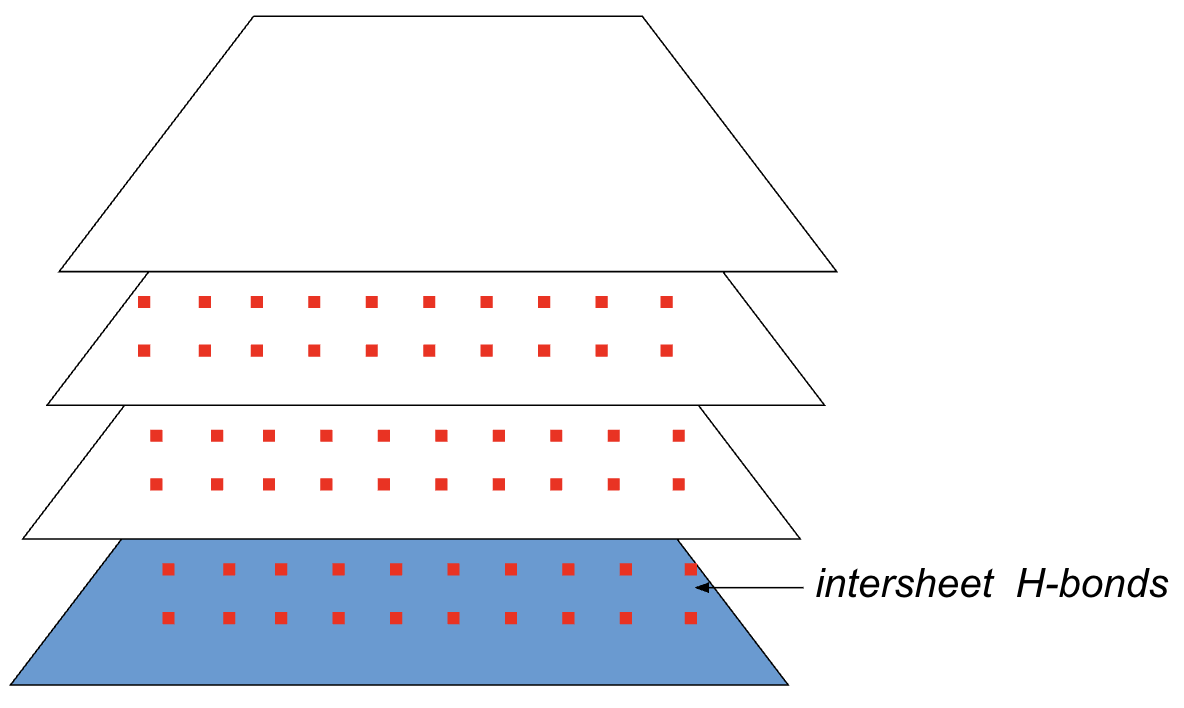
Test
Matching
Spaced
Call with Kai

No analytics yet

Send a link to your students to track their progress

69 Terms
1
New cards
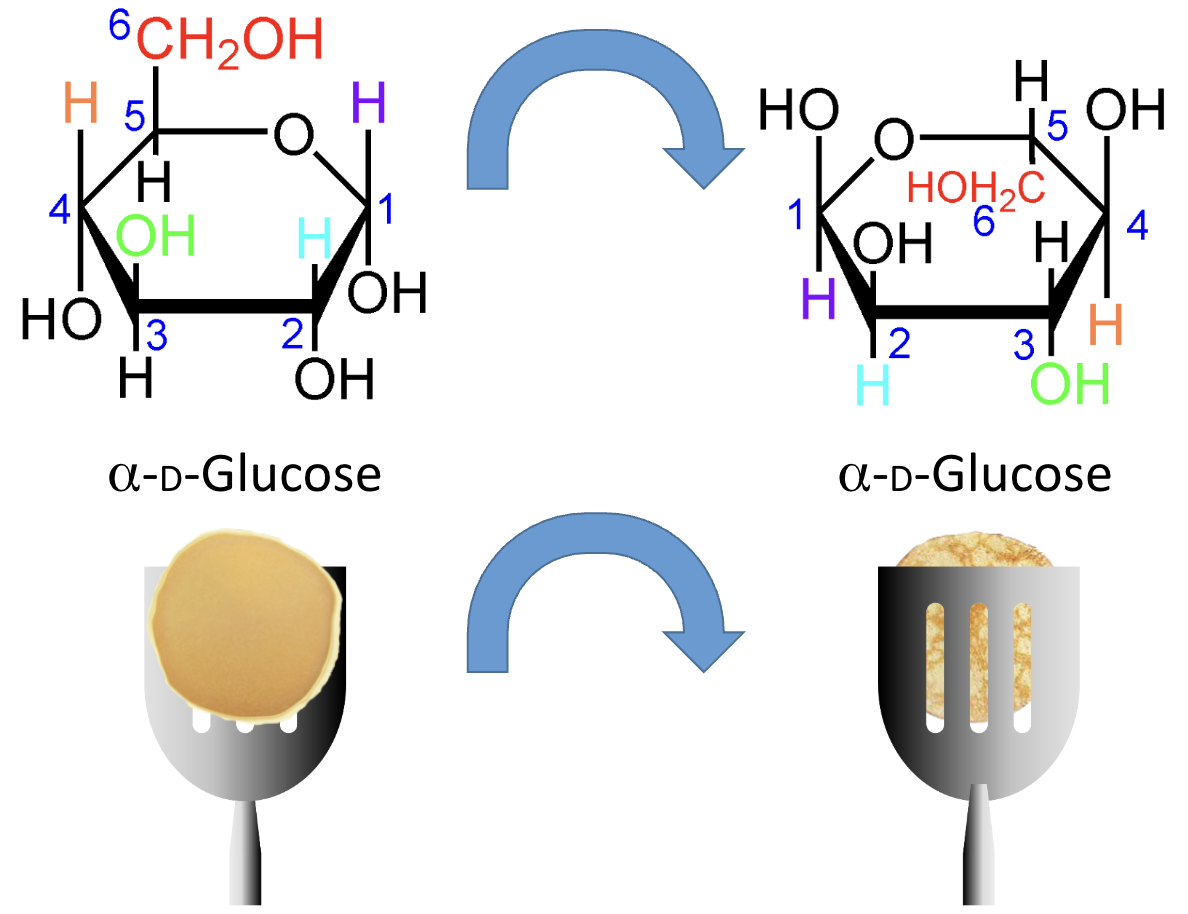
<p>Does flipping a Haworth sugar change its identity?</p>

Does flipping a Haworth sugar change its identity?

No. It is still the same sugar.
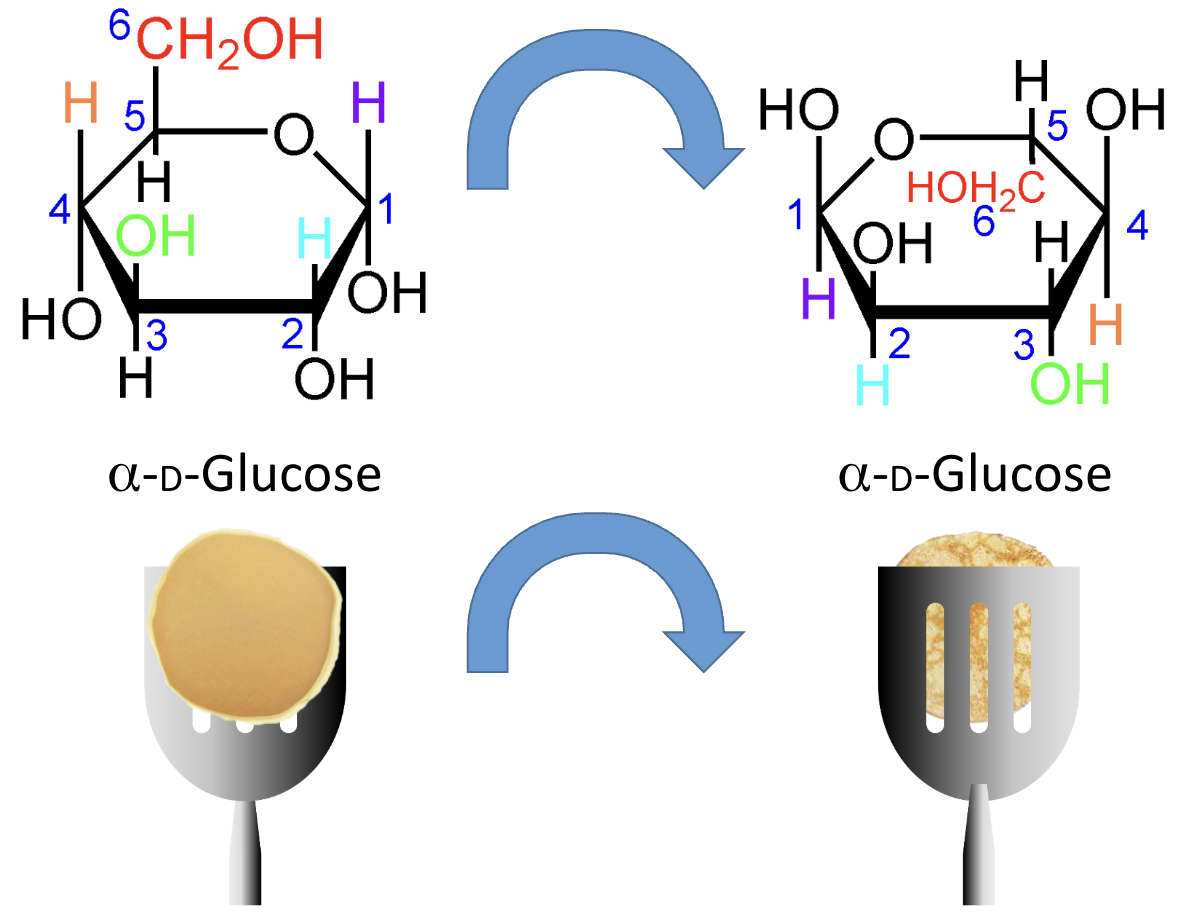
<p>No. It is still the same sugar.</p>
2
New cards

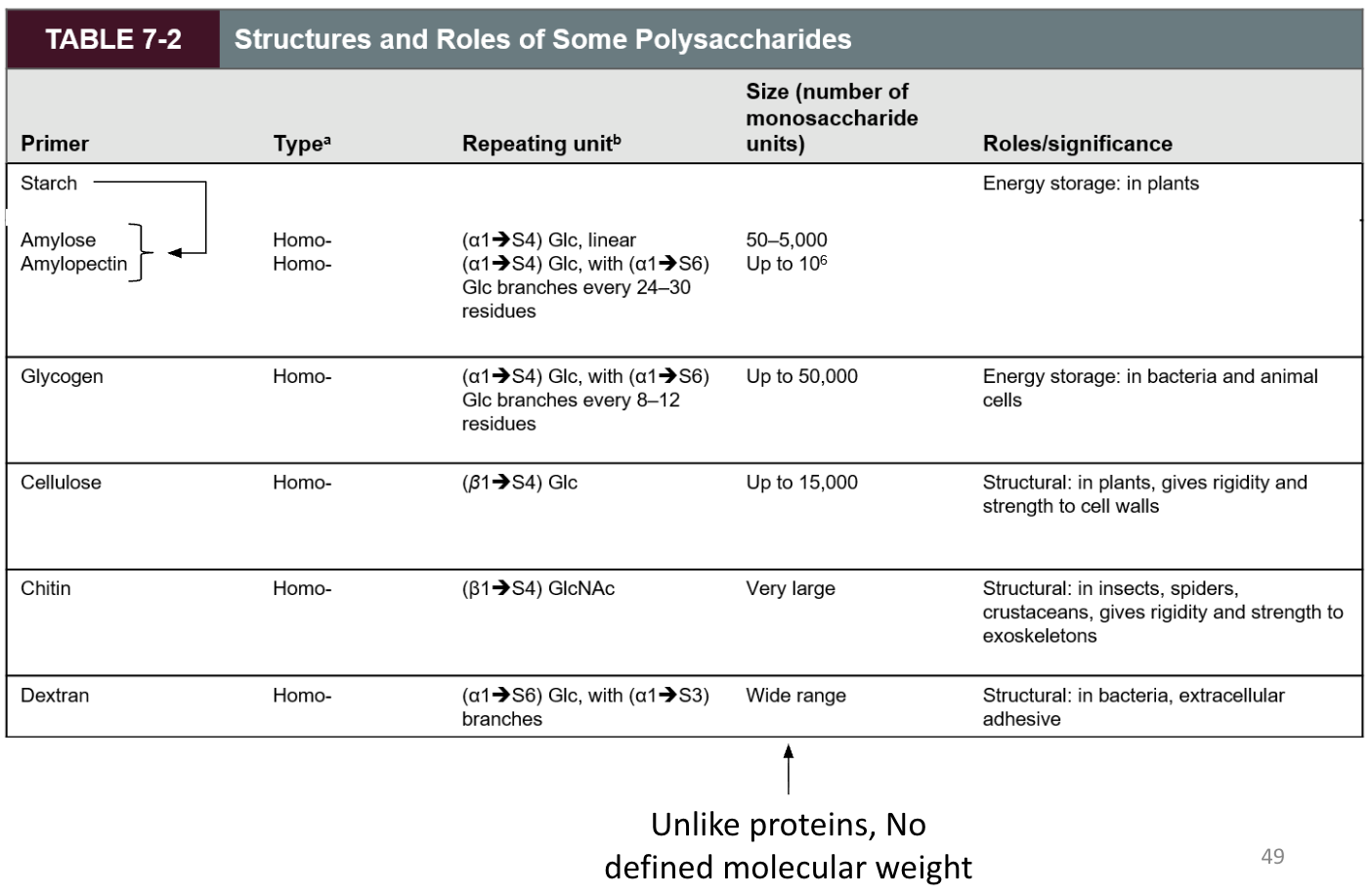
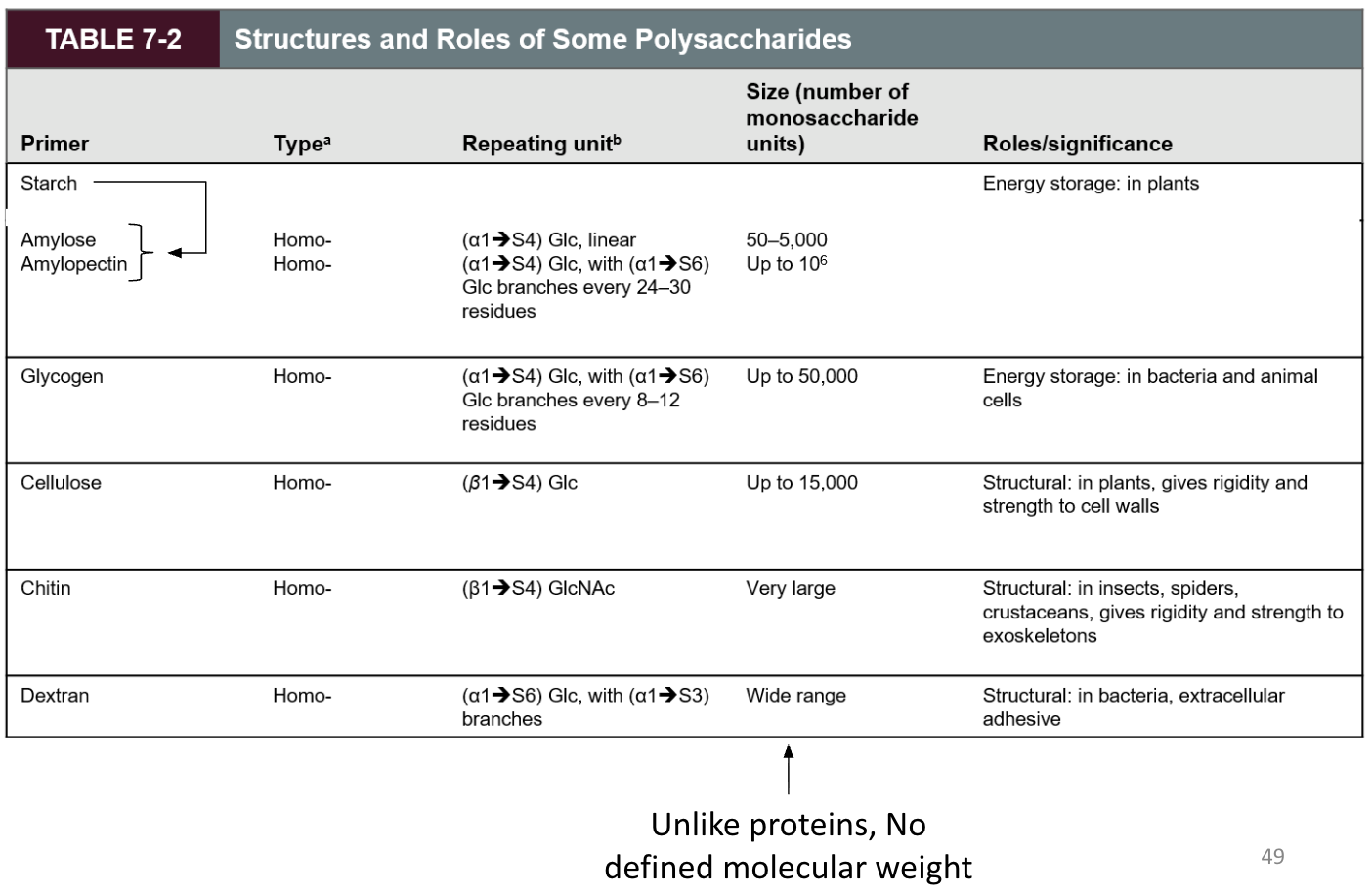
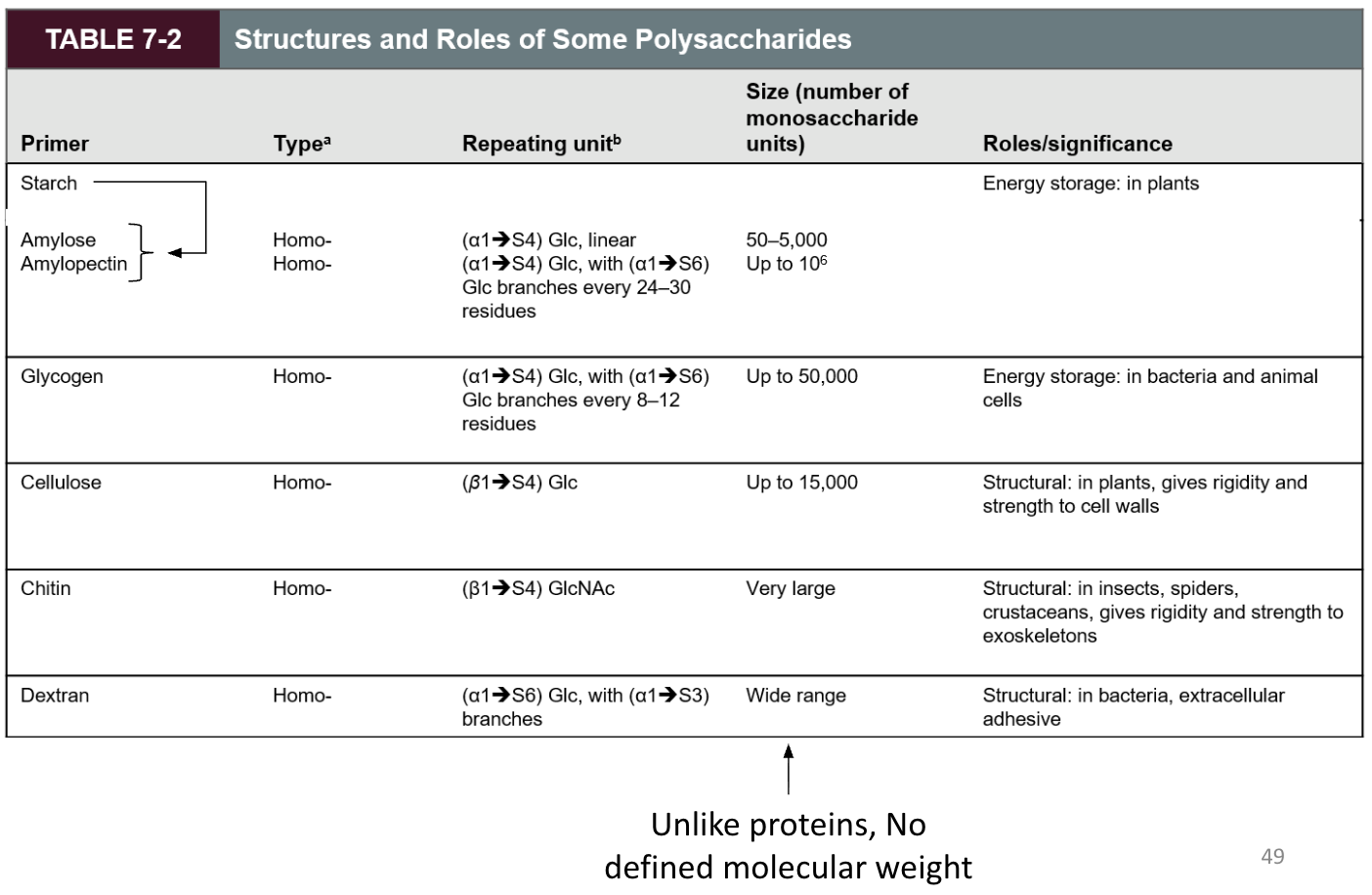
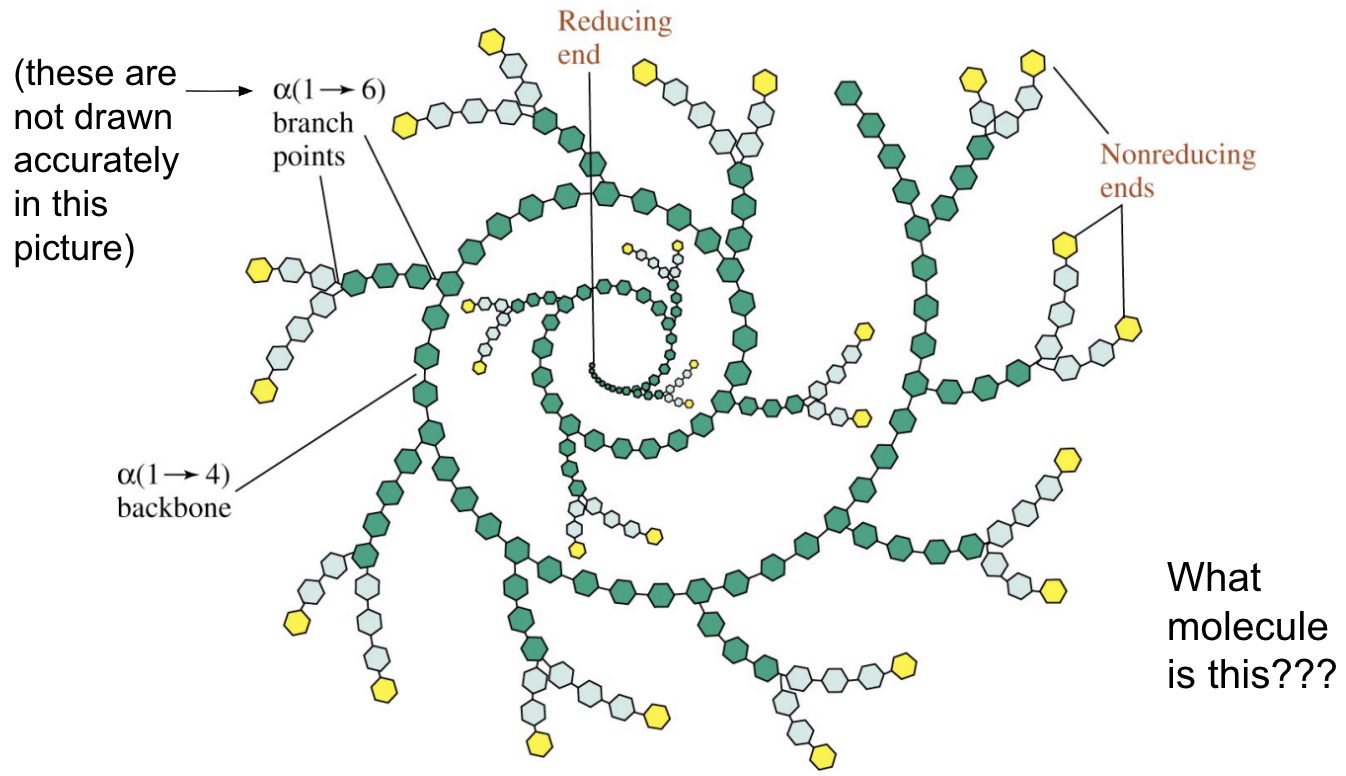
What is the major storage polysaccharide in plants?

α-amylose and amylopectin

3
New cards

What is the major storage polysaccharide in animals?

Glycogen.

4
New cards

What linkage is found in α-amylose?

α(1→4) glycosidic linkages.

5
New cards

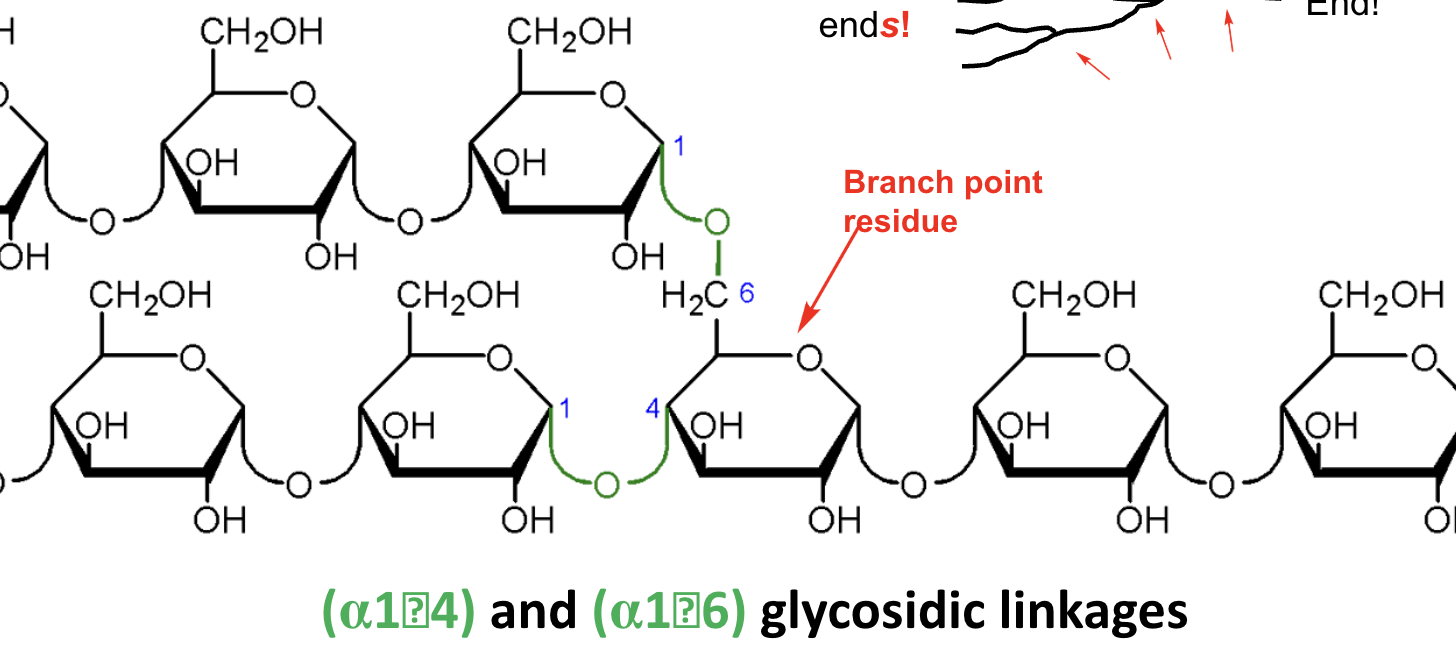
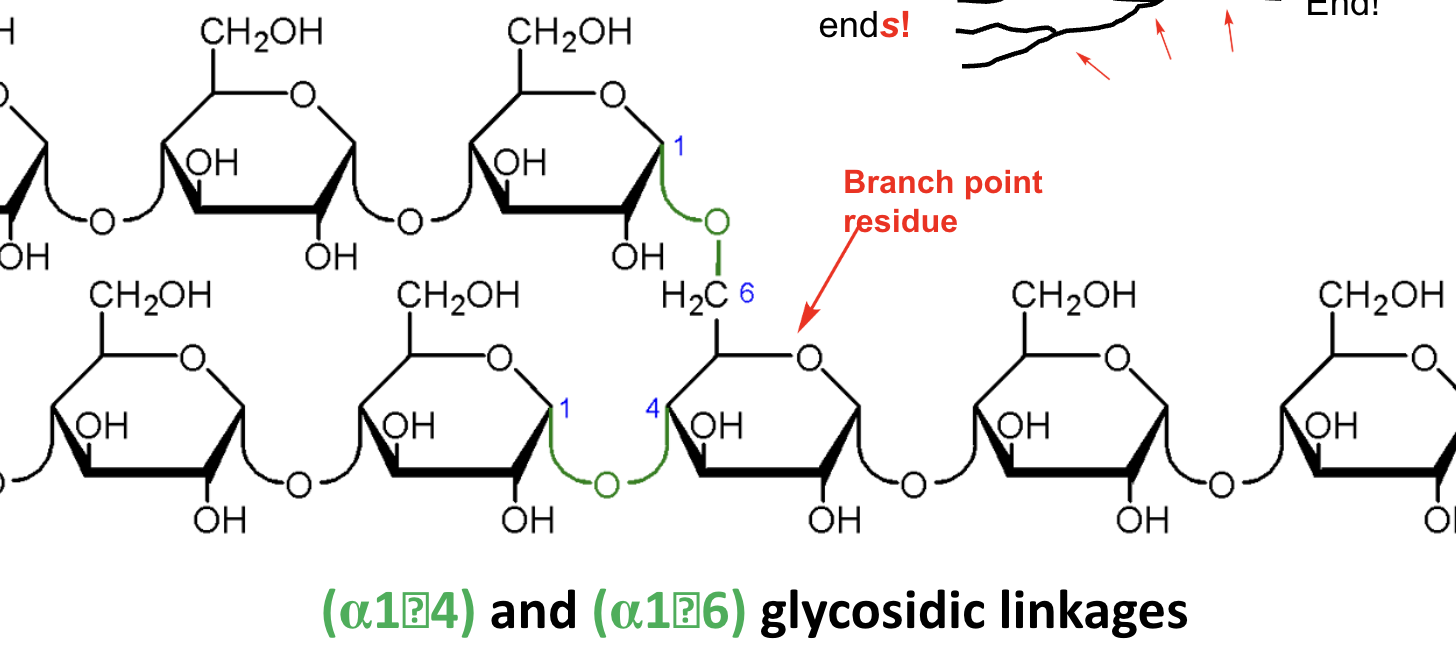
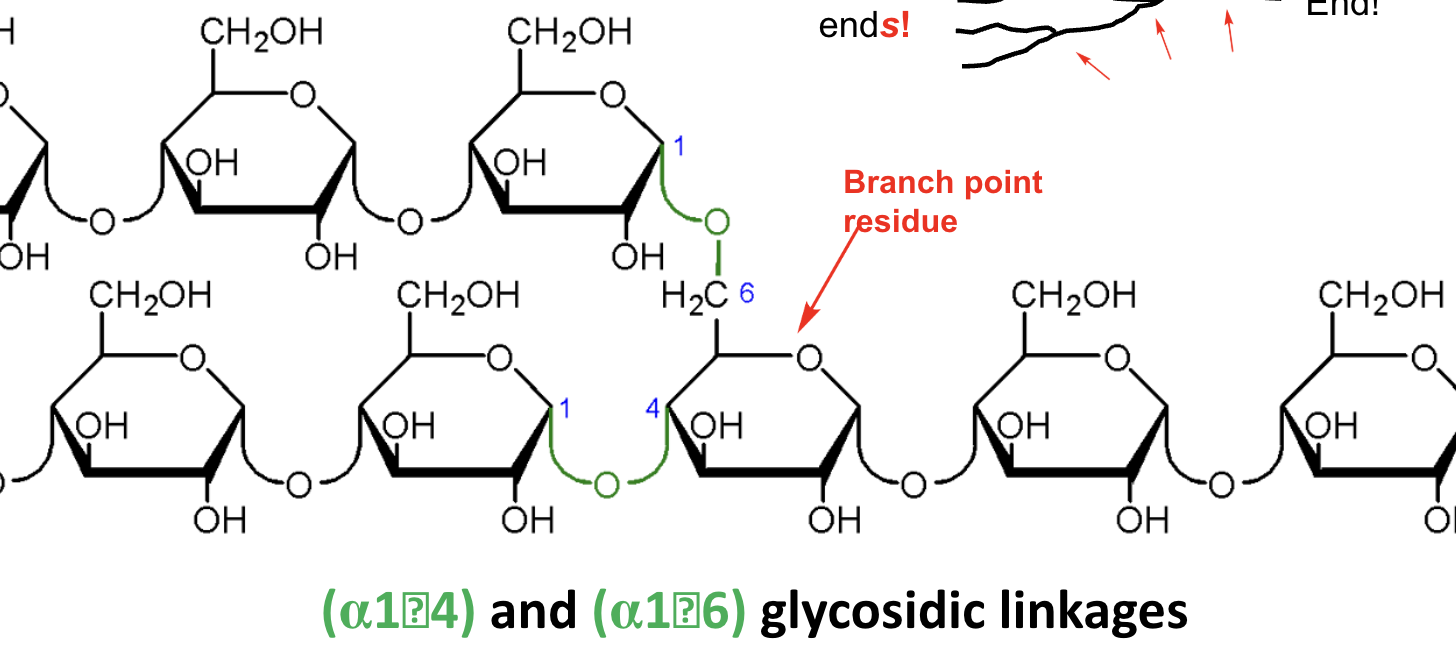
What linkages are found in amylopectin?

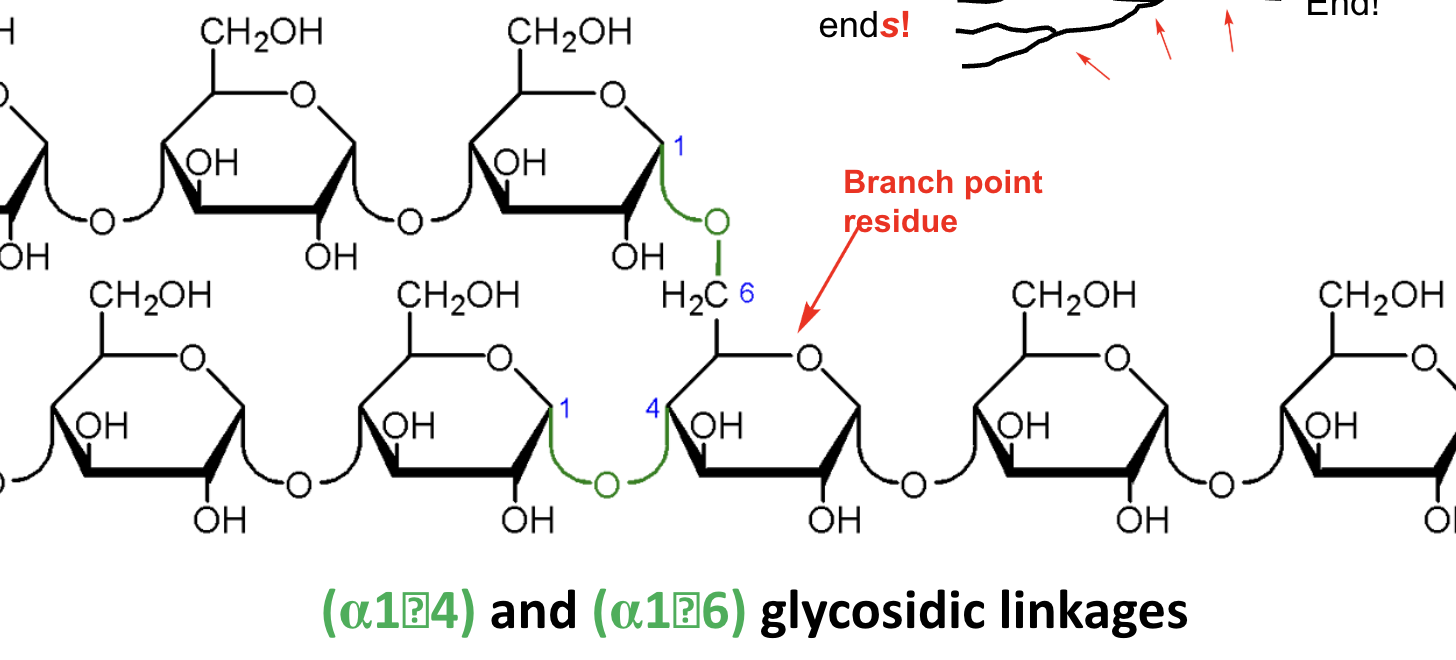
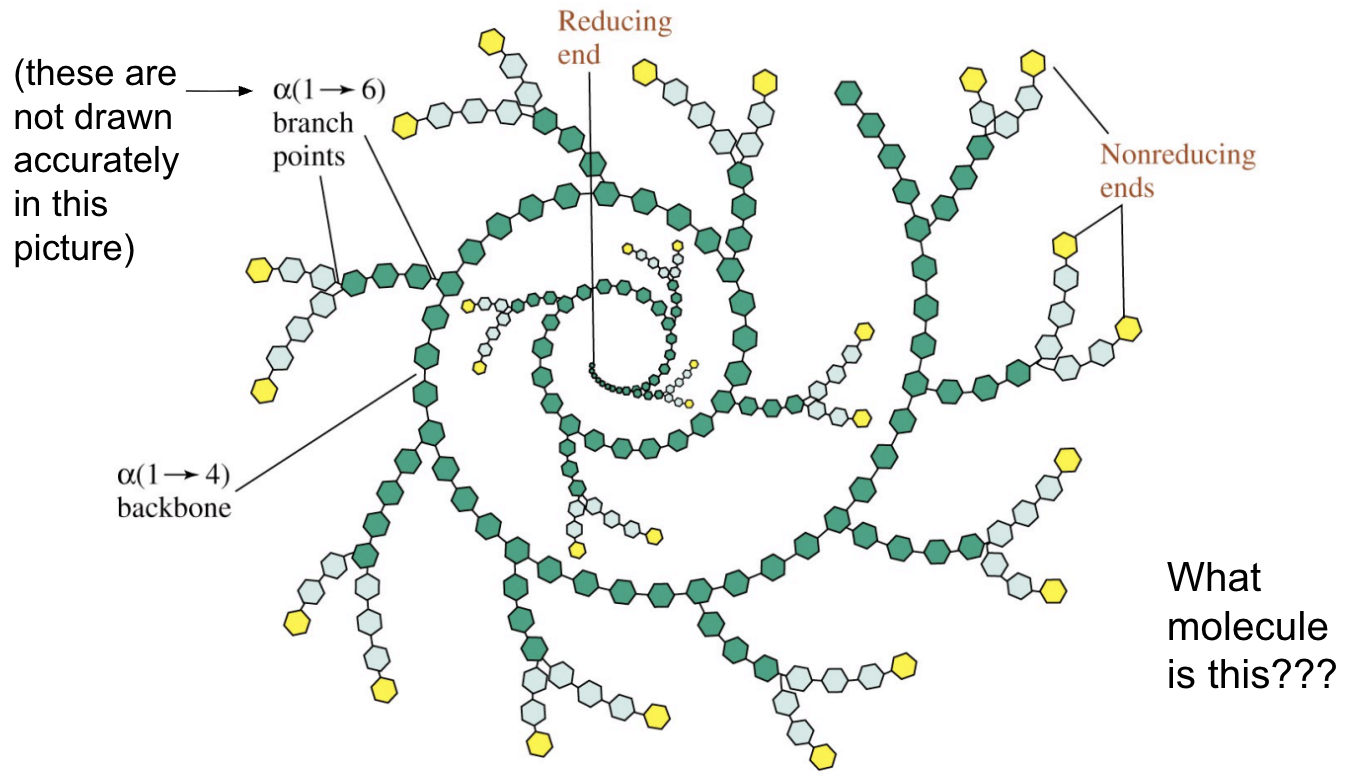
α(1→4) linkages with α(1→6) branch points every 24-30 glucose units.

6
New cards

What linkages are found in glycogen?

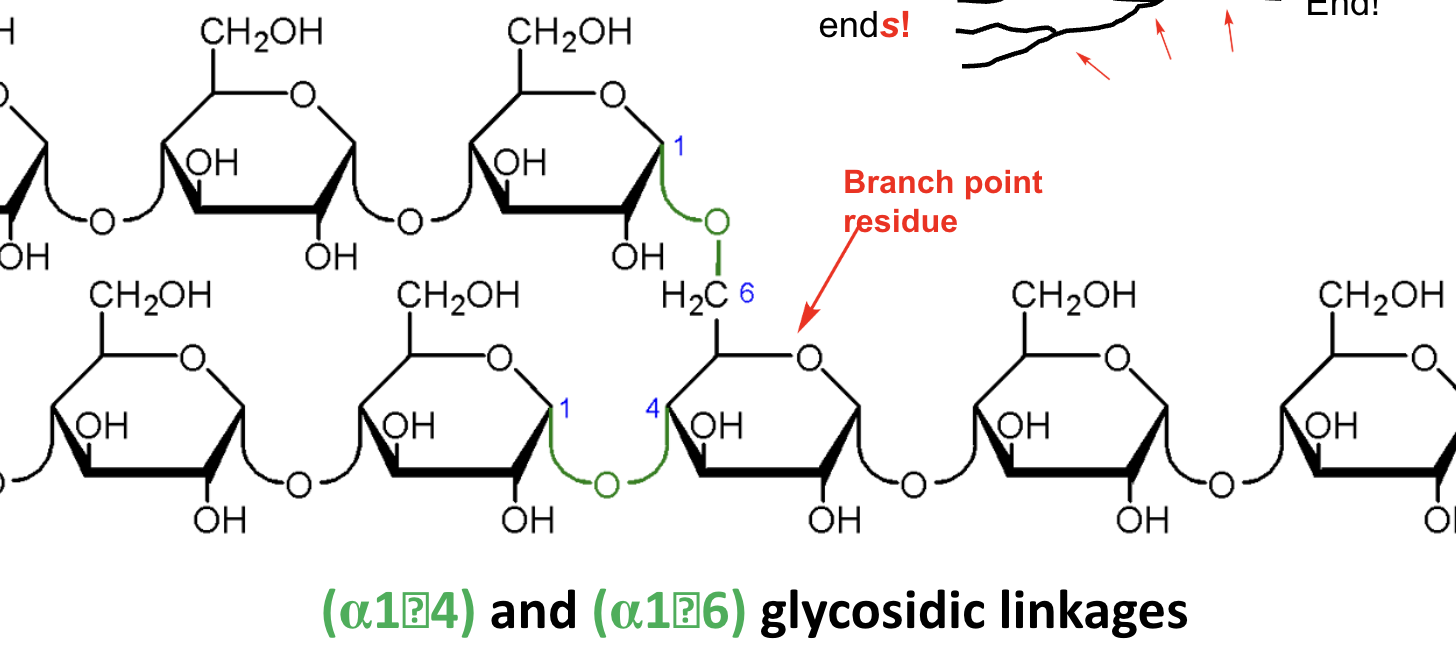
α(1→4) linkages with α(1→6) branch points every 8-12 glucose units.

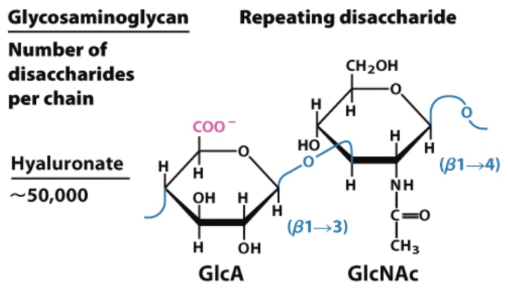
7
New cards

Which is more highly branched: amylopectin or glycogen?

Glycogen.
8
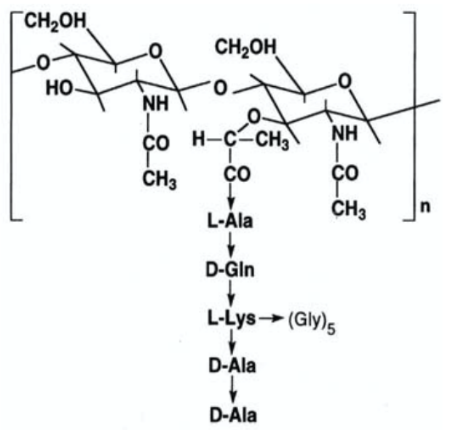
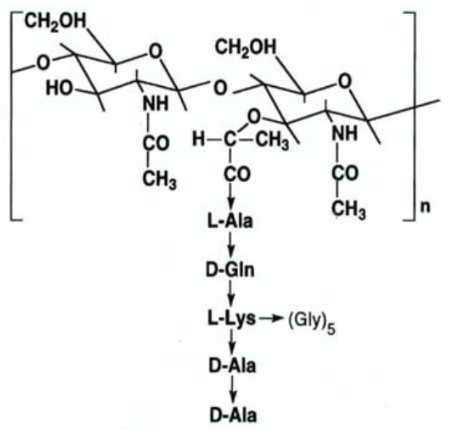
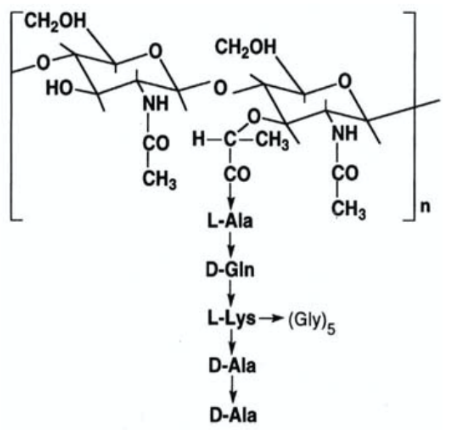
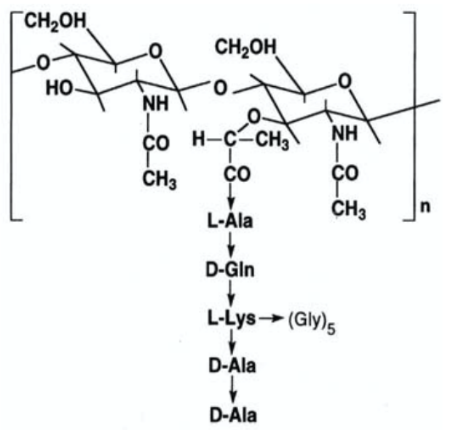
New cards
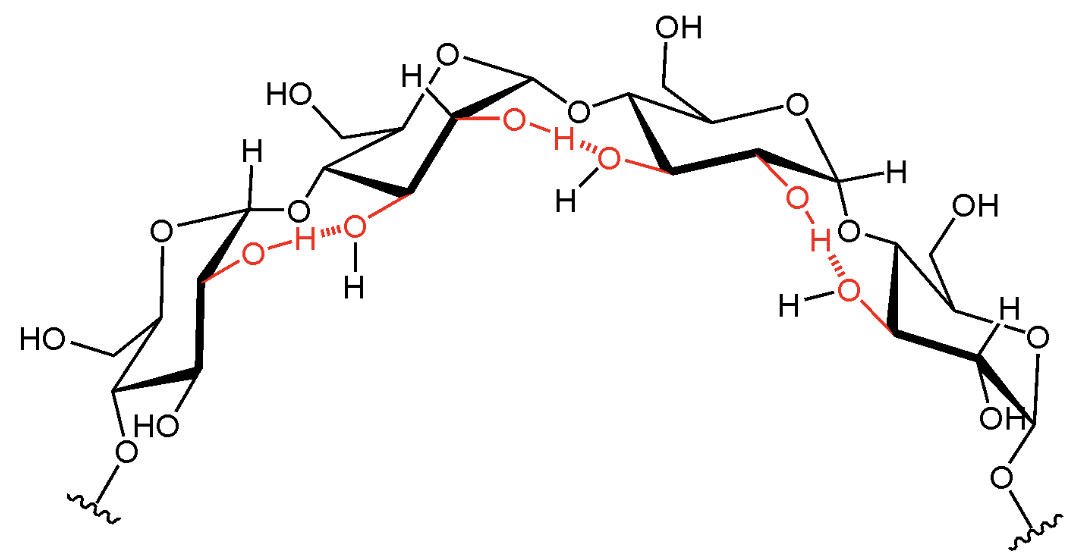
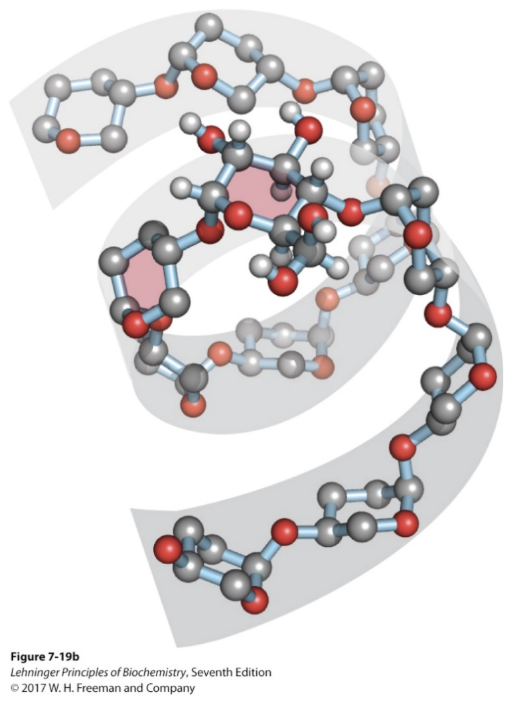
<p>What kind of glycosidic linkage gives starch (amylose) its <strong>helical</strong> shape?</p>

What kind of glycosidic linkage gives starch (amylose) its helical shape?

α(1→4) glycosidic linkages.
<p>α(1→4) glycosidic linkages.</p>
9
New cards
<p>In the <strong>most stable conformation</strong>, what overall shape does an α(1→4)-linked polysaccharide chain adopt?</p>

In the most stable conformation, what overall shape does an α(1→4)-linked polysaccharide chain adopt?

A curved left-handed helical structure.
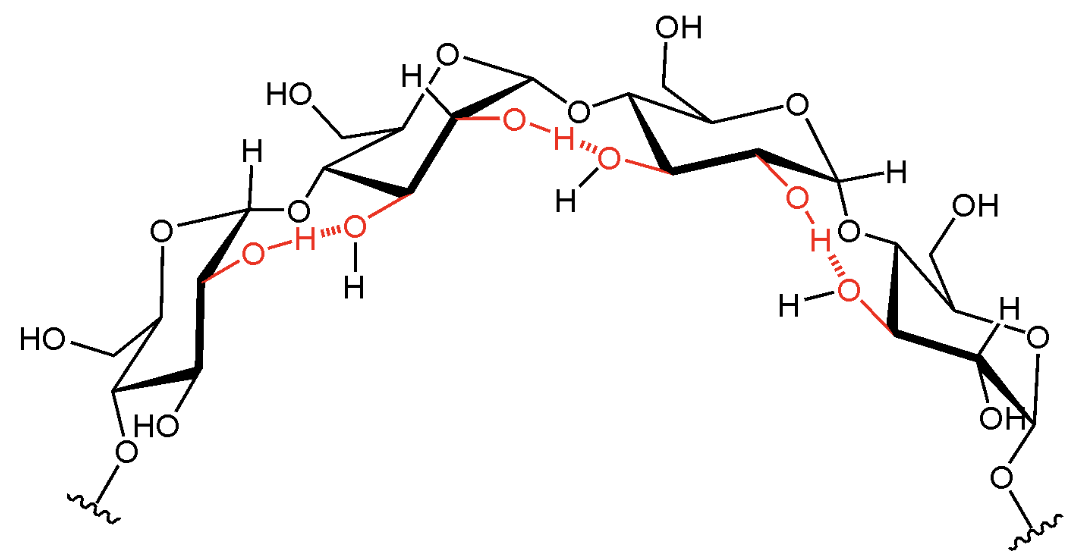
<p>A <strong>curved</strong> <strong>left-handed helical </strong>structure.</p>
10
New cards
<p>Which polysaccharides are associated with the α(1→4) left-handed helix?</p>

Which polysaccharides are associated with the α(1→4) left-handed helix?

Starch (amylose) and glycogen.
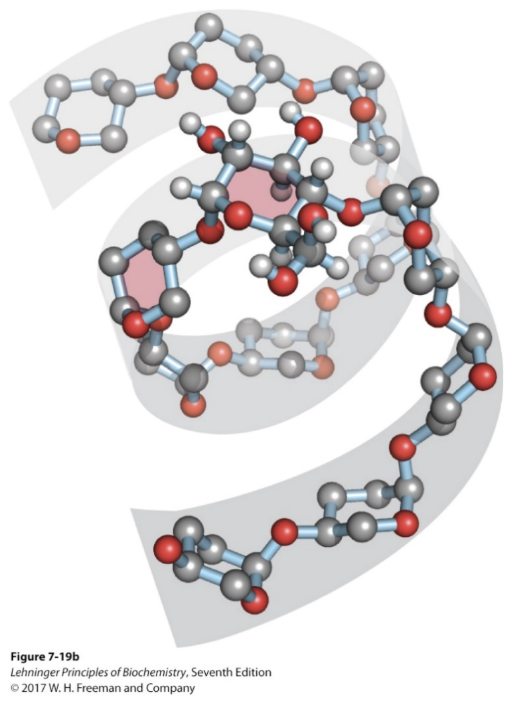
<p>Starch (amylose) and glycogen.</p>
11
New cards
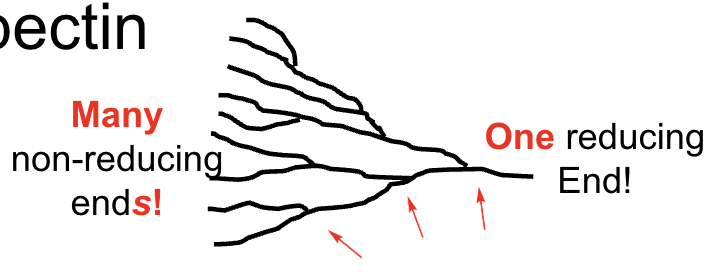
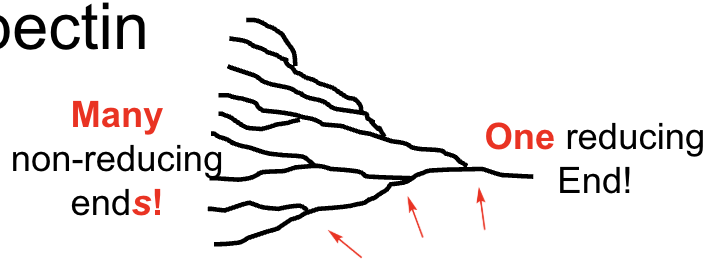
<p>How many reducing ends does amylopectin have?</p>

How many reducing ends does amylopectin have?

One reducing end.
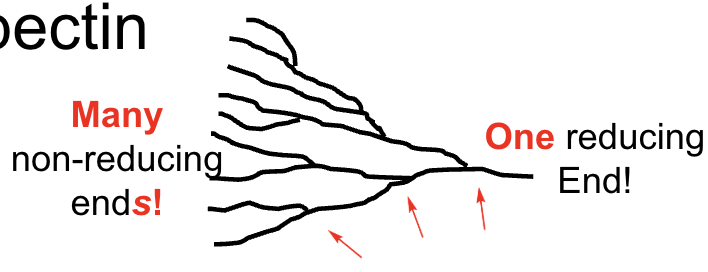
<p><strong>One</strong> reducing end.</p>
12
New cards
<p>How many non-reducing ends does amylopectin have?</p>

How many non-reducing ends does amylopectin have?

Many non-reducing ends.
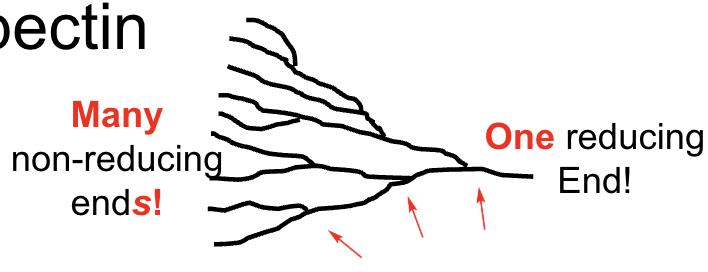
<p><strong>Many</strong> non-reducing ends.</p>
13
New cards
<p>Where are new branches formed in amylopectin or glycogen?</p>

Where are new branches formed in amylopectin or glycogen?

At α(1→6) branch-point residues.
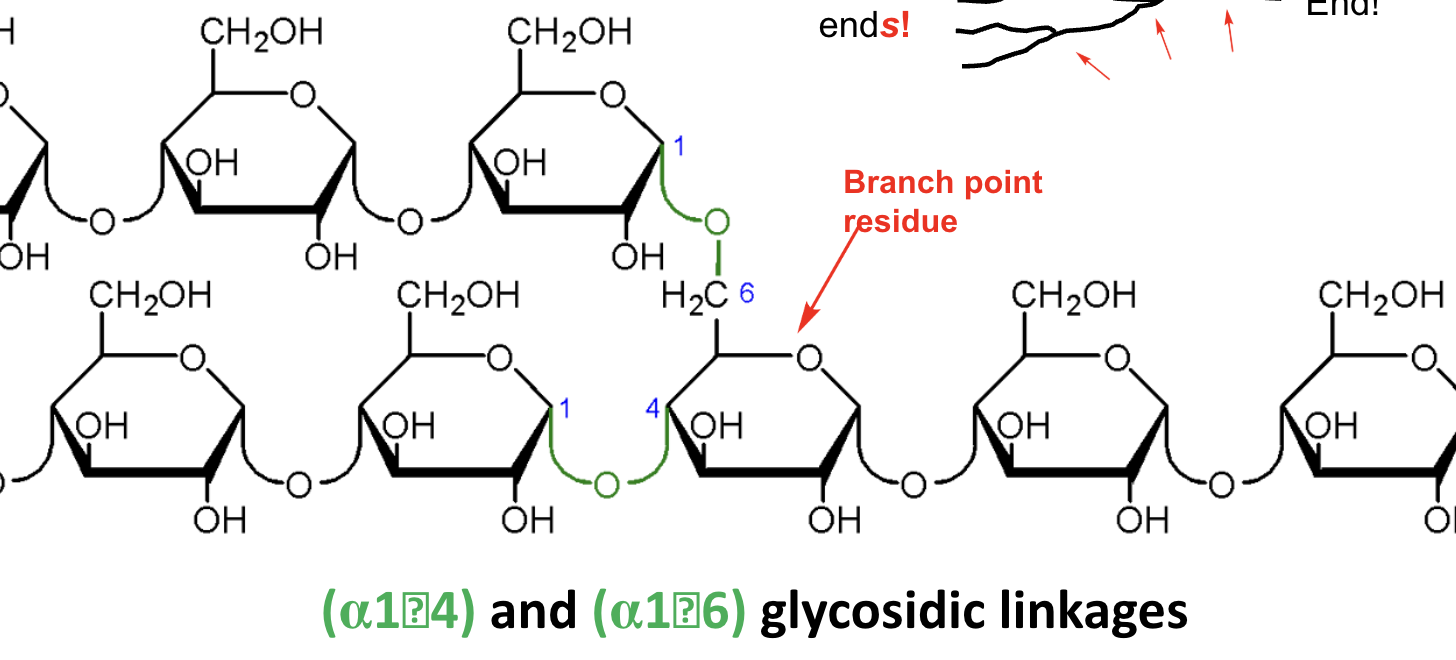
<p>At <strong>α(1→6) </strong>branch-point residues.</p>
14
New cards
<p>What are the two main glycosidic linkages in amylopectin?</p>

What are the two main glycosidic linkages in amylopectin?

α(1→4) and α(1→6).
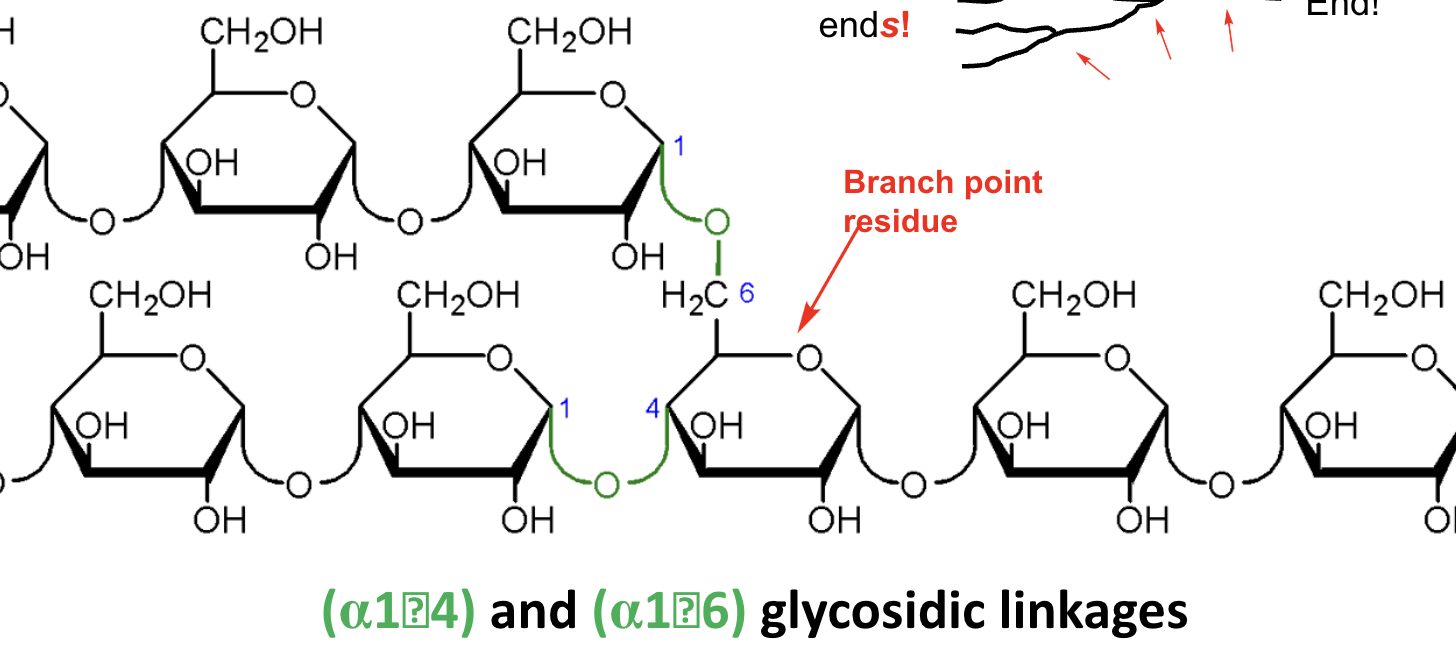
<p>α(1→4) and α(1→6).</p>
15
New cards

What does the branch frequency ratio for amylopectin look like?

24–30 to 1.
<p>24–30 to 1.</p>
16
New cards
<p>What does the branch frequency ratio for <strong>glycogen</strong> look like?</p>

What does the branch frequency ratio for glycogen look like?

8–12 to 1.
<p>8–12 to 1.</p>
17
New cards
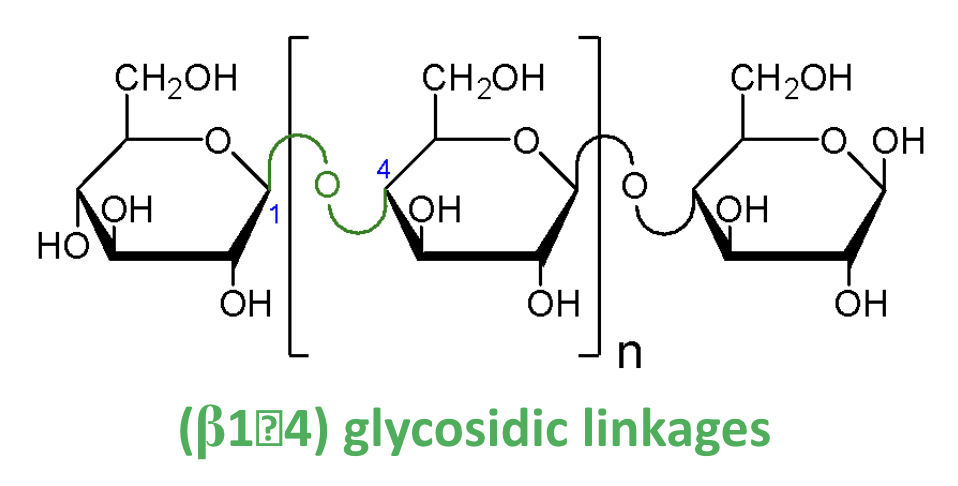
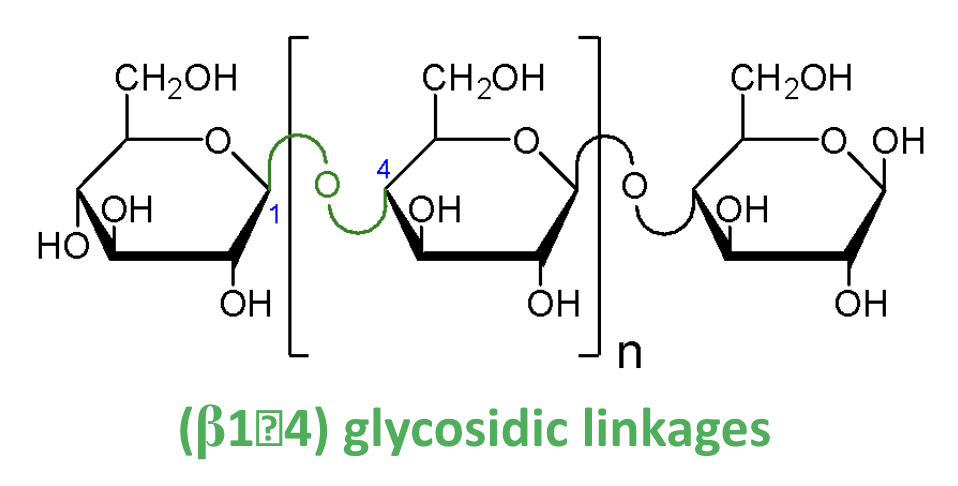
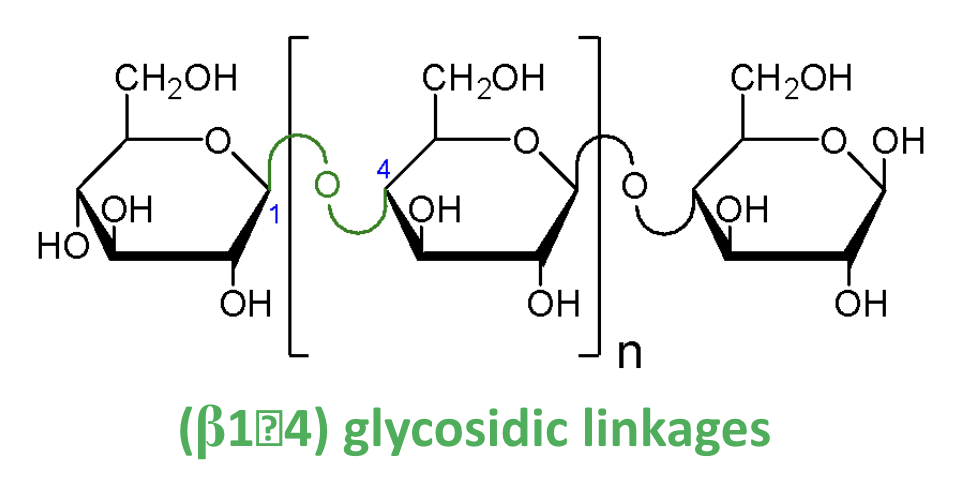
<p>What kind of linkage does <strong>cellulose</strong> have?</p>

What kind of linkage does cellulose have?

β(1→4) glycosidic linkages.
<p><strong>β(1→4)</strong> glycosidic linkages.</p>
18
New cards
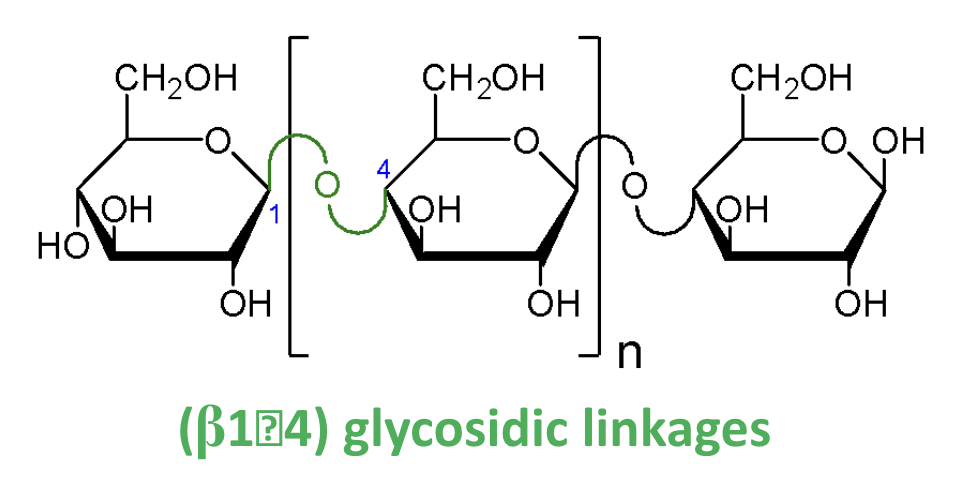
<p>What happens to alternating glucose residues in cellulose?</p>

What happens to alternating glucose residues in cellulose?

They are flipped 180 degrees.
<p>They are flipped 180 degrees.</p>
19
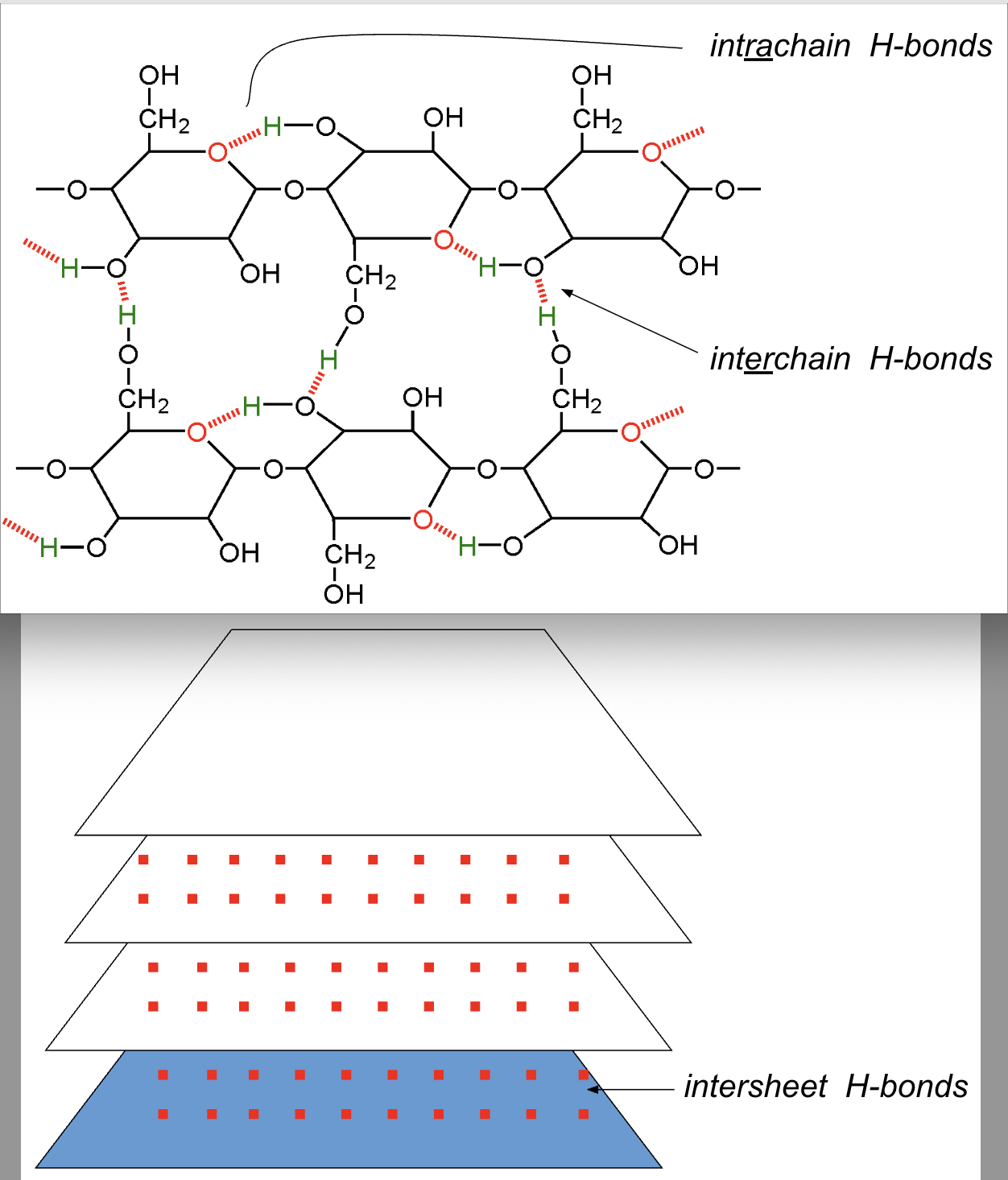
New cards
<p>What is the important property of cellulose? And what kinds of those abilities does cellulose show?</p>

What is the important property of cellulose? And what kinds of those abilities does cellulose show?

HUGE hydrogen-bonding ability: Intra-chain, inter-chain, and inter-sheet hydrogen bonding.
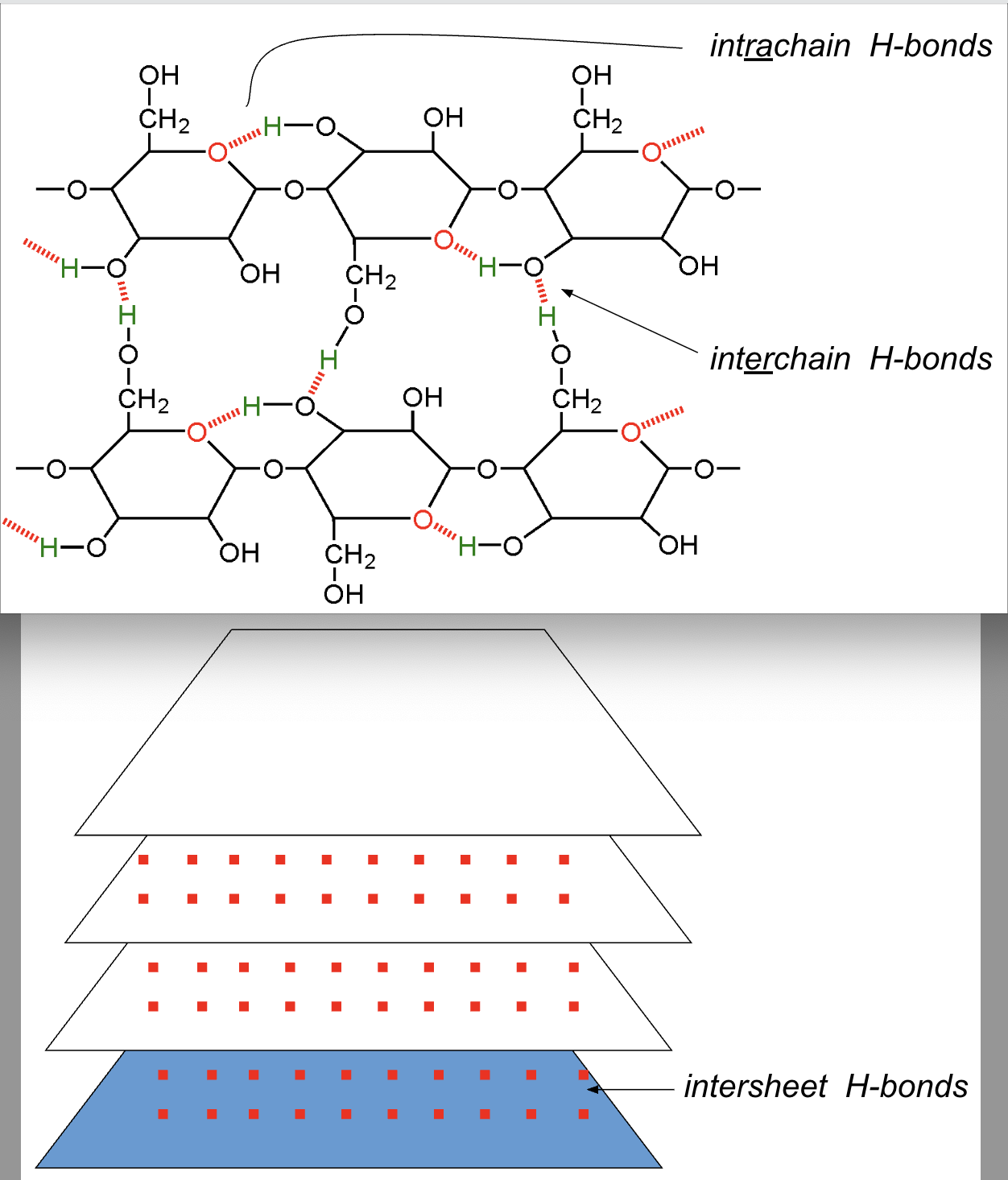
<p><strong>HUGE hydrogen-bonding ability</strong>: Intra-chain, inter-chain, and inter-sheet hydrogen bonding.</p>
20
New cards
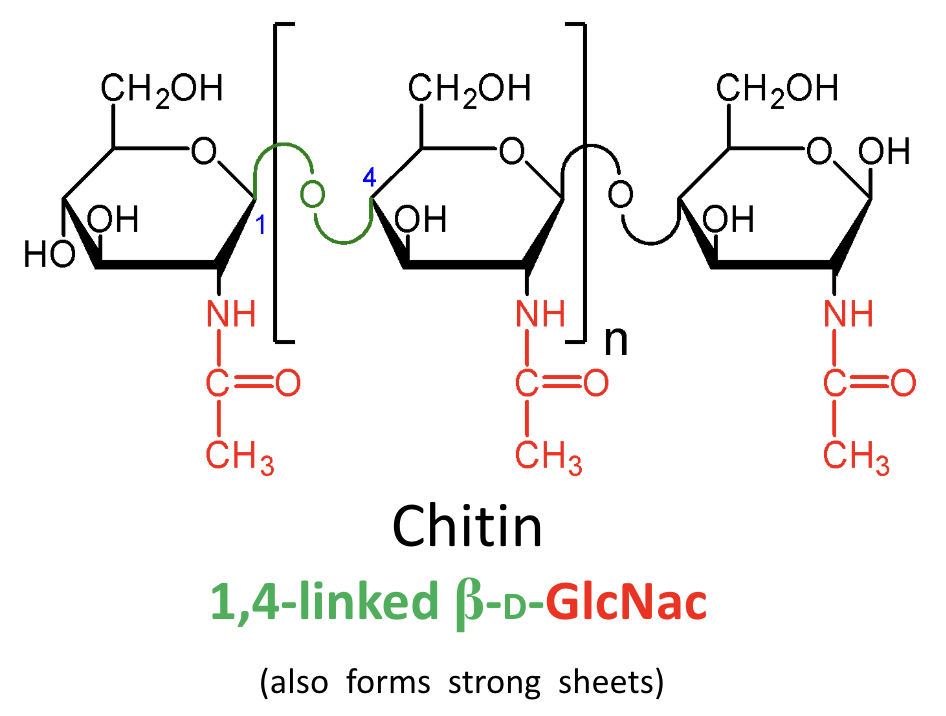
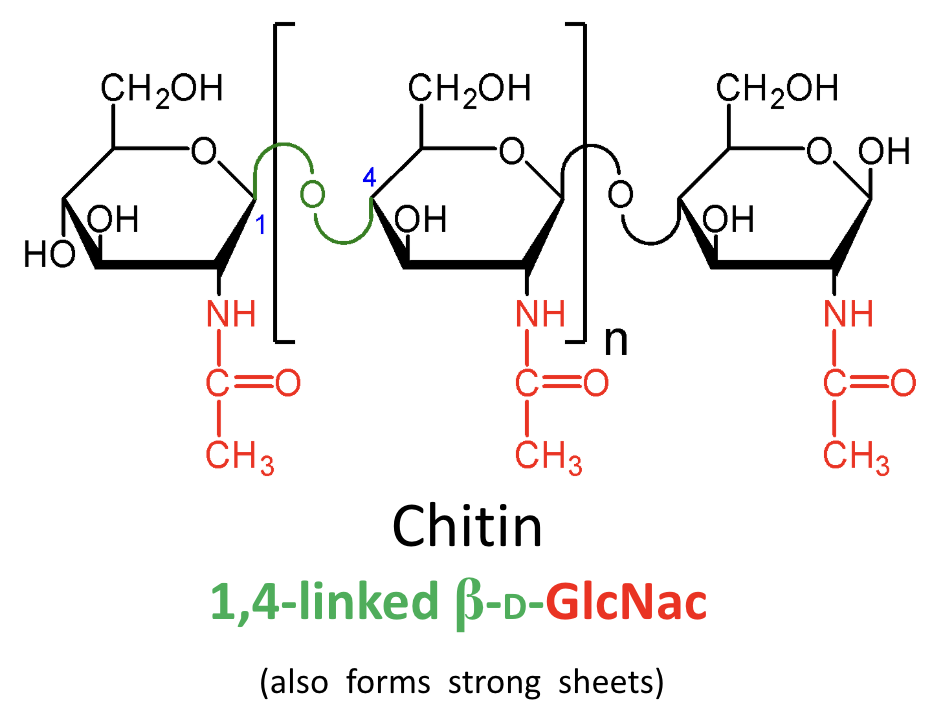
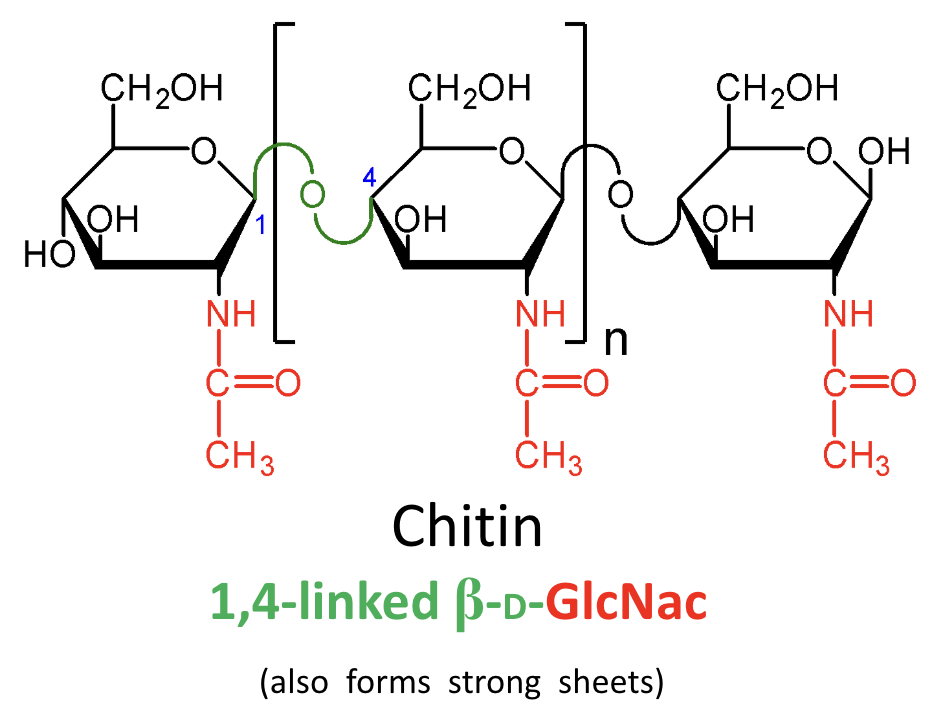
<p>What linkage does chitin have?</p>

What linkage does chitin have?

β(1→4) linkages.
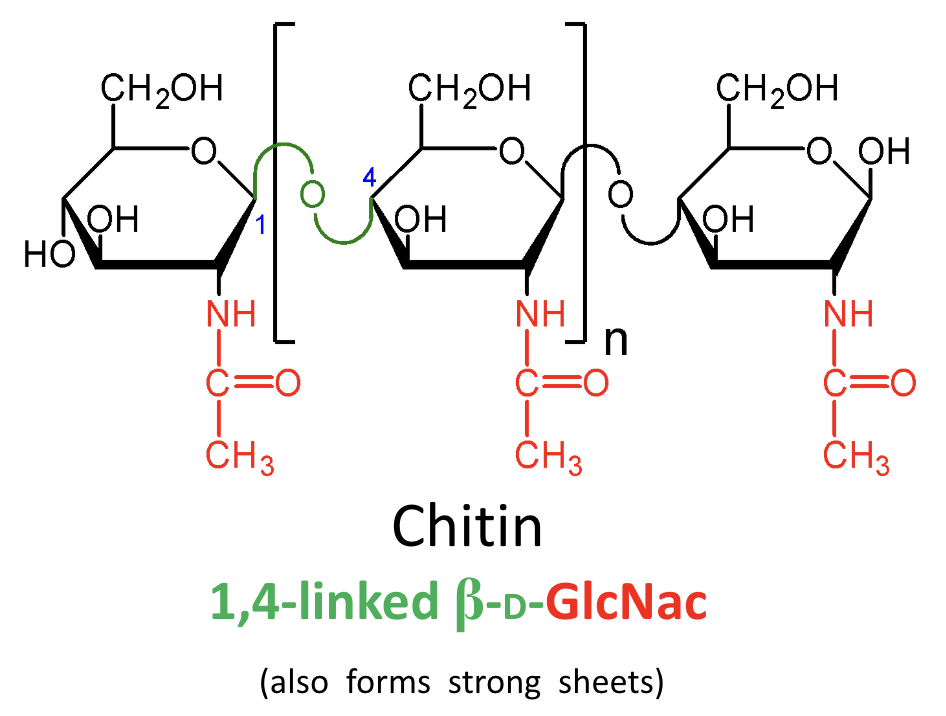
<p><strong>β(1→4)</strong> linkages.</p>
21
New cards
<p>What monosaccharide derivative is found in chitin?</p>

What monosaccharide derivative is found in chitin?

N-acetyl-glucosamine (GlcNAc)
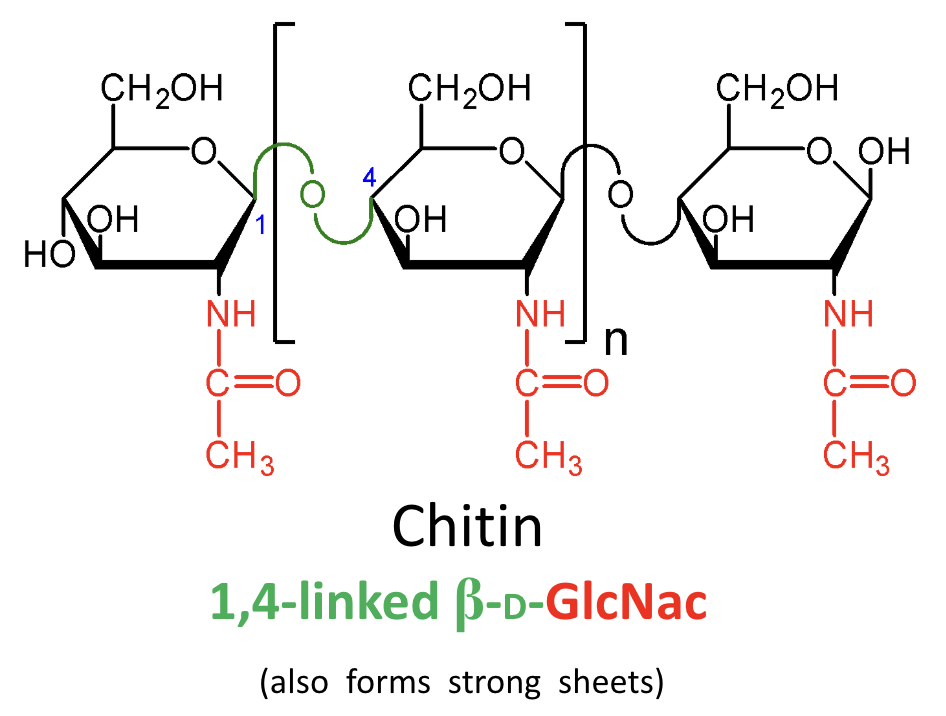
<p><strong>N-acetyl-glucosamine (GlcNAc)</strong></p>
22
New cards
<p>How does chitin differ from cellulose at C2?</p>

How does chitin differ from cellulose at C2?

Chitin has -NHCOCH3 at C2 instead of -OH.
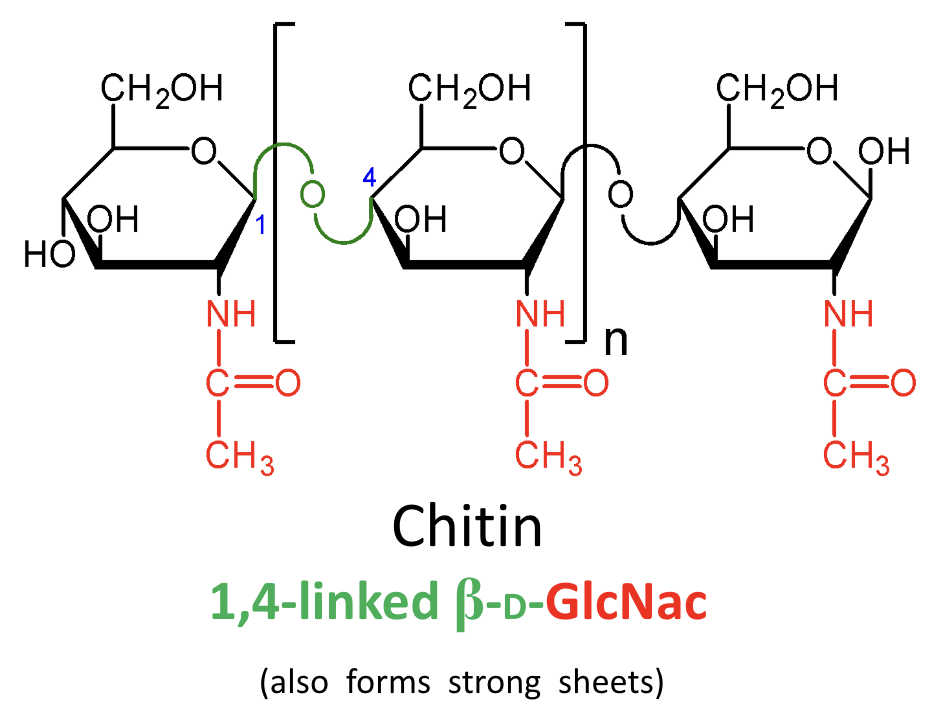
<p>Chitin has -NHCOCH3 at C2 instead of -OH.</p>
23
New cards
<p>What does linkage affect in polysaccharides?</p>

What does linkage affect in polysaccharides?

Structure and bulk properties.
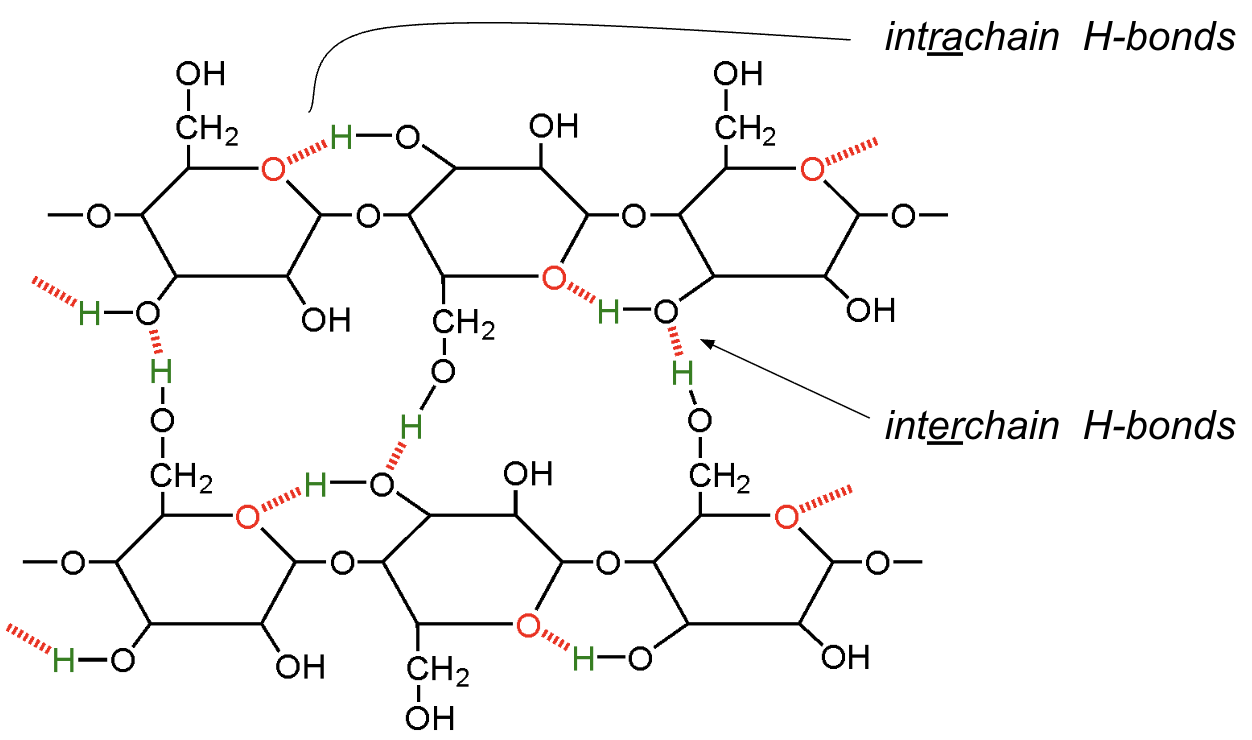
<p>Structure and bulk properties.</p>
24
New cards
<p>What does hydrogen bonding affect?</p>

What does hydrogen bonding affect?

Rotations around bonds and the bulk properties of the polysaccharide.
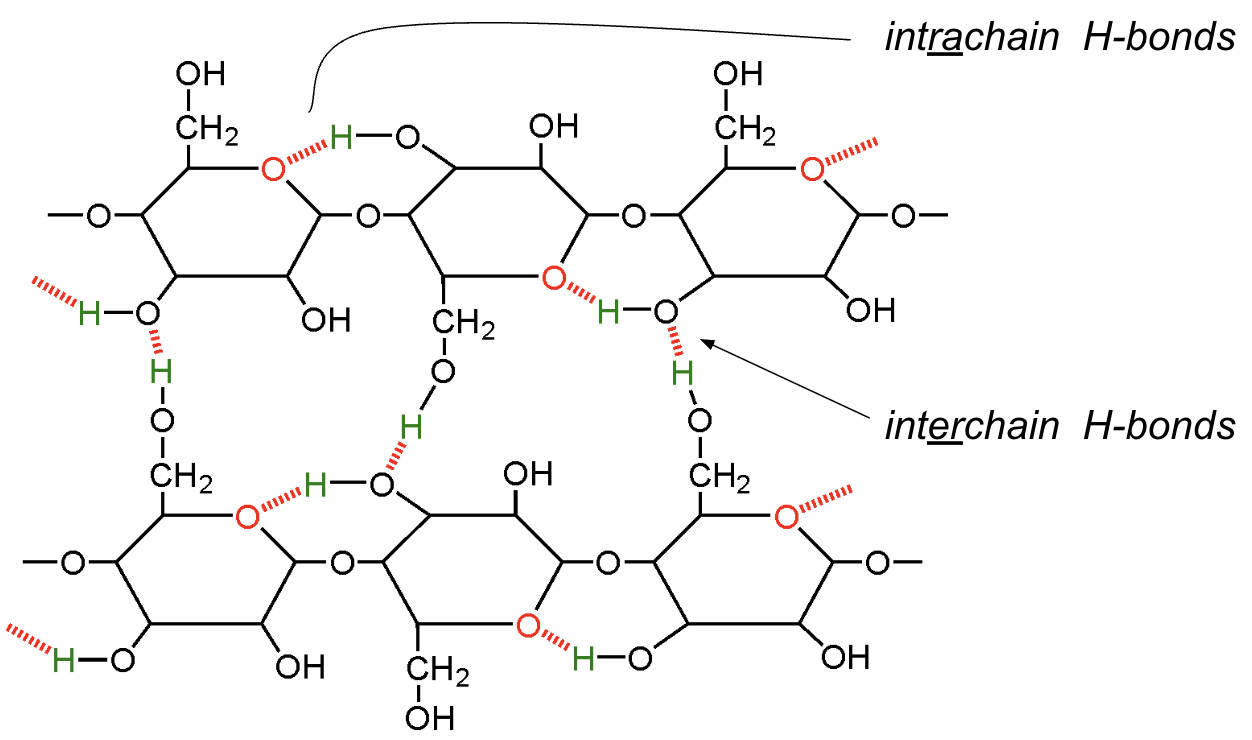
<p>Rotations around bonds and the bulk properties of the polysaccharide.</p>
25
New cards
<p>What do β linkages allow between adjacent residues?</p>

What do β linkages allow between adjacent residues?

Hydrogen bonds.
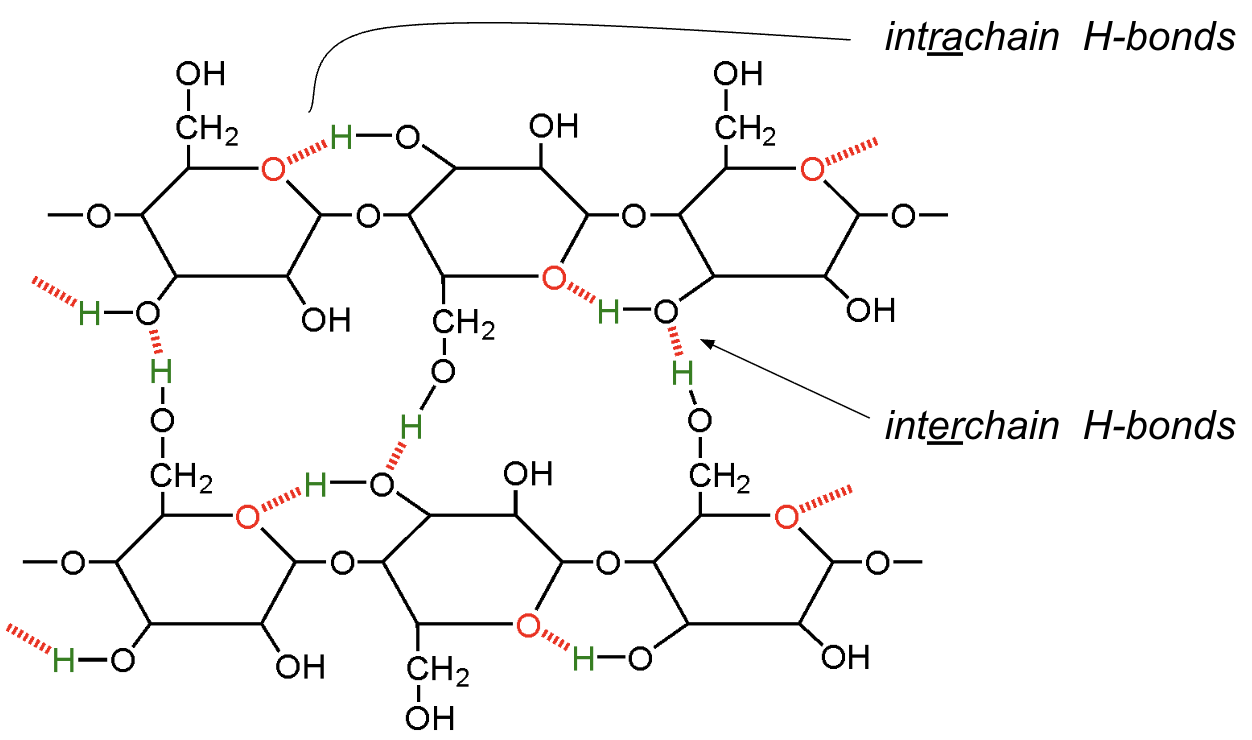
<p>Hydrogen bonds.</p>
26
New cards
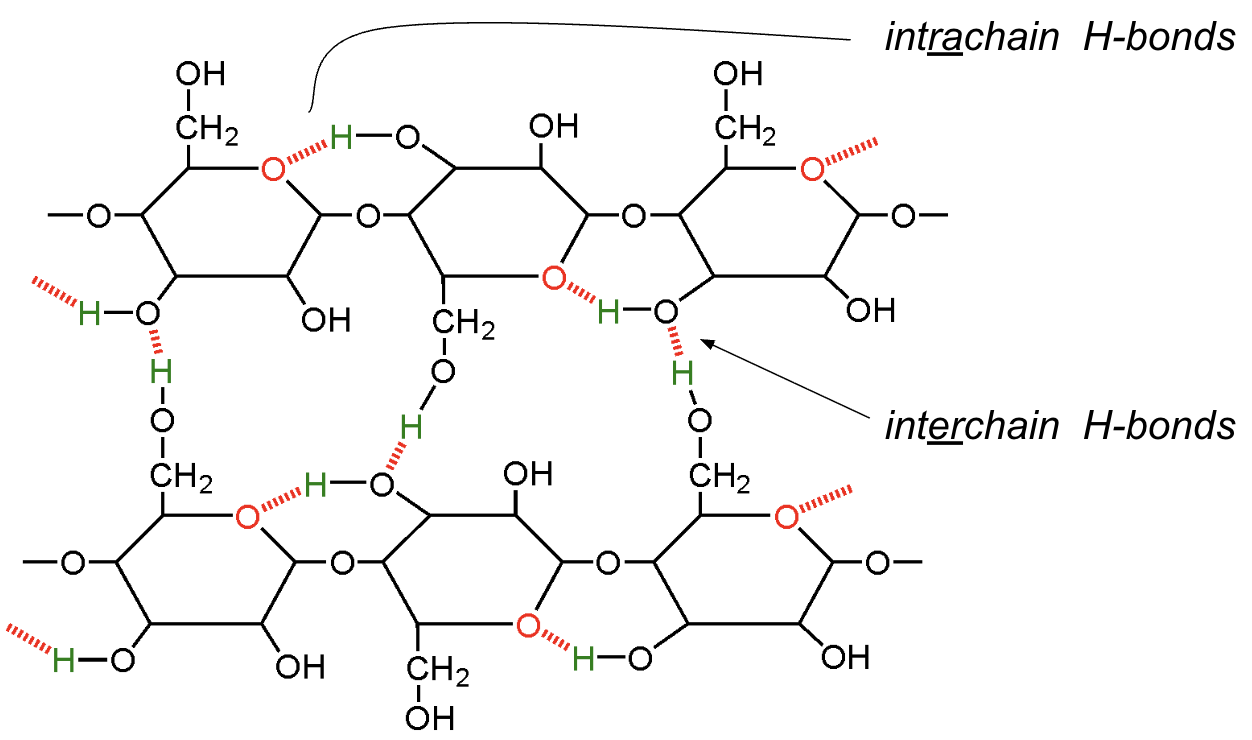
<p>Why can cellulose form strong sheets?</p>

Why can cellulose form strong sheets?

Because cellulose ribbons lie side by side and are held together by extensive interchain hydrogen bonds.
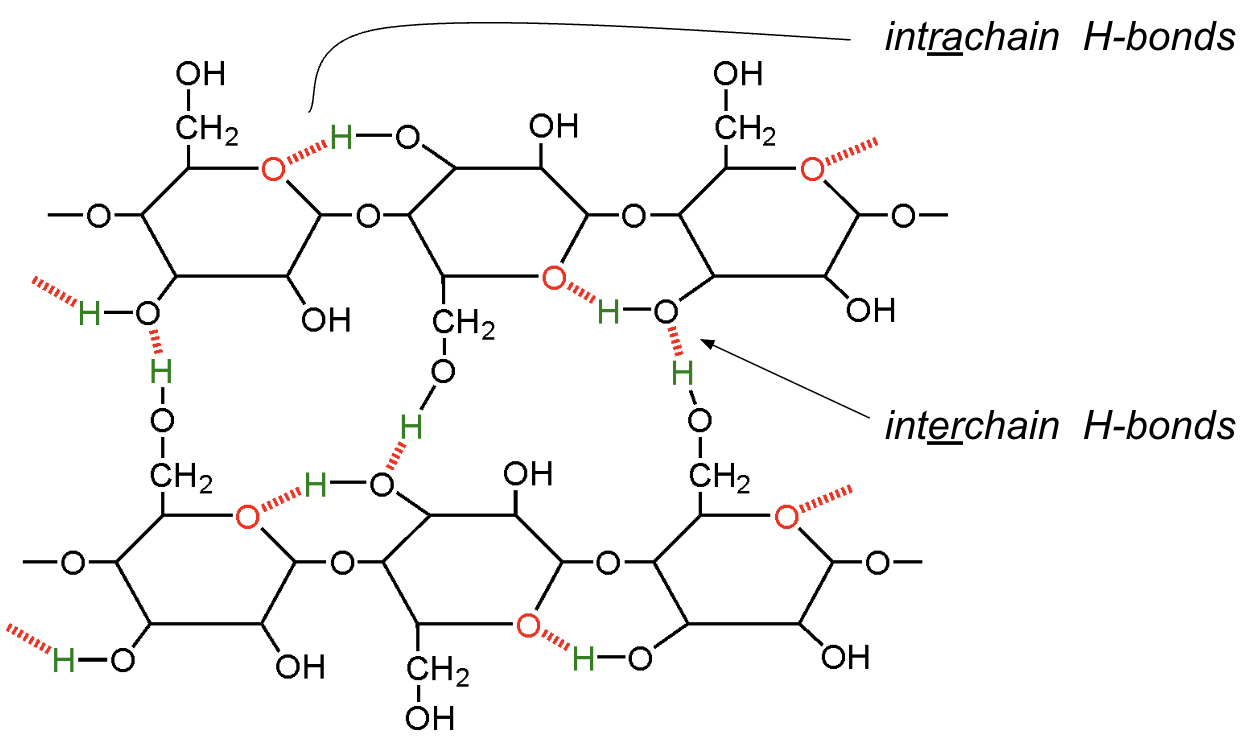
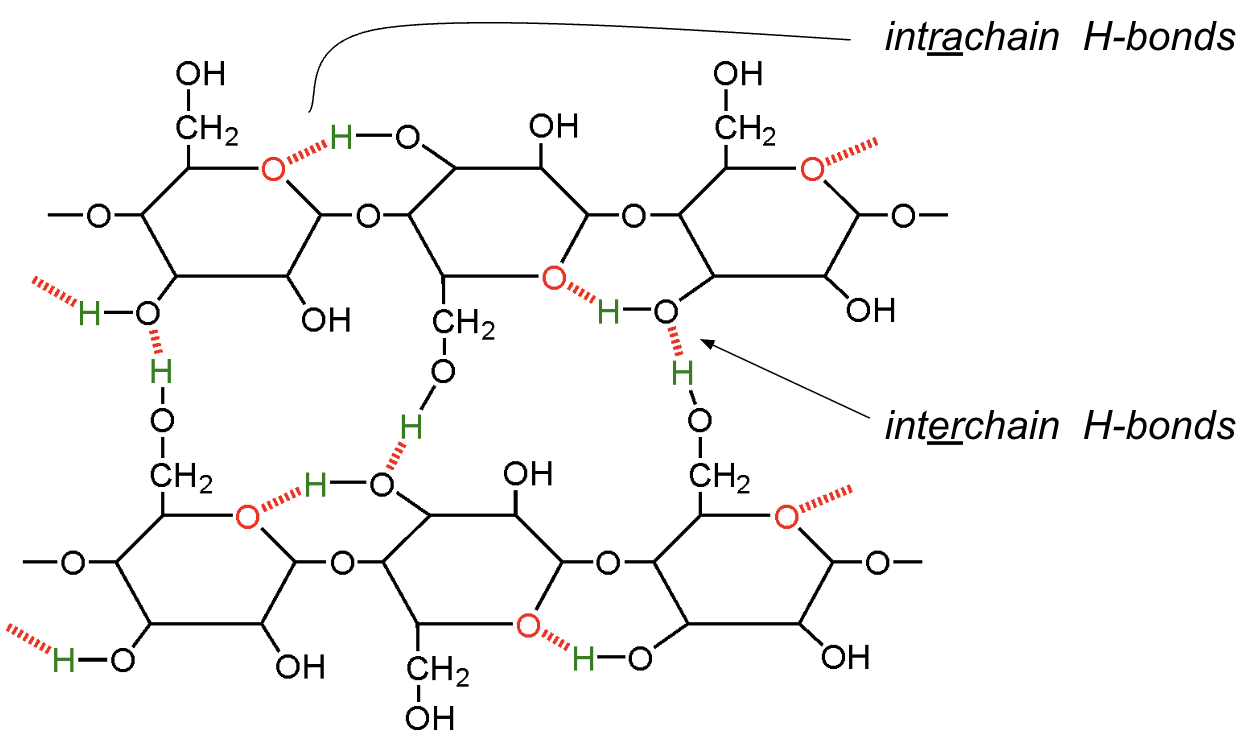
<p>Because cellulose <strong>ribbons</strong> <strong>lie side by side</strong> and are held together by <strong>extensive</strong> <strong>interchain</strong> hydrogen bonds.</p>
27
New cards
<p>What holds cellulose ribbons together in a sheet?</p>

What holds cellulose ribbons together in a sheet?

Extensive interchain hydrogen bonds.
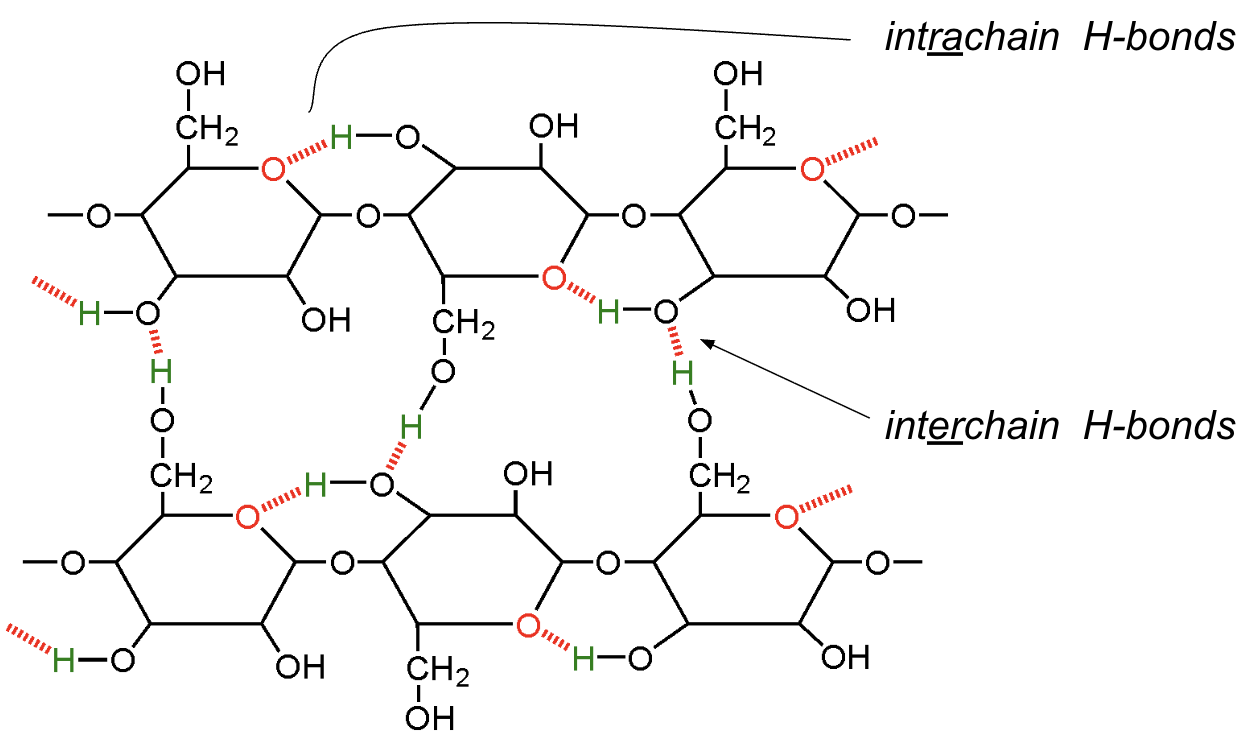
<p>Extensive interchain hydrogen bonds.</p>
28
New cards
<p>What type of hydrogen bonds are present within a single cellulose chain?</p>

What type of hydrogen bonds are present within a single cellulose chain?

Intrachain hydrogen bonds.
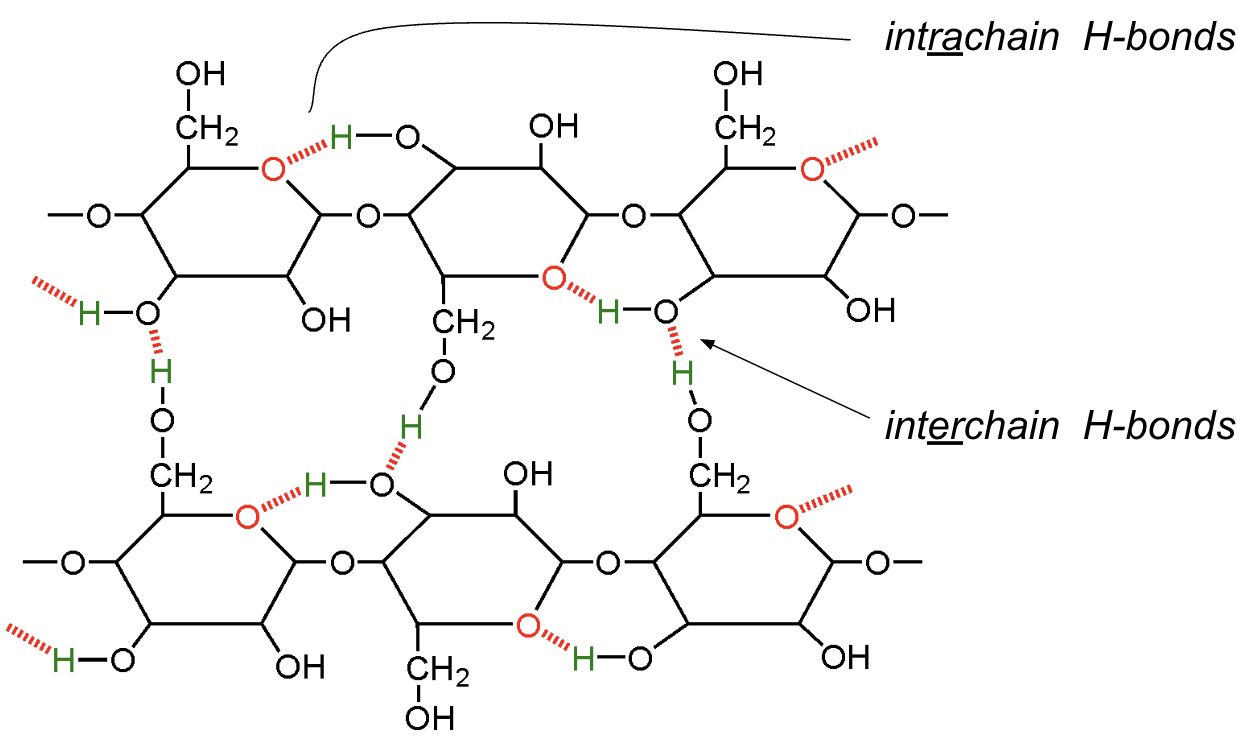
<p><strong>Intrachain</strong> hydrogen bonds.</p>
29
New cards
<p>What type of hydrogen bonds are present between neighboring cellulose chains?</p>

What type of hydrogen bonds are present between neighboring cellulose chains?

Interchain hydrogen bonds.
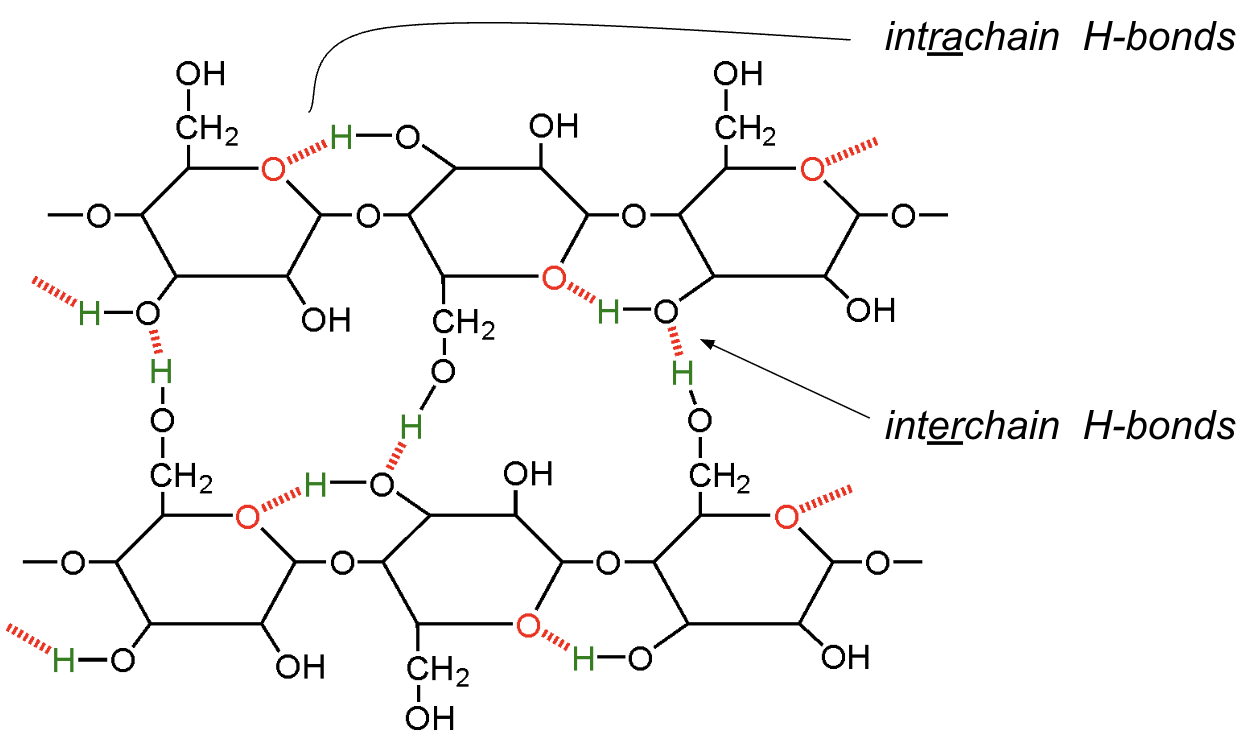
<p>Interchain hydrogen bonds.</p>
30
New cards
<p>What can cellulose sheets do to each other?</p>

What can cellulose sheets do to each other?

Hydrogen-bond to each other to form a 3-D lattice.
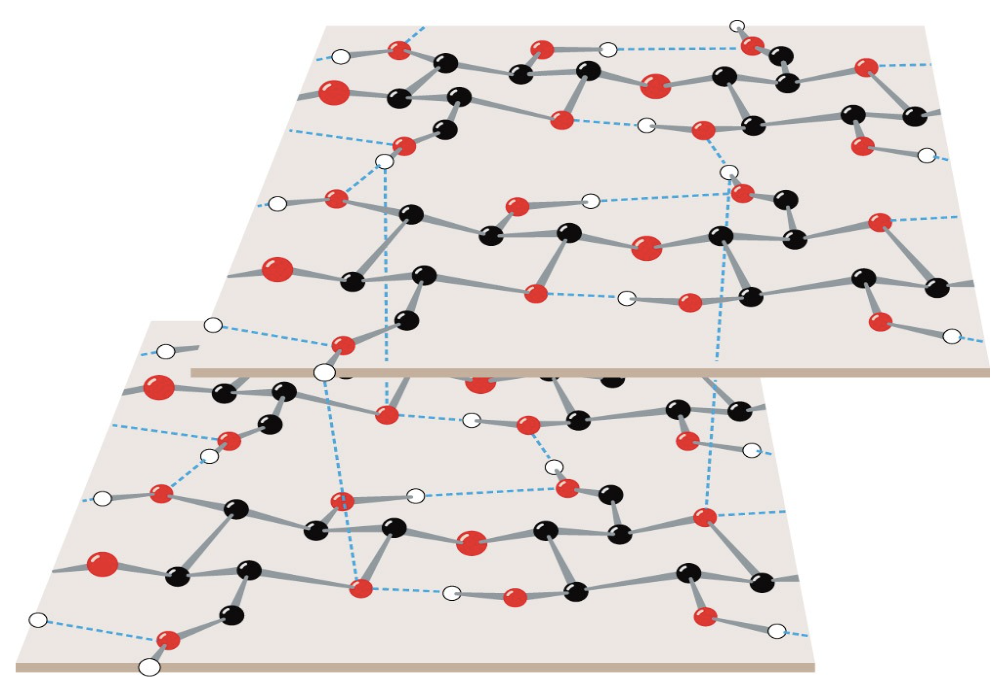
<p>Hydrogen-bond to each other to form a 3-D lattice.</p>
31
New cards
<p>What larger structure can cellulose sheets form?</p>

What larger structure can cellulose sheets form?

A 3-D lattice.
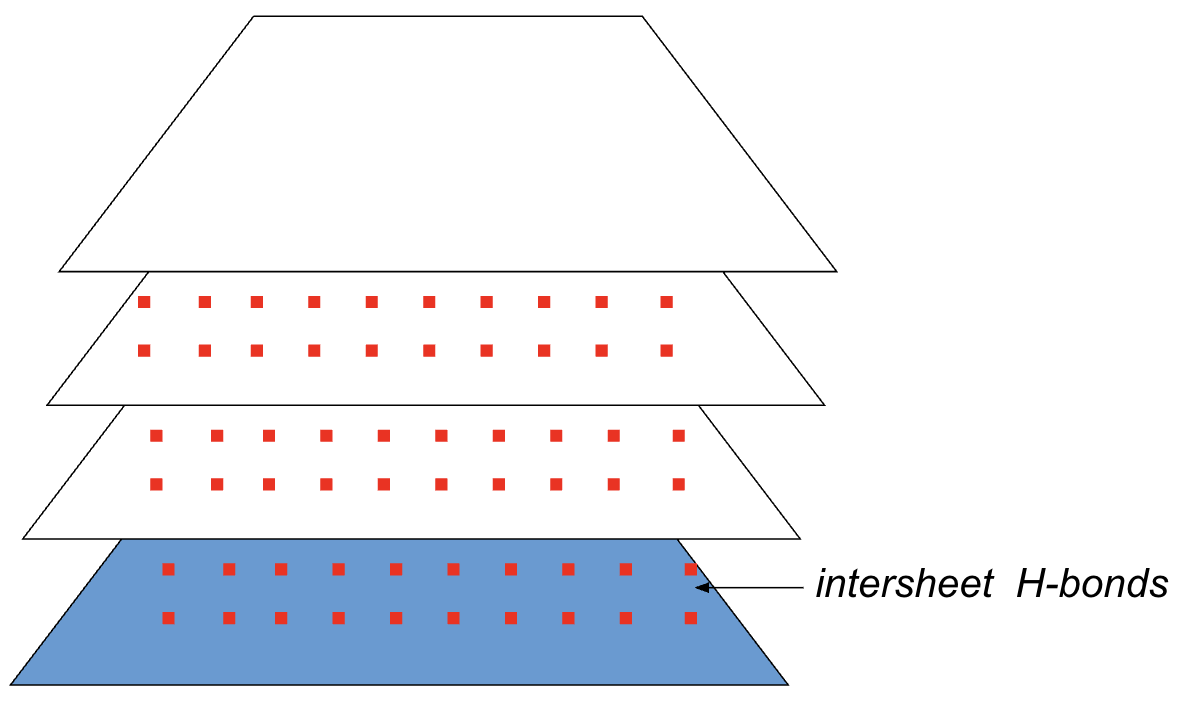
<p>A 3-D lattice.</p>
32
New cards

Which kind of linkage tends to support adjacent-residue hydrogen bonding?

β linkages.

33
New cards

What are homopolysaccharides? And what are they used for?

Polysaccharides with 1 repeating sugar unit; energy storage and structural elements.

34
New cards

What are heteropolysaccharides? And what are they used for?

Polysaccharides with more than 1 repeating structural unit and often other molecules; extracellular support in all kingdoms.
35
New cards
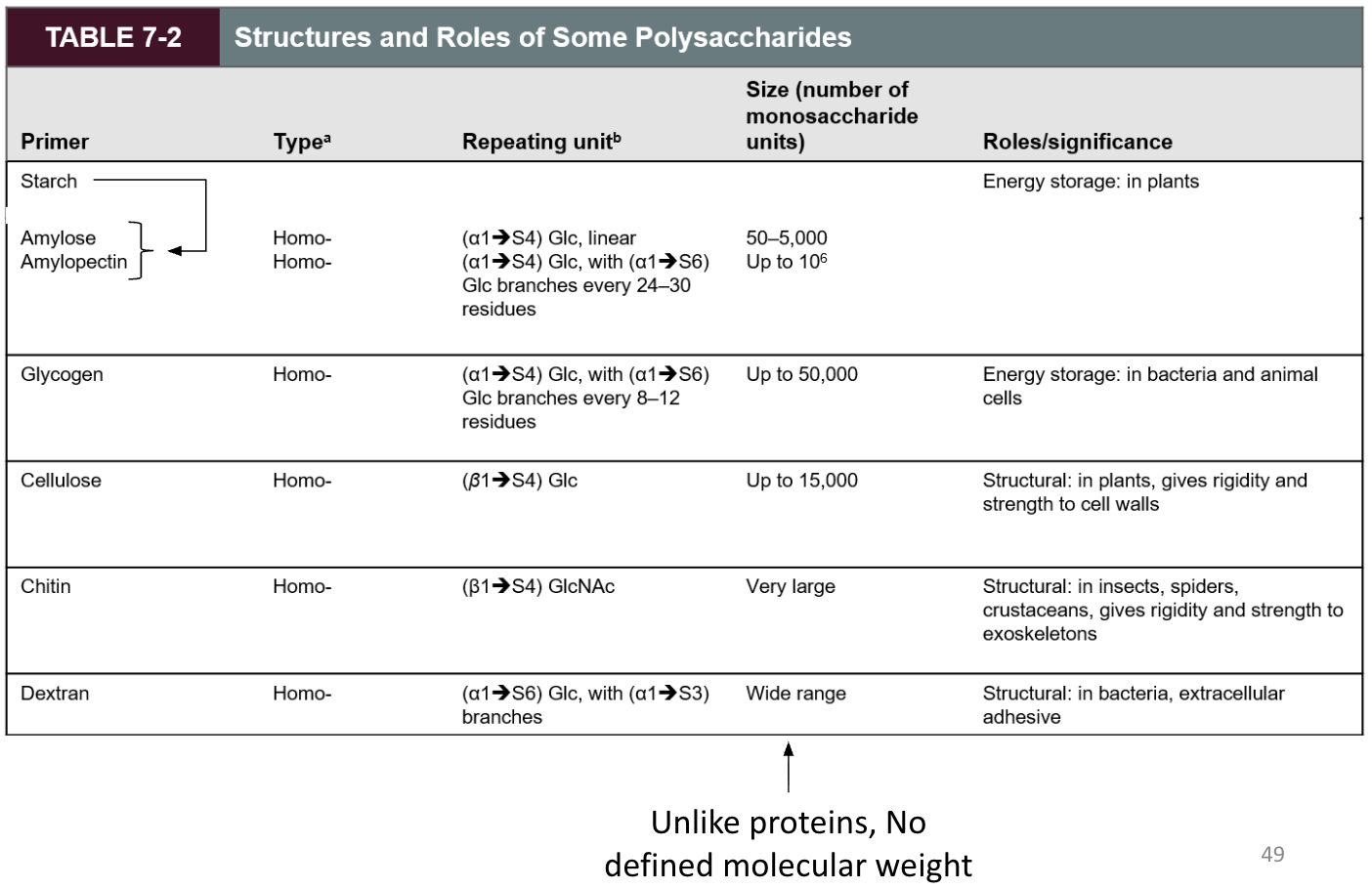
<p>What kind of polysaccharide is <strong>starch</strong>?</p>

What kind of polysaccharide is starch?

A homopolysaccharide.
<p>A <strong>homo</strong>polysaccharide.</p>
36
New cards
<p>What are the two major forms of <strong>starch</strong>?</p>

What are the two major forms of starch?

Amylose and amylopectin.
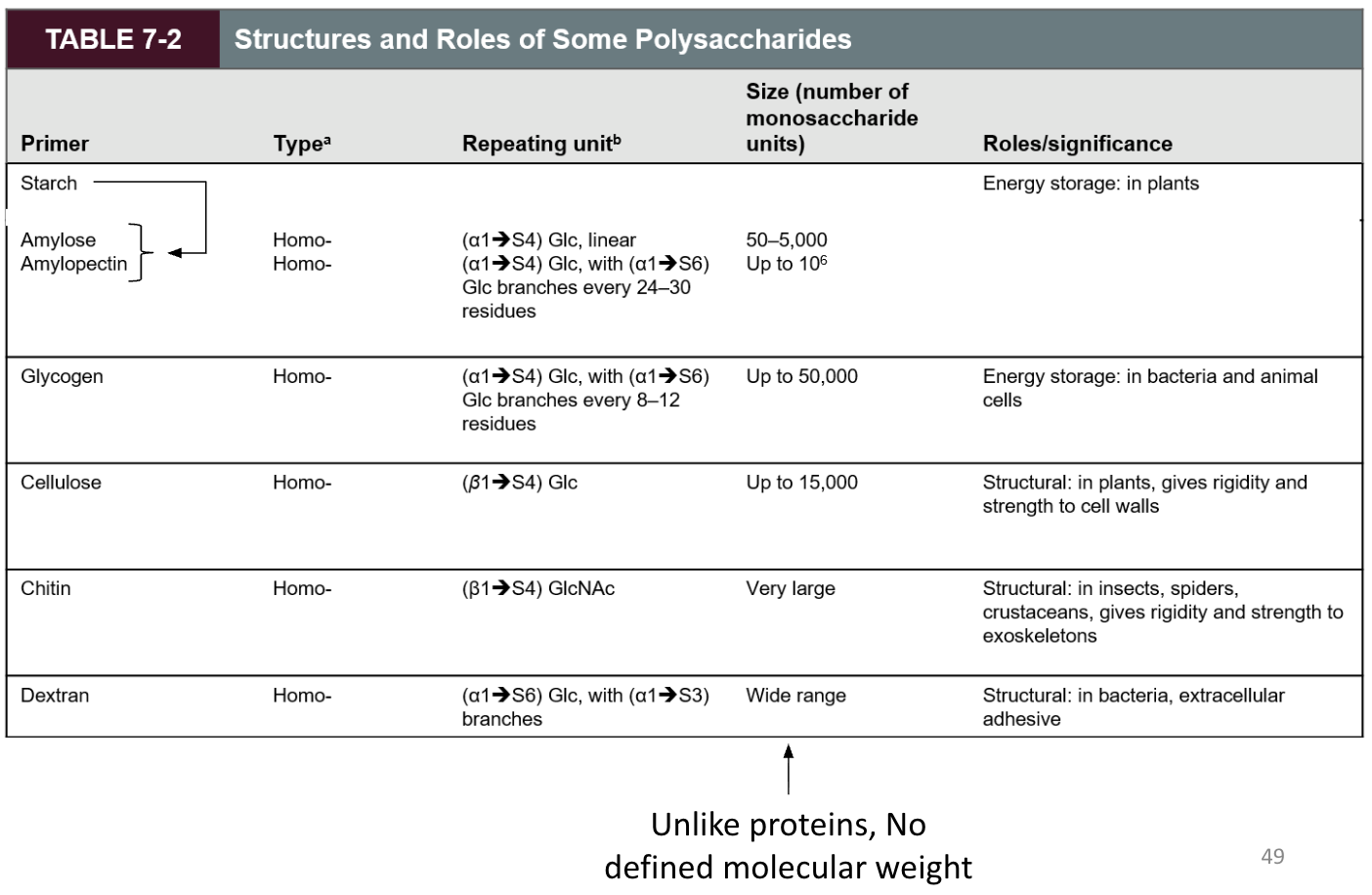
<p><strong>Amylose</strong> and <strong>amylopectin</strong>.</p>
37
New cards
<p>What is the role of <strong>starch</strong>?</p>

What is the role of starch?

Energy storage in plants.
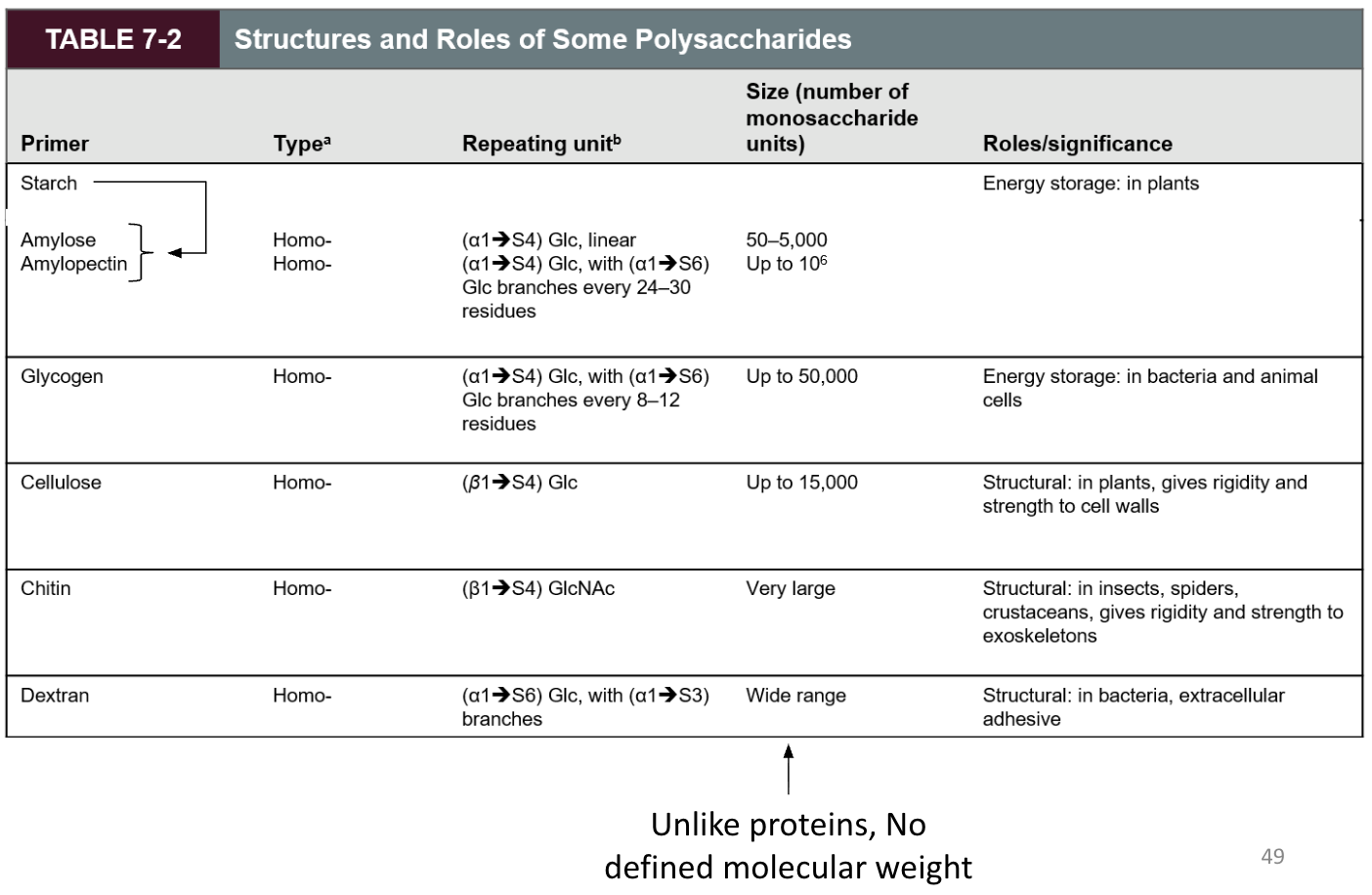
<p><strong>Energy storage</strong> in <strong>plants</strong>.</p>
38
New cards
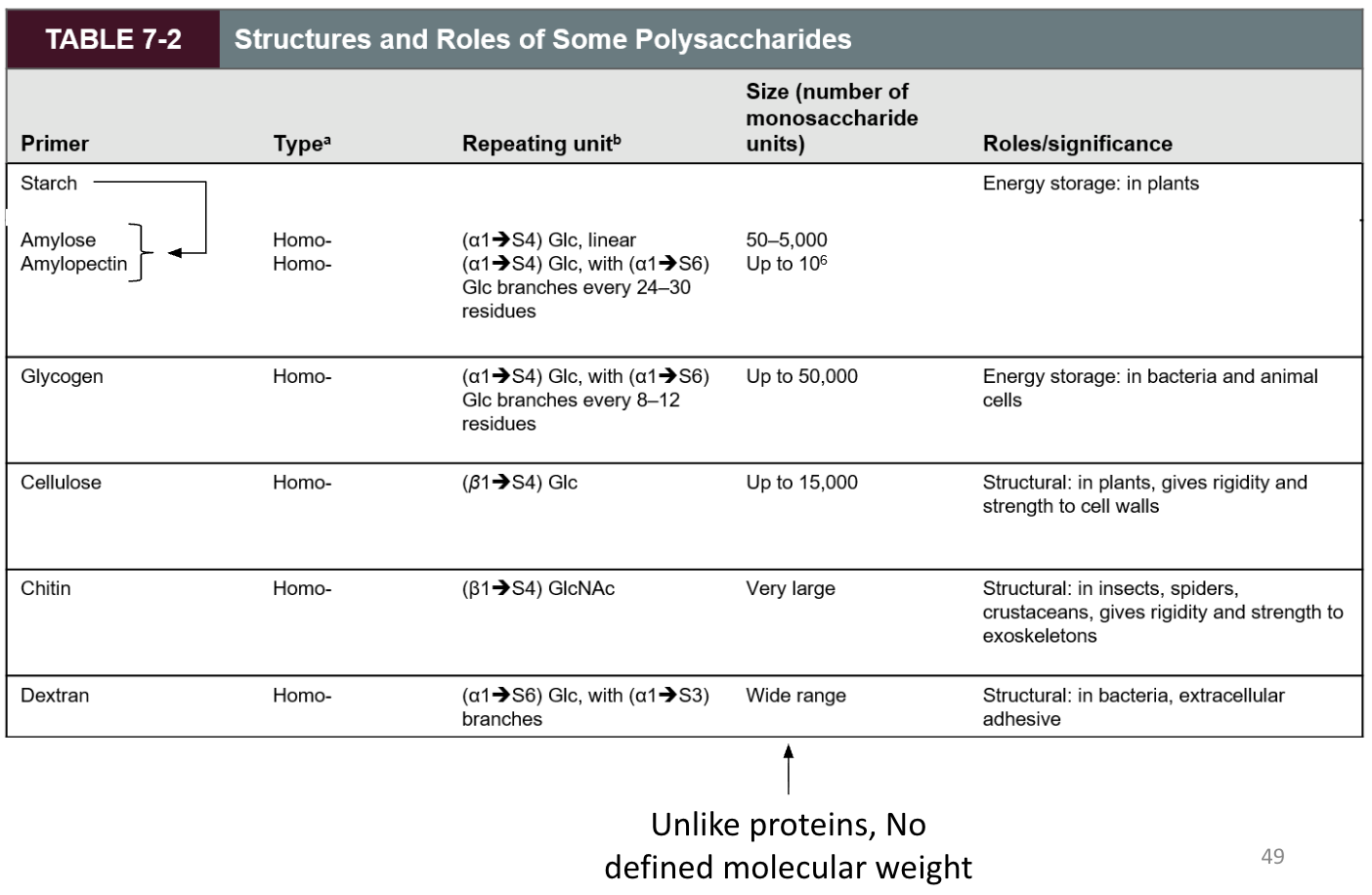
<p>What is the approximate size range of <strong>amylose</strong>?</p>

What is the approximate size range of amylose?

About 50–5,000 monosaccharide units.
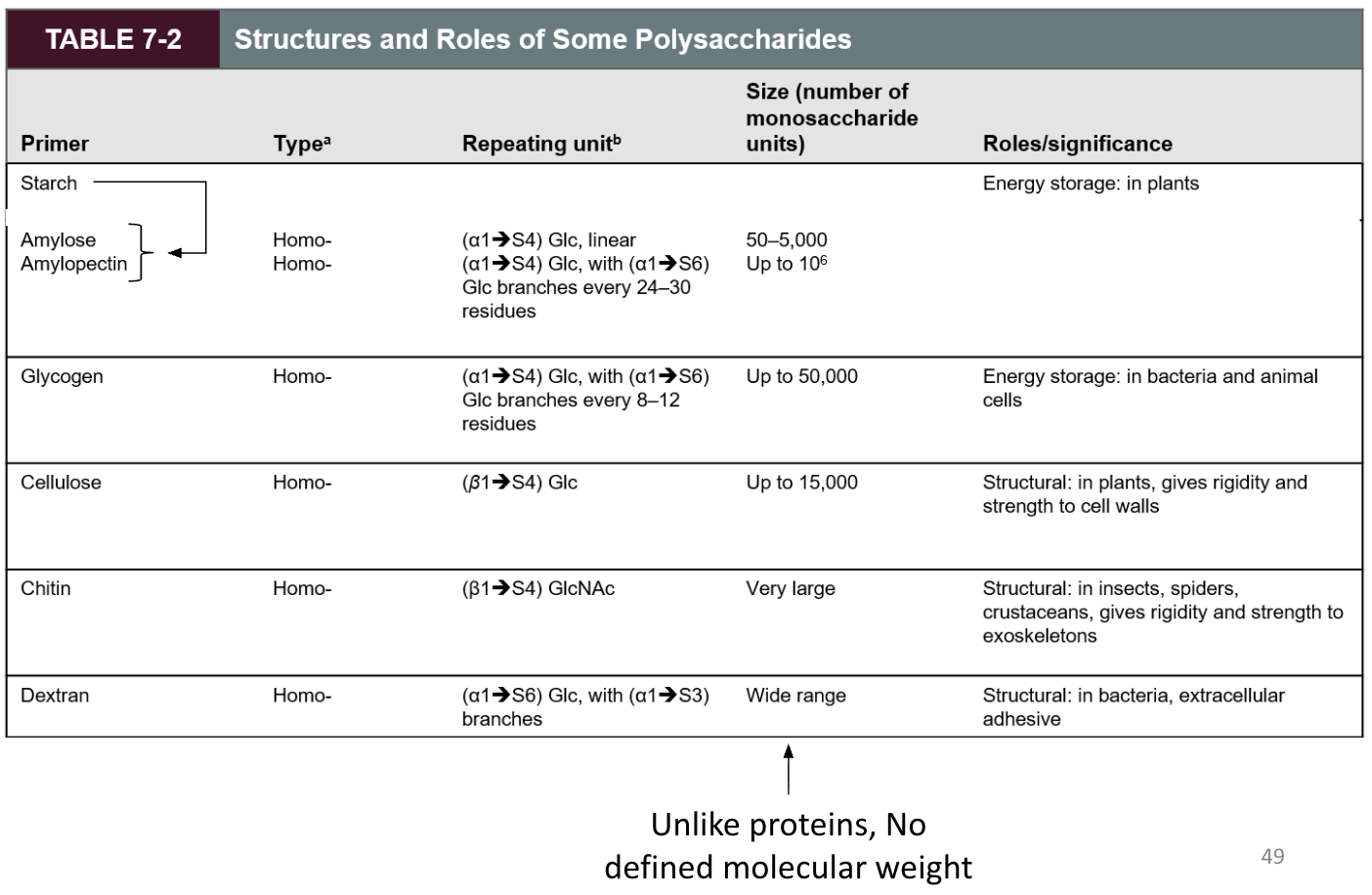
<p>About <strong>50–5,000</strong> monosaccharide units.</p>
39
New cards
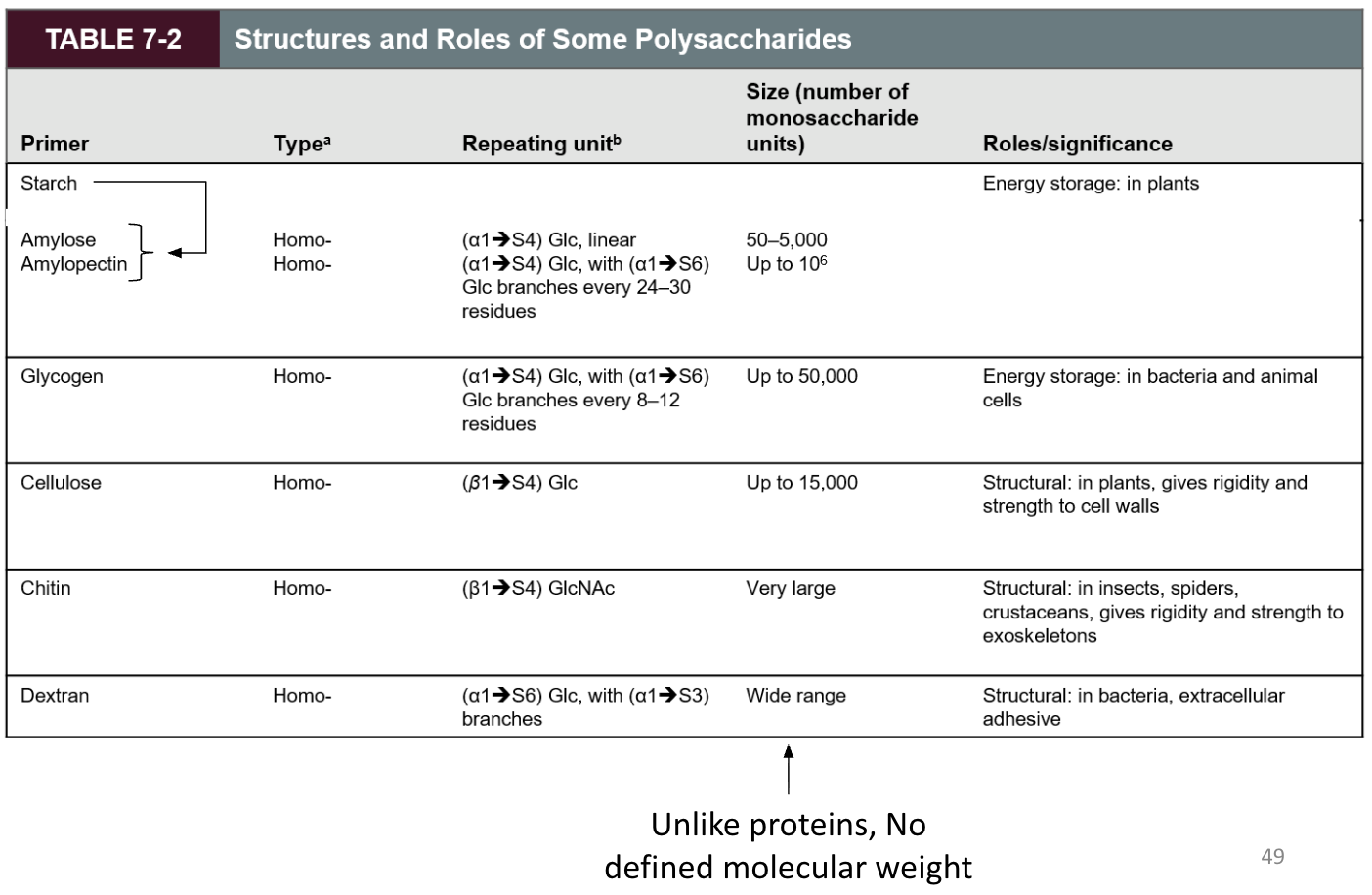
<p>What is the approximate size of <strong>amylopectin</strong> from the table?</p>

What is the approximate size of amylopectin from the table?

Up to 106 monosaccharide units.
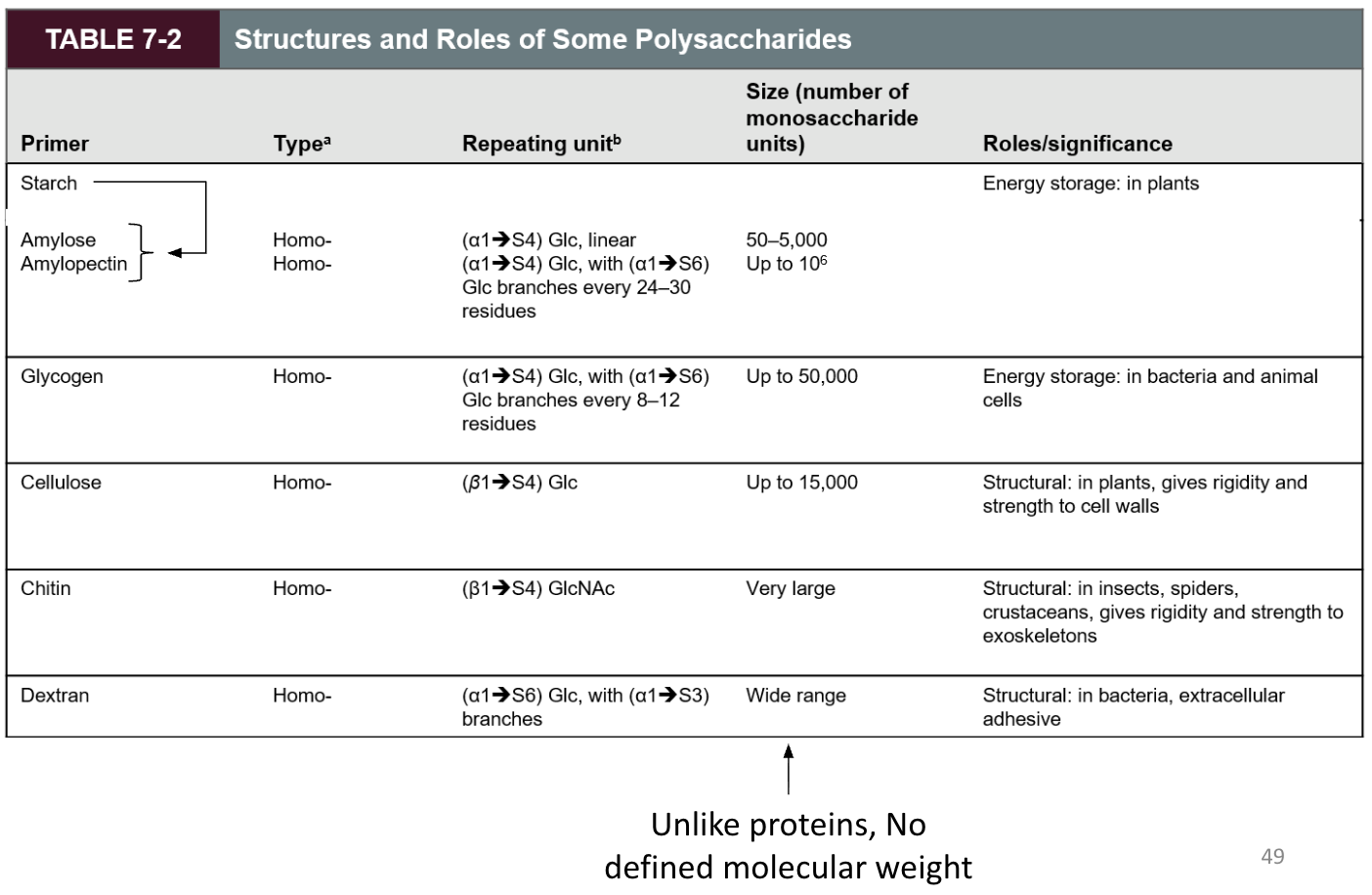
<p>Up to <strong>10<sup>6</sup></strong> monosaccharide units.</p>
40
New cards
<p>What is the repeating unit in <strong>glycogen</strong>?</p>

What is the repeating unit in glycogen?

α(1→4)-linked glucose with α(1→6) branches every 8–12 residues.
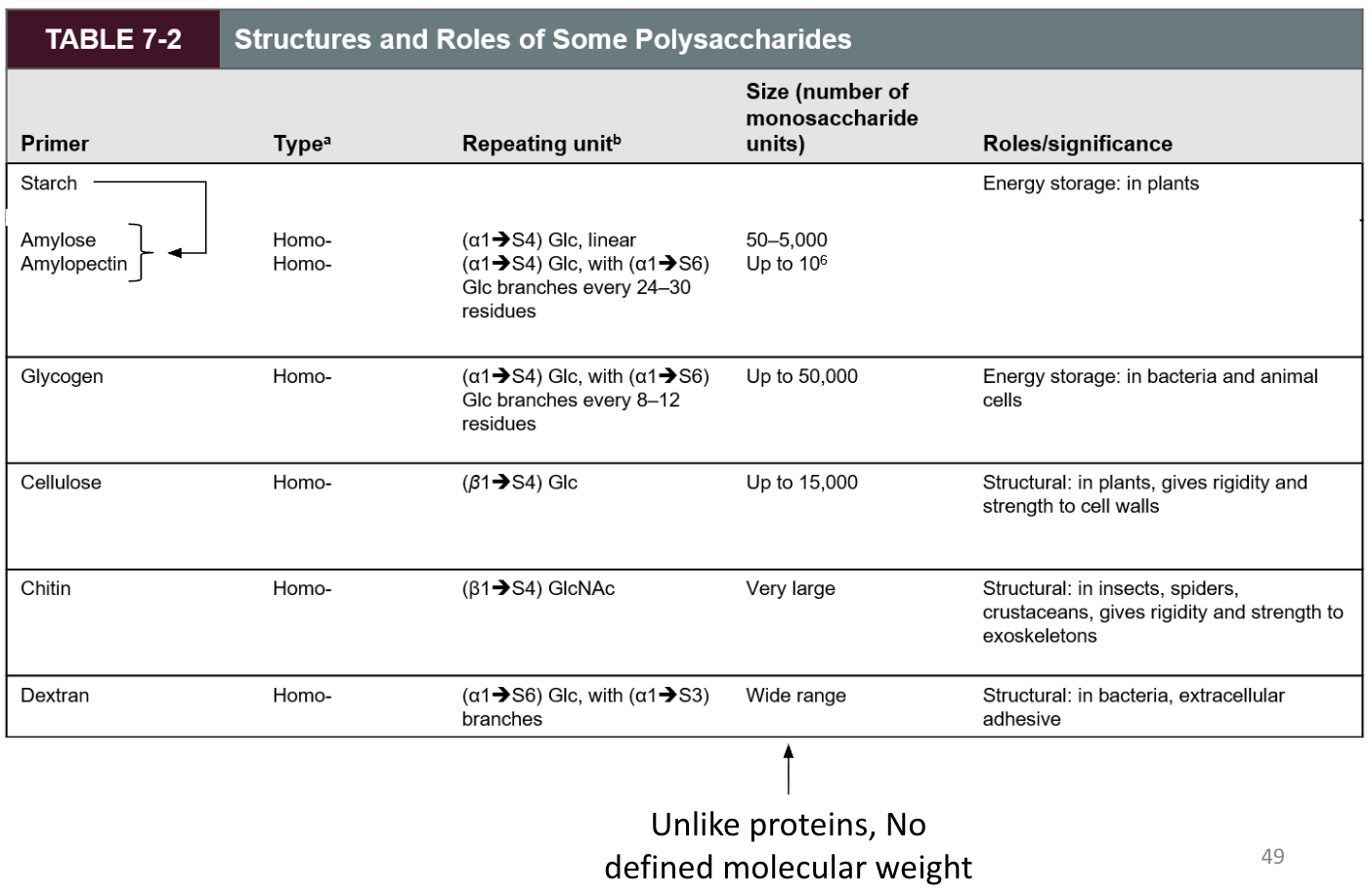
<p><strong>α(1→4)-linked glucose</strong> with <strong>α(1→6) branches</strong> every <strong>8–12</strong> residues.</p>
41
New cards
<p>What is the role of <strong>glycogen</strong>?</p>

What is the role of glycogen?

Energy storage in bacteria and animal cells.
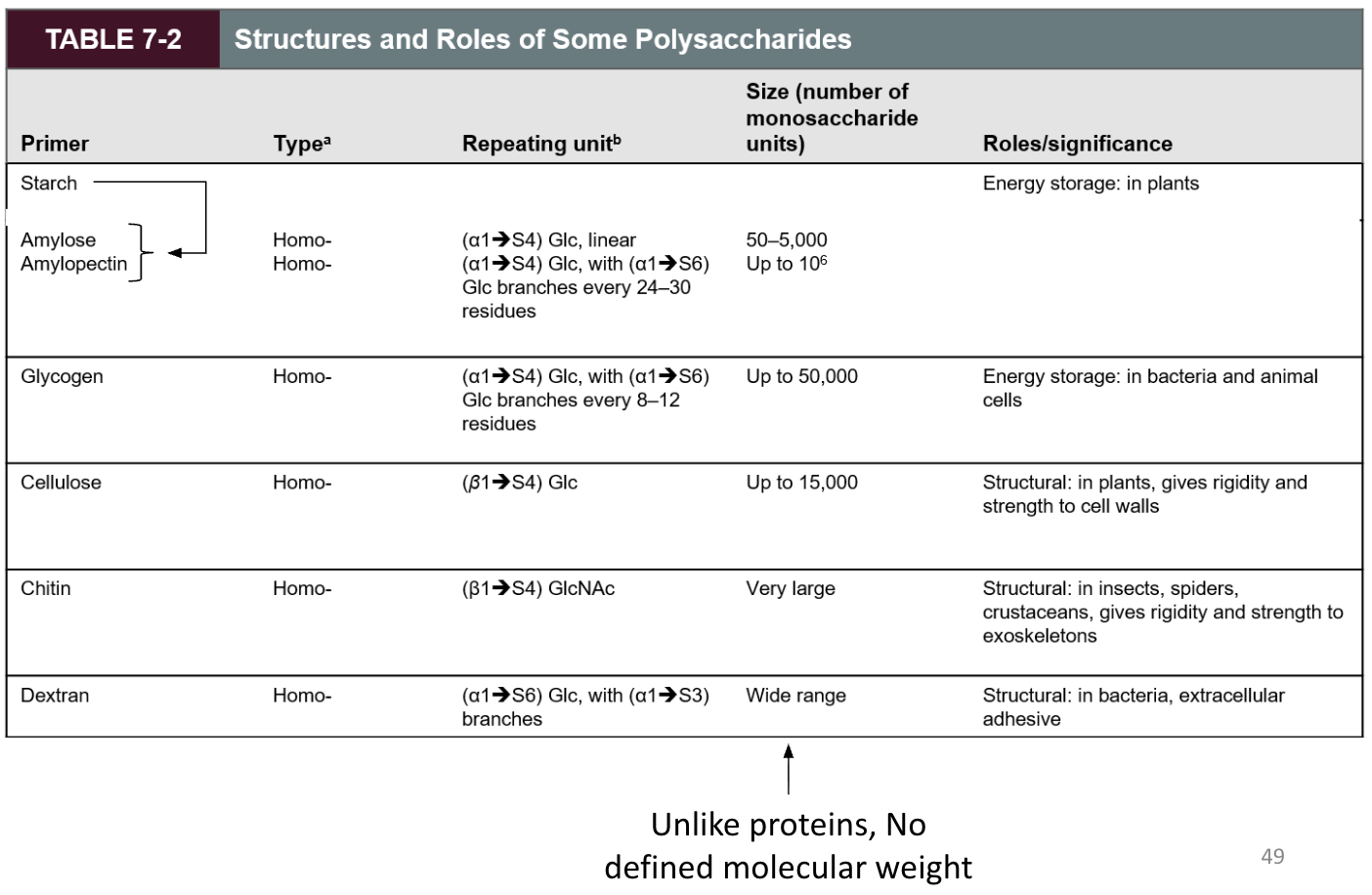
<p><strong>Energy storage </strong>in<strong> bacteria </strong>and<strong> animal cells.</strong></p>
42
New cards
<p>What is the approximate size of <strong>glycogen</strong> from the table?</p>

What is the approximate size of glycogen from the table?

Up to 50,000 monosaccharide units.
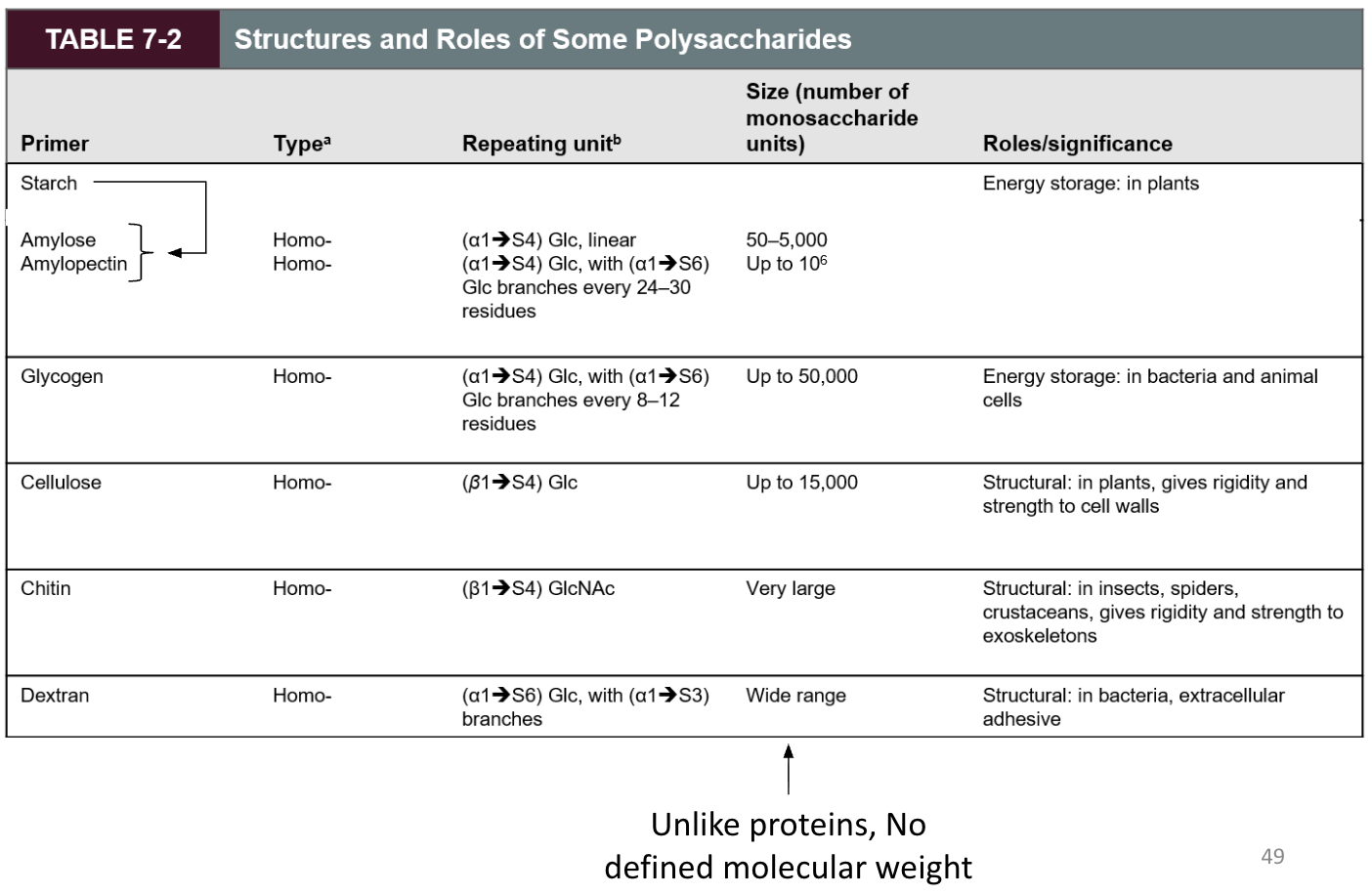
<p>Up to <strong>50,000</strong> monosaccharide units.</p>
43
New cards
<p>What is the repeating unit in <strong>cellulose</strong>?</p>

What is the repeating unit in cellulose?

β(1→4)-linked glucose.
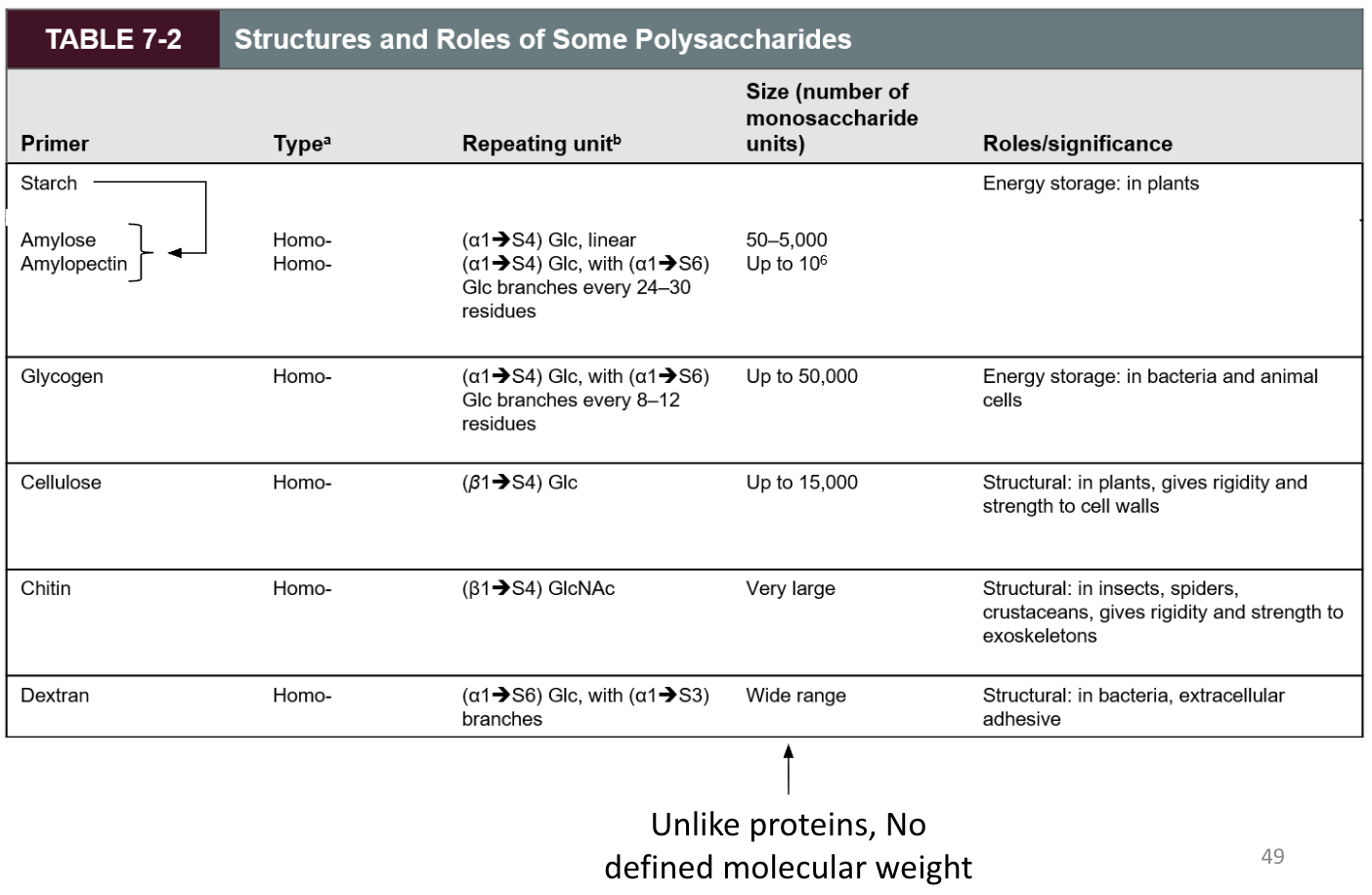
<p><strong>β(1→4)-linked glucose</strong>.</p>
44
New cards
<p>What is the role of <strong>cellulose</strong>?</p>

What is the role of cellulose?

Structural in plants; gives rigidity and strength to cell walls.
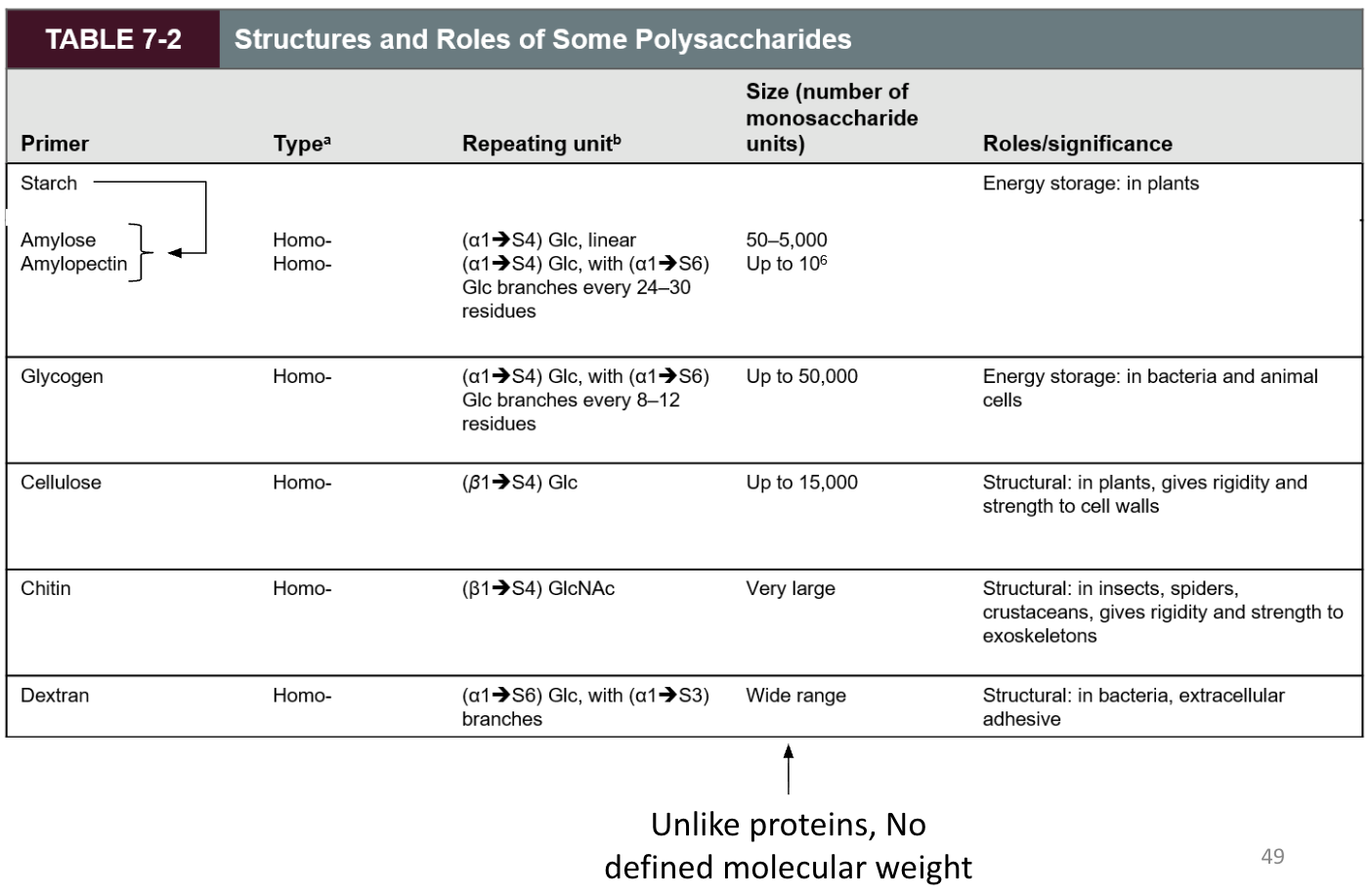
<p><strong>Structural</strong> in <strong>plants</strong>; gives <strong>rigidity</strong> and <strong>strength</strong> to <strong>cell walls</strong>.</p>
45
New cards
<p>What is the approximate size of <strong>cellulose</strong> from the table?</p>

What is the approximate size of cellulose from the table?

Up to 15,000 monosaccharide units.
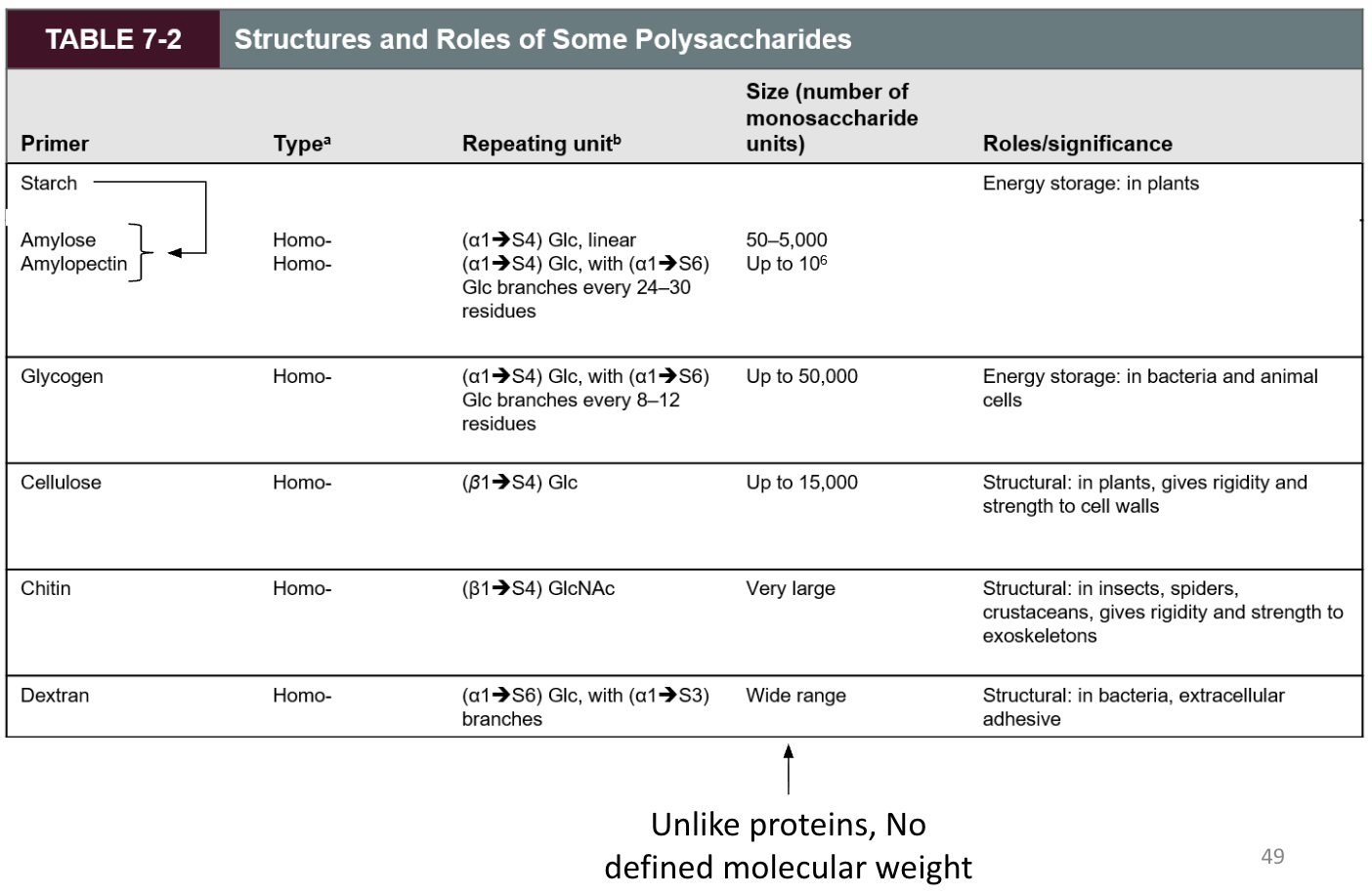
<p>Up to <strong>15,000</strong> monosaccharide units.</p>
46
New cards
<p>What is the repeating unit in <strong>chitin</strong> from the table?</p>

What is the repeating unit in chitin from the table?

β(1→4)-linked GlcNAc.
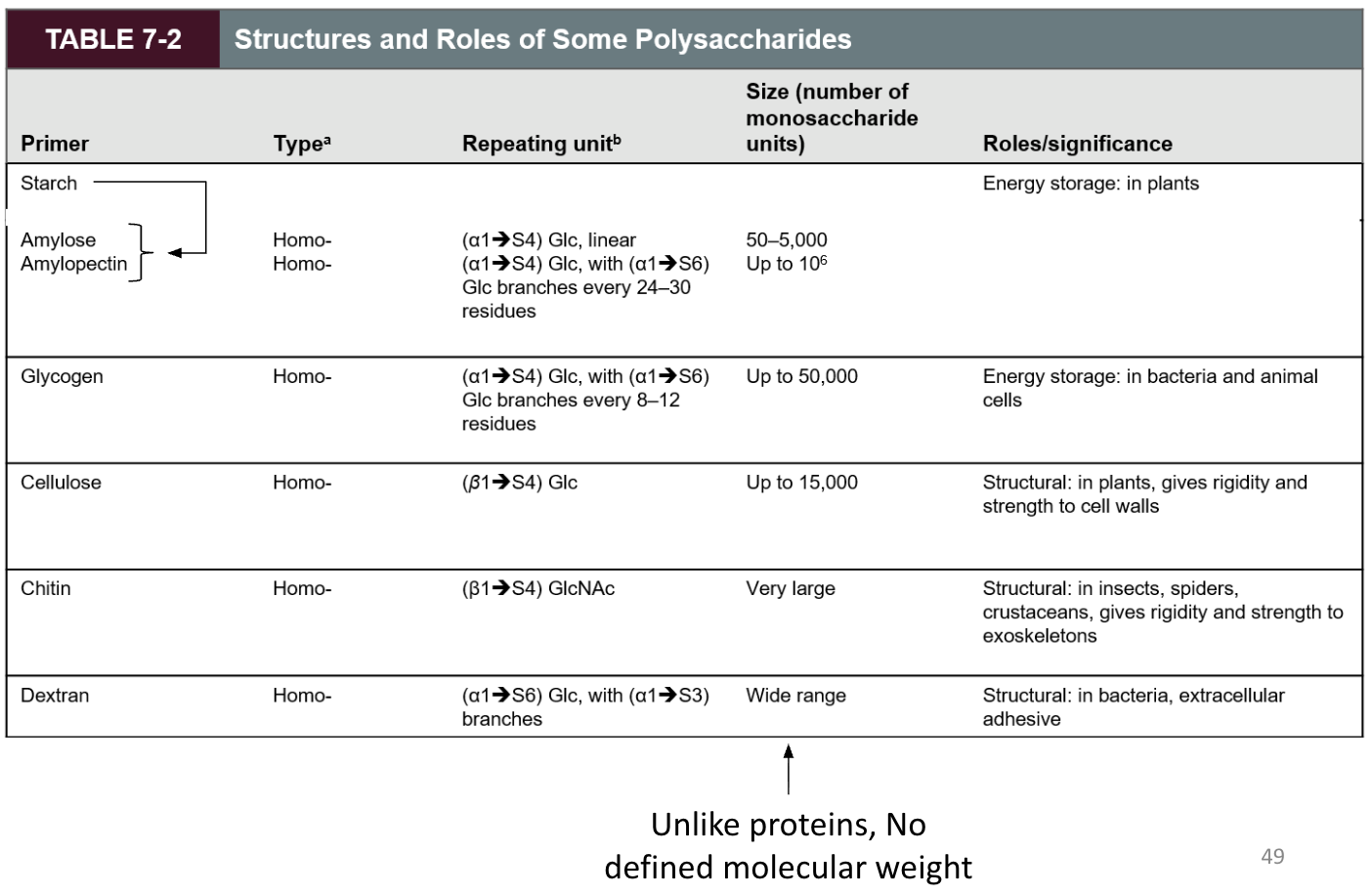
<p><strong>β(1→4)-linked GlcNAc.</strong></p>
47
New cards
<p>What is the role of <strong>chitin</strong>?</p>

What is the role of chitin?

Structural in insects, spiders, and crustaceans; gives rigidity and strength to exoskeletons.
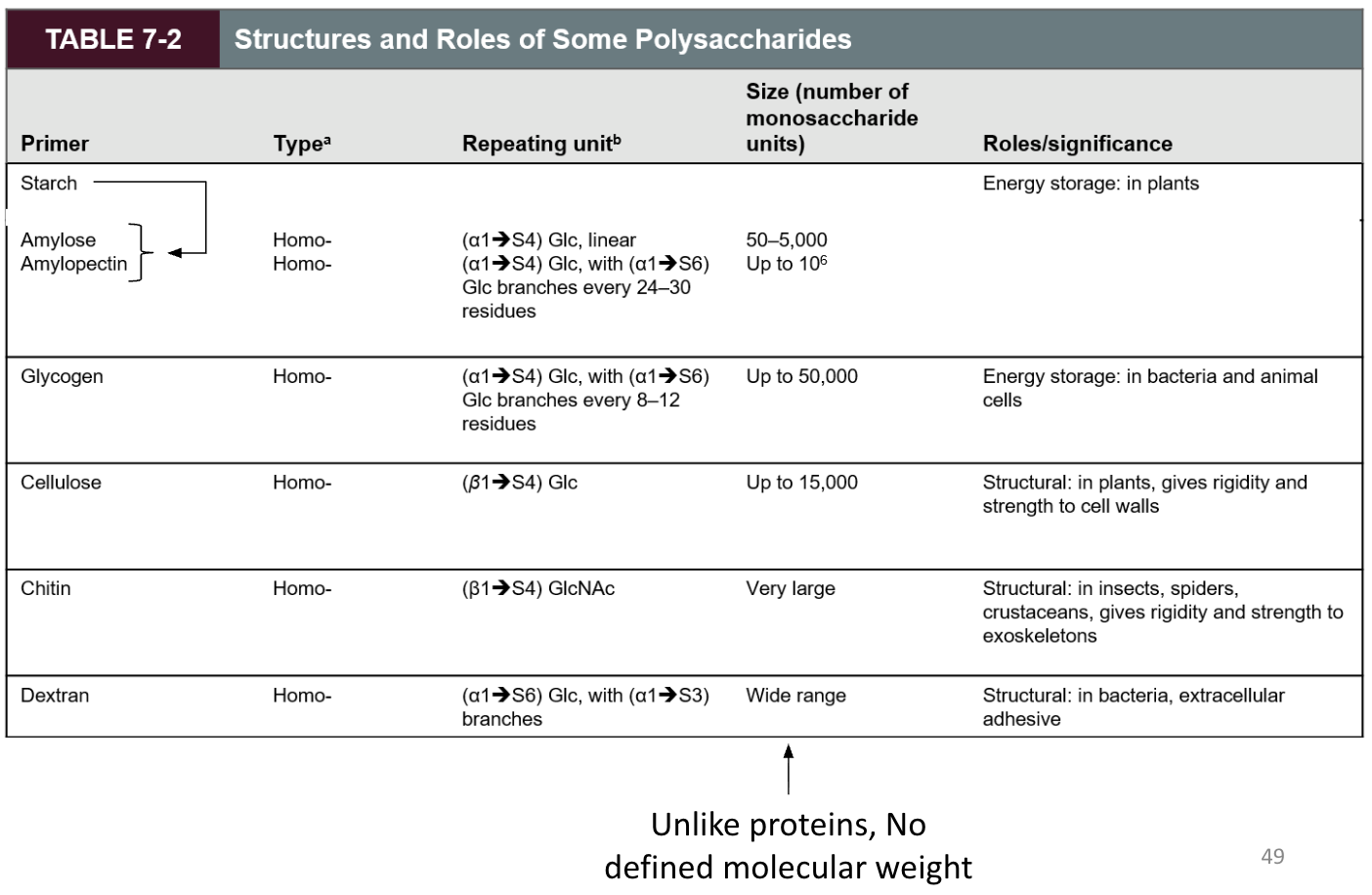
<p><strong>Structural</strong> in <strong>insects</strong>, <strong>spiders</strong>, and <strong>crustaceans</strong>; gives <strong>rigidity</strong> and <strong>strength</strong> to <strong>exoskeletons</strong>.</p>
48
New cards
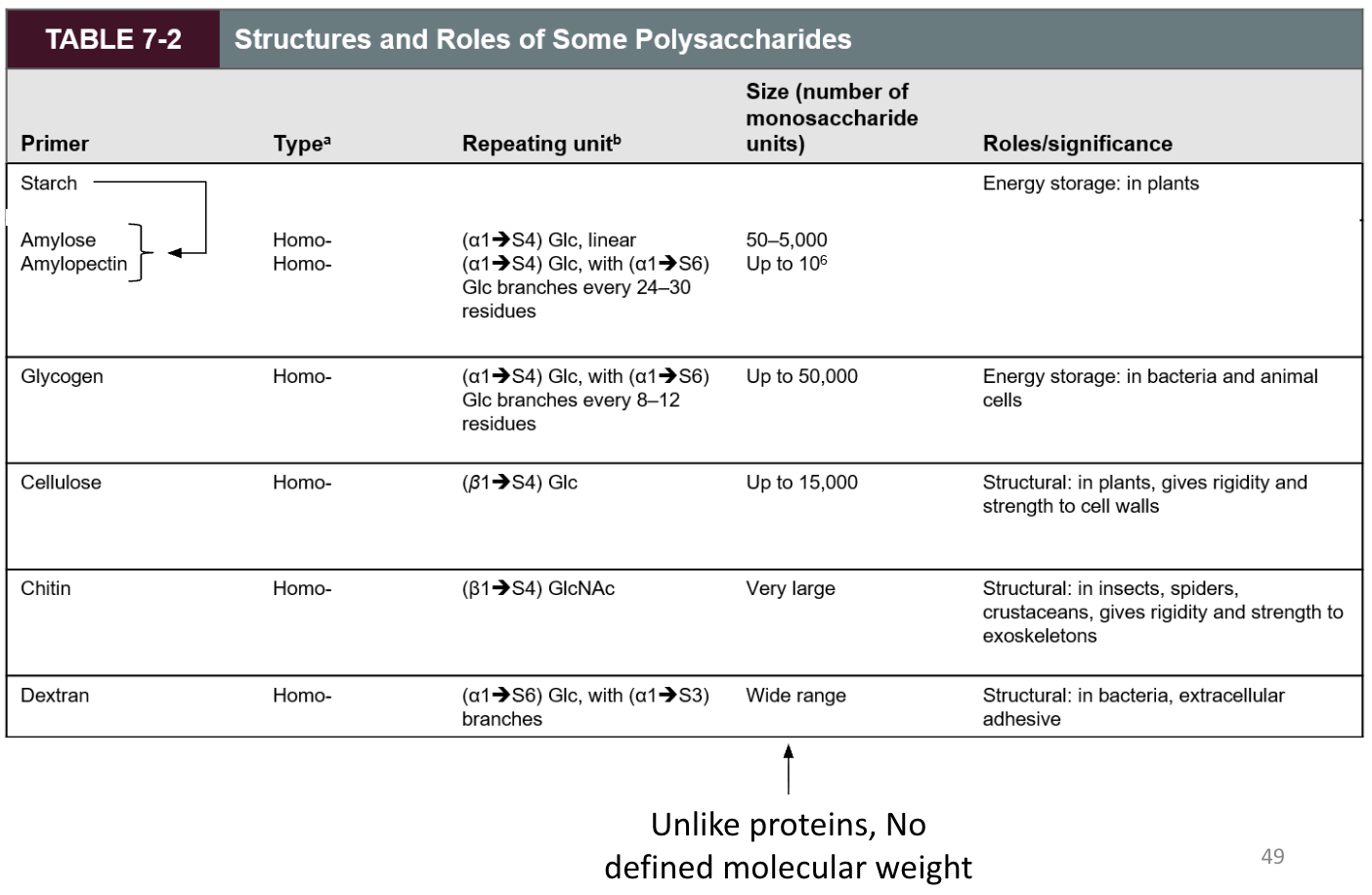
<p>How large is <strong>chitin</strong> according to the table?</p>

How large is chitin according to the table?

Very large.
<p><strong>Very large</strong>.</p>
49
New cards
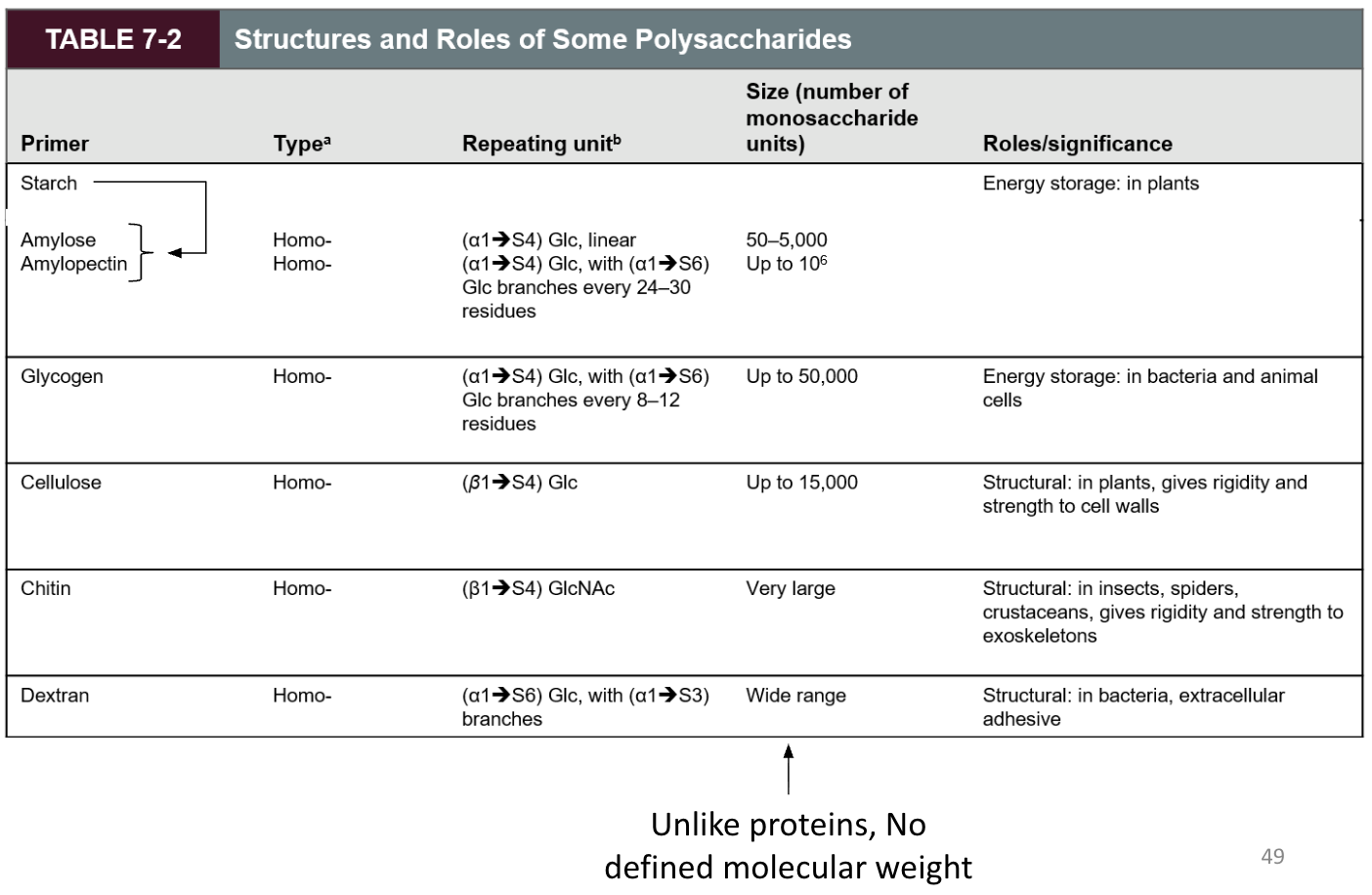
<p>What is <strong>dextran</strong>?</p>

What is dextran?

A homopolysaccharide of glucose with α(1→6) linkages and α(1→3) branches.
<p>A <strong>homo</strong>polysaccharide of glucose with <strong>α(1→6) linkages </strong>and <strong>α(1→3) branches</strong>.</p>
50
New cards
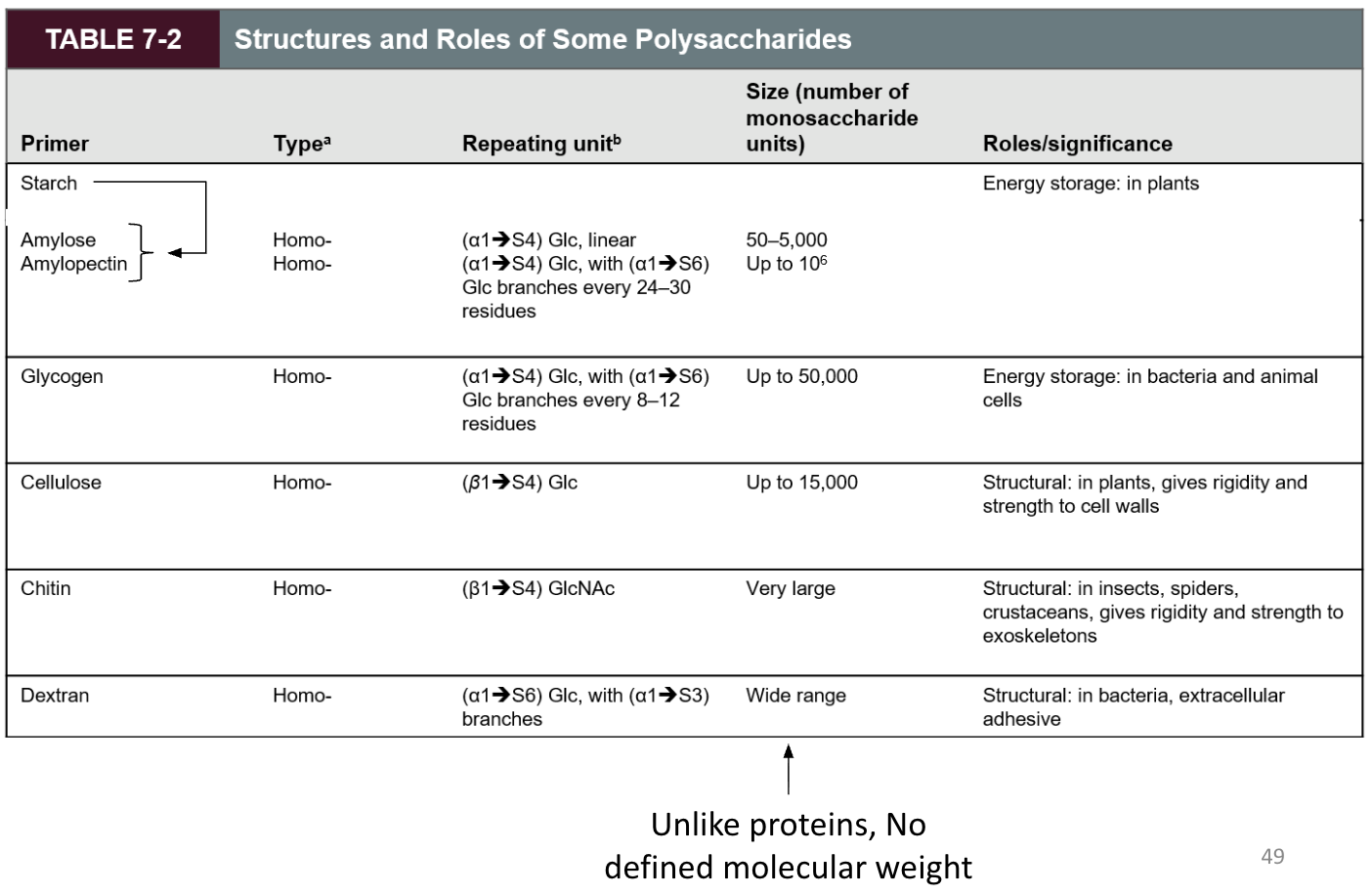
<p>What is the role of <strong>dextran</strong>?</p>

What is the role of dextran?

Structural in bacteria; extracellular adhesive.
<p><strong>Structural</strong> in <strong>bacteria</strong>; <strong>extracellular</strong> <strong>adhesive</strong>.</p>
51
New cards

What are two examples of heteropolysaccharides?

Hyaluronan and Peptidoglycan
52
New cards
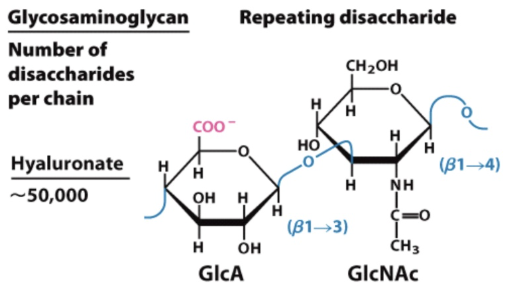
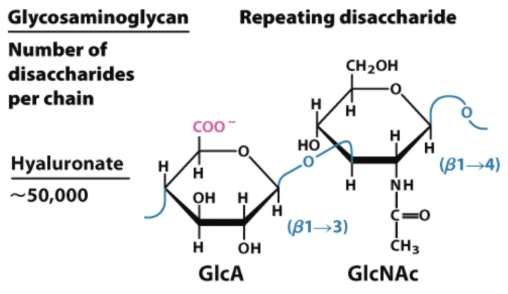
<p>What is hyaluronan?</p>

What is hyaluronan?

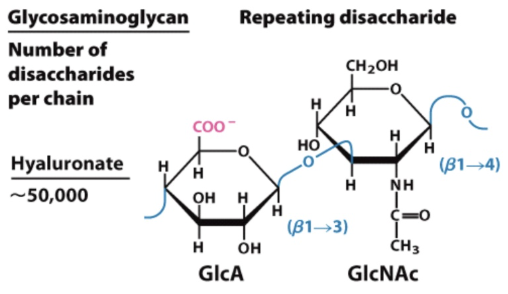
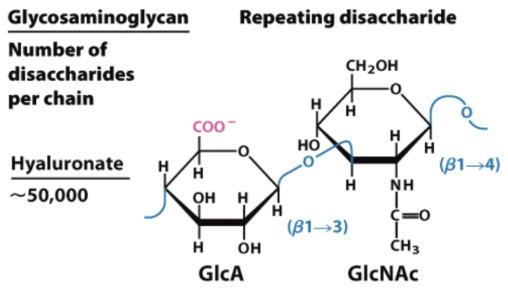
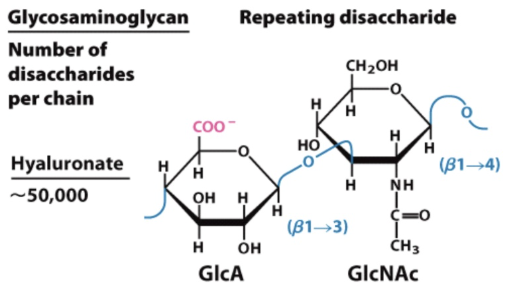
A glycosaminoglycan made of repeating extracellular disaccharides.
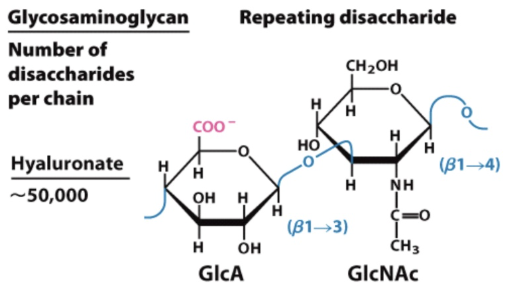
<p>A glycosaminoglycan made of repeating extracellular disaccharides.</p>
53
New cards
<p>What type of sugars are commonly found in glycosaminoglycans like hyaluronan?</p>

What type of sugars are commonly found in glycosaminoglycans like hyaluronan?

N-acetyl sugars, often highly acidic sugars such as glucuronic acid (GlcA).
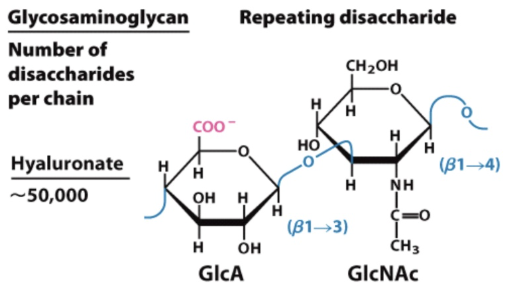
<p>N-acetyl sugars, often highly acidic sugars such as glucuronic acid (GlcA).</p>
54
New cards
<p>What are the repeating sugar types in hyaluronan?</p>

What are the repeating sugar types in hyaluronan?

Glucuronic acid (GlcA) and N-acetyl-glucosamine (GlcNAc).
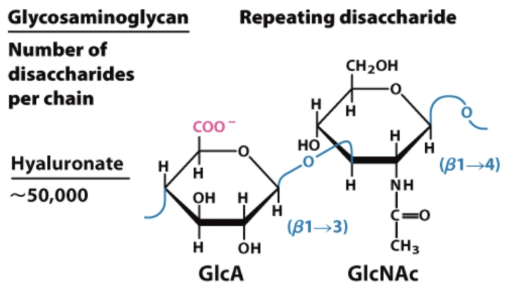
<p>Glucuronic acid (GlcA) and N-acetyl-glucosamine (GlcNAc).</p>
55
New cards
<p>What enzyme do some pathogenic bacteria express to help invade tissue?</p>

What enzyme do some pathogenic bacteria express to help invade tissue?

Hyaluronidase.
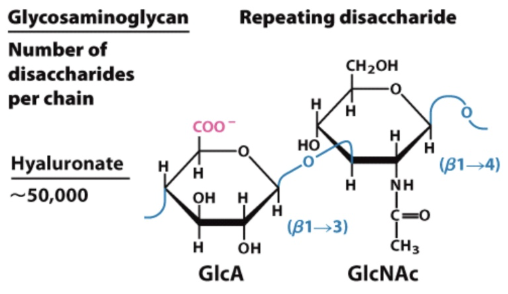
<p><strong>Hyaluronidase</strong>.</p>
56
New cards
<p>What does hyaluronidase help bacteria do?</p>

What does hyaluronidase help bacteria do?

Invade tissue.
<p>Invade tissue.</p>
57
New cards
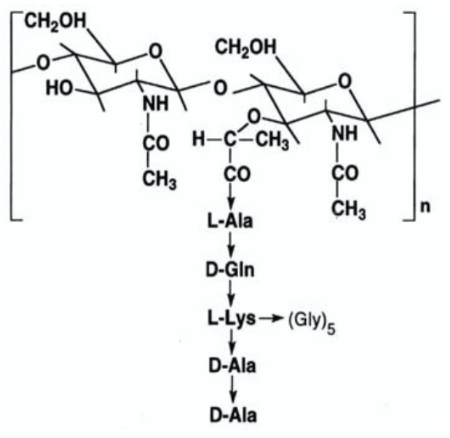
<p>What is peptidoglycan?</p>

What is peptidoglycan?

A complex network of the bacterial cell wall that provides strength and a barrier.
<p>A complex network of the bacterial cell wall that provides strength and a barrier.</p>
58
New cards
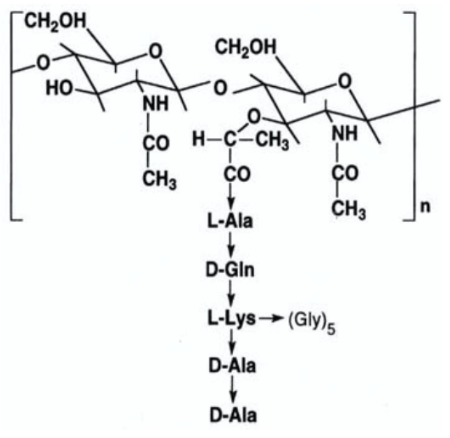
<p>What repeating sugars are found in peptidoglycan?</p>

What repeating sugars are found in peptidoglycan?

N-acetyl-glucosamine (GlcNac) and N-acetyl-muramic acid (Mur2Ac).
<p>N-acetyl-glucosamine (GlcNac) and N-acetyl-muramic acid (Mur2Ac).</p>
59
New cards
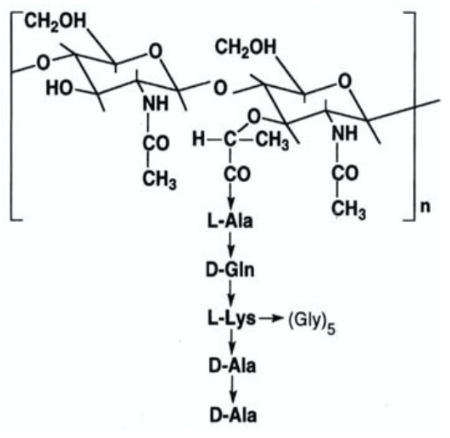
<p>What antibiotic targets peptidoglycan-related enzymes?</p>

What antibiotic targets peptidoglycan-related enzymes?

Penicillin.
<p><strong>Penicillin</strong>.</p>
60
New cards
<p>How does penicillin kill bacteria?</p>

How does penicillin kill bacteria?

It inhibits enzymes involved in amino acid crosslinks.
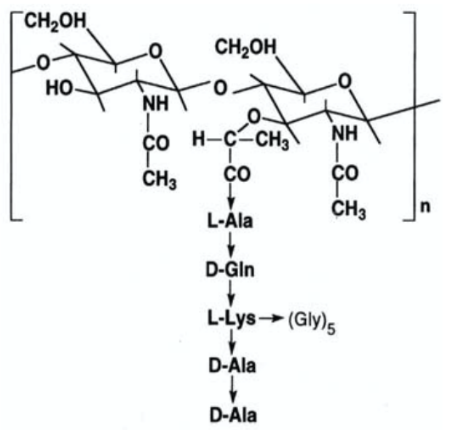
<p>It <strong>inhibits enzymes </strong>involved in <strong>amino acid crosslinks.</strong></p>
61
New cards

Why are differences in metabolism important medically?

They are areas of attack for drugs such as antibiotics.
62
New cards
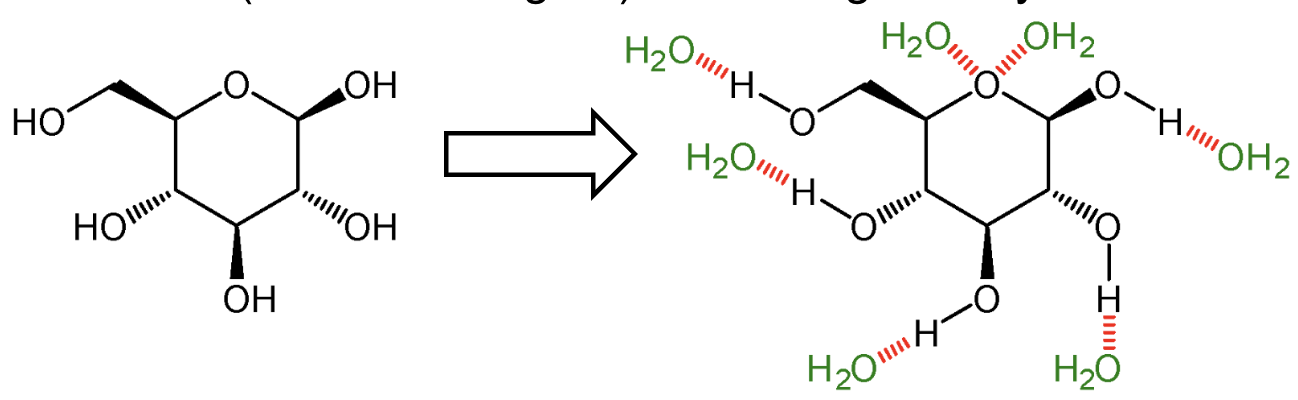
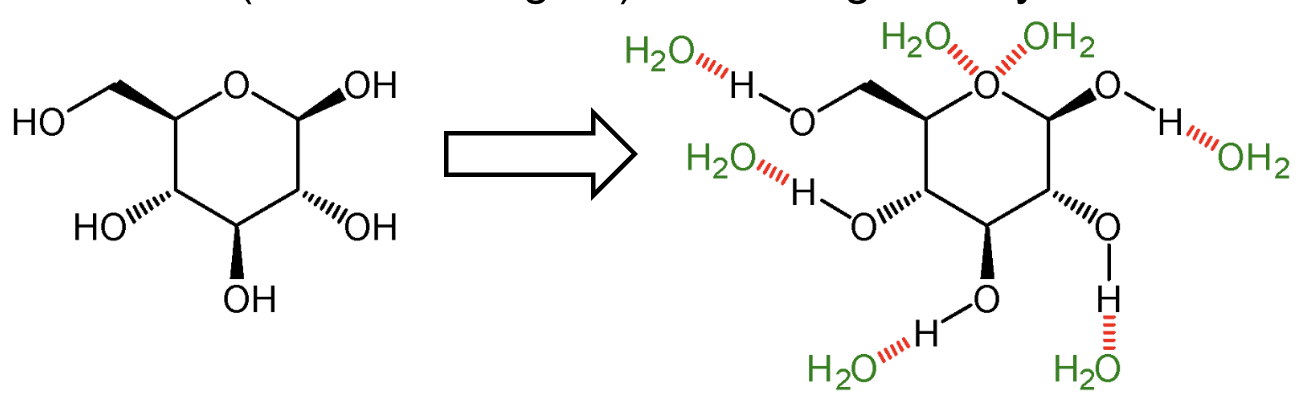
<p>Why are polysaccharides better for storage than free glucose?</p>

Why are polysaccharides better for storage than free glucose?

Free glucose is a strong osmolyte and would create dangerous osmotic pressure.
Polysaccharides lower osmotic stress and can be stored in an insoluble, compartmentalized form.
<p>Free glucose is a <strong>strong osmolyte</strong> and would create <strong>dangerous osmotic pressure.</strong> <br>Polysaccharides <strong>lower osmotic stress</strong> and can be stored in an <strong>insoluble</strong>, <strong>compartmentalized</strong> <strong>form</strong>.</p>
63
New cards
<p>Where do glycosidases act on polysaccharides?</p>

Where do glycosidases act on polysaccharides?

On the non-reducing ends.
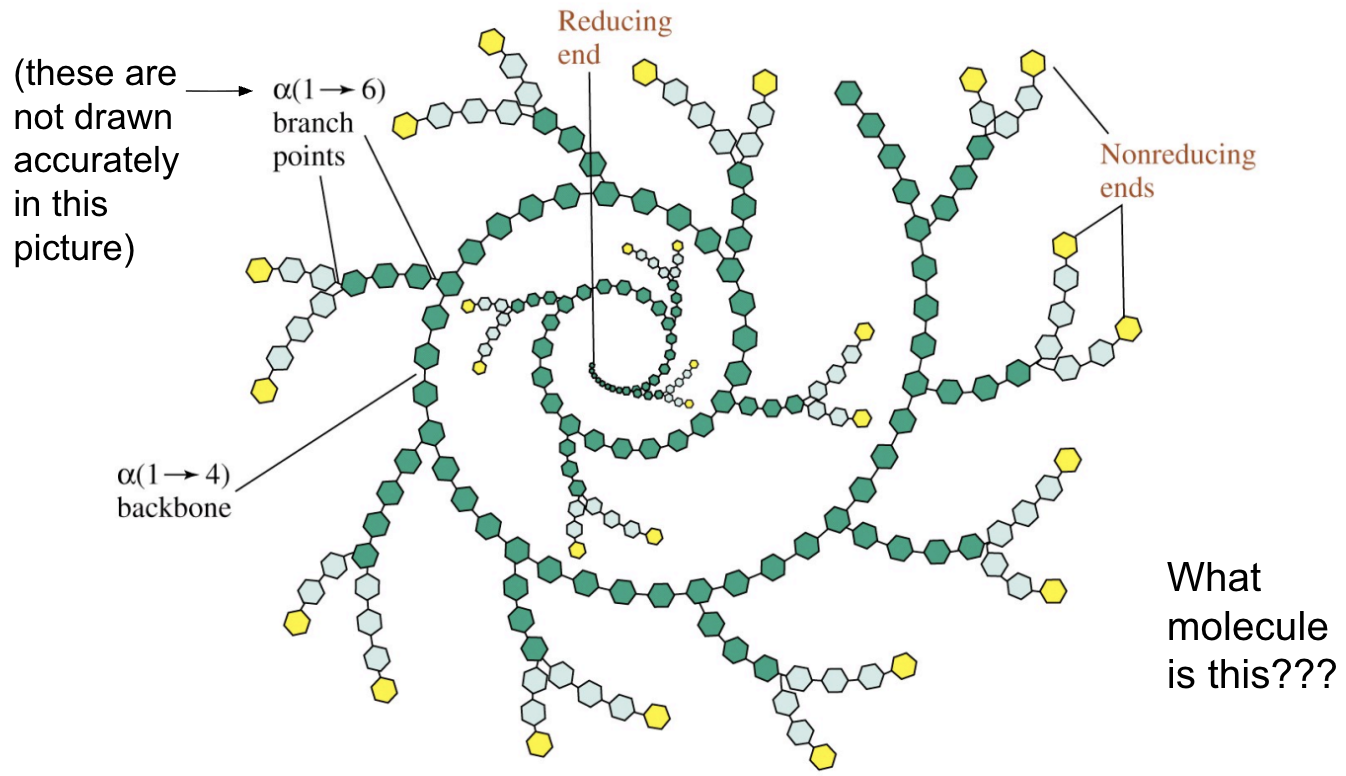
<p>On the <strong>non-reducing </strong>ends.</p>
64
New cards
<p>What is another name given for glycosidases?</p>

What is another name given for glycosidases?

Glycosyl hydrolases.
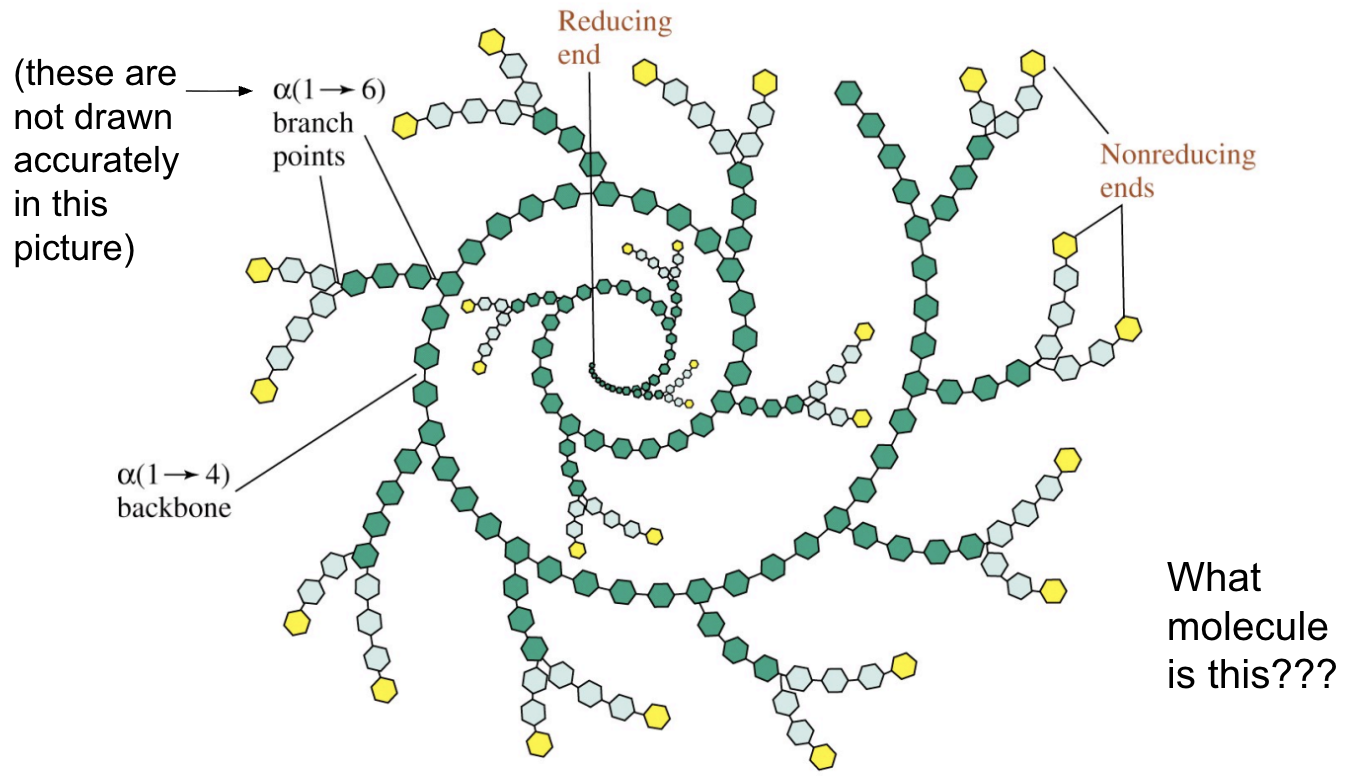
<p>Glycosyl hydrolases.</p>
65
New cards
<p>Why do <strong>branched</strong> polysaccharides allow <strong>fast enzyme response</strong>?</p>

Why do branched polysaccharides allow fast enzyme response?

Because branching creates many non-reducing ends for enzymes to act on.
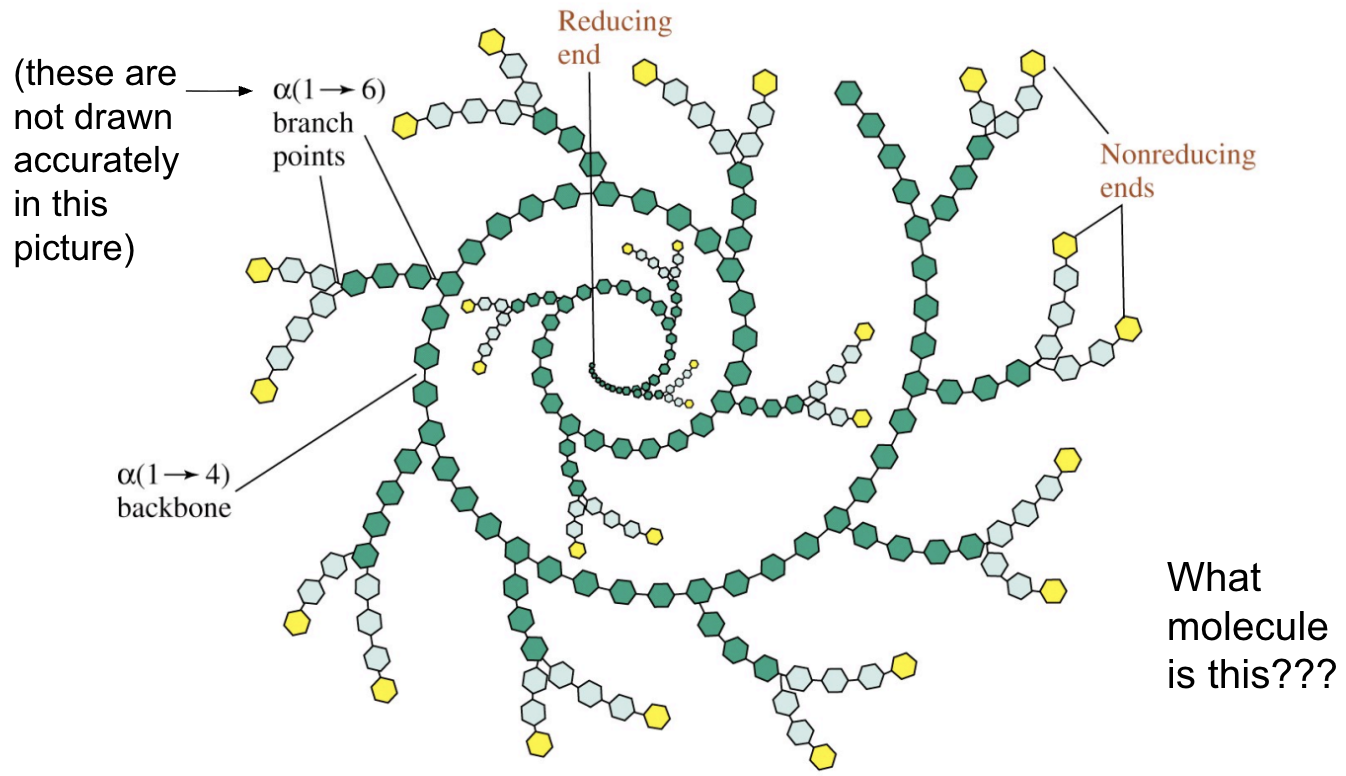
<p>Because branching creates many non-reducing ends for enzymes to act on.</p>
66
New cards
<p>How many non-reducing ends are produced by <strong>n branches</strong>?</p>

How many non-reducing ends are produced by n branches?

(n+1).
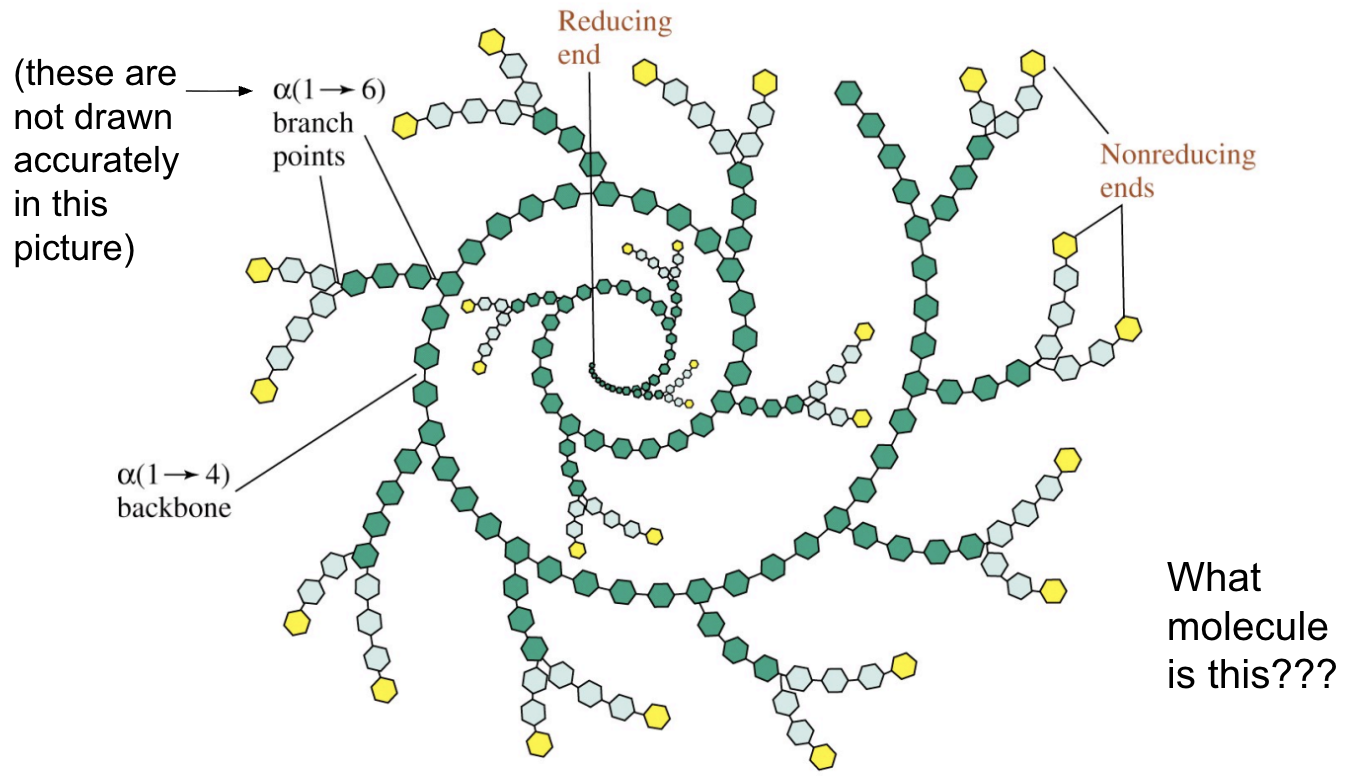
<p><strong>(n+1)</strong>.</p>
67
New cards
<p>How many reducing ends does a glycogen particle have?</p>

How many reducing ends does a glycogen particle have?

One.
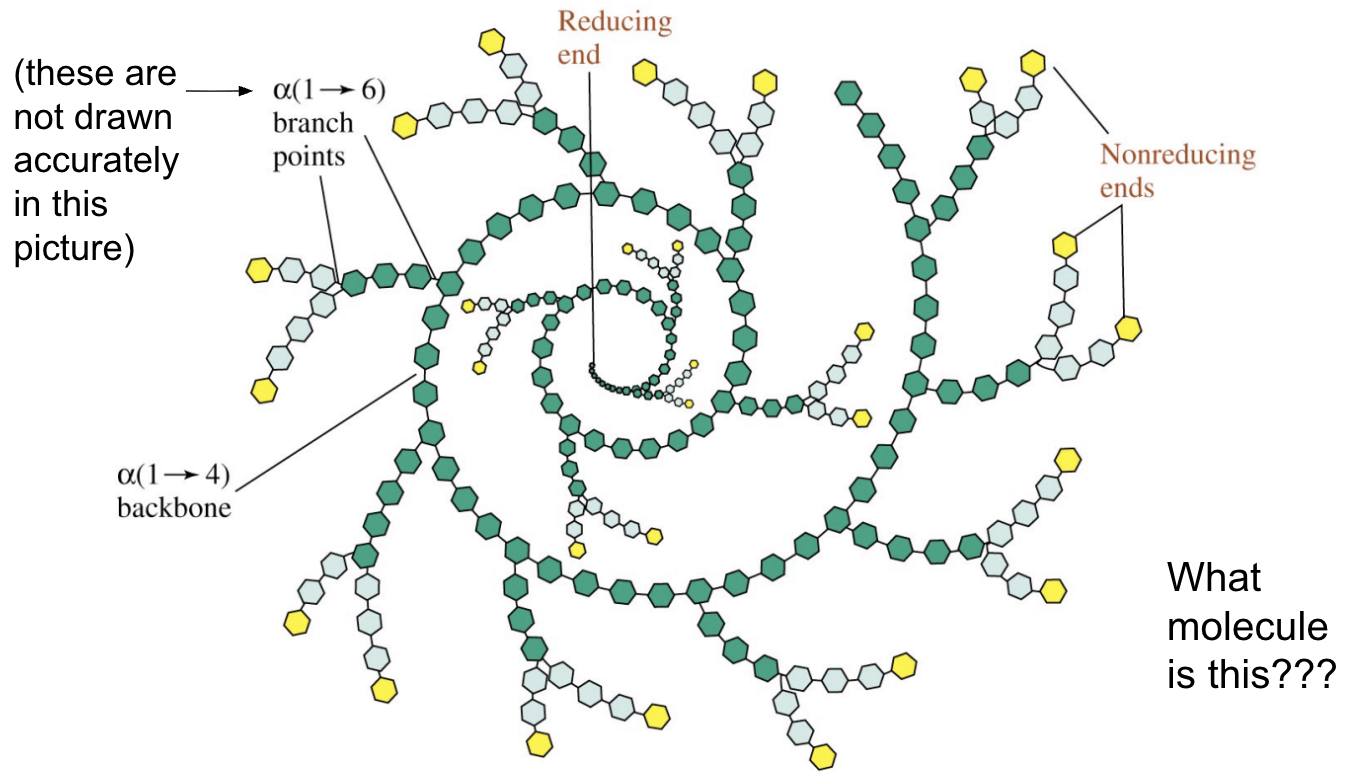
<p>One.</p>
68
New cards
<p>What kind of ends are numerous on glycogen?</p>

What kind of ends are numerous on glycogen?

Non-reducing ends.
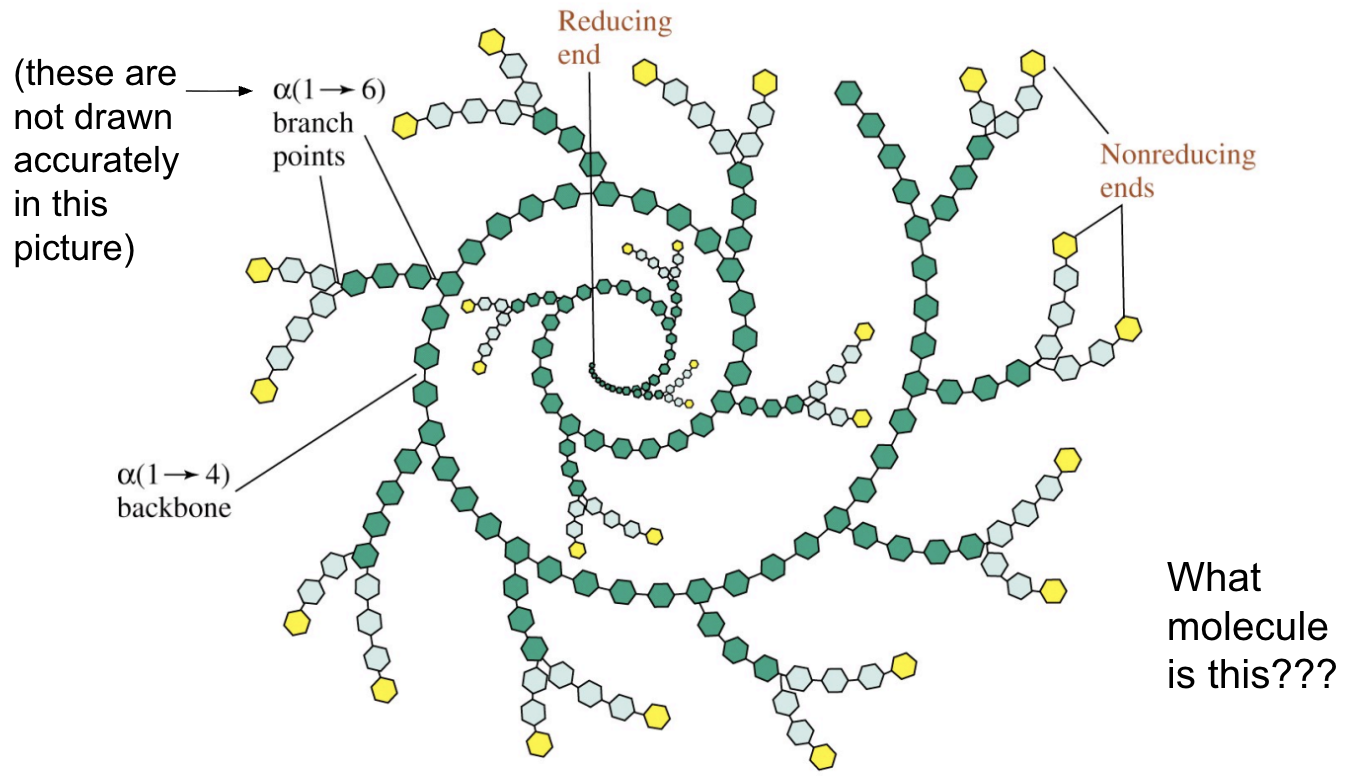
<p>Non-reducing ends.</p>
69
New cards
<p>Chitin monomer?</p>

Chitin monomer?

N-acetyl-glucosamine (GlcNAc).
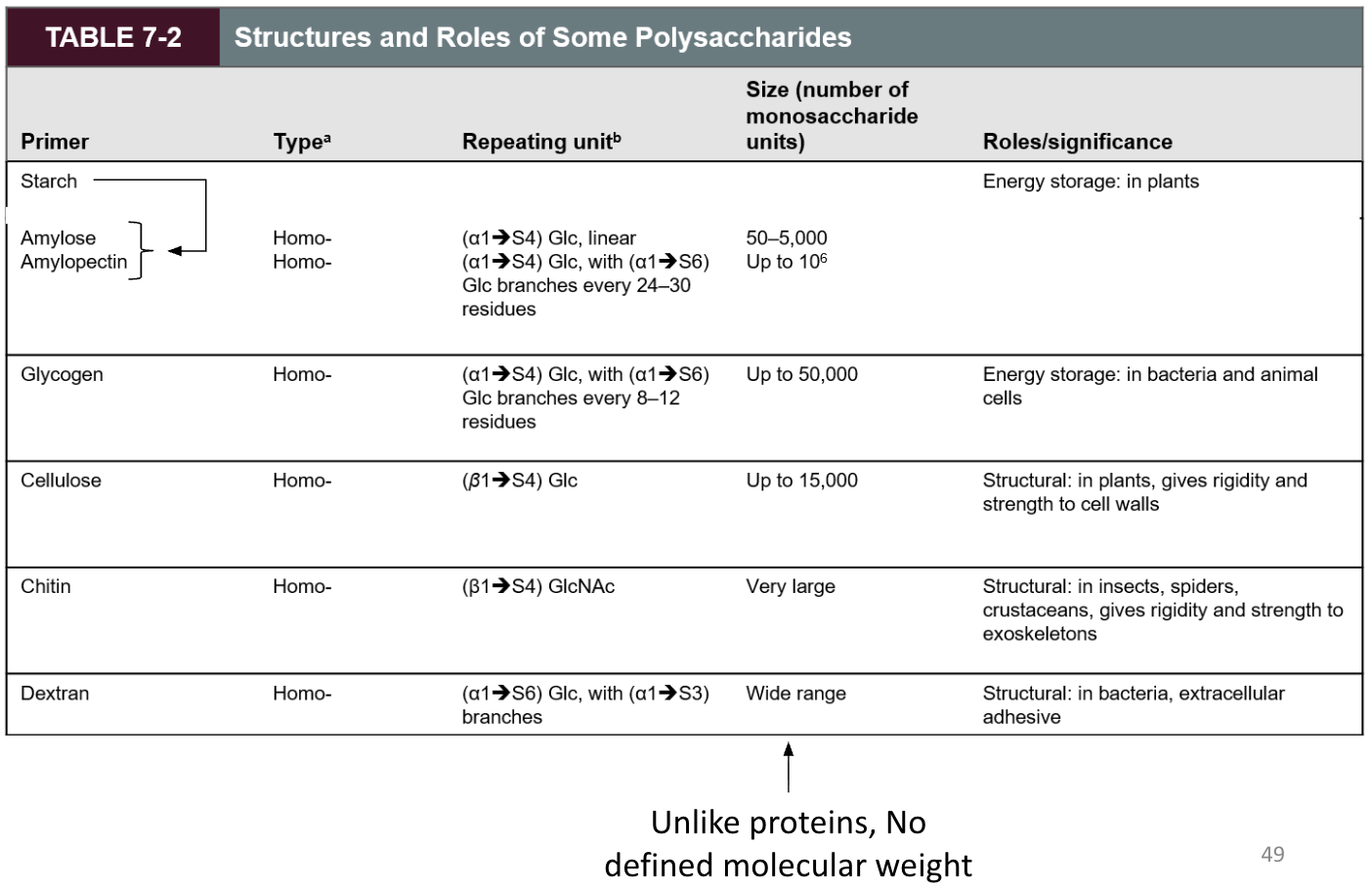
<p>N-acetyl-glucosamine (GlcNAc).</p>

Explore top notes

note
Excretory system
Updated 713d ago
0.0(0)
note
Module 1.5a Sleep: Consciousness
Updated 187d ago
0.0(0)
note
Chapter 14-Natural Resources
Updated 1040d ago
0.0(0)
note
Napoleon
Updated 1169d ago
0.0(0)
note
AP World Unit 2
Updated 349d ago
0.0(0)
note
Excretory system
Updated 713d ago
0.0(0)
note
Module 1.5a Sleep: Consciousness
Updated 187d ago
0.0(0)
note
Chapter 14-Natural Resources
Updated 1040d ago
0.0(0)
note
Napoleon
Updated 1169d ago
0.0(0)
note
AP World Unit 2
Updated 349d ago
0.0(0)

Explore top flashcards

flashcards
Así se dice 2 Cap. 2
51
Updated 1006d ago
0.0(0)
flashcards
List 1B
86
Updated 934d ago
0.0(0)
flashcards
Chapter 9- Management
91
Updated 1105d ago
0.0(0)
flashcards
Key Terms ITI Exam 2
58
Updated 784d ago
0.0(0)
flashcards
Exam 1
89
Updated 1149d ago
0.0(0)
flashcards
Economics
61
Updated 894d ago
0.0(0)
flashcards
Así se dice 2 Cap. 2
51
Updated 1006d ago
0.0(0)
flashcards
List 1B
86
Updated 934d ago
0.0(0)
flashcards
Chapter 9- Management
91
Updated 1105d ago
0.0(0)
flashcards
Key Terms ITI Exam 2
58
Updated 784d ago
0.0(0)
flashcards
Exam 1
89
Updated 1149d ago
0.0(0)
flashcards
Economics
61
Updated 894d ago
0.0(0)