Intelligence & Personality Tests
 Call Kai
 Learn
Learn Practice Test
 Spaced Repetition
 Match
Match Flashcards
 Knowt Play
1/47

There's no tags or description
Looks like no tags are added yet.
Name | Mastery | Learn | Test | Matching | Spaced | Call with Kai | Chat |
|---|
No analytics yet
Send a link to your students to track their progress
48 Terms
SB5
Best-known intelligence test in the world
was used as the gold standard against which all other intelligence tests being developed were validated
SB5
Follows the Cattell-Horn-Carroll heirarchical model of cognitive abilities
45-75 minutes
Full scale battery takes from ____ minutes to administer — SB5
SB5
Can be administered to examinees 2-85 y/o
SB5
Testing begun with two routing subtests (Object Series-Matrices and Vocabulary)
to determine the starting point for the remaining subtests
SB5
Yields a:
full scale IQ
nonverbal and verbal IQs
5 Factor Indices
Fluid Reasoning
Knowledge
Quantitative Reasoning
Visual-Spatial Processing
Working Memory
SB5 five indices:
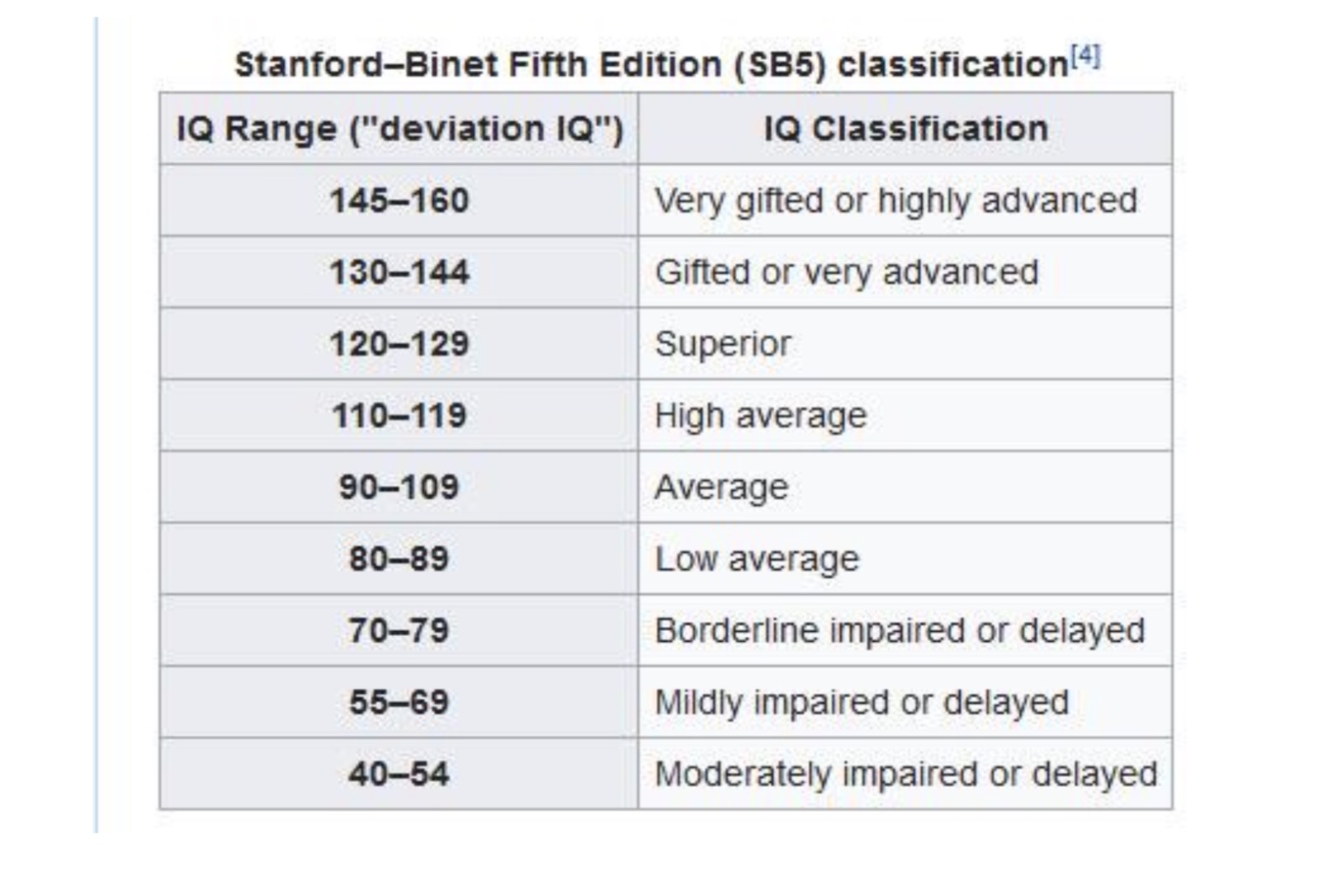
SB5 Classification:
WAIS 4 - Wechsler Adult Intelligence Scale 4th
WISC 5 - Wechsler Intelligence Scale for Children 5th
WPPSI IV - Wechsler Preschool and Primary Scale of
Intelligence
WASI - Wechsler Abbreviated Scale of Intelligence
Wechsler Tests:
WAIS 4
Who: Adults (ages 16–90)
Purpose: Measures adult intelligence (IQ)
WAIS 4
Consists of 15 subtests:
▫ Block Design
▫ Similarities
▫ Digit Span
▫ Matrix Reasoning
▫ Vocabulary
▫ Arithmetic
▫ Symbol Search
▫ Visual Puzzles
▫ Information
▫ Coding
▫ Letter-Number
Sequencing
▫ Figure Weights
▫ Comprehension
▫ Cancellation
▫ Picture Completion
WAIS 4
Provides a:
Full Scale IQ (FSIQ)
General Ability Index (GAI)
Index Scores
each with a mean of 100 and SD of 15
WISC 5
For ages 6 to 16 y/o , 11 months
WISC 5
Special group studies include score ranges for populations such as those with intellectual disability, ADHD, ASD, and gifted
WPPSI-IV
For children 4 to 6.5 y/o
can now be administered to children ages 2.6-7.7 y/o
WASI
Takes only 15 to 30 minutes to administer
• For ages 6 to 89 y/o
• Brief measure tied to both the WISC III and WAIS III
WASI
Results are less stable,
should not be used when a more accurate estimate from a full version is needed
16 PF
Cattell’s Taxonomy
16 PF
Type: Objective personality test
Made by: Raymond Cattell
Measures: 16 personality traits (e.g., warmth, dominance, emotional stability)
Use: Personality profiling, career guidance
16 PF
Based on the commonsense theory that if a human trait exists, a word in the language would have been developed to describe it
Now contains 185 items
16 PF
HSPQ: for high school students 12-18 y/o
CPQ: for children ages 8-12
NEO FFI
Type: Objective personality test
Measures: Big Five traits (OCEAN)
Shorter version of NEO-PI
Openness
Conscientiousness
Extraversion
Agreeableness
Neuroticism
BIG 5 Traits NEO FFI:
Draw-A-Person
Developed by Machover
is still used as a clinical assessment tool
Draw-A-Person
Was developed from Goodenough’s Draw a Man Task used to assess intelligence
Draw-A-Person
It is used as a means for evaluating behavioral or emotional problems
within the context of the clinical interview
Draw-A-Person
Psychodynamically based impulses
would be differentially projected upon female and male persons
HTP
Individual simply draw a house, a tree, and a person, usually on 3 separate sheets of paper
• The individual is asked to describe, define, and interpret each of the drawings
HTP
tends to be used primarily as a way of interactively engaging a client to determine therapeutic intervention
John Buck
HTP developed by?
HTP
Measures aspects of personality and overall neurological & mental functioning
Object of projection of the client's inner, subconscious world.
empathy, intuition, creativity
Good HTP Interpreters - high in _____, _____, _____ or cognitive flexibility
objective tests
HP must be administered together with ______ ___ to support the interpretations
House Interpretations
Home-life associations
Quality of Interfamilial relationships
Attitudes toward home situation
At least one door
One window
One wall
A roof
House Drawings by normals:
Trunk
represent the:
ego
sense of self
intactness of the personality
regressive fantasies
Christmas trees after the season is over can mean __________ (thinking about holidays and family and good times to make yourself feel better).
anima / animus
Here, the idea is that the person of the same sex is like you, and the person of the opposite sex is what you may not admit is like you.
Very Jungian when you think of it, in that the opposite sex is the ____/____
TAT
Developed by Christina Morgan and Henry Murray
based on Murray’s theory of needs
Apperception
to perceive in terms of past perceptions
TAT
Consists of 30 black and white picture cards, and one blank card
• Selection of the 20 depends on the age and sex of the examinee
TAT
Examinee is expected to identify with the hero in their story and project their needs, attitudes, and feelings on this character
themes
intensity & duration
outcomes
Not scored in any objective fashion. Scored according to:
▫ Frequency of various ____
▫ ____ and _____ of the stories
▫ ____ are taken into account
CAT
Consists of 10 pictures and is designed for children 3-10 y/o.
CAT
Uses animals in human social settings
• Children can better identify with animals than humans
Sentence Completion Test
Type: Projective test
Task: Finish incomplete sentences
Example: “I feel happy when…”
Measures: Attitudes, emotions, personality
Rotter Incomplete Sentences Blank
A person is asked to complete a number of sentence fragments that are related to possible conflicts or emotions
• 40 sentence fragments
highschool
college
adult
Rotter Incomplete Sentences Blank 3 FORMS: