PSY 2410: Child and Adolescent Psychology - Exam 4 (Final)
 Studied by 0 people
 Call Kai
 Learn
Learn Practice Test
 Spaced Repetition
 Match
Match Flashcards
 Knowt Play
1/77

There's no tags or description
Looks like no tags are added yet.
Name | Mastery | Learn | Test | Matching | Spaced | Call with Kai |
|---|
No analytics yet
Send a link to your students to track their progress
78 Terms
Adolescence
The time period between the beginning of puberty and adulthood
Puberty
- Time between the first onrush of hormones and full adult size and sexuality
- Usually lasting three to five years
- Requires many more years to achieve psychosocial maturity
Menarche
First menstrual period, signaling the beginning of ovulation
- Pregnancy is biologically possible, but ovulation and menstruation are often irregular for years after menarche.
Spermarche
First ejaculation of sperm
- Erections can occur as early as infancy, but ejaculation signals sperm production
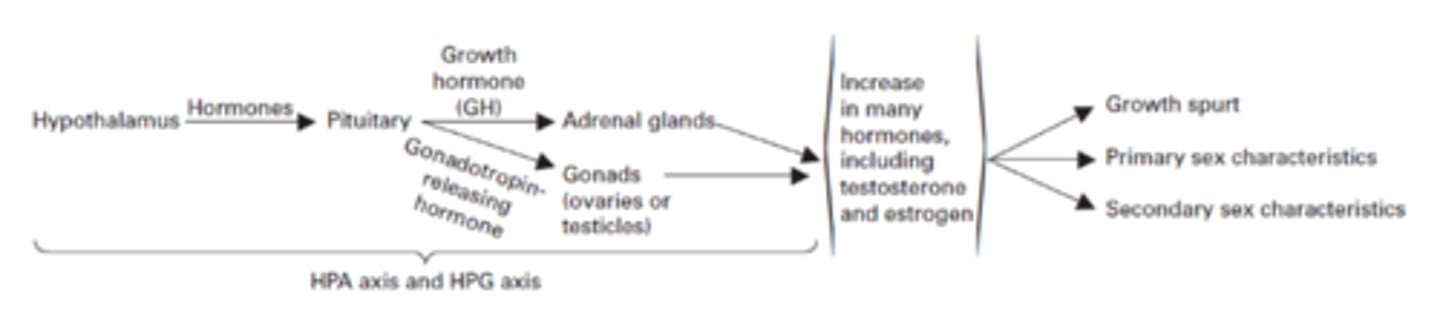
Hormones during Puberty
Pituitary gland (in brain) and adrenal glands (above kidneys) produces hormones
- Hormones that regulate puberty follow the HPA
(hypothalamus-pituitary-adrenal) axis
A surge of hormones affects bodies, brains, and behavior before any visible signs of puberty appear.
Sex Hormones
Estradioland and testosterone
- Sex hormones triggered by GnRH (gonadotropin-releasing hormone)
- Correlate with physical changes and brain restructuring
Gonads
Paired sex glands (ovaries or testicles)
- Follows the HPG hypothalamus-pituitary-gonad) axis
- HPG regulate how much estrogen/androgens are created, kickstarting puberty
Biological Sequence of Puberty
Psychological Disorders During Puberty
-Adolescence is the peak time for the emergence of many disorders.
- Boys are at greater risk for conduct disorders.
- Girls are at greater risk for depression.
- To prevent relapse, adolescence may be an effective time for therapy.
Body Rhythms
Circadian rhythm changes at puberty: Teenagers tend to be night owls more than early birds.
Dangers from sleep deprivation and irregular sleep schedules:
- Insomnia, nightmares, mood disorders, sleepiness while driving, and interference with learning
Three of every four high school seniors are sleep deprived.
Even if they go to sleep at midnight, as many do, they must get up before 8 A.M., as almost all do. Then they are tired all day.
Brain Growth During Adolescence
The usual sequence of brain maturation, propelled by hormones that activate the limbic system at puberty, can lead to danger.
- Steady maturation of prefrontal cortex
- Dramatic early adolescent hormonal growth (HPG axis) affecting limbic system
- Direct hormonal influence of amygdala
- When stress, arousal, passion, sensory bombardment, drug intoxication, or deprivation is extreme, the adolescent brain is overtaken by impulses that might overwhelm the cortex -> limbic system takes over, leads to outbursts
Prefrontal Cortex
Responsible for planning and emotional regulation
Emotions and the Brain
Brain immaturity makes teenagers vulnerable to social pressures and stresses.
- fMRI brain scans reveal that emotional control is not fully developed until adulthood because the prefrontal cortex is less connected to the limbic system.
- Heightened arousal in brain reward centers (nucleus accumbens)
- Gray matter replaces white matter as you age
When does puberty begin?
Pubertal hormones begin to accelerate between ages 8 and 14; visible signs of puberty appear a year later.
- Genes on the sex chromosomes have a marked effect on age of puberty; variation in age of puberty is a combination of genes, families, and ethnic groups.
- Girls generally develop ahead of boys.
- Children who have a relatively large proportion of body fat experience puberty sooner (leptin and threshold effect?)
Secular Trend in Puberty
Long-term direction of onset of puberty reveals a secular trend over the past three centuries
- Each generation has experienced puberty earlier and has grown taller.
- The secular trend has stopped in most nations.
- Could be due to nutritional or lifestyle changes or hormones in food
Stress and Puberty
Puberty arrives earlier
- Affects children who are genetically sensitive to context
Early Puberty
- Increases rate of emotional and behavioral problems
- Linked to teen pregnancy and later health issues
- Tension with peers if puberty is too early or late
Growth spurt
A relatively sudden and rapid physical growth that occurs during puberty.
- Each body part increases in size on a schedule; growth is not always symmetrical.
- Weight usually precedes height, and growth of the limbs precedes growth of the torso
- Height spurt follows weight spurt, and then a year or two later a muscle spurt occurs.
Organ Growth
- Lungs triple in weight; adolescents breathe more deeply and slowly.
- Heart doubles in size and heartbeat slows, decreasing pulse rate and increasing blood pressure.
- Skin becomes oilier, sweatier, more prone to acne.
- Hair becomes coarser and darker.
- New hair grows under arms, on faces, and over sex organs.
Factors of malnutrition in adolescence
- Circadian rhythm
- Drive for independence
- Wish for peer acclaim
low iron - reduces energy, impacts learning
low calcium -increases risk of bone weakness
Body image in adolescence
- Affected by need for peer approval and social
media
- Poor body image leads to depression and poor
eating habits
Eating Disorders
Anorexia nervosa
• Characterized by distorted body image, severe calorie restriction, and intense fear of weight gain
• Can be fatal
Bulimia nervosa
• Characterized by binge eating and subsequent purging, usually by induced vomiting and/or use of laxatives; can also include excessive exercise
Binge eating disorder
• Common in adolescence; involves compulsive overeating
Primary sex characteristics
Parts of the body that are directly involved in reproduction, including the vagina, uterus, ovaries, testicles, and penis
Secondary sex characteristics
Physical traits that are not directly involved in reproduction but that indicate sexual maturity
• Beards
• Breasts
Sexual Activity in Adolescence
- Hormones trigger sexual thoughts; culture shapes
thoughts into fantasies.
- Masturbation is common in all genders.
- Emotions regarding sexual experiences are strongly
influenced by social norms.
Sexual Problems in Adolescence
Sex in adolescence is more hazardous now.
- Puberty occurs earlier, increasing risky behavior.
- Restrictive reproductive laws mean more likely the teen may need to carry the pregnancy to term.
- Teen parents have fewer helpers.
- STIs are increasing.
Sexual Abuse
Child sexual abuse
• Includes all sexual activity
• Girls are particularly vulnerable
• Increases risks of adolescent hazards
Characteristics
• Family members most likely to abuse
• Victims are often isolated
Sexually Transmitted Infections (STI)
Diseases spread by sexual contact, including syphilis, gonorrhea, genital herpes, chlamydia, and HIV
- In the United States, half of all new STIs occur in people ages 15-25, even though this age group has less than one-fourth of the sexually active people.
- Worldwide, sexually active teenagers have higher rates of
most common STIs.
Egocentrism
Egocentrism to abstract logic occurs between ages 11 and 18
• Brain maturation
• Intense conversations
• Schooling
• Moral challenges
• Increased independence
Self-Centered Thinking
Adolescent egocentrism
• No grasp of others' perspectives
• Thoughts and actions not grounded in social reality
Rumination
To think obsessively about something, perhaps to the point that a past experience or current fantasy captures the mind, making further action difficult.
Imaginary audience
Imagined others who are watching an adolescent's appearance, ideas, and behavior
Personal fable
Aspect of adolescent egocentrism characterized by an adolescent's belief that their thoughts, feelings, or experiences are unique, more wonderful or awful than anyone else's
Invincibility fable
Adolescent's egocentric conviction that they cannot be overcome or even harmed by anything that might defeat a typical mortal, such as unprotected sex, substance abuse, or high-speed driving
Formal operational thought
Piaget's fourth and final stage of cognitive development
- Characterized by more systematic logical thinking and by the ability to understand and systematically manipulate abstract concepts.
- Examples seen in comparison between primary and secondary school abilities:
Math: Younger kids are using real numbers
Adolescents add in variables, imaginary numbers
Social Studies: Younger kids focus on daily life, basic facts
Adolescents learn more abstract concepts
Science: Younger kids focus on more hands on science
Adolescents focus on molecular levels and laws
Hypothetical Thought
Reasoning that includes propositions and possibilities that
may not reflect reality
Deductive Reasoning
Reasoning from a general statement, premise, or principle,
through logical steps, to figure out (deduce) specifics
• Sometimes called top-down reasoning
Inductive Reasoning
Reasoning from one or more specific experiences or facts to a general conclusion
• Sometimes called bottom-up reasoning
Dual processing
The notion that two networks exist within the human brain, one for emotional processing of stimuli and one for analytical reasoning
Intuitive thought
Thought that arises from an emotion or a hunch,
beyond rational explanation, and is influenced by past
experiences and cultural assumptions
Analytic thought
Thought that results from analysis, such as a
systematic ranking of pros and cons, risks and
consequences, possibilities and facts
- Analytic thought depends on logic and rationality.
Age and Two Processes
Paul Klaczynski found that almost every adolescent is analytical and logical on some problems but not on others
- As they grow older, adolescents sometimes gain in logic and sometimes regress.
- Apparent in gender intensification, the belief that certain roles are best filled by men and others by women
- People prefer emotional conclusions over logic
- increased myelination increases reaction time -> intuitive thinking
Attitudes about Learning
Stereotype threat
• The thought a person has that one's appearance or behavior will be misread to confirm another person's oversimplified, prejudiced attitudes
Fixed mindset
• An approach to understanding intelligence that sees ability as an innate entity, a fixed quantity present at birth
Growth mindset
• An approach to understanding intelligence that holds that intelligence grows incrementally, and thus can be increased by effort
Fixed-mindset students
• Compete for grades and teacher attention
• Rank themselves among their peers and disengage if self-ranked as low
Growth mindset students
• Help each other, laugh together, and cooperate on class projects
• Seek challenges, work hard at learning, enjoy discussion with their classmates, change their opinions based on what they learn, and choose difficult courses
Impulsivity in Adolescents
Adolescents become less impulsive as they mature, but they still enjoy the thrill of a new sensation.
Measuring Education
- High schools have more requirements for graduation than in the past.
- High schools now offer advanced placement classes.
- Some schools require exit exams to graduate.
- Data does not support these tests.
PISA (Programme for International Student Assessment)
• International test taken by 15-year-olds that is designed to measure problem-solving and cognition in daily life
• Designed to measure high school learning that will be applied later on
• Scores reflect national policy
May impact what kids are learning in school, engagement, and creativity
Student engagement
• Essential for effective secondary education
• Measurements include involvement in courses, emotions about their school, and relationships to their friends and teachers
• Seems to be low in secondary schools
- Hypotheses for decreased engagement in high school students:
- School organization, teacher alienation, sports programs, and puberty
School Organization
• Most secondary schools are organized in ways to alienate students from each other.
• High schools typically require students to change rooms, teachers, and classmates every 40 minutes or so, disrupting engagement.
• Schools are too large.
• "Honors" classes alienate other students.
Teacher Engagement
Secondary school teachers have dozens, even hundreds, of students.
• The possibility that one student or one parent might complain, causing public attack and job loss, leads teachers to become impersonal, distant, and boring.
• There is a lack of gender and ethnic diversity among teachers.(harder to feel like you belong at school if teachers don't look like you)
Sports and Puberty
Sports
• Athletes have less time to study, so they become disengaged.
• Cutting after-school programs disengages students from school.
Puberty
• Students are mentally distracted.
• Disengaged behaviors may be admired by peers.
• Anti-adult, peer-culture encourages disengagement.
Identity
Erikson
• Identity versus role confusion
• Erikson's fifth stage of development, when people wonder "Who am I?" but are confused about which of many possible roles to adopt
YRBS (Youth Risk Behavior Survey)
• Surveys over 30 years show "remarkable individual difference" among U.S. adolescents in behavior and brain development based on socioeconomic background
Identity achievement
• When a person reconsiders the goals and values of their parents and culture to forge their own identity
Achieving Identity
Role confusion (identity diffusion)
• When adolescents have no clear identity but fluctuate from one persona to another
Foreclosure
• Erikson's term for premature identity formation, when an adolescent adopts parents' or society's roles and values without questioning or analysis
Moratorium
• A socially acceptable way to postpone achieving identity
Identity achievement
• A lifelong quest as self-concept shifts
enrolling in college undecided, gap year, temporary
No Role Confusion
For many youths who cannot afford college, the military offers a temporary identity —complete with haircut, uniform, and comrades.
Religious Identity
Spiritual grounding may be integral to the quest for identity.
• Most adolescents agree with most of their parents' religious beliefs.
• Adolescents commonly become less devout.
• Many adolescents question organized religion and embrace spirituality.
Political Identity
• Parents are the main influence of their children's political identity and involvement.
• Adolescence may be the crucial time for forming attitudes.
• Adolescents tend to be more progressive than their elders, especially on social issues
Vocational Identity
Adolescents are no longer expected to decide on a vocation.
- Fluctuations in the job market mean that most adults change jobs, careers, and vocations several times.
- During adolescence, career aspirations are still influential, not as a specific job, but as a general motivator and goal.
Ethnic Identity
In the United States, about half of all adolescents are of African, Asian, Hispanic, Pacific Islander or Indigenous heritage.
• Establishing a solid ethnic identity is especially difficult for adolescents who are multiracial.
• When children move past concrete operational thought, they seek to understand their heritage.
Gender Identity
Erikson's "gender intensification" no longer fits adolescent development; it is now called gender identity.
• Analytic, hypothetical thinking leads adolescents to question or reject traditional gender norms and the gender binary.
• People who are distressed by their gender identity have gender dysphoria and may transition to another gender or take puberty blockers.
Peers and Parents
Both peers and parents are influential.
• Older siblings can be role models or bullies.
• These relationships can be destructive or supportive.
• Emotional problems often originate with the parents, and then those problems cause peer rejection.
Family Closeness
Family closeness may be crucial.
• Communication
• Support
• Connectedness
• Control
Parental Monitoring
Parents' ongoing awareness of what their children are doing, where, and with whom
Cultural Expectations
Parent-child conflict is less evident in cultures that stress familism, the belief that family members should sacrifice personal freedom and success to preserve and protect the family.
• Family closeness is a strong value in Mexican culture.
• U.S. teens believe they should have control over their physical appearance.
• The Covid-19 pandemic added stress and chaos to family systems.
Family Conflict
All close relationships include disagreements.
• Family conversation and compromise are essential.
• Ideally, caregivers avoid being too strict or too permissive and instead maintain support while increasing autonomy.
Closeness with Peers
Choosing Friends
• Teenagers select friends whose values and interests they share, abandoning friends who follow other paths.
Peer pressure
• Encouragement to conform to friends or contemporaries in behavior, dress, and attitude.
Romantic partners
• Finding a "soulmate" is a goal for many adolescents.
• Peer support is vital.
Sexual Identity
Peers, more than parents, influence sexual activity.
Sexual Orientation
A person's romantic or sexual attraction, which can be to others of the same gender, another gender, or every gender
- Can be weak, strong, or overwhelming
Sex Eduation
From parents
• Often inadequate and focuses on risk more than pleasure or identity
From the media
• Correlation between exposure to media sex and adolescent sexual initiation
From educators
• Most U.S. parents want up-to-date sex education for their adolescents.
• Timing and content vary by state and community.
• Sex education varies by nations.
• Abstinence-only programs were not successful.
From peers
• Adolescent sexual behavior is strongly influenced by peers, especially when parents are silent, forbidding, or vague.
• Adolescents choose friends whose sexual inclinations are similar to their own and then talk about it.
• Many adolescent couples don't discuss issues such as pregnancy and STIs.
Technology and Human Relationships
Four concerns are often expressed:
1. Equity (gender, economic, and age)
2. Sex
- Sexting: Sending sexual messages or photographs (usually of one's naked body) via phone or computer
3. Cyberbullying
- When people try to harm others via electronic means, such as social media, cell phone photos, or texts
4. Relationship stopping
- Does technology interfere with human interaction?
Depression and Anxiety
Increase due to hormones during puberty, academic and social stressors
Major depression - Feelings of hopelessness, lethargy, and worthlessness that last two weeks or more.
Parasuicide - Any potentially lethal action against the self that does not result in death
- Parasuicide is common, completed suicide is not.
Cluster suicides - Several suicides committed by members of a group within a brief period of time; increase due to hormones during puberty, academic, and social stressors
Deliquency and Defiance
Behaviors
• Externalizing and internalizing behaviors are more closely connected in adolescence than at any other age.
Breaking the law
• Both prevalence and incidence of criminal actions escalate in late adolescence.
• Black and Hispanic male adolescents are more likely to be arrested.
• Adolescents who are taken to court to be sentenced are likely to foreclose on identity as a criminal.
• Some adolescents confess to crimes they have not done
Two Kinds of Teenage Lawbreakers
1. Adolescence-limited offender: A person who breaks the law as a teenager but whose criminal activity stops by age 20
2.Life-course-persistent offender: A person whose criminal activity begins in adolescence and continues throughout life; a "career" criminal
- Peers facilitate or halt lawbreaking.
- Adolescent crime has decreased dramatically in the past 30 years (Due to higher graduation rates from HS, less drug use, smaller families, less lead poisoning, different policing policies)
Drug Abuse
Usually begins with legal drugs
• Turbulent emotions lead adolescents to psychoactive drugs for relief.
• Psychoactive drugs excite the limbic system and disrupt the prefrontal cortex.
• Rate of every hazard increases with this drug use
• Imaginary audience and invincibility fable add to the problem.
Alcohol
• Most frequently abused drug in North America
• Repeated drinking may damage the hippocampus and prefrontal cortex.
•
Marijuana
Adolescents who regularly smoke marijuana are more likely to drop out of school, become teenage parents, and be unemployed.
Nicotine
Impairs digestion, nutrition, and growth
Preventing Drug Abuse
Making a drug illegal does not stop adolescents from using it, and it may increase excitement.
• Laws may reduce availability.
• Taxes discourage purchase.
• Advertising campaigns against teen smoking by public health advocates reduce smoking.
• Antismoking announcements produced by cigarette companies increase use.
 Note
Note  Flashcards (40)