Section 4 - Thermoregulation
 Studied by 0 people
 Call Kai
 Learn
Learn Practice Test
 Spaced Repetition
 Match
Match Flashcards
 Knowt Play
1/34

There's no tags or description
Looks like no tags are added yet.
Name | Mastery | Learn | Test | Matching | Spaced | Call with Kai |
|---|
No analytics yet
Send a link to your students to track their progress
35 Terms
Hypothermia
A patholigcal lowering of the body temperature to or beyond the point of survival
Homeotherm
Warm-blooded animal
Mammals and birds
Able to maintain ther own body temperatures
Poikilotherms
Cold-blooded animal
Body temperatures are roughly the same as the environment
Which type generates their own eat? Homeotherms or Poikilotherms?
Homeotherms
How do homeotherms generate their own heat?
By converting matter to energy
Results in a large amount of energy where 2/3rds is lost as heat.
Generation of heat at the cellular level (how it works)
What type (Homeo/Poikilo) sees more of this action?
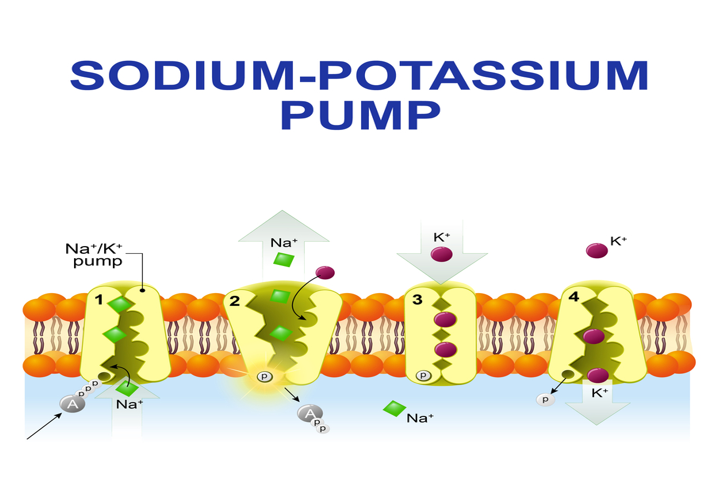
The Na/K pump in the membrane flips to move potassium into and sodium out of the cell. This process, which is active transport, utilizes ATP. Therefore, the entire process generates heat which is captured and stored in the body’s water reservoir.
Homeotherms have more pumps per cell than poikilotherms
What types of cells are especially important to the addition of body heat?
Muscle cells
What organ creates a significant amount of the body’s heat?
The heart
Diurnal Temperature Rhythm
A body temperature pattern that repeats on a daily basis
Diurnal animals
Animals active during the daylight hours but asleep at night
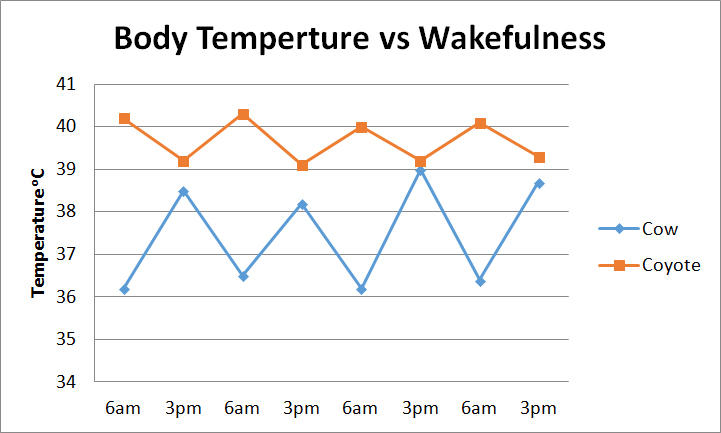
At what point in the daily cycle of a diurnal animal is the body’s temperature the coolest?
The time right as they awaken from sleep
Why does the body cool so much during sleep?
the BMR (Basal metabolic rate) is at a minimal, meaning heat rate, nerve function, and respiration are slowed—generating less heat
How does the body warm itself after waking?
As an animal moves about, its metabolism increases, of which increases heat generation
How are nocturnal animals different than diurnal animals?
Due to nocturnal animals being awake at night and asleep during the day, they essentially have a “flipped” heat graph compared to diurnal animals.
Why do dehydrated animals have a harder time regulating their body temperature?
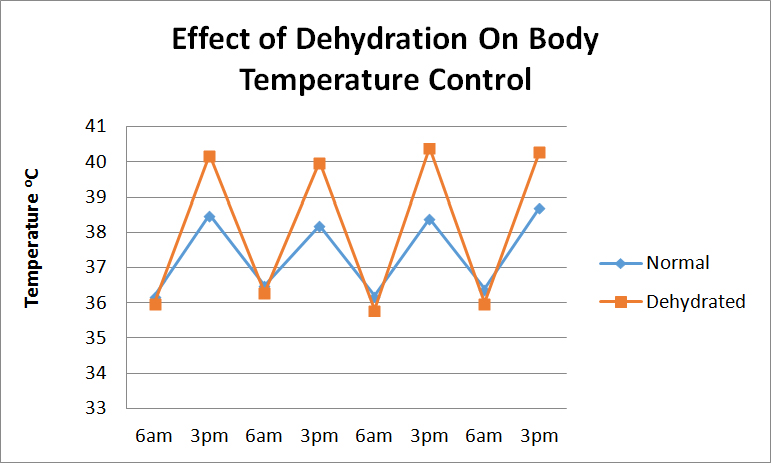
Due to the lack of water content in the animal’s body (water is a heat sink)
Lack of water leads to a wider fluctuation in body temperatures
What external factors heavily impact an animal’s body temperature?
The temperature of the environment itself (extreme temps call for more physiological effort)
The water content found in the environment (humidity and precipitation… water is a heat sink!)
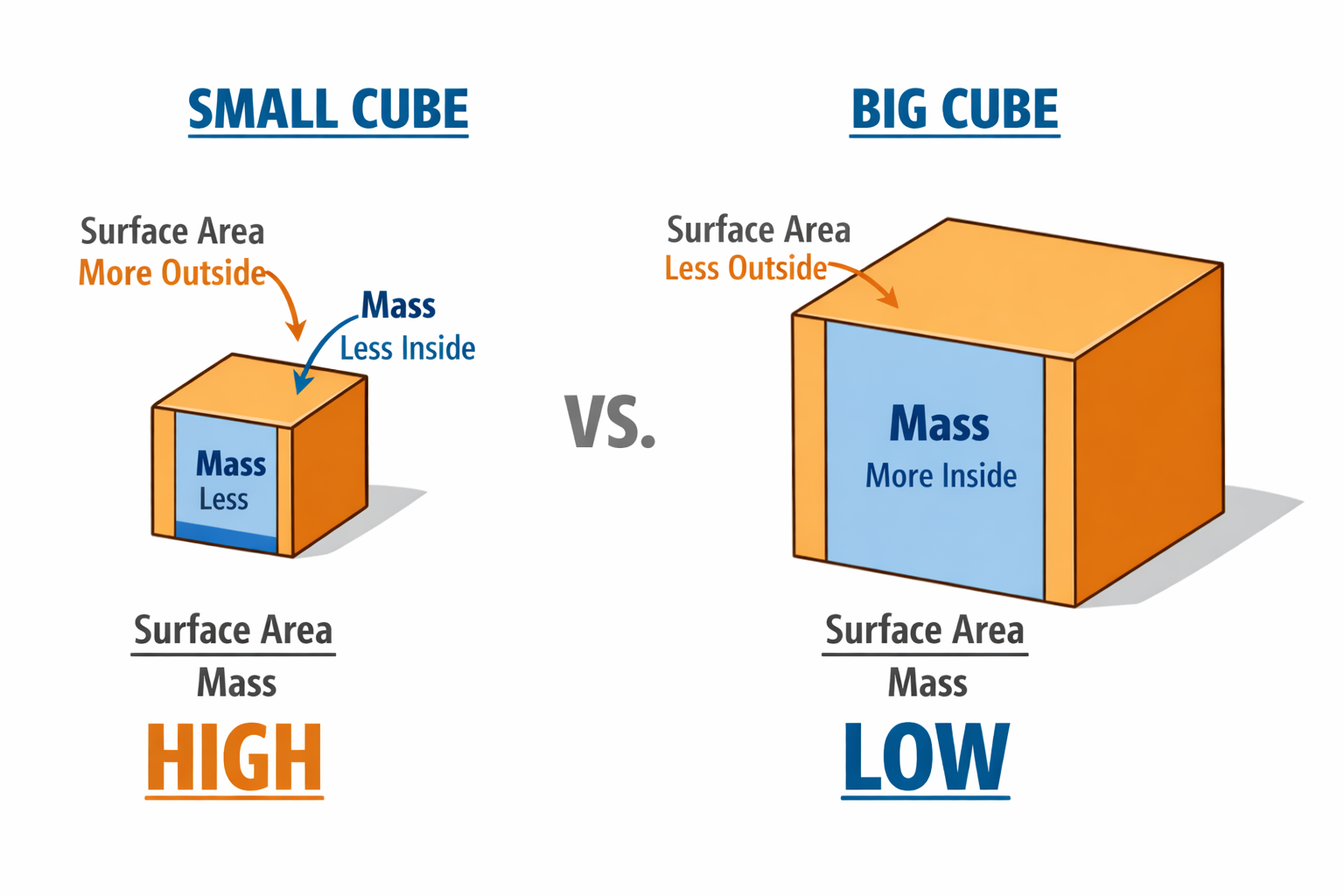
What does “smaller animals have a great surgace area per unit of mass” actually mean?
For every gram of body weight, a small animal has more exposed skin than a large animal does
This is important for why smaller animals get dehydrated faster
The hypothalamus senses low and high temperatures and activates specific systems to maintain body heat
True
How does the body cool itself down?
Maximize surface area
Sweating (insensitive)
Water is brought to the surface of the body to then be dissipated into the environment. The cool water on the body surface then allows for heat in the body to be drawn out into the environment.
Panting
Why do animals pant?
To increase water and heat loss
Water is expelled when breathing!
What do eccrine glands mostly secrete? apocrine glands?
eccrine: water
apocrine: proteins
What species has the most eccrine glands?
Humans
How do animals respond to low temperatures?
Minimized exposed surface area
Puckering of the skin (goosebumps)
Piloeretion
Erection of hair
Shivering
Muscle spasms (recall than 75% of muscle activity is lost as heat)
Decrease blood flow to the extremities
Extremities have more exposed surface area + not as important as the torso cavity
Brown fat metabolism
Brown fat vs white fat
Brown fat contains more mitchondira and have a faster metabolic rate
Hibernation
A dormant state in animals where all physiological processes are slowed
They are NOT stopped
Strictly done by warm-blooded animals
Heavily dependent on brown fat
What can wake an animal from hibernation early?
When core body temperature reaches a critically low level
Waking raises BMR and core body temp.
Why is exposure to water at extreme temperatures dangerous?
Water causes faster air exposure due to the heat conductivity of water
Hyperthermia
A pathological increasing of body temperature to or beyond the point of survival
Associated with times of extreme fluid loss
What species is most at risk for hyperthermia?
Pigs, as they are unable to sweat or pant well
Depend on mud
Why is hypothermia a risk during anesthesia?
Neural tissue is put to sleep, and the body itself cools as if asleep. The hypothalamus then cannot sense and correct body temperature.
Heat stroke
Result of body temperature building up faster than the evaporative cooling effects can remove it
Why do fevers occur?
The body raises the BMR to combat the infection, as bacteria and viruses are generally killed in the presence of high heat
What could happen during a fever if the hypothalamus’ temperature detecting cells are denatured/damaged?
Can lead to the body temperature to climb continually without any rate limit
Denature
Change in the function of a protein
BMR is partially regulated by cells in the hypothalaus which sense heat
True
 Note
Note  Flashcards (20)