Neurons and Glia
 Studied by 0 people
 Call Kai
 Learn
Learn Practice Test
 Spaced Repetition
 Match
Match Flashcards
 Knowt Play
1/19

There's no tags or description
Looks like no tags are added yet.
Name | Mastery | Learn | Test | Matching | Spaced | Call with Kai |
|---|
No analytics yet
Send a link to your students to track their progress
20 Terms
The Neuron- Form and Function
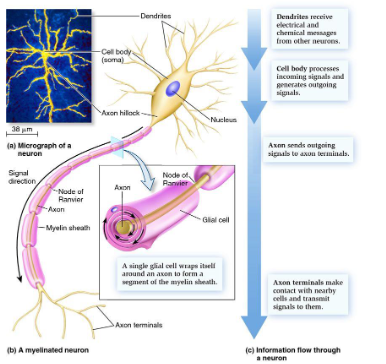
What determines a neuron's resting membrane potential?
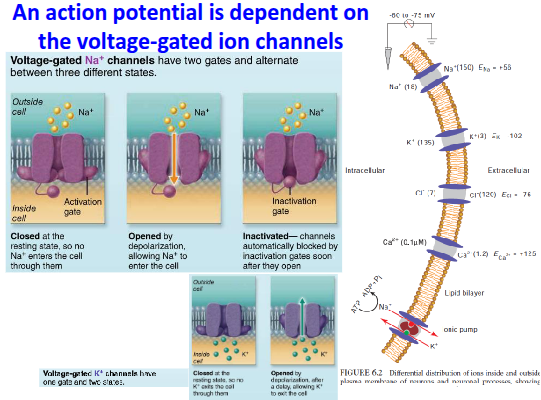
It is determined by the concentration of ions (such as K⁺, Na⁺, Ca²⁺ and Cl⁻), the lipid bilayer, and the proteins that span the membrane (ion channels and pumps).
Which ions are found in higher concentration inside and outside the neuron?
Potassium ions (K⁺) are slightly higher inside the neuron, while sodium ions (Na⁺) are slightly higher outside the cell membrane.
What mechanism maintains the resting membrane potential?
The Na⁺/K⁺ ATPase pump maintains it by removing Na⁺ ions from the cell and bringing K⁺ ions into the cell.
How does the Na⁺/K⁺ ATPase pump work?
It actively transports three Na⁺ ions out of the neuron for every two K⁺ ions it moves in, using energy from ATP.
What is the overall charge inside the neuron compared with the outside?
The inside of the neuron is slightly negatively charged compared with the outside.
What is the approximate value of a neuron's resting membrane potential?
Approximately –65 millivolts (mV).
What is an action potential and how does it transmit information in neurons?
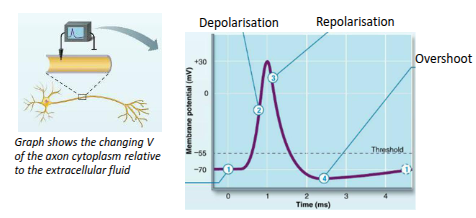
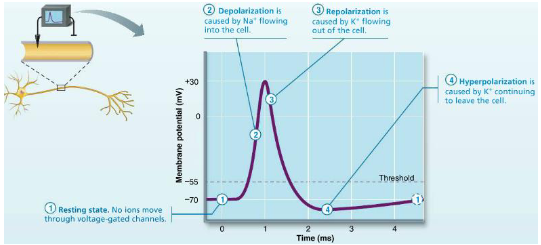
An action potential (also called a nerve impulse, spike or discharge) is a rapid and reversible change in the resting membrane potential. It is an ‘all-or-nothing’ response of fixed amplitude, and neurons transmit information through the frequency and pattern of their action potentials.
How is an action potential generated in a neuron?
When a neuron’s membrane is depolarised to the threshold level, voltage-gated Na⁺ channels open, allowing Na⁺ to enter and rapidly depolarise the cell. This is followed by inactivation of Na⁺ channels and activation of voltage-gated K⁺ channels, causing K⁺ to exit and repolarise the membrane. This sequence produces the action potential—an all-or-nothing response of fixed amplitude.
What is a membrane potential?
A membrane potential is the difference in ion concentration across a cell’s membrane, creating an electrical potential difference.
How do neurons use their membrane potential?
Neurons use changes in membrane potential as signals to receive, integrate, and transmit information.
How can a neuron’s membrane potential be changed?
By altering the membrane’s permeability to specific ions through the opening or closing of ion channels.
What are graded potentials?
Graded potentials are local changes in membrane potential that vary in size and decrease with distance from the point of stimulation.
What are action potentials?
Action potentials are brief, all-or-nothing spikes in membrane potential of fixed amplitude that do not degrade with distance, allowing long-distance communication between neurons.
What happens when Na⁺ channels open on a neuron’s dendrite?
The influx of Na⁺ makes the inside of the neuron less negative (depolarisation).
What happens when anion (Cl⁻) channels open in a neuron?
The inside of the neuron becomes more negative (hyperpolarisation).
How do graded potentials influence action potential generation?
Graded potentials determine whether a neuron becomes excited and more likely to generate an action potential, or inhibited and less likely to do so, at the axon initial segment.
An action potential is dependent on the voltage-gated ion channels
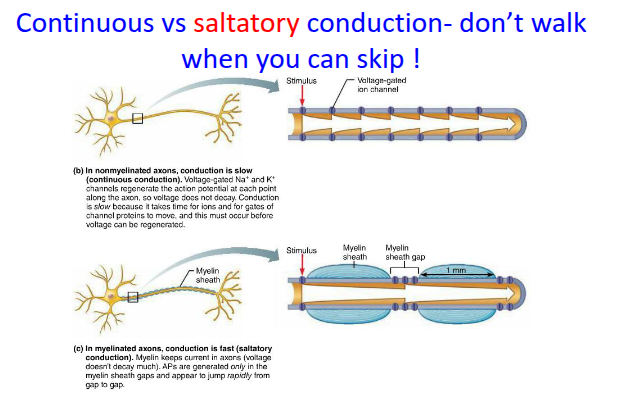
How does myelination enable rapid transmission of action potentials?
Myelination insulates long sections of the axon, leaving small unmyelinated gaps called nodes of Ranvier (about 1 μm wide) that are rich in voltage-gated Na⁺ and K⁺ channels. The action potential “jumps” from one node to the next by saltatory conduction, allowing it to travel quickly along the axon.
 Note
Note  Flashcards (49)