M6+7 Maiden- Small is beautiful: life as a microbe + The genetic and genomic diversity of the bacteria + Bacterial species, subspecies structure and typing
 Studied by 0 people
 Call Kai
 Learn
Learn Practice Test
 Spaced Repetition
 Match
Match Flashcards
 Knowt Play
1/7

There's no tags or description
Looks like no tags are added yet.
Name | Mastery | Learn | Test | Matching | Spaced | Call with Kai |
|---|
No analytics yet
Send a link to your students to track their progress
8 Terms
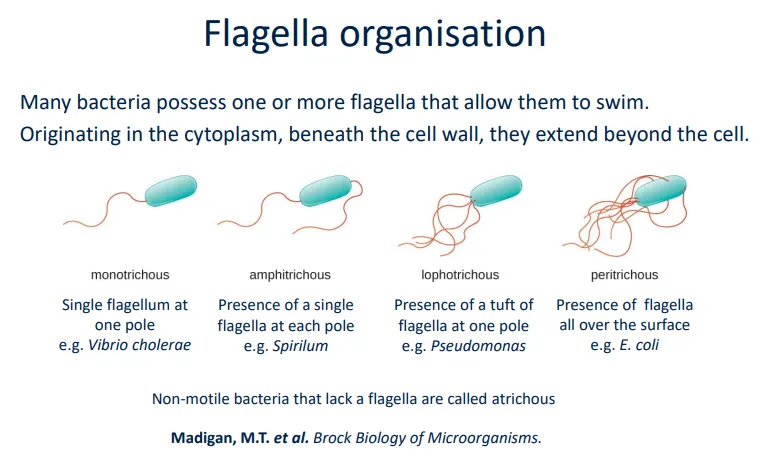
what are the different kinds of flagella organisation?
what are linkage equilibrium and disequilibrium?
linkage equilibrium is found in sexual organisms- this is where different genes are randomly assorted in a population
linkage disequilibrium is found in asexual organisms- this is where genes are associated non-randomly in a population eg. two genes are more likely to be found together because one parent organism has both, so its whole lineage will also have both- particular patterns will accumulate in different lineages
in bacteria these exist on a continuum depending on the degree of horizontal gene transfer and recombination
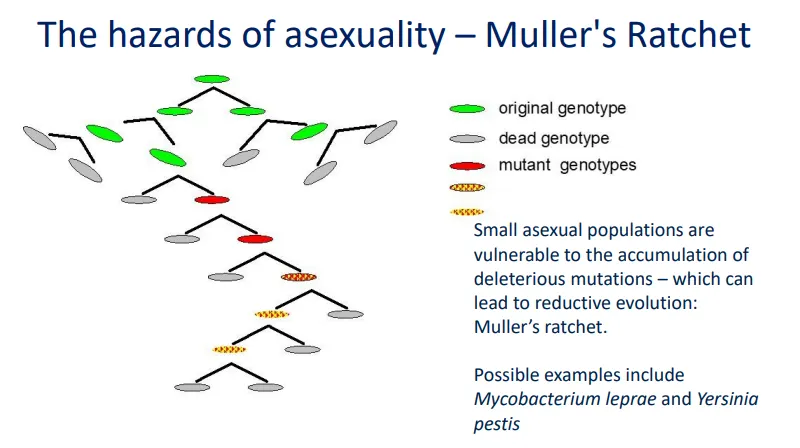
what is Muller’s ratchet?
Muller’s ratchet is a case of reductive evolution- small asexual populations (without recombination) are vulnerable to the accumulation of deleterious mutations
ultimately these species will go extinct, because they evolve themselves into a corner and can’t be ‘rescued’ by recombination
in asexual populations, genomes are inherited as indivisible blocks, so that an organism inherits the same mutations as its parent, more mutations occur, and it passes the entire increased mutational load onto its own offspring
one generation will never have fewer mutations than the generation before, so they accumulate
this is greater in small populations because they are more affected by genetic drift, so less mutated lineages may die out due to stochastic changes
as the prokaryotic genome size increases, how do the proportions of different kinds of genes change?
as the genome size increases:
the proportion of genes for DNA translation, replication and repair decrease- new proteins (eg. kinds of polymerase) aren’t needed as the genome increases, the process doesn’t change
the proportion of genes for metabolism and transport increases- the metabolic diversity increases so the organism can deal with a wider range of environments + becomes more resilient
the proportion of regulatory genes increases- more structural genes mean more regulatory genes are needed to control transcription
why are bacterial coding sequences non-randomly arranged in the chromosome?
coding sequences, particularly of more essential genes, are more likely to be encoded on the leading strand of the chromosome- there is a bias of coding locations in the chromosome
this is because when simultaneously replicating and transcribing DNA, head-on collisions between the machinery are much less likely in the leading strand than the lagging strand- this forms truncated products, so it is selected against
ie. DNA polymerase from replicating the lagging strand (forming the Okazaki fragments) can collide head-on with RNA polymerase from transcribing the newly formed DNA
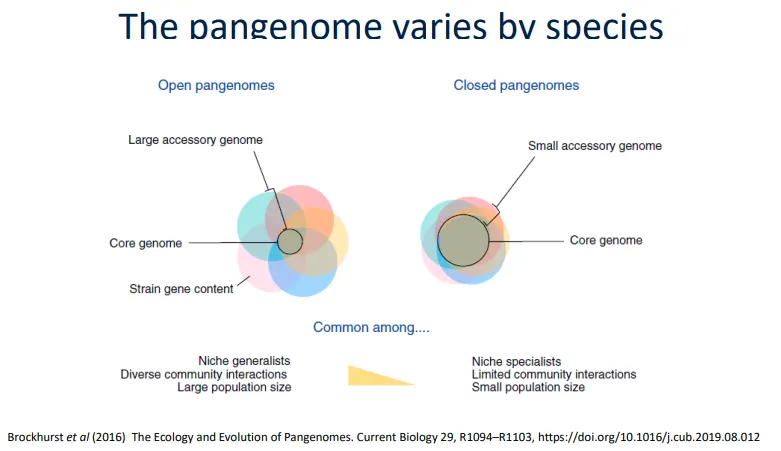
what are pangenomes?
the pangenome is the entire array of genes available to a bacterium- essentially, the gene pool of a species/group
bacteria have a core genome and an accessory genome, comprising the genes in the population which each individual/strain may or may not have
most bacteria have an open genome (along a continuum) because horizontal gene transfer is widespread (compared to human closed genomes, where most of our genes are the same, and the differences are pretty superficial)
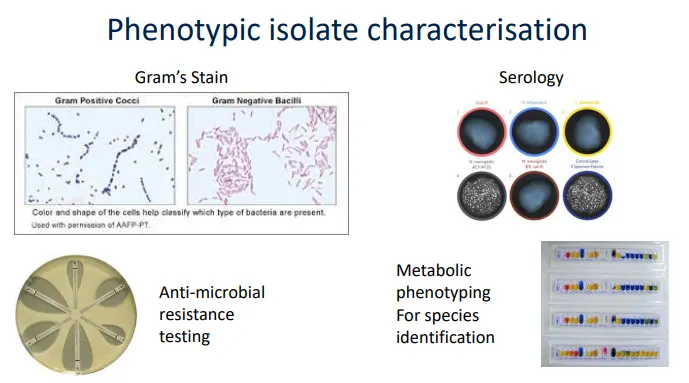
how can bacteria be characterised?
staining + microscopy to observe morphology
responses to anti-microbial compounds, pHs and temperatures
serology- applying antibodies and determining responses
metabolic phenotyping- using strips with different metabolites to produce a metabolic fingerprint
MALDI-TOF- mass spectrometry of all proteins found to obtain a protein fingerprint
DNA sequencing- comparing single genes, multiple loci or whole genomes using gel electrophoresis/Sanger sequencing
what is a single locus that is often sequenced for bacterial classification?
the 16S rRNA gene- codes for a highly conserved ribosomal RNA strand
contains universal regions that can be easily used to generate primers for PCR and Sanger sequencing
however, this high conservation means it has a limited resolution- to species level at best
it is a single gene so it is rapid, but for a higher resolution multi-locus sequencing is needed (normally conserved housekeeping genes are used)
sometimes there can be multiple gene copies in a cell, so there may be variation within an isolate
 Note
Note  Flashcards (77)