Elbow & Forearm Complex
 Call Kai
 Learn
Learn Practice Test
 Spaced Repetition
 Match
Match Flashcards
 Knowt Play
1/93

There's no tags or description
Looks like no tags are added yet.
Name | Mastery | Learn | Test | Matching | Spaced | Call with Kai |
|---|
No analytics yet
Send a link to your students to track their progress
94 Terms
The elbow & forearm is complex and a highly congruent joint. It has…
3 bones & 4 joints: humerus, ulna, radius
Which joints are involved in elbow flexion/bending & extension/straightening, b/c they create a stable, hinge-like mechanism?
Humeroulnar and humeroradial joints
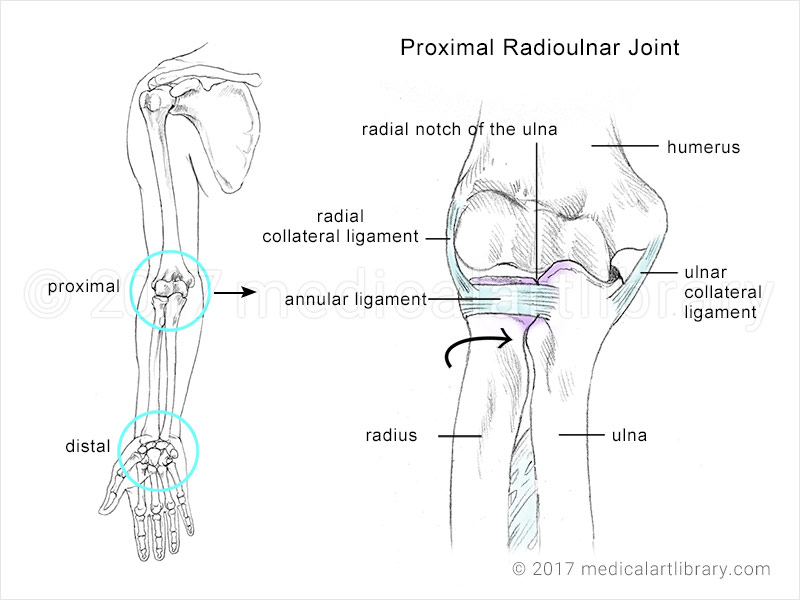
Which joints are involved in forearm pronation & supination? (fxn of elbow & forearm complex)
Proximal & distal radio-ulnar joints
Which plane & axis of rotation does elbow flexion/extension occur in?
Sagittal plane, frontal axis
Which plane & axis of rotation does forearm rotation occur in?
Transverse plane, vertical axis
Medial and Lateral are anatomical terms describing…
the location in relation to the body’s midline/where something is
Medial: closer to midline
Lateral: away from midline
Valgus and Varus are clinical terms to describe…
a joint angulation OR an angular directed force/which way it’s pointing
Valgus = angled outward (pointing laterally)
Varus = angled inward (pointing medially)
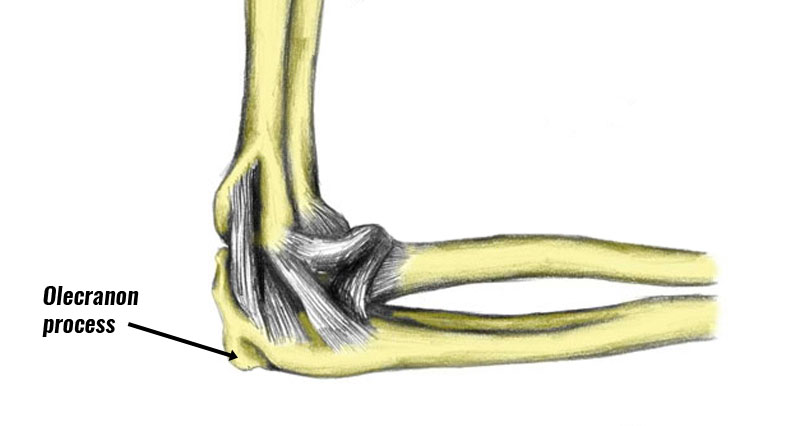
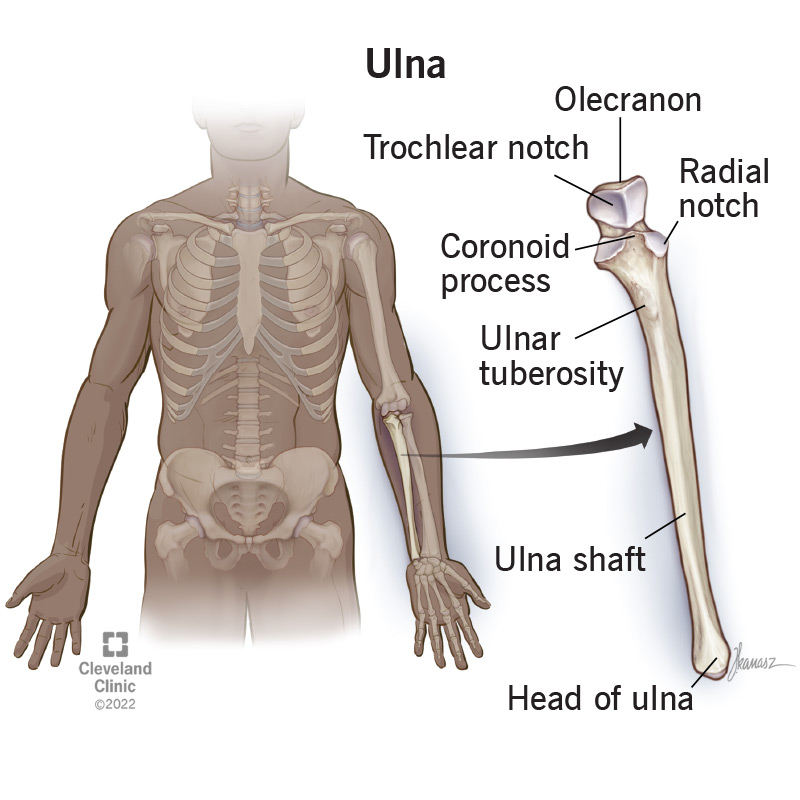
Proximal Ulna: Olecranon process
Forms “point” of elbow
Triceps insertion
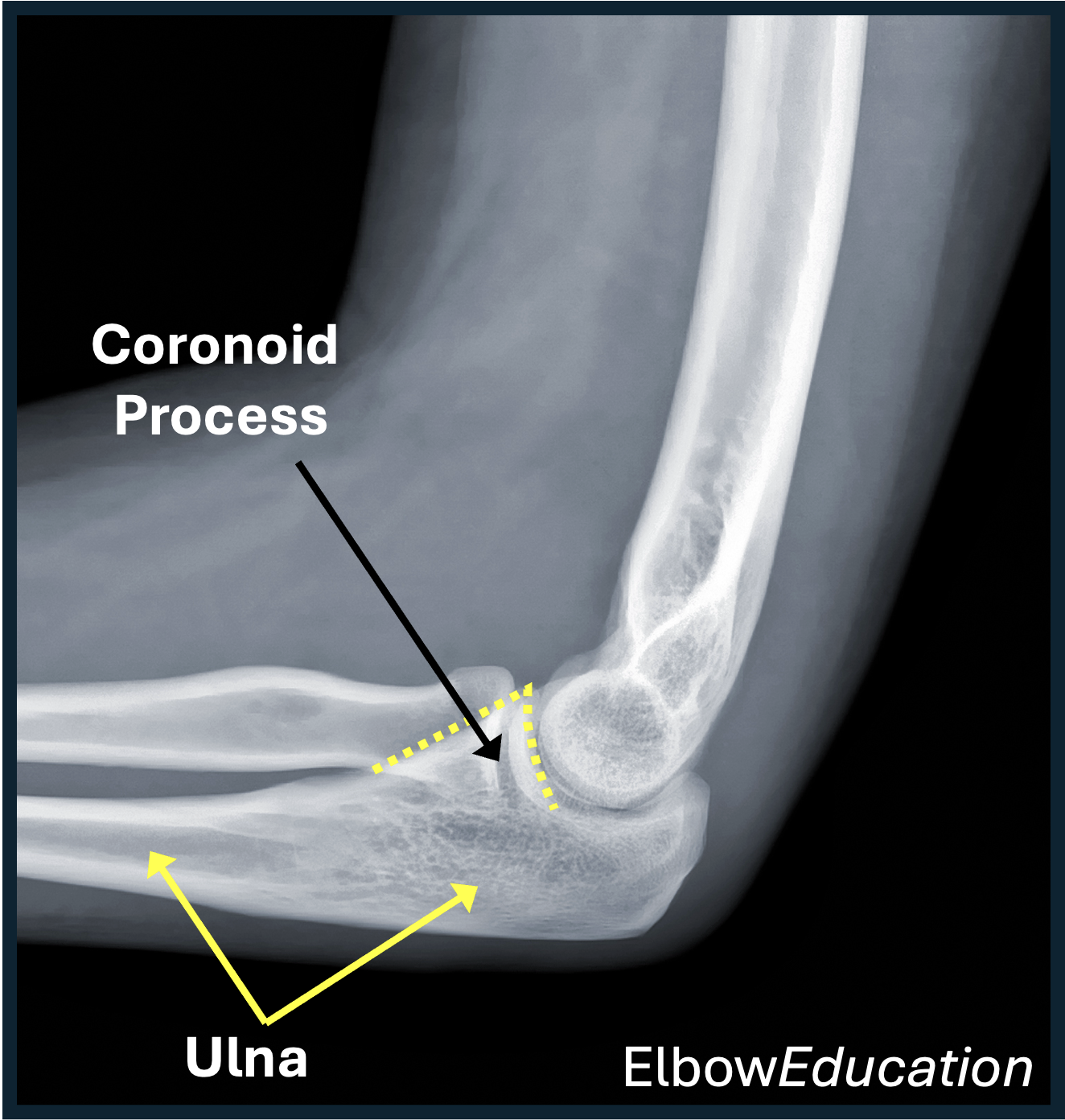
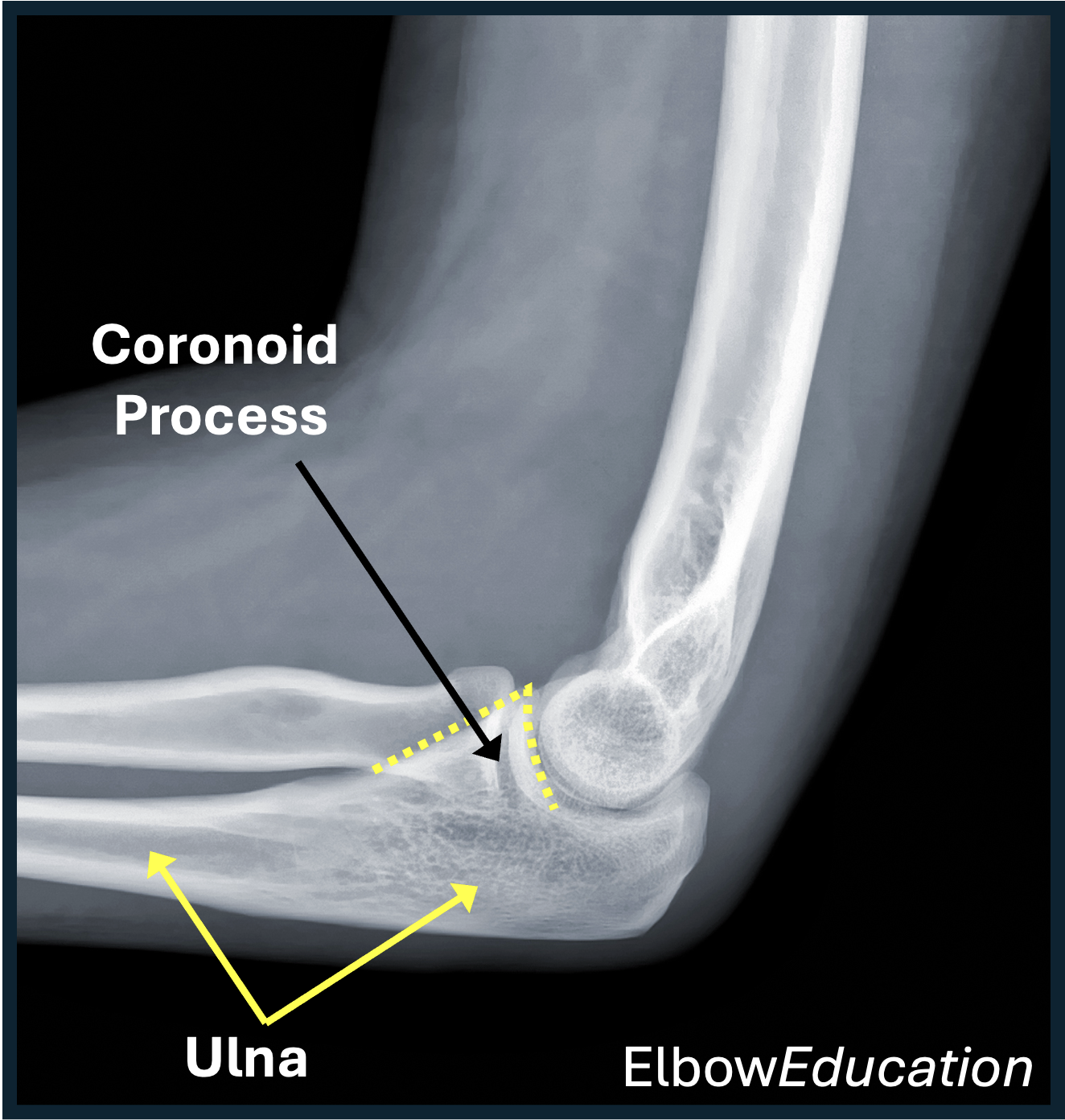
Proximal Ulna: Coronoid process
Means “hook-like”
Triangular, bony projection: anterior buttress for elbow joint, preventing posterior dislocation
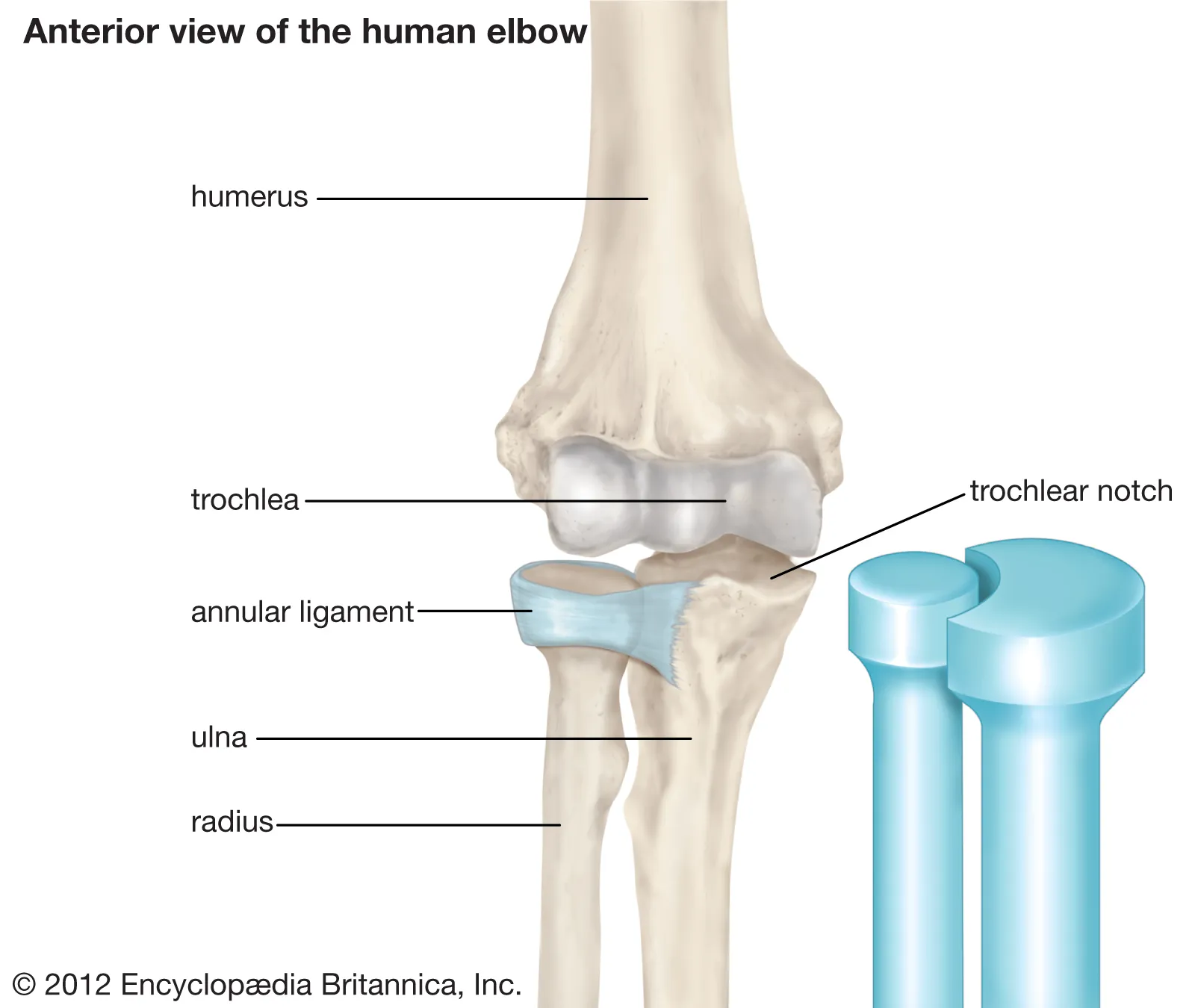
Proximal Ulna: Trochlear notch
Jaw-like process btwn olecranon & coronoid process
Articulates w/ trochlea of humerus, forming the humeroulnar joint
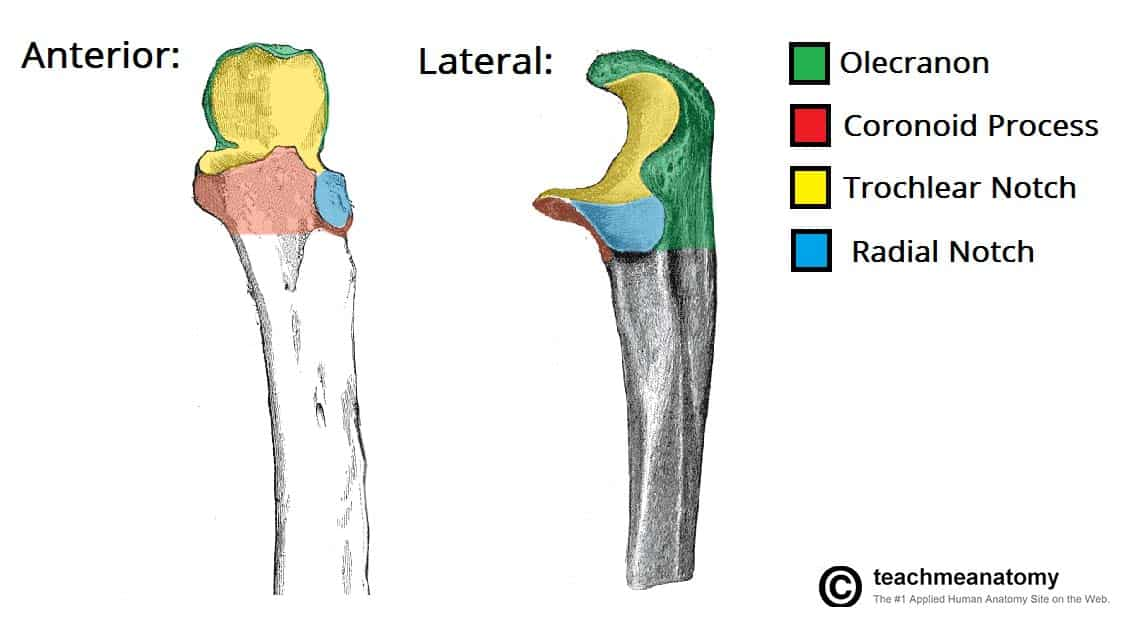
Proximal Ulna: Radial notch
narrow, concave articular surface on the lateral side of the coronoid process in the proximal ulna
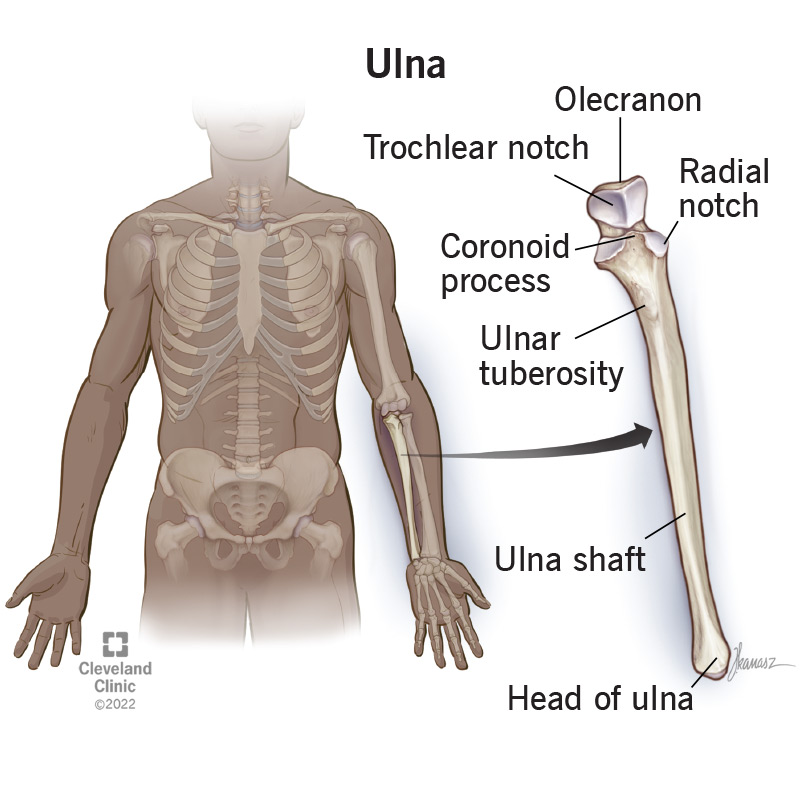
Proximal Ulna: Ulnar tuberosity
Brachialis insertion
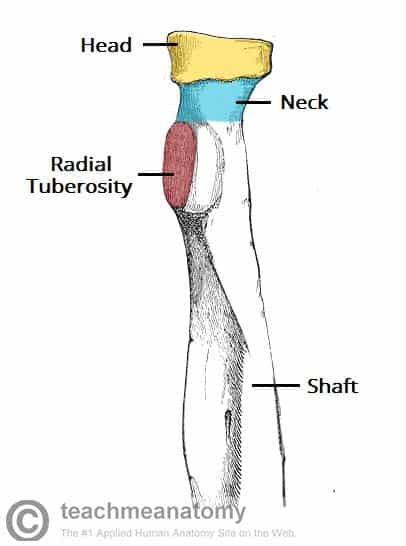
Proximal Radius: Radial head
Disc-like
Rim: 280* covered by articular cartilage + articulates w/ ulna forming the PRUJ
Fovea: depression in center + articulates w/ capitulum, forming the humeroradial joint
Proximal Radius: Radial neck & Radial (bicipital tuberosity)
Neck: area directly underneath the radial head
Radial (bicipital) tuberosity: Rough area on bone for a muscle to insert or attach to
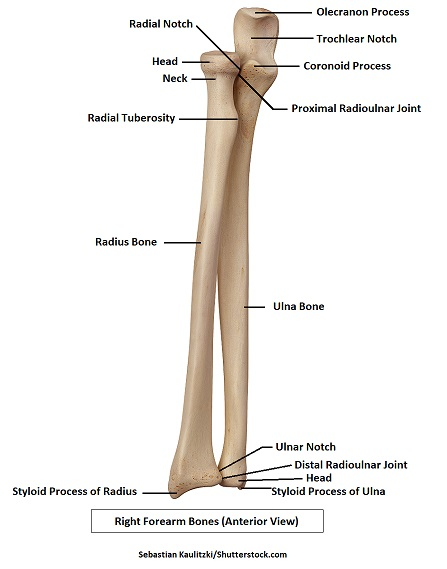
The proximal ulna consists of the?
Olecranon process
Coronoid process
Trochlear & radial notch
Ulnar tuberosity
The proximal radius consists of the?
Radial head: disc-like, rim, fovea
Radial neck
Radial (bicipital) tuberosity
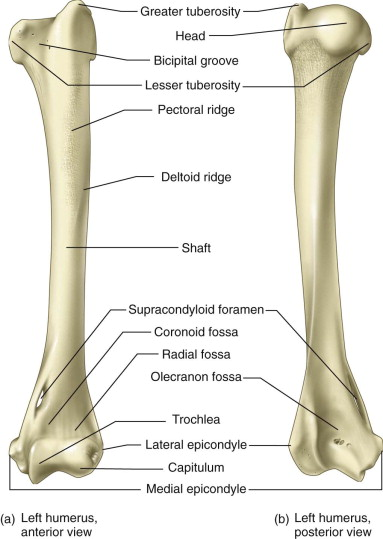
The distal humerus consists of the?
Trochlea & coronoid fossa
Capitulum & radial fossa
Medial epicondyle
Lateral epicondyle
Medial & lateral supracondylar ridges
Olecranon fossa
Distal Humerus: What do the trochlea & coronoid fossa, and the olecranon fossa articulate with?
Ulna
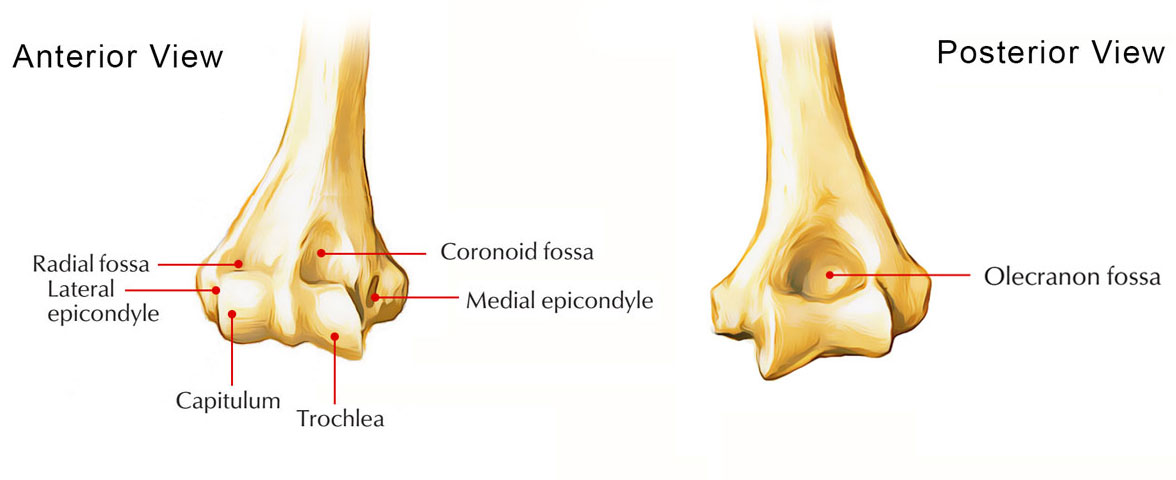
Distal Humerus: What do the capitulum & radial fossa articulate with?
Radius
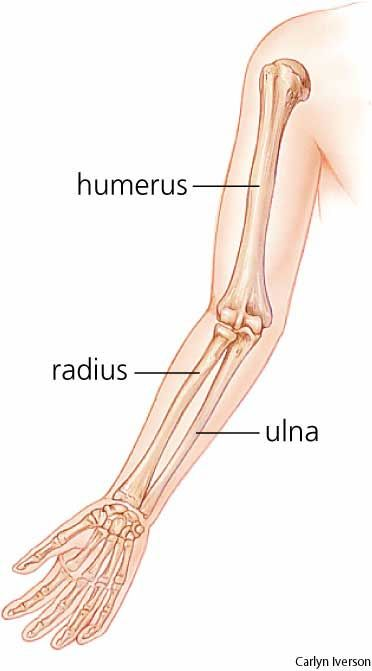
Distal Humerus: What does the medial epicondyle articulate with?
Proximal attachment of medial collateral ligament & most forearm pronator/flexor muscles
Distal Humerus: What does the lateral epicondyle articulate with?
Proximal attachment of lateral collateral ligaments and most forearm supinator & wrist extensors
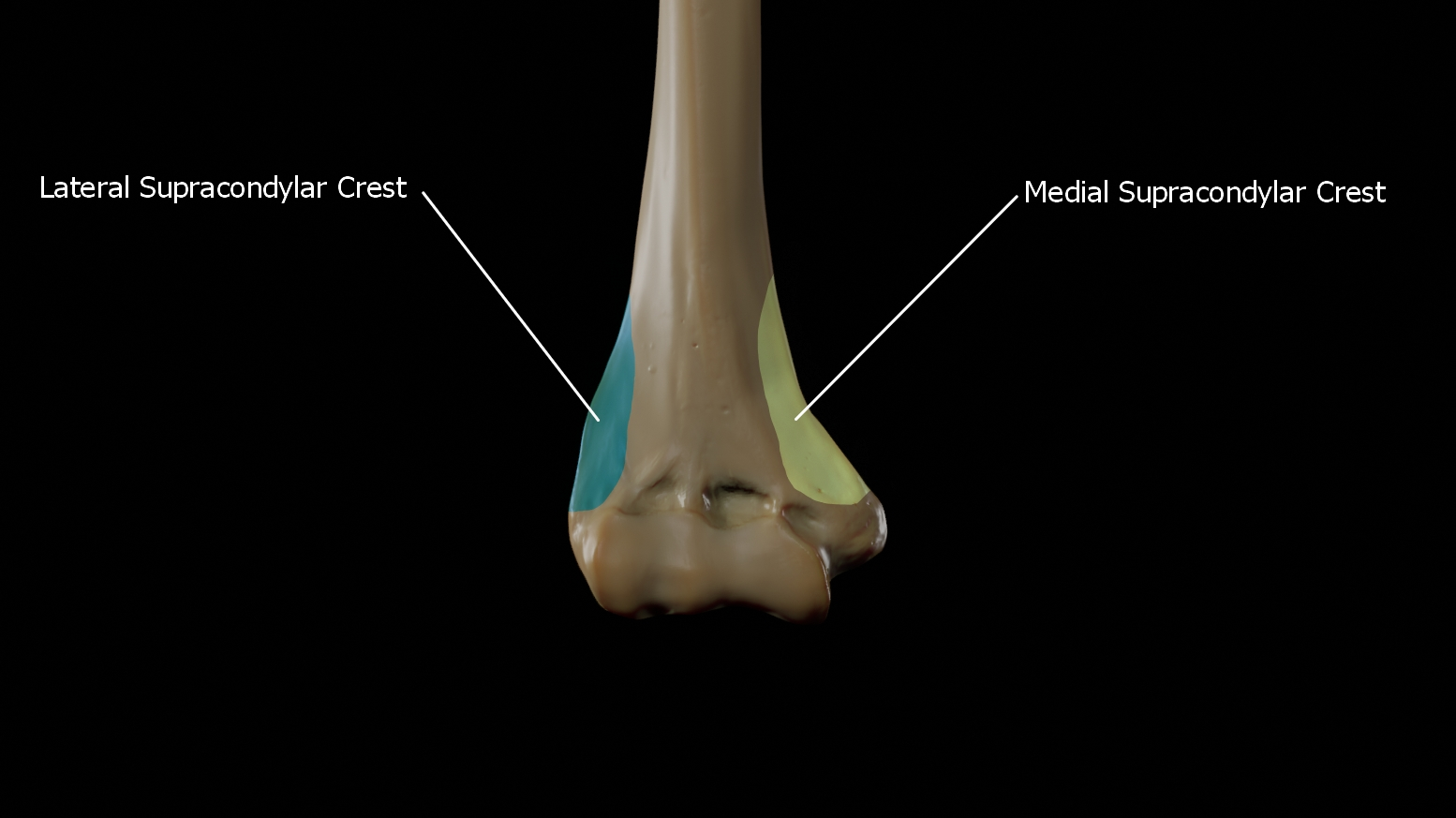
Distal Humerus: What do the medial & lateral supracondylar ridges articulate with?
None
Medial Elbow Surface Anatomy: Humerus
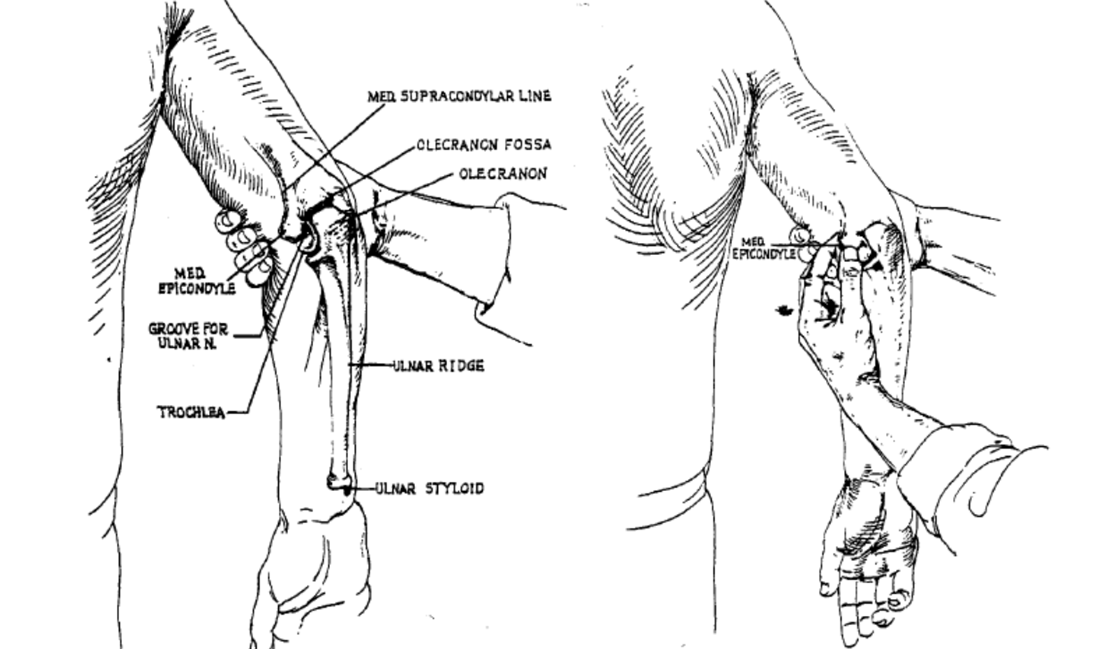
Medial epicondyle
Medial supracondylar line
Cubital tunnel: groove for ulnar n.
Olecranon fossa: covered by triceps tendon (needs to be relaxed to feel indentation of fossa)
Medial Elbow Surface Anatomy: Ulna
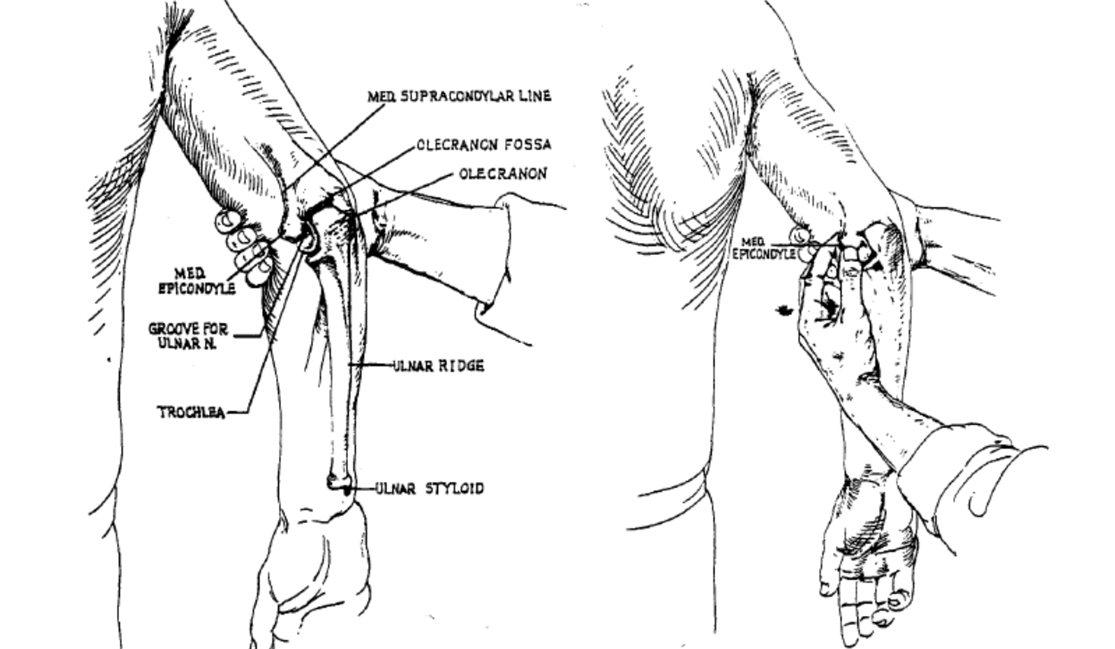
Olecranon
Posterior ulnar border: follow all the way to distal end of ulna
When the elbow is flexed, the olecranon and medial/lateral epicondyles form a?
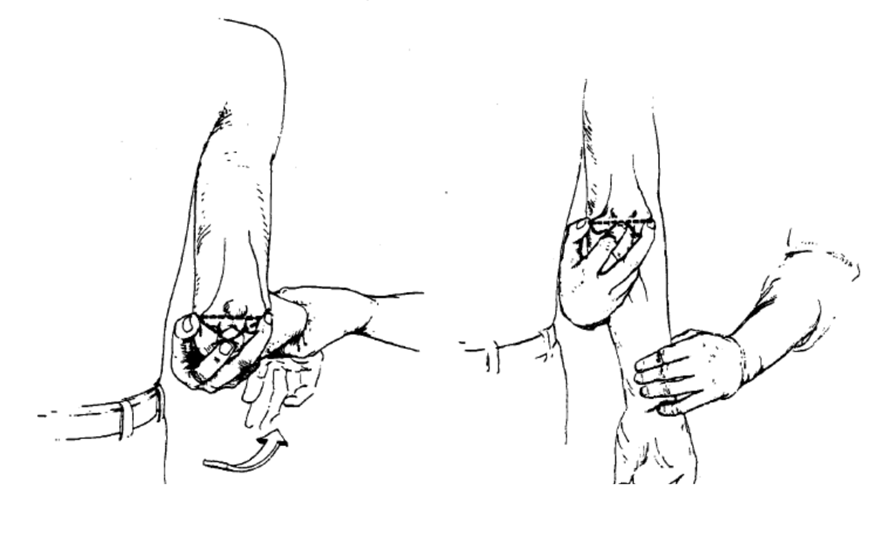
Triangle
When the elbow is extended, the three bony prominences are positioned in a
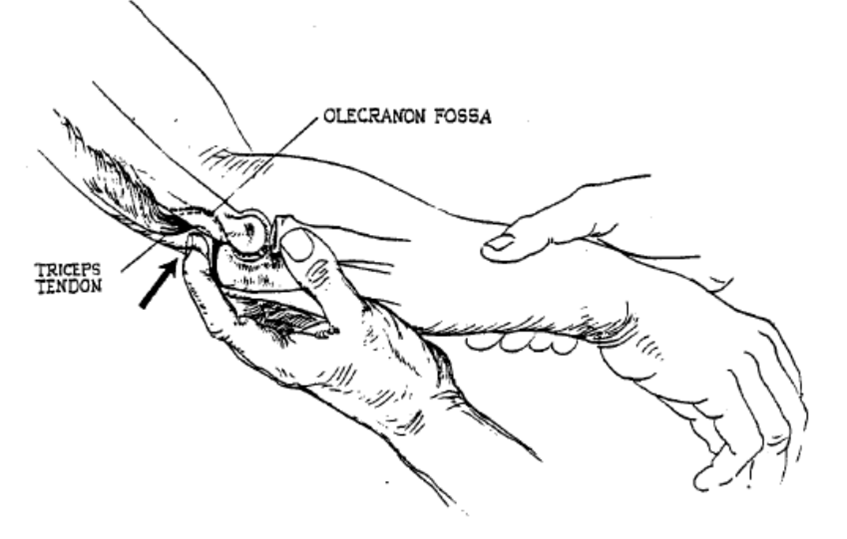
straight line (medial epicondyle, lateral epicondyle, olecranon)
Lateral elbow Surface Anatomy: Humerus
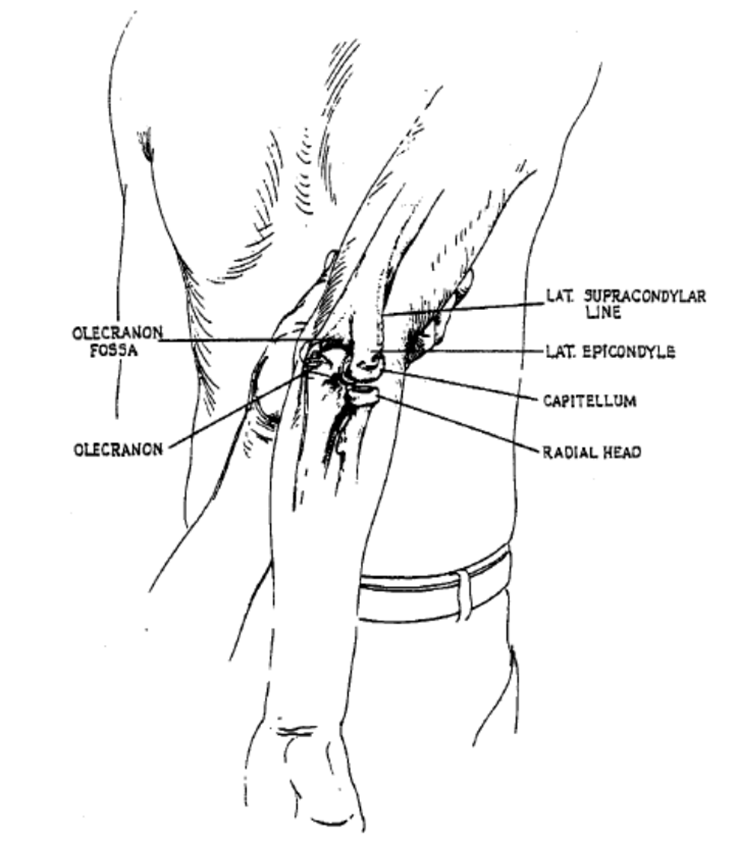
Lateral epicondyle
Lateral supracondylar line of humerus
Capitellum: hard to palpate, articulates w/ radial head
Lateral elbow Surface Anatomy: Radius
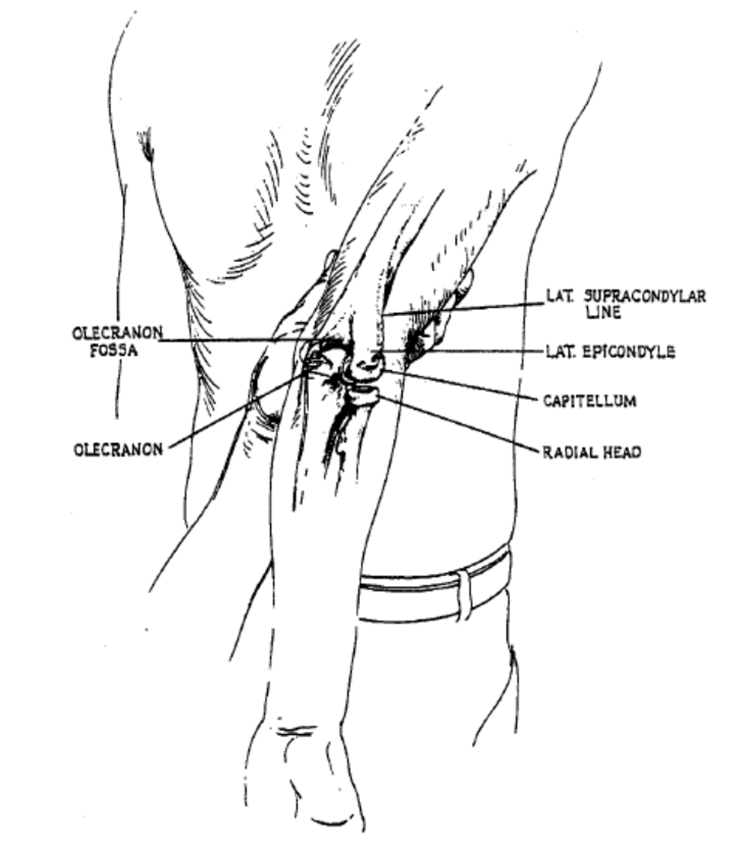
Radial head: feel rotation of it when forearm pronates, supinates
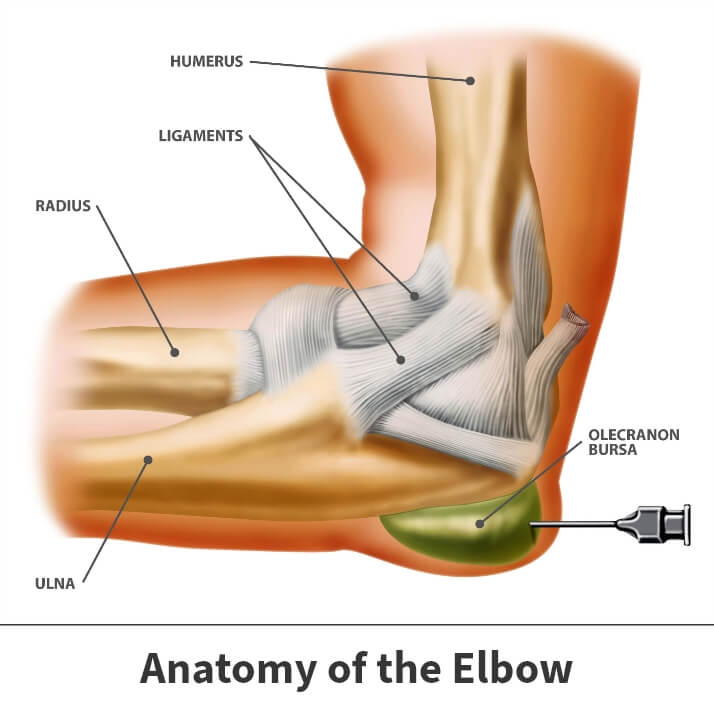
Olecranon Bursae (3)
Subcutaneous olecranon bursa (olecranon bursa): between olecranon process & the skin
Subtendinous olecranon bursa: between the triceps tendon & the olecranon
Intratendinous olecranon bursa: within the triceps tendon
Bursa is a?
pouch that contains synovial fluid to reduce friction & facilitate motion
Subcutaneous Olecranon Bursitis
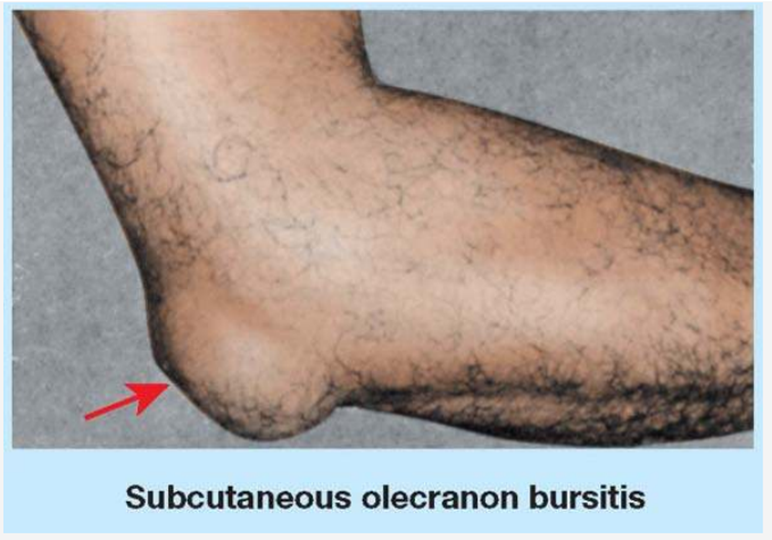
Painful w/ elbow flexion & direct pressure
Mechanism of injury:
Direct trauma to elbow
Repeated excessive pressure = “student’s elbow”
Repetitive elbow flexion-extension (ex. Assembly line jobs)
4 articulations within Elbow & Forearm Complex
Humeroulnar joint
Humeroradial joint/radiocapitellar joint
Proximal radial-ulnar joint (PRUJ)
Distal radio-ulnar joint (DRUJ)
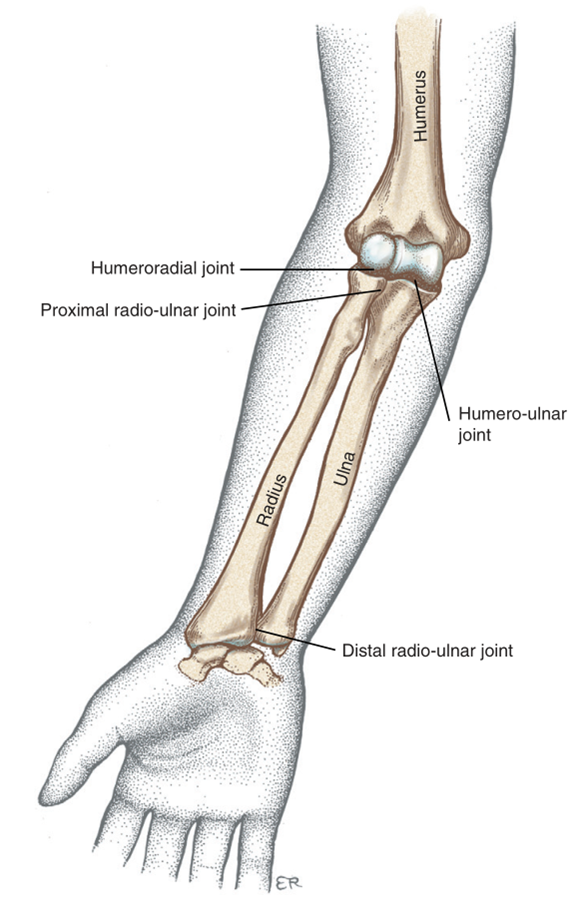
The humeroulnar joint, humeroradial joint and PRUJ are enclosed by a?
single elbow joint capsule and is strengthened by collateral ligaments
Elbow flexion/extension: Normal ROM is?
0-145*, but highly variable in population
Functional range: 30-130*
Someone w/ elbow stiffness will compensate when performing ADLs by using their shoulder a lot
Humeroulnar and Humeroradial joint: Function
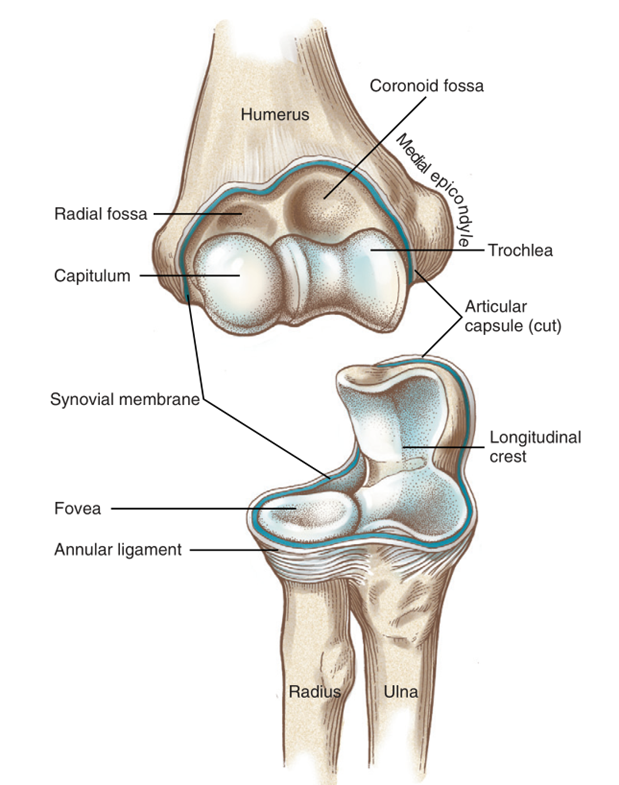
elbow flexion & extension
Humeroulnar and Humeroradial joint: Joint type
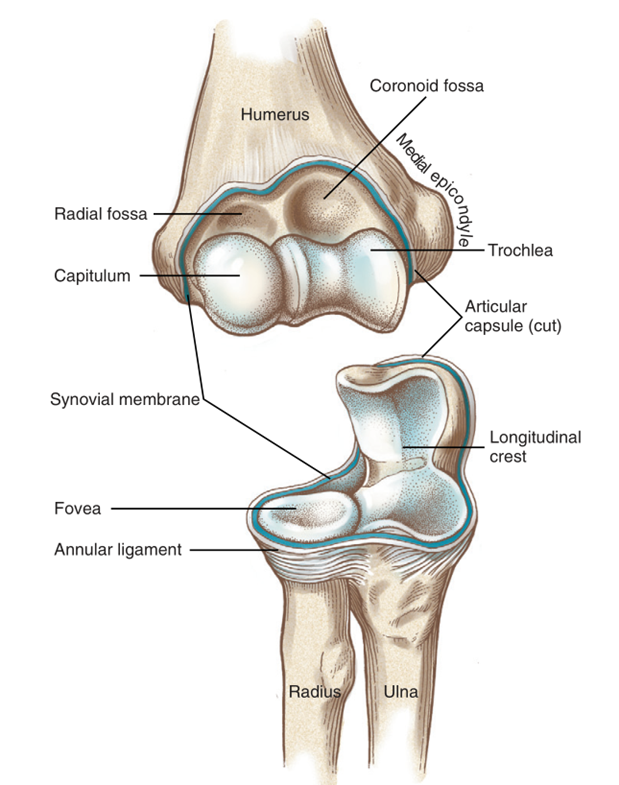
modified hinge joint
proximal ulna slightly rotates w/ lateral side to side motion as elbow flexes/extends
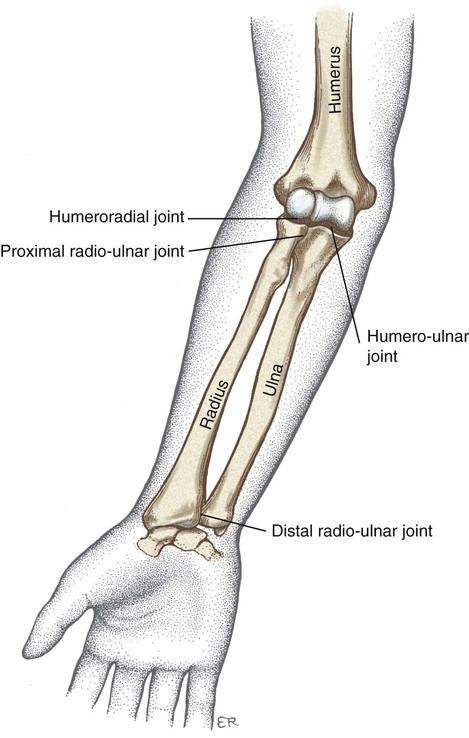
Humeroulnar and Humeroradial joint: Features
Spiral-like, tapered groove creates structural stability
Enclosed by articular capsule
Synovial membrane lines the inside of the joint capsule
80° flexion = position of comfort for swelling/inflammation
Lowest intracapsular air pressure
something that wraps around a screw 🪛
Carrying/Valgus Angle is the direction/where things are going
Due to trochlea asymmetry, the medial lip/side is longer
Rotates away in a valgus faction
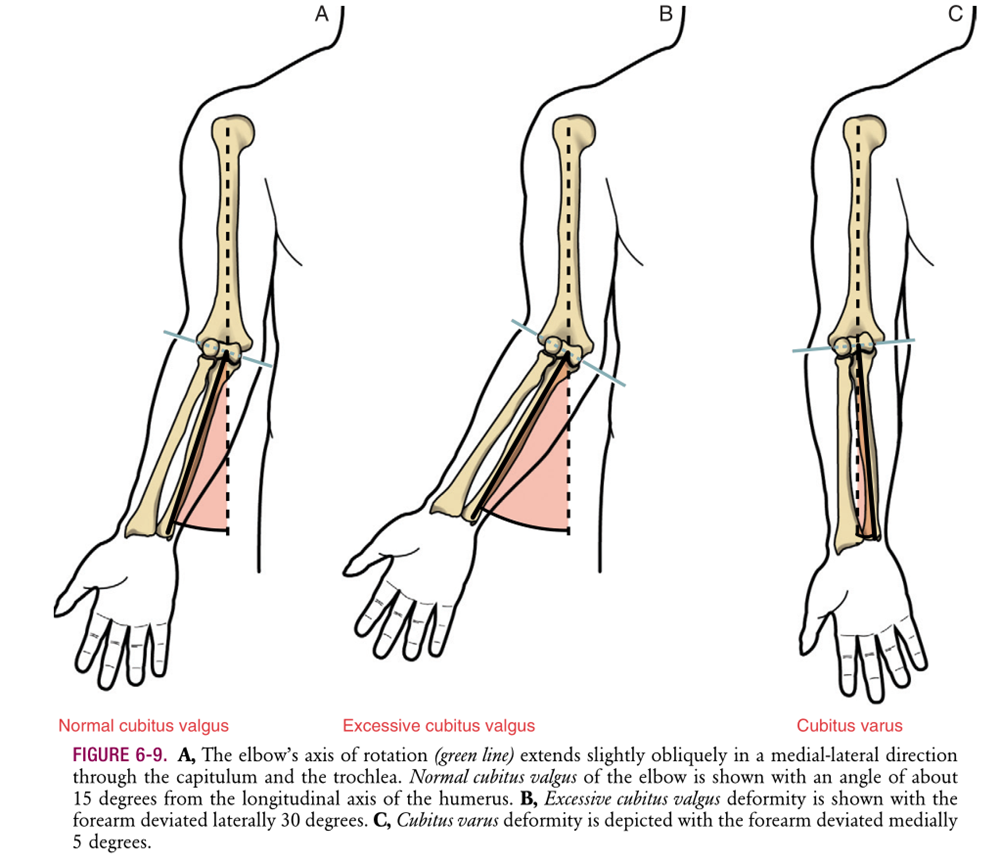
Cubital Vagus Angles
Normal: Ulna deviates laterally by 15* in frontal plane
Excessive: ~30* (more than gen. population)
Cubital varus: medial deviation by 5* (goes more inside to cubital tunnel)
Generally, men have a smaller angle (5-10*) VS women (10-15*)
Humeroulnar and humeroradial joint arthrokinematics are?
Concave-on-convex
Roll & slide in same direction
Load Transmission in Full Extension (weightbearing)
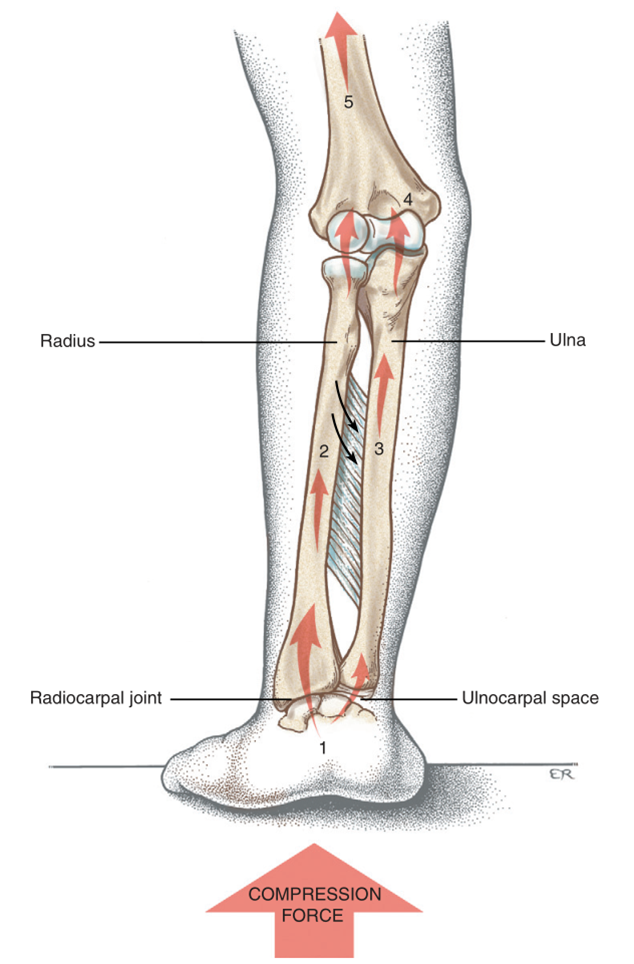
60% of axial load ➡ Humeroradial joint
40% of axial load ➡ Humeroulnar joint
Load Transmission in Flexion
50% of load ➡ Humeroradial joint
50% of load ➡ Humeroulnar joint
Forearm pronation/supination: Normal ROM
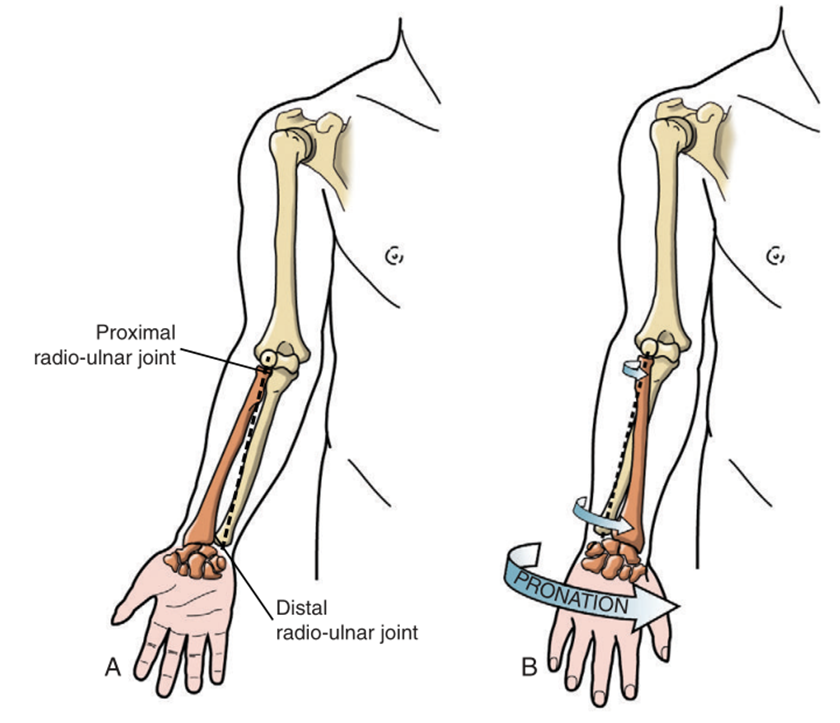
85° Supination (always more deg.)
80° Pronation
Forearm pronation/supination: Functional Range
50° Supination
50° Pronation
How would someone with limited pronation or supination compensate in ADLs?
More shoulder use w/ external & internal rotation
Is pronation or supination more important in function?
Supination: drinking, eating, etc.
Proximal radioulnar joint: Function
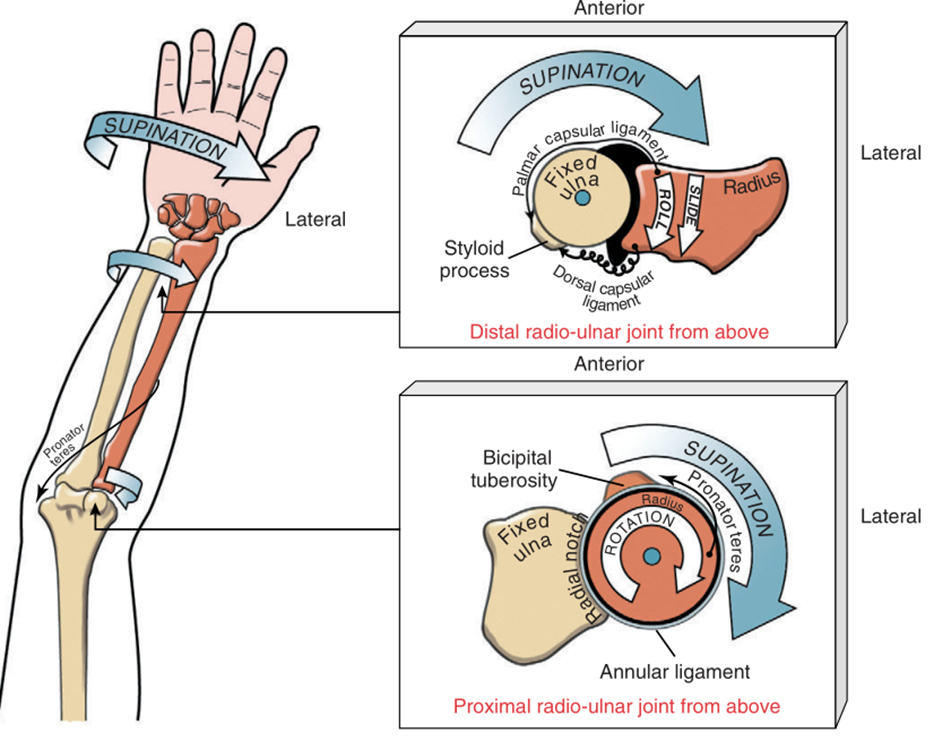
Forearm rotation in combo w/ distal radioulnar joint
Pivot joint
PRUJ & DRUJ are hinges of the door; loss of either hinge = loss of forearm rotation!
Proximal radioulnar joint: Stabilizers
Annular ligament
Interosseous membrane
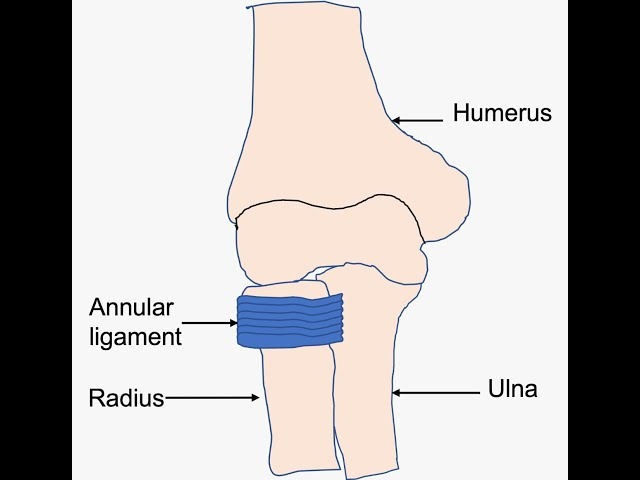
Proximal radioulnar joint: Arthrokinematics
Radial head spins against radial notch of ulna
Roll & slide in same direction (concave on convex)
Ulna bone is stationary in forearm rotation, radius rotates.
Static stabilizers of the elbow and forearm
Anterior & posterior joint capsules
Ligaments
Ulnar collateral ligament complex (UCL)
Lateral collateral ligament complex (LCL)
Lateral ulnar collateral ligament (LUCL)
Radial collateral ligament
Annular ligament
Interosseous membrane
Static stabilizers of the elbow and forearm: What provides dynamic stability to the elbow complex? (what are we able to move around the elbow)
Muscles around the elbow joint, like the forearm muscles
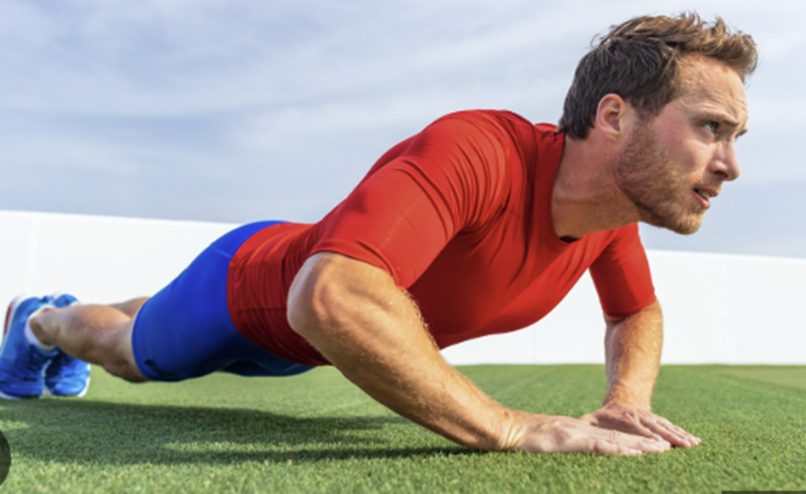
Varus force is what kind of stress?
Lateral-to-medial stress (inward)
Diamond push up style
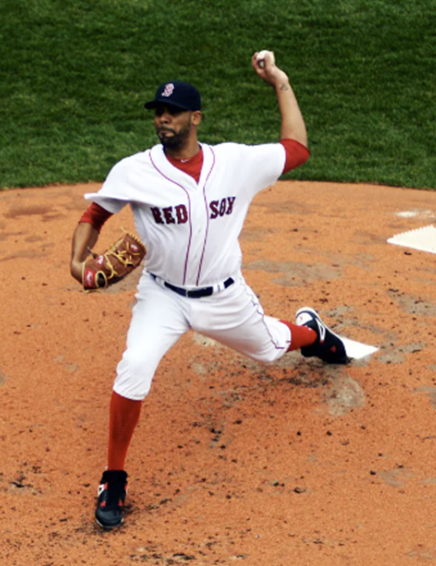
Valgus force is what kind of stress?
Medial-to-lateral stress
Pitching in baseball, then release of that force
Ulnar collateral ligament complex (UCL), aka Medial collateral ligament (MCL)
Fan-shaped
Function: resists valgus stress
At medial elbow
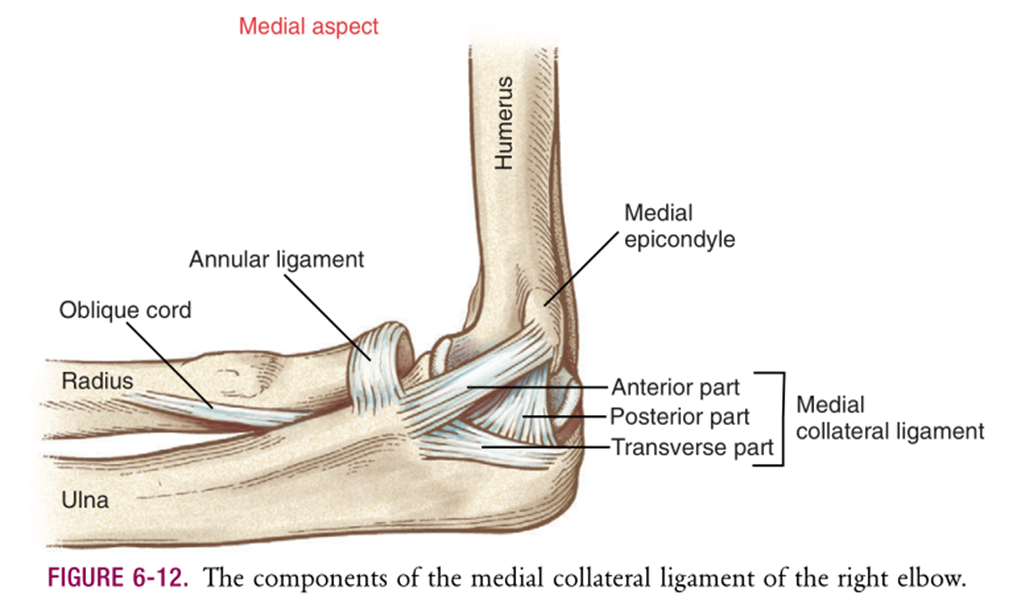
Ulnar collateral ligament complex (UCL), aka Medial collateral ligament (MCL): 3 fiber bundles
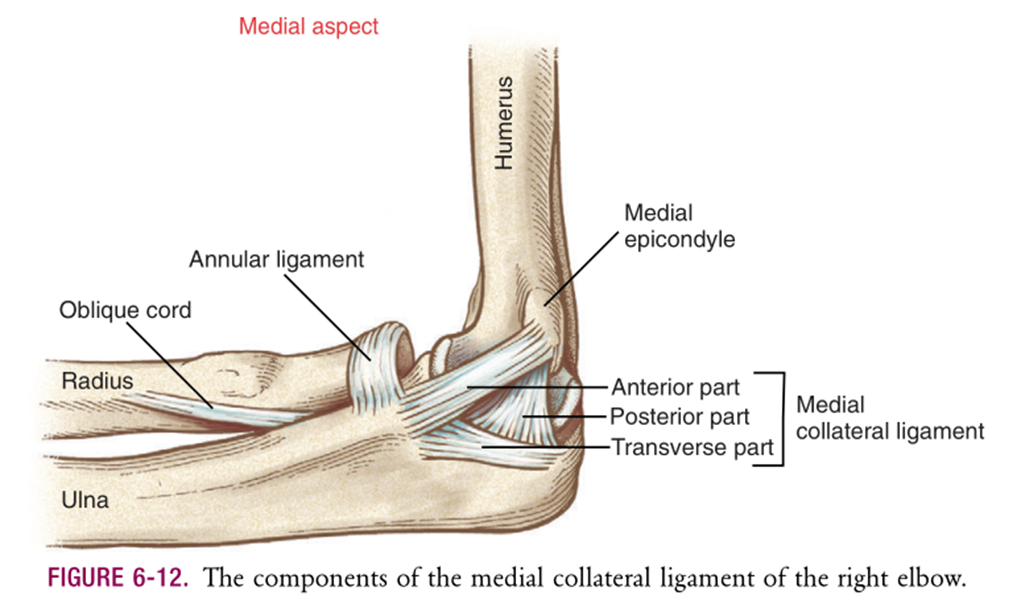
Anterior bundle: stiffest fibers; most vital stabilizer to valgus stress
Posterior bundle (POL)
Transverse ligament: poorly defined from olecranon to coronoid process. Little functional significance
Clinical corner: Tommy John Surgery
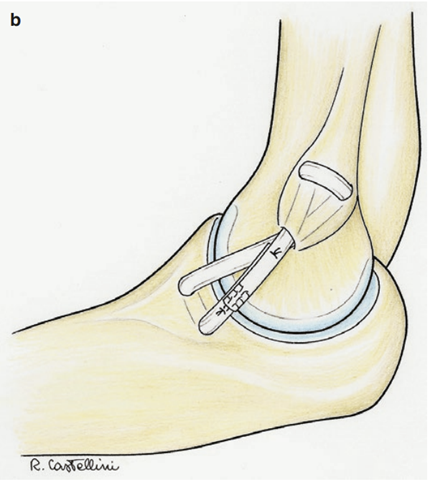
Ulnar collateral ligament complex (UCL) tear common in overhead throwing athletes needing surgical reconstruction
Indications: Pain w/ valgus stress + sense of elbow instability
Lateral Collateral ligament complex (LCL)
Function: resists VARUS stress
3D Y-shape in lateral elbow
Diagonal ligament = vital due to its strategic anatomical position
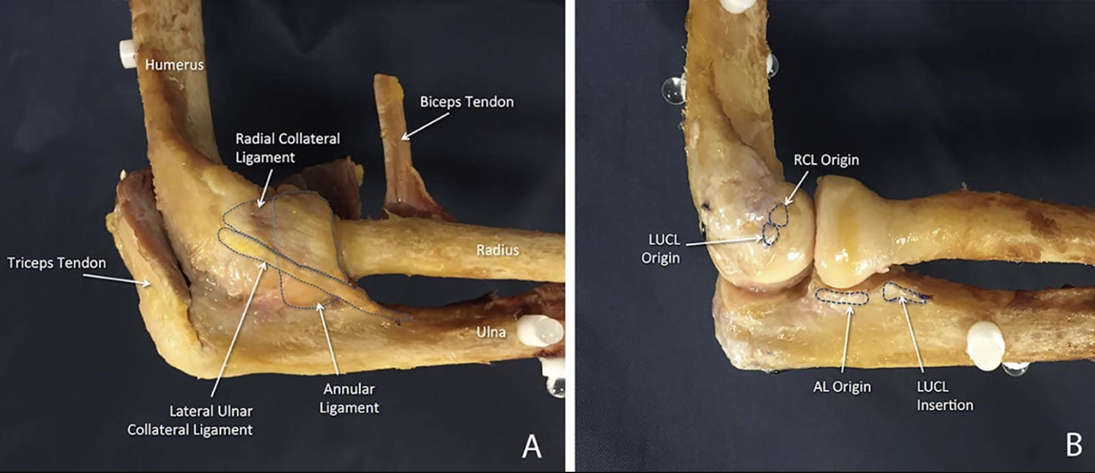
Lateral Collateral ligament complex (LCL): Lateral ulnar collateral ligament (LUCL)
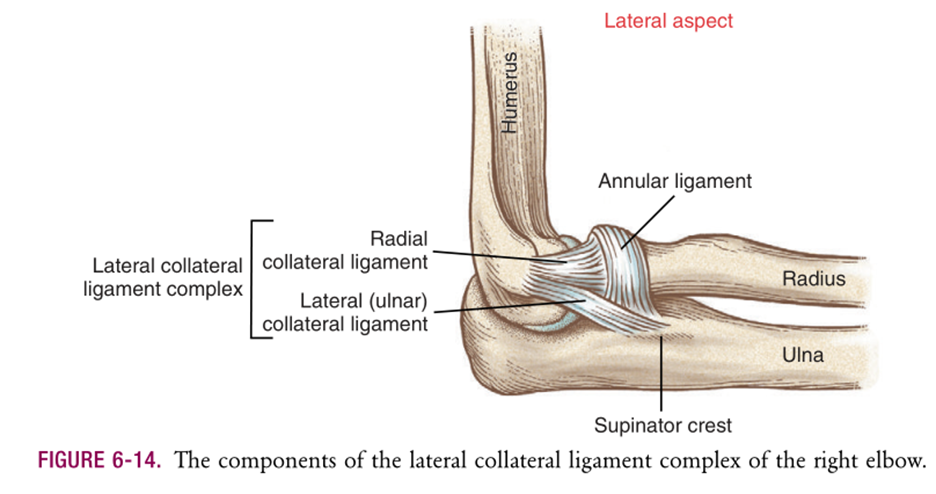
KEY stabilizer against varus stress & posterolateral rotary instability
Lateral Collateral ligament complex (LCL): Radial collateral ligament (RCL)
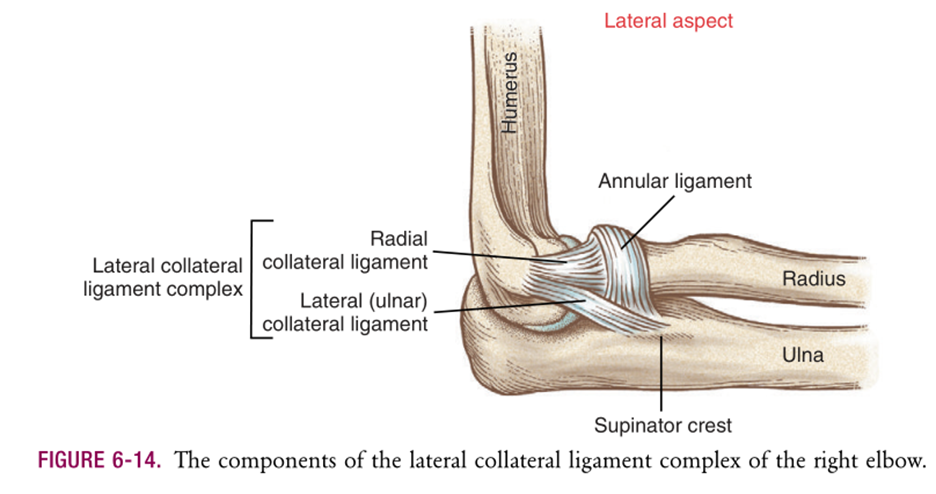
connects lateral epicondyle to annular ligament
stabilizes against varus stress
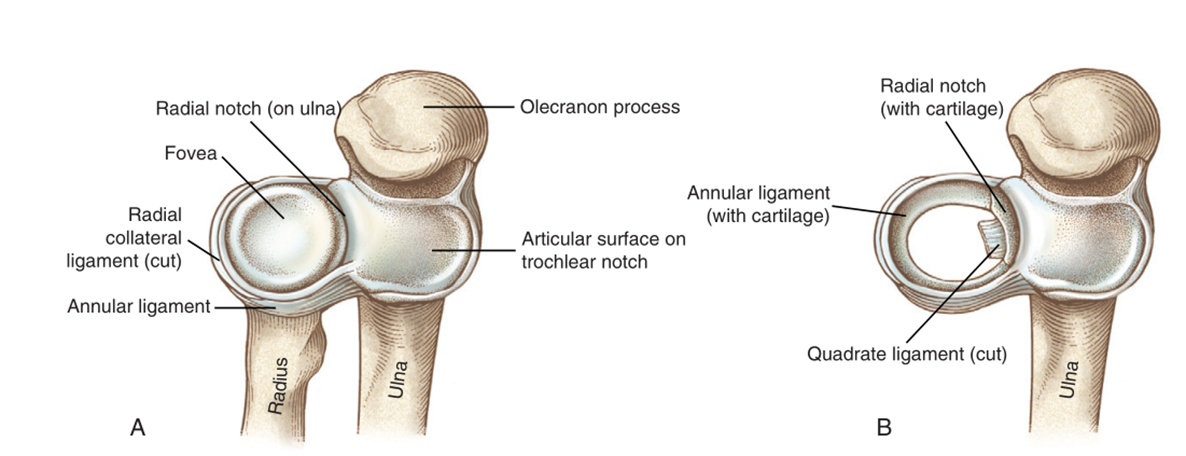
Lateral Collateral ligament complex (LCL): Annular ligament provides… 💍
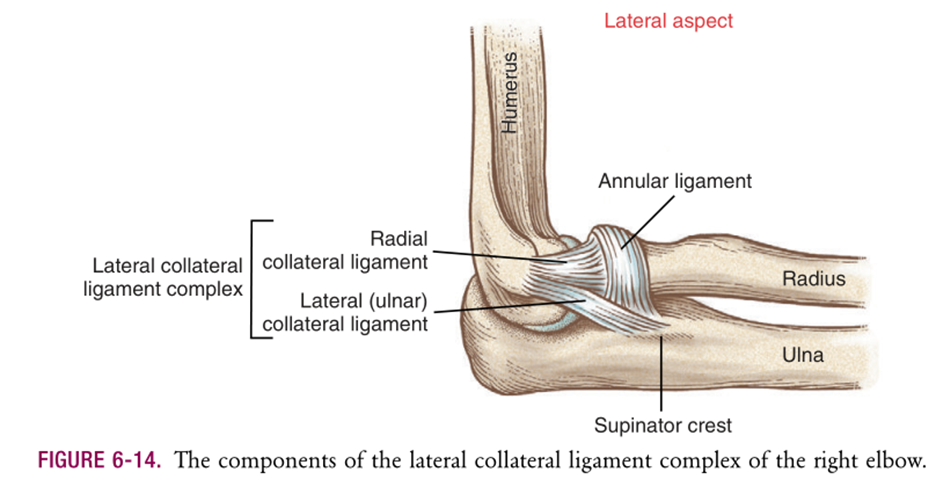
Stabilization of radial head in rotation & against varus stress
Key stabilizer of PRUJ in forearm rotation
Annular ligament + radial notch of ulna ➡ forms fibro-osseous ring around radial head 💍
relevant in rotation
Clinical corner: elbow dislocations
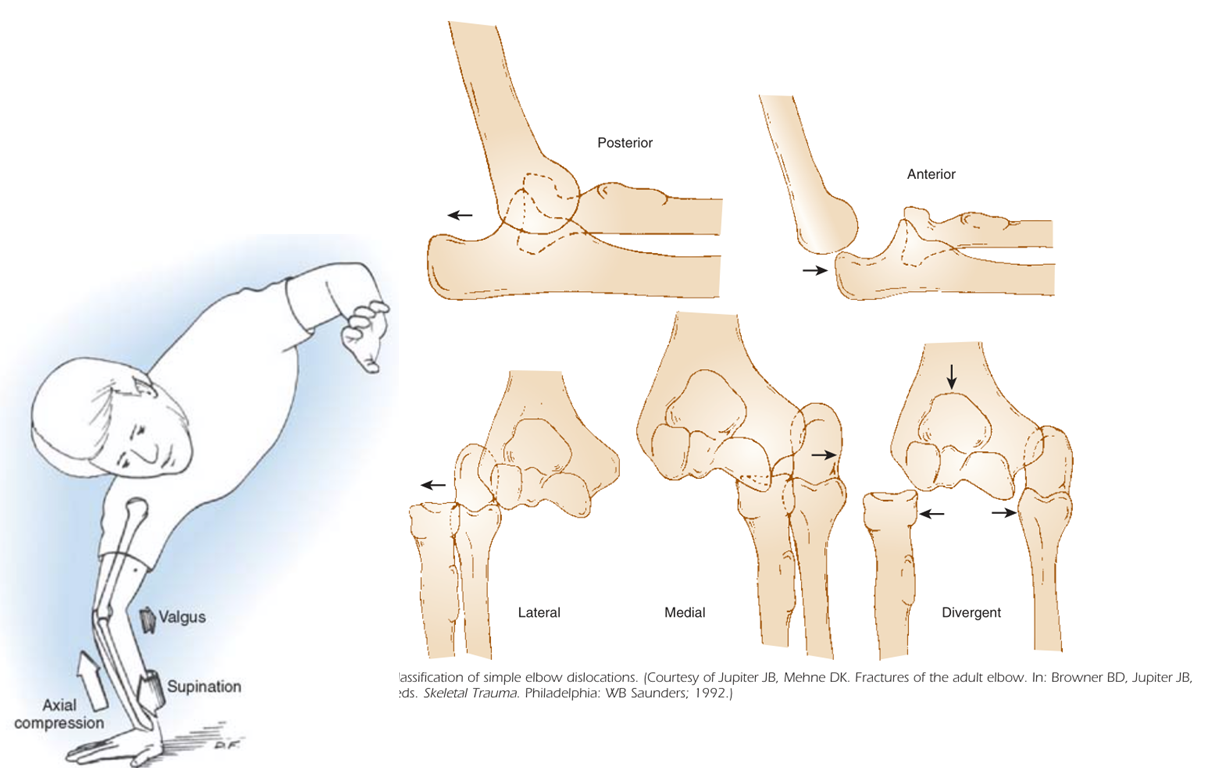
20% of all dislocations in body, despite it being a stable joint
Common in young people 5-20 yrs
Mostly associated w/ fractures of: distal humerus, coronoid process, radial head
Mechanism of injury:
high energy fall on outstretched hand (FOOSH) = posterior dislocation
direct trauma = anterior dislocation
Interosseous membrane function
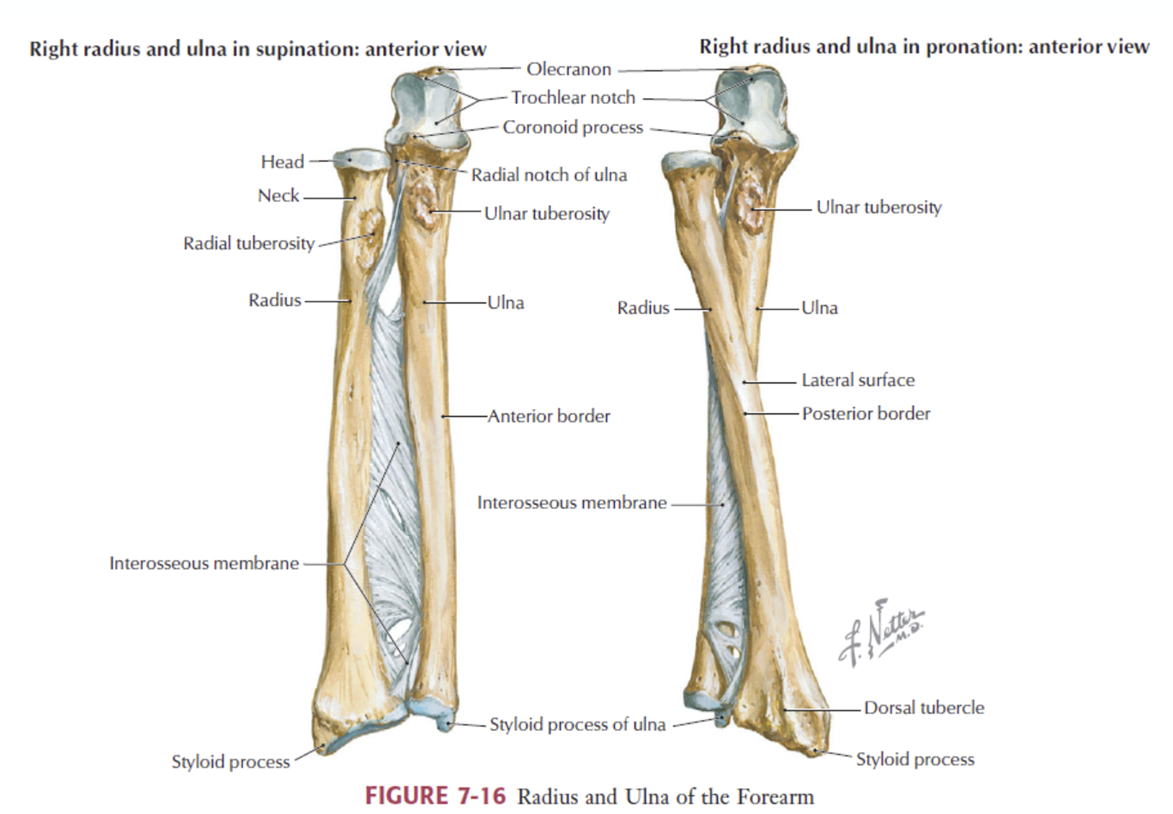
binds radius to ulna
attachment site for some extrinsic muscles of hand
shunt muscle-produced forces from radius to ulna
tear causes proximal migration of radius
Weightbearing in extension: Wrist Level
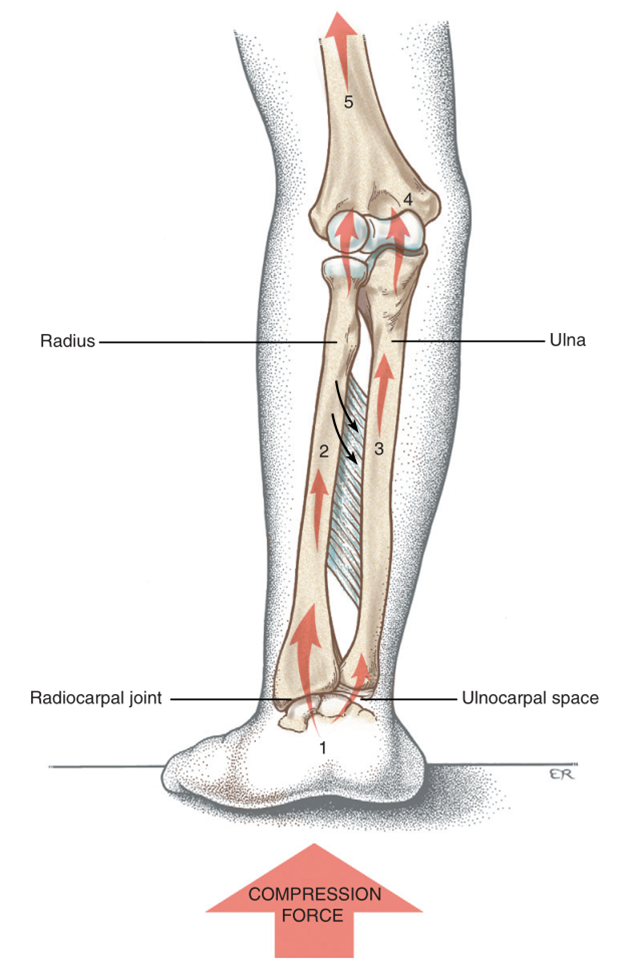
80% of axial load ➡ Humeroradial joint
20% of axial load ➡ Humeroulnar joint
Weightbearing in extension: Elbow Level
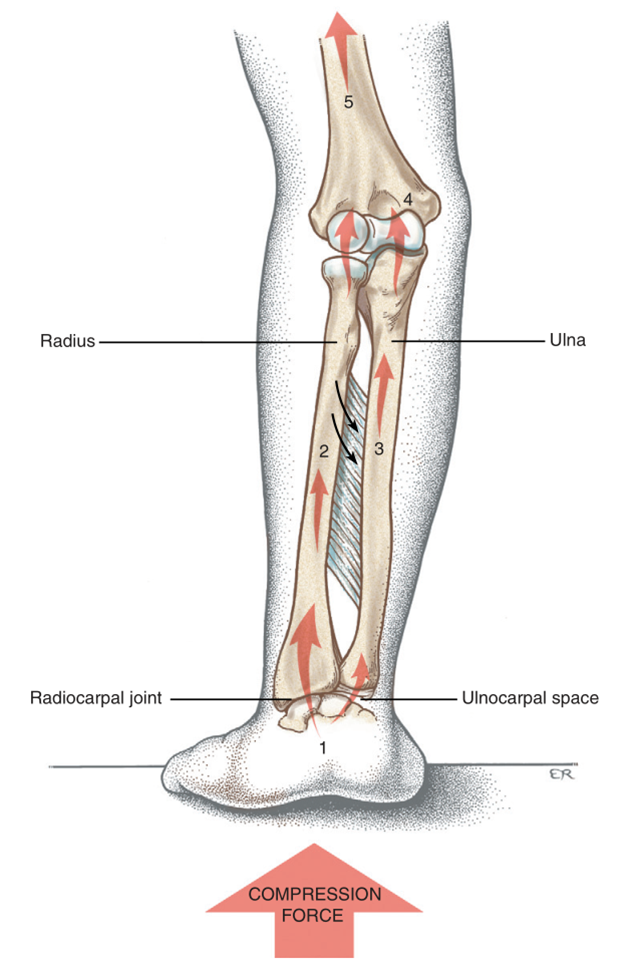
60% of axial load ➡ Humeroradial joint
40% of axial load ➡ Humeroulnar joint
Some percent has been re-directed from the radius to the ulna here.
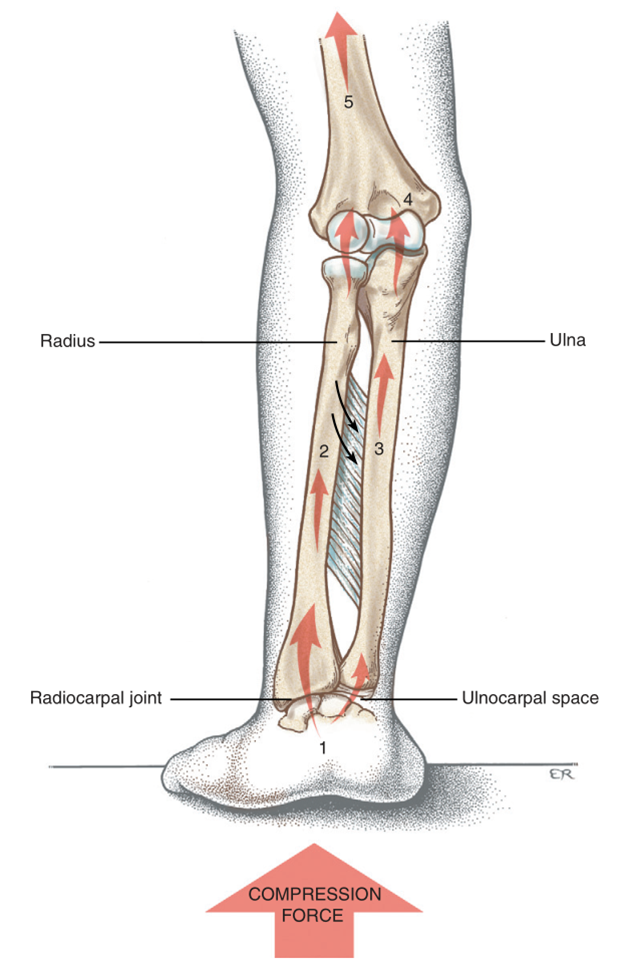
Weightbearing in extension: Interosseous membrane transfers force from the?
radius to the ulna in the forearm
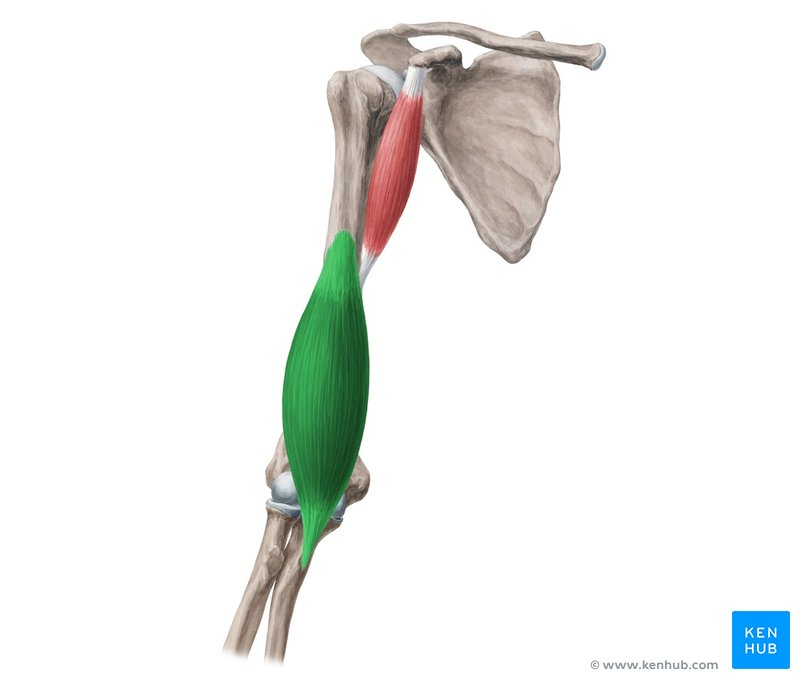
Anterior Arm Muscle Anatomy: Biceps brachii, brachialis, brachioradialis
Biceps brachii: most superficial muscle mass we can palpate
Deep to biceps brachii is brachialis, directly underneath it (don’t palpate)
Biceps insert into radius; palpate biceps tendon by flexing elbow, index finger hooks cubital fossa
Brachioradialis: more lateral muscle to the forearm
Anterior Forearm Muscles: Superficial Layer (on top)
Pronator teres
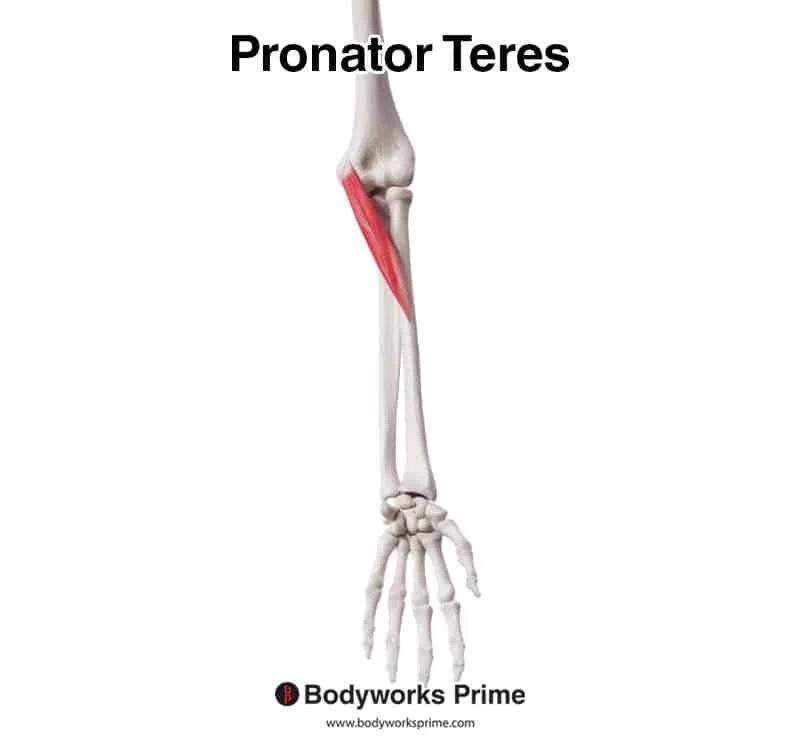
Anterior Forearm Muscles: Intermediate Layer
Flexor digitorum superficialis (FDS)
Anterior Forearm Muscles: Deep Layer
Flexor digitorum profundus (FDP)
Flexor pollicis longus (FPL)
Pronator quadratus (PQ): Forms the deepest layer in the anterior compartment
Posterior Forearm Muscles
Lateral Component: Brachioradialis, extensor carpi radialis brevis & longus (ECRB/L)
Superficial Layer:
Deep Layer: Supinator +
Muscles attaching to medial epicondyle
Common flexor tendon attachment site (PFPF)
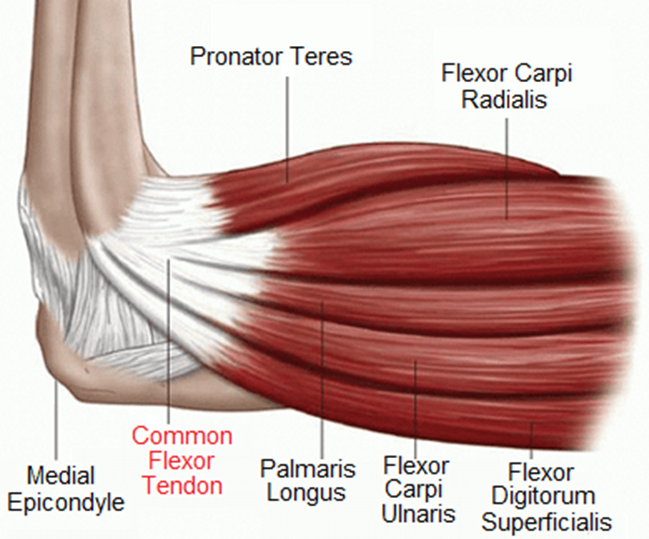
The lateral epicondyle is a common…
extensor tendon attachment site (posterior; wrist & finger extensors)
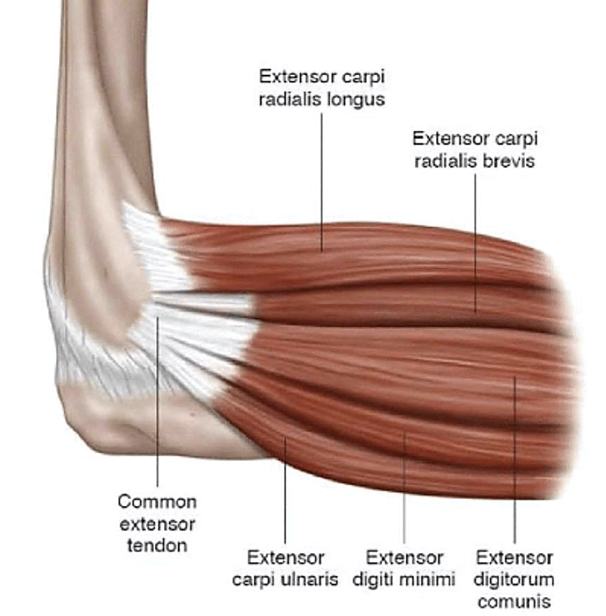
Lateral elbow tendinopathy = Lateral epicondylitis (Tennis elbow) 🎾
Most common cause of non-traumatic elbow pain
1-3% in general population
Presentation: Lateral elbow pain sometimes radiating into the lateral forearm
Affected tissue: Common wrist/finger extensor tendon attachment @ lateral epicondyle
Medial elbow tendinopathy = Medial epicondylitis (Golfer’s elbow) ⛳
Less common compared to lateral epicondylopathy
Presentation: Medial elbow pain
Affected tissue: Common flexor/pronator attachment @ the medial epicondyle
Tendinopathy is primary?
Degenerative instead of inflammatory in pathophysiology
More common in nonathletes than athletes
Due to repetitive overuse creating microtears in the tendon – a tendon’s “mid-life crisis”
Elbow flexors are the?
brachialis, biceps, brachioradialis
Elbow extensors that are posterior arm muscles are the:
Triceps brachii: main elbow extensor. See & feel in elbow extension.
Anconeus: stabilize elbow joint in extension. Expansion of the tendon
Both innervated by radial n.
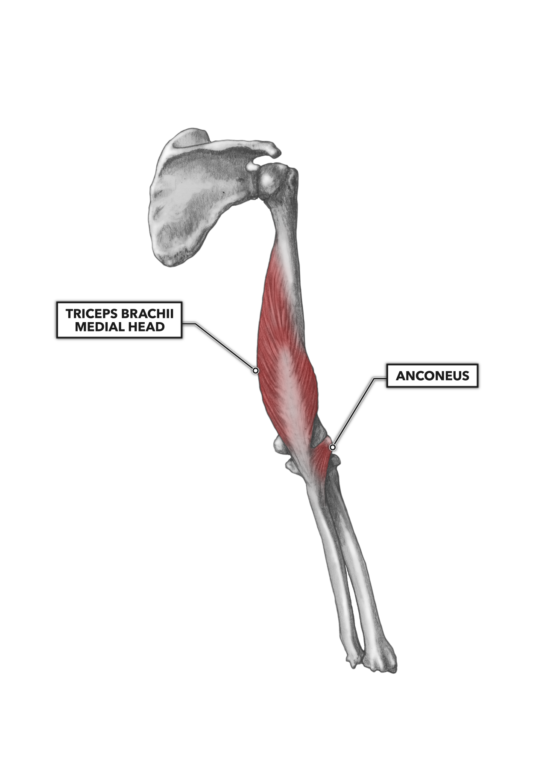
Forearm supinators are the?
biceps brachii & supinator
Forearm pronators are the?
Pronator teres & quadratus
Elbow Flexor: Brachialis 🐴
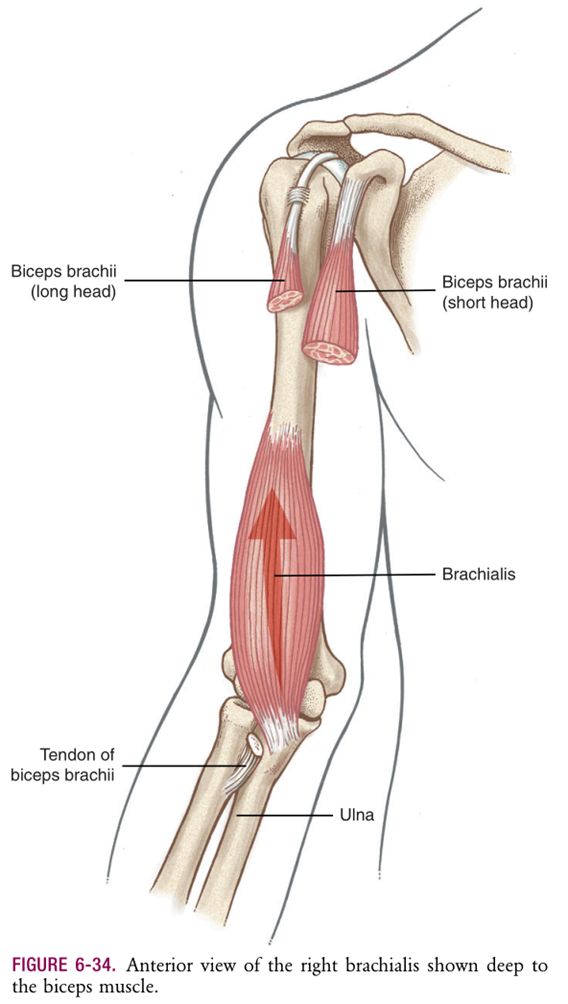
ONLY flexor inserting into ulna (non-rotating)
Pure flexor working in ALL elbow positions
Innervated by musculocutaneous n. (anterior/front part of arm)
“Workhorse of elbow flexion”
Located deep to biceps (can’t palpate)
EX: eating soup, brushing teeth (elbow flexion w/ forearm pronated)
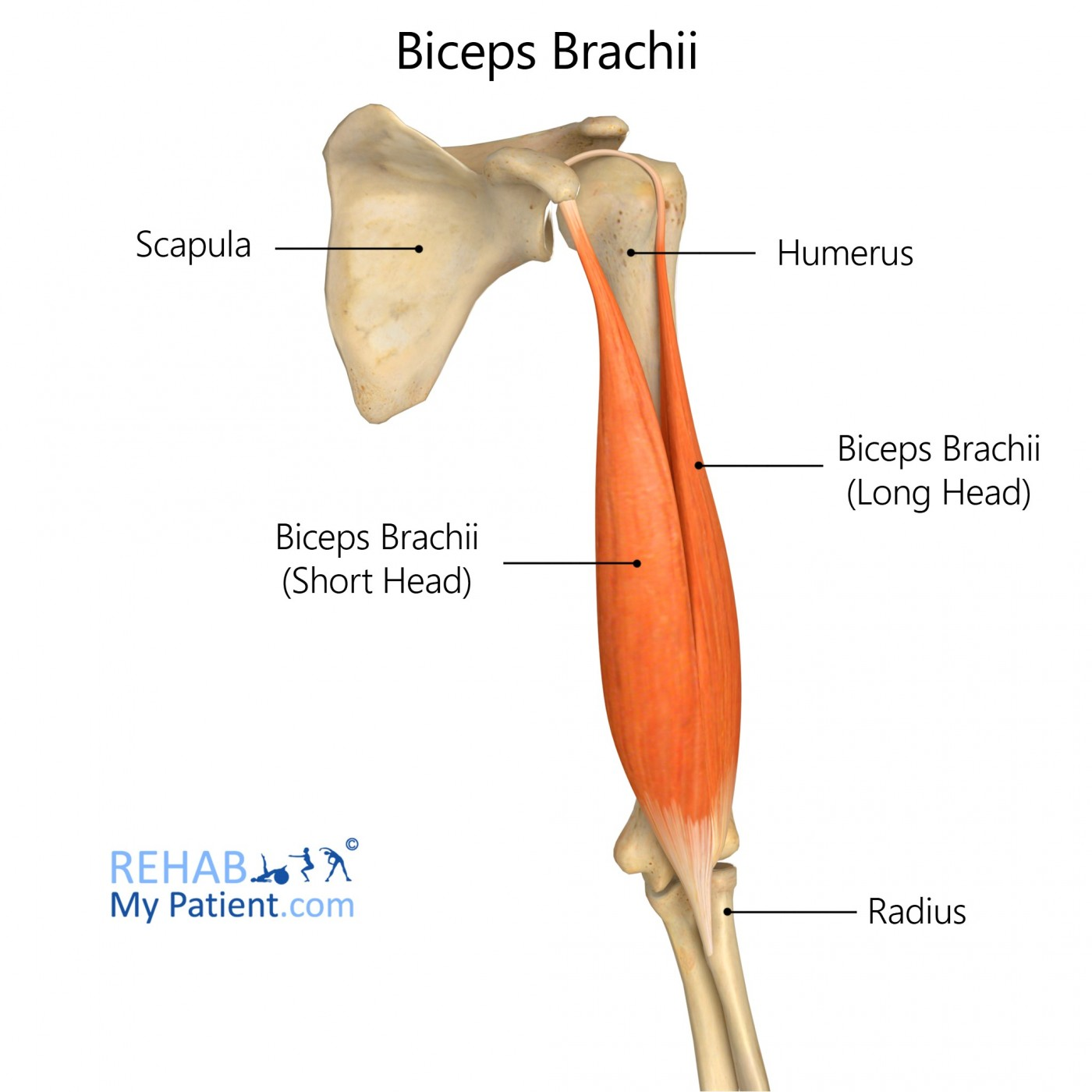
Elbow Flexor: Biceps Brachii
Crosses shoulder & elbow joints (2)
Function: strong supinator & flexor in supination
Attaches to proximal radius (radial tuberosity & bicipital aponeurosis)
Innervated by musculocutaneous n. (anterior/front part of arm)
Biggest muscle mass
Part of the insertion blends into anterior forearm fascia ➡ bicipital aponeurosis (fibrous lacertus)
Median n. travels beneath bicipital aponeurosis = possible median n. compression site
If ruptured: 50% loss in peak supination strength VS 30% loss in peak flexion strength
EX: combing hair, eating apple, wash face (elbow flexion, forearm supination)
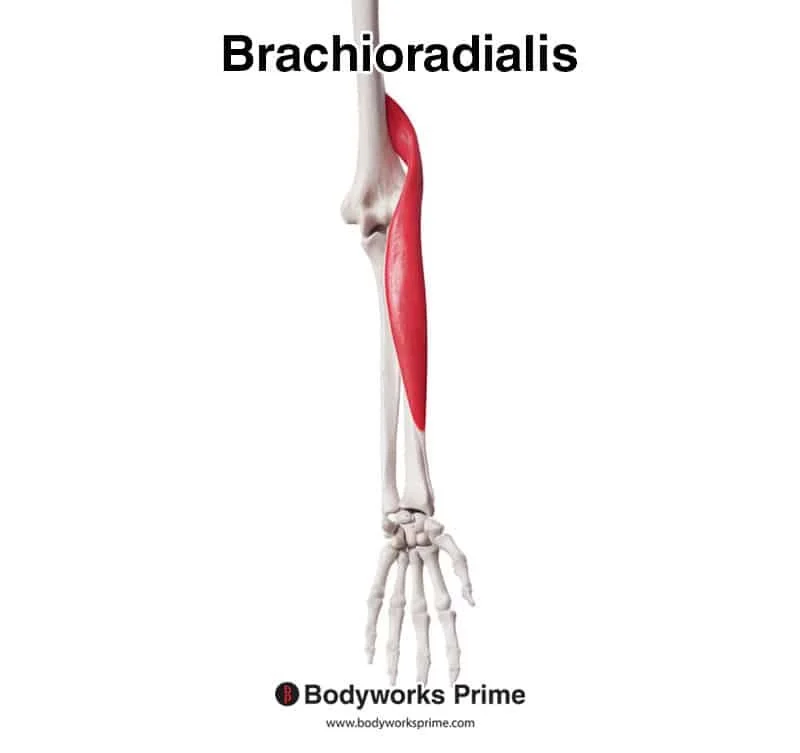
Elbow Flexor: Brachioradialis
Attaches to distal radius
Most effective as a flexor in neutral rotation
Rotates forearm to neutral from supination or pronation
Innervated by radial nerve, provides weak elbow flexion in case of musculocutaneous nerve injury
Longest muscle of elbow
EX: Hammering nail, playing drum (elbow flexion w/ neutral forearm)
Forearm rotation affects the strength of muscles attached to the radius but not the ulna because…
the ulna doesn’t rotate. Position matters
In which position of forearm rotation is the peak torque of elbow flexion achieved?
Supination b/c this is where biceps are most effective at becoming elbow flexor
Biceps has most muscle mass = peak torque, more cross-section
Triceps Brachii: Function
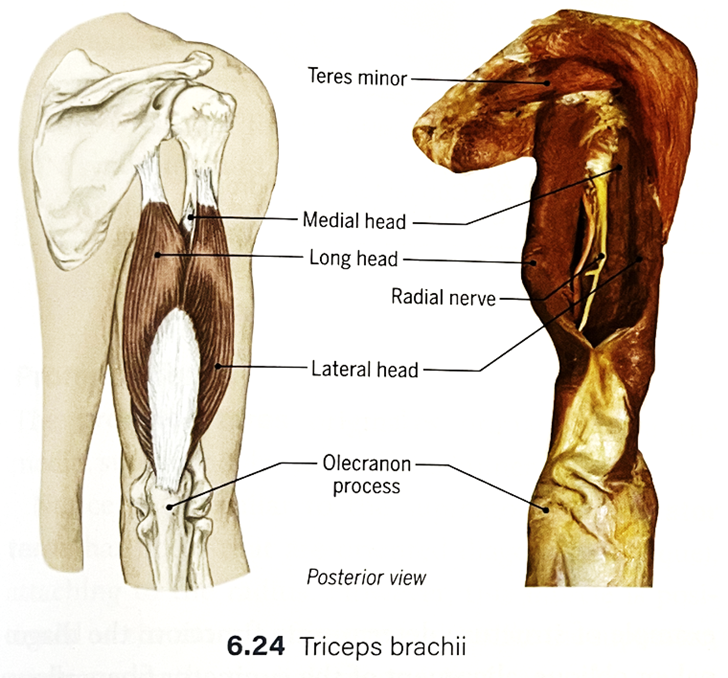
Provide stability against valgus forces by compressing olecranon against humerus
3 heads converge to a single tendon insertion @ olecranon process
EX: transfers (pushing up from arms of chair), wheelchair mobility
Anconeus
Small cross-sectional area & movement arm
Can’t prod. great extension torque
More important as elbow stabilizer in extension
EX: casting fishing line, throw football
Forearm Pronators
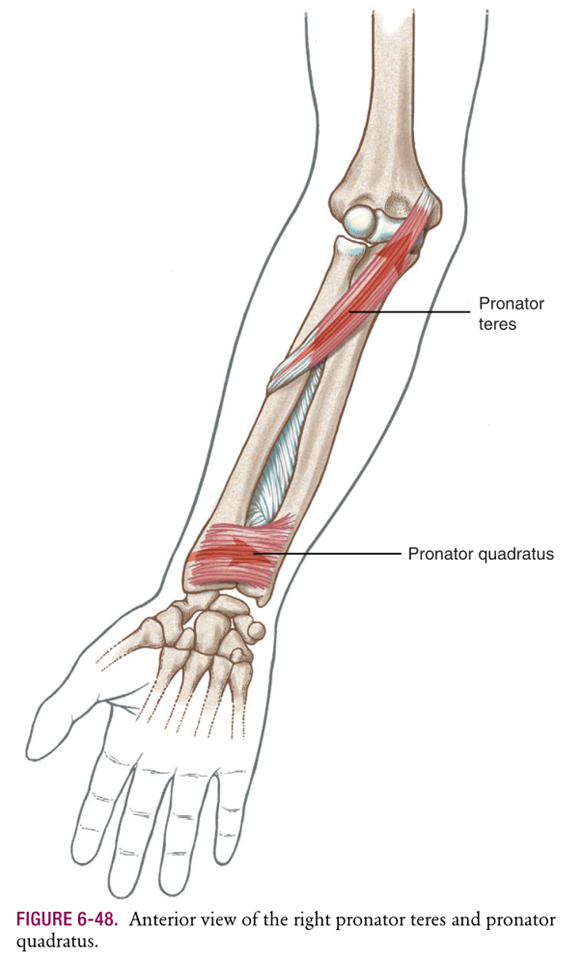
Pronator Quadratus: main forearm pronator & stabilizer of DRUJ
Pronator Teres: long & oblique; most active in high-power activities like unscrewing tight lid
Weak flexor
Pronator Teres
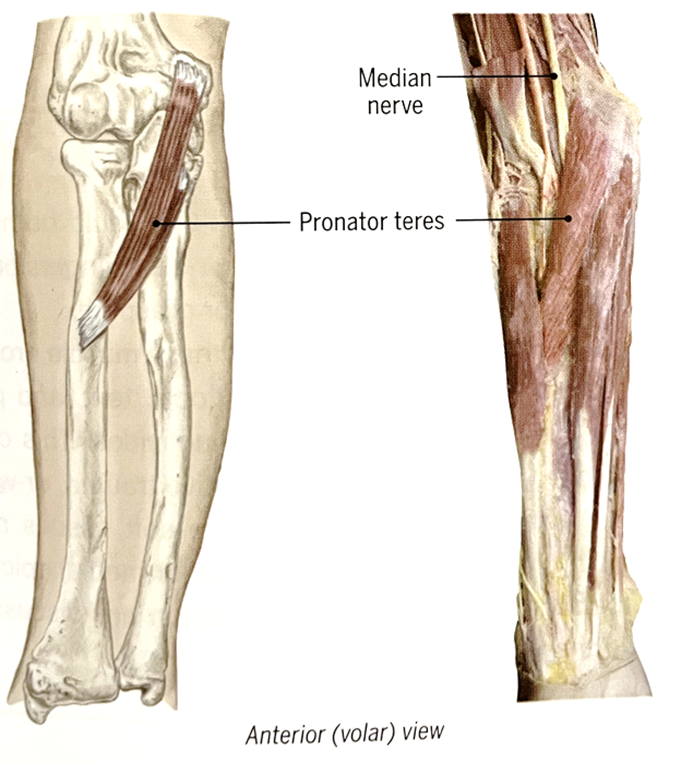
2 heads: humeral (superficial) & ulnar (deep)
Median n. passes btwn 2 heads
Pronator Syndrome: compression of median n. @ pronator teres
Diff. from carpal tunnel where median n. compression is @ wrist
EX: knitting, pouring drinks
Pronator Quadratus
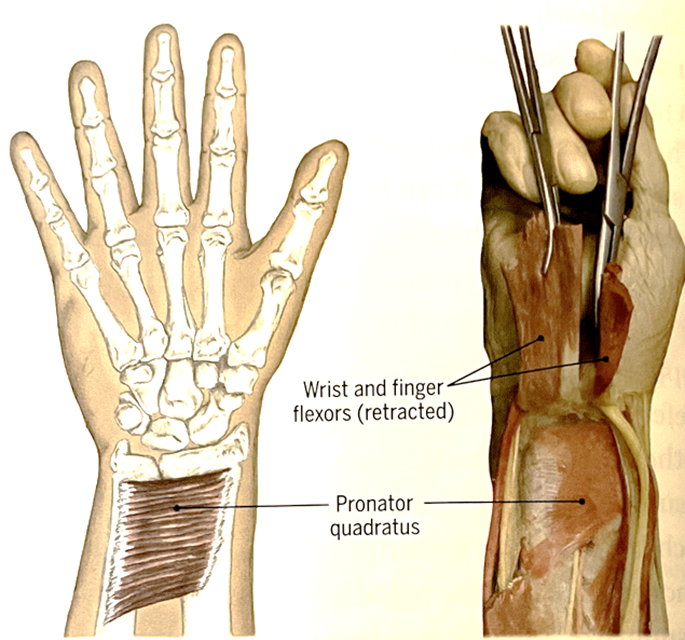
Deep to forearm flexors just proximal to wrist
Main pronator working in ALL positions
Key dynamic stabilizer of DRUJ: compresses radius against ulna
EX: replacing overhead lightbulb, unlocking combo lock
Forearm Supinators 🔼
Supinator: main supinator in low-power mvmts in ALL elbow positioins
Biceps brachii: main supinator in HIGH-power mvmts & in elbow flexion
EX: turning screwdriver
Supinator
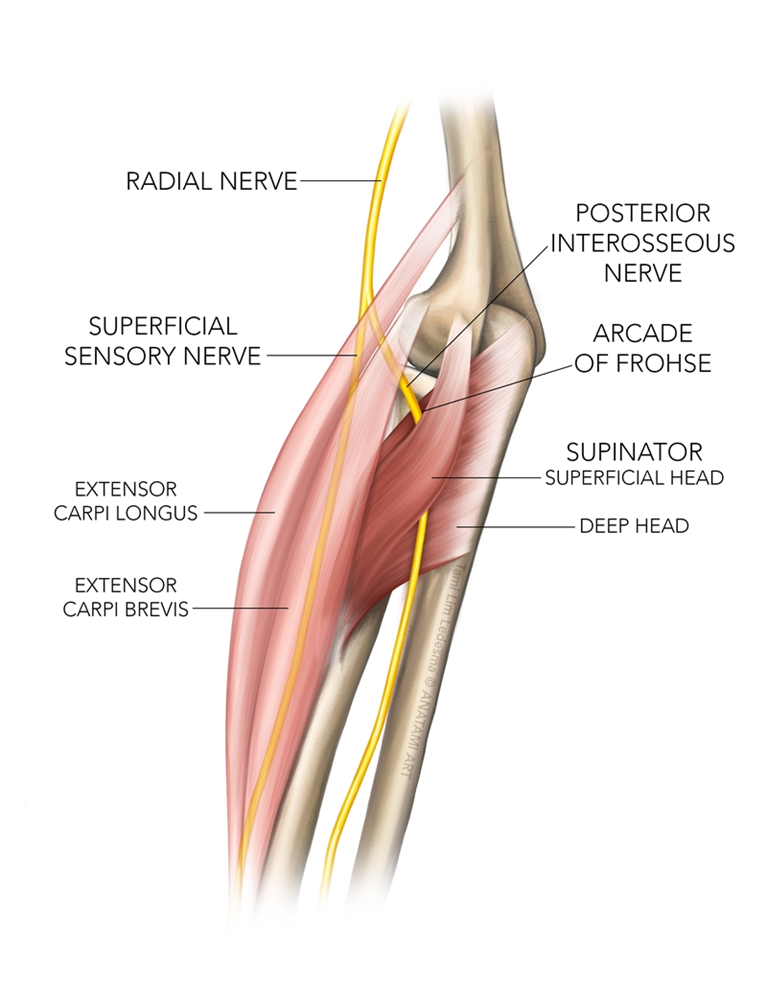
Pure supinator in ALL elbow positions
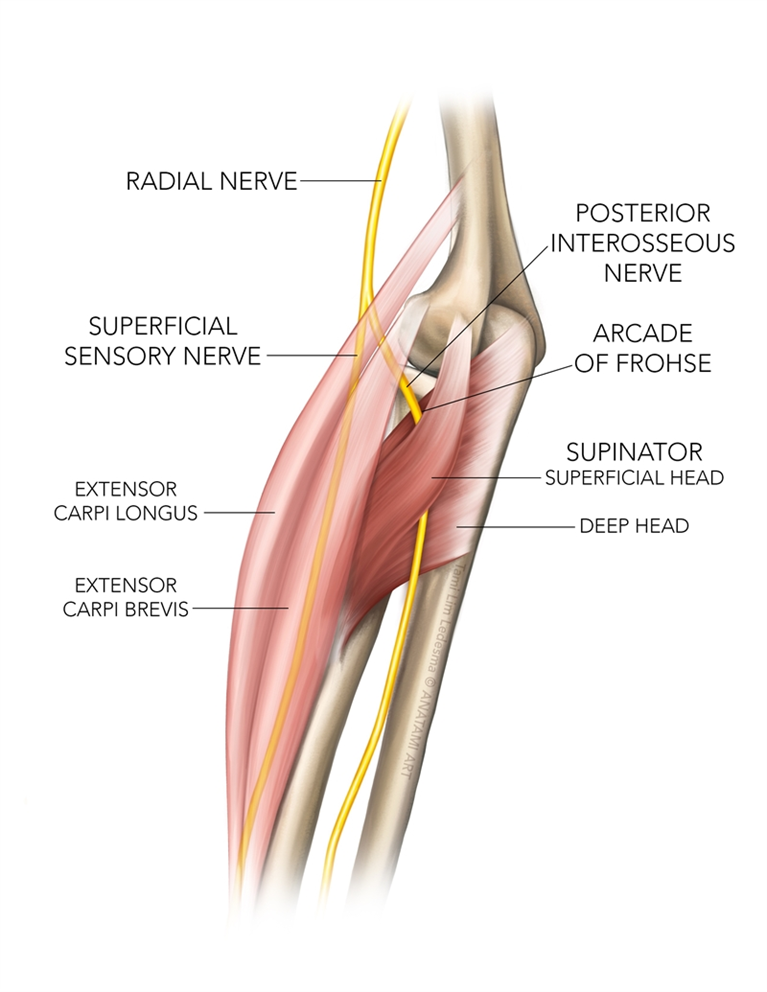
2 heads: superficial & deep (PIN radial n. passes thru these 2)
Proximal edge of superficial head forms fibrous band (arcade of Frohse, most common site of PIN compression)
EX: using screwdriver, turn doorknob
Compression of radial n. @ supinator = PIN syndrome
Weak finger & wrist extension
Lateral forearm pain

